Since my coffee hadn’t set in yet this morning, I unwisely became involved in another discussion about O O-D-A and Colonel John Boyd. What most people refer to as the O-O-D-A Loop, I refer to as Boyd’s Process because it’s much more involved than some simplistic circular diagram. Since I typed the whole reply out, I may as well reproduce it.
The foundation of O-O-D-A is Boyd’s Aerial Attack Study. The premise of the AAS is diametrically opposite of what 99% of people think about O-O-D-A. The common interpretation of O-O-D-A is that it somehow involves ‘thinking faster,’ which is physiologically impossible.
O-O-D-A is an analytical concept that Boyd spoke about and mentioned in passing late in his career. The neat extensive diagram sometimes seen was developed by one of Boyd’s acolytes, not Boyd, although he did approve it while he was in the throes of prostate cancer. This is Boyd’s original hand drawn sketch of the process. It is rather complex and doesn’t look anything like the circular models seen in current discussions.

The simplistic circular bastardized diagram that is commonly seen was not part of Boyd’s repertoire and is not even worth mentioning in relation to any serious discussion of O-O-D-A.
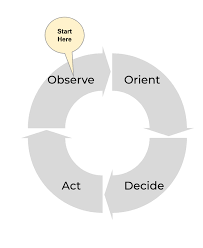
The concept of O-O-D-A Loops is mentioned only briefly a few times in Boyd’s multi-hour presentations. Even then he mentioned it in relation to strategy not tactics.
The AAS describes an operational tactical concept that Boyd developed during his time as an instructor at the USAF Fighter Weapons School. He was known as ‘Forty Second Boyd’ because of his ability to defeat any aerial opponent in 40 seconds or less.
However, this ability came from an understanding of possible attack and defense patterns and the capabilities of his aircraft’s weapons systems. He had pre-planned his counters to every move his opponent might make and then vigorously executed the counter faster than his opponent could avoid it.
Because Boyd was a talker and not a writer (he dictated the entire AAS to his boss’s secretary), whether he placed any value on ‘O-O-D-A Loops’ as anything other than a descriptive metaphor is unclear. Nothing in his presentations leads to the conclusion that he thought of it as a tactical decision making template.
Here is an example of Boyd’s thinking in the AAS.
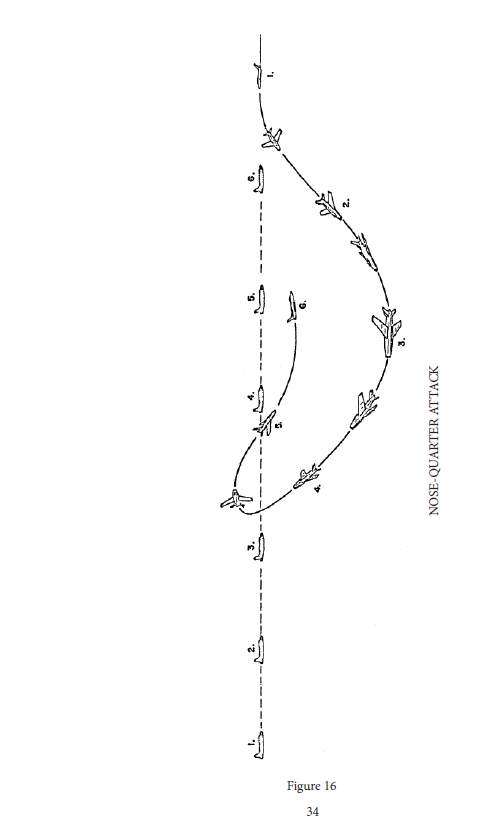
This is the kind of tactical and weapon analysis that was the foundation for tactical execution in the AAS.

Another aspect of Forty Second Boyd is that he was willing to push his aircraft, the F-100, to limits no one else would. He brutalized his plane so badly that at times it required significant rebuilding after he landed.
The Aerial Attack Study is readily available on the Internet. It’s essential reading for anyone who wants to talk about Boyd’s Process from an informed perspective.
 tacticalprofessor
Observe, Decide, Orient, Attack. Is the correct, actual order of events. The idea of orienting before deciding is clearly putting the mental cart before the horse. Life Does Not Happen That Way!
“Orientation is the schwerpunkt [focal point]. It shapes the way we interact with the environment—hence orientation shapes the way we observe, the way we decide, the way we act.”
John R. Boyd, Organic Design for Command and Control (1987), 16
If you understand the content of Orientation-cultural tradition, previous experience, genetic heritage, new information and analysis and synthesis you come to understand that Orientation effects Observation, Decisions and Actions. That is why Boyd thought Orientation was the most important part of the cycle.
I learned thus in drivers Ed in high school. It was called S.I.D.E see car, indentify courses action to avoid, decide, execute.