#Fridayfundamentals
Shooting To Live for the 21st Century – Concealed Carry Skills and Drills
Session 1
This session derives from two contemporary Courses of Fire, the original Michigan Council On Law Enforcement Standards Basic Pistol Safety Training Assessment and the New York State Concealed Carry License Live-Fire Proficiency Assessment https://troopers.ny.gov/minimum-standards-new-york-state-concealed-carry-firearm-safety-training to mimic and expand on the Recruit Training Programme described by Fairbairn and Sykes in their classic text Shooting To Live. Together the Assessments mimic the first live fire Practices of the RTP. To expand on it, the distance is increased from two yards used by F&S to 4 yards, the boundary in Proxemics between Social Space and Public Space.
The target consists of three sheets of printer paper stacked vertically in landscape mode. Fold one in half and use it as the top sheet. Put this array on whatever target backer is convenient. The Shoot-N-C is an optional addition on the middle sheet, used as the ‘aiming mark’ mentioned in STL.

This session can be done either at an outdoor range or almost all indoor ranges. The draw for the NYS Assessment is dry, i.e., no ammo in the gun, and most indoor ranges will permit it. There is no time limit so even ranges that require shooting no faster than one shot every three seconds can be placated.
Part I – MCOLES Safety Training Assessment
- String 1
- Load five rounds in the pistol and come to Low Ready.
- Bring the pistol to eye level, acquire a sight picture, and fire one shot.
- Return to Low Ready.
- Repeat four more times for a total of five shots.
- String 2
- Repeat String 1 for another five individual shots.
- String 3
- Load five rounds in the pistol and come to Low Ready
- Bring the pistol to eye level, acquire a sight picture, and fire two shots.
- Return to Low Ready.
- Bring the pistol to eye level, acquire a sight picture, and fire three shots.
The passing standard established by MCOLES was hybrid. Of the three strings, two had to have all five shots hit anywhere on all three sheets of paper. So it’s basically a 100% standard but you get to throw out your worst String.
The second part of this session is the New York State Concealed Carry License Live-Fire Proficiency Assessment. It uses the same target as the MCOLES Assessment. The distance is also four yards.
Part II – NYS CCL Live-Fire Proficiency Assessment
- Verify that the pistol is unloaded.
- Safely holster without loading.
- Draw the unloaded pistol, acquire a sight picture on the target, and dry snap one time.
- Safely holster without loading
- Draw the pistol and load with five rounds.
- To load, use the push method of loading as described by Fairbairn and Sykes.
- “To load the pistol, turn it over, grasping the slide firmly with the thumb and forefinger of the left hand.”
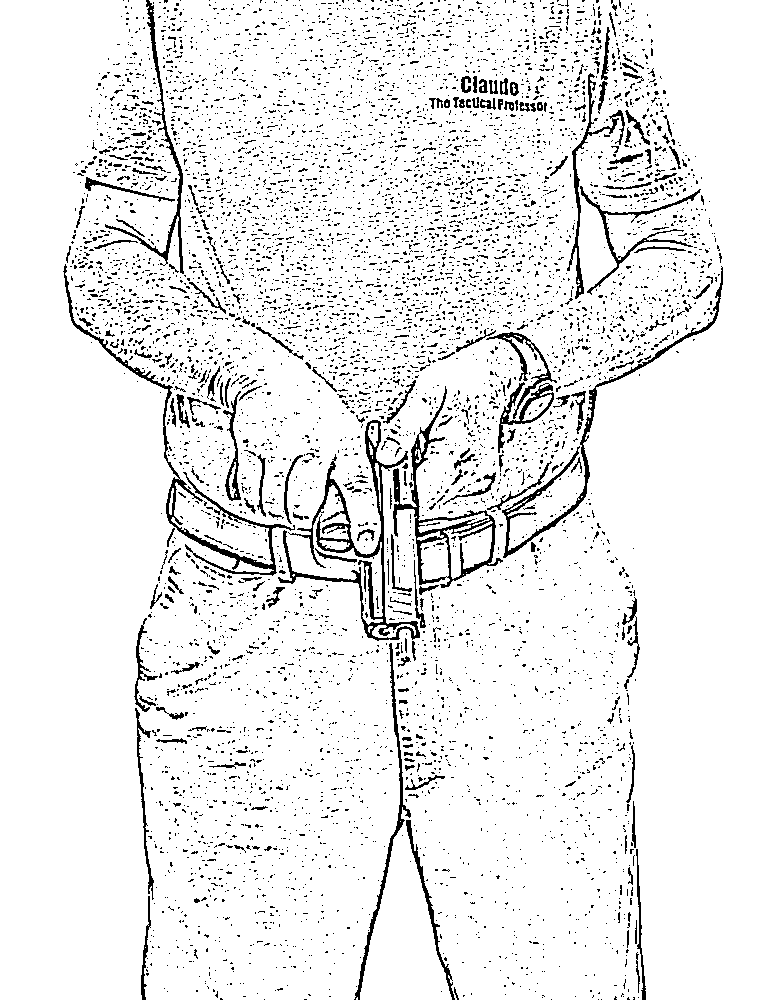
“Push forward with the right hand until the slide is felt to be open to its fullest extent.”

“Immediately that point is reached, release the hold with the left hand. The slide flies forward, taking with it and forcing into the breech, the topmost cartridge of the magazine, the pistol pointing to the ground meanwhile.”

- Achieve a proper firing grip and come to Low Ready.
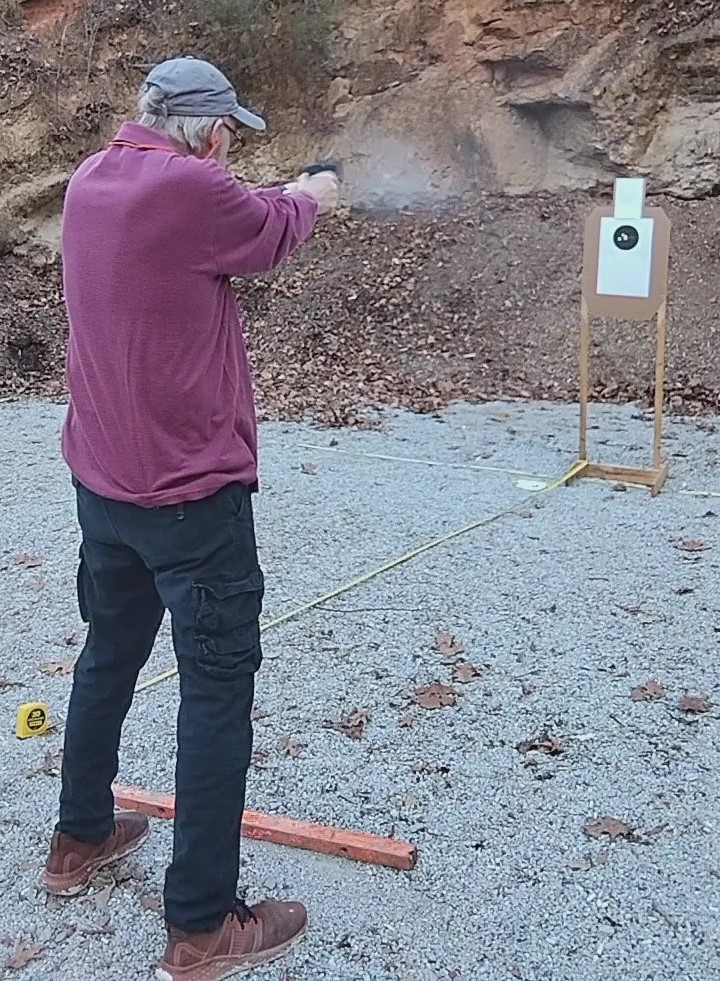
- Bring the pistol to eye level, acquire a sight picture, and fire five shots.
- Verify that the pistol is unloaded.
- Safely holster
The passing standard for the NY State Proficiency Assessment is that 4 of the 5 shots (80%) must hit somewhere on the three sheets of paper.
The total round count for this session is twenty rounds. While that may seem low by some people’s standard, it is as much as many owners of snub nose revolvers and small pistols like the Ruger LCP will want to fire at one session. As a beginning, shooting this session provides some familiarity with shooting the pistol, what its concussion and recoil feel like, and an indicator of the shooter’s capability within a distance envelope that most criminal victimizations take place in.
 tacticalprofessor