Package Deal Update
I’m gratified that Thinking Clearly about Self-Defense and Personal Protection has been well received. One reader sent me the following comment, which I found quite gratifying.
I went through the book quickly and my initial impression is that it is superb. Tremendous intellectual effort and incredibly sage and mature counsel on the subject. It’s also incredibly in-depth and thoughtful.
J.T.
I want to spread the word as far as I can so I’ve now included it in the Shooting Drills Package https://www.payloadz.com/go/sip?id=3348053
The Package still includes Serious Mistakes Gunowners Make, also.

I appreciate the loyalty of those who have already purchased the Package, so I will be sending previous purchasers a download link for the book.
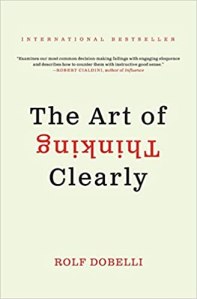
Two non-gun related books heavily influenced me in writing the book. The Art of Thinking Clearly by Rolf Dobelli and Small Data: The Tiny Clues That Uncover Huge Trends by Martin Lindstrom are both very insightful books about topics that aren’t often discussed.

Without knowing a proper name for it, I’ve been working with ‘small data’ for decades. I think Lindstrom would have approved of the Deloitte & Touche Real Estate Capital Markets Database that I created years ago. It started out with a few notes in Word and eventually grew into the broadest analysis of Wall Street’s entry into the commercial real estate finance business that has been done. Even the Wall Street soothsayers were only tracking 20 percent of the data in my database.
Contrary to the popular opinion that “the plural of anecdote is not data,” Lindstrom’s work shows that the opposite is actually true. All of Gary Klein’s work about decision-making is based on small data. Concealed Carry Skills and Drills, one of the books in the Package, is based on the concept of small data.
The collection of books in the Package presents a very comprehensive view of using firearms and other tools for preservation of life. Tools, skills, philosophy, and pitfalls are all covered. Those who are serious about our Art will find them useful reading, I am sure. I hope you will consider purchasing the collection.
Surveillance Detection
#fridayfundamentals
I had an encounter yesterday with some unpleasant people while grocery shopping. When I got back to my car, they pulled up nearby at a somewhat odd angle in the parking lot. Since I wasn’t sure if they planned to initiate a confrontation, I quickly drove out of the lot.
After such an encounter, it’s prudent to take a Surveillance Detection Route that does not lead directly home afterward. Doing so isn’t particularly difficult but it does require a little thought at the time. You also need to use your rear view and side mirrors regularly during the process. And have a safe place to go if it turns out you are being followed.
First of all, turn out of the parking lot in the opposite direction that you would take to go home. As you drive, look for signalized intersections to turn onto non-arterial through streets. If possible, hit the red light. Sitting at the red light for a minute will allow you to scan the cars behind you without being an inattentive driver. Make at least three turns watching your mirrors after you turn. Contrary to popular opinion, they don’t all have to be Right Turns. Sitting in the Left Turn lane at a signal will frequently give you a better scan of the cars behind you by using your driver’s side mirror than you can get through the rear view mirror. You’ll also have a slightly longer view of the traffic behind you as they turn.
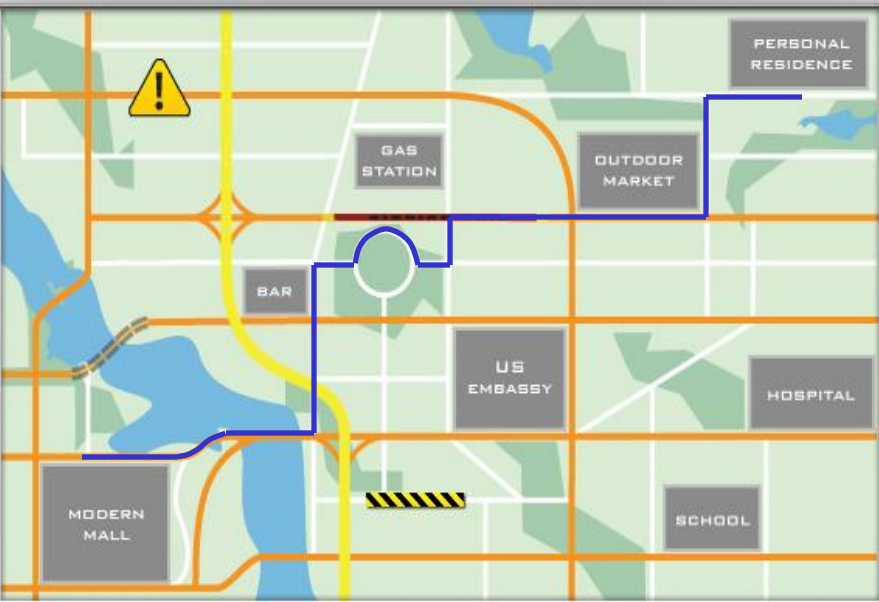
What you are looking for is vehicles that repeatedly make the same turns as you do. It doesn’t have to be the same vehicle that was involved in the initial encounter. Pairs of people often have two cars and the other vehicle might be the one following you.
Once you go into the Surveillance Detection mode, make a conscious determination you aren’t being followed before you decide to head back in the direction of your home. If you are being followed, don’t go home. Go to a safe place. POlice stations are overrated as safe refuges because they are often unmanned after shift change. Even Atlanta Zone Headquarters in the middle of the afternoon are sometime completely locked up. A woman was murdered in the lobby of an unmanned small town POlice station a few years ago by her estranged husband who was following her.
A better choice is someplace that is usually occupied by some kind of First Responders. Fire stations are one example and hospital Emergency Rooms are another. Even these aren’t fool proof but they are generally a better bet than going to the POlice. Think about several possibilities ahead of time and have them in mind as contingencies if you do need to go into the Surveillance Detection mode.
You could also call 911 but that requires you to able to link up with a patrolling POlice car or go to some place you’re directed to by the dispatcher to wait for help. Waiting for help in a stationary location when you’re being followed is an invitation to disaster. Driving to a safe place is probably a better idea.
Sound your horn even before you get into the safe refuge. Turn on your flashers and, if possible, activate the car alarm. If you have any kind of defensive tool, think ahead about how you might employ it should the situation require. That’s another good reason not to have a pistol stashed under the front seat or some other place it might have shifted around from.
Usually, when someone following you realizes that you are aware they are following, they will break off the pursuit. Don’t count on it though. You want to be prepared to play the game completely to the end. Just because you’re paranoid doesn’t mean they’re NOT out to get you.
On a separate note, a reader of Thinking Clearly about Self-Defense and Personal Protection sent me the following note. It is spot on so I am reproducing it verbatim.
Hi Claude,
You might want to put a notice at the beginning of your book to make sure you have an Internet connection when reading the book, because a lot of the text won’t make sense until the reader reads the article at the hyperlink. And there are a lot of them.
Good thought. Thinking Clearly about Self-Defense and Personal Protection contains numerous references to incidents in The Real World™ to provide context for the concepts in my articles. For copyright reasons, I can’t reproduce the articles in the book, so I link to them. An internet connection will be invaluable for understanding the context behind many of the concepts.
Thanks for the tip. Winner, winner, he receives the complete package of my books with my compliments for his suggestion.
Thinking Clearly about Self-Defense and Personal Protection
My new book is finished and available on my Payloadz store for download as a PDF.
https://www.payloadz.com/go?id=3377208
Fighting is a ‘game’ of minds.
–Rich Grassi, Editor of The Tactical Wire
Mental preparation for Personal Protection using tools is what the book is all about. Mr. Grassi’s comment encapsulates that concept superbly.
This book is a collection of my articles and essays, some previously published, some unpublished, some published but no longer available. The focus is on the mental processes that lead to achieving Positive Outcomes and avoiding Negative Outcomes. Many of the articles reference actual incidents to provide context from The Real World™ for what would otherwise be hypothetical or theoretical topics.
As alluded to in the title, Self-Defense is only a subset of Personal Protection. Often the person being protected is not ourselves but a loved one, friend, or innocent bystander. While gunowners usually think of a confrontation occurring between themselves and a criminal, the fact is that we are usually around other people. The possibility that another person will probably be peripherally involved and perhaps in danger is high. This simple fact requires serious thought ahead of time because people do unexpected things under stress.
The book is organized into several sections. Each section contains a number of articles that pertain to a topic. In many cases, an article relates to several sections so the most appropriate category was used.
- Mindset
- Awareness
- Know the Rules
- Decision-making
- Incident Analysis
- Negative Outcomes
- Appendix of shooting drills
No publication can be a definitive work about such a broad subject but my hope is to stimulate thinking about the complexity of the subject from a different perspective than usual. It’s 105 pages of discussion that often gets overlooked when we talk about Personal Protection.
If you would like to purchase a copy for only $7.99, here is the link.
https://www.payloadz.com/go?id=3377208
As with all my books, Serious Mistakes Gunowners Make is included with your purchase.
Children are creative
The statement was that the child put a speaker next to (the shelf) to crawl up and get (the gun)
Crawford County Prosecutor Matt Crall
Grandmother charged after her 4-year-old Galion grandson shoots himself dead with her unsecured pistol.
The woman had left a loaded.22 caliber, semi-automatic pistol on top of a shelf.
Leaving loaded and unsecured guns lying around, even on a top shelf, is irresponsible. I’ve known a number of people who think that’s an acceptable practice but it’s actually idiotic. When children live in the household, as the boy did in this case, it’s even worse, if that’s possible.
I’ve been encouraged to write a Second Edition of Serious Mistakes Gunowners Make. Sadly, I’ve acquired a lot of new material, although all of it follows the same pattern.
OTOH, this murderer should simply be thrown into an active volcano forthwith.
According to police, the shooter fired bullets at a residence from a nearby alleyway, and one of those bullets struck Trinity, who was jumping [on a trampoline] with friends.
Minn. Girl, 9, Is Fatally Shot While Jumping on Trampoline with Her Friends
https://people.com/crime/minnestota-girl-fatally-shot-jumping-trampoline/
Breaking Contact (Part 5)
#mindsetmonday
Our goal in personal protection is to force a break in contact. We want them to go away, or we want to go away. One or the other.
The final segment of the CCW Safe Series about my concept of Breaking Contact is posted.
https://ccwsafe.com/blog/breaking-contact-pt-5
This edition focuses on success stories. I like those.
[W]hen a concealed carrier enters a self-defense situation with the goal of breaking contact — as opposed to a goal of killing or disabling an attacker — the defender has a substantially higher likelihood of avoiding a deadly shooting or making a successful self-defense claim when all else fails.
Shawn Vincent
Cover is your friend
The teen ducked behind a tree. The prosecutor’s report said one of the rounds fired by the deputy was recovered later from that tree, and several other rounds were recovered from other trees between the teen and the deputy.
A deputy and a trooper mistakenly fired 8 rounds at an innocent boy.
Be aware of not only who is around you but what is around you, including things that can prevent you from getting ventilated.
Trooper 1 stated to investigators that at the time he exited his patrol vehicle he believed the gunshots he was hearing (Deputy 1’s gunshots) were actually that of LEATHERMAN towards himself. He stated he fired in self-defense at LEATHERMAN believing he was being shot at.
My Battalion Commander made the comment during Civil Disturbance training that the POlice are, at most, used to operating in pairs. Pairs generally only exist in large urban areas. When an ad hoc group of POlice come together, such as in this case, it’s very easy for things to go South quickly. The LAPD has very strict requirements for a supervisor to assume command as Incident Commander when groups of officers assemble. In cases such as this no such control mechanism is possible and things can easily get out of hand, as they did. My advice is that if you see a group of POlice from different agencies gathering, leave the area immediately.
Note also that Officer 1 was downrange of Deputy 1 and Trooper 1 while they were firing at the innocent bystander. Struggling with Subject 1 on the ground to take him into custody might have saved that Officer’s life.
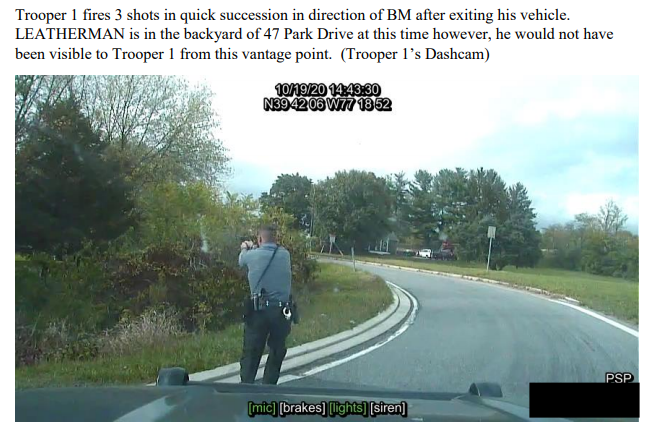
The full 27 page report from the State’s Attorney about the incident is available to download from the news article.
Another of my rules is that if I were to hear shots fired, I am going the other way as quickly as I can. Nothing good comes from ‘running to the sound of guns’ as a Private Citizen. Something something, curiosity killed the cat, something something.
Being Mindful Of and Avoiding Danger
#mindsetmonday
Dr. Sherman House, the Real Dr. House™, https://civiliandefender.com/ was an armored truck guard for quite a while. He turned me on to the fact that such robberies often begin with unannounced gunfire by the robbers. When I see an armored truck at a grocery store or other place, I wait in my car until after it leaves.
Armored truck guard shot in the face during robbery attempt at NE Houston bank, HPD says
Tactical Professor books (all PDF)
Real Shootouts of the LAPD https://realshootoutsofthelapd.com/
Serious Mistakes Gunowners Make http://seriousgunownermistakes.com
Indoor Range Practice Sessions http://indoorrangepracticesessions.com
Concealed Carry Skills and Drills http://concealedcarryskillsanddrills.com
Shooting Your Black Rifle http://shootingyourblackrifle.com
Advanced Pistol Practice http://bit.ly/advancedpistolpractice
Package deal of Serious Mistakes, Indoor Sessions, Concealed Carry, and Shooting Your Black Rifle (20% off) https://store.payloadz.com/details/2644448-ebooks-sports-shooting-drills-package.html
Every Day Skills
While there are plenty of posts about ‘Every Day Carry’ for personal protection, there are very few about Every Day Skills for personal protection. Tools are only useful if they are used with some degree of skill. Also many of the skills we use for personal protection don’t involve tools at all, other than the one between our ears.
I am now undertaking a long term project for a Fortune 500 retailer that involves being in their stores. So, I’ve taken my own advice and ‘gotten a real job.’ Dear Instructors, Get a Real Job Being back in ‘The Real World’ is an interesting experience, especially because I’m on the road, working different hours, and staying in motels.
A few of the things I’ve had to work on are:
- Surveillance Detection
- Situational Awareness (consider it in the context of changing a tire in the rain, for instance)
- Securing my tools repetitively
- Camouflage
- and numerous more
Chronicling my experiences with what personal protection for normal people really involves will be quite interesting. I am quite looking forward to it. It will be an adventure.
Breaking Contact (Part I)
CCW Safe is doing a series about our ultimate goal in Personal Protection. I am happy that I have been able to make a contribution to the literature of our Art.
Our goal in personal protection is to force a break in contact [with a criminal attacker]. We want them to go away, or we want to go away. One or the other.
https://ccwsafe.com/blog/breaking-contact-pt-1
This philosophical fundamental is the true meaning of “Get off the X” for the Private Citizen. Sidestepping or whatever method is taught to get off the X isn’t the end or even the important part of the process. Forcing the attacker to withdraw or making our escape is the end objective.
It’s nothing new. Military units have probably been doing this since before the Roman Empire existed. It’s easily overlooked at the moment of an incident, though. For some folks, escaping is a natural response but for others it is counter-intuitive and needs to be practiced.
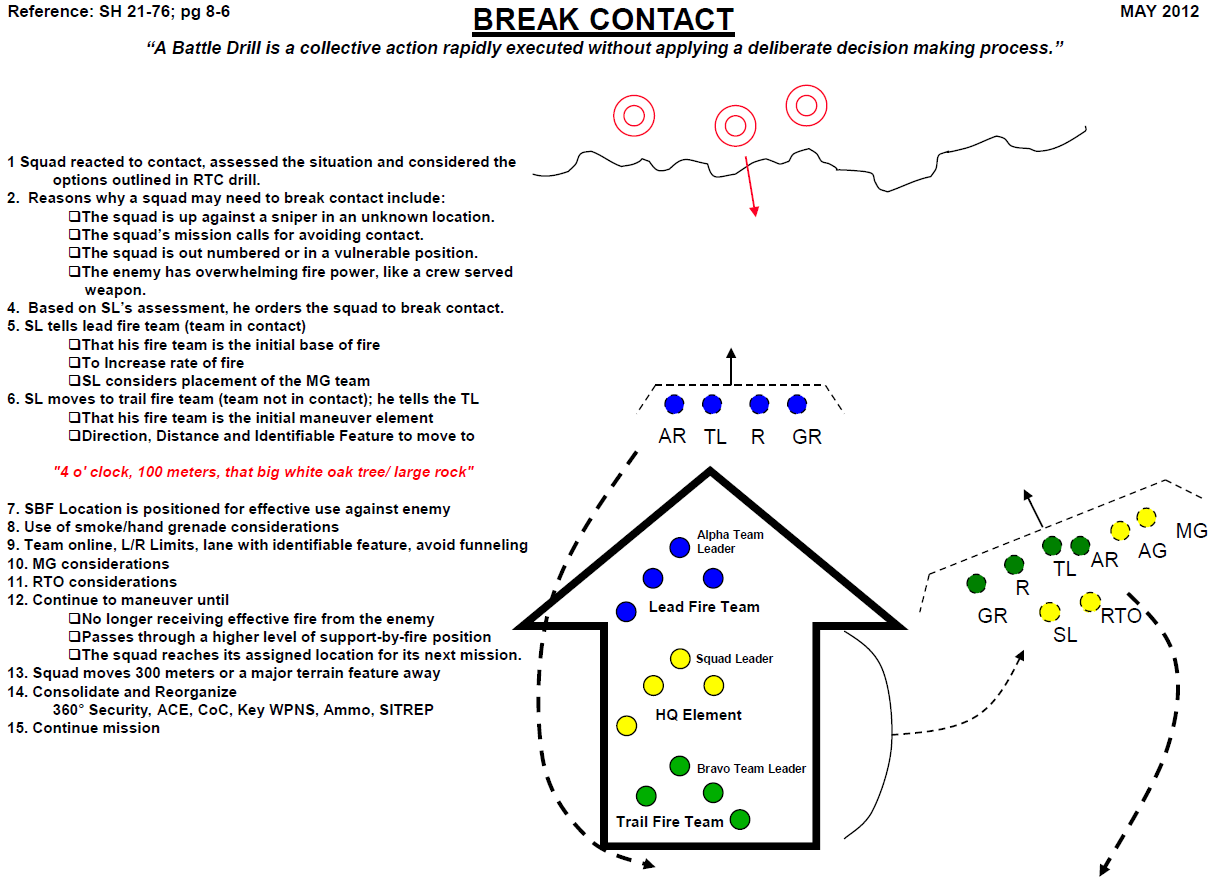
In some cases, what we’ve learned needs to be unlearned and replaced with a more appropriate tactic. Assaulting through the kill zone of an ambush toward the enemy is a prime example. Infantrymen are taught this from Day 1 of their military training. However, it’s often not a viable response in civilian life. Sadly, the LT Dwain Williams incident https://tacticalprofessor.wordpress.com/2021/02/26/using-cover-effectively/ is an example of how wrong this tactic can go.
As Shawn points out in the Breaking Contact article https://ccwsafe.com/blog/breaking-contact-pt-1, POlice officers are especially vulnerable to falling prey to the subconscious instinct to chase when they are off-duty. Several incidents in Real Shootouts of the LAPD https://realshootoutsofthelapd.com demonstrate this. However, private citizens are vulnerable too and he cites several cases where this occurred.
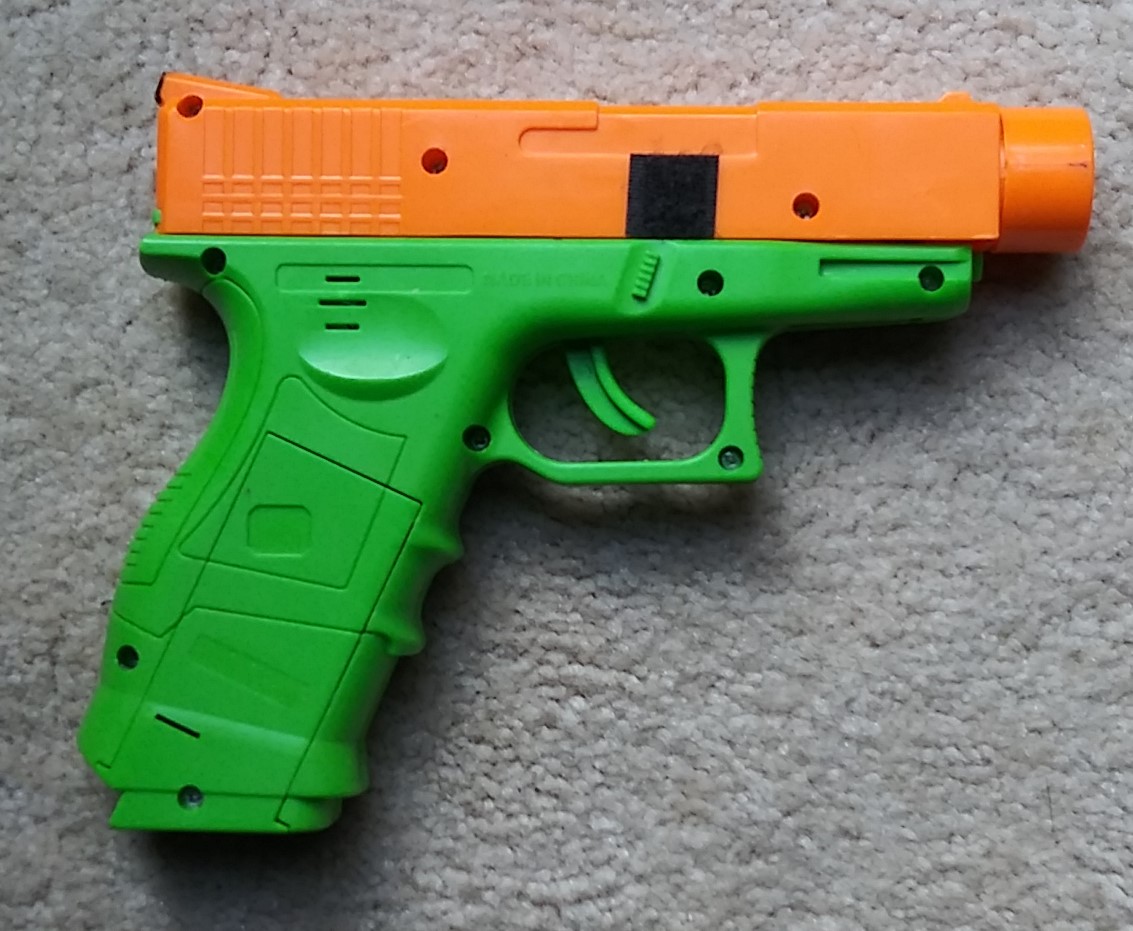
Practicing, using an inert replica of your tool, a simple Battle Drill of Breaking Contact with an attacker is worth actually doing rather than just thinking about. We learn physical skills through repetition.
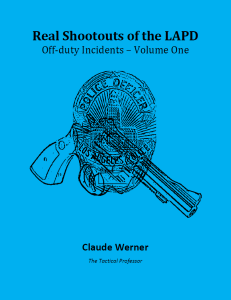
If you would like to purchase Real Shootouts of the LAPD, click on the image below.
Decisions and experience
Good decisions come from experience. Experience comes from bad decisions.
Although incorrectly attributed to Will Rogers, the concept of learning from other peoples’ experience rather than our own still has value. We can use the Intelligence community’s technique of ‘walking back the cat’ to de-construct an incident. This allows us to visualize it and learn from the experience of someone else.
The concept of ‘Decision points’ has been emphasized by both Gary Klein, PhD., a noted expert on the decision-making process, and President George W. Bush. Any drama contains not just one, but a sequence of decisions and decision points we can study.

The Don’t Shoot/Shoot decision is the one most commonly focused on the training and firearms communities. However, any Defensive Gun Use, whether shots are fired or not, contains a plethora of decisions and decision points. These occur before, during, and after the shooting or display of a firearm takes place.
A rich source for walking back the cat is the Categorical Use of Force reports by the LAPD Board of Police Commissioners. The following is an analysis of one incident by an off-duty LAPD officer. The analysis will use the phases of an incident as described in my book Real Shootouts of the LAPD. http://realshootoutsofthelapd.com
The incident began as an Aggravated Assault on an LAPD off-duty officer. The full report by the Board of Police Commissioners, including its Findings about Tactics, Drawing and Exhibiting of a Firearm, and Use of Lethal Force can be found here. http://www.lapdonline.org/assets/pdf/011-11_Harbor-OIS.pdf
Incident Summary
The Situation
Officer A, who was off-duty, walked to his vehicle parked in the driveway of a residence. He did not see anyone around at the time. His duty weapon was in the right front pocket of his pants. After driving out of the driveway, he backed his vehicle up and left the lights on. He then walked back to the gate to close it.
- Decision point — Leave home armed with his weapon on his person or at least accessible? Even for POlice officers, this is not as absolute a decision as it would seem, as can be seen in other LAPD off-duty incidents.
- Decision point — Close gate (initial entry barrier to home) or not? As mundane as this decision seems, many people leave their garage doors open when they drive away from their home.
The Buildup
Officer A saw the Subject walking on the sidewalk coming toward him. The Subject then began to run toward Officer A. As the distance to the Subject became closer, Officer A saw the Subject had a handgun in his hand. The Subject pointed the handgun at Officer A.
- Decision point — Maintain awareness of surroundings or focus on telephone or other attention divider?
- Decision point — Maintain surveillance on the suspect or not?
- Decision point — Recognize and accept that an armed attack is imminent or not?
Drawing and Exhibiting
Officer A drew his service pistol from his pocket.
- Decision point — Draw own pistol or not?
The Gunfight
Immediately after drawing his pistol, Officer A fired one round at the Subject.
- Decision point — Don’t Shoot or Shoot?
- Decision point — Fire in place or Shoot on the Move?
- Decision point — Obtain an adequate sight picture to make a hit or fire without visual reference?
The Subject seemed unaffected, so Officer A fired a second round at the Subject.
- Decision point — Don’t Shoot or Shoot a second time?
- Decision point — Fire in place or Shoot on the Move?
- Decision point — Obtain an adequate sight picture to make a hit or fire without visual reference?
After running past Officer’s A car, the subject collapsed on the sidewalk behind a short block wall.
Post Gunfight Actions
Because he could not see him and wanted to wait for responding officers to arrive, Officer A did not approach the Subject.
- Decision point — Approach the suspect or not?
Officer A retreated to cover at the house and called 911.
- Decision point — Hold position or retreat to cover?
- Decision point — Call 9-1-1 or do something else?
While he was calling 911, Officer A observed another male come over to the Subject, squat down, then stand up and adjust his shirt. The second male then walked away.
- Decision point — Interact with/challenge the secondary suspect or not?
Two other males walked to the fallen Subject, leaned over to look at him, and then walked away.
- Decision point — Interact with/challenge the tertiary suspects or not?
There are also implied decision points subsequent in the drama but were not elaborated on by the BOPC.
- Actions on approach of responding officers.
- What statements, if any, should be made to responding officers and then to detectives.
- Whom else to notify about the incident; Significant Other, etc.
- Retain an attorney or call pre-paid legal assistance plan.
At least 21 decisions/decision points are readily discernible in this incident. There are perhaps even more, despite this being a relatively uncomplicated DGU. Also note that of the 21, only six (Don’t Shoot or Shoot [X2]), (Fire in place or Shoot on the Move [X2]), and (Obtain an adequate sight picture to make a hit or fire without visual reference [X2]) can be readily practiced with live fire. Those and another, (Draw own pistol or not) can be practiced dry. The other two-thirds of the decisions are more in the nature of ‘soft skills’ that are best decided upon in advance and then practiced away from the range.
“Best decided upon in advance and practiced away from the range” represents our opportunities during the current ammo shortage. Rather than sit on our hands because ammo has become so precious, we can begin developing and practicing a more complete repertoire of the skills we need for Personal Protection. If you would like to read my analyses of the rest of the incidents described in the book, please subscribe to me on Patreon. Patreon link I will be posting the rest of them there.


You must be logged in to post a comment.