Special Forces – The Big Picture
#throwbackthursday
February’s weekly episodes of The Big Picture will feature the role of Special Forces during the Cold War. https://www.history.com/topics/cold-war/cold-war-history
Guest Narrator for the first episode is Mr. Henry Fonda, the famed screen actor.
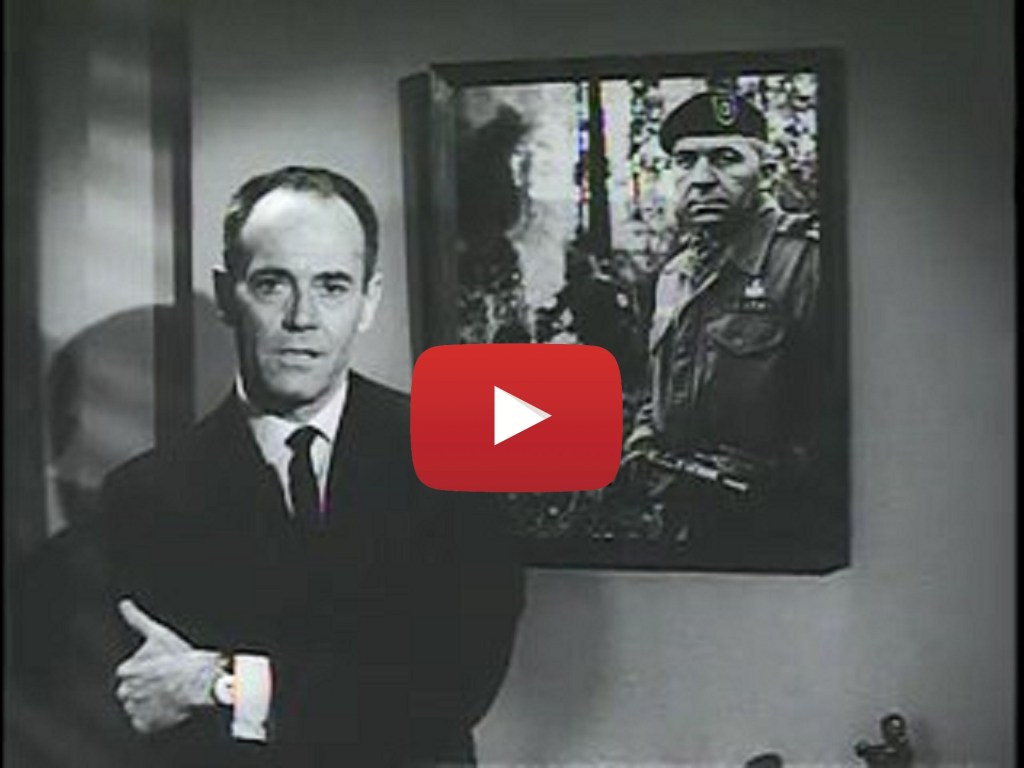
This man wears the uniform of the Special Forces. To use the word special in describing him is no mistake as you’ll see during the next half hour. He’s a mature, dedicated, and skillful professional and his line of work is demanding. It takes in a full scope of unconventional or guerrilla operations.
Special Warfare involves three types of activity; unconventional warfare, psychological warfare, and counterinsurgency operations. This last includes the complete range of military, political, economic, and sociological action. New emphasis is being placed on unconventional warfare and the reason isn’t hard to see.
Today, the threat of war takes three forms; general nuclear war, conventional war, and guerrilla or unconventional war. Fortunately, the world has never yet seen a general nuclear war. Conventional warfare, the regular forces of two or more nations in combat but without using nuclear weapons we know all too well but at the moment no such traditional war is going on. Unconventional warfare is a different story.
In a number of key spots around the world intense guerrilla operations are underway right now. It makes little difference to the people of a country whether they lose their freedom to an invading army of regulars or through the action of guerrilla forces sponsored by an outside power.
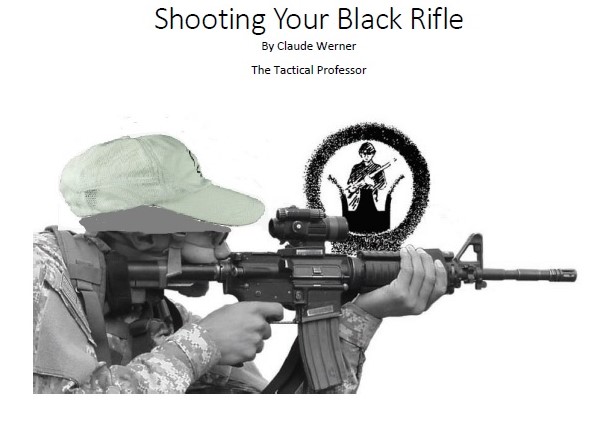
My book Shooting Your Black Rifle seems appropriate to this series of films. If you would like to purchase it, click on the image below.
Commence Firing – The Big Picture
#throwbackthursday
“Since the earliest days in American history, marksmanship has played a vital role in the growth and development of our country. The rifle was essential to those pioneers who marched westward, often the means of survival. Marksmanship continues to be fundamental right down to this day. Weapons change, tactics change but being able to hit the mark has never lost its importance. Sometimes it means the difference between life and death. From colonial days, marksmanship has been an American tradition. The right to bear arms was one of the basic freedoms demanded by the Continental Army and rifles and the spirit of the man who manned them were decisive factors in our country’s initial fight for independence.”

To Keep and Bear Arms – The Big Picture

#throwbackthursday
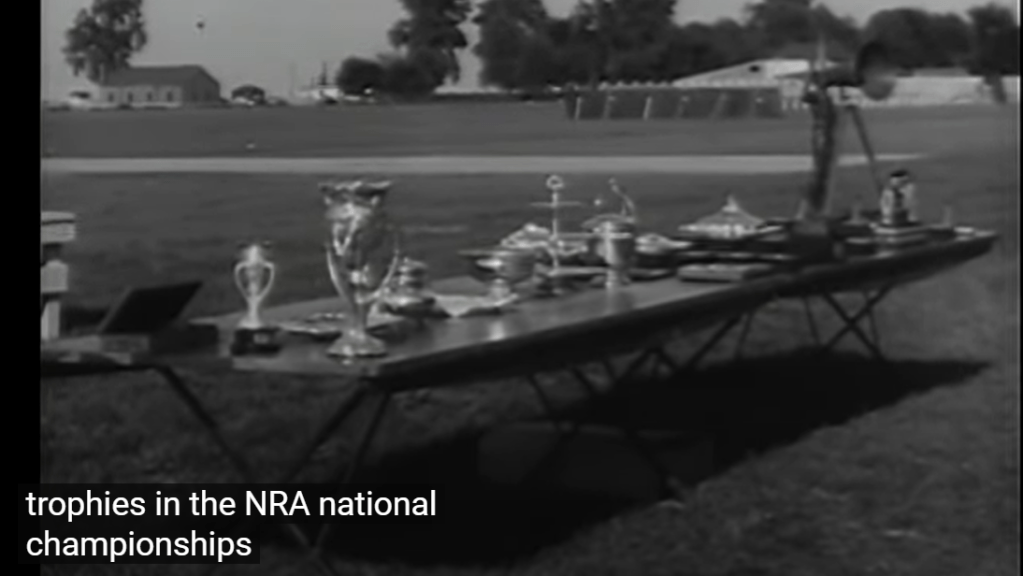
The Big Picture was a long running weekly TV series produced by the United States Army. This episode is a co-presentation of the US Army and the National Rifle Association. It is partially narrated by Craig Stevens, who played Peter Gunn on the TV detective series of the same name. The program also contains scenes from the National Championship at Camp Perry.
For those unfamiliar with Peter Gunn, the series is available on YouTube. The theme song, played by Henry Mancini, has been described as perhaps the coolest and most suave of any TV theme.
Fundamentals of Pistol Shooting (Part 8)
#fridayfundamentals

My friend and colleague Shelley Hill of Image Based Decisional Drills https://www.imagebaseddecisionaldrills.com/ has generously contributed the following post about the importance of the Use of Force decisional process and training for it. We’ve been slapped in the face by the news about good and bad Use of Force decision making. It is the most important, consequential, and least practiced aspect of the Fundamentals.
Decisions Come Before Technique
by Shelley Hill
In the process of Personal Protection, from the time that a bad guy chooses you, you will have a limited amount of time to make a decision. THEY choose how and when. YOU have to respond to their actions. YOUR reactions need to be confident, quick, and decisive.
Seeing, recognizing, and believing danger is the first task. Having a plan for avoidance, deselection and escalation is second. If these fail, the fight is on, and it must be won. The first time you have to use the different levels of force, with everything on the line, should not be the first time you practice your skills. A wide variety of options are available for responding to an attempted attack. The choices you have include:
- Non-lethal (mindset, verbal, walk away, flashlight, etc.),
- Less than lethal (OC/pepper spray, Combatives, etc.) and
- Lethal options (firearm, knife, advanced Combatives, etc.).
Your decision or decisions will come first, ideally before the incident ever begins. After deciding what to do, you will apply a technique to implement your decision. We must commit to a course of action and take advantage of making decisions ahead of time. Our instinctive responses to danger are fight, flight, or freeze. If we have thought about and practiced our decisions before the incident takes place, we have a better chance of expanding our instinctual reactions to something more effective or appropriate. When pre-need decisions have already been made, the techniques we have practiced will usually fall into place.
Recognition -primed decision making (RPD) is a model of how people make quick, effective decisions when faced with complex situations. In this model, the decision maker is assumed to generate a possible course of action, compare it to the constraints imposed by the situation, and select the first course of action that is not rejected. RPD has been useful for diverse groups including medical professionals, fire ground-commanders, chess players, and stock market traders.
It functions well in conditions of time pressure, and in which information is partial and goals defined only in a limited way. It appears, as discussed by Gary A. Klein in Sources of Power, to be a valid model for how human decision-makers make decisions. The result of pre-need decision-making is a decision that may not be perfect but is good enough to help keep you, or a loved one, safe.
With the help of Brian Hill and Claude Werner, I produced a decision learning system called Image Based Decisional Drills (IBDD). It is an evolution of the technique of visualization that has been used successfully for decades to help athletes, competitive shooters, and others make their decisions ahead of time and then carry them out as a programmed response instead of improvising decisions as they go.
It is called it IBDD because you are learning to quickly make ONE good FIRST decision based on visual stimuli. The word “decisional” means “having the power or authority to make decisions”, and drills means practicing. Image Based Decisional Drills is a system that can be used in either dry practice or live fire. It consists of a deck of 21 Image Cards that provide IMAGES that will help you to recognize danger and to make smart decisions ahead of time.
There are benefits to practicing good FIRST decisions through IBDD and then following up with GOOD techniques.
- Visual cueing and pre-need decision making.
- Learning distance management through “Reactionary Zones.”

- Tool cycling and strategy changes that can be practiced repeatedly.
- Pressure testing decisions under realistic time constraints with feedback for improvement.
- The ability to practice your skills whether you are ON or OFF the range. The actual mechanics of shooting can be practiced separately while the IBDD drills will help with tool handling and selection.
Whatever system you use to practice your decision making skills, it’s important to keep an important concept in mind. It is easier to adapt a plan you made ahead of time to the situation than it is to improvise a plan on the spot. Make a plan, practice your plan, and then work your plan if the need arises.
Part 1 https://tacticalprofessor.wordpress.com/2021/11/05/fundamentals-of-pistol-shooting-part-1/
Part 2 https://tacticalprofessor.wordpress.com/2021/11/12/fundamentals-of-pistol-shooting-part-2/
Part 3 https://tacticalprofessor.wordpress.com/2021/11/22/fundamentals-of-pistol-shooting-part-3/
Part 4 https://tacticalprofessor.wordpress.com/2021/12/03/fundamentals-of-pistol-shooting-part-4/
Part 5 https://tacticalprofessor.wordpress.com/2021/12/10/fundamentals-of-pistol-shooting-part-5/
Part 6 https://tacticalprofessor.wordpress.com/2021/12/17/fundamentals-of-pistol-shooting-part-6/
Part 7 https://tacticalprofessor.wordpress.com/2021/12/24/fundamentals-of-pistol-shooting-part-7/
Tactical Professor books (all PDF)
- Indoor Range Practice Sessions http://indoorrangepracticesessions.com
- Concealed Carry Skills and Drills http://concealedcarryskillsanddrills.com
- Advanced Pistol Practice http://bit.ly/advancedpistolpractice
- Real Shootouts of the LAPD https://realshootoutsofthelapd.com/
- Thinking Clearly about Self-defense and Personal Protection https://www.payloadz.com/go?id=3377208
- Serious Mistakes Gunowners Make http://seriousgunownermistakes.com
- Shooting Your Black Rifle http://shootingyourblackrifle.com
- Package deal of Thinking Clearly about Self-defense and Personal Protection, Serious Mistakes, Indoor Sessions, Concealed Carry, and Shooting Your Black Rifle (50% off) https://store.payloadz.com/details/2644448-ebooks-sports-shooting-drills-package.html
Purchase of any book includes Serious Mistakes Gunowners Make.
Strategies, Tactics, and Options for Personal Protection presentation at Rangemaster Tactical Conference
Fundamentals of Pistol Shooting (Part 7)
#fridayfundamentals
My friend and colleague Brian Hill of The Complete Combatant http://www.thecompletecombatant.com/ has a unique perspective on one of the decision-making aspects of the Fundamentals. It was touched on in Part 1 of this series https://tacticalprofessor.wordpress.com/2021/11/05/fundamentals-of-pistol-shooting-part-1/. He has generously contributed the following post to expand and explain his viewpoint.
The Three Choices
The act of drawing from concealment to the first shot is the essential skill for the armed citizen, whether we are practicing, competing, or protecting ourselves. To improve the probability of success, the action requires a “recognition primed decision,” to use Gary Klein’s phrase. There are only three possible courses of action for the shooter once the decision to shoot has been reached. The need for a mental model which is conducive to quick decisions can be explained as follows.
1-Shoot
If the shooter can perform a clean draw, align the sights or index the pistol relative to the target, then the decision should be primed that the pattern is correct and to execute the process of shooting. This decision will be compressed to a short period of time; therefore, the intuition will recognize the correctness with feedback from both vision and feel. This observation will be based on the feeling of fluidity and efficiency of the movement with a visual confirmation of alignment allowing the pattern to be recognized as “good enough” relative to the size of the target. The shooter is not using a comparative analysis but a recognition of previous successes.
2-Correct and then shoot
Often pressure or lack of skill will alter this process; therefore, the shooter will have to correct either the physical index or visual alignment of the sight and target, or both. The pattern will be recognized as not “good enough,” and a correction will be applied. This correction cost the shooter a quarter of a second to make a correction which is much faster than firing another shot which may be no better than the previous one. Of course, the other possibility is looking to the target for indication of success or failure, and the minimum amount of time for this type of correction is .75 to 1.5 seconds. The more we practice the correct pattern, the faster the recognition primed decision happens. Experts gain an advantage in processing speed and a significant probability of making the right decision sooner, hence the need for practice.
3-Assess new information
Finally, as the shooter commits to the shooting process, something changes, the target disappears, changes, or stops needing to be engaged; therefore, the shooter needs to assess a possible new course of action, such as stopping the process of shooting, going to a ready position and taking the finger off the trigger, or moving away. Using the previous two steps, if there is not a “good enough” solution and no correction can be made, requires the shooter to reevaluate the situation. If there is any doubt then the answer is no, and the shooter needs to adjust or stop.
Shooting happens in highly compressed time periods, but the properly prepared mind will be able to perform efficiently and consistently. The key is repeated exposure to both success and failure, allowing the priming of the process. Practice with this style of immediate feedback will allow progress rapidly and is the key to competency under pressure.
The Complete Combatant http://www.thecompletecombatant.com/
Everything we hear is an opinion, not a fact. Everything we see is a perspective, not the truth.
–Marcus Aurelius
In addition to the alignment process of the pistol to the target Brian mentions, the smoothness of the trigger press necessary will influence the success of the shot. Shooters are often victims of “urgency bias” with regard to trigger press. This is akin to the common human tendency to feel “I have to do something NOW.” Urgency bias can lead to “El Snatcho” and can negate the alignment of the pistol with the target. So, the necessary smoothness is also a decision that the shooter must make. What will suffice at two yards will probably not lead to good results at 10 yards. It is also a recognition primed decision that is only learned through practice.
The final part of the series will focus on the most important, consequential, and least practiced aspect of the Fundamentals, DON’T SHOOT/SHOOT.
Part I https://tacticalprofessor.wordpress.com/2021/11/05/fundamentals-of-pistol-shooting-part-1/
Part 2 https://tacticalprofessor.wordpress.com/2021/11/12/fundamentals-of-pistol-shooting-part-2/
Part 3 https://tacticalprofessor.wordpress.com/2021/11/22/fundamentals-of-pistol-shooting-part-3/
Part 4 https://tacticalprofessor.wordpress.com/2021/12/03/fundamentals-of-pistol-shooting-part-4/
Part 5 https://tacticalprofessor.wordpress.com/2021/12/10/fundamentals-of-pistol-shooting-part-5/
Part 6 https://tacticalprofessor.wordpress.com/2021/12/17/fundamentals-of-pistol-shooting-part-6/
Tactical Professor books (all PDF)
- Indoor Range Practice Sessions http://indoorrangepracticesessions.com
- Concealed Carry Skills and Drills http://concealedcarryskillsanddrills.com
- Advanced Pistol Practice http://bit.ly/advancedpistolpractice
- Real Shootouts of the LAPD https://realshootoutsofthelapd.com/
- Thinking Clearly about Self-defense and Personal Protection https://www.payloadz.com/go?id=3377208
- Serious Mistakes Gunowners Make http://seriousgunownermistakes.com
- Shooting Your Black Rifle http://shootingyourblackrifle.com
- Package deal of Thinking Clearly about Self-defense and Personal Protection, Serious Mistakes, Indoor Sessions, Concealed Carry, and Shooting Your Black Rifle (50% off) https://store.payloadz.com/details/2644448-ebooks-sports-shooting-drills-package.html
Purchase of any book includes Serious Mistakes Gunowners Make.
Strategies, Tactics, and Options for Personal Protection presentation at Rangemaster Tactical Conference
Fundamentals of Pistol Shooting (Part 6)
#fridayfundamentals
How do we know we’re doing the Fundamental of Pistol Shooting correctly? That’s where Standards and measurement come in. The term ‘Standards’ is intimidating to many people so if it makes you more comfortable, say ‘baseline’ instead.
The most important thing is to have a Standard, any standard. As the saying goes, “If you don’t know where you’re going, there’s no road that will get you there.” Even the gurus of 20th Century ‘point shooting,’ Fairbairn and Sykes, had standards their officers had to meet.
Another aspect of the situation is that Standards introduce pressure. Pressure brings about failures, both human and mechanical. The book Holloway’s Raiders https://www.amazon.com/Holloways-Raiders-Captain-R-Walt-ebook/dp/B01LWMDZ4D has an excellent example of a pistol that worked fine at the range but malfunctioned when the officer got into a gunfight. The gun was no different, it was how the officer handled it under the pressure of a gunfight that changed the pistol’s performance. Chuck Haggard https://agiletactical.com/ and I have both observed that malfunctions are far more common in POlice gunfights than is generally acknowledged. This phenomenon is well documented in the LAPD Categorical Use of Force reports. https://www.lapdonline.org/police-commission/categorical-use-of-force/
When shooters enter competitions, it’s very common for malfunctions in their pistols to show up. “I don’t understand it, my gun never malfunctions when I practice but here I’m having a lot of problems” is a frequent comment by new competitors. Consequently, the Standard you choose is less important than simply having one, and the pressure it brings about, in the first place.
The most relevant shooting task for those who want a CCW is to pass the Qualification Course, if their State requires one. Millions of people who obtain Licenses to Carry have had to qualify with their pistol to get the license. Only a few thousand, a tiny fraction, will ever fire a pistol for Personal Protection.
Experienced shooters often tell new shooters “It’s easy; blah, blah, blah” with regard to shooting a Qualification. No, it’s not. For someone who’s never fired a pistol before, it’s a daunting task. Most people have not taken any test at all, even one on pen and paper, since high school. Testing of any kind is a process that is usually hated and feared. Add in the presence of a deadly weapon and the test becomes a huge psychological obstacle.
Time is an aspect of any deadly force encounter. The saying “There are no timers in a gunfight” is foolish. The most important timer, your life clock, is running the whole time. It can be stopped if you don’t react in time. One POlice who was involved in an extended gunfight said to himself, “Hey, I need to slow down and aim better.” What he meant was ‘I need to apply the Fundamentals, shoot better, and start neutralizing my opponent with bullets.’ He came to realize the concept that time matters.
If you don’t take the time do it something right in the first place, how are you going to get the time to do it over?
My mother
Until the invention of electronic timers, there was no way to accurately time individual shots. Timers didn’t exist in the Fairbairn/Sykes/Applegate era, only stopwatches. And yet, even Shooting to Live mentions that an observer with a stopwatch can be a tremendous aid to improving performance.
Pick a Standard, any standard, and see how well you can meet it. If your State requires a Qualification Course, that’s a good place to start. If not, pick some Standard, they’re readily available on the Internet, and use that. Then, over time, improve your performance against the Standard. For instance, using 100% as your goal on the Qualification instead of the minimum passing score. You’ll be better prepared if you do have to defend yourself and you’ll feel more confident in general.
The final two parts of this series will feature guest articles about the Decisions aspect of the Fundamentals paradigm.
Part I https://tacticalprofessor.wordpress.com/2021/11/05/fundamentals-of-pistol-shooting-part-1/
Part 2 https://tacticalprofessor.wordpress.com/2021/11/12/fundamentals-of-pistol-shooting-part-2/
Part 3 https://tacticalprofessor.wordpress.com/2021/11/22/fundamentals-of-pistol-shooting-part-3/
Part 4 https://tacticalprofessor.wordpress.com/2021/12/03/fundamentals-of-pistol-shooting-part-4/
Part 5 https://tacticalprofessor.wordpress.com/2021/12/10/fundamentals-of-pistol-shooting-part-5/
Tactical Professor books (all PDF)
- Indoor Range Practice Sessions http://indoorrangepracticesessions.com
- Concealed Carry Skills and Drills http://concealedcarryskillsanddrills.com
- Advanced Pistol Practice http://bit.ly/advancedpistolpractice
- Real Shootouts of the LAPD https://realshootoutsofthelapd.com/
- Thinking Clearly about Self-defense and Personal Protection https://www.payloadz.com/go?id=3377208
- Serious Mistakes Gunowners Make http://seriousgunownermistakes.com
- Shooting Your Black Rifle http://shootingyourblackrifle.com
- Package deal of Thinking Clearly about Self-defense and Personal Protection, Serious Mistakes, Indoor Sessions, Concealed Carry, and Shooting Your Black Rifle (50% off) https://store.payloadz.com/details/2644448-ebooks-sports-shooting-drills-package.html
Purchase of any book includes Serious Mistakes Gunowners Make.
Strategies, Tactics, and Options for Personal Protection presentation at Rangemaster Tactical Conference
Fundamentals of Pistol Shooting (Part 5)
#fridayfundamentals
The fourth Fundamental of Pistol Shooting is:
Follow Through
Following through can be tricky in more ways than one, even grammatically. The noun form of the word has a hyphen, while the verb form does not.
follow-through (noun)
- : the part of the stroke following the striking of a ball
- : the act or an instance of following through
follow through (verb)
- : to continue a stroke or motion to the end of its arc
- : to press on in an activity or process especially to a conclusion
https://www.merriam-webster.com/dictionary/follow-through
Follow-through is one of the most ignored aspects of shooting well. As the verb definition implies, following through means continuing to keep the gun on target until the shot is concluded. The shot is not concluded until the bullet has left the barrel. Therein lies the issue with not following through. Shooters will frequently move the gun, or themselves, before the bullet has left the barrel. Sometimes the lack of follow-through occurs even before the shot is fired.
The way lack of follow-through occurs can take three forms. Shooters will lift their heads, drop the gun, or pull the gun back close to the body immediately after the gun fires. This is driven by several different motivations.
- The desire to see where the bullet hit. That desire is why shooters lift their heads.
- They’ve been told to ‘scan and assess’ without being told that scan and assess comes after following through. This is the usual motivation for dropping the gun and is noticeably prevalent during NRA Personal Protection training.
- They’ve been taught that after firing their rounds, they have to immediately make ready for physical combat with an aggressor. Preparation for physical contact is the reason for pulling the gun back to the body.
None of these three actions accomplish what they are intended to. They are all counter-productive to both good marksmanship and to their original intent.
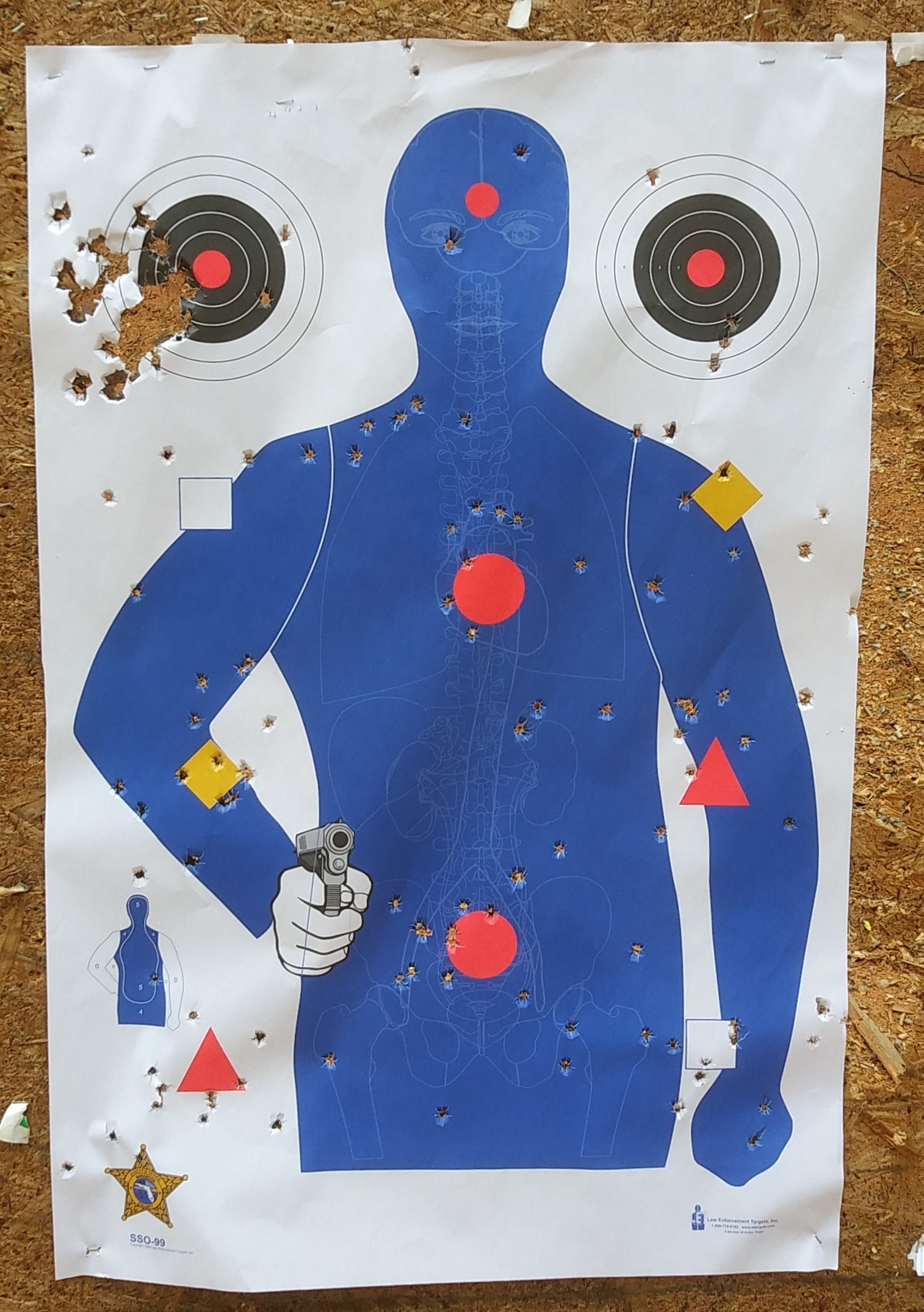
In defensive shooting, hits on an adversary are rarely visible the moment after the shot is fired, so lifting the head in an attempt to see the hits accomplishes nothing. When practicing, unless some kind of reactive target is being used, a shooter can’t usually tell where the round has hit on a paper target anyway. This is especially true if the previous hits on the target haven’t been pasted or taped and the target looks like Swiss cheese.
Scan and assess actually should occur in the reverse order, i.e., assess and scan. First, we want to assess the efficacy of our shooting on the initial threat and second, scan for additional threats. Assessment is properly done by looking through the sights to see if the opponent is still continuing the fight. If so, then additional and immediate sighted gunfire is the appropriate response. Note that during the assessment, the trigger finger is still going to be in the trigger guard and on the trigger, ready to instantly fire again, if necessary. Once the assessment determines that the attacker has been “neutralized with bullets,” https://www.cnn.com/2021/12/02/europe/sword-ninja-france-police-shot-intl/index.html then the finger comes out of the trigger guard, the pistol is lowered, and a scan for other threats begins.
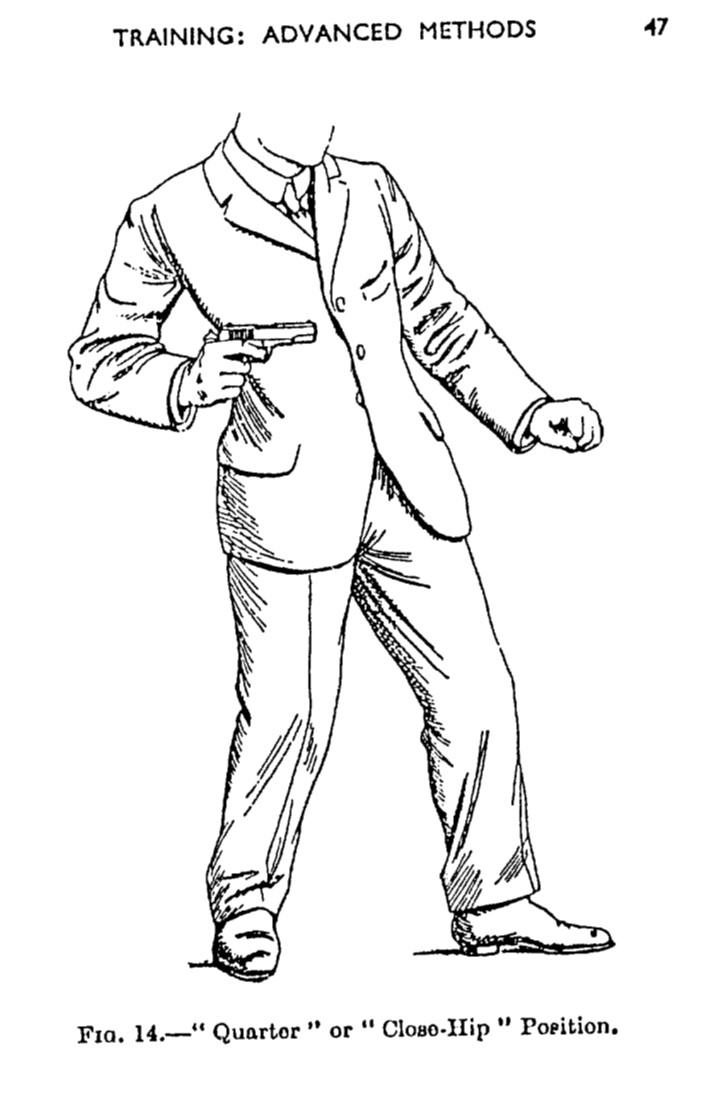
The desire by an criminal to close with a defender through a hail of bullets is a figbar of the imagination of certain segments of the training community. As the saying goes, “once the bullets start flying, everyone starts moving.” To which should be added, “away from the source of the bullets.” Assuming the fight is continuing, more accuracy will be required as the distance increases. This accuracy refinement is unlikely to be achieved by using a two handed version of the Fairbairn-Sykes “Quarter-hip” position.
A way to practice your follow-through is to count ‘one thousand’ after each shot prior to making any movement such as moving the gun, your head, or taking your finger off the trigger. Also be sure you’re keeping your eyes open during and after the shot. Blinking the eyes at the moment of ignition is far more common than most people know. Either a video camera or a partner to your side can help detect blinking.
There is a good article about how to develop follow-through on the NRA’s website.
https://www.nrafamily.org/articles/2020/4/6/follow-through-a-shooting-fundamental
The next Part will cover standards and measurement.
Part I https://tacticalprofessor.wordpress.com/2021/11/05/fundamentals-of-pistol-shooting-part-1/
Part 2 https://tacticalprofessor.wordpress.com/2021/11/12/fundamentals-of-pistol-shooting-part-2/
Part 3 https://tacticalprofessor.wordpress.com/2021/11/22/fundamentals-of-pistol-shooting-part-3/
Part 4 https://tacticalprofessor.wordpress.com/2021/12/03/fundamentals-of-pistol-shooting-part-4/
Tactical Professor books (all PDF)
- Indoor Range Practice Sessions http://indoorrangepracticesessions.com
- Concealed Carry Skills and Drills http://concealedcarryskillsanddrills.com
- Advanced Pistol Practice http://bit.ly/advancedpistolpractice
- Real Shootouts of the LAPD https://realshootoutsofthelapd.com/
- Thinking Clearly about Self-defense and Personal Protection https://www.payloadz.com/go?id=3377208
- Serious Mistakes Gunowners Make http://seriousgunownermistakes.com
- Shooting Your Black Rifle http://shootingyourblackrifle.com
- Package deal of Thinking Clearly about Self-defense and Personal Protection, Serious Mistakes, Indoor Sessions, Concealed Carry, and Shooting Your Black Rifle (50% off) https://store.payloadz.com/details/2644448-ebooks-sports-shooting-drills-package.html
Purchase of any book includes Serious Mistakes Gunowners Make.
STOPP Presentation at Rangemaster Tactical Conference
The direct purchase link for the STOPP Presentation is: https://www.payloadz.com/go?id=3381307
Fundamentals of Pistol Shooting (Part 4)
#fridayfundamentals
The third Fundamental of Pistol Shooting is:
- ‘Press the trigger smoothly and straight to the rear.’
First of all, let’s distinguish between ‘trigger manipulation,’ a physical process, and ‘trigger control,’ a mental process. Trigger control is the result of the Decide phase of each shot referenced in the first post of this series. Being a mental process, trigger control will not be addressed in this post.
Note that trigger manipulation has two components. The first, Press the trigger smoothly, is fairly well known even when it’s not well done. A dictionary definition of smoothly is:
in an even way, without suddenly stopping and starting again
https://www.oxfordlearnersdictionaries.com/us/definition/english/smoothly
Consider the way you squeeze a tube of toothpaste. While the trigger press is often much faster than that, as an analogy it describes the feel of the process fairly well. What we want to do is to press the trigger adequately to make the pistol fire and no more.
Pressing smoothly avoids trigger yanking, the opposite of Pressing the Trigger Smoothly. My friend and colleague Ken Hackathorn refers to yanking as ‘El Snatcho,’ which is a good way of describing it. Trigger yanking isn’t a problem in the Fairbairn-Sykes scenario of hitting a full size silhouette at two yards fifty percent of time. However, when the distance is greater, the hit standard higher, or the target is smaller, then we need to avoid yanking and press the trigger smoothly even if we must press it quickly.
The second component, straight to the rear, is not nearly as well understood. Our trigger fingers are not well set up to press the trigger straight to the rear. Physiologically, the finger most naturally moves in an arc curling toward the tip of the thumb. This is easily observed by manipulating the trigger finger without a pistol in your hand. To overcome this built in tendency, training the trigger finger is necessary. An easy practice exercise is available in the Press the trigger smoothly post. https://tacticalprofessor.wordpress.com/2018/11/16/press-the-trigger-smoothly/
This is a video with further explanation about the straight to the rear practice drill.
Learning to Press the trigger smoothly and straight to the rear is critical to becoming “A real shooter with aim.” Aim, as described in Part 2 of this Series, doesn’t do much good if you yank the pistol away from the target as you fire the shot.
The next Part will cover ‘Follow Through.’
Part 1 of the Series
https://tacticalprofessor.wordpress.com/2021/11/05/fundamentals-of-pistol-shooting-part-1/
Part 2 of the Series
https://tacticalprofessor.wordpress.com/2021/11/12/fundamentals-of-pistol-shooting-part-2/
Part 3 of the Series
https://tacticalprofessor.wordpress.com/2021/11/22/fundamentals-of-pistol-shooting-part-3/
Tactical Professor books (all PDF)
- Indoor Range Practice Sessions http://indoorrangepracticesessions.com
- Concealed Carry Skills and Drills http://concealedcarryskillsanddrills.com
- Advanced Pistol Practice http://bit.ly/advancedpistolpractice
- Real Shootouts of the LAPD https://realshootoutsofthelapd.com/
- Thinking Clearly about Self-defense and Personal Protection https://www.payloadz.com/go?id=3377208
- Serious Mistakes Gunowners Make http://seriousgunownermistakes.com
- Shooting Your Black Rifle http://shootingyourblackrifle.com
- Package deal of Thinking Clearly about Self-defense and Personal Protection, Serious Mistakes, Indoor Sessions, Concealed Carry, and Shooting Your Black Rifle (50% off) https://store.payloadz.com/details/2644448-ebooks-sports-shooting-drills-package.html
Purchase of any book includes Serious Mistakes Gunowners Make.
STOPP Presentation at Rangemaster Tactical Conference
Chicago Concealed Carry in the news
It pains me that my hometown of Chicargo has now become infamous as perhaps the murder capital of the world. The situation is so outrageous that I give thanks regularly I no longer live there.
Nearly 50 Shot During Weekend in Mayor Lori Lightfoot’s Chicago
The good news about Chicago now is that Private Citizens have the legal capability to carry firearms for personal protection.
Elderly retired firefighter with concealed carry [License] shoots Chicago robber dead: police
https://www.foxnews.com/us/chicago-elderly-man-firefighter-shoots-kills-robber
Chicago conceal carry [License] holder guns down car thief after being shot at in the street
https://www.foxnews.com/us/chicago-licensed-carry-holder-guns-down-car-thief-response-being-shot
It’s always entertaining when the media uses the term “guns down.” Makes it sound like an unlawful killing, even when it’s not.
Those of us who wanted to carry when I lived there either had to do so illegally or go through some rigmarole such as working an unpaid shift as a Cook County bailiff each month.
The story about the elderly firefighter defending himself pleases me so much that I’m offering Concealed Carry Skills and Drills and Indoor Range Practice Sessions along with a face target of the notorious BTK murderer for only $7.99. As always, my most important work, Serious Mistakes Gunowners Make is included at no extra cost.
Link to package:
https://www.payloadz.com/go?id=3384555
The custom face target, included as a PDF in the package.

Tactical Professor books (all PDF)
- Real Shootouts of the LAPD https://realshootoutsofthelapd.com/
- Thinking Clearly about Self-defense and Personal Protection https://www.payloadz.com/go?id=3377208
- Serious Mistakes Gunowners Make http://seriousgunownermistakes.com
- Indoor Range Practice Sessions http://indoorrangepracticesessions.com
- Concealed Carry Skills and Drills http://concealedcarryskillsanddrills.com
- Advanced Pistol Practice http://bit.ly/advancedpistolpractice
- Shooting Your Black Rifle http://shootingyourblackrifle.com
- Package deal of Thinking Clearly about Self-defense and Personal Protection, Serious Mistakes, Indoor Sessions, Concealed Carry, and Shooting Your Black Rifle (50% off) https://store.payloadz.com/details/2644448-ebooks-sports-shooting-drills-package.html
Purchase of any book includes Serious Mistakes Gunowners Make.
STOPP Presentation at Rangemaster Tactical Conference
The direct purchase link for the STOPP Presentation is:
Fundamentals of Pistol Shooting (Part 2)
#fridayfundamentals
The first Fundamental of Pistol Shooting is:
- Grip the pistol firmly.
The proper grip for any handgun should accomplish several objectives:
- Maximize our hand friction on the handgun. The way we prevent the handgun from moving around in our hand(s) is simply via friction. Therefore, the more hand surface we have in contact with the gun, the more friction we can achieve.
- Minimize the gun’s motion during recoil by stabilizing the supporting joints, principally the wrists, when the gun fires.
- Reduce the distance between the line of the handgun’s bore and our hands to the smallest amount possible. This diminishes the rotational torque generated by the handgun upon firing.
After establishing the appropriate grip, a series of index points can be used to feel when the grip has been properly achieved. Especially in defensive encounters, there is no time for visually checking whether the proper grip is in place. Having a set of index points allows a shooter to establish a proper firing grip in the holster and during the drawstroke to know that the grip is as it should be.
A previous blog post covered the grip in detail with illustrations. Click the image below to go to that post.

There have been endless discussions and opinions about how tightly to grip the pistol. These range from the ‘convulsive’ grip of the Fairbairn-Sykes-Applegate technique to the percentages of grip with both hands as explained by the Modern Technique/IPSC/USPSA school of thought.
Probably the easiest way to think about it is to grip the pistol as tightly as you would a hammer or baseball bat. Both hammers and baseball bats require you to grip the tool tightly enough to prevent it from moving in your hand before, during, and after an impact. That’s the same thing we’re trying to accomplish with the pistol.
The next segment will cover ‘Visually index the pistol on target.’
Tactical Professor books (all PDF)
- Indoor Range Practice Sessions http://indoorrangepracticesessions.com
- Concealed Carry Skills and Drills http://concealedcarryskillsanddrills.com
- Advanced Pistol Practice http://bit.ly/advancedpistolpractice
- Real Shootouts of the LAPD https://realshootoutsofthelapd.com/
- Thinking Clearly about Self-defense and Personal Protection https://www.payloadz.com/go?id=3377208
- Serious Mistakes Gunowners Make http://seriousgunownermistakes.com
- Shooting Your Black Rifle http://shootingyourblackrifle.com
- Package deal of Thinking Clearly about Self-defense and Personal Protection, Serious Mistakes, Indoor Sessions, Concealed Carry, and Shooting Your Black Rifle (50% off) https://store.payloadz.com/details/2644448-ebooks-sports-shooting-drills-package.html
Purchase of any book includes Serious Mistakes Gunowners Make.
STOPP Presentation at Rangemaster Tactical Conference
The direct purchase link for the STOPP Presentation is: https://www.payloadz.com/go?id=3381307
 tacticalprofessor
You must be logged in to post a comment.