Fundamentals of Pistol Shooting (Part 1)
#fridayfundamentals

During my time teaching at the elite Rogers Shooting School, I refined the Fundamentals of Pistol Shooting down to Four elements. In order of doing them, they are:
- Grip the pistol firmly.
- See the sights.
- Press the trigger smoothly.
- Follow through.
Any time a shooter missed a target before it went away, (disappearing targets do that) not performing one element on that list was the cause.
Over time, nuances of those elements have changed in my mind about how to explain them but the basic concepts remain the same. Now I break the process into two phases, ‘Preparing for the Shot’ and ‘Making the Shot.’ The reason is that between the two mechanical, i.e., physical, phases there are two decisions that have to be made; 1) the Don’t Shoot/Shoot decision and 2) whether the preparation for the shot is adequate to make a hit. The concept of making a decision about adequate preparation was developed by my colleague Brian Hill of The Complete Combatant http://www.thecompletecombatant.com/ and it’s right on target, no pun intended.
The overall process could be described as:
- Prepare for the shot
- Grip the pistol firmly
- Visually index the pistol on target
- Decide
- Don’t Shoot/Shoot
- Whether there is adequate preparation to make a hit
- Make the shot
- Press the trigger smoothly and straight to the rear
- Follow through
The decision step is a mental process, not a physical one, so it will not be included in this series.
Training aids and Memory aids are useful tools. As a Memory aid for the Fundamentals, I’ve created the bookmark shown at the beginning of the post to provide a quick reference guide to the mechanical aspects of the Fundamentals. The PDF is attached so you can download it, print it, fold it, and use it as an everyday reminder to keep the Fundamentals fresh in your mind.
This series will have an additional four Parts on the next four Fridays. Each post will explain one element of the Fundamentals in greater detail. I hope you will find the series useful.
Tactical Professor books (all PDF) — Note: bad links fixed
- Indoor Range Practice Sessions http://indoorrangepracticesessions.com
- Concealed Carry Skills and Drills http://concealedcarryskillsanddrills.com
- Advanced Pistol Practice http://bit.ly/advancedpistolpractice
- Real Shootouts of the LAPD https://realshootoutsofthelapd.com/
- Thinking Clearly about Self-defense and Personal Protection https://www.payloadz.com/go?id=3377208
- Serious Mistakes Gunowners Make http://seriousgunownermistakes.com
- Shooting Your Black Rifle http://shootingyourblackrifle.com
- Package deal of Thinking Clearly about Self-defense and Personal Protection, Serious Mistakes, Indoor Sessions, Concealed Carry, and Shooting Your Black Rifle (50% off) https://store.payloadz.com/details/2644448-ebooks-sports-shooting-drills-package.html
Purchase of any book includes Serious Mistakes Gunowners Make.
STOPP Presentation at Rangemaster Tactical Conference
The direct purchase link for the STOPP Presentation is https://www.payloadz.com/go?id=3381307
The LCP Project – Ill-Annoy CCL Qualification (5 yard stage)
Continuing The LCP Project, this video shows the 5 yard stage of the Illinois (Ill-Annoy) Concealed Carry License Qualification shot with a Ruger LCP. This stage was shot by drawing from a concealed holster, although a concealed draw is not required when shooting the Qualification to obtain a CCL. The 10 required shots were fired as 3 shots in 3 seconds 3 times. The 10th shot was a shot to the face in 3 seconds.
The 5 yard face shot reminds me of something my Dad once said to a would be robber, “Do you want it in the belly or the teeth?” The robber suddenly remembered an appointment he was late for and left. No shooting was necessary in that incident. My shot placement on the Qual was unintentional but brought back a memory.
Ammo for the LCP Project was furnished by Ammoman https://www.ammoman.com/
The 10 yard stage video can be seen at https://youtu.be/3EKAoExWDE0
Tactical Professor books (all PDF)
- Thinking Clearly about Self-defense and Personal Protection https://www.payloadz.com/go?id=3377208
- Real Shootouts of the LAPD https://realshootoutsofthelapd.com/
- Serious Mistakes Gunowners Make http://seriousgunownermistakes.com
- Indoor Range Practice Sessions http://indoorrangepracticesessions.com
- Concealed Carry Skills and Drills http://concealedcarryskillsanddrills.com
- Advanced Pistol Practice http://bit.ly/advancedpistolpractice
- Shooting Your Black Rifle http://shootingyourblackrifle.com
- Package deal of Thinking Clearly about Self-defense and Personal Protection, Serious Mistakes, Indoor Sessions, Concealed Carry, and Shooting Your Black Rifle (50% off) https://store.payloadz.com/details/2644448-ebooks-sports-shooting-drills-package.html
Purchase of any book includes Serious Mistakes Gunowners Make.
STOPP Presentation at Rangemaster Tactical Conference
The LCP Project – Ill-Annoy CCL Qualification
The Ruger LCP is a far more capable gun than it’s given credit for. The LCP Project is intended to show what the gun is capable of and some modifications and equipment that are useful when carrying and shooting it.
This video shows the 10 yard stage of the Illinois (Ill-Annoy) Concealed Carry License Qualification shot with a Ruger LCP. The target was a standard B-27 with the addition of a legal size sheet of paper. The sheet of paper is the size of the scoring area of the Illinois POlice qualification that the CCL Qual is derived from. The score on the legal sized sheet was 100%. Note that when the Course is shot to obtain a CCL, hits anywhere on the silhouette count and only 21 hits (70%) are required to pass.
Ammo for the LCP Project was furnished by Ammoman https://www.ammoman.com/
Tactical Professor books (all PDF)
- Thinking Clearly about Self-defense and Personal Protection https://www.payloadz.com/go?id=3377208
- Real Shootouts of the LAPD https://realshootoutsofthelapd.com/
- Serious Mistakes Gunowners Make http://seriousgunownermistakes.com
- Indoor Range Practice Sessions http://indoorrangepracticesessions.com
- Concealed Carry Skills and Drills http://concealedcarryskillsanddrills.com
- Advanced Pistol Practice http://bit.ly/advancedpistolpractice
- Shooting Your Black Rifle http://shootingyourblackrifle.com
- Package deal of Thinking Clearly about Self-defense and Personal Protection, Serious Mistakes, Indoor Sessions, Concealed Carry, and Shooting Your Black Rifle (50% off) https://store.payloadz.com/details/2644448-ebooks-sports-shooting-drills-package.html
Purchase of any book includes Serious Mistakes Gunowners Make.
STOPP Presentation at Rangemaster Tactical Conference
Serious Mistakes – Unintentional Discharges (Part III)
Teen finds mom shot to death after stray bullet hits her in her sleep
Police said the 22-year-old neighbor told them he had an ‘accidental discharge’ while he was loading [sic] his firearm. His attorney, Jeff Sliz, said his client was cleaning his 9 millimeter pistol at the time.
‘He didn’t have the magazine in it, but he was cleaning it and apparently there was a bullet [sic] in the chamber and it accidentally discharged and went through the wall,’ Sliz said.
My colleague Chuck Haggard made the comment: “I see people using random walls as a ‘safe direction’ way too often.”
I believe it was Mas Ayoob who said many years ago that the only reasonably ‘safe direction’ in an apartment or motel is the bowl of a terlet. The combination of water, porcelain, and pipes are far more bullet resistant than two sheets of drywall. Shooting it would be a mess but less likely to kill someone else than sending a bullet through a wall into an adjacent unit..

The man who fired the shot has been charged with involuntary manslaughter and reckless conduct. Odds are that he will do some prison time. So much for the idea of joining the Navy and becoming a diver.
It’s hard to imagine what life will be like for the son who found his mother dead. Let’s face it, a close range bullet wound to the head was probably an ugly wound. That’s a psychological scar that will be with him as long as he lives.
This is an example of why I believe the commonly taught sequence of ‘magazine out then clear the chamber’ is incorrect. I lock the gun open first thing, then remove the magazine, and finally visually and physically check the chamber for no ammunition. The magazine is not the source of ammunition, it’s the source of follow-on ammunition. The chamber is the source of the fireable ammunition and should be dealt with first. But that’s just me.
There are so many Negative Outcomes that will result from one Serious Mistake. It’s very sad.
Click on the image to purchase my book Serious Mistakes Gunowners Make.
Friday Fundamentals – Ball and Dummy
My last post about shooting Dots https://tacticalprofessor.wordpress.com/2021/09/24/marksmanship-practice-shooting-dots/ generated a few questions about whether my ammo was bad. No, I incorporated random Ball and Dummy into the Dot Drill, just as I do in most of my practice sessions. Ball and Dummy, both random and alternating, is an excellent method for evaluating how smooth your trigger press is and if you are refining your sight picture adequately. This is not the same as practicing malfunction clearance, as mentioned in the article.
Highly recommended. My favorite dummies are from ST ACTION PRO. They are inexpensive, highly visible, and don’t get lost on the range as much as others do.
Tactical Professor Information Products
STOPP Presentation at Rangemaster Tactical Conference
https://tacticalprofessor.wordpress.com/2021/09/14/stopp-presentation-now-available/https://www.payloadz.com/go?id=3381307
Books (all PDF)
- Thinking Clearly about Self-defense and Personal Protection https://www.payloadz.com/go?id=3377208
- Real Shootouts of the LAPD https://realshootoutsofthelapd.com/
- Serious Mistakes Gunowners Make http://seriousgunownermistakes.com
- Indoor Range Practice Sessions http://indoorrangepracticesessions.com
- Concealed Carry Skills and Drills http://concealedcarryskillsanddrills.com
- Advanced Pistol Practice http://bit.ly/advancedpistolpractice
- Shooting Your Black Rifle http://shootingyourblackrifle.com
- Package deal of Thinking Clearly about Self-defense and Personal Protection, Serious Mistakes, Indoor Sessions, Concealed Carry, and Shooting Your Black Rifle (50% off) https://store.payloadz.com/details/2644448-ebooks-sports-shooting-drills-package.html

What is ball and dummy?
Sometimes, we instructors take our subject matter knowledge for granted. A friend posted that she was pulling a few of her shots low and left. She’s right handed. My reply was ‘ball and dummy.’ She then asked me what that meant.
Ball and dummy means interspersing dummy (inert) ammunition among your live ammunition during a practice session. It’s a key training tool at the elite Rogers Shooting School. The dummies can be random, e.g., three or four dummies in a 15-17 round magazine. They can also be alternating; i.e., live, dummy, live, dummy, live, dummy, etc. for the entire magazine.
The purpose of ball and dummy is to watch the sights when the dummy round is clicked on to learn how smoothly, or not, you are pressing the trigger. Ball and dummy for marksmanship training is NOT the same as an Immediate Action Drill…
View original post 277 more words
Marksmanship practice – shooting dots
#fridayfundamentals
I’ve written about shooting dots and the history of dot shooting in a previous post. https://tacticalprofessor.wordpress.com/2018/07/27/the-origin-and-evolution-of-dot-torture/
This is a video I made a decade ago about how to shoot dots. The Course of Fire details are in my previous post.
Tactical Professor Information Products
STOPP Presentation at Rangemaster Tactical Conference
https://tacticalprofessor.wordpress.com/2021/09/14/stopp-presentation-now-available/
https://www.payloadz.com/go?id=3381307
Books (all PDF)
- Thinking Clearly about Self-defense and Personal Protection https://www.payloadz.com/go?id=3377208
- Real Shootouts of the LAPD https://realshootoutsofthelapd.com/
- Serious Mistakes Gunowners Make http://seriousgunownermistakes.com
- Indoor Range Practice Sessions http://indoorrangepracticesessions.com
- Concealed Carry Skills and Drills http://concealedcarryskillsanddrills.com
- Advanced Pistol Practice http://bit.ly/advancedpistolpractice
- Shooting Your Black Rifle http://shootingyourblackrifle.com
- Package deal of Thinking Clearly about Self-defense and Personal Protection, Serious Mistakes, Indoor Sessions, Concealed Carry, and Shooting Your Black Rifle (50% off) https://store.payloadz.com/details/2644448-ebooks-sports-shooting-drills-package.html
Intended Victim not ‘Subject’
The man did not know he was being followed according to police and once at the man’s home, [the shootee] allegedly produced a firearm and confronted the subject [sic] as he was trying to get out of his vehicle and go into his home.
https://wfxl.com/news/local/valdosta-shooting-ruled-self-defense
‘Subject,’ in POlice terms, is almost always used in the context of a wrong doer. In current times, the default treatment of anyone who shoots someone else is that the shooter is a criminal who must then prove his or her innocence. While some States provide some legal protection for self-defense, unless you never travel outside the county you live in, those protections cannot be relied on. ‘Stand Your Ground’ should always be viewed as a courtroom strategy not a tactical option. Keep that in mind. Do your best to AVOID or ESCAPE prior to being forced into CONFRONT or RESIST.
Surveillance Detection is a useful skill. Your car mirrors are a tool for you to use frequently, especially at 5AM. It’s beneficial to always take a few turns for Surveillance Detection purposes prior to committing yourself to turning into your driveway or other place you cannot escape from. Once you are Decisively Engaged https://tacticalprofessor.wordpress.com/2014/06/25/situational-awareness-and-positioning-part-i/ because your path is blocked, you are forced to CONFRONT or RESIST.
Note also that “the man was able to retrieve a handgun of his own.” ‘Retrieve’ most likely means that the gun was in the car not on his person. This mention is not intended as commentary about leaving unsecured guns in cars. Rather, it is an observation that many of the incidents in my database involve successfully accessing guns that are stored off-body.
Tactical Professor books (all PDF)
- Thinking Clearly about Self-defense and Personal Protection https://www.payloadz.com/go?id=3377208
- Real Shootouts of the LAPD https://realshootoutsofthelapd.com/
- Serious Mistakes Gunowners Make http://seriousgunownermistakes.com
- Indoor Range Practice Sessions http://indoorrangepracticesessions.com
- Concealed Carry Skills and Drills http://concealedcarryskillsanddrills.com
- Advanced Pistol Practice http://bit.ly/advancedpistolpractice
- Shooting Your Black Rifle http://shootingyourblackrifle.com
- Package deal of Thinking Clearly about Self-defense and Personal Protection, Serious Mistakes, Indoor Sessions, Concealed Carry, and Shooting Your Black Rifle (50% off)
https://store.payloadz.com/details/2644448-ebooks-sports-shooting-drills-package.html
Purchase of any book includes Serious Mistakes Gunowners Make.
Trigger Press or Alignment on Target?
#fridayfundamentals
In the context of Three Shots, Three Seconds, Three Yards https://tacticalprofessor.wordpress.com/2021/05/08/3x3x3-level-one/, which is more important, trigger press or alignment on target? The conventional wisdom is that trigger press is the important factor in making hit in a self-defense situation. I’m always cautious about the metrics that underlie assumptions and doctrine, though.
Certainly, when shooting a B-8 target, trigger press is an important skill. However, if the gun isn’t in line with the target, does a smooth trigger press have any value? While this may seem like an advocacy of point shooting, it’s not, but that discussion is for another post.
This video is a preliminary experiment of aligning the gun on the target and then yanking/jerking the trigger. The pistol used is the gun with the trigger everyone loves to hate, a KelTec P32.
At this point, it’s just an experiment to me. What I’d like to have is more input from other shooters because I’m no longer neurologically equipped to yank/jerk the trigger.
Doing the experiment is fairly simple and only requires five rounds. A target is attached to this post.
At 3 yards, aim at the heart on the target, touch the trigger face, and then fire 1 shot with a trigger jerk. Repeat 4 times for 5 shots total. Email me, tacticalprofessor@gmail.com, a picture of your results. I’ll randomly award a package of my books to one person who sends me their results.
Tactical Professor books (all PDF)
- Thinking Clearly about Self-defense and Personal Protection https://www.payloadz.com/go?id=3377208
- Real Shootouts of the LAPD https://realshootoutsofthelapd.com/
- Serious Mistakes Gunowners Make http://seriousgunownermistakes.com
- Indoor Range Practice Sessions http://indoorrangepracticesessions.com
- Concealed Carry Skills and Drills http://concealedcarryskillsanddrills.com
- Advanced Pistol Practice http://bit.ly/advancedpistolpractice
- Shooting Your Black Rifle http://shootingyourblackrifle.com
- Package deal of Thinking Clearly about Self-defense and Personal Protection, Serious Mistakes, Indoor Sessions, Concealed Carry, and Shooting Your Black Rifle (50% off) https://store.payloadz.com/details/2644448-ebooks-sports-shooting-drills-package.html
Purchase of any book includes Serious Mistakes Gunowners Make.
The Sandra Ochoa Incident (Shooting Analysis II)
In a previous post https://tacticalprofessor.wordpress.com/2021/08/17/the-sandra-ochoa-incident-shooting-analysis/, I discussed Officer A’s shooting performance during the incident. The weapon system manipulation aspects also bear discussion.
This incident forced Officer A to manipulate two different flashlights in rapid succession. He approached the scene with a hand held light, which most industry professionals would consider a best practice. At the gate, he immediately had to make a SHOOT decision and held onto his handheld light while shooting using his weapon mounted light. His shooting grip was compromised as a result. This image capture is from immediately after his sixth shot.
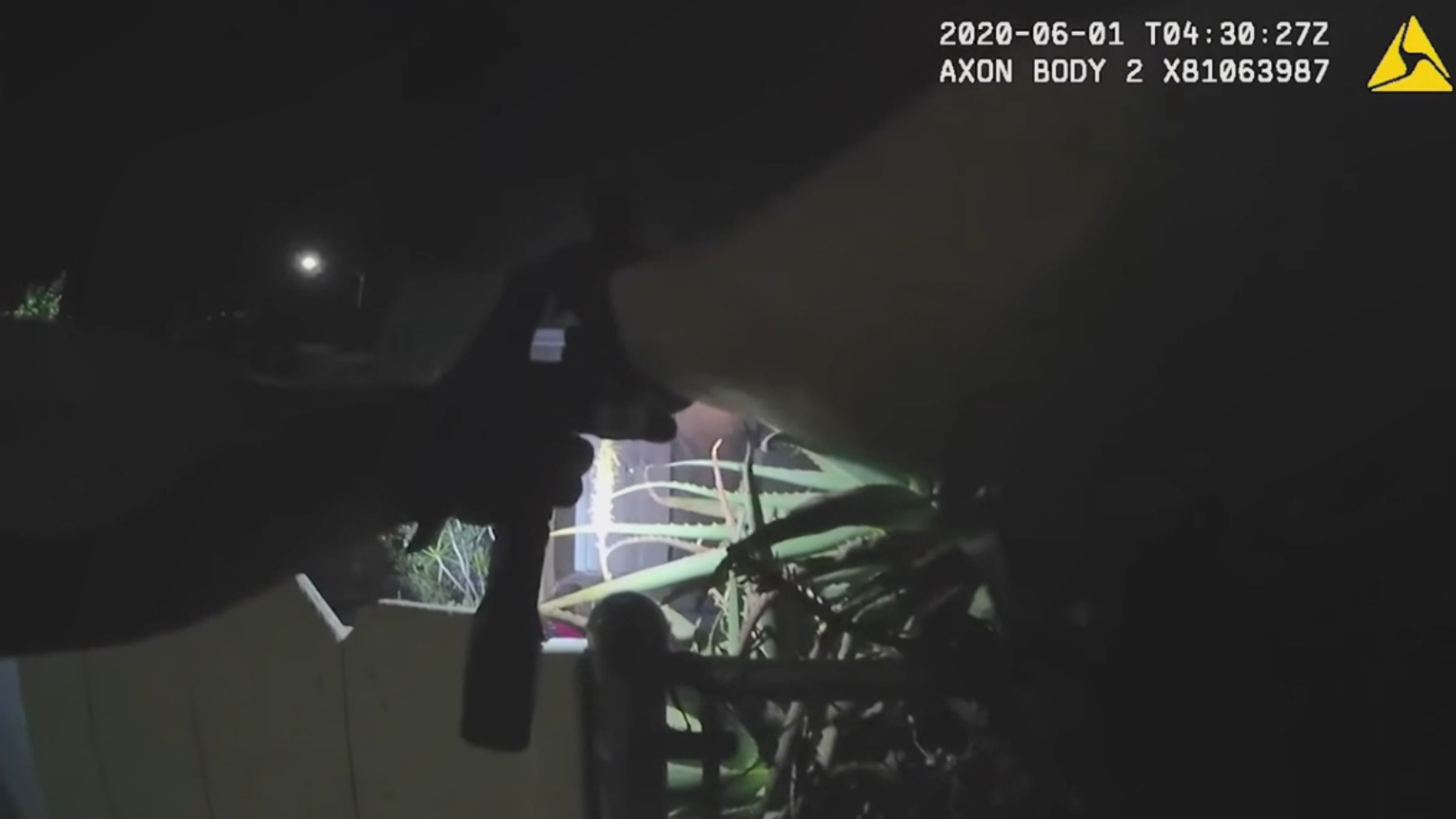
It’s apparent he is holding onto his handheld light with the ring and little fingers of his Support (left) Hand and trying to wrap his index and middle fingers around his pistol. The compromised grip may have been part of the reason for his low hit rate with the first five shots. This observation is not a criticism of Officer A, rather it’s a recognition of the complexity of the manipulation problem he encountered. Having and rapidly using two different types of flashlight in succession is not a training drill we often practice, myself included.
As is often the case, technology has advanced more rapidly than practical doctrine for using it. Several possibilities arise for using the two lights.
- Simply do the best you can with what you’ve got, as Officer A was forced to do.
- Shoot one handed, while maintaining control of the handheld light in the Support Hand.
- Drop the handheld, shoot with the weapon mounted light, and then retrieve the handheld light when necessary or feasible.
- Have the handheld on a large flexible ring that allows it to be dropped without losing total control of it. This is the approach I am currently experimenting with.
It’s worth noting that one incident in Real Shootouts of the LAPD involved the use of a flashlight. Also, some of the tragedies referenced in Serious Mistakes Gunowners Make could have been averted by the use of a flashlight. The Ochoa Incident gives us some food for thought about the need for doctrine and practice with flashlights.
Other Tactical Professor books (all PDF)
- Thinking Clearly about Self-defense and Personal Protection https://www.payloadz.com/go?id=3377208
- Serious Mistakes Gunowners Make http://seriousgunownermistakes.com
- Indoor Range Practice Sessions http://indoorrangepracticesessions.com
- Concealed Carry Skills and Drills http://concealedcarryskillsanddrills.com
- Advanced Pistol Practice http://bit.ly/advancedpistolpractice
- Shooting Your Black Rifle http://shootingyourblackrifle.com
- Package deal of Thinking Clearly about Self-defense and Personal Protection, Serious Mistakes, Indoor Sessions, Concealed Carry, and Shooting Your Black Rifle (50% off) https://store.payloadz.com/details/2644448-ebooks-sports-shooting-drills-package.html
The Sandra Ochoa Incident (Shooting Analysis)
Body Worn Video (BWV) not only has value for analysis of Use of Force, it also can be used as a shooting analysis tool. By looking at a BWV in conjunction the results of a subsequent investigation, we can arrive at a more complete picture of the shooting incident.
On May 31, 2020, LAPD officers responded to a radio call of a “murder suspect there now.” Upon arrival, the officers observed the suspect cutting the victim’s throat and an Officer-Involved Shooting (OIS) occurred. The BWV of both officers present was later released by the LAPD. The incident was adjudicated by the LAPD Board of Police Commissioners on May 4, 2021. The shooting was ruled objectively reasonable, necessary, and In Policy. https://www.lapdonline.org/assets/pdf/023-20-ois-pr.pdf
A short edited and annotated video of the shooting portion of the incident is available on my YouTube Channel.
Several points can be derived from the BWV and the subsequent investigation and rulings. The first is that there is a significant difference between a shooting and gunfight. Noted firearms authority Ken Hackathorn mentioned years ago that a Private Citizen is just as likely to be involved in a ‘shooting’ as in a ‘gunfight,’ if not more so. In a shooting, there is sufficient cause to use a firearm (deadly force) in defense against an assailant who is armed with a contact weapon or personal weapons (fists, shod feet, etc.). This incident is a good example. The assailant was armed with a pair of scissors and succeeded in murdering her victim with those scissors.
The cadence of shooting by Officer A is another item we can analyze. The LAPD Force Investigation Division quantified the officer’s splits (time between shots) as follows:
- Shot 2 – 0.340
- Shot 3 – 0.286
- Shot 4 – 0.232
- Shot 5 – 0.247
The average of those splits was 0.276 seconds, with a total time for the first 5 shots of 1.105. The officer was shooting at a cyclic rate for the first five shots. Although he said he ‘assessed’ between those shots, it’s unlikely there was any assessment between shots 1 through 5. Shot number 6 had a split time of 0.711. That’s the more likely point of there being an assessment of bullet damage, i.e., target effect.
Just like Sergeant Tim Gramins in 2013 https://www.police1.com/officer-shootings/articles/why-one-cop-carries-145-rounds-of-ammo-on-the-job-clGBbLYpnqqHxwMq/ , he may have said to himself, “Hey, I need to slow down and aim better.” I.e., shoot better – meaning, achieve an adequate sight picture and perform a smoother trigger press. What likely occurred by the officer was a ‘Bullet damage assessment’ after 5 shots, followed by a marksmanship improvement and a more accurate 6th shot.
Of the 6 shots fired, 2 were hits. There’s no way to say for sure but the likelihood is that of the first 5 shots, 1 was a hit. The 6th shot was likely a hit and perhaps a better hit that got the message across. Viewed this way, there were actually 2 sequences of fire. Sequence 1 consisted of 5 shots resulting in 1 hit, a 20% hit ratio. Sequence 2 consisted of 1 shot, which resulted in 1 hit, a 100% hit ratio.
Nothing in this analysis is intended as a criticism of the officer. Shooting someone who isn’t immediately adjacent to a victim is difficult enough. Shooting with an innocent downrange and right next to the assailant is a very difficult task that is seldom practiced for.
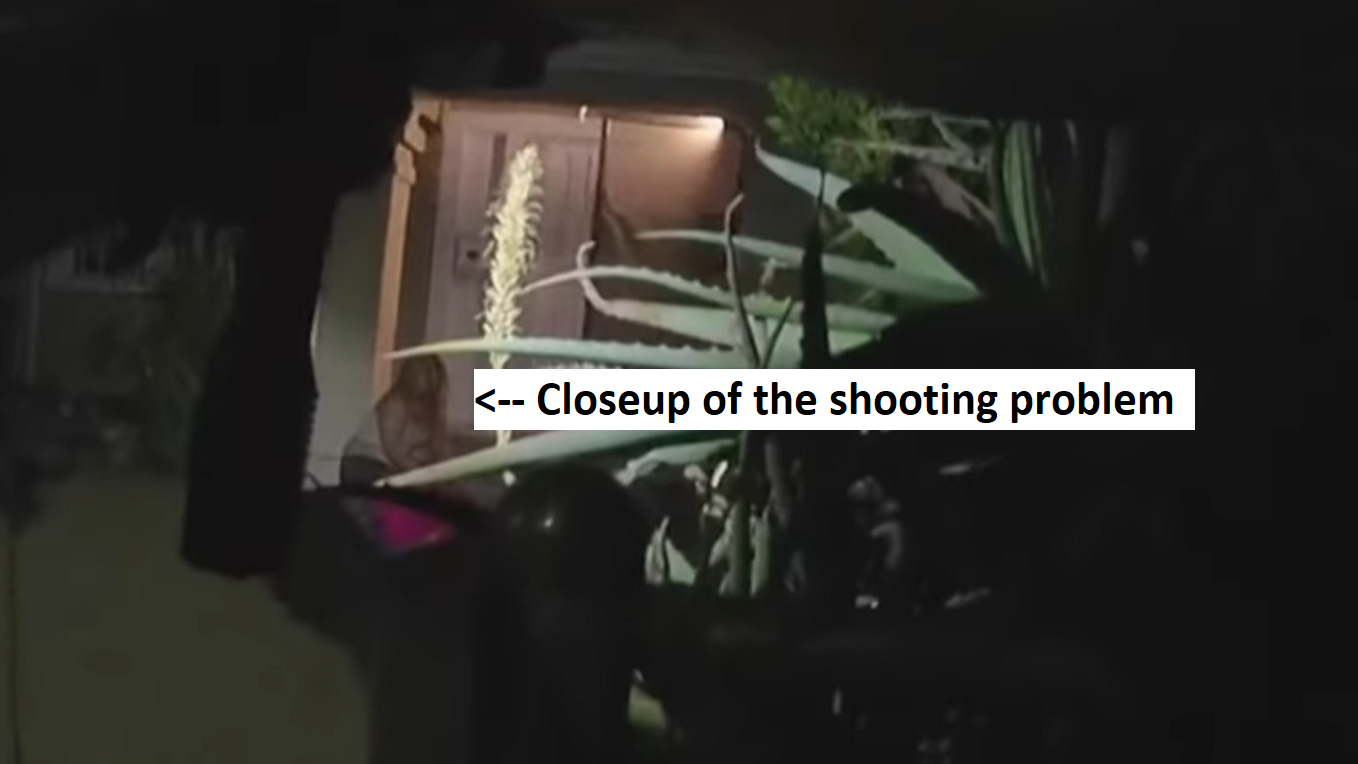
Although the victim in this case died, there’s a good chance she had been fatally wounded prior to the shooting. The officer did the best he could under the circumstances. Not all situations have a Positive Outcome.
Other items of note were that, as is frequently the case, the officer under-estimated the number of shots he fired. There’s nothing uncommon about that. In most of the Categorical Use of Force reports, when more than two shots are fired, the officer undercounts. On the other hand, the officer estimated the distance of the shot quite accurately. He thought it was 20 to 25 feet and the actual distance was 18 feet. Very few people’s eyeballs are calibrated to better than 10% margin of error for distance.
The full LAPD news release video (NRF023-20) is posted on the LAPD YouTube Channel.
Incidents like these, but involving off duty officer incidents, is why I found my work on Real Shootouts of the LAPD https://realshootoutsofthelapd.com/ so worthwhile. The off duty Officer Involved Shootings very much mirrored the thousands of Private Citizen Armed Encountered I have studied. However, there was a great deal more detail available about what led up to the encounter and how it unfolded.
Other Tactical Professor books (all PDF)
- Thinking Clearly about Self-defense and Personal Protection https://www.payloadz.com/go?id=3377208
- Serious Mistakes Gunowners Make http://seriousgunownermistakes.com
- Indoor Range Practice Sessions http://indoorrangepracticesessions.com
- Concealed Carry Skills and Drills http://concealedcarryskillsanddrills.com
- Advanced Pistol Practice http://bit.ly/advancedpistolpractice
- Shooting Your Black Rifle http://shootingyourblackrifle.com
- Package deal of Thinking Clearly about Self-defense and Personal Protection, Serious Mistakes, Indoor Sessions, Concealed Carry, and Shooting Your Black Rifle (50% off) https://store.payloadz.com/details/2644448-ebooks-sports-shooting-drills-package.html
 tacticalprofessor
You must be logged in to post a comment.