Man shot and killed for peeing in public – Or was he?
Title of the story:
Man urinating in Houston street shot dead after being confronted by angry residents
https://currently.att.yahoo.com/news/man-urinating-houston-street-shot-114605999.html
This certainly implies that this poor gentleman was killed for relieving himself.
However, more details come out further down the page.
Houston Police Department spokesperson Lt Ronnie Willkens said witnesses told police the victim was in the neighbourhood [sic] to buy drugs, and that an unspecified number of residents confronted him when he started urinating in the street.
Then the plot thickens further:
Fuentes and the suspect then got into an argument, during which both men pulled out guns. The suspect shot Fuentes-Buezo and then fled the scene.
The details are sketchy so far but there’s a distinct possibility that ‘Mr. Pee Pee’ pulled a gun on the wrong person in the group that confronted him.
Of course, there’s the de rigueur regurgitation of anti-gun statistics at the end of the article.
Here’s the original story by The Independent.
The headline looks like this on a Google search.

It’s called Yellow Journalism https://en.wikipedia.org/wiki/Yellow_journalism in the US and Tabloid Journalism https://en.wikipedia.org/wiki/Tabloid_journalism in Lost Britain (formerly known as the United Kingdom). This story is a very pure example.
The sadly entertaining thing is that The Independent tries to put on the image that it isn’t a Tabloid Journal.

Anyone who thinks there’s not a Culture War going on is sadly mistaken.
The BOGO on Tactical Professor books continues
I’m grateful to my subscribers who send me news reports about the Negative Outcomes gunowners encounter. The ones about children gaining unauthorized access to guns really make me sad, especially because some folks defend practices that lead to those tragedies. Consequently, the purchase of any Tactical Professor book now includes a free copy of Serious Mistakes Gunowners Make.
In addition, I have reduced the price of Serious Mistakes by itself to $4.99. I’d make it free except that people only value things they pay for.
If anyone who has purchased any of my books would like a free copy of Serious Mistakes, email me through the About section above and I will send you one.
Tactical Professor books (all PDF)
- Real Shootouts of the LAPD (Serious Mistakes included free) https://realshootoutsofthelapd.com
- Indoor Range Practice Sessions (Serious Mistakes included free) http://indoorrangepracticesessions.com
- Concealed Carry Skills and Drills (Serious Mistakes included free) http://concealedcarryskillsanddrills.com
- Advanced Pistol Practice (Serious Mistakes included free) http://bit.ly/advancedpistolpractice
- Shooting Your Black Rifle (Serious Mistakes included free) http://shootingyourblackrifle.com
- Package deal of Serious Mistakes, Indoor Sessions, Concealed Carry, and Shooting Your Black Rifle (20% off) https://store.payloadz.com/details/2644448-ebooks-sports-shooting-drills-package.html
- Serious Mistakes Gunowners Make http://seriousgunownermistakes.com
Deadly Conduct and Attempted Murder
Those are the charges in two incidents where Negative Outcomes resulted from gunfire. Both situations occurred when people thought they were making good decisions about employing a firearm for Personal Protection but the legal system doesn’t agree. Unfortunately, both incidents are material for the updated and expanded Second Edition of Serious Mistakes Gunowners Make http://seriousgunownermistakes.com that will be published later this year.
Mom charged [with Deadly Conduct] after shooting her 5-year-old son while trying to target loose dog, H[ouston]PD says
A mother [who was riding a bike down the street] has been charged after accidentally shooting her 5-year-old son [who was also riding his bike down the street] while trying to shoot a dog that was running across the street in north Houston, according to Houston police.
FBI agent charged [with Attempted Murder and other crimes] in off-duty shooting of man on subway
https://abcnews.go.com/US/wireStory/fbi-agent-charged-off-duty-shooting-man-subway-78019158
Valdivia shot and wounded the man from a distance of roughly 2 to 3 feet (0.6 to 0.9 meters) after repeatedly telling the man to back up, county prosecutor Robert Hill said in court.
The man had approached Valdivia on a train, sat across from him and asked the agent for money, Hill said. The man muttered expletives and began to walk away when the agent said he didn’t have any money to give, the prosecutor added.
‘Watch your mouth,’ the agent told the man, according to Hill.
After the man turned and approached him again, Valdivia pulled a gun from a holster and shot him, the prosecutor said. Another passenger was in the agent’s line of fire, about 15 feet (4.6 meters) away, [which resulted in an additional charge of Reckless Endangerment] but wasn’t harmed, Hill added.
Note that getting the last word in, e.g., “Watch your mouth,” is not the way to Break Contact. Breaking Contact (Part I) The moment a criminal, or in this case undesirable, breaks contact, let it go. If possible, increase your distance by going in the opposite direction. Moving away from an adversary is a good skill to practice, probably far more useful in everyday life than practicing shooting on the move.
Guns are not general purpose tools for Personal Protection. They are special purpose tools that are useful only in a very limited set of circumstances. The legal system did not believe either of these incidents fell within that set of circumstances. Probably both persons charged will end up pleading to lesser offenses. Whether those will be felonies or not remains to be seen.
The mother’s relationship with her son is unlikely to ever be the same and she may lose her right to own a firearm forever. The FBI Agent’s once promising career is over, even if he is acquitted on all the charges, which is unlikely. At best, he can hope to keep his job as an FBI Agent, if he wins acquittal. The chances he will ever advance or get a good assignment again are minuscule.
If you carry a gun, carry pepper spray, PERIOD. Lacking a non-lethal force option implies that all you are willing and capable of doing to defend yourself and your loved ones is to kill someone. That’s not a rational decision.
Whether it was necessary to do anything in the dog incident at all is questionable but using pepper spray as a defensive tool would have had less consequences. Also try to avoid or deal with having irrational fears about dogs.
The important thing in viewing these stories is not to harsh on the persons involved because that’s easy but non-productive. Rather, try to learn something from their misfortunes.
- Do you consistently carry a non-lethal force option?
- Have you practiced with your NL force option using an inert version?

- If you have irrational fears, have you confronted them and programmed yourself with a rational response to the trigger?
- Have you mentally and physically practiced breaking contact?
Gaining knowledge from others’ experiences is one of the useful legs of Will Rogers’ learning triad. https://www.goodreads.com/quotes/116468-there-are-three-kinds-of-men-the-ones-that-learn
Tactical Professor books (all PDF)
- Real Shootouts of the LAPD https://realshootoutsofthelapd.com
- Serious Mistakes Gunowners Make http://seriousgunownermistakes.com
- Indoor Range Practice Sessions http://indoorrangepracticesessions.com
- Concealed Carry Skills and Drills http://concealedcarryskillsanddrills.com
- Advanced Pistol Practice http://bit.ly/advancedpistolpractice
- Shooting Your Black Rifle http://shootingyourblackrifle.com
- Package deal of Serious Mistakes, Indoor Sessions, Concealed Carry, and Shooting Your Black Rifle (20% off) https://store.payloadz.com/details/2644448-ebooks-sports-shooting-drills-package.html
Breaking Contact (Part 5)
#mindsetmonday
Our goal in personal protection is to force a break in contact. We want them to go away, or we want to go away. One or the other.
The final segment of the CCW Safe Series about my concept of Breaking Contact is posted.
https://ccwsafe.com/blog/breaking-contact-pt-5
This edition focuses on success stories. I like those.
[W]hen a concealed carrier enters a self-defense situation with the goal of breaking contact — as opposed to a goal of killing or disabling an attacker — the defender has a substantially higher likelihood of avoiding a deadly shooting or making a successful self-defense claim when all else fails.
Shawn Vincent
Cover is your friend
The teen ducked behind a tree. The prosecutor’s report said one of the rounds fired by the deputy was recovered later from that tree, and several other rounds were recovered from other trees between the teen and the deputy.
A deputy and a trooper mistakenly fired 8 rounds at an innocent boy.
Be aware of not only who is around you but what is around you, including things that can prevent you from getting ventilated.
Trooper 1 stated to investigators that at the time he exited his patrol vehicle he believed the gunshots he was hearing (Deputy 1’s gunshots) were actually that of LEATHERMAN towards himself. He stated he fired in self-defense at LEATHERMAN believing he was being shot at.
My Battalion Commander made the comment during Civil Disturbance training that the POlice are, at most, used to operating in pairs. Pairs generally only exist in large urban areas. When an ad hoc group of POlice come together, such as in this case, it’s very easy for things to go South quickly. The LAPD has very strict requirements for a supervisor to assume command as Incident Commander when groups of officers assemble. In cases such as this no such control mechanism is possible and things can easily get out of hand, as they did. My advice is that if you see a group of POlice from different agencies gathering, leave the area immediately.
Note also that Officer 1 was downrange of Deputy 1 and Trooper 1 while they were firing at the innocent bystander. Struggling with Subject 1 on the ground to take him into custody might have saved that Officer’s life.
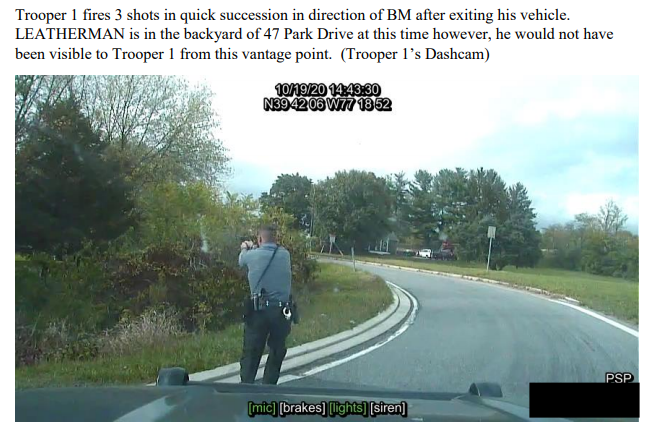
The full 27 page report from the State’s Attorney about the incident is available to download from the news article.
Another of my rules is that if I were to hear shots fired, I am going the other way as quickly as I can. Nothing good comes from ‘running to the sound of guns’ as a Private Citizen. Something something, curiosity killed the cat, something something.
Being Mindful Of and Avoiding Danger
#mindsetmonday
Dr. Sherman House, the Real Dr. House™, https://civiliandefender.com/ was an armored truck guard for quite a while. He turned me on to the fact that such robberies often begin with unannounced gunfire by the robbers. When I see an armored truck at a grocery store or other place, I wait in my car until after it leaves.
Armored truck guard shot in the face during robbery attempt at NE Houston bank, HPD says
Tactical Professor books (all PDF)
Real Shootouts of the LAPD https://realshootoutsofthelapd.com/
Serious Mistakes Gunowners Make http://seriousgunownermistakes.com
Indoor Range Practice Sessions http://indoorrangepracticesessions.com
Concealed Carry Skills and Drills http://concealedcarryskillsanddrills.com
Shooting Your Black Rifle http://shootingyourblackrifle.com
Advanced Pistol Practice http://bit.ly/advancedpistolpractice
Package deal of Serious Mistakes, Indoor Sessions, Concealed Carry, and Shooting Your Black Rifle (20% off) https://store.payloadz.com/details/2644448-ebooks-sports-shooting-drills-package.html
Breaking Contact (Part 3)
#fridayfundamentals
The CCW Safe https://ccwsafe.com/ series about my concept of Breaking Contact continues with Part 3.
https://ccwsafe.com/blog/34532
Part 2 of the series focused on situations where the concealed carrier initiated contact. Part 3 focuses on incidents where the carrier was initially approached and failed to take the opportunity to Break Contact.
I hate platitudes when they’re used in an attempt to simplify a complex topic into a sound bite. “Better to be tried by twelve than carried by six” is one of the most commonly parroted sayings in the firearms community. While many times we are presented with the optometrist’s question, “Which is better, A or B?,” decisions that are made in advance and are going to affect the rest of our lives seldom are binary. I like to think we’re smarter than parrots that have been trained to say one or two things.

As Shawn points out, the decision process has several more options.
When the goal is not necessarily to kill or disable a would-be attacker, a defender is open to other options that carry less legal risk and may produce more positive outcomes.
When breaking contact is the goal, sometimes it is better to disengage rather than attempt to de-escalate.
My personal paradigm is:
- Avoid
- Escape
- Confront
- Resist
Any attempt at de-escalation, even when benign, is a part of Confront. Disengage is part of Escape. Escaping is higher on my priority list than Confronting.
Similarly, in the Gerald Strebendt incident, he unnecessarily moved up the paradigm from Escape to Confront. A confrontation inherently carries more risk associated with it than an escape. As John Hall, former head of the FBI Firearms Training Unit put it:
Any encounter carries with it an element of chance.
My initial post about Breaking Contact (Part I) is located here:
The second is here.
If you would like to purchase my book, click on the image below. The detailed investigations and reports of incidents involving off-duty LAPD officers are very instructional for understanding the differences between Avoiding, Escaping, and Confronting.
3X3X3 – Level One
Three Shots, Three Seconds, Three Yards has been discussed in the context of gunfights since the 1970s. It is the most commonly cited statistic about gunfights.
Practicing to hit the silhouette every time using the 3X3X3 basis is Level One of learning to shoot the drill well. It is a good baseline for entry level shooters and those who have never measured their performance.
Level One – hit a silhouette consistently
Level Two – hit a sheet of paper consistently
Level Three – hit a half sheet of paper consistently
Level Four – hit a quarter sheet of paper consistently
The dry practice drill was discussed in a previous post.
Here’s the live fire version.
When I wrote Real Shootouts of the LAPD, I wasn’t surprised that NYPD Lt. Frank McGee was pretty much on the mark when he first described it. Almost all of the off-duty shootouts fit into that statistic.
A related note is that I fired about 100 .22 Long Rifle rounds through my 317 snub with a standard (8.5 lb) mainspring. There was not one Failure to Fire during the session. Ammunition for my .38 is precious and hard to come by so I used the .22 for demo purposes. For those who think that was cheating, I also shot with my SCCY CPX-2 9mm.

If you would like to purchase my book about actual shootouts that are not a figbar of someone’s imagination, click on the image below.
Decisions and experience
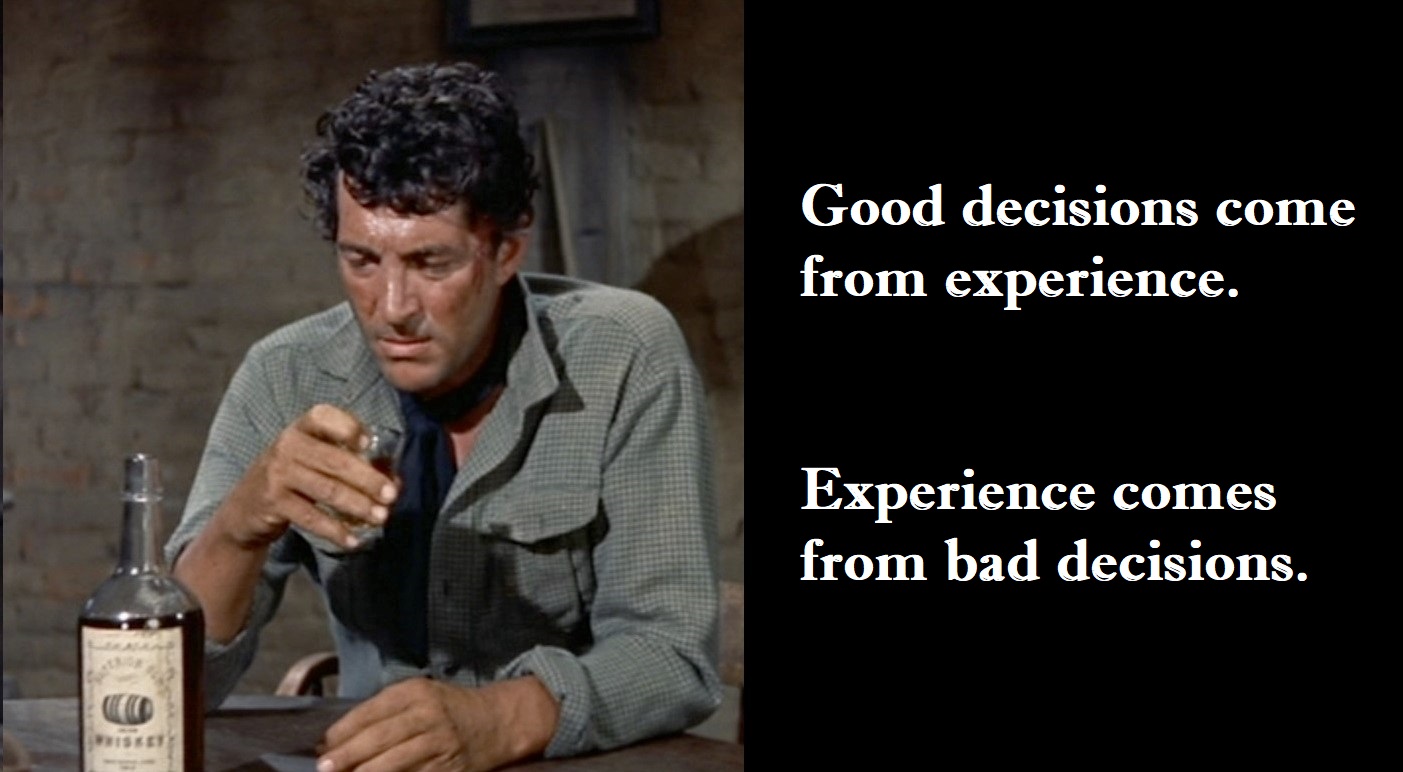
Good decisions come from experience. Experience comes from bad decisions.
Although incorrectly attributed to Will Rogers, the concept of learning from other peoples’ experience rather than our own still has value. We can use the Intelligence community’s technique of ‘walking back the cat’ to de-construct an incident. This allows us to visualize it and learn from the experience of someone else.
The concept of ‘Decision points’ has been emphasized by both Gary Klein, PhD., a noted expert on the decision-making process, and President George W. Bush. Any drama contains not just one, but a sequence of decisions and decision points we can study.
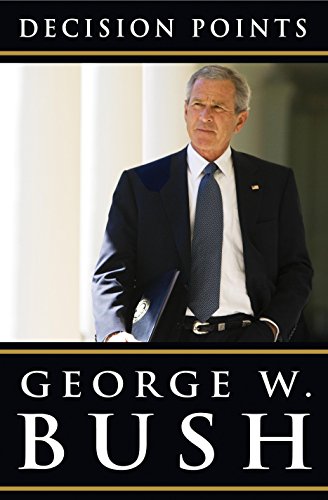
The Don’t Shoot/Shoot decision is the one most commonly focused on the training and firearms communities. However, any Defensive Gun Use, whether shots are fired or not, contains a plethora of decisions and decision points. These occur before, during, and after the shooting or display of a firearm takes place.
A rich source for walking back the cat is the Categorical Use of Force reports by the LAPD Board of Police Commissioners. The following is an analysis of one incident by an off-duty LAPD officer. The analysis will use the phases of an incident as described in my book Real Shootouts of the LAPD. http://realshootoutsofthelapd.com
The incident began as an Aggravated Assault on an LAPD off-duty officer. The full report by the Board of Police Commissioners, including its Findings about Tactics, Drawing and Exhibiting of a Firearm, and Use of Lethal Force can be found here. http://www.lapdonline.org/assets/pdf/011-11_Harbor-OIS.pdf
Incident Summary
The Situation
Officer A, who was off-duty, walked to his vehicle parked in the driveway of a residence. He did not see anyone around at the time. His duty weapon was in the right front pocket of his pants. After driving out of the driveway, he backed his vehicle up and left the lights on. He then walked back to the gate to close it.
- Decision point — Leave home armed with his weapon on his person or at least accessible? Even for POlice officers, this is not as absolute a decision as it would seem, as can be seen in other LAPD off-duty incidents.
- Decision point — Close gate (initial entry barrier to home) or not? As mundane as this decision seems, many people leave their garage doors open when they drive away from their home.
The Buildup
Officer A saw the Subject walking on the sidewalk coming toward him. The Subject then began to run toward Officer A. As the distance to the Subject became closer, Officer A saw the Subject had a handgun in his hand. The Subject pointed the handgun at Officer A.
- Decision point — Maintain awareness of surroundings or focus on telephone or other attention divider?
- Decision point — Maintain surveillance on the suspect or not?
- Decision point — Recognize and accept that an armed attack is imminent or not?
Drawing and Exhibiting
Officer A drew his service pistol from his pocket.
- Decision point — Draw own pistol or not?
The Gunfight
Immediately after drawing his pistol, Officer A fired one round at the Subject.
- Decision point — Don’t Shoot or Shoot?
- Decision point — Fire in place or Shoot on the Move?
- Decision point — Obtain an adequate sight picture to make a hit or fire without visual reference?
The Subject seemed unaffected, so Officer A fired a second round at the Subject.
- Decision point — Don’t Shoot or Shoot a second time?
- Decision point — Fire in place or Shoot on the Move?
- Decision point — Obtain an adequate sight picture to make a hit or fire without visual reference?
After running past Officer’s A car, the subject collapsed on the sidewalk behind a short block wall.
Post Gunfight Actions
Because he could not see him and wanted to wait for responding officers to arrive, Officer A did not approach the Subject.
- Decision point — Approach the suspect or not?
Officer A retreated to cover at the house and called 911.
- Decision point — Hold position or retreat to cover?
- Decision point — Call 9-1-1 or do something else?
While he was calling 911, Officer A observed another male come over to the Subject, squat down, then stand up and adjust his shirt. The second male then walked away.
- Decision point — Interact with/challenge the secondary suspect or not?
Two other males walked to the fallen Subject, leaned over to look at him, and then walked away.
- Decision point — Interact with/challenge the tertiary suspects or not?
There are also implied decision points subsequent in the drama but were not elaborated on by the BOPC.
- Actions on approach of responding officers.
- What statements, if any, should be made to responding officers and then to detectives.
- Whom else to notify about the incident; Significant Other, etc.
- Retain an attorney or call pre-paid legal assistance plan.
At least 21 decisions/decision points are readily discernible in this incident. There are perhaps even more, despite this being a relatively uncomplicated DGU. Also note that of the 21, only six (Don’t Shoot or Shoot [X2]), (Fire in place or Shoot on the Move [X2]), and (Obtain an adequate sight picture to make a hit or fire without visual reference [X2]) can be readily practiced with live fire. Those and another, (Draw own pistol or not) can be practiced dry. The other two-thirds of the decisions are more in the nature of ‘soft skills’ that are best decided upon in advance and then practiced away from the range.
“Best decided upon in advance and practiced away from the range” represents our opportunities during the current ammo shortage. Rather than sit on our hands because ammo has become so precious, we can begin developing and practicing a more complete repertoire of the skills we need for Personal Protection. If you would like to read my analyses of the rest of the incidents described in the book, please subscribe to me on Patreon. Patreon link I will be posting the rest of them there.
Using Cover Effectively
#fridayfundamentals
Active Self Protection recently made a good video about last December’s murder of a retired Chicargo firefighter during a carjacking.
Unfortunately it won’t embed because it’s Age Restricted. If you care to watch it, this is what to search for.
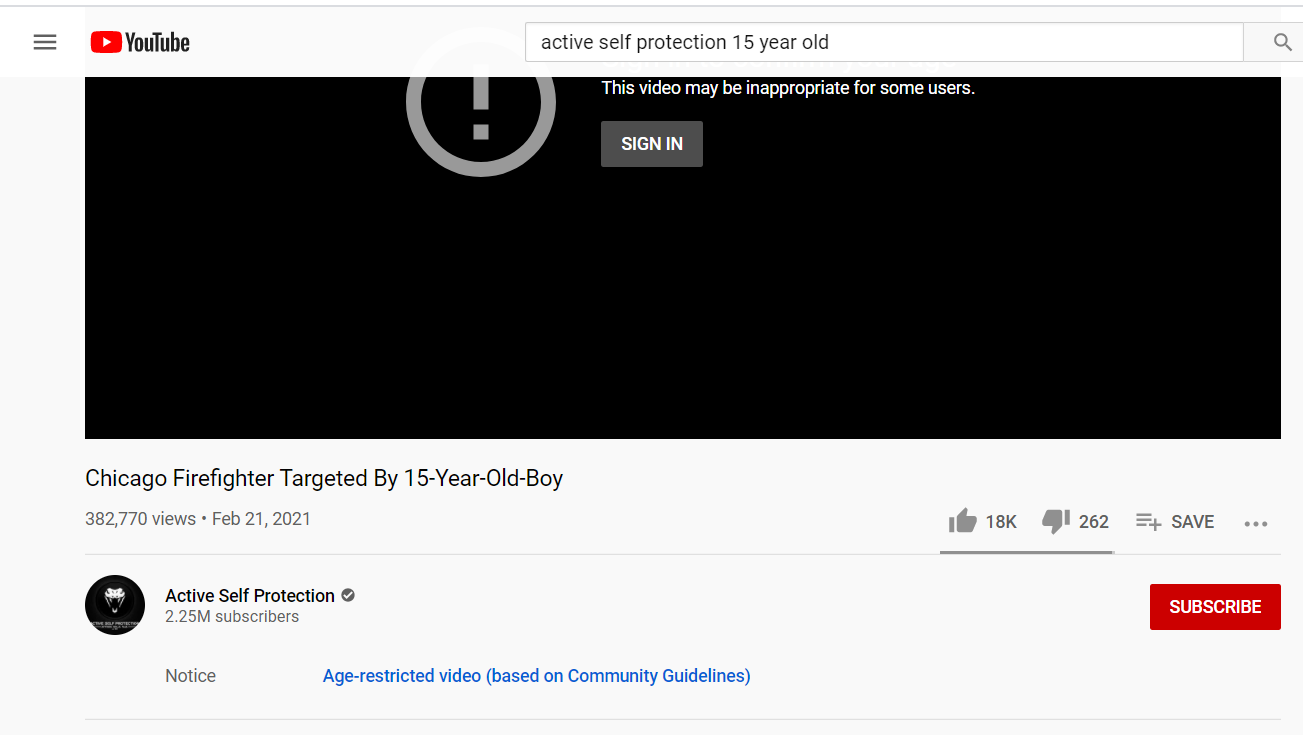
John made an important point in his video that bears reiteration and amplification.
Appropriate and effective use of cover is an important tactic in protecting ourselves.
John Correia
Things to keep in mind about using cover.
- Cover protects us from bullets and contact weapon attacks.
- Any cover can be defeated, either by adequate weaponry or by maneuver.
Here’s my initial video commentary about the situation. It wasn’t as simple as it looks at first glance.
Whether the second Carjacker would have shot LT Williams will never be known but it cannot be discounted as a possibility. There’s a good chance he was the leader of the crew and probably very dangerous. It wasn’t his first rodeo.
The incident provides a good example of the difficulties faced when dealing with multiple attackers. LT Williams was in a very difficult position as a result of this attack. We will never know if he even saw the second armed Carjacker and could have realized that he was vulnerable to being flanked. This was a well-rehearsed Carjacking crew with a good SOP. One comment on the YouTube video about the incident opined that this same crew had tried to Carjack him earlier and he had only escaped by luck.

Here’s the complete video of the incident on YouTube.
Disregard the TV station’s gauche and inappropriate invitation to Like and Subscribe at the end.
This was the funniest comment on the YouTube video. It’s unclear which person the comment is about.

Another of John’s points was that it’s important to keep in mind our mission. As Armed Citizens, we don’t need to get the bracelets on a criminal, we just need to force a Break In Contact and then go home.
My first LAPD Shootouts book is based on off-duty incidents at home. It provides a great deal more documentation and explanation of what Home Defense with a firearm really looks like than news reports. The lessons learned apply whether you’re a POlice officer or an Armed Citizen.
Even more about Skill Development
‘three shots, three yards, three seconds,’ https://tacticalprofessor.wordpress.com/2021/02/19/skills-conversation-about-lapd-shootouts/ has generated some good discussion and questions, which makes me happy. Someone posted a question on the Facebook page for Growing Up Guns.
Nothing was said about whether this done from a low or compressed ready, or from concealment, as far as the par time. Being LE based info, I’m assuming this was done from a duty holster. Thoughts?
It’s a progression, just like the size of the target. When someone is first learning to shoot, do it from Low Ready, muzzle below the feet of the target, finger off the trigger. Once a shooter achieves some degree of proficiency, which I would personally define as being able to consistently hit the quarter sheet, then branching can begin. Others might be satisfied with hitting the full sheet consistently as a standard.
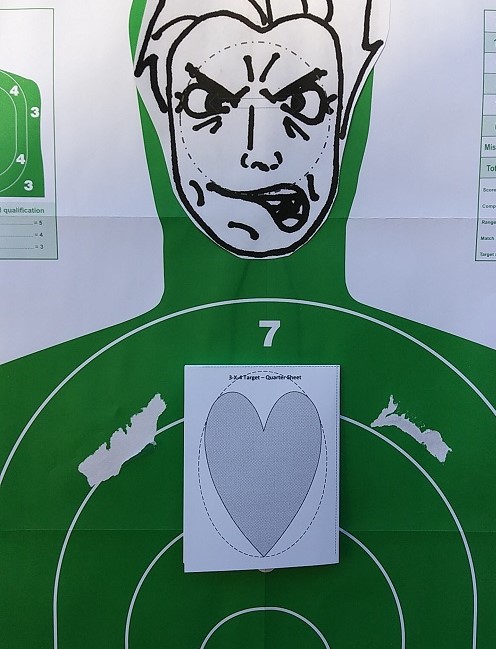
There are numerous possible branching variations.
- From the midpoint of the drawstroke.
- From the holster. Take your pick of open, concealed, or Level III Security.
- Primary Hand Only from Low Ready
- Support Hand Only from Low Ready
- Etc.
I use the term ‘midpoint of the drawstroke’ rather than ‘compressed ready’ because I’m not a fan of muzzling suspects prior to making the SHOOT decision. If the bore is parallel to the ground, there’s almost no way to avoid muzzling others. From that perspective, the idea of having the bore parallel to the ground as a ready position is purely “square range” thinking.
For those who are feeling exceptionally froggy, try stacking all three targets on a single silhouette. Shoot all three targets as one string using three round magazines and reloading between targets. Obviously, your time will be more than three seconds. Keep in mind that the second most missed shot is the first shot after a Stoppage Clearance. Reloading is a Stoppage Clearance so you’ll have two opportunities to maintain your focus.
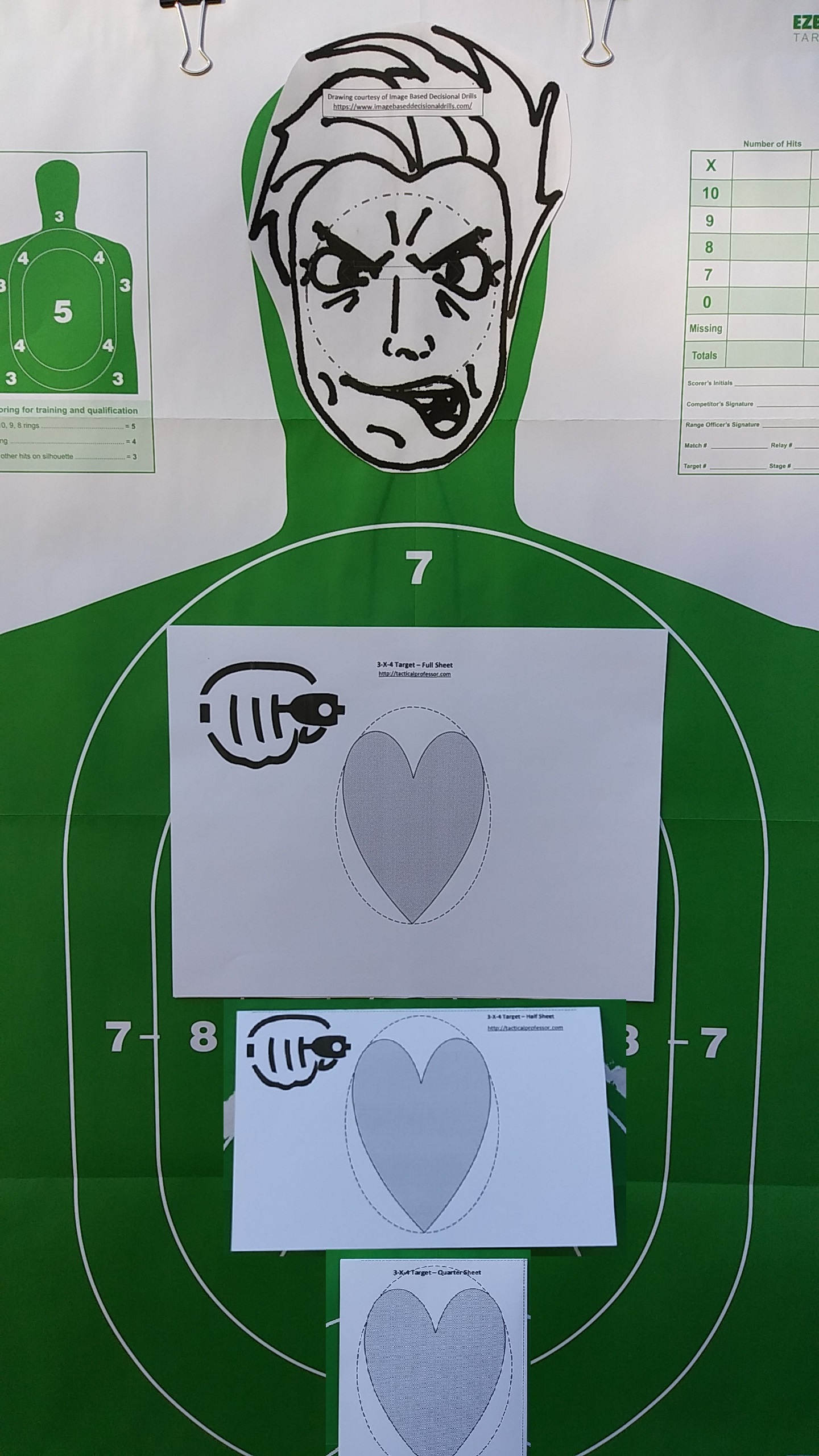
The end outcome, consistent hits on a variable sized target, is the focal point of the drill. There are numerous tasks that can achieve it, most of which have value.
Click on the image below to order Real Shootouts of the LAPD.


You must be logged in to post a comment.