Putting Orient Back into OODA
The latest edition of The Tactical Wire is the Concealed Carry Special Edition. It includes an article about the OODA Cycle that I authored.
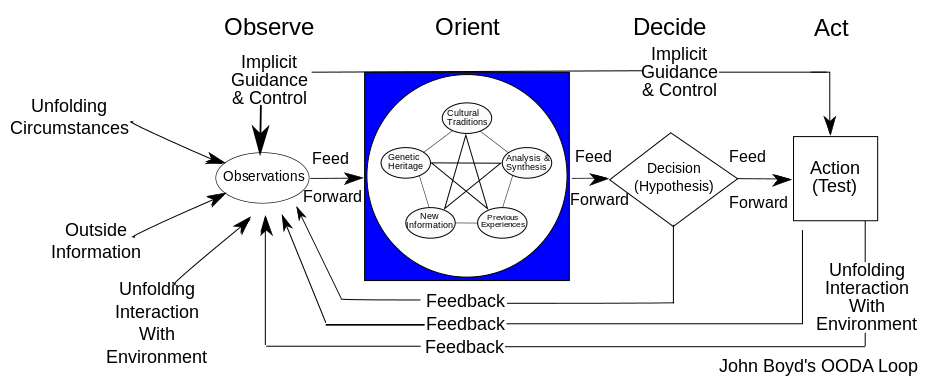
The OODA cycle, frequently referred to as the OODA Loop, was developed by the late Colonel John R. Boyd, USAF. The OODA cycle has subsequently become highly influential in thinking about how to conduct combat operations at all levels from the tactical to the grand strategic. It is often simplistically depicted with only four components in a circle, although that hardly does justice to the depth of Boyd’s thought.
What it’s not is what is so often pictured.

A better way to look at it would be this:
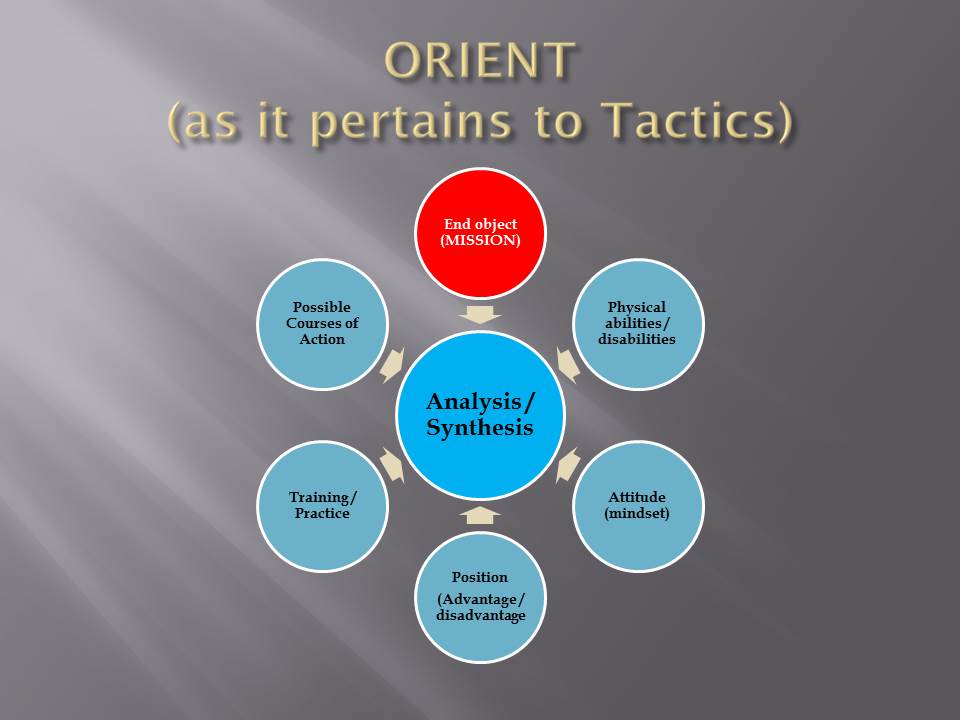
The article is my explanation of why. There are several other good articles also.
http://www.theoutdoorwire.com/specials/ccse2015/feature.php?id=229663
Situational Awareness and Positioning (part V)
In every encounter, there is an element of chance.
–John Hall, former head of the FBI Firearms Training Unit
In previous parts of this series (I-IV), the concept discussed was physical awareness and positioning in relation to an adversary or situation. A recent incident captured on video relates to a different but similar concept: emotional awareness and positioning.
In the incident, a veteran observed a bum aka ‘homeless person’ wearing a mixed service uniform while panhandling. He was justifiably incensed, as would be most veterans. “I was angry. I was frustrated. I was sad” he said. I don’t blame him. However, what resulted from his feelings was neither smart nor legally justifiable.
The veteran aggressively challenged the bum from a distance, then closed with him, pursued him across several lanes of traffic, and continued to pursue him on the other side of the boulevard. As the incident unfolds, the bum tries to disengage, is verbally apologetic, and changes direction several times attempting to escape. The entire time the veteran is loudly shouting, verbally forces the bum to remove part of his clothing, and then blocks the bum’s escape path. The incident went on for several minutes.
While I sympathize with the veteran’s frustration, the simple fact of the matter is that he let his emotions get away from him. A couple of relevant declarations made at this year’s Rangemaster Tactical Conference come to mind.
- John Hearne, in his presentation Performance Under Fire, made the statement “You’ve got to keep your emotions under control.”
- My colleague Nick Hughes mentioned to me in conversation a question he poses in his book, How To Be Your Own Bodyguard. “Are you doing this because you have to or because you want to?” He then related a personal anecdote where a person had to remind him of his own question.
When the veteran/bum video was posted on Facebook, I had two responses.
- Good way to get stabbed.
- Regardless of what I was doing, if someone acted toward me the way the veteran did toward the bum, I would have painted him orange in a New York second. And the police would have then told me to have a nice day. It was aggressive challenging behavior that anyone would be justified in feeling threatened by (although not sufficiently to employ lethal force, which is why I advocate always carrying pepper spray).
If we go looking for trouble, we had better be prepared to find it. Make no mistake: verbally challenging someone, shouting at them, chasing them, forcing them to remove their clothing, and then blocking their escape route is looking for trouble. Such a situation always has branching possibilities (if, then, else) that people don’t generally consider before jumping over the edge of the cliff.
- If the bum had pulled out a knife, then what would have been an appropriate, or even possible, response at that point? I make the assumption that all itinerants I encounter are armed with some kind of weapon.
- What if the bum had run out in front of a car and been struck and killed?
- What if a car had hit the vet while he was chasing the bum across the street?
- What if they had gotten into a physical conflict and ended up rolling around in traffic?
There are other possibilities also, but those are good examples of possible Negative Outcomes well within the realm of possibility. In any of those cases, the situation would have gone downhill for the vet like an avalanche.
So, let’s go back to Nick’s question: was the vet doing this because he had to or because he wanted to? That answer is quite clear, he wanted to. He felt the need to defend the honor of his service and the service of his fellow veterans.
Unfortunately, it’s very hard to provide a legal, or even moral, justification for using force to defend honor. Even if no legal repercussions arise, moral ones can. If the bum had run into traffic and been struck and killed, how do you think the veteran would have felt for the rest of his life, even if no charges were filed against him?
John Farnam’s saying “Avoid stupid people, stupid places, and stupid things” is definitely apropos in this situation. All three of those elements were broken. Jeff Cooper alluded many years ago to the fact that the more ‘rules’ we break simultaneously, the more possibility we will incur a problem. When we lose control of our emotions, that’s when we start unconsciously breaking rules, whether they are legal rules or just rules of good judgment and conduct.
With every decision we make, we are setting ourselves up either for success or failure. Keeping a check on our emotions helps set ourselves up for success. Letting our emotions get out of control is good way to set ourselves up for failure.
Planning for the worst case?
Living in California, I think it may be in my best interest to consider the worst-case scenario.
–a person who shall remain anonymous
I’ve previously mentioned my issue with planning for the worst case, but since ‘worst case planning’ comes up so often, the topic bears some further discussion. The essential problem is assuming that planning for the worst case is merely planning for the most likely case taken to a greater extent. Unfortunately, that’s not necessarily true. The optimum solution in worst case planning may actually be a less, or even least, optimal solution for the most likely case.
The questions of competing probabilities and definitional issues rear their ugly heads again in this decision process. As an example, the worst case scenario that people imagine in a home defense scenario consists of multiple intruders, armed with projectile weapons, with their weapons in hand, ready to shoot the defender in reaction time. While that’s certainly possible, it’s definitely not the most likely case, if the bump in the night is really a burglar. And even the definition of ‘worst possible case’ is open to question in the context of home defense, as is the definition in many contexts.
The question I posed previously was “Is ‘the worst possible case’ having a dangerous armed intruder in your house or shooting and killing a family member by mistake?” Therein lays the definitional issue. The statistical/tactical issue is that the most likely case is probably a lone intruder, not armed with a projectile weapon, who is preoccupied with stealing your stuff and not waiting in ambush for you.
Let’s address the statistical/tactical issue since I’ve already mentioned the definitional issue. In the past, I have, in fact, planned for the worst possible burglary case envisioned by people. My plan for a late night, already in bed, worst case scenario was as follows:
- Put on my M17A1 protective mask
- Place my pistol (then a 1911A1) in hand
- Open the bedroom door slightly
- Pick up an M7 CS grenade and pull the pin, using a small hook I had placed on the door frame
- Have my then wife grab onto my clothing, close her eyes, and stop breathing
- Roll the grenade out into the kitchen and let it fill the house with CS gas
- My house was small and
- would have completely filled with CS gas within a few seconds
- Go out the door and move toward the back door as an exit
- Shoot anyone who was in my way in the head, whether they were standing or laying on the ground prostrate from the effects of the gas
- I’ve been in a confined cloud of CS from a grenade; it’s incredibly incapacitating.
- That’s where I got the idea.
- It’s not like the CS chamber most veterans have been exposed to.
- Exit the house, regroup, and plan my next move to a safer location
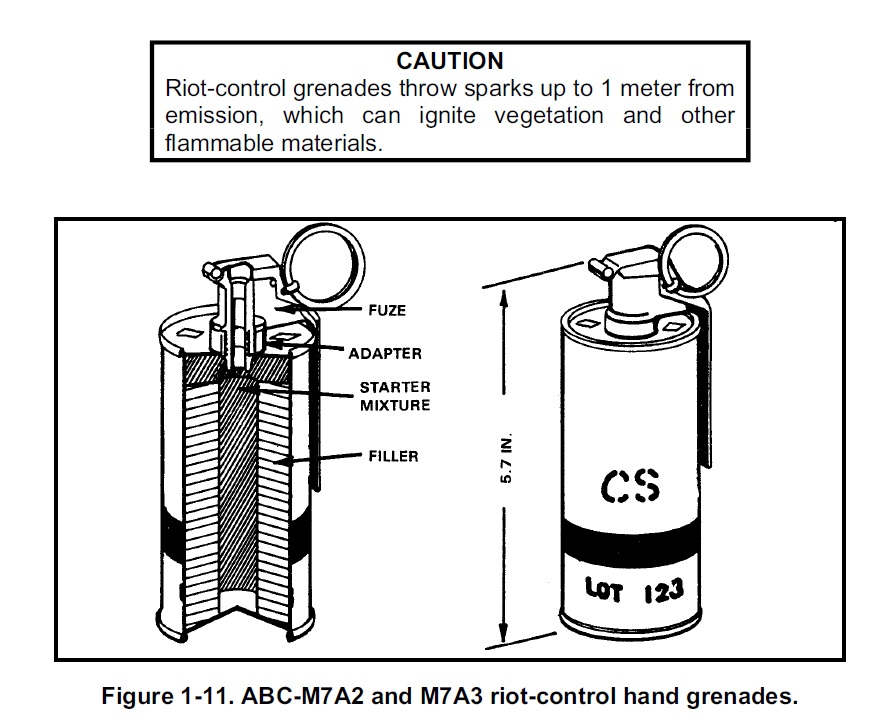
I was certain of the efficacy of this plan, since even a hardened group of assassins would be unlikely to expect a counterattack that would have made John Wick look like an Eagle Scout. However, I did consider that there were several downsides to the plan.
- Most likely, the grenade would have set the house on fire and burned it down. My landlord would have been unhappy and the couple who lived upstairs might have burned to death.
- The authorities probably would probably take a dim view of my executing a bunch of people, even if they did have nefarious intent.
- If my then wife had been accidently overcome by the gas, I would have been faced with the choice of finding her, picking her up, and carrying her out of the house, or leaving her behind with the rest of the deaders while the house was burning. (I would have carried her out, but that is a decision, not a given, in a serious house fire.)
I had also planned a lower intensity response for the more likely scenario of one guy with a screwdriver stealing my stuff. That plan was to challenge him from whatever concealment was available and tell him to get out. If he took one step toward me, I would have shot him. If I could see he had a projectile weapon, in hand or not, I would have shot him immediately.
Note that even in a simple scenario, there’s a decision tree (if, then, else). Those kinds of decisions are best made ahead of time. Making decisions before the situation arises is part of the Orient phase of the OODA process. Forward looking decisions are what allow you to speed up decision-making in the moment, not trying to think faster on the spot. Trying to construct a decision process in the midst of an incident will force you back into the Orient phase and actually slow down your decision-making.
The issue with worst case planning is that it usually ignores both the direct and opportunity costs implicit in the plan. Worst case planning also frequently lacks any branching or contingency aspects, which is not the way life works. Consider carefully ALL the ramifications of worst case planning in light of most likely case possibilities. What you may find is that it’s best to plan and prepare for the most likely case. Then, think of how that plan can be adapted to a much smaller probability of the worst case scenario.


You must be logged in to post a comment.