Updated version of Boyd’s Aerial Attack Study
Thanks to Rob Pincus, I have found a cleaner copy of Colonel John Boyd’s Aerial Attack Study (AAS). It was recreated by Mr. Mark Hart from the declassified 1964 version. The recreation is much easier on the eyes than the reproductions of the original mimeographed edition that are generally available.
Prior to Colonel Boyd’s AAS, fighter combat was viewed by the majority of fighter pilots as an intuitive skill rather than one that could be codified. Some conceptual principles had been developed along with elementary tactics such as the Thach Weave, but Boyd was the one who wrote the definitive book. Only Major General Frederick “Boots” Blesse had preceded Colonel Boyd in writing a book, No Guts No Glory, about jet fighter combat. Major General Blesse’s book wasn’t the exhaustive treatise on the subject that the AAS was.
Another visit to John Boyd and OODA
A friend of mine shared a memory of this article on Facebook. I’m glad that he did.
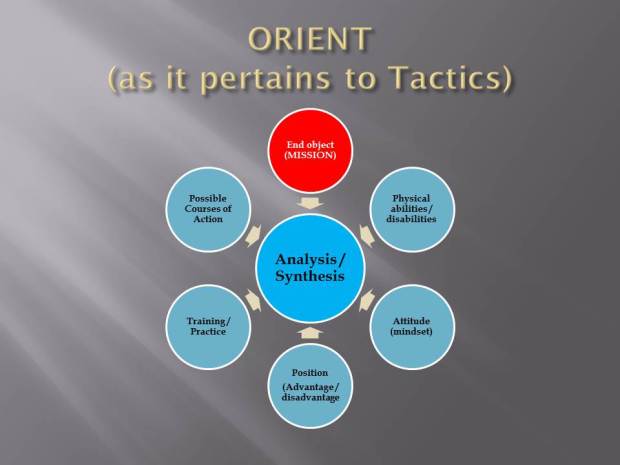
I’ve evolved my thinking about Orient to include more nuance but the article is still a good primer on the depth of Boyd’s concept and how we can and should apply it.
“Orientation is the schwerpunkt [focal point]. It shapes the way we interact with the environment—hence orientation shapes the way we observe, the way we decide, the way we act.”
— John R. Boyd, Organic Design for Command and Control (1987)
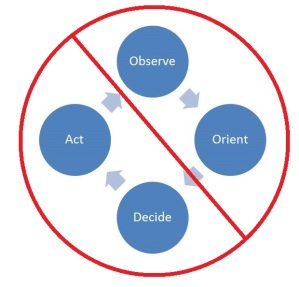
And please keep in mind that it does a disservice to Colonel Boyd’s ideas when they are reduced to a simplistic four point circular diagram.
Lessons from an Armed Robbery
Barry Fixler, former Marine and Viet Nam veteran, owns a jewelry store in New York State. On Valentine’s Day 2005, a couple of criminals decided to relieve him of his merchandise. It didn’t turn out the way they planned. We are fortunate that much of the incident was captured on video. There are numerous lessons we can draw from the incident. Let me preface all my commentary by saying that I greatly admire Mr. Fixler’s courage and how he handled the situation.
Bottom Line Up Front: Good Guy 1, Bad Guys 0; that’s clearly a commendable victory.
Why think ahead and why practice?
Today’s news contains an article with several lessons in it for the Armed Private Citizen.
Police: Man outside Walmart shot [his gun] in self-defense
The lessons cut across an array of topics relevant to Personal Protection. Let’s use the CAN/MAY/SHOULD/MUST paradigm as a basis for the discussion.
Keep your tape loops short
One word is best.
As much as I like the:
You look familiar. You got any warrants?
method, last night I defaulted to ‘No’ when I was approached last night by a female panhandler in the Publix parking lot. Because I keep my head up, I saw the encounter coming.
“Something, something, car, homeless.”
“No.”
“What?”
“No.”
“Okay.” She then walked away.
I didn’t say it in an ugly way, just very firmly. The power of a firm ‘No’ is very strong.

I also had my pepper spray in hand in case things went any further.
Podcast about Standards
“If you don’t know where you’re starting from and you don’t know where you’re going then any route will get you there, but that doesn’t mean you’ll end up in the place you want to be.”
–The Tactical Professor
John Johnston and I discuss standards on his latest Ballistic Radio show and podcast.
Whose Standards? (Podcast – Season 5, Ballistic Radio Episode 207, May 7th, 2017)
- what a standard is
- the different kinds of standards we have in:
- mindset,
- gun handling and,
- performance with firearms
- the difference between training and education
- the importance of the firearms community and its educational efforts
- the difference between Personal Protection and Self Defense
- where to start in your own progression of standards.
Standards (Part V – Know the Rules)
Deputies: Homeowner arrested after fatally shooting intruder in shower
The man went inside and confronted another man he found in his shower, deputies said. The homeowner left after the two exchanged words.
‘He returned home, retrieved a firearm, came back over to the residence and fired multiple rounds into the shower … killing the intruder,’ said Mason County Sheriff’s Lt. Travis Adams.
The homeowner called 911 and told dispatchers that he had just shot and killed an intruder, Adams said.
It’s not clear how long [the intruder] had been inside the home, but detectives don’t believe the homeowner gave him any warnings before he fired his gun, they said.
Deputies later arrested the homeowner for second-degree murder. They believe he had ample time to call for help when he went back home.
The odds are that the shooter will spend a significant portion of the rest of his life in prison. This is a Negative Outcome. It’s a clear example of how foolish the “I’ll shoot anyone I find in my house” ideology is.
I’ll shoot anyone I find in my house.
—Bad idea
When I posted the link to the story on my Facebook page, one person replied that he SHOULD have been allowed to kill the intruder. My response was: “No, adjusting our response to the context of the situation is what keeps us from being savages.” Usually, it makes me cringe when news stories refer to someone being ‘gunned down’ but in this case, I think it would be appropriate. What the shooter did was a savage act of unnecessary lethal violence. It wasn’t motivated by fear for his safety or the safety of his loved ones; rather, it was a senseless expression of emotional outrage. We shoot people only when we have to not because we want to.
Another person commented that it was his property and the intruder had committed the offense of breaking and entering. The question was why wasn’t this a Castle Doctrine case. The Castle Doctrine is not an absolute defense. Reasonableness of your response will almost always be applied as a test of the response’s legality. Gunning someone down while they’re taking a shower isn’t likely to be viewed as ‘reasonable.’ As Massad Ayoob put it in the linked article:
Yes, your home is that castle. However, that doesn’t mean you’re allowed to install an execution chamber.
The number of people who own firearms or other deadly weapons and yet haven’t the slightest clue about the legal ramifications of their use is astounding. Know the Rules needs to be a standard of our conduct just as much as the physical ability to use the weapon. What you might think the rules are or should be is irrelevant. The actual rules are all that are important.
It used to be that reliable information about the legalities of personal protection was hard to come by. Not anymore. There are numerous readily available sources of information about the law. Without leaving the comfort of your home, several good sources are available.
- What Every Gun Owner Needs to Know About Self-Defense Law (free download)
- Deadly Force: Understanding Your Right to Self Defense
- The Law of Self Defense: The Indispensable Guide to the Armed Citizen
- Law Of Self Defense online course
For the lack of reading and understanding a book, the Washington shooter will pay dearly. His legal fees for the trial will most likely cost him everything he owns and he’ll still probably go to prison.
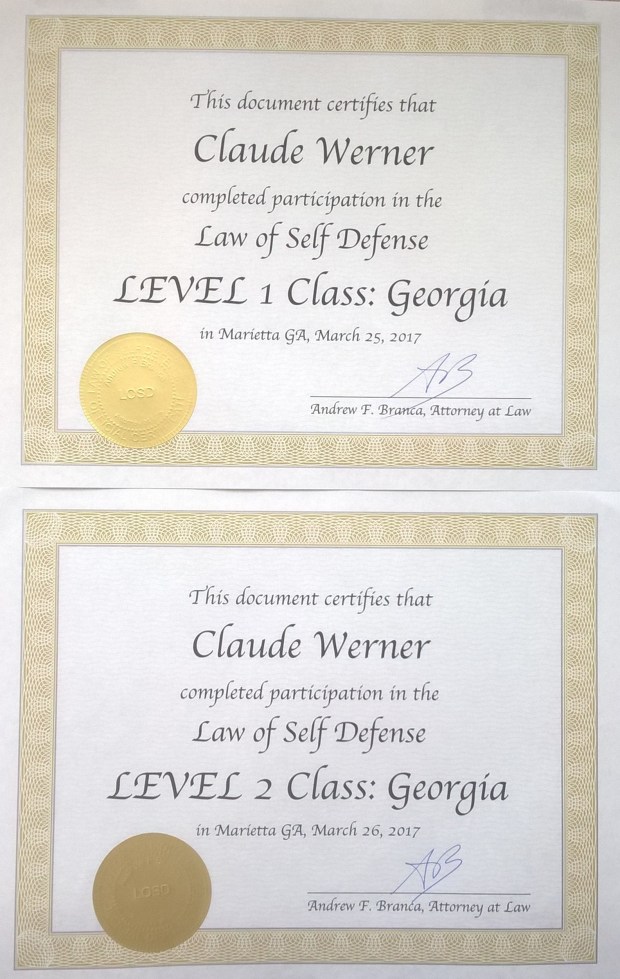
I recently attended the Law Of Self Defense Level I and II classes. They were an excellent legal education resource, tailored specifically to the State I live in, Georgia. The law does not necessarily make sense nor does it have anything to do with what you think it should be. The cost of such training is minor compared to the cost of a trial or even just being arrested on a charge that is later dropped. The optional simulator exercise at the end of the day was also a sobering demonstration of how poorly unpracticed people tend to shoot under stress. LOSD classes are available all over the country and are specifically tailored to the laws of the State they are given in.
A benefit of membership in the Armed Citizens’ Legal Defense Network is the training DVDs provided with membership. Once again, you can learn a great deal about the appropriate and inappropriate uses of forces without having to leave your living room.
Don’t guess, don’t listen to the foolishness you read on Internet Forums, and don’t make decisions based on what you think the rules SHOULD be. Invest at least a little of your resources and find out what the rules really are. It’s true that most situations are fairly cut and dried and work out legally for the defender. The issue is that when things go bad, they tend to go really badly. The rest of your life can easily be at stake. Very few of us would look forward to spending decades in the can (prison) without a Man Lock by McGard.

Perhaps the most unintentionally funny advertisement ever.
Also, if you’ve taken a State CCW class, the one hour briefing when your eyes glazed over doesn’t count as any kind of meaningful legal education. Don’t confuse that with education that actually teaches you how to apply the law to your personal situation.
Fair disclaimer: I was a guest of LOSD for the classes and didn’t have to pay for them. However, no promotional consideration for my recommendation was offered nor accepted by me.
Endnote: The intruder in Washington was probably a confused drunk. That’s not going to go over well for the shooter, either.
Chinese Whispers and the FBI (Part I)
Chinese Whispers is the game in which a short message is whispered from person to person and then the beginning and ending stories are compared. Often what begins as “I like that girl’s dress” ends up as something like “her Grandmother slept with Batman!”
The FBI released its annual report Law Enforcement Officers Killed and Assaulted (LEOKA) report on October 17. LEOKA will eventually be the starting point for numerous Chinese Whispers in the firearms and law enforcement communities. Whispers will circulate about statistical data such as distances of ‘gunfights,’ lighting conditions, weapon disarms, etc. Often, these claims will not even be based on current data but ‘commonly cited information,’ ‘well known statistics,’ or other such dubious sources.
What can we actually learn from LEOKA about how to be safer? The best single source in the Report is the Summaries of Officers Feloniously Killed and a recent addition, Selected Summaries of Officers Assaulted and Injured with Firearms or Knives/Other Cutting Instruments. Rather than relying on tabular data, which is interesting but not instructive, reading the Summaries provides us clues about circumstances, positioning, and actions. The FBI uses the term ‘The Deadly Mix’ to describe the combination of officer, offender, and circumstances. Reading the Summaries can give us insight about how that mix occurs and its outcome.
The circumstances of incidents in LEOKA are categorized as:
- Disturbance call,
- Arrest situation, including pursuits
- Civil disorder,
- Handling, transporting, custody of prisoner,
- Investigating suspicious person/circumstance,
- Ambush,
- Unprovoked attack,
- Investigative activity,
- Handling person with mental illness,
- Traffic pursuit/stop,
- Tactical situation.
While LEOs have interest in all the categories, Private Citizens can learn from incidents such as Investigating suspicious persons/circumstances and Handling person with mental illness, too. For those who think intervening in others’ affairs is a good idea (I do not), looking at the incidents in the Arrest category is a worthwhile exercise to see how easily things can go bad.
The West Virginia incident in the Summaries of Officers Assaulted and Injured is an entertaining, if somewhat macabre, example of just how weird and unpredictable the life of a police officer can be. The rookie involved certainly got a baptism of fire that day.
On January 1, a lieutenant and a patrol officer with the Lewisburg Police Department were both shot during a traffic stop at 4:20 p.m. The 36-year old veteran lieutenant, who had 15 years of law enforcement experience, and the 20-year-old patrol officer, who been on the job for 1 month, were both wearing body armor when they stopped a man driving a vehicle that had been reported stolen by a law enforcement agency in Texas.
More about LEOKA in the next Part.
Pride and fear
“when pride arrives, logic [leaves].” –Samurai Rising
I would say the same is true of fear, which is one reason I don’t care for the “I was in fear for my life” mantra. When we in the industry teach fear to our students, I am concerned we are setting them up to make bad decisions.
1000 Days of Practice (Part III)
Many people find it difficult to dryfire every day because they don’t have access to a firearm. Airline pilots and business people whose job require frequent air travel have a hard time of it. There are different ways of dealing with it.
The first would be to practice every day you do have access to your firearm and start counting. Doing that means you wouldn’t have a consecutive progression of the 1,000 Days but you would still get in 1,000 Days, it would just take longer.
Another approach would be to broaden the focus of your practice, as I mentioned in Part I. That’s one reason I entitled this series 1,000 Days of Practice.
Other skills appropriate to personal protection could be included as part of your mission statement for the 1,000 Days. This wouldn’t be 1,000 Days of Dryfire but it could be 1,000 Days of Personal Protection practice. Many of the most important Personal Protection Skills are soft skills that don’t require equipment to practice. Some that come to mind are:
- situational awareness
- the decision-making process
- incident analysis
- wargaming and decision exercises
- proxemics, and
- human communication and interaction
The memory aid I use for personal protection is RADAR.
- Ready – being prepared, mentally and physically
- knowledge,
- skills,
- tools
- Aware – eyes on the horizon, ears not plugged up
- Where am I?,
- Who is around me?,
- What are they doing?,
- What is going on?,
- Points Of Likely Concealment
- What is wrong in my right world?
- Decide – based on your decision criteria
- options,
- priorities, and
- the situation
- Act – do what you need to do
- Ready Again – be ready for your plan to need adjustment or the police to arrive.
Dryfire is one component of the Ready stage but it’s certainly not the only one. Understanding the criminal mindset and their methods of operation is also key. How about spending a few minutes periodically reviewing criminal victimizations that occurred to others and wargaming how to either avoid or deal with the situation? I have taken this so far as to go on a field trip to the location of a particularly bad incident and actually observe the lay of the land.

There are games that smart cops used to play to tune up their situational awareness. How common they are anymore, I don’t know. For instance, when in a waiting area, look around the room, then close your eyes and try to describe everyone in the room; clothes, height, weight, etc. That would be Aware practice.
Or, let’s say you encountered something that caused your to Alert and then realized it wasn’t a problem. You could mentally wargame what you thought the original problem and your solution. Take it all the way through to Ready Again, including your interaction with the authorities afterward.
There are many different ways to approach the 1,000 Days and tailor the focus to your personal needs and circumstances.
I’ll be going through a more in-depth explanation of RADAR, including some decision exercises, in the Violent Criminals and You class that William Aprill and I are teaching next month. William will be giving his extensive presentation on the criminal mindset and how differently criminals think.
 tacticalprofessor
You must be logged in to post a comment.