Back Up Gun Match
#fridayfundamentals
Johns Creek IDPA held a Back Up Gun match last night. It was fun to be able to shoot a match with my LCP. I was able to acquit myself well and finished 7th even though I had the smallest gun there and made a couple of boo-boos. There were three snub revolvers in the match also.
Folks who were using fanny packs and chest packs got a chance to test them out, which in one case didn’t work out well. Carrying a gun with such a system also means practicing being able to access it efficiently and safely.
There will be more in-depth coverage on the Shooting and Marksmanship Tier of my Patreon page. https://www.patreon.com/TacticalProfessor
Setting Ourselves Up for Failure
Chicago TV news crew robbed at gunpoint while filming a story on robberies
https://www.yahoo.com/entertainment/chicago-tv-news-crew-robbed-020000583.html
“Common sense is not a flower that grows in everyone’s garden.”
A friend’s comment about many people’s critical thinking skills

When I lived in Chicargo, several of my friends moved to the Wicker Park neighborhood because it was both trendy and convenient. One of the first things they did when I went to visit was to show me the guns they had bought. The guns were all pistol grip shotguns because at that time Chicargo didn’t allow any new handguns to be registered. Citizens who wanted to be armed just bought shotguns instead; so much for the efficacy of gun control.
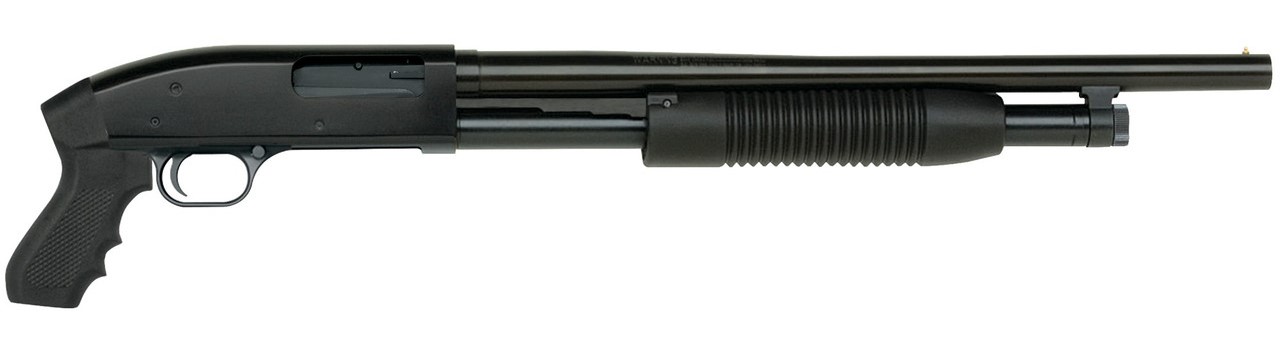
Although it’s easy to poke fun at folks like the news crew that was robbed, they are far from the only people who are oblivious to dangers they place themselves in. People unthinkingly do it every single day.
While talking at The Home Depot with a friend who is an Assistant Manager there, she spotted two men walk out the door while carrying something but didn’t stop at the cashier. Her reaction was to run out the door after them. It turned out that they had legitimately done an exchange at the Service Desk and weren’t stealing. When she returned to where we were talking, I was nowhere to be found.
She looked around and saw me standing behind a display wall. When we started talking again, the conversation changed to a different subject.
Her: “I thought I had pissed you off while we were talking.”
Me: “No, I was just taking cover in case they started shooting when you chased them.”
Her: “I never thought of it but I guess that was a possibility.”
Me: “There are more killings and shootings at Home Depot than is generally known.”
I mentioned to her about the recent killing in the Florida Home Depot of a young woman by the father of her child. https://www.fox35orlando.com/news/escambia-county-home-depot-shooting Two bystander employees were wounded during the murder. She hadn’t even heard about it. Not long before that an Asset Protection officer was shot and killed at a California Home Depot while chasing a thief. https://abc7news.com/pleasanton-home-depot-shooting-blake-mohs-worker-killed-suspect/13161846/
“It’s not the bullet with my name on it that I’m worried about, it’s the one marked ‘To Whom It May Concern’ that scares me most.“
Army saying
Better Aim – Shooting From a Vehicle
#fridayfundamentals
Let’s learn something from the recent Yahoo story about “Chicago rideshare driver with concealed carry license shoots 2 robbers who stole his cellphone, fired at him” https://thetacticalprofessor.net/2023/08/13/needs-to-have-better-aim-redux/
Shooting from the driver’s seat of a vehicle at a carjacker less than two yards away requires a different technique to be successful at making good hits. Using an inert pistol is a good way to try it out. They’re available for $20 or less at martial arts stores or online. Even if it doesn’t fit your holster, you can just put it on your lap.
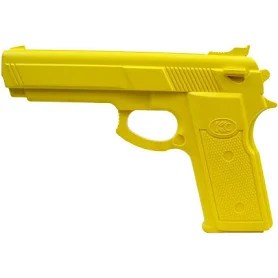
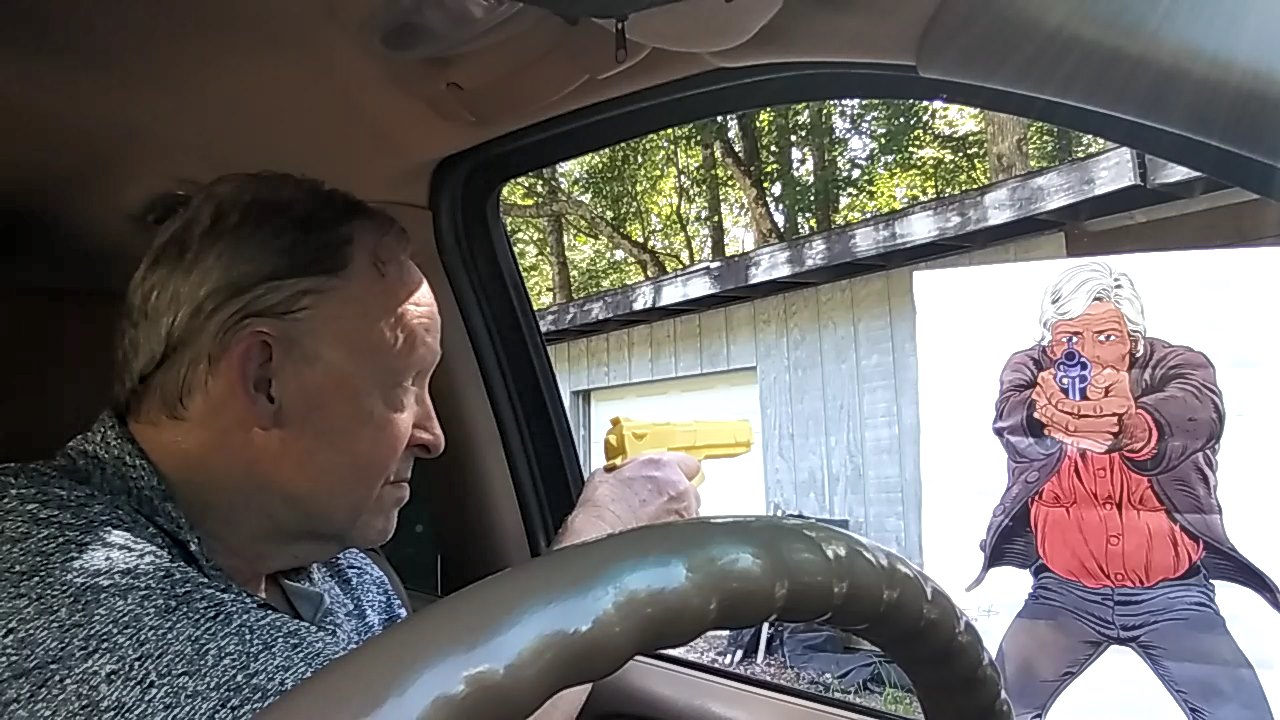
Using the inert gun, you can practice indexing on a target. You’ll probably see that one handed and two handed presentations yield different forms of target index. Neither of them will look like either a usual sight picture or classic point shooting.
One handed presents almost vertical.
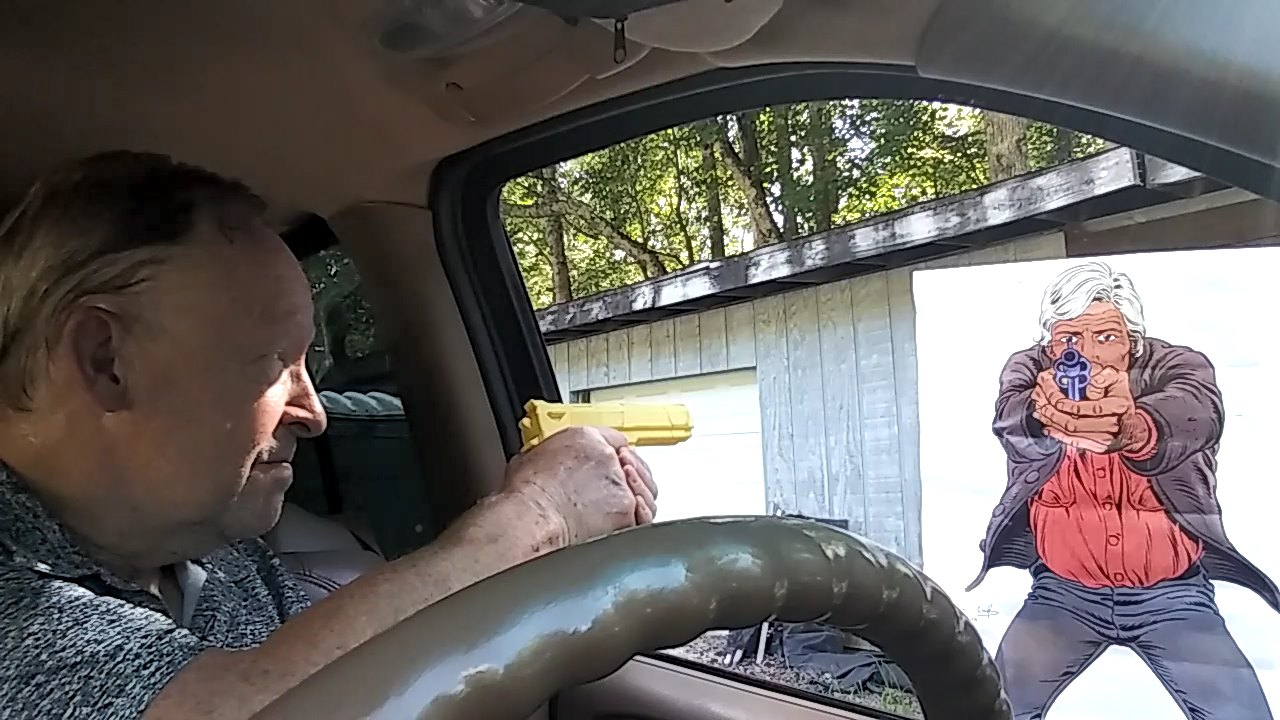
A two handed presentation will produce an index much more canted to the side than one handed. It takes a little getting used to place the muzzle accurately on the target.
Anyone who considers themselves a serious student of the Art should have an inert pistol of some sort. You can use it to practice things you can’t safely do with a real pistol. A SIRT gun is an ideal tool for this but not everyone is willing to spring that kind of cash. For less than the cost of a box of ammo, you can get a training aid that can be used in many different ways.
Needs to have better aim – Redux
A recent Yahoo story was about “Chicago rideshare driver with concealed carry license shoots 2 robbers who stole his cellphone, fired at him” https://news.yahoo.com/chicago-rideshare-driver-concealed-carry-012004396.html . Some of the comments were simply congratulatory or expressed relief the driver wasn’t injured.
But being a story posted on Yahoo, it naturally included many responses by simple-minded Internet Common Taters to the effect of :
“He needs to improve his aim. Two cons could have been taken out.”

I’ve written about this before. https://thetacticalprofessor.net/2016/07/24/the-cost-of-killing/
There are three aspects of this incident worth mentioning; sociological, tactical, and marksmanship. The sociological aspect is covered more than adequately in the post linked above. The tactical aspect relates to the object of the exercise of Personal Protection. What we are trying to achieve is covered in my series about Breaking Contact. https://thetacticalprofessor.net/2021/10/27/breaking-contact-part-6/
The marksmanship aspect is something that clearly these potato heads have never considered past ‘maybe’ popping off a box of ammo at an indoor range.

Trying to get even a decent sight picture on a criminal who is threatening you near your driver’s side car door is almost impossible. Try it sometime with your inert gun and the difficulty becomes immediately obvious.
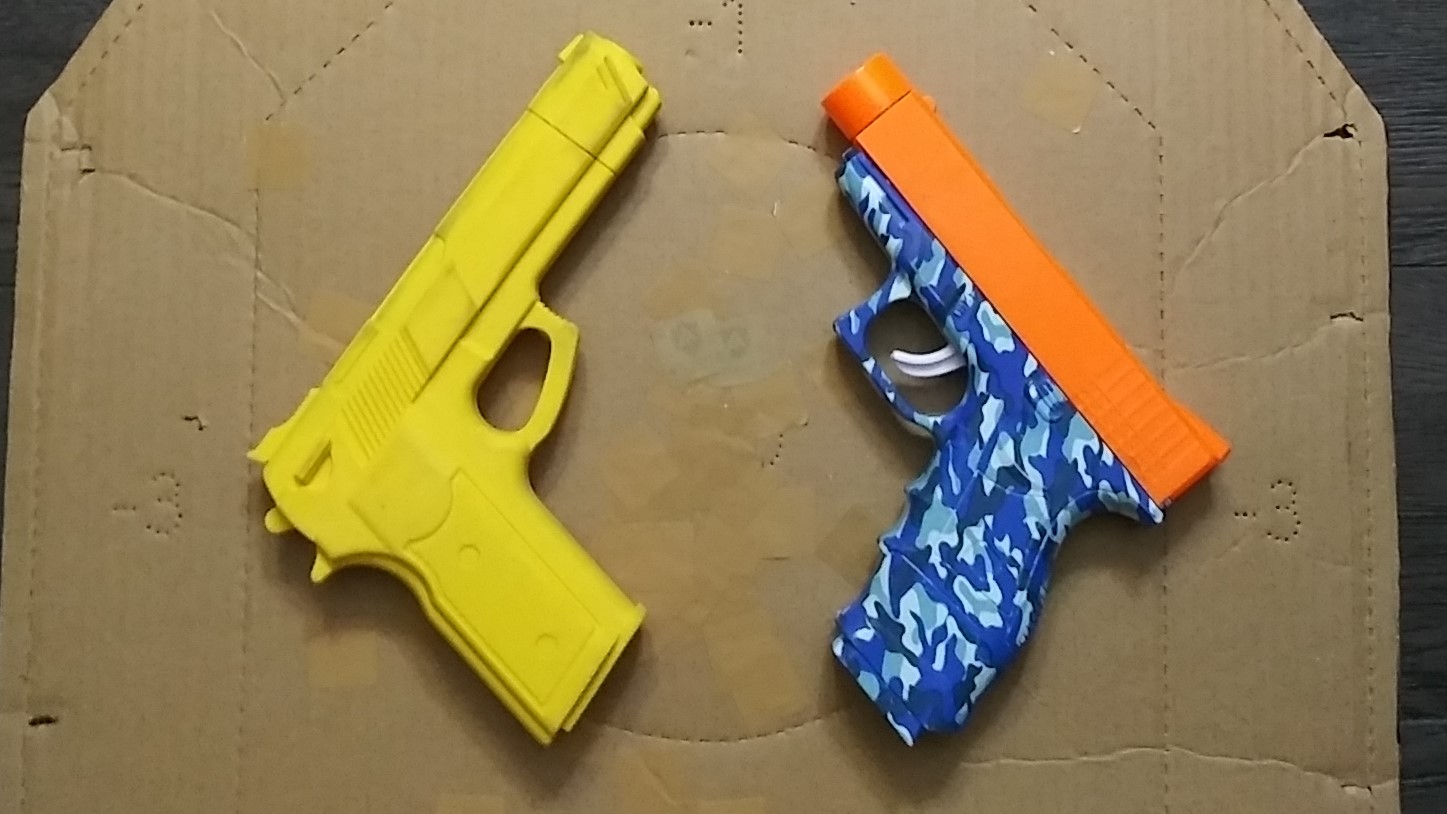
The only really good way to learn it is by using a SIRT pistol and a cardboard target on a stand outside the door. Those are resources very few people have. Even if they did, finding a place to practice it is difficult. Your neighbors and the POlice will not be very enthusiastic about you practicing this way in public. Nor will the Board of Directors of your gun club be happy about such a useful exercise at the club.
So I wish the potato heads would cut the Ride Share Driver some slack. He forced a Break In Contact, wasn’t injured, and didn’t have to interact with the Criminal Justice system excessively. That’s a win.
FDR and the Rangers
#throwbackthursday
Trigger Warning! This is a series of posts about my personal experiences. It has nothing to do with self-defense, hand guns, or Personal Protection.
President Franklin D. Roosevelt personally chatted with some soldiers of the 6th Ranger Battalion in the Oval Office shortly before he passed away from a cerebral hemorrhage.
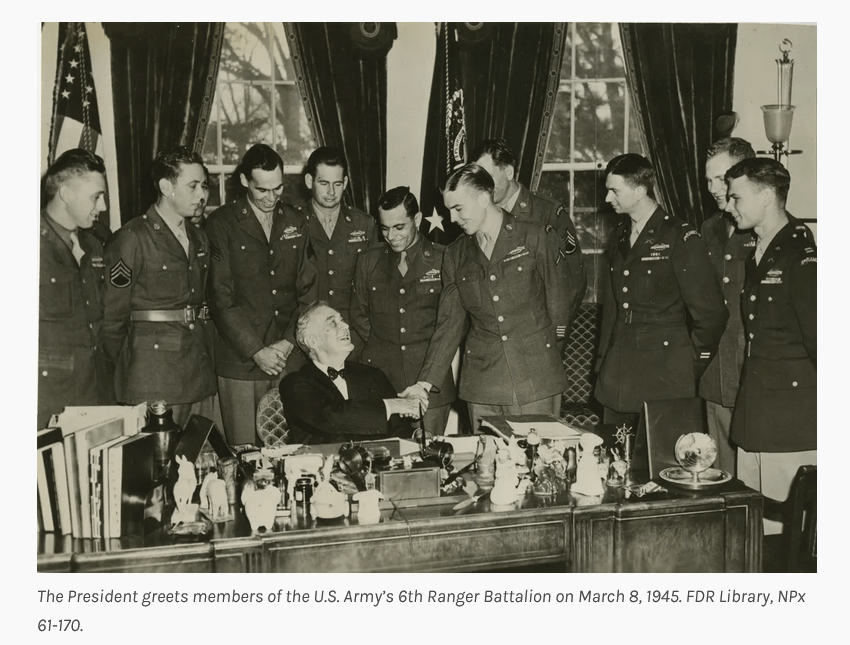
The 6th Ranger Battalion was deactivated shortly after the end of the War.
https://www.army.mil/article/242208/75th_anniversary_of_the_deactivation_of_the_6th_ranger_battalion
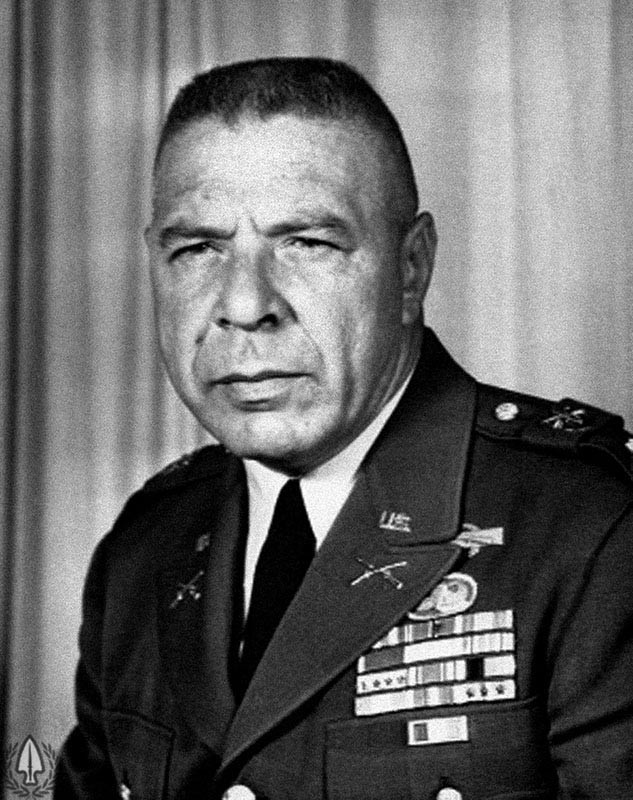
Colonel (then Major) Bull Simons was the Acting Battalion Commander at the deactivation.
Six Degrees of Separation
Colonel Simons was Deputy Commander of the “Joint Contingency Task Group,” the Special Forces soldiers who conducted the Son Tay Raid https://www.army.mil/article/241352/operation_ivory_coast_a_mission_of_mercy in 1970. Another member of the JCTG was Major (then Staff Sergeant) Thomas Powell, who received the Distinguished Service Cross for his actions during the Raid. I was so fortunate as to go through Ranger School with Major Powell (then a Second Lieutenant) a few years later. He was instrumental in helping me receive an Outstanding grade for my last patrol, despite being so tired and hungry I could barely think.
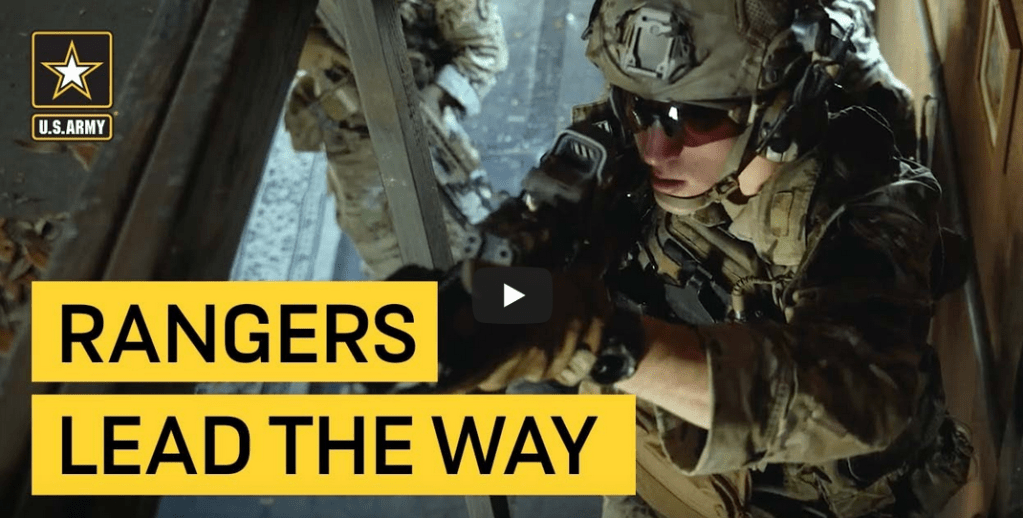
I’m not sure if that gives me a connection to FDR but I am proud of the fact that I volunteered to be one of the “Original 600” of the modern era Rangers.

Cold War Memories – The Effects of A Thermonuclear Attack
#throwbackthursday
Trigger Warning! This series of posts has nothing to do with self-defense, hand guns, or Personal Protection.
Some time while I was a teenager, one of the Chicargo newspapers ran a Sunday feature article about what a Soviet thermonuclear attack would have been like. This would have been the period of 1968-1972. The article talked about the effects on the city if a Soviet thermonuclear weapon exploded over the elevated train Loop downtown.

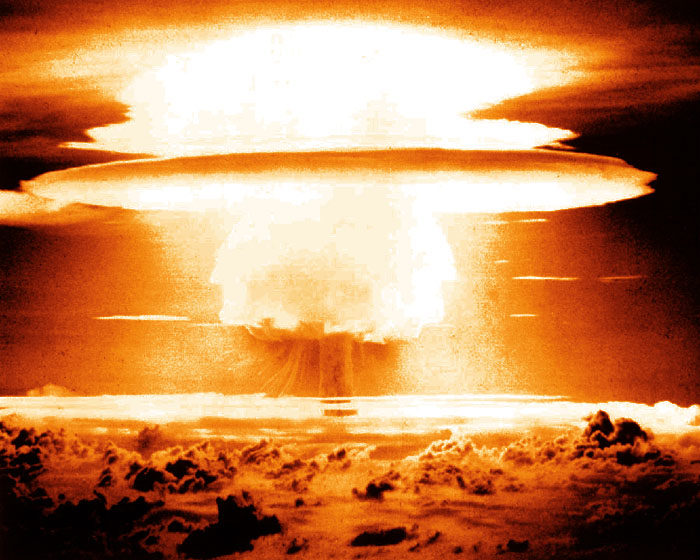
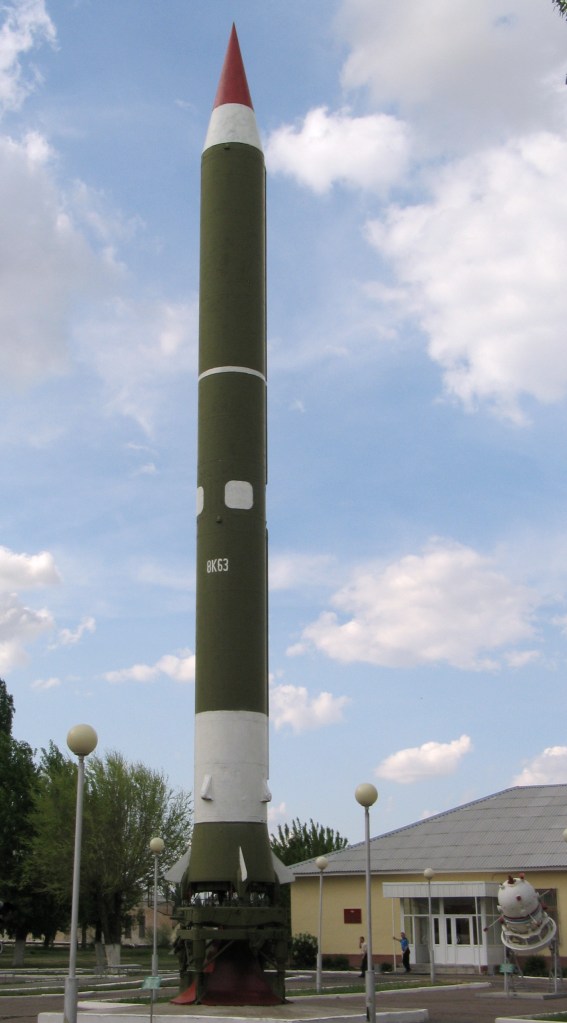
IIRC, the article used a 1 megaton warhead as the weapon. However the most likely candidate during that time period would have been a missile of the R-12/SS-4 type that precipitated the Cuban Missile Crisis https://www.russianspaceweb.com/cuban_missile_crisis.html . It had a maximum yield of 2.3 megatons.
The tactic of thermonuclear combat was to explode a weapon above a city as an airburst to maximize the destruction it caused. Even if the weapon’s fireball didn’t touch the ground, its heat would for a moment be hotter than the surface of the Sun. As a result, everything below the fireball would be vaporized. My memory of the article was that the entire downtown area would be turned into a crater 20 feet deep.
My research for this article uncovered a very informative website called Nuclear Secrecy by Professor Alex Wellerstein. An amazing part of the website is an interactive ability to input weapon and target parameters to generate a map of a weapon’s effects. https://nuclearsecrecy.com/nukemap/ All maps in this article are courtesy of Dr. Wellerstein’s website. Using this website provided even more accurate indicators of the destruction a weapon would have caused. The airburst altitude for the parameters chosen was 4,120 meters (13,596 feet).
The entire downtown area would have been turned into a crater not the 20 feet of my recollection but rather 122 meters (402 feet) deep. The crater would have a diameter of about one kilometer. The fireball would have a diameter of about 7/8ths of a mile. Inside the fireball, everything would have been vaporized. All Starbucks baristas and customers in the area of the fireball would have ceased to exist in a millionth of a second. No further crying about too many customers would occur after that millionth of a second.
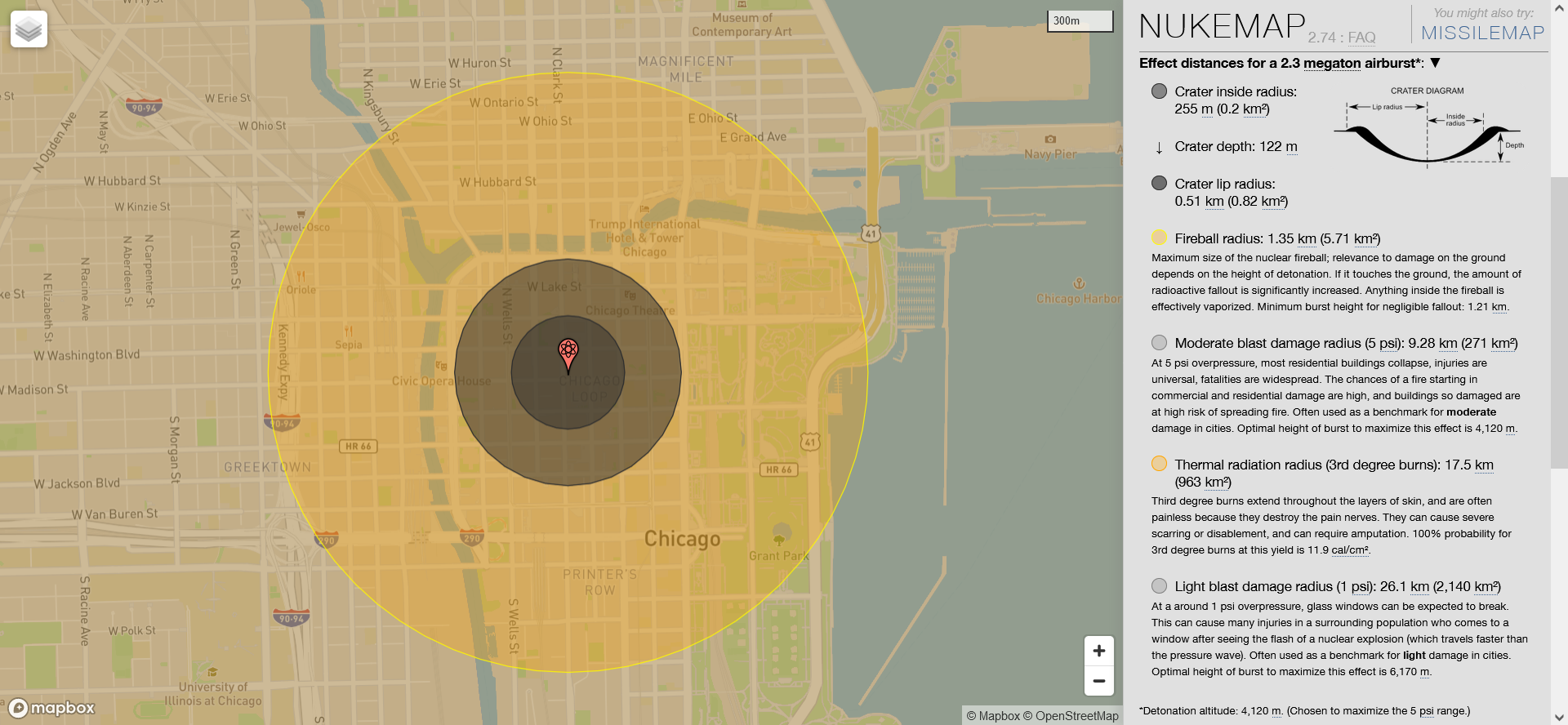
Unfortunately, the high school I attended during this time period was inside the “Moderate blast damage radius” of a weapon. This means the building had a high probability of collapsing but almost certainly would have instantly started burning. All of us would have been injured and many killed immediately.
“Most buildings collapse, Injuries are universal, fatalities are widespread.”
Department of Defense

Fortunately, my neighborhood was only in the “Thermal radiation radius.” Most of the buildings were brick so might not have been knocked down. Someone standing near a window would have been torn to shreds by flying glass though. Anyone outside would have sustained 3rd degree burns over much of their body and died shortly thereafter.

Much of Crook County would have been impacted by the blast.

A bleaker picture emerged during my research. A 1990 Federal Emergency Management Agency document, the Nuclear Attack Planning Base, forecast more than just one weapon would have hit Chicargo. The city’s prominence as a population center and manufacturing base for the military-industrial complex at the time meant that most likely 12 weapons would have been targeted against the area. Probably most of Northern Illinois not only would have been destroyed but would have been completely wiped off the face of the planet. https://nuke.fas.org/guide/usa/napb-90/index.html
No more crying at Starbucks about too many customers there for several centuries at least.

Next post: The Army and the Fulda Gap.
FBI Double Action Course
#wheelgunwednesday
Prior to the FBI adoption of the Wheaties cereal box sized S&W Model 1076 in 1990, revolvers were the Bureau’s sidearm for well over half a century. After the FBI switched to the S&W Model 13 revolver in 1981, it created a publication, FBI Revolver Courses and Techniques, for using the gun with the Weaver technique.

“Sight Alignment: During close-in shooting (five to seven yards), the shooter does not have time to acquire perfect sight alignment. The shooter is, therefore, instructed to fire with both eyes open and to bring the sights up to eye level, seeing the front sight in the secondary vision. As distances increase, the need for better sight alignment increases and trigger pull should be slower.”
One of the Courses in the publication is the Double Action Course. It is intended as a practice regimen for double action shooting. The par times are short as is the allotted time for the one reload included. All strings are fired from the holster except one string at 15 yards.
DOUBLE ACTION COURSE (DAC)
The entire course is fired using the Weaver Position.
5 Yards
6 rounds -2 rounds on each whistle (in 3 seconds)
4 rounds -2 rounds on each whistle (in 3 seconds)
7 Yards
6 rounds -2 rounds on each whistle (in 3 seconds)
4 rounds -2 rounds on each whistle (in 3 seconds)
10 rounds -Load 6 rounds, on whistle, fire 6, reload 4 rounds, fire 4, all in 20 seconds.
15 Yards
6 rounds -2 rounds on each whistle (in 3 seconds). Fired from Weaver Ready.

4 rounds -All 4 rounds in 6 seconds
25 Yards
5 rounds -All 5 rounds in 10 seconds kneeling position
5 rounds -Repeat
Scoring: 2 points each for hits in either the KS or K4 area.
100 points possible.
Firing at an indoor range where drawing from the holster isn’t permitted can be done by using a table start.

Par times can be used via ear buds underneath hearing protection muffs and a par timer app on one’s cell phone. The phone’s Bluetooth connection will transmit the start and stop beeps to the ear buds.

Although it was shot by FBI Agents on the huge B-21 target, any silhouette will do.

It’s a fun course and very practical for those who carry a weapon.

Note to indoor range owners and operators. Granted that OSHA regulations can be onerous to work downrange maintenance with. But having inoperative carriers, targets left downrange on carriers and on the floor, thousands of fired brass cases in front of the booths, etc. presents a very unappealing scenario to the public. This is not a new phenomenon. In 1919, Walter Winans devoted an entire chapter WHY PISTOL SHOOTING IS UNPOPULAR in his book The Modern Pistol and How to Shoot It about the unpleasantness of this experience.
Reliability Testing – Part II
Continuing on with “How many rounds would you say make up a legitimate ‘reliability test’ for a pistol?”
This is a comment to the 2023 post that echoed a comment I failed to notice and answer on the 2017 post.
“ ‘One of the mathematical analyses presented in the original Facebook discussion was that 5 malfunctions per 1000 meant more than one malfunction in a 17 round magazine (8.72%).’
You need to link to this math because it isn’t correct if you assume independence.”
Here is the person’s explanation, verbatim.
“Claude – 5 in 1000 is a 0.5% failure rate, or a 99.5% success rate per shot. The odds of shooting twice in a row is 99.5% X 99.5%, or 99.5% to the 2nd power. The odds of shooting 17 rounds with no problems is 99.5% to the 17th power, or 91.8%, leaving an 8.2% chance of failure.”
The problem is that the assumed 0.5% failure rate was the result of shooting twice. So double counting the failure and then raising it to the 2nd power is an inherent structural flaw in the analysis. I don’t claim to be a statistician but occasionally a structural problem in constructing a mathematical analysis will be immediately obvious to me. If the output of a mathematical analysis is obviously divergent from reality (Glock 17s do not average more than one malfunction per magazine), it means the math is flawed in one way or another.
What is the reliability of a Glock 17? During one class I was teaching at the elite Rogers Shooting School, I had two failures to go into battery with the Gen 2 Glock 17 I used as my School gun. I pushed the slide closed with my thumb (OMG, a diagnostic malfunction clearance) and went on with the drill. The malfunctions seemed odd to me because they were out of the ordinary. Upon further reflection, I realized the teaching season was nearly over (October) and I had neither cleaned nor lubricated the gun all year. It had fired, with various types of ball ammo, somewhere upward of 15,000 rounds without a malfunction. The other School guns performed similarly.
An analysis that determined a Glock 17 had a probability of one malfunction per magazine flew in the face of my experience. That’s the kind of thing I keep an eye open for. If an analysis doesn’t match up with a broad segment of reality, there’s probably something wrong with the analysis.
Having built a model rocket does not make you a rocket scientist.

Reliability Testing
A colleague asked me a few days ago:
“How many rounds would you say make up a legitimate ‘reliability test’ for a pistol?”
My response was 100 because that’s more than 99.9% of people will ever fire a pistol they buy. He was surprised about this answer because he thought it would be considerably more.
There’s a very detailed discussion about it in a post I wrote years ago. Most of the cognoscenti who were responded to the question then felt that 1000 rounds was the minimum desirable number. There were certain aspects of their analyses leading to that conclusion that I felt weren’t explored with enough depth.
https://thetacticalprofessor.net/2017/04/21/reliability/
Numerous justifications for 1000 round torture tests were presented to me by the cognoscenti. One of the mathematical analyses presented in the original Facebook discussion was that 5 malfunctions per 1000 meant more than one malfunction in a 17 round magazine (8.72%). My belief about that obtuse analysis remains the same.
“If I’m going to have at least one malfunction per magazine, I’ll just keep carrying a revolver.”
I’ll write a bit more about my latest revolver work for #wheelgunwednesday next week.

Hahaha. Alt Text autogenerated by Microsoft Word for the above picture:
“A board game with brown squares”
WWII Helicopter Rescue Mission – Unintentional Discharge Related
Dr. Mark Felton never ceases to amaze with his recounts of wartime exploits. The elaborate efforts made by the US Army to rescue a soldier involved a journey three-quarters of the way around the globe.
“A soldier based in a weather station atop a 4700 foot tall mountain [in Burma] had accidentally shot himself in the hand and infection had set in. He needed immediate evacuation to hospital.”
“On the 24th of January 1945, a helicopter undertook the first combat medical evacuation in history.”
Ironically, the first helicopter Medevac mission in history was not due to combat action but rather because of an Unintentional Discharge.

 tacticalprofessor
You must be logged in to post a comment.