Preventing Negligent Discharges While Eating at a Restaurant
#Saturdaysafety
OMG – Another Tactical Professor rant
Simple TTP to Prevent Negligent Discharges While Eating at a Restaurant
1) Have a decent holster that keeps your pistol from falling out of your pants and use it any time you carry your pistol. Even if you’re just getting out of your vehicle to eat something or put gas in the tank, don’t just stick your gun in your waistband.
2) Let falling guns fall and then pick them up deliberately and without haste. Keep your finger out of the trigger guard as you do so.
If you do have a Negligent Discharge in a public place, don’t try to run out the door immediately. Check to see if anyone has become a casualty.
Note that I generally agree with my colleague Marty Hayes’ https://armedcitizensnetwork.org/ comment that most Unintentional Discharges don’t fit the legal definition of ‘Negligent.’ However, someone who is walking around with a pistol stuck in their waistband in such a low level of security that it easily falls out and causes someone else to get injured is being Negligent. That activity can be foreseeable as reckless and likely to cause someone else to become wounded.
THE STORY
Normal day at Cracker Barrel’ ends with shrapnel stuck forever in Charlotte man’s leg [when someone else has a Negligent Discharge and injures an innocent bystander]
https://news.yahoo.com/normal-day-cracker-barrel-ends-213119642.html
SYNOPSIS OF THE INCIDENT
A traveling man eating at Cracker Barrel in North Carolina dropped his pistol. According to the police report, the pistol was a .45 1911 Colt. He tried to catch the gun from falling and it discharged. The bullet hit the wall, broke into pieces, and several pieces embedded in another man’s leg.
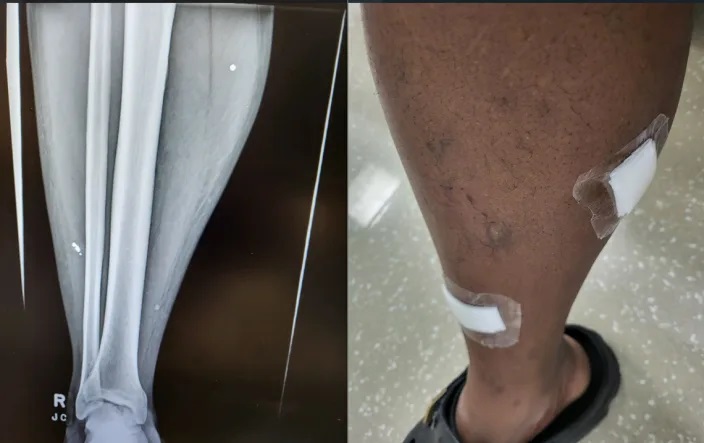
Image courtesy of Charlotte Observer
The shooter then tried to run out of the restaurant but was stopped by a customer at the cashier’s stand.
A Social Security eligible out of state man from Ohio was the shooter. He was cited and released by local POlice for violating North Carolina concealed weapons law. Whether he had a permit for concealed carry is unclear.
Upon being taken to hospital, doctors recommended the victim leave the pieces of metal in his leg. He said they told him it would be riskier to take them out.
MOST LIKELY EXPLANATION OF HOW THE INCIDENT OCCURRED
Because he was traveling across several States with a large heavy pistol, the gun was placed somewhere off-body in his vehicle. Serious Mistake. https://store.payloadz.com/go/?id=2617872 As my colleague Karl Rehn https://krtraining.com/ has noted, most people who obtain concealed carry licenses/permits do so in order to keep a gun in their vehicles and off-body in the console or door pocket. Or even worse, if that’s possible, on the floor underneath the floor mat or stuck between the seat and the console.
Upon stopping at the Cracker Barrel, he didn’t holster the pistol but rather just stuck it in his waistband without a holster. It is possible he wasn’t even wearing a belt but that’s conjecture on my part. Then because autoloaders are butt heavy, when the gun came out of his waistband because he was shifting around in the unpadded chair, it fell outside of his pants toward the floor. A point in favor of revolvers in such a situation is that they will slide down the inside of the pant leg like an Unintentional Turd Discharge (UTD) rather than falling rapidly to the floor. Ask me how I know this.
The no longer concealed carrier tried to grab the gun as it fell. His finger got into the trigger guard, as will usually happen when trying to grab a falling pistol, and the pistol discharged. Whether the thumb safety was even engaged when he tried to grab the pistol will never be known.
The shooter’s court date is June 9 for the citation. If he doesn’t return from Ohio to face the charge, a bench warrant will probably be issued for his arrest since it is a criminal charge. Whether the injured man will press charges further has not yet been decided.
HOW TO PREVENT SUCH AN INCIDENT
1) If your gun is too big and heavy to carry in a holster when it’s not in your safe or arms room, then you need a smaller lighter gun. The 1911 pistol was designed to be carried in a sturdy flap holster on a cavalry trooper’s 2 ½ inch pistol belt or kept in the unit’s arms room. One or the other, no in-between. That’s the other part of “the 1911 was designed to ….” people don’t much talk about.
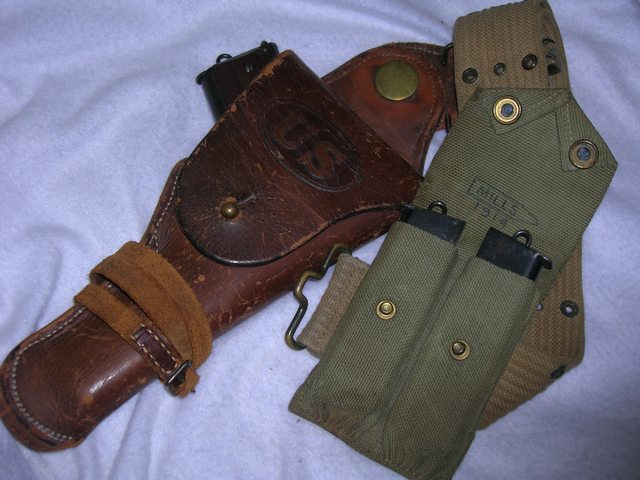
Image courtesy of FrankD on the CMP Forum
2) If your holster isn’t comfortable for all day carry, including while you are seated for long periods, then you need to get a more suitable holster and/or pistol. Although the platitude “A pistol should be comforting [to carry] not comfortable” is heard periodically, it is in severe conflict with the reality of most peoples’ lives.
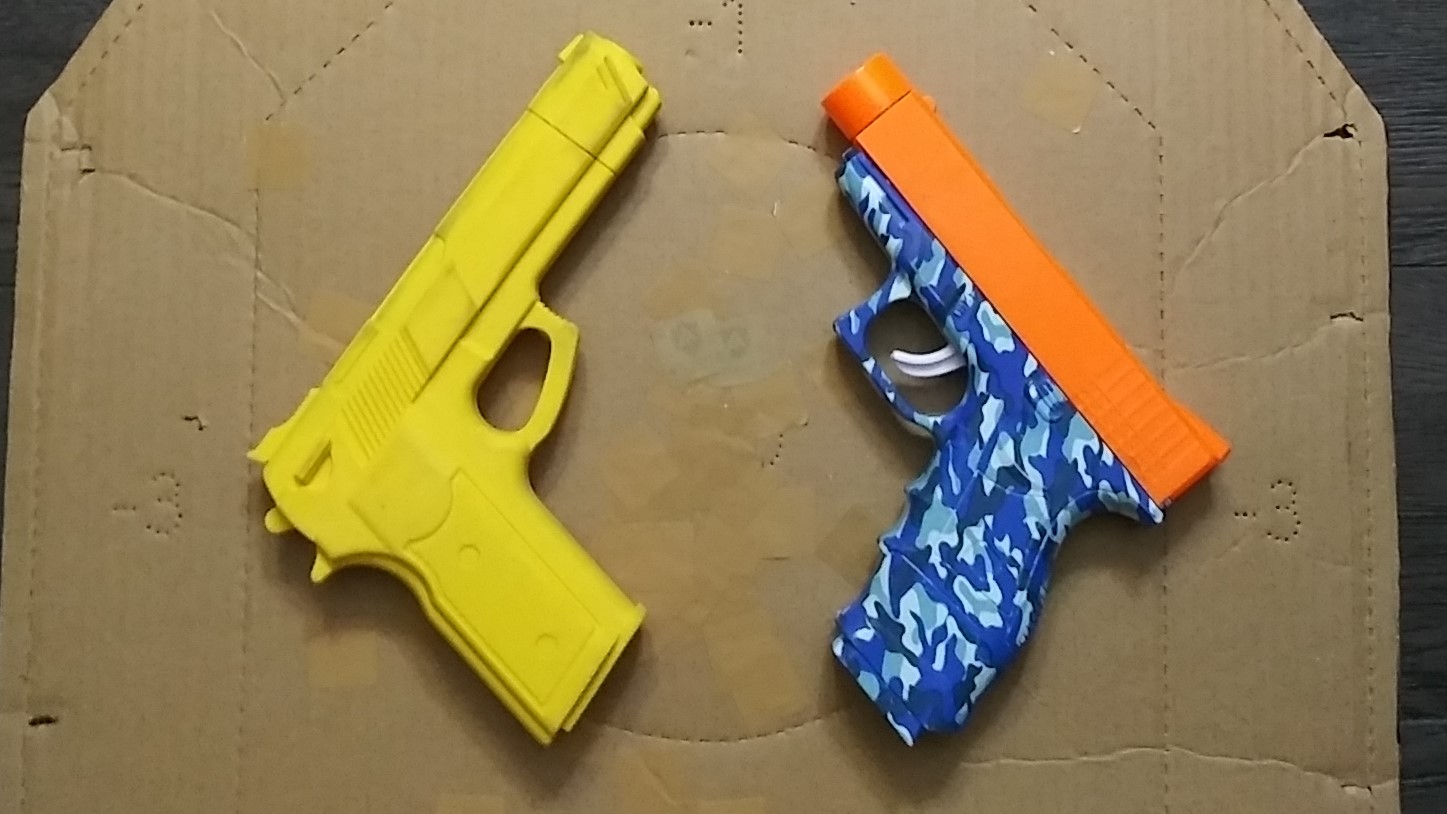
3) Practice letting a fallen gun fall to the ground before trying to pick it up. Brian Hill of The Complete Combatant http://www.thecompletecombatant.com/ calls this “Rule 5” and I agree with him completely. If you don’t want to practice with your $1000 cool breeze carry pistol, then get some kind of inert dummy gun and practice with it. If you don’t want to spend the money on a Blue Gun https://www.blueguns.com/ , serviceable training aids are available on Amazon. There are training aids available even in the toy section of Walmart, assuming you don’t live in Chicargo where Walmart has decided to close.
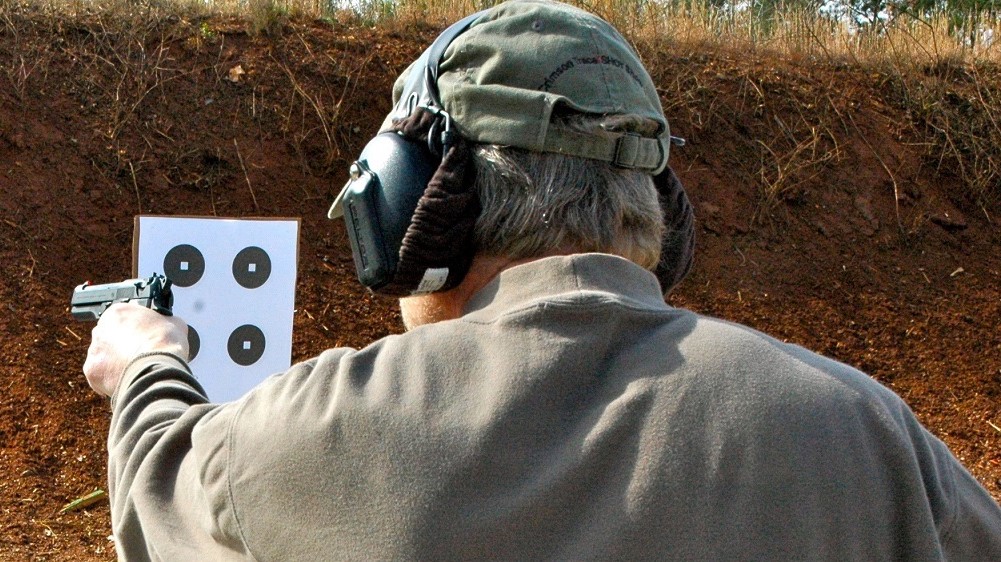
This kind of incident makes those of us who are responsible gun carriers look bad. There’s more involved in Every Day Carry of a Deadly Weapon than just buying a gun and sticking it in your pants or purse. Consider the number of incompetent drivers you see who you know should only be riding the bus; not operating a two-ton murder machine.
1) Learn what you need to be able to do, 2) get the proper equipment, 3) practice the skills you need, and then 4) live the lifestyle.
That’s the proper sequence. Don’t be deliberately ignorant and irresponsible.
If you are interested in more in-depth writing about Point Shooting or Personal Defense Incidents and Analysis, please subscribe to my Patreon page by clicking on the image below.
Unsighted Pistol Shooting
“You have a large target in front of you and the natural qualification of being able to point your finger at a certain object; by handling your revolver a short time you will be able to point the barrel of the revolver as you would your finger, pulling the trigger double action as the barrel swings into line with the target. When you have accomplished this you have the principle of quick shooting at short range and quick draw will be taken up later.” —
One of the early pioneers of defensive pistol shooting, J. Henry FitzGerald, wrote that in his book Shooting in 1930. Beginning in May, I will begin a four month series on my Patreon page about Unsighted Pistol Shooting.
https://www.patreon.com/TacticalProfessor
The concept is variously described as ‘point shooting,’ ‘reflexive shooting,’ ‘instinctive shooting,’ and several other terms. They all refer to the concept of firing a pistol without reference to the sights. Some systems call for the pistol to be brought into the eye-target line and others do not.

Although the historical documents are readily available, much Internet commentary about unsighted firing is not well researched or documented. The standards of what the founders of the various systems said could be accomplished, marksmanship-wise, are almost always ignored.
To shed more light on the subject, my Patreon series will be a survey of the actual historical literature with regard to technique, training methods, and standards. There are four distinct periods that the literature can be divided into. They are the Great War and Interwar Period, World War II and its Post War Period, the Vietnam War Era, and the Post Vietnam Era. Delph (Jelly) Bryce and other famous point shooters who didn’t write about training will not be included because they produced no literature.
The cost of the Unsighted Fire Tier will be three dollars ($3) monthly. You can unsubscribe at any time and not be charged for future months.
Most widely known of the unsighted systems is Fairbairn and Sykes Shooting to Live along with US Army doctrine developed during WWII. Those will be the topic for May’s Unsighted Tier.
The second component of the series will be a separate Tier concentrating on current incidents and how unsighted fire would or would not help solve the occurrence. Integrating actual incidents into training and practice has been something I’ve focused on since the early days of IDPA, when I was a Match Director.
Each week the Incident Analysis Tier will feature an incident from the current Armed Citizen column of the NRA Journals. Many people are not familiar with The Armed Citizen column, which is a very useful start point for doing Incident Analysis pertaining to Private Citizens instead of the POlice. Part of my Analysis will be the marksmanship problem posed and what was needed to solve it.

The cost of the Incident Analysis Tier will be Five dollars ($5) monthly. It will also include all the posts of the Unsighted Fire Tier. You can unsubscribe at any time and not be charged for future months.
This will be a new type of education and instruction available to my readers. I am excited about the series and I hope you will join me for it.
Subcompact Pistol (LCP) Progress Evaluation
This is a short course I devised for my Patreon snub revolver and subcompact pistol programs. It’s based on the Nevada Concealed Firearms Permit Qualification Course. Instead of just shooting three long untimed strings (3, 5, and 7 yards), the timing is based on Lt. Frank McGee’s 3 shots, 3 seconds, 3 yards paradigm. Several additional start positions are also included.
It has some cool music too. Somewhat reminiscent of the soundtrack from the TV series Lex.
NRA Annual Meeting 2023 – Day 1
The NRA Annual Meeting was held this year on April 14-16, 2023 In Indianapolis. There is no cost to attend for NRA members. Approximately 70,000 NRA members were expected to attend. The venue was the Indiana Convention Center, a large and well-appointed facility. Midway USA was the official sponsor of the Annual Meeting. There was a wide variety of educational opportunities in addition to the “14 acres of Guns and Gear” on display. Despite being attended by many thousands of people carrying firearms both concealed and openly, there were no mass shootings at the event.

Before even entering the venue, a truck was observed with large LED signs on its sides was seen circling the building. The signs were various anti-NRA disinformation slogans targeted at both the general public and NRA members. This truck circled the Convention Center continuously all three days of the Meeting.
Day 1
Interesting items observed on Friday were:
- AimCam, a new integrated camera and shooting glasses system that allows video of what the shooter sees through the master eye vis-à-vis images captured from slightly off-center.
- The Savage Arms Stance, a microcompact 9mm pistol for concealed carry.
- A Kel-tec slimline 9mm pistol.
- Wilderness Tactical renovation of the Renegade ankle holster. WT also had an in the pocket double pouch, which could be used for two spare magazines or a magazine and small flashlight.
- A wide variety of offerings by Taurus USA. Caleb Giddings, the Taurus Marketing Manager and “degenerate revolver enthusiast,” stated that he has fired over 1,000 rounds through several Taurus Model 82s in practice and competition without failures. One of the improvements Taurus has made to the 82 is to capture the trigger return spring and eliminate the rebound slide. This removes one frictional component of the trigger action and improves the feel and weight of the trigger press. Taurus also had compact and full size versions of the TX22, new .22 Long Rifle pistol that Taurus states can be dry fired without damage.
In addition to the displays of guns and gear, there were continuous educational offerings on all three days of the meeting. https://s15.a2zinc.net/clients/NRA/nraam2023/Public/Sessions.aspx?ID=4750 The topics ranged from generally gun related topics, Dr. John R. Lott’s Gun Control Myths as an example, to theme focused classes such as Lessons Learned From Analyzing 40,000+ Real Gunfights by John Correia of Active Self Protection.
“Lessons Learned from Analyzing 40,000+ Real Gunfights [delved] into the top lessons gleaned from analyzing tens of thousands of actual defensive incidents caught on surveillance video by the national SME in that arena. Real-life incidents will be viewed and analyzed in class to highlight these lessons learned.” was the program description.
An overview of Lessons Learned from Analyzing 40,000+ Real Gunfights will be my next post.
A Rifleman Went to War
by Herbert W. McBride
“From these men I learned many things, the most important of which was the point which they all insisted was absolutely vital: the ability to control one’s own nerves and passions—in other words, never to get excited.”
H.W. McBride
H.W. McBride was an American who joined the Canadian Army in 1914 because he “wanted to find out what a ‘regular war’ was like.” He wrote two books about his experiences, The Emma Gees and A Rifleman Went to War. Both books are available on Amazon and other internet sites.
The above quote comes from Chapter 1 – How Come? [He volunteered for The Great War] of A Rifleman Went to War.
This is the section of that chapter elaborating about the quote.
“At the age of fifteen I enlisted in and for several years remained a member of the Third Regiment. During that time, my father rose to the rank of Colonel commanding, and I became a sergeant. Then I went to work in Chicago and immediately affiliated with the First Illinois Infantry—Company I—Captain Chenoweth commanding. During the summer of 1893, having been informed by a wise medico that I had T. B. [tuberculosis], I put in my time ranging around in Colorado and New Mexico, part of the time as a cowpuncher and the rest working for a coal-mining company. (That is, I was supposed to be working for them, but, as a matter of fact, I was using them simply as a meal ticket, as I spent every minute of my idle time in scouting around looking for something to shoot at.) I met and got acquainted with a lot of the real old timers: men famous during the hectic days of Abilene, Dodge and Hays City and, of course, those who had been mixed up in the various ructions incident to the clearing up of the famous Maxwell Land Grant, upon part of which this mine was located.
Trinidad, near the mine (Sopris), was one of the hot spots in the old days and many a bad man had met his ‘come-uppance’ there and along the Picketwire or, as the original Spanish name has it, the Purgutoire River. From these men and from my practical shooting with them in various matches, I learned just about how good they and their erstwhile friends—and enemies—could really shoot, both with the pistol and the rifle. Bat Masterson, Jim Lee, Schwin Box and Nat Chapin, just to name the best of them, were all good shots, but the best of them never could hold a candle to the amazing performances of a lot of hitherto unknown ‘experts’ who are continually bobbing up in the moving pictures and the sensational stories published in supposedly reputable magazines in the year of grace, 1930.
I should have included Brown—Three-finger Brown—in the above list. He was as good as the best of them although he had to do all his shooting left-handed: due to the fact that he had allowed his curiosity to over-ride his good sense in the matter of investigating the doings of a band of ‘Penitentes’ one might and, as a result, lost the thumb and first finger of his right hand.
All these men had grown up in the West and had lived through the various ‘wars’ and ructions which flared up every now and then, all the way from Texas to the Black Hills. They all bore the scars of combat but the very fact that they had survived was, to my notion, the best evidence that they were good. Those were the days of the survival of the fittest, especially in the case of men who, like all those mentioned, had occupied positions as legal guardians of the peace, all along the border.
From these men I learned many things, the most important of which was the point which they all insisted was absolutely vital: the ability to control one’s own nerves and passions—in other words, never to get excited.
I had the opportunity to see a couple of them in action during some disturbances which came up during the Fourth of July celebration and never will forget that, while armed, they never even made a motion toward a gun: they simply walked up to the belligerent and half drunken ‘bad men’ and disarmed them and then walked them off to the calabozo to cool off. Yes, I learned a lot from those men. That they could shoot, both quickly and accurately, is unquestioned, but the thing that had enabled them to live to a ripe middle age was not so much due to that accomplishment as to the fact that they were abundantly supplied with that commodity commonly called ‘guts.’ That was the point, above all others, that impressed me and remained with me after I had returned to the East; and, ever since, I have tried to live up to the standard of those pioneers of the shooting game.”
Words well worth considering in a time when “I was in fear for my life” has become a mantra.
LAPD Shooting Re-enactment
An LAPD officer, using a Red Dot Sighted pistol, was forced to shoot a hostage taker at a range of five feet in July of 2021. The Board of Police Commissioners number for the incident is Categorical Use Of Force number 041-21. Tactics, Drawing and Exhibiting, and Use of Deadly Force by Officer A in the incident were all adjudicated as In Policy by the BOPC.
This video re-creates the marksmanship problem faced by the officer. The target was moving for the officer, which this video does not re-create. The pistol used in the video is a Glock 42 supplied by Glock for my Subcompact Pistol Training Tier on Patreon.
In keeping with the LAPD theme of the video, the second part of the video contains a demonstration of a permissible variation of the LAPD Retired Officer Qualification Course, also shot with the Glock 42. This Course has value to the Armed Private Citizen as a self-evaluation of some good to have marksmanship skills for concealed carry.
The Covert Draw
Someone in my Patreon Subcompact Autoloader Tier https://www.patreon.com/TacticalProfessor/membership asked the question,
“Could you offer some insight and technique to the surreptitious, covert, or stealth draw?”
That’s a question worth exploring because of the tradeoffs involved. As Thomas Sowell has said, everything involves comparisons and costs.
There are two aspects to the drawstroke; 1) Access and Grip and 2) Present to target. Access and Grip is the most time consuming part of the drawstroke but not the most difficult. Getting the gun well indexed on the target is the hardest part. Missing the first shot is far more common than not being able to get the gun out.
A covert draw facilitates Access and Grip but complicates Present. Once the draw is complete, the gun is positioned out of the path of your normal drawstroke. If shooting is required, the first shot might actually be slower if we Comstock a bad hit.
The gun is also probably pointing at your own body in the process. While holding it at a concealed Ready, you may have to engage in dialogue or movement and remember to not shoot yourself at the same time. Given the light triggers that many people favor, that’s an unpleasant prospect.
Even if the gun isn’t visible to a potential attacker, it may be noticeable to someone at a different angle. That person may not be a hostile. A covert draw could end up as an Aggravated Assault on an uninvolved party.
And if no shooting is required, a covert re-holstering will be necessary. Some deep concealment holsters can be difficult to re‑holster without making a big production out of it.
Being able to Access and Grip in a low profile way might be a more useful way of addressing the problem. With Access and Grip accomplished, if we get the ‘Go Signal,’ we have the most time consuming part of the drawstroke out of the way. We can then use our normal Presentation, at which we hopefully have many repetitions and can execute well.
Although the Covert Draw concept sounds appealing, the tradeoffs need to be considered. The costs may be found to outweigh any potential benefit.
Can-May-Must-Should in One Incident
In a road rage incident on Sunday February 26, 2023, a gunowner who was driving erratically and then threatened another driver was subsequently shot and killed by yet a third party who intervened on behalf of the driver who threatened.
All of the elements of Can-May-Must-Should http://modernserviceweapons.com/?p=19028 are readily apparent in this one interesting incident. It also involves Serious Mistakes Gunowners Make. https://store.payloadz.com/details/2617872-ebooks-true-crime-serious-mistakes-gunowners-make.html I may have to add a chapter about Bluffing with Guns or “Don’t write checks with your mouth that your ass can’t cash.”
I’ll be writing more about this in my Patreon Personal Defense Incidents and Analysis Tier https://www.patreon.com/TacticalProfessor/membership but the essential elements are as follows.
- A 71 year old man, Alden Jones, was driving erratically and cutting off other cars.
- At a stop light, he got out of his car with a pistol, went back to the car stopped behind him, and banged on the window with his pistol.
- The driver of the third car in the incident, who was stopped behind the second car, got out of his car and attempted to verbally intervene on behalf of the second car’s driver.
- The initial aggressor, Jones, then turned his attention to the third driver and began to walk toward him, pistol in hand.
- The third driver warned Jones that he was also armed.
- Jones continued to approach the third driver.
- At “a very close distance,” the third driver opened fire, killing Jones on the spot.
- The third driver remained on scene and waited for the authorities.
- Upon the arrival of the POlice, the third driver stated he had shot in defense of himself and his wife, who was also in the car.
- Witnessed corroborated the third driver’s account of the incident.
- He was not charged by the POlice with any wrongdoing. The District Attorney’s Office will make the final decision.
The incident plays out almost in complete reverse of the paradigm’s order. Decisions always precede the technical aspects of shooting.
Should he have intervened? That’s a Moral choice; some people may have chosen to, others may not have. Must he have shot? When an angry person, whom you have witnessed threaten a third party, approaches you with a pistol in hand, your options are limited. As M5 said in Star Trek: The Original Series, “Consideration of all programming is that we must survive.” May he have shot? The POlice seem to think so. “The investigation thus far is indicative of self-defense.” Could {Can) he shoot adequately to solve the problem? Jones is dead and the third man and his wife are unharmed. The Can aspect was satisfied.
The proxemics https://en.wikipedia.org/wiki/Proxemics aspects of the situation are also interesting. Since the cars were stopped in line at a traffic signal, the verbal warning was most likely door to door distance, making it less than 21 feet. A Toyota Camry is 16 feet long as a distance reference. The POlice media release indicates that the shots were fired at “a very close distance.” The distance from the driver door frame of a Camry to the front bumper is 7 feet. So the shooting most likely took place around the boundary between the Near and Far Phases of Social Space https://en.wikipedia.org/wiki/Proxemics#Interpersonal_distance in proxemics.
The report doesn’t indicate that the shooter had his gun drawn prior to the actual shooting. If this is true, then this incident demonstrates that you Can, in fact, draw against an already drawn gun. So much for the popular belief that it isn’t possible. That belief is usually based on scenarios where the person with the drawn gun knows you’re armed and are going to draw, is just waiting for your move, and has pre‑determined to counter your draw. The “real world” is often much different.
The incident also contradicts the popular slogan “Don’t talk to the POlice.” Better advice might be “Don’t get arrested,” coupled with “Don’t talk your way into Jail.”
Guns stolen from cars
In other relevant gunowner news, 217 guns have been stolen from cars in Nashville so far this year. https://www.nashville.gov/departments/police/news/more-200-guns-stolen-vehicles-so-far-year That is 76% of the guns stolen in Davidson County, the county Nashville is located in.
If this rate continues, more than 1,000 guns will be stolen from cars in Nashville alone in 2023. Some of them will end up involved in criminals activities. This one is a no-brainer; don’t leave unsecured guns in your car. If you have to leave a gun in your car when you go to work or other prohibited places, get a car safe and use it. And certainly, don’t leave your gun in your car outside your home at night. https://patch.com/georgia/alpharetta/entering-auto-suspects-stole-more-40-firearms-during-crime-spree-police
Mindset Beyond Platitudes
My friend and colleague Shelley Hill wrote two articles about mindset that are well worth reading.
“We hear that term quite often in the self defense world, but what does it really mean?”
https://www.shootingillustrated.com/content/what-does-mindset-actually-mean-part-1/
https://www.shootingillustrated.com/content/what-does-mindset-actually-mean-part-2/
Here are few other short explanations about mindset.
From Chapter III of the classic 1942 text Shooting to Live by Fairbairn and Sykes:
“The instructor will be well advised to give his pupils short ‘rest’ periods at fairly frequent intervals and to utilise such intervals to impress upon them the conditions under which they may be called upon to use their pistols eventually. … [W]hen obliged to shoot, they will have to do so with all the aggressiveness of which they are capable.”
From a presentation to the International Association of Chiefs of Police (IACP) about Violent Encounters – A Study of Felonious Assaults on Our Nation’s Law Enforcement Officers (An FBI publication):
Mind-set
“Thirty-six of the 50 officers in the study had ‘experienced hazardous situations where they had the legal authority’ to use deadly force ‘but chose not to shoot.’ They averaged 4 such prior incidents before the encounters that the researchers investigated. ‘It appeared clear that none of these officers were willing to use deadly force against an offender if other options were available,’ the researchers concluded.
The offenders were of a different mind-set entirely. In fact, [one of the researchers] said the study team ‘did not realize how cold blooded the younger generation of offender is. They have been exposed to killing after killing, they fully expect to get killed and they don’t hesitate to shoot anybody, including a police officer. They can go from riding down the street saying what a beautiful day it is to killing in the next instant.’
‘Offenders typically displayed no moral or ethical restraints in using firearms,’ the report states. ‘In fact, the street combat veterans survived by developing a shoot-first mentality.’
‘Officers never can assume that a criminal is unarmed until they have thoroughly searched the person and the surroundings themselves.’ Nor, in the interest of personal safety, can officers ‘let their guards down in any type of law enforcement situation.’”
From the late William T. Aprill:
“They are not like you.”
Don’t Play with Guns in Vehicles
“A student is dead after a firearm was accidentally discharged in a vehicle in the parking lot of Dalhart High School.
…
According to [Superintendent] Byrd, a student not enrolled in the district went to the high school at lunch and picked up three students when the firearm went off in the parking lot.”
Just don’t do it. Fooling around with guns in cars is a Serious Mistake that can easily lead to a tragedy.
If you have to put it in a lockbox, have a lockbox that’s big enough for the holstered gun and put the gun in the box without removing it from the holster.
 tacticalprofessor
You must be logged in to post a comment.