A conversation I’m glad I will never have to have
“Mommy, where’s Daddy?”
“I’m sorry, sweetie, you killed him with his own gun when you were just a little boy because he didn’t believe in securing firearms.”
A conversation I’m glad I will never have to have with a child.
Fundamentals of Pistol Shooting (Part 6)
#fridayfundamentals

How do we know we’re doing the Fundamental of Pistol Shooting correctly? That’s where Standards and measurement come in. The term ‘Standards’ is intimidating to many people so if it makes you more comfortable, say ‘baseline’ instead.
The most important thing is to have a Standard, any standard. As the saying goes, “If you don’t know where you’re going, there’s no road that will get you there.” Even the gurus of 20th Century ‘point shooting,’ Fairbairn and Sykes, had standards their officers had to meet.
Another aspect of the situation is that Standards introduce pressure. Pressure brings about failures, both human and mechanical. The book Holloway’s Raiders https://www.amazon.com/Holloways-Raiders-Captain-R-Walt-ebook/dp/B01LWMDZ4D has an excellent example of a pistol that worked fine at the range but malfunctioned when the officer got into a gunfight. The gun was no different, it was how the officer handled it under the pressure of a gunfight that changed the pistol’s performance. Chuck Haggard https://agiletactical.com/ and I have both observed that malfunctions are far more common in POlice gunfights than is generally acknowledged. This phenomenon is well documented in the LAPD Categorical Use of Force reports. https://www.lapdonline.org/police-commission/categorical-use-of-force/
When shooters enter competitions, it’s very common for malfunctions in their pistols to show up. “I don’t understand it, my gun never malfunctions when I practice but here I’m having a lot of problems” is a frequent comment by new competitors. Consequently, the Standard you choose is less important than simply having one, and the pressure it brings about, in the first place.
The most relevant shooting task for those who want a CCW is to pass the Qualification Course, if their State requires one. Millions of people who obtain Licenses to Carry have had to qualify with their pistol to get the license. Only a few thousand, a tiny fraction, will ever fire a pistol for Personal Protection.
Experienced shooters often tell new shooters “It’s easy; blah, blah, blah” with regard to shooting a Qualification. No, it’s not. For someone who’s never fired a pistol before, it’s a daunting task. Most people have not taken any test at all, even one on pen and paper, since high school. Testing of any kind is a process that is usually hated and feared. Add in the presence of a deadly weapon and the test becomes a huge psychological obstacle.
Time is an aspect of any deadly force encounter. The saying “There are no timers in a gunfight” is foolish. The most important timer, your life clock, is running the whole time. It can be stopped if you don’t react in time. One POlice who was involved in an extended gunfight said to himself, “Hey, I need to slow down and aim better.” What he meant was ‘I need to apply the Fundamentals, shoot better, and start neutralizing my opponent with bullets.’ He came to realize the concept that time matters.
If you don’t take the time do it something right in the first place, how are you going to get the time to do it over?
My mother
Until the invention of electronic timers, there was no way to accurately time individual shots. Timers didn’t exist in the Fairbairn/Sykes/Applegate era, only stopwatches. And yet, even Shooting to Live mentions that an observer with a stopwatch can be a tremendous aid to improving performance.
Pick a Standard, any standard, and see how well you can meet it. If your State requires a Qualification Course, that’s a good place to start. If not, pick some Standard, they’re readily available on the Internet, and use that. Then, over time, improve your performance against the Standard. For instance, using 100% as your goal on the Qualification instead of the minimum passing score. You’ll be better prepared if you do have to defend yourself and you’ll feel more confident in general.
The final two parts of this series will feature guest articles about the Decisions aspect of the Fundamentals paradigm.
Part I https://tacticalprofessor.wordpress.com/2021/11/05/fundamentals-of-pistol-shooting-part-1/
Part 2 https://tacticalprofessor.wordpress.com/2021/11/12/fundamentals-of-pistol-shooting-part-2/
Part 3 https://tacticalprofessor.wordpress.com/2021/11/22/fundamentals-of-pistol-shooting-part-3/
Part 4 https://tacticalprofessor.wordpress.com/2021/12/03/fundamentals-of-pistol-shooting-part-4/
Part 5 https://tacticalprofessor.wordpress.com/2021/12/10/fundamentals-of-pistol-shooting-part-5/
Tactical Professor books (all PDF)
- Indoor Range Practice Sessions http://indoorrangepracticesessions.com
- Concealed Carry Skills and Drills http://concealedcarryskillsanddrills.com
- Advanced Pistol Practice http://bit.ly/advancedpistolpractice
- Real Shootouts of the LAPD https://realshootoutsofthelapd.com/
- Thinking Clearly about Self-defense and Personal Protection https://www.payloadz.com/go?id=3377208
- Serious Mistakes Gunowners Make http://seriousgunownermistakes.com
- Shooting Your Black Rifle http://shootingyourblackrifle.com
- Package deal of Thinking Clearly about Self-defense and Personal Protection, Serious Mistakes, Indoor Sessions, Concealed Carry, and Shooting Your Black Rifle (50% off) https://store.payloadz.com/details/2644448-ebooks-sports-shooting-drills-package.html
Purchase of any book includes Serious Mistakes Gunowners Make.
Strategies, Tactics, and Options for Personal Protection presentation at Rangemaster Tactical Conference
The New Reality
#mindsetmonday
My friend and colleague, Ken Hackathorn, has some pertinent thoughts about what he calls “The New Reality” in America. His presentation is well worth watching.
He addresses two separate topics in the video. The first is the rapid changes that are occurring in our legal environment. Things have a way of coming full circle. A couple of decades ago, the NRA made a DVD based on the Personal Protection In The Home course.

It reflected the predominant thinking at the time in the firearms community about the consequences of a self-defense shooting. The train of thought then was that any shooting, regardless of justification or location, was going to result in long term interaction with the legal system. Being arrested, handcuffed, doing the perp walk, and, at the least, arraigned were our expectations.
Over a period of 20 years or so, that perception changed due to “Make My Day,” “Castle Doctrine,” and “Stand Your Ground” laws. However, the public perception of the justification of a shooting can clearly change the legal situation, regardless of the law. Several nightmarish legal cases in recent memory that were ultimately found Not Guilty are clear examples. Attorney Steven Harris has commented:
Never forget, it’s not a level legal playing field despite Constitutional protections and even the best defense counsel lawyering; it’s an uphill battle, often nothing but a crap-shoot.
Attorney Steven Harris
http://modernserviceweapons.com/?p=19230#more-19230
The full NRA video is available here. https://vimeopro.com/user19079434/ppith/video/125252291
Note: I claim no rights to the NRA PPITH video and post the link for authentication purposes only.

My previous posts about breaking contact are here:
https://tacticalprofessor.wordpress.com/2021/04/10/breaking-contact-part-i/
https://tacticalprofessor.wordpress.com/2021/04/19/breaking-contact-our-objective/
https://tacticalprofessor.wordpress.com/2021/05/04/breaking-contact-part-2/
https://tacticalprofessor.wordpress.com/2021/05/14/breaking-contact-part-3/
https://tacticalprofessor.wordpress.com/2021/05/19/breaking-contact-part-4/
https://tacticalprofessor.wordpress.com/2021/05/31/breaking-contact-part-5/
https://tacticalprofessor.wordpress.com/2021/07/13/the-opposite-of-breaking-contact/
https://tacticalprofessor.wordpress.com/2021/10/27/breaking-contact-part-6/
The second thing Ken addresses is ammunition availability, usage, and stockpiling. Since very few of my readers shoot 100 rounds a month in practice and shoot a monthly IDPA match, a broader context of looking at the issue bears discussion. That topic will be covered in a future post. The short version, to paraphrase my late colleague Paul Gomez, is:
Get familiar with yor guns!
Tactical Professor books (all PDF)
- Indoor Range Practice Sessions http://indoorrangepracticesessions.com
- Concealed Carry Skills and Drills http://concealedcarryskillsanddrills.com
- Advanced Pistol Practice http://bit.ly/advancedpistolpractice
- Real Shootouts of the LAPD https://realshootoutsofthelapd.com/
- Thinking Clearly about Self-defense and Personal Protection https://www.payloadz.com/go?id=3377208
- Serious Mistakes Gunowners Make http://seriousgunownermistakes.com
- Shooting Your Black Rifle http://shootingyourblackrifle.com
- Package deal of Thinking Clearly about Self-defense and Personal Protection, Serious Mistakes, Indoor Sessions, Concealed Carry, and Shooting Your Black Rifle (50% off) https://store.payloadz.com/details/2644448-ebooks-sports-shooting-drills-package.html
Purchase of any book includes Serious Mistakes Gunowners Make.
STOPP Presentation at Rangemaster Tactical Conference
Fundamentals of Pistol Shooting (Part 5)
#fridayfundamentals
The fourth Fundamental of Pistol Shooting is:
Follow Through
Following through can be tricky in more ways than one, even grammatically. The noun form of the word has a hyphen, while the verb form does not.
follow-through (noun)
- : the part of the stroke following the striking of a ball
- : the act or an instance of following through
follow through (verb)
- : to continue a stroke or motion to the end of its arc
- : to press on in an activity or process especially to a conclusion
https://www.merriam-webster.com/dictionary/follow-through
Follow-through is one of the most ignored aspects of shooting well. As the verb definition implies, following through means continuing to keep the gun on target until the shot is concluded. The shot is not concluded until the bullet has left the barrel. Therein lies the issue with not following through. Shooters will frequently move the gun, or themselves, before the bullet has left the barrel. Sometimes the lack of follow-through occurs even before the shot is fired.
The way lack of follow-through occurs can take three forms. Shooters will lift their heads, drop the gun, or pull the gun back close to the body immediately after the gun fires. This is driven by several different motivations.
- The desire to see where the bullet hit. That desire is why shooters lift their heads.
- They’ve been told to ‘scan and assess’ without being told that scan and assess comes after following through. This is the usual motivation for dropping the gun and is noticeably prevalent during NRA Personal Protection training.
- They’ve been taught that after firing their rounds, they have to immediately make ready for physical combat with an aggressor. Preparation for physical contact is the reason for pulling the gun back to the body.
None of these three actions accomplish what they are intended to. They are all counter-productive to both good marksmanship and to their original intent.
In defensive shooting, hits on an adversary are rarely visible the moment after the shot is fired, so lifting the head in an attempt to see the hits accomplishes nothing. When practicing, unless some kind of reactive target is being used, a shooter can’t usually tell where the round has hit on a paper target anyway. This is especially true if the previous hits on the target haven’t been pasted or taped and the target looks like Swiss cheese.
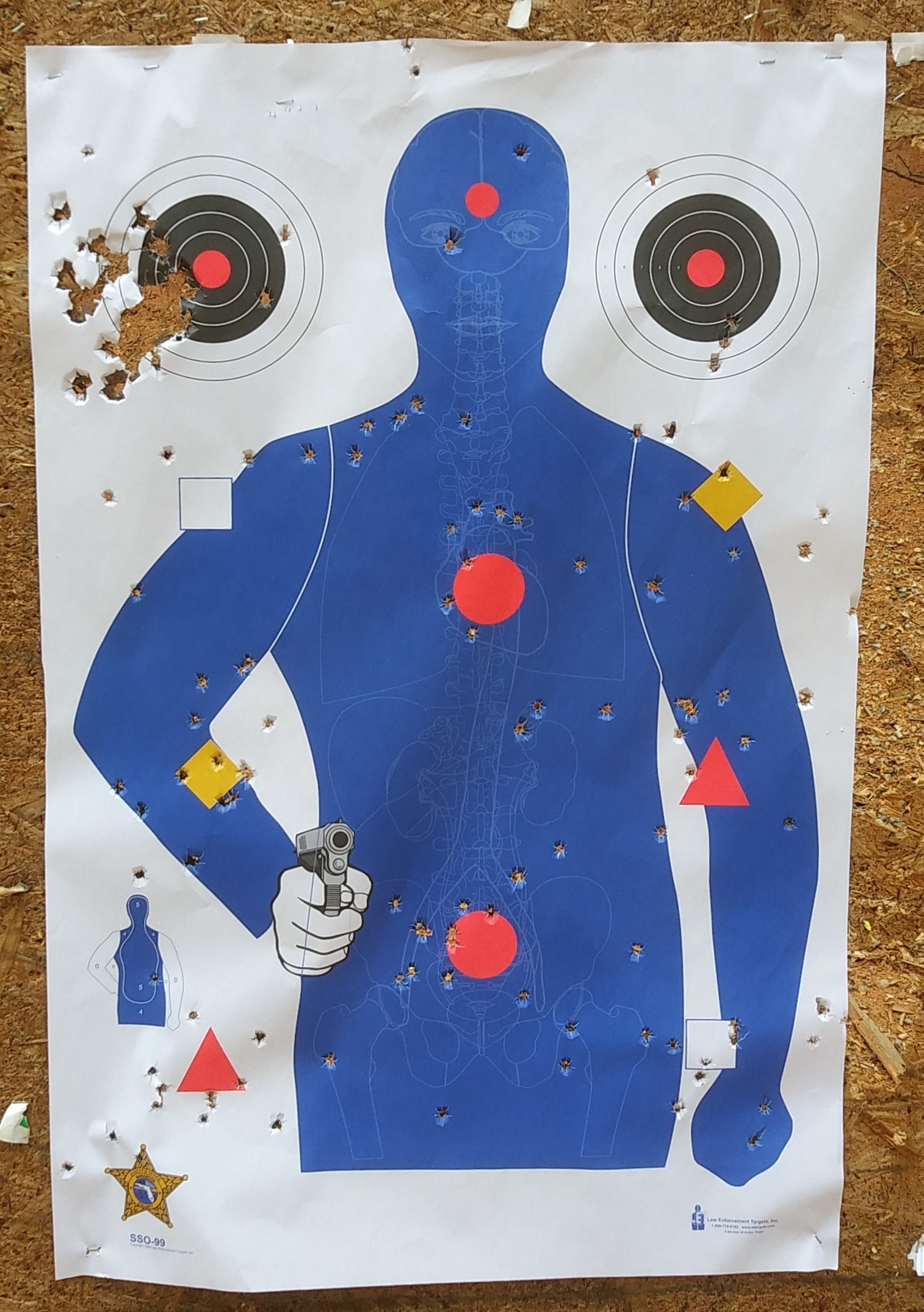
Scan and assess actually should occur in the reverse order, i.e., assess and scan. First, we want to assess the efficacy of our shooting on the initial threat and second, scan for additional threats. Assessment is properly done by looking through the sights to see if the opponent is still continuing the fight. If so, then additional and immediate sighted gunfire is the appropriate response. Note that during the assessment, the trigger finger is still going to be in the trigger guard and on the trigger, ready to instantly fire again, if necessary. Once the assessment determines that the attacker has been “neutralized with bullets,” https://www.cnn.com/2021/12/02/europe/sword-ninja-france-police-shot-intl/index.html then the finger comes out of the trigger guard, the pistol is lowered, and a scan for other threats begins.
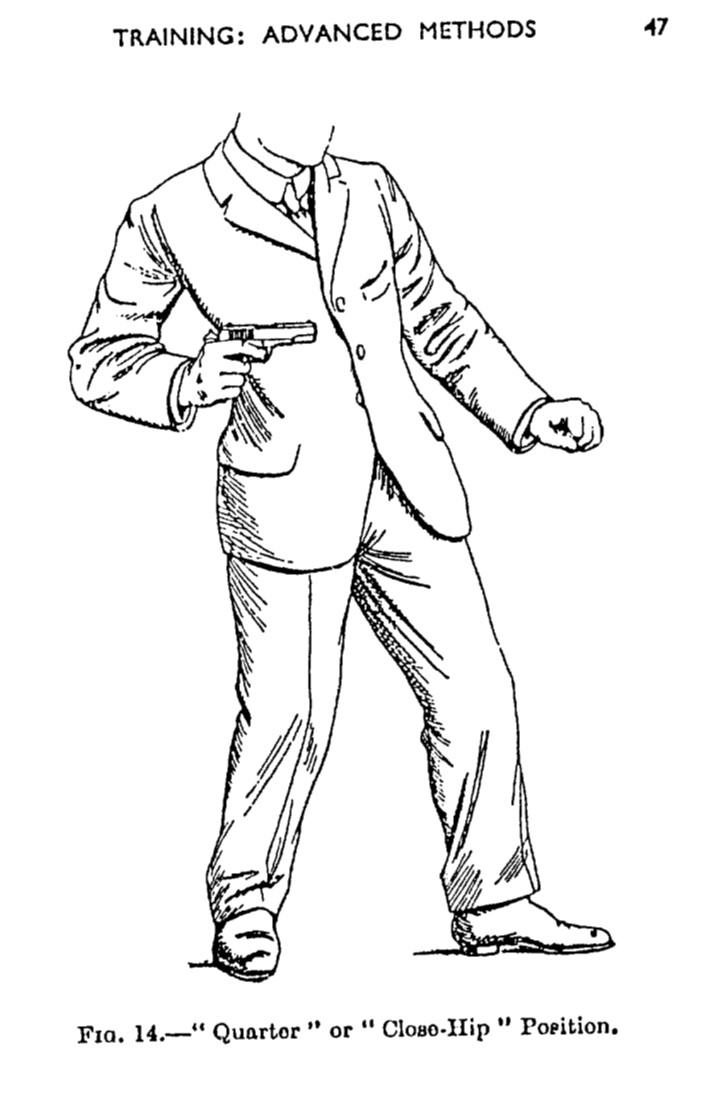
The desire by an criminal to close with a defender through a hail of bullets is a figbar of the imagination of certain segments of the training community. As the saying goes, “once the bullets start flying, everyone starts moving.” To which should be added, “away from the source of the bullets.” Assuming the fight is continuing, more accuracy will be required as the distance increases. This accuracy refinement is unlikely to be achieved by using a two handed version of the Fairbairn-Sykes “Quarter-hip” position.
A way to practice your follow-through is to count ‘one thousand’ after each shot prior to making any movement such as moving the gun, your head, or taking your finger off the trigger. Also be sure you’re keeping your eyes open during and after the shot. Blinking the eyes at the moment of ignition is far more common than most people know. Either a video camera or a partner to your side can help detect blinking.
There is a good article about how to develop follow-through on the NRA’s website.
https://www.nrafamily.org/articles/2020/4/6/follow-through-a-shooting-fundamental
The next Part will cover standards and measurement.
Part I https://tacticalprofessor.wordpress.com/2021/11/05/fundamentals-of-pistol-shooting-part-1/
Part 2 https://tacticalprofessor.wordpress.com/2021/11/12/fundamentals-of-pistol-shooting-part-2/
Part 3 https://tacticalprofessor.wordpress.com/2021/11/22/fundamentals-of-pistol-shooting-part-3/
Part 4 https://tacticalprofessor.wordpress.com/2021/12/03/fundamentals-of-pistol-shooting-part-4/
Tactical Professor books (all PDF)
- Indoor Range Practice Sessions http://indoorrangepracticesessions.com
- Concealed Carry Skills and Drills http://concealedcarryskillsanddrills.com
- Advanced Pistol Practice http://bit.ly/advancedpistolpractice
- Real Shootouts of the LAPD https://realshootoutsofthelapd.com/
- Thinking Clearly about Self-defense and Personal Protection https://www.payloadz.com/go?id=3377208
- Serious Mistakes Gunowners Make http://seriousgunownermistakes.com
- Shooting Your Black Rifle http://shootingyourblackrifle.com
- Package deal of Thinking Clearly about Self-defense and Personal Protection, Serious Mistakes, Indoor Sessions, Concealed Carry, and Shooting Your Black Rifle (50% off) https://store.payloadz.com/details/2644448-ebooks-sports-shooting-drills-package.html
Purchase of any book includes Serious Mistakes Gunowners Make.
STOPP Presentation at Rangemaster Tactical Conference
The direct purchase link for the STOPP Presentation is: https://www.payloadz.com/go?id=3381307
Fundamentals of Pistol Shooting (Part 4)
#fridayfundamentals
The third Fundamental of Pistol Shooting is:
- ‘Press the trigger smoothly and straight to the rear.’
First of all, let’s distinguish between ‘trigger manipulation,’ a physical process, and ‘trigger control,’ a mental process. Trigger control is the result of the Decide phase of each shot referenced in the first post of this series. Being a mental process, trigger control will not be addressed in this post.
Note that trigger manipulation has two components. The first, Press the trigger smoothly, is fairly well known even when it’s not well done. A dictionary definition of smoothly is:
in an even way, without suddenly stopping and starting again
https://www.oxfordlearnersdictionaries.com/us/definition/english/smoothly
Consider the way you squeeze a tube of toothpaste. While the trigger press is often much faster than that, as an analogy it describes the feel of the process fairly well. What we want to do is to press the trigger adequately to make the pistol fire and no more.
Pressing smoothly avoids trigger yanking, the opposite of Pressing the Trigger Smoothly. My friend and colleague Ken Hackathorn refers to yanking as ‘El Snatcho,’ which is a good way of describing it. Trigger yanking isn’t a problem in the Fairbairn-Sykes scenario of hitting a full size silhouette at two yards fifty percent of time. However, when the distance is greater, the hit standard higher, or the target is smaller, then we need to avoid yanking and press the trigger smoothly even if we must press it quickly.
The second component, straight to the rear, is not nearly as well understood. Our trigger fingers are not well set up to press the trigger straight to the rear. Physiologically, the finger most naturally moves in an arc curling toward the tip of the thumb. This is easily observed by manipulating the trigger finger without a pistol in your hand. To overcome this built in tendency, training the trigger finger is necessary. An easy practice exercise is available in the Press the trigger smoothly post. https://tacticalprofessor.wordpress.com/2018/11/16/press-the-trigger-smoothly/
This is a video with further explanation about the straight to the rear practice drill.
Learning to Press the trigger smoothly and straight to the rear is critical to becoming “A real shooter with aim.” Aim, as described in Part 2 of this Series, doesn’t do much good if you yank the pistol away from the target as you fire the shot.
The next Part will cover ‘Follow Through.’
Part 1 of the Series
https://tacticalprofessor.wordpress.com/2021/11/05/fundamentals-of-pistol-shooting-part-1/
Part 2 of the Series
https://tacticalprofessor.wordpress.com/2021/11/12/fundamentals-of-pistol-shooting-part-2/
Part 3 of the Series
https://tacticalprofessor.wordpress.com/2021/11/22/fundamentals-of-pistol-shooting-part-3/
Tactical Professor books (all PDF)
- Indoor Range Practice Sessions http://indoorrangepracticesessions.com
- Concealed Carry Skills and Drills http://concealedcarryskillsanddrills.com
- Advanced Pistol Practice http://bit.ly/advancedpistolpractice
- Real Shootouts of the LAPD https://realshootoutsofthelapd.com/
- Thinking Clearly about Self-defense and Personal Protection https://www.payloadz.com/go?id=3377208
- Serious Mistakes Gunowners Make http://seriousgunownermistakes.com
- Shooting Your Black Rifle http://shootingyourblackrifle.com
- Package deal of Thinking Clearly about Self-defense and Personal Protection, Serious Mistakes, Indoor Sessions, Concealed Carry, and Shooting Your Black Rifle (50% off) https://store.payloadz.com/details/2644448-ebooks-sports-shooting-drills-package.html
Purchase of any book includes Serious Mistakes Gunowners Make.
STOPP Presentation at Rangemaster Tactical Conference
Fundamentals of Pistol Shooting (Part 3)
The second Fundamental of Pistol Shooting is:
‘Visually index the pistol on target.’
This post is NOT intended to arouse more of the point shooting versus sighted fire debate. Those arguments are loaded with fuzzy definitions and the Telephone Game. The Telephone Game and the Training Industry Rather, it is an acknowledgement that humans are visual creatures. We are much more adept at hand-eye coordination when the eye guides the hand. Try hammering a nail sometime without being able to see the nail head. It doesn’t work very well.
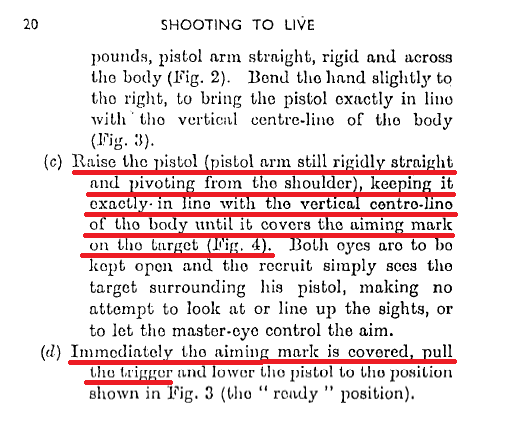
Even Fairbairn and Sykes tacitly acknowledged this in Shooting to Live. Notice the Firing Position that they began their Preliminary Course for Recruits with. It clearly demonstrates a visual reference to the target, even if that doesn’t include ‘aiming’ using the sights.

Another frequently overlooked concept in Shooting to Live is to “cover the aiming mark.” While not well explained in the book, it seems to imply the principle of ‘spot shooting’ Spot shooting that their contemporary Ed McGivern talked about explicitly.
The late great Jimmy Cirillo RIP Jim Cirillo developed a similar technique for teaching POlice officers. He called it the “weapon silhouette point.” With this technique, the silhouette of the gun, rather than the sights, is visually indexed on the target. Jimmy would actually tape the sights of the pistol to show that they were not required to make effective hits at close range. However, the gun itself had to be aligned on the target for the technique to be effective. Even without using the sights, there were aspects of spot shooting in classes that he conducted.
It’s worthwhile to keep in mind Tom Givens’ https://rangemaster.com/ comment about how inadequate the sights of autoloading pistols were in 1942 when Shooting to Live was written. Scott Jedlinski of the Modern Samurai Project https://www.modernsamuraiproject.com/ made a humorous quip at this year’s Rangemaster Tactical Conference. What is the Tactical Conference?
1911 sights in those days were ‘suggestions.’
The bottom line is that the most important line in pistol shooting is the eye-target line. The closer we get the gun to that line, the better our hits will be, even if TJ Hooker did teach you to keep the gun low.

Part I of the Series Fundamentals of Pistol Shooting (Part 1)
Part II of the Series Fundamentals of Pistol Shooting (Part 2)
The next segment will cover ‘Press the trigger smoothly and straight to the rear.’
Tactical Professor books (all PDF)
- Indoor Range Practice Sessions http://indoorrangepracticesessions.com
- Concealed Carry Skills and Drills http://concealedcarryskillsanddrills.com
- Advanced Pistol Practice http://bit.ly/advancedpistolpractice
- Real Shootouts of the LAPD https://realshootoutsofthelapd.com/
- Thinking Clearly about Self-defense and Personal Protection https://www.payloadz.com/go?id=3377208
- Serious Mistakes Gunowners Make http://seriousgunownermistakes.com
- Shooting Your Black Rifle http://shootingyourblackrifle.com
- Package deal of Thinking Clearly about Self-defense and Personal Protection, Serious Mistakes, Indoor Sessions, Concealed Carry, and Shooting Your Black Rifle (50% off) https://store.payloadz.com/details/2644448-ebooks-sports-shooting-drills-package.html
Purchase of any book includes Serious Mistakes Gunowners Make.
STOPP Presentation at Rangemaster Tactical Conference
The direct purchase link for the STOPP Presentation is: https://www.payloadz.com/go?id=3381307
Chicago Concealed Carry in the news
It pains me that my hometown of Chicargo has now become infamous as perhaps the murder capital of the world. The situation is so outrageous that I give thanks regularly I no longer live there.
Nearly 50 Shot During Weekend in Mayor Lori Lightfoot’s Chicago
The good news about Chicago now is that Private Citizens have the legal capability to carry firearms for personal protection.
Elderly retired firefighter with concealed carry [License] shoots Chicago robber dead: police
https://www.foxnews.com/us/chicago-elderly-man-firefighter-shoots-kills-robber
Chicago conceal carry [License] holder guns down car thief after being shot at in the street
https://www.foxnews.com/us/chicago-licensed-carry-holder-guns-down-car-thief-response-being-shot
It’s always entertaining when the media uses the term “guns down.” Makes it sound like an unlawful killing, even when it’s not.
Those of us who wanted to carry when I lived there either had to do so illegally or go through some rigmarole such as working an unpaid shift as a Cook County bailiff each month.
The story about the elderly firefighter defending himself pleases me so much that I’m offering Concealed Carry Skills and Drills and Indoor Range Practice Sessions along with a face target of the notorious BTK murderer for only $7.99. As always, my most important work, Serious Mistakes Gunowners Make is included at no extra cost.
Link to package:
https://www.payloadz.com/go?id=3384555
The custom face target, included as a PDF in the package.

Tactical Professor books (all PDF)
- Real Shootouts of the LAPD https://realshootoutsofthelapd.com/
- Thinking Clearly about Self-defense and Personal Protection https://www.payloadz.com/go?id=3377208
- Serious Mistakes Gunowners Make http://seriousgunownermistakes.com
- Indoor Range Practice Sessions http://indoorrangepracticesessions.com
- Concealed Carry Skills and Drills http://concealedcarryskillsanddrills.com
- Advanced Pistol Practice http://bit.ly/advancedpistolpractice
- Shooting Your Black Rifle http://shootingyourblackrifle.com
- Package deal of Thinking Clearly about Self-defense and Personal Protection, Serious Mistakes, Indoor Sessions, Concealed Carry, and Shooting Your Black Rifle (50% off) https://store.payloadz.com/details/2644448-ebooks-sports-shooting-drills-package.html
Purchase of any book includes Serious Mistakes Gunowners Make.
STOPP Presentation at Rangemaster Tactical Conference
The direct purchase link for the STOPP Presentation is:
Fundamentals of Pistol Shooting (Part 2)
#fridayfundamentals
The first Fundamental of Pistol Shooting is:
- Grip the pistol firmly.
The proper grip for any handgun should accomplish several objectives:
- Maximize our hand friction on the handgun. The way we prevent the handgun from moving around in our hand(s) is simply via friction. Therefore, the more hand surface we have in contact with the gun, the more friction we can achieve.
- Minimize the gun’s motion during recoil by stabilizing the supporting joints, principally the wrists, when the gun fires.
- Reduce the distance between the line of the handgun’s bore and our hands to the smallest amount possible. This diminishes the rotational torque generated by the handgun upon firing.
After establishing the appropriate grip, a series of index points can be used to feel when the grip has been properly achieved. Especially in defensive encounters, there is no time for visually checking whether the proper grip is in place. Having a set of index points allows a shooter to establish a proper firing grip in the holster and during the drawstroke to know that the grip is as it should be.
A previous blog post covered the grip in detail with illustrations. Click the image below to go to that post.

There have been endless discussions and opinions about how tightly to grip the pistol. These range from the ‘convulsive’ grip of the Fairbairn-Sykes-Applegate technique to the percentages of grip with both hands as explained by the Modern Technique/IPSC/USPSA school of thought.
Probably the easiest way to think about it is to grip the pistol as tightly as you would a hammer or baseball bat. Both hammers and baseball bats require you to grip the tool tightly enough to prevent it from moving in your hand before, during, and after an impact. That’s the same thing we’re trying to accomplish with the pistol.
The next segment will cover ‘Visually index the pistol on target.’
Tactical Professor books (all PDF)
- Indoor Range Practice Sessions http://indoorrangepracticesessions.com
- Concealed Carry Skills and Drills http://concealedcarryskillsanddrills.com
- Advanced Pistol Practice http://bit.ly/advancedpistolpractice
- Real Shootouts of the LAPD https://realshootoutsofthelapd.com/
- Thinking Clearly about Self-defense and Personal Protection https://www.payloadz.com/go?id=3377208
- Serious Mistakes Gunowners Make http://seriousgunownermistakes.com
- Shooting Your Black Rifle http://shootingyourblackrifle.com
- Package deal of Thinking Clearly about Self-defense and Personal Protection, Serious Mistakes, Indoor Sessions, Concealed Carry, and Shooting Your Black Rifle (50% off) https://store.payloadz.com/details/2644448-ebooks-sports-shooting-drills-package.html
Purchase of any book includes Serious Mistakes Gunowners Make.
STOPP Presentation at Rangemaster Tactical Conference
The direct purchase link for the STOPP Presentation is: https://www.payloadz.com/go?id=3381307
Points of Likely Contact
Sometimes we can be aware of danger zones and other times we can be on the lookout for specific spots where a predator might lay in ambush for the unsuspecting. The latter can be described as Points of Likely Contact. Recessed doorways, pillars inside parking garages, and dumpsters are examples of PoLC.
Today as I was on my daily walk, I noticed a suspicious individual hanging out behind a dumpster I pass by. There’s not really any good reason for someone to be hanging around a dumpster at noon that I can think of. So I made a detour through another pathway and walked around the front of the building instead of behind it.
This situation is a good example of Area of Interest and Area of Influence.

I’m interested in an Area that far exceeds the range of my weapons or a predator’s weapons. In this case, I saw him at least 35 yards away, so I had plenty of time and space to make a detour. No need to make any contact with lowlifes at all, if I can Avoid them. Avoid is the first, and most desirable, element of the Avoid, Escape, Confront, Resist paradigm.

When the terrain permits, my Area of Interest is 100 yards or more. For example, the distance from the turn lane guidepoles to the traffic light is about 130 yards. I’m actively watching distances that far away when I can.
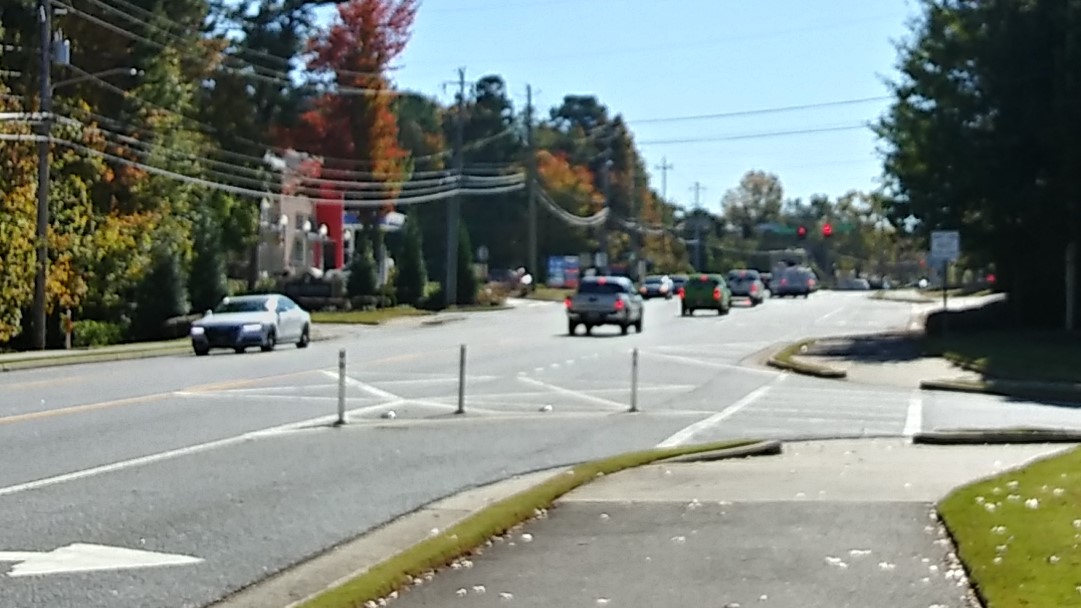
I keep my eyes on the horizon whenever I can. That maximizes my view of my Area of Interest. This is also a good technique when driving. Look past the bumper of the car in front of you and as far into the traffic ahead as you can.
New Package Deal
It was suggested that I create a package of the STOPP Presentation and Advanced Pistol Practice. That package is now available at:
https://www.payloadz.com/go?id=3384448
As with all of my materials, purchase of the package also includes Serious Mistakes Gunowners Make.
When the time for talking is over
When someone pulls a deadly weapon on you, the time for posturing and talking is over. Regardless of whether it’s an edged weapon, gun, or impact tool, at that point the adversary has displayed deadly intent. In terms of the Avoid, Escape, Confront, Resist paradigm, you should either be Escaping or Resisting not Confronting.
You might use some De-escalation words as you move away, but that’s merely a ploy to buy time not a serious attempt to defuse the situation.
“They say running is good for your health, in my neighborhood, it can save your life.” –Chicargo humor
The need for this mindset was very clear in the Calvin ‘Mad Dog’ Gonnigan incident https://wgntv.com/news/courts-man-killed-1-wounded-2-in-south-austin-after-plea-to-stop-shooting-gun-on-july-4/. It also applied to several other incidents that have been brought to my attention recently.
Practice changing direction quickly and be ready to do it at a moment’s notice. Break Contact as soon as you can.
Tactical Professor books (all PDF)
- Thinking Clearly about Self-defense and Personal Protection https://www.payloadz.com/go?id=3377208
- Indoor Range Practice Sessions http://indoorrangepracticesessions.com
- Concealed Carry Skills and Drills http://concealedcarryskillsanddrills.com
- Advanced Pistol Practice http://bit.ly/advancedpistolpractice
- Real Shootouts of the LAPD https://realshootoutsofthelapd.com/
- Serious Mistakes Gunowners Make http://seriousgunownermistakes.com
- Shooting Your Black Rifle http://shootingyourblackrifle.com
- Package deal of Thinking Clearly about Self-defense and Personal Protection, Serious Mistakes, Indoor Sessions, Concealed Carry, and Shooting Your Black Rifle (50% off) https://store.payloadz.com/details/2644448-ebooks-sports-shooting-drills-package.html
Purchase of any book includes Serious Mistakes Gunowners Make.
 tacticalprofessor
You must be logged in to post a comment.