When the time for talking is over
When someone pulls a deadly weapon on you, the time for posturing and talking is over. Regardless of whether it’s an edged weapon, gun, or impact tool, at that point the adversary has displayed deadly intent. In terms of the Avoid, Escape, Confront, Resist paradigm, you should either be Escaping or Resisting not Confronting.
You might use some De-escalation words as you move away, but that’s merely a ploy to buy time not a serious attempt to defuse the situation.
“They say running is good for your health, in my neighborhood, it can save your life.” –Chicargo humor
The need for this mindset was very clear in the Calvin ‘Mad Dog’ Gonnigan incident https://wgntv.com/news/courts-man-killed-1-wounded-2-in-south-austin-after-plea-to-stop-shooting-gun-on-july-4/. It also applied to several other incidents that have been brought to my attention recently.
Practice changing direction quickly and be ready to do it at a moment’s notice. Break Contact as soon as you can.
Tactical Professor books (all PDF)
- Thinking Clearly about Self-defense and Personal Protection https://www.payloadz.com/go?id=3377208
- Indoor Range Practice Sessions http://indoorrangepracticesessions.com
- Concealed Carry Skills and Drills http://concealedcarryskillsanddrills.com
- Advanced Pistol Practice http://bit.ly/advancedpistolpractice
- Real Shootouts of the LAPD https://realshootoutsofthelapd.com/
- Serious Mistakes Gunowners Make http://seriousgunownermistakes.com
- Shooting Your Black Rifle http://shootingyourblackrifle.com
- Package deal of Thinking Clearly about Self-defense and Personal Protection, Serious Mistakes, Indoor Sessions, Concealed Carry, and Shooting Your Black Rifle (50% off) https://store.payloadz.com/details/2644448-ebooks-sports-shooting-drills-package.html
Purchase of any book includes Serious Mistakes Gunowners Make.
STOPP Presentation at Rangemaster Tactical Conference
Fundamentals of Pistol Shooting (Part 1)
#fridayfundamentals

During my time teaching at the elite Rogers Shooting School, I refined the Fundamentals of Pistol Shooting down to Four elements. In order of doing them, they are:
- Grip the pistol firmly.
- See the sights.
- Press the trigger smoothly.
- Follow through.
Any time a shooter missed a target before it went away, (disappearing targets do that) not performing one element on that list was the cause.
Over time, nuances of those elements have changed in my mind about how to explain them but the basic concepts remain the same. Now I break the process into two phases, ‘Preparing for the Shot’ and ‘Making the Shot.’ The reason is that between the two mechanical, i.e., physical, phases there are two decisions that have to be made; 1) the Don’t Shoot/Shoot decision and 2) whether the preparation for the shot is adequate to make a hit. The concept of making a decision about adequate preparation was developed by my colleague Brian Hill of The Complete Combatant http://www.thecompletecombatant.com/ and it’s right on target, no pun intended.
The overall process could be described as:
- Prepare for the shot
- Grip the pistol firmly
- Visually index the pistol on target
- Decide
- Don’t Shoot/Shoot
- Whether there is adequate preparation to make a hit
- Make the shot
- Press the trigger smoothly and straight to the rear
- Follow through
The decision step is a mental process, not a physical one, so it will not be included in this series.
Training aids and Memory aids are useful tools. As a Memory aid for the Fundamentals, I’ve created the bookmark shown at the beginning of the post to provide a quick reference guide to the mechanical aspects of the Fundamentals. The PDF is attached so you can download it, print it, fold it, and use it as an everyday reminder to keep the Fundamentals fresh in your mind.
This series will have an additional four Parts on the next four Fridays. Each post will explain one element of the Fundamentals in greater detail. I hope you will find the series useful.
Tactical Professor books (all PDF) — Note: bad links fixed
- Indoor Range Practice Sessions http://indoorrangepracticesessions.com
- Concealed Carry Skills and Drills http://concealedcarryskillsanddrills.com
- Advanced Pistol Practice http://bit.ly/advancedpistolpractice
- Real Shootouts of the LAPD https://realshootoutsofthelapd.com/
- Thinking Clearly about Self-defense and Personal Protection https://www.payloadz.com/go?id=3377208
- Serious Mistakes Gunowners Make http://seriousgunownermistakes.com
- Shooting Your Black Rifle http://shootingyourblackrifle.com
- Package deal of Thinking Clearly about Self-defense and Personal Protection, Serious Mistakes, Indoor Sessions, Concealed Carry, and Shooting Your Black Rifle (50% off) https://store.payloadz.com/details/2644448-ebooks-sports-shooting-drills-package.html
Purchase of any book includes Serious Mistakes Gunowners Make.
STOPP Presentation at Rangemaster Tactical Conference
The direct purchase link for the STOPP Presentation is https://www.payloadz.com/go?id=3381307
Don’ts in the news
Several don’ts can be seen in this incident and the subsequent story.
- Don’t go outside to investigate noises in the night.
- Don’t challenge people who are not on your property.
- Don’t shoot someone in the back when he is running away from you.
- Don’t make comments on a public forum that you think this kind of behavior is justifiable and/or commendable.
Billy, don’t be a hero, don’t be a fool with your life
The arrest report for the incident states that the shootee is intubated and unable to make a statement. Odds are good that Mr. Locke is going to do time in prison for Aggravated Battery with a Firearm. Think clearly about what your Mission is and what Negative Outcomes can occur to you. Do your thinking and planning ahead of time. Program yourself mentally for Positive Outcomes and avoiding Serious Mistakes.
Tactical Professor books (all PDF) — Note: bad links fixed
- Real Shootouts of the LAPD https://realshootoutsofthelapd.com/
- Thinking Clearly about Self-defense and Personal Protection https://www.payloadz.com/go?id=3377208
- Serious Mistakes Gunowners Make http://seriousgunownermistakes.com
- Indoor Range Practice Sessions http://indoorrangepracticesessions.com
- Concealed Carry Skills and Drills http://concealedcarryskillsanddrills.com
- Advanced Pistol Practice http://bit.ly/advancedpistolpractice
- Shooting Your Black Rifle http://shootingyourblackrifle.com
- Package deal of Thinking Clearly about Self-defense and Personal Protection, Serious Mistakes, Indoor Sessions, Concealed Carry, and Shooting Your Black Rifle (50% off) https://store.payloadz.com/details/2644448-ebooks-sports-shooting-drills-package.html
Purchase of any book includes Serious Mistakes Gunowners Make.
STOPP Presentation at Rangemaster Tactical Conference
The direct purchase link for the STOPP Presentation is https://www.payloadz.com/go?id=3381307
Skills involved in the Oakland Incident (Part I)
#saturdayskills
An aspect of POlice Use of Deadly Force incidents is that they tend to receive more media and other coverage than successful Private Citizen incidents. Captain (Ret.) Ersie Joyner’s gas station shootout in Oakland https://www.ktvu.com/news/retired-oakland-police-captain-wounded-1-other-killed-during-gas-station-gun-battle is no exception. Given the media’s bias, if this had occurred to a lawfully carrying Private Citizen, it’s unlikely it would have received the degree of favorable coverage it has. The amount of coverage works in our favor when viewing it from the standpoint of Lessons to be Learned.
The surveillance video of the incident gives us a very definite view of the skillset Captain Joyner used. It also gives us the opportunity to wargame other skills or tactics that would have been desirable.
- Wait for an opportunity to escape or counterattack
- Create distance while maintaining visual contact with assailants
- Establish grip
- Make the Draw Decision
- Draw to the eye-target line
- Engage Mr. Red, preferably with at least two rounds
- Transition 60 degrees and engage Mr. Black, preferably with at least two rounds
- Actual Positioning – pursue into the open
- Alternative Positioning – pursue to a position of cover or at least concealment
- Desirable Positioning – create even more distance
- Desirable Positioning – take cover
Tasks 3, 5, 6, and 7 constitute the solution to the shooting aspects of the incident. Individually, they are very similar to the 6 and 10 foot Stages of the Louisiana Qual Course video.
Just as with the off-duty incidents chronicled in Real Shootouts of the LAPD https://realshootoutsofthelapd.com/, it’s not hard to picture a Private Citizen becoming involved in exactly this same scenario. If Kalifornia had a Shall Issue system for issuing licenses/permits to carry handguns, it’s probable that more such Outcomes would occur.
An interesting aspect of the incident was that despite three robbers physically searching the victim, his concealed handgun was not discovered. This seems unusual. A distinct possibility is that he carried a small pistol in his pocket. At the moment he began to access his handgun, his elbow position is much more consistent with a pocket draw than either an Appendix or Hip carry draw.

Task 3, Establish Grip, is the most time consuming part of the drawstroke. Surreptitiously being able to Establish Grip while creating distance and prior to making the Draw Decision would explain how Captain Joyner was able to Draw and Engage so quickly. The ability to Establish Grip without making the motions commonly associated with drawing a pistol is one of the strengths of pocket carry. In many cases, it’s possible to shield an attacker’s view of Establishing Grip by slightly blading one’s body, although Captain Joyner didn’t do that in this case.
Captain Joyner must be exceptionally coordinated because when executing Task 2, Create Distance, he was actually able to take three steps backward without tripping over his own feet. He was able to do this even while he was in the process of Establishing Grip. Humorously speaking, since we’ve been told that tripping over one’s feet when walking backward is almost inevitable, this was an absolutely amazing display of physical prowess. In actuality, using a dragging shuffle step probably would have been more of a giveaway to his assailants than simply walking backward.
The mother of the deceased robber made the statement to the press, “death was not the answer. many people act unruly and even commit crimes in young adulthood, but go on to lead productive lives.” Captain Joyner clearly felt that his own death was not the answer and good for him for making that decision. Even if a criminal doesn’t intend to shoot you, it doesn’t mean they won’t have an Unintentional Discharge and kill you ‘by accident.’
More about the skills involved and how to practice them will be covered in a future Part II.
Tactical Professor books (all PDF) — Note: bad links fixed
- Real Shootouts of the LAPD https://realshootoutsofthelapd.com/
- Thinking Clearly about Self-defense and Personal Protection https://www.payloadz.com/go?id=3377208
- Serious Mistakes Gunowners Make http://seriousgunownermistakes.com
- Indoor Range Practice Sessions http://indoorrangepracticesessions.com
- Concealed Carry Skills and Drills http://concealedcarryskillsanddrills.com
- Advanced Pistol Practice http://bit.ly/advancedpistolpractice
- Shooting Your Black Rifle http://shootingyourblackrifle.com
- Package deal of Thinking Clearly about Self-defense and Personal Protection, Serious Mistakes, Indoor Sessions, Concealed Carry, and Shooting Your Black Rifle (50% off) https://store.payloadz.com/details/2644448-ebooks-sports-shooting-drills-package.html
Purchase of any book includes Serious Mistakes Gunowners Make.
STOPP Presentation at Rangemaster Tactical Conference
The direct purchase link for the STOPP Presentation is https://www.payloadz.com/go?id=3381307
Breaking Contact (Part 6)
#walkbackwednesday

It makes me happy that my thoughts about the explicit difference in the missions of Law Enforcement and Private Citizens are becoming mainstream. I appreciate the various members of the training community who are amplifying my concept that Breaking Contact is the fundamental mission of Private Citizens in self-defense or defense of others. My colleague John Correia has produced an excellent video about a recent incident with numerous learning points in it.
My initial takeaways from the ASP video.
- pay attention and recognize when you’re in a transitional space
- when your gas gets started pumping, step around to the other side of your vehicle
- purposeful compliance until your counter-attack or escape opportunity arises
- counter ambush (i.e., counter-attack)
- different missions between law enforcement officers and private citizens
- the mission for a private citizen defensive encounter is to break contact
- only hits count (close range precision marksmanship)
The close range precision marksmanship of this incident are particularly noticeable in the video. Although Mr. Red was only double arm’s length (5 feet) away, he was also in profile. His target area in total was no larger than a sheet of paper in portrait mode.

Mr. Black was about triple arm’s length (8 feet) away. Like Mr. Red, he was also a profile target and his target area was not very large.
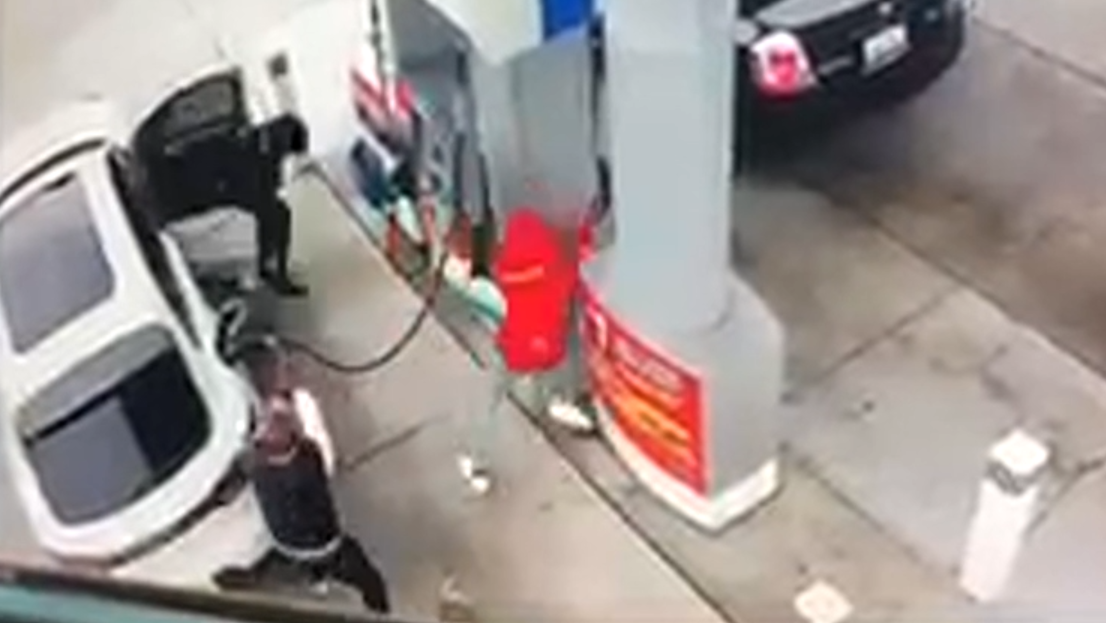
The ability to hit an eight inch circle or even smaller target at close range with the first shot can be essential to survival. Regardless of what one thinks about using the sights under stress, it’s obvious that Captain Joyner had his pistol in his eye-target line. He did this despite both attackers being within proxemic Social Space. An important note about Captain Joyner is that this wasn’t his first rodeo; Oakland is a tough place.
Over his career, Joyner was involved in five shootings as an officer
KTVU
Breaking Contact is one of the fundamental concepts of Thinking Clearly about Self-defense and Personal Protection https://www.payloadz.com/go?id=3377208 It’s a strategy in the sense of doing the right things, as opposed to tactics, which are doing things right.
CCW Safe https://ccwsafe.com/ did an excellent series of blog posts about the concept of Breaking Contact. The key principle and goal is contained in the first post.
Our goal in personal protection is to force a break in contact. We want them to go away, or we want to go away. One or the other.
- Part 1 – https://ccwsafe.com/blog/breaking-contact-pt-1
- Part 2 – https://ccwsafe.com/blog/breaking-contact-pt-2
- Part 3 – https://ccwsafe.com/blog/breaking-contact-pt-3
- Part 4 – https://ccwsafe.com/blog/breaking-contact-pt-4
- Part 5 – https://ccwsafe.com/blog/breaking-contact-pt-5
My article about the basic philosophy of breaking contact is here.
The Oakland POlice Department has posted a clear picture of the getaway vehicle.

Tactical Professor books (all PDF)
- Thinking Clearly about Self-defense and Personal Protection https://www.payloadz.com/go?id=3377208
- Real Shootouts of the LAPD https://realshootoutsofthelapd.com/
- Serious Mistakes Gunowners Make http://seriousgunownermistakes.com
- Indoor Range Practice Sessions http://indoorrangepracticesessions.com
- Concealed Carry Skills and Drills http://concealedcarryskillsanddrills.com
- Advanced Pistol Practice http://bit.ly/advancedpistolpractice
- Shooting Your Black Rifle http://shootingyourblackrifle.com
- Package deal of Thinking Clearly about Self-defense and Personal Protection, Serious Mistakes, Indoor Sessions, Concealed Carry, and Shooting Your Black Rifle (50% off) https://store.payloadz.com/details/2644448-ebooks-sports-shooting-drills-package.html
Purchase of any book includes Serious Mistakes Gunowners Make.
STOPP Presentation at Rangemaster Tactical Conference
The Baldwin Killing (Part I)
Since I’ve been asked several times my opinion about the Baldwin Killing, I’ll address those questions from the perspective of firearms safety only. The incident is a high profile example of a Serious Mistake leading to a Negative Outcome. Such a tragic event bears analysis to see what are the lessons that can be learned to prevent other such incidents, either on a movie set or in our personal lives, in the future.
For those who haven’t read the news lately, actor Alec Baldwin unintentionally discharged a revolver on a movie set last week. https://www.independent.co.uk/arts-entertainment/films/news/alec-baldwin-shooting-halyna-hutchins-latest-b1945263.html The film’s Cinematographer was killed by a single bullet that struck her in the torso and the Director was injured. RIP Ms. Hutchins.
Those who are interested in a legal aspects of the case can find my colleague Andrew Branca’s initial legal analysis on YouTube. https://youtu.be/upDuj8Ec Such an analysis is out of my league, so I will stay in my own lane and confine my comments to safety.
What occurred points out a very simple fact of life:
Firearms, like electricity, are relentlessly unforgiving of the slightest lapse in attention
The Tactical Professor
One of the slides in the NRA Basics of Pistol Shooting Course states that Ignorance and Carelessness are the causes of firearms accidents.

The concept of ‘tolerance stackup’ often applies when an Unintentional Discharge occurs. By this we mean that when Ignorance and Carelessness overlap each other, the possibility of a Negative Outcome dramatically increases. Sadly for Ms. Hutchins, she was downrange when that overlap occurred.
A comment was made on an earlier version of Andrew’s video about the probability that the gun being used was a single action revolver. The commentator noted that the manual of arms of a single action is more complicated than a modern autoloading pistol. The extra steps involved in clearing a single action may have contributed to the discharge. For once, a comment was worth reading. Extra caution needs to be taken when handing firearms that have an unfamiliar and perhaps difficult manual of arms. That’s definitely a lesson that can be taken away from the incident.
There is no standard manual of arms that can be applied across all firearms, even modern ones. For instance, the Ruger LCP has a manual device for locking open the action but it does not lock open automatically. Conversely, the KelTec P-32 and P3AT do not have an external device to lock open the slide and require an empty magazine to do so. Despite the fact that the guns look very similar, they operate differently and require the operator to understand how to work them.
Another comment on the earlier Branca video came from a POlice firearms instructor who said there were at least 11 different firearms safety rules that have to be observed on any firearms range. While a case can be made for that argument, 11 or more rules constitutes a checklist that has to be written down. The need for long lists to be written down, i.e., a checklist, was learned in aviation somewhere around a century ago. While appropriate for range operators, and perhaps the film’s armorer, it’s not compatible with the way the human mind works. A memory aid has to be short, e.g., the Four Rules, or organized as an acronym, e.g., SALUTE.
The Four Rules of Safe Gunhandling are a good memory aid. However, we need to keep in mind that a memory aid is not a full explanation of the concepts being remembered, it is merely a way to jog our memories about what the base concepts are so we can apply them fully. The distinction between checklists, memory aids, and the concepts either are based on is another lesson we can take away from The Baldwin Killing.
“That could never happen to me” thinking is one reason I developed the underlying concepts contained in Serious Mistakes Gunowners Make http://seriousgunownermistakes.com years ago. I didn’t intend it for Hollywood actors but in retrospect, I wish the entire crew of the movie had read it. I’m not trying to be facetious or unkind to Ms. Hutchins’ memory by saying that.
More thoughts about The Baldwin Killing tomorrow.
Tactical Professor books (all PDF)
- Serious Mistakes Gunowners Make http://seriousgunownermistakes.com
- Real Shootouts of the LAPD https://realshootoutsofthelapd.com/
- Thinking Clearly about Self-defense and Personal Protection https://www.payloadz.com/go?id=3377208
- Indoor Range Practice Sessions http://indoorrangepracticesessions.com
- Concealed Carry Skills and Drills http://concealedcarryskillsanddrills.com
- Advanced Pistol Practice http://bit.ly/advancedpistolpractice
- Shooting Your Black Rifle http://shootingyourblackrifle.com
- Package deal of Thinking Clearly about Self-defense and Personal Protection, Serious Mistakes, Indoor Sessions, Concealed Carry, and Shooting Your Black Rifle (50% off) https://store.payloadz.com/details/2644448-ebooks-sports-shooting-drills-package.html
Purchase of any book includes Serious Mistakes Gunowners Make.
STOPP Presentation at Rangemaster Tactical Conference
Failing the Interview
To my knowledge, John Farnam https://defense-training.com/ coined the term “Failing the Interview.” It is an acknowledgement that the victimization process has two parties, the criminal and the potential victim. Criminals rarely attack victims by doing a ‘Tueller Drill.’ With very rare exceptions, criminal usage of what is commonly called the Tueller Drill is almost exclusively confined to ‘Breaking out of encirclement’ when confronted by the POlice.
Even the most inexperienced criminal knows that proper victim selection is paramount to continued success in criminal endeavors. Poor victim selection, especially in environments where potential victims may be armed, can lead to incarceration at the least and even being shot to death by the victim.
Rather than an abrupt approach, criminals observe a potential victim and decide whether they have or can gain a significant advantage over the victim. It is the first step of Boyd’s Process from the viewpoint of a criminal predator.
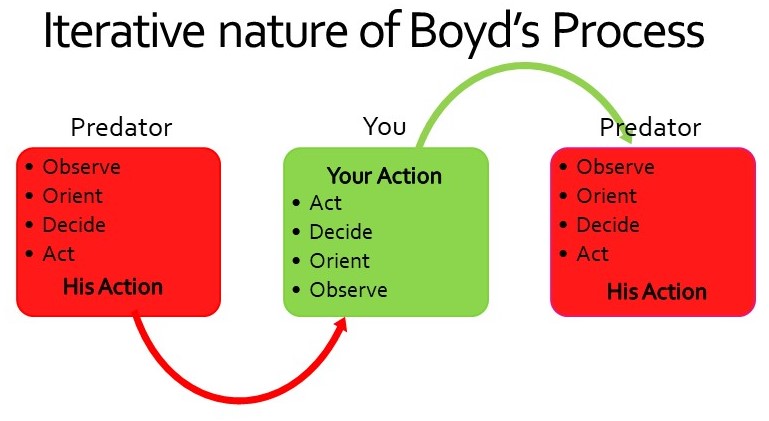
This can occur either as an Ambush or during a Movement to Contact, i.e., a hunting expedition. If they feel they can gain an advantage, the victimization process begins. If the criminal doesn’t feel they can gain an advantage, i.e., a GO condition, then they wait or search for another potential victim. This victimization decision process is “The Interview.” It usually takes place without the knowledge of the potential victim, although at times it will be an actual verbal interview.
What I’m looking for, Claude, is big ole bag of money.
A polished and experienced armed robber or extortionist to me on one occasion.
“Failing the interview” is the result of the potential victim’s portrayal of self as being someone who will be difficult to gain an advantage over or who will be uncooperative with the victimization process.
Well, what I’ve got is a bunch of empty tool bags.
My reply to the criminal.
I was tempted to say “I get off work at 10 p.m. Meet me in the parking lot and we’ll get this over with today” but I decided to avoid getting The Last Word In. For both of us, this was merely a rehearsal rather than an actual incident. Criminals practice dry repetitions of their repertoires just like we do.
What is the process to Fail the Interview? The first step to set ourselves up for success in this regard is to be aware of our surroundings. Both we and criminals have an Area of Interest and an Area of Influence.

https://www.jcs.mil/Portals/36/Documents/Doctrine/pubs/jp3_0ch1.pdf?ver=2018-11-27-160457-910
We want the criminal to make a NO GO decision on us while we are still in his Area of Interest and before we reach his Area of Influence. The NO GO decision is the absence of a GO decision. The default for criminals is NO GO because criminals know there are plenty of two-legged cheeseburgers walking around and the next one will be along in just a minute or two.
The second step is to portray ourselves as someone who is aware of and will not cooperate with the victimization process. Although the term ‘victim blaming’ is has been in vogue for some years, that concept is often an excuse for ignorant or foolish behavior. When someone gets badly sunburned, we don’t blame the Sun, we ask why the person spent so much time in the Sun without adequate sunscreen.
As my colleague Brian Hill http://www.thecompletecombatant.com/ points out, walking around with one’s face buried in a cell phone places a person in a posture of submission. Whether the person is actually submissive or not, that posture sets the tone for the victimization process to begin. Blithely talking on a cell phone in transitional spaces is another key indicator to a criminal that the potential victim is not paying attention to their surroundings. This is a way of setting one’s self up for predation. Being aware of our surroundings is a passive way of defeating the predator’s intent.
There are also active ways of Failing the Interview. The easiest is to openly indicate an intent to be uncooperative. Changing direction, displaying positive body language, or simply saying NO https://tacticalprofessor.wordpress.com/2017/09/21/keep-your-tape-loops-short/ are non-violent ways of signaling an uncooperative attitude. They fall into the areas of Escape and Confront in the Avoid, Escape, Confront, Resist https://tacticalprofessor.wordpress.com/2021/07/31/recognition-primed-decision-making-part-iv/ paradigm.
The list of ways to Fail, or Not Fail, the interview is extensive. The first step of all of them is to recognize that The Interview exists and make conscious and continuous efforts to Fail it. If we are effective at Failing the Interview, we won’t have to escalate to the Resist step of A-E-C-R. Preempting the need to go to active Resistance is our best bet for avoiding a Negative Outcome, either during the encounter or afterward.
In every encounter, there is an element of chance.
John Hall, former Head of the FBI Firearms Training Unit
Tactical Professor books (all PDF)
- Real Shootouts of the LAPD https://realshootoutsofthelapd.com/
- Thinking Clearly about Self-defense and Personal Protection https://www.payloadz.com/go?id=3377208
- Serious Mistakes Gunowners Make http://seriousgunownermistakes.com
- Indoor Range Practice Sessions http://indoorrangepracticesessions.com
- Concealed Carry Skills and Drills http://concealedcarryskillsanddrills.com
- Advanced Pistol Practice http://bit.ly/advancedpistolpractice
- Shooting Your Black Rifle http://shootingyourblackrifle.com
- Package deal of Thinking Clearly about Self-defense and Personal Protection, Serious Mistakes, Indoor Sessions, Concealed Carry, and Shooting Your Black Rifle (50% off) https://store.payloadz.com/details/2644448-ebooks-sports-shooting-drills-package.html
Purchase of any book includes Serious Mistakes Gunowners Make.
STOPP Presentation at Rangemaster Tactical Conference
The LCP Project – Ill-Annoy CCL Qualification (5 yard stage)
Continuing The LCP Project, this video shows the 5 yard stage of the Illinois (Ill-Annoy) Concealed Carry License Qualification shot with a Ruger LCP. This stage was shot by drawing from a concealed holster, although a concealed draw is not required when shooting the Qualification to obtain a CCL. The 10 required shots were fired as 3 shots in 3 seconds 3 times. The 10th shot was a shot to the face in 3 seconds.
The 5 yard face shot reminds me of something my Dad once said to a would be robber, “Do you want it in the belly or the teeth?” The robber suddenly remembered an appointment he was late for and left. No shooting was necessary in that incident. My shot placement on the Qual was unintentional but brought back a memory.
Ammo for the LCP Project was furnished by Ammoman https://www.ammoman.com/
The 10 yard stage video can be seen at https://youtu.be/3EKAoExWDE0
Tactical Professor books (all PDF)
- Thinking Clearly about Self-defense and Personal Protection https://www.payloadz.com/go?id=3377208
- Real Shootouts of the LAPD https://realshootoutsofthelapd.com/
- Serious Mistakes Gunowners Make http://seriousgunownermistakes.com
- Indoor Range Practice Sessions http://indoorrangepracticesessions.com
- Concealed Carry Skills and Drills http://concealedcarryskillsanddrills.com
- Advanced Pistol Practice http://bit.ly/advancedpistolpractice
- Shooting Your Black Rifle http://shootingyourblackrifle.com
- Package deal of Thinking Clearly about Self-defense and Personal Protection, Serious Mistakes, Indoor Sessions, Concealed Carry, and Shooting Your Black Rifle (50% off) https://store.payloadz.com/details/2644448-ebooks-sports-shooting-drills-package.html
Purchase of any book includes Serious Mistakes Gunowners Make.
STOPP Presentation at Rangemaster Tactical Conference
The LCP Project – Ill-Annoy CCL Qualification
The Ruger LCP is a far more capable gun than it’s given credit for. The LCP Project is intended to show what the gun is capable of and some modifications and equipment that are useful when carrying and shooting it.
This video shows the 10 yard stage of the Illinois (Ill-Annoy) Concealed Carry License Qualification shot with a Ruger LCP. The target was a standard B-27 with the addition of a legal size sheet of paper. The sheet of paper is the size of the scoring area of the Illinois POlice qualification that the CCL Qual is derived from. The score on the legal sized sheet was 100%. Note that when the Course is shot to obtain a CCL, hits anywhere on the silhouette count and only 21 hits (70%) are required to pass.
Ammo for the LCP Project was furnished by Ammoman https://www.ammoman.com/
Tactical Professor books (all PDF)
- Thinking Clearly about Self-defense and Personal Protection https://www.payloadz.com/go?id=3377208
- Real Shootouts of the LAPD https://realshootoutsofthelapd.com/
- Serious Mistakes Gunowners Make http://seriousgunownermistakes.com
- Indoor Range Practice Sessions http://indoorrangepracticesessions.com
- Concealed Carry Skills and Drills http://concealedcarryskillsanddrills.com
- Advanced Pistol Practice http://bit.ly/advancedpistolpractice
- Shooting Your Black Rifle http://shootingyourblackrifle.com
- Package deal of Thinking Clearly about Self-defense and Personal Protection, Serious Mistakes, Indoor Sessions, Concealed Carry, and Shooting Your Black Rifle (50% off) https://store.payloadz.com/details/2644448-ebooks-sports-shooting-drills-package.html
Purchase of any book includes Serious Mistakes Gunowners Make.
STOPP Presentation at Rangemaster Tactical Conference
Defense of Others
#fridayfundamentals
‘Self-defense’ is only one subset of Personal Protection. Defense of Others is the other subset. September’s Armed Citizen column of the NRA Journals Shooting Illustrated – September 2021 has two incidents involving Defense of Others. Both occurred in public places outside the home. One was successful, the other Not So Much. Defense of Others situations often do not fall in the 3 shots, 3 seconds, 3 yards paradigm.
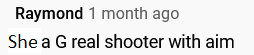
In the successful incident, a man and woman were in a Madera, California Wal-Mart parking lot. The man was attacked, the woman pulled out her pistol from her car, fired one round, and dropped the attacker in his tracks at 10 yards. In the words of commentator Raymond:
In the Not So Much successful incident, Calvin ‘Mad Dog’ Gonnigan shot at three people in Chicargo who were celebrating Independence Day. A nearby Concealed Carry Licensee shot at ‘Mad Dog’ but only peripherally wounded him several times. ‘Mad Dog’ left but then came back to murder one of his victims by shooting her in the face and even further seriously wounding the other two victims. Eventually, the POlice arrived from the District Headquarters, which was a block away, and took ‘Mad Dog’ into custody.

Madera County is largely rural. It’s a likely bet that the woman had practiced her aim before. Chicargo, being an urban area, is unlikely to result in much practice. That’s probably why ‘Mad Dog’ did most of his shooting at close range and probably why the CCL was not particularly successful. The Illinois qualification course can be passed by only hitting one shot out of 10 at 10 yards and that only has to hit an arm of the silhouette target.
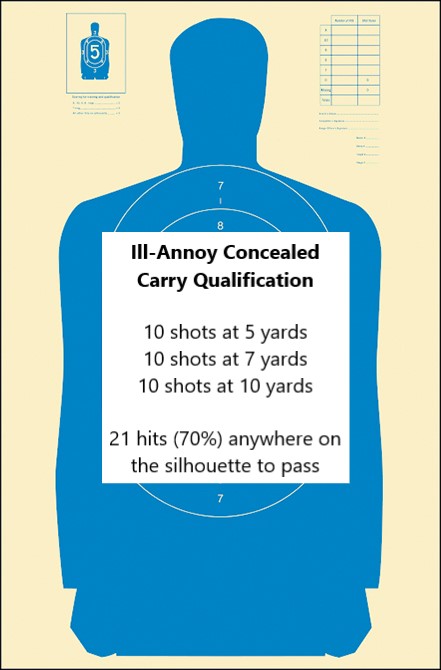
For those who carry a gun not only to protect themselves but also to protect their loved ones and friends, getting in a little structured practice can be useful, maybe even life saving. Indoor Range Practice Sessions http://indoorrangepracticesessions.com has a series of drills that could be done even in Chicargoland. And Serious Mistakes Gunowners Make is included with your purchase.

Tactical Professor books (all PDF)
- Thinking Clearly about Self-defense and Personal Protection https://www.payloadz.com/go?id=3377208
- Real Shootouts of the LAPD https://realshootoutsofthelapd.com/
- Serious Mistakes Gunowners Make http://seriousgunownermistakes.com
- Indoor Range Practice Sessions http://indoorrangepracticesessions.com
- Concealed Carry Skills and Drills http://concealedcarryskillsanddrills.com
- Advanced Pistol Practice http://bit.ly/advancedpistolpractice
- Shooting Your Black Rifle http://shootingyourblackrifle.com
- Package deal of Thinking Clearly about Self-defense and Personal Protection, Serious Mistakes, Indoor Sessions, Concealed Carry, and Shooting Your Black Rifle (50% off) https://store.payloadz.com/details/2644448-ebooks-sports-shooting-drills-package.html
Purchase of any book includes Serious Mistakes Gunowners Make.
STOPP Presentation at Rangemaster Tactical Conference
https://tacticalprofessor.wordpress.com/2021/09/14/stopp-presentation-now-available/ https://www.payloadz.com/go?id=3381307
 tacticalprofessor
You must be logged in to post a comment.