Putting Orient Back into OODA
The latest edition of The Tactical Wire is the Concealed Carry Special Edition. It includes an article about the OODA Cycle that I authored.
The OODA cycle, frequently referred to as the OODA Loop, was developed by the late Colonel John R. Boyd, USAF. The OODA cycle has subsequently become highly influential in thinking about how to conduct combat operations at all levels from the tactical to the grand strategic. It is often simplistically depicted with only four components in a circle, although that hardly does justice to the depth of Boyd’s thought.
What it’s not is what is so often pictured.

A better way to look at it would be this:
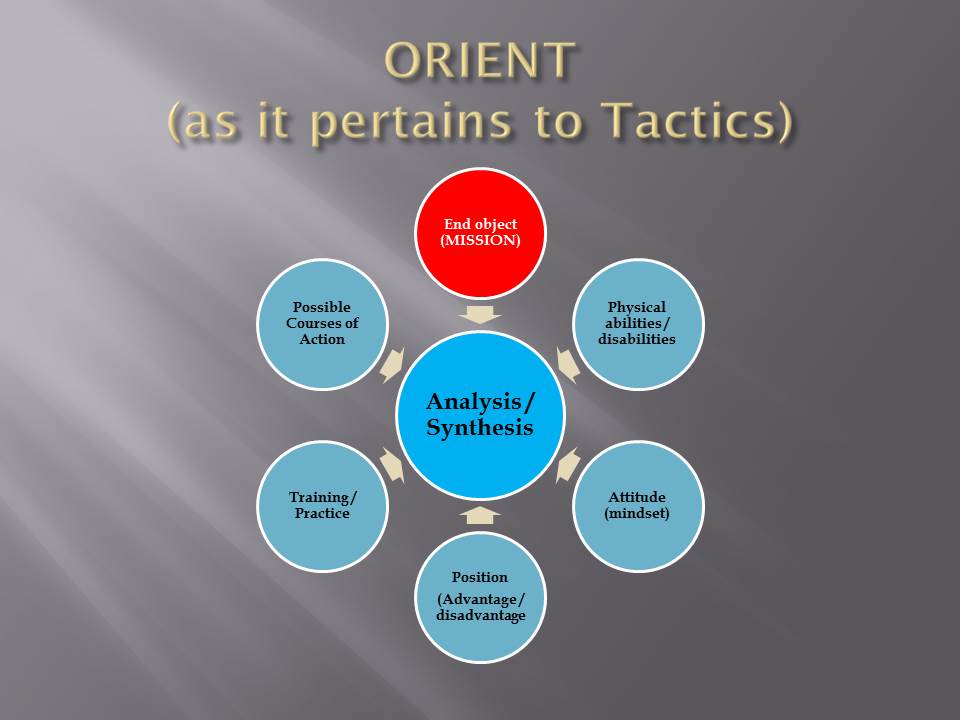
The article is my explanation of why. There are several other good articles also.
http://www.theoutdoorwire.com/specials/ccse2015/feature.php?id=229663
Situational Awareness and Positioning (part V)
In every encounter, there is an element of chance.
–John Hall, former head of the FBI Firearms Training Unit
In previous parts of this series (I-IV), the concept discussed was physical awareness and positioning in relation to an adversary or situation. A recent incident captured on video relates to a different but similar concept: emotional awareness and positioning.
In the incident, a veteran observed a bum aka ‘homeless person’ wearing a mixed service uniform while panhandling. He was justifiably incensed, as would be most veterans. “I was angry. I was frustrated. I was sad” he said. I don’t blame him. However, what resulted from his feelings was neither smart nor legally justifiable.
The veteran aggressively challenged the bum from a distance, then closed with him, pursued him across several lanes of traffic, and continued to pursue him on the other side of the boulevard. As the incident unfolds, the bum tries to disengage, is verbally apologetic, and changes direction several times attempting to escape. The entire time the veteran is loudly shouting, verbally forces the bum to remove part of his clothing, and then blocks the bum’s escape path. The incident went on for several minutes.
While I sympathize with the veteran’s frustration, the simple fact of the matter is that he let his emotions get away from him. A couple of relevant declarations made at this year’s Rangemaster Tactical Conference come to mind.
- John Hearne, in his presentation Performance Under Fire, made the statement “You’ve got to keep your emotions under control.”
- My colleague Nick Hughes mentioned to me in conversation a question he poses in his book, How To Be Your Own Bodyguard. “Are you doing this because you have to or because you want to?” He then related a personal anecdote where a person had to remind him of his own question.
When the veteran/bum video was posted on Facebook, I had two responses.
- Good way to get stabbed.
- Regardless of what I was doing, if someone acted toward me the way the veteran did toward the bum, I would have painted him orange in a New York second. And the police would have then told me to have a nice day. It was aggressive challenging behavior that anyone would be justified in feeling threatened by (although not sufficiently to employ lethal force, which is why I advocate always carrying pepper spray).
If we go looking for trouble, we had better be prepared to find it. Make no mistake: verbally challenging someone, shouting at them, chasing them, forcing them to remove their clothing, and then blocking their escape route is looking for trouble. Such a situation always has branching possibilities (if, then, else) that people don’t generally consider before jumping over the edge of the cliff.
- If the bum had pulled out a knife, then what would have been an appropriate, or even possible, response at that point? I make the assumption that all itinerants I encounter are armed with some kind of weapon.
- What if the bum had run out in front of a car and been struck and killed?
- What if a car had hit the vet while he was chasing the bum across the street?
- What if they had gotten into a physical conflict and ended up rolling around in traffic?
There are other possibilities also, but those are good examples of possible Negative Outcomes well within the realm of possibility. In any of those cases, the situation would have gone downhill for the vet like an avalanche.
So, let’s go back to Nick’s question: was the vet doing this because he had to or because he wanted to? That answer is quite clear, he wanted to. He felt the need to defend the honor of his service and the service of his fellow veterans.
Unfortunately, it’s very hard to provide a legal, or even moral, justification for using force to defend honor. Even if no legal repercussions arise, moral ones can. If the bum had run into traffic and been struck and killed, how do you think the veteran would have felt for the rest of his life, even if no charges were filed against him?
John Farnam’s saying “Avoid stupid people, stupid places, and stupid things” is definitely apropos in this situation. All three of those elements were broken. Jeff Cooper alluded many years ago to the fact that the more ‘rules’ we break simultaneously, the more possibility we will incur a problem. When we lose control of our emotions, that’s when we start unconsciously breaking rules, whether they are legal rules or just rules of good judgment and conduct.
With every decision we make, we are setting ourselves up either for success or failure. Keeping a check on our emotions helps set ourselves up for success. Letting our emotions get out of control is good way to set ourselves up for failure.
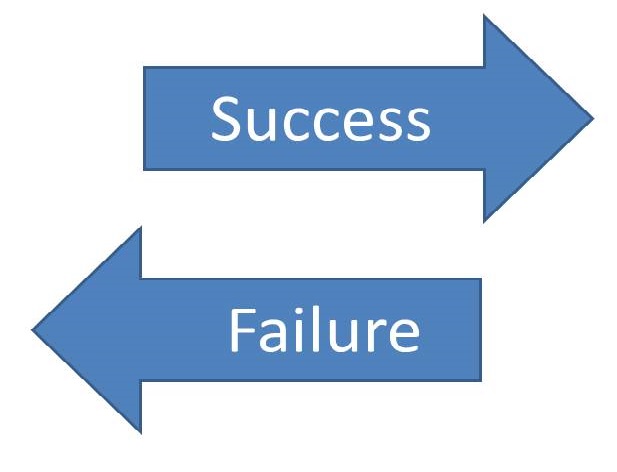
Not thinking things through
A completely irrelevant post on Facebook (a new flamethrower) brought something to mind that I hadn’t thought about in a couple of decades. It relates to the concept of defining the mission, desired outcome, and possible consequences. Those are things integral, yet unstated, to the Orient phase of the OODA process and fundamental to achieving success.
Most discussions about OODA get caught up in the speed aspect, which is actually a tertiary part of the process. It’s not just a simple speed-based looping cycle, as is often depicted.
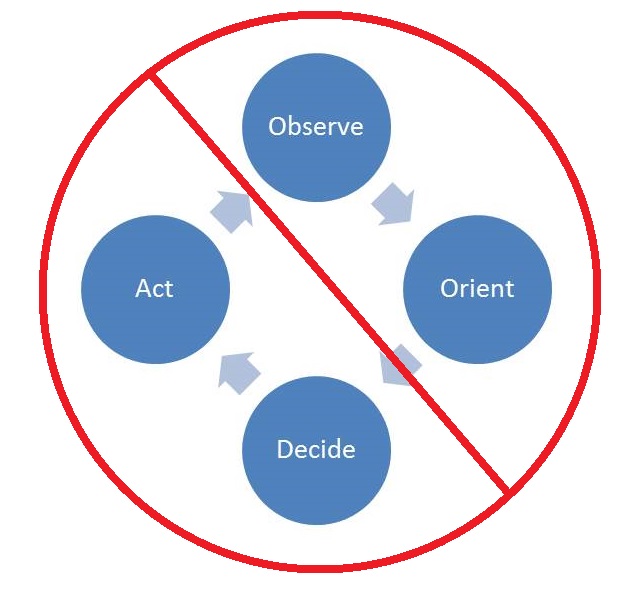
Years ago, I had a friend who didn’t care for guns but kept a flare pistol for home defense. She mentioned this to me in conversation. Her logic was that she didn’t want to kill someone. My response was “So you don’t want to kill someone but you’re okay with launching something into him that burns at several thousand degrees and might burn your house down?” She said she hadn’t thought about it that way. It certainly would have been possible for her to Act quickly but would it have been a good decision? I don’t think so.
It’s easy to get caught up in a linear process from the starting point without looking far enough down the path to a likely result and consequence. One component of Awareness is to keep your head up and look far down the road, just as you should when driving, rather than being fixated on the bumper in front of you.
It’s important to note that what is considered the most successful recent example of Boyd’s thinking was the planning of the First Gulf War. It took months and involved several different iterations of the strategic plan. In Boyd’s original hand drawn diagram of the OODA process, he actually had three different loops; one depicting planning, one depicting execution, and a third showing an overlay of the previous two. The third version is the popularized full diagram but it obscures the importance of the analysis/synthesis part of the process. There are many inputs necessary, including consequences, before an effective decision can be made. That planning is what makes rapid, effective Action possible.
Keeping in mind the desired outcome has to always be part of our decision-making. ‘Outcome Based Decision-Making’ should be an integral part of our thought process. As they said in DEA:
Focus on the object, not on the obstacle.
Lima Goes to Hollywood and The Power of the Grey Man
There’s a lot to being a grey man. Many worthwhile observations in this post.

Amidst all the media attention surrounding my Babywearing and Carrying class was a call from CBS’s show, “The Doctors.” They thought my class was interesting and wanted to fly me out to California to talk about it. It took me a few days to get to the place where I decided to take the trip. I said yes on Tuesday, had a travel itinerary on Wednesday night and was on a plane on Thursday.
This is the first solo trip I’ve taken in a very long time to a destination that doesn’t include rendezvousing with friends or family or a firearms class.
No lie, the idea of two days in Hollywood by myself was very appealing though the reminders to be careful started in earnest along with concerns of, “Aren’t you nervous to be traveling by yourself?”
I don’t subscribe to that kind of worry and fear. Lots of people…
View original post 1,365 more words
Grace at Night
[This lady]
“made a list of ten factors that can make an incident traumatic. Eight of the ten happened [in their incident]:1. In your home
2. In the presence of children
3. Prolonged
4. Death and rape threats
5. Guns
6. Theft
7. Beating
8. Shots fired
9. Rape
10. Murder”

One week ago our family went through a harrowing, life-changing experience. This is how my husband described last Tuesday evening in a prayer update:
Last night at about 9:45 pm at our house, Caleb announced to Amy and I as we worked on a paint job in the children’s room that three men had just entered our back door. When I got to the door, I saw two guns brandished among the three criminals. Though we offered all our money and goods to them they beat me and hit Amy twice.
We are praising the Lord that after about 15 minutes wherein they tore the house apart, we were able to chase them away. They took some material possessions, but our lives and honor were spared because of the good hand of our God who placed a wall between our lives and their weapons.
Tomorrow, we are taking a…
View original post 1,710 more words
Negative Outcomes: Self-Inflicted Gun Shot Wounds (Part II)
Unfortunately, once we covered up the trigger guard, the path was paved for negligent discharges going back into the holster. Carelessly leaving the finger inside the trigger guard when reholstering will result in the holster helping the finger press the trigger. That’s not the holster’s fault, it’s the user’s.
Situational Awareness and Positioning (part IV)
There are so many times in a day when you have to let people into your space. I think we have to accept it. My tolerance changes radically when I’m in transitional areas like parking lots etc.
–DTOM
It’s important to take context into account when speaking about SAP. There’s been some commentary about my post that I must not live in a big city or ever take the subway. Since I grew up in Chicargo and live in Atlanta, that’s not true. I ride public transportation quite often, even when I don’t have to.
The comment about transitional areas is on point. Rarely are we concerned about being robbed or beaten up in line at Starbucks. The video of the dude getting mugged in NOLA recently is more our concern and representative of the positioning I’m getting at.

While public places, e.g., the coffee shop in Lakewood WA, and crowds are not totally risk free, I think my colleague William Aprill would say our risk profile for violent crime is lower there than in transitional areas or when we are alone. The criminal incidents that I personally have had to deal with all fell in those two categories. Either positioning or awareness, along with will, allowed me to control those situations. Controlling the situations allowed them to conclude without anyone getting shot or stabbed, which is my desired outcome.
In fact, one of my encounters took place at a MARTA train station in Atlanta at 9 a.m. I was alone and midway through the station on my way to work, so both criteria (alone and in transition) were met. It was what I call an “opportunistic meeting engagement.” Three individuals coming from another direction apparently liked the fact I was on crutches and in a boot from a recent surgery. It was the first time in my life I experienced Clint Smith’s saying “Predators look at you like you’re food.” But I saw their look, change of demeanor, and change of direction from the full width of the upper platform while they were still about 15 yards away. That immediately put me into Condition Orange and I initiated my reaction. Because I had seen them so far away, I had time to react on my terms, rather than theirs. There was no escape for me since I could barely hobble on my crutches. So I faced them, put my hand in my overcoat pocket on my snub revolver and said to myself “Guys, this isn’t going to turn out the way you think it is.” I don’t believe I said it out loud and no words were exchanged between us. At the moment I thought it though, the Marine Corps Drill Team could not have done a better Right Flank, March than those guys did, in unison. Clearly, this was not their first rodeo.
What happened was that they targeted me in an obvious fashion. When a sketchy character, or three of them, changes direction and begins to close with you, it’s an indicator that an incident is developing. As a police officer friend says “Nothing good is coming of that.” However, I failed to act in the way I was supposed to. In John Farnam’s vernacular, I ‘failed the interview.’ Most criminal predations on the street begin with an evaluation by the predator as to whether it has the potential for being a successful victimization, as opposed to turning into a fight. Economic predators are not generally interested in a fight. They know all too well that there is an element of chance in every violent encounter. That is not to say they won’t fight, but rather given the choice between a victimization and a fight, they will pick the victimization.
So our object is to see them early enough and understand what is happening such that we can set ourselves up to fail the interview. The criminal then moves on to find another victim. I would prefer that they pick an undercover police officer and then get dealt with.
However, what happens afterward is not my problem. I am not a police officer; my weapons and tactics are for protecting me and mine, not society at large. That’s the way our legal system is structured; I understand it and abide by it.
Situational Awareness and Positioning (part III)
When he got within 5 or 6 feet… Lawler leveled the Glock and fired once, hitting DeCosta in the groin.
Man pulls 13-inch knife during fight, gets shot
A previous post discussed The Tueller Principle, or as Dennis put it originally “How Close Is Too Close?” In light of the above incident, The Tueller Principle and two related concepts bear further clarification and quantification.
A concept that is seldom discussed in the personal protection community, among either instructors or practitioners, is proxemics. The term proxemics was originated by a cultural anthropologist, Edward Hall, in his book The Hidden Dimension. Its meaning is how we, as humans, interpret and manage the physical space around us. This should be an integral part of planning for personal protection, but usually is not.
Professor Hall’s work breaks out several spatial zones that we perceive around us. Most important to us regarding the realm of personal protection is that we make instinctive judgments about whom we allow into these zones and what our reactions are to those who enter, or try to enter, the zones.
- Intimate Space – where we only allow loved ones to be.
- Personal Space – the area in which we are comfortable having people we know and trust.
- Social Space – the zone where we communicate and/or interact with others generally.
- Public Space – an area where we accept that people in general can be, regardless of whether we know them or are interacting with them.
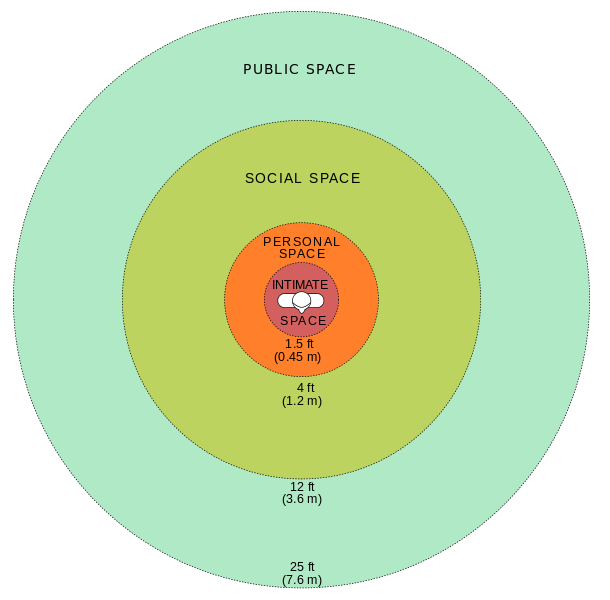
Diagram by WebHamster
It is also important to note that Hall’s work was preceded and partially inspired by the work of a Swiss zoologist, Dr. Heini Hediger. After extensive study of animals in the wild, Dr Hediger, in his book Wild Animals in Captivity, introduced several concepts about predator-prey behavior that are particularly relevant to the personal protection community.
- Flight distance – the distance at which prey will seek to escape the approach of a predator.
- Defense distance – the point at which pursued prey, which is being overtaken by a predator, will have a ‘defense reaction,’ in the words of Dr. Hediger.
- Critical distance – the boundary at which prey that is cornered, or feels it is, will initiate a counter-attack on the predator. I.e., the prey has lost its ability to maneuver or escape (decisively engaged) and then reacts in an emergency mode.
Dr. Hediger states that these distances “are specific, within certain limits, and may be accurately measured, often within inches.” p20 When he says inches, he is referring to very small animals; larger animals will generally be measured at intervals of feet or yards/meters. The larger the animal, the greater each distance will be, generally speaking.
The questions that then arise are: 1) what is the overlap between the works of Tueller, Hall, and Hediger and 2) why is that overlap important? Hall theorized that Hediger’s concepts of flight, defense, and critical distance are no longer applicable to humans. However, I do not believe that is true. Human behavior during a criminal predation tends to follow Dr. Hediger’s concept quite closely.
The incident described in the first paragraph is an excellent example of a phenomenon I observed in my long term study of The Armed Citizen and other reports of armed self-defense by private citizens. My impression after the study of thousands of incidents was that people tended to allow human predators to encroach not quite to arm’s length before shooting. When I say encroach, I do not mean actually shoot at, as in a gunfight, but rather attempt to close the distance, whether armed or unarmed.
Encroaching is actually more dangerous than a full throttle attack. If an armed predator runs at us at full speed, it’s obvious what his intent is and our decision becomes fairly simple. On the other hand, an encroachment induces uncertainty into the encounter, in the form of the question “How Close Is Too Close?” Of course, if gunfire is being exchanged, then typical spatial boundaries and zones no longer apply.
Shooting a human predator, especially when he is encroaching, is a communication and social transaction. It is the strongest form of communicating “Stop, don’t come any closer!” Dr. Hediger would term this the critical reaction that occurs at ‘Critical Distance.’ My impression is that it will most likely occur in what Hall termed the ‘near phase of Social Space.’ For North Americans, this zone is between four and seven feet. In other words, our Critical Distance lies within that zone. We will do what we need to do to prevent a predator from crossing the boundary between Social Space and our Personal Space.
How does this relate to The Tueller Principle? The minimum safe boundary established by Tueller is 21 feet. However, the boundary that Hall theorized between public space and social space is only 12 feet. What this means is that we will have an inherent tendency to allow people, and specifically predators, to approach us well with the boundary of safety established by Tueller. That 12 foot boundary for Social Space may be the maximum boundary of our Flight Distance, even with a sketchy character. If our Critical Distance is only 4-7 feet, that could represent a major problem when dealing with a predator.
My late colleague Paul Gomez periodically quizzically commented that “people don’t shoot criminals far enough away.” The relationship between the concepts of Tueller, Hall, and Hediger may be the reason why. It’s something we in the training community need to do a better job of explaining and training.
Situational awareness is not just about seeing what’s going on; it’s also about interpreting that information and what to do about it.
At least a half-dozen times, I ordered him to stop.
Another of my colleagues commented to me “We only say ‘Drop the gun’ once around here.”
Things I learned from the Masters
Reflecting on Shunryu Suzuki’s comment – “In the beginner’s mind there are many possibilities, but in the expert’s there are few,” some frequently ignored or overlooked fundamentals taught by people who have been at this a long time come to mind. My research on ‘bad shootings’ has reinforced some things to me.
Jeff Cooper – The Four Rules
1. ALL GUNS ARE ALWAYS LOADED.
2. NEVER LET THE MUZZLE COVER ANYTHING YOU ARE NOT PREPARED TO DESTROY.
3. KEEP YOUR FINGER OFF THE TRIGGER UNTIL YOUR SIGHTS ARE ON THE TARGET.
4. BE SURE OF YOUR TARGET AND WHAT IS BEYOND IT.
John Farnam
The person most likely to shoot you is YOU. Why? Because you’re always there.
Bill Rogers
• Muzzle direction is the primary safety; always has been and always will be.
• Identify your target at night, preferably with a flashlight, before you shoot it.
The Most Dangerous Man
• Shooting isn’t always the optimal solution.
• Holding someone at gunpoint isn’t as easy as it seems.
Ken Hackathorn –
It’s a downrange world
Massad Ayoob
Avoiding the problem (implied task) is a lot easier than fixing the problem, either at the moment or in the legal system later.
Concealed Carry and Printing
Do you even follow Michael Kors and Kate Spade, bro?
Yet another uninformed and ignorant discussion about clothing, guns, and ‘dressing around the gun’ came to my attention today. Here was one of the comments.
People are so unaware of what is around them, they never notice printing. The only time I really worry about it is when I am entering a non permissive environment. I make sure to readjust and cover with my under shirt and top shirt, instead of just my top shirt.
And another.
Nobody has ever noticed when I’ve carried, as far as I know. Nobody has ever said anything, anyway.
When the story about the Arkansas Realtor® who was recently murdered surfaced, I did some texting with a friend about Louis Vuitton handbags and knockoffs. She packs her heater in her purse every day. Although it’s long, I am going to put her commentary here in its entirety because the level of detail is important to observe and understand. My original question was “When I see women carrying Louis Vuitton handbags, are they actually paying $1-3K for them or are those knockoffs?” Here was her response:
Wow… that’s a good question. If you put a[n] authentic bag beside a replica, you can easily tell. Here are a few other ways to tell…Authentic bags follow a pattern and are continuous. There’s never a bottom seam. So, on 1 side of the bag, the LV is upside down because it is cut from a single canvas. The pattern across the bag and on the ends will touch a seam, but the pattern should mirror itself and be even across the sides or end.
The hardware on the bags are always brass. The thread used on the handle is always a mustard yellow and the top stitching shows 5 stitches across. The inside of the handle has burgundy piping, and over time the handle will turn dark brown because it is made from vachetta cowhide leather. The LV monogram will never be broken in a pattern and the V sits a little higher than the L in the monogram. The date stamp is underneath the pocket on the inside of the bag and is always evenly spaced.
The tag on the bag has the LV logo as well as Louis Vuitton Made in Paris. The mustard yellow stitching will create a V shape and almost touches the top of the LV logo. The size of the bag is also on a leather tab…25, 35, etc. That’s the width of the bottom of the bag.
Oh, and the inside of the bag is a solid chocolate leather.
Guys, if you think a woman like that, and there are many, doesn’t notice everything that is the slightest bit out of place with your clothing, you are ignorant and uninformed about how conscious most women are about clothing and style. Now, I have no doubt that People of Walmart don’t notice your T-shirt is pulled down over your full size service pistol. OTOH, the moment you walk into any White Collar business environment, you may as well assume you’re busted. That woman might not say anything to you because she MAY want your business, at least initially. However, don’t labor for one second under the illusion that she doesn’t notice something out of place, even if she’s not quite sure what it means. It’s as obvious to her as a Hi-Point at an IPSC match would be to us. It’s funny how many people who carry weapons tend to assume that the only type of “worst case scenario” is running into some meth head who is trained in mixed martial arts and is carrying a brace of Glock 22s with another brace of Glock 27s on his ankles for backup.
With the escalating number of signs prohibiting weapons, whether they have the force of law or not, and the amount of public hoopla about active shooters, getting made while carrying is going to become more of an issue in the future. Sooner, more likely than later, businesses are going to start calling the police if they suspect someone is packing a gun in violation of their company’s posted policy. Even if the sign doesn’t have force of law, having several police officers come up to you out of the Blue and escort you off the property will be unpleasant. It also has the potential for an Officer Involved Shooting with you as the shootee.
One of the major problems in the training community is that almost every trainer with a Mil or LE background has not spent one single day actually working in the White Collar or Retail Business environments. Unfortunately, what this means is that although they can teach you how to run a pistol well, they are utterly unqualified to even speak about Concealed Carry, as it pertains to most people, much less teach it. Even Jeff Cooper admitted that when he wore a suit, he carried a J frame revolver, not a 1911. Of course, Jeff actually owned suits and knew how to tie a tie.
If we really want to extend the opportunity to ‘always carry’ to an expanding percentage of the American populace, we’re going to have to come up with a better concept than ‘dress around the gun.’ Every time I hear that phrase, it makes me cringe. Whenever the vast majority of people who don’t buy their clothes at WalMart hear it, they think “that’s not me,” as my psychologist friend William Aprill clued me in to several years ago.


You must be logged in to post a comment.