What is the Tactical Conference?
The Rangemaster Tactical Conference started as an International Defensive Pistol Association Major Match in the late 1990s. The IDPA Indoor Winter Championship, as it was then called, was held at Rangemaster’s facility at that time in Memphis, Tennessee. The organizer was Tom Givens, the owner of Rangemaster, a long time pistol competitor, and the leading trainer for Tennessee Concealed Pistol Licenses in Memphis. It was a large enough event to be featured as a segment on Shooting USA.
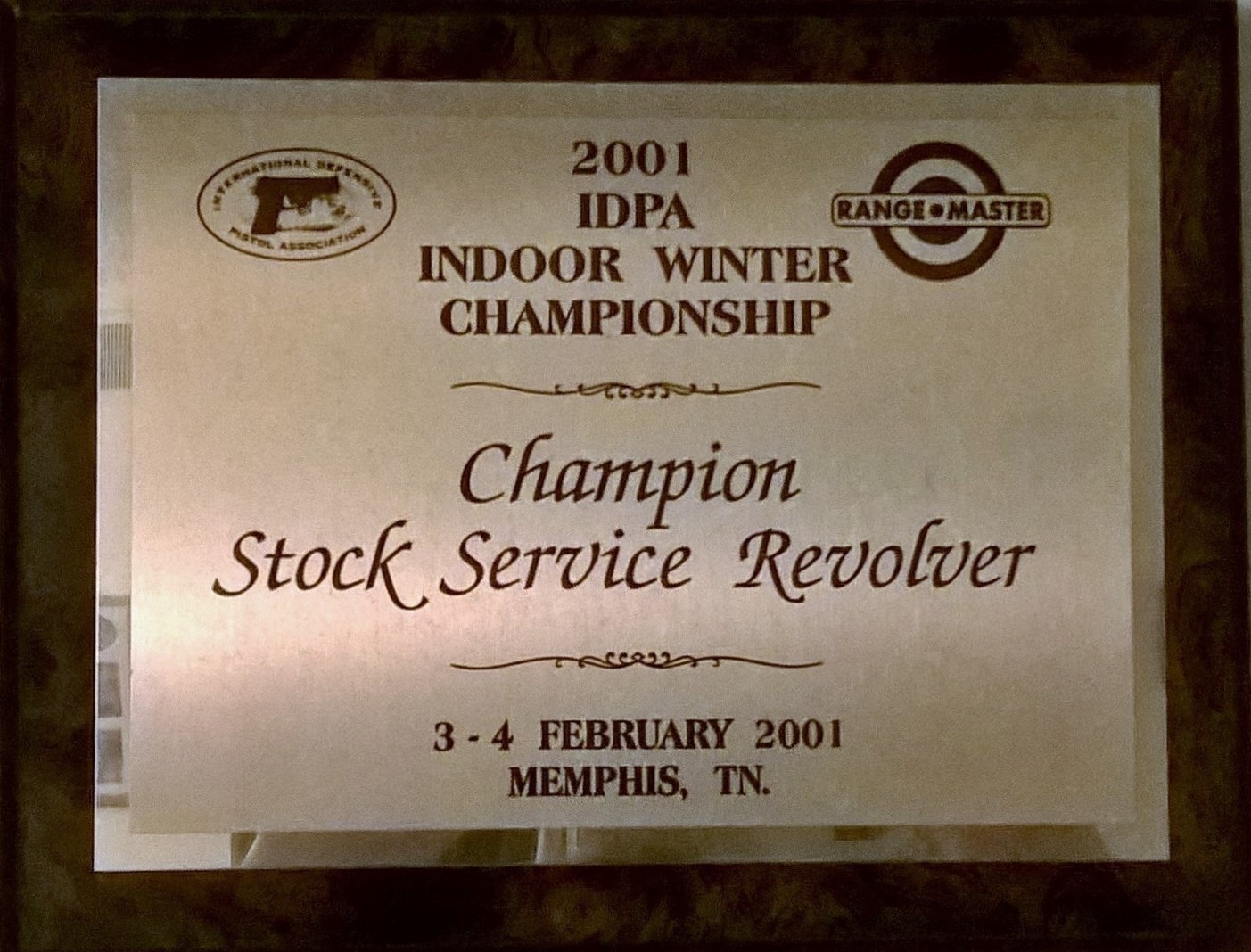
Typically, a shooting match consists of a few minutes of shooting and hours or days of idle time. However, the Winter Indoor Championship presented a unique opportunity because it was held at an indoor range with classrooms. Tom Givens’ relationship with the training industry meant that he was able to host various trainers who could present concurrent lectures about Self-Defense and Personal Protection. Some of the earliest presenters were well known names such as Massad Ayoob, Marty Hayes, and John Farnam.
The Pistol Match is still an integral part of the Conference. All attendees are invited to shoot the Match to get an idea of the strengths and weaknesses of their skills. Not everyone shoots it, though, because of the wide variety of other training opportunities that are also available during the three days.
Eventually, the demand for the tactical lectures and training necessitated moving to larger venues. The Memphis Police Academy, US Shooting Academy in Tulsa, and DARC in Little Rock have all been sites over the years. The larger venues allowed a wide variety of instructional blocks, including lectures, live fire shooting classes, and unarmed hands-on training. As the Conference grew, trainers held classes such as Managing Post-Shooting Stress and Trauma, Snub Nose Revolver Skills, Tactical Medicine for the Prepared Citizen, and Home Defense Shotgun Skills.The 2021 Conference was held at the excellent Dallas Pistol Club.
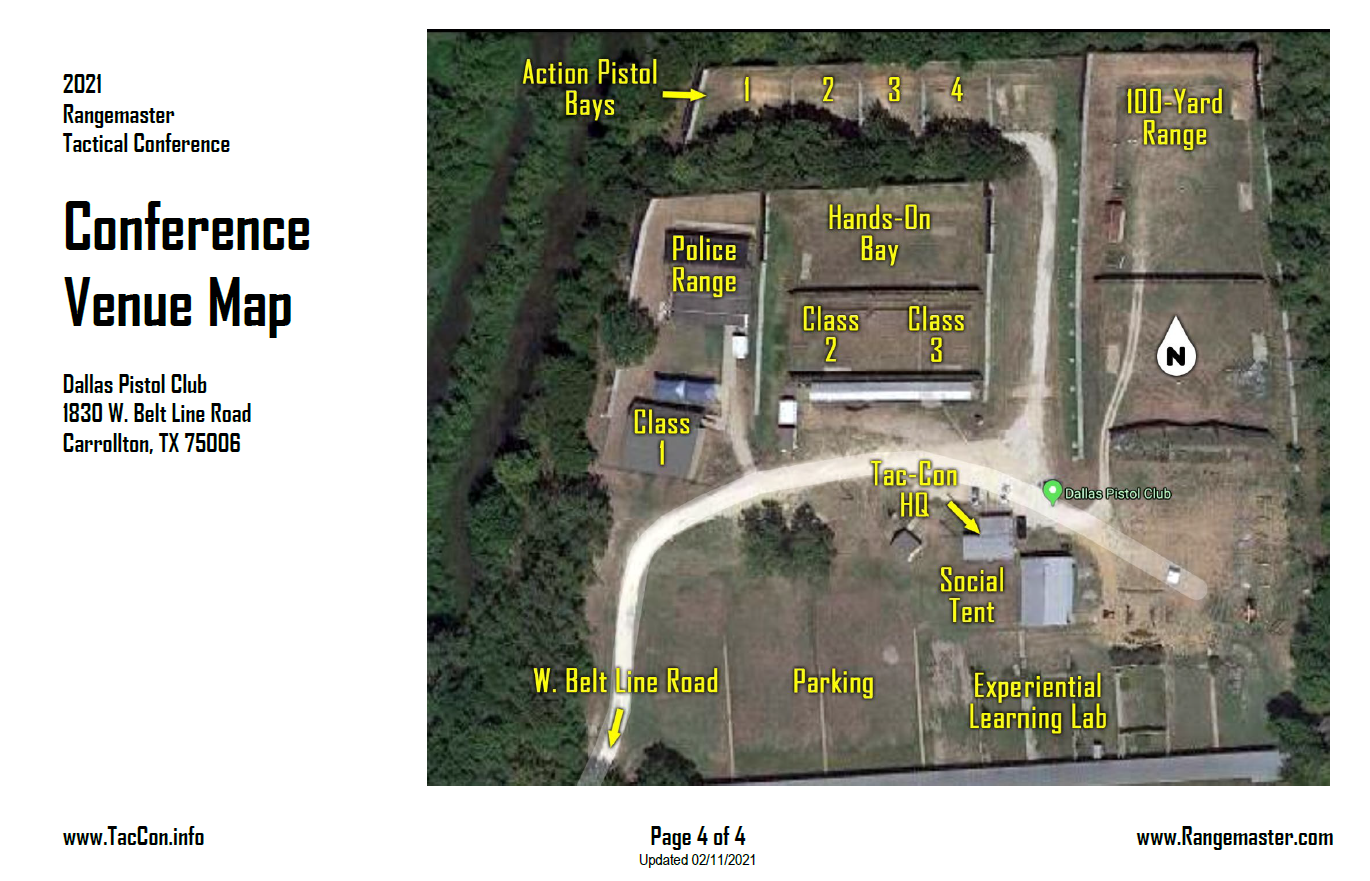
Serious Mistakes Gunowners Make was inspired by lessons learned in an Experiential Learning Laboratory session conducted by Craig Douglas of Shivworks at one year’s Conference. The Experiential Learning Laboratory has become a staple each year as a well-structured Force on Force exercise specifically for Armed Private Citizens.
Starting from just a few lectures at its inception, the Conference has grown to an extravaganza of educational offerings attended by hundreds of people over a period of three days. A vast number of training opportunities are made available for the prepared individual. The 2021 Conference featured 54 different blocks of instruction by dozens of different trainers. Some of the sessions repeated to allow attendees access to them because there is so much going on at the Conference.
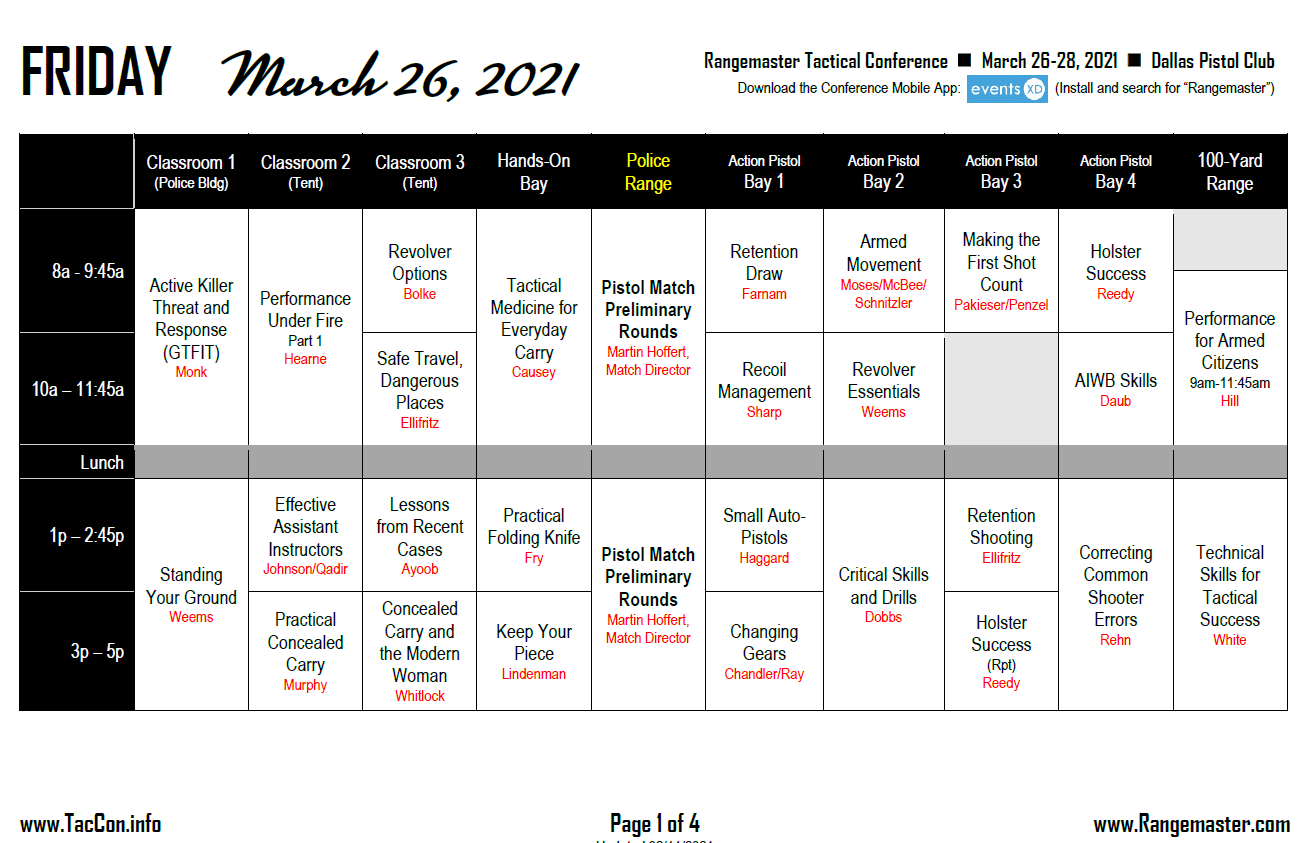
There is no other opportunity like it available for the Armed Citizen who wishes to be prepared to prevent criminal violence against themselves and their families. The Conference is held in late March each year. The 2022 Conference will be held at the Dallas Pistol Club in Dallas, Texas. Registration opens in May and sells out by October every year.
Rangemaster Course of Fire
This is the Course of Fire for the Rangemaster Tactical Conference 2018. It’ somewhat different each year but usually has similar elements to this.
It’s not complicated yet is a good test of marksmanship ability.
Decisions and experience
Good decisions come from experience. Experience comes from bad decisions.
Although incorrectly attributed to Will Rogers, the concept of learning from other peoples’ experience rather than our own still has value. We can use the Intelligence community’s technique of ‘walking back the cat’ to de-construct an incident. This allows us to visualize it and learn from the experience of someone else.
The concept of ‘Decision points’ has been emphasized by both Gary Klein, PhD., a noted expert on the decision-making process, and President George W. Bush. Any drama contains not just one, but a sequence of decisions and decision points we can study.
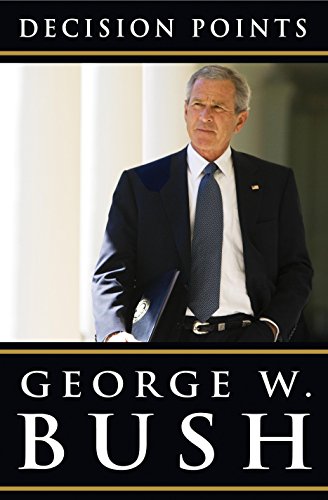
The Don’t Shoot/Shoot decision is the one most commonly focused on the training and firearms communities. However, any Defensive Gun Use, whether shots are fired or not, contains a plethora of decisions and decision points. These occur before, during, and after the shooting or display of a firearm takes place.
A rich source for walking back the cat is the Categorical Use of Force reports by the LAPD Board of Police Commissioners. The following is an analysis of one incident by an off-duty LAPD officer. The analysis will use the phases of an incident as described in my book Real Shootouts of the LAPD. http://realshootoutsofthelapd.com
The incident began as an Aggravated Assault on an LAPD off-duty officer. The full report by the Board of Police Commissioners, including its Findings about Tactics, Drawing and Exhibiting of a Firearm, and Use of Lethal Force can be found here. http://www.lapdonline.org/assets/pdf/011-11_Harbor-OIS.pdf
Incident Summary
The Situation
Officer A, who was off-duty, walked to his vehicle parked in the driveway of a residence. He did not see anyone around at the time. His duty weapon was in the right front pocket of his pants. After driving out of the driveway, he backed his vehicle up and left the lights on. He then walked back to the gate to close it.
- Decision point — Leave home armed with his weapon on his person or at least accessible? Even for POlice officers, this is not as absolute a decision as it would seem, as can be seen in other LAPD off-duty incidents.
- Decision point — Close gate (initial entry barrier to home) or not? As mundane as this decision seems, many people leave their garage doors open when they drive away from their home.
The Buildup
Officer A saw the Subject walking on the sidewalk coming toward him. The Subject then began to run toward Officer A. As the distance to the Subject became closer, Officer A saw the Subject had a handgun in his hand. The Subject pointed the handgun at Officer A.
- Decision point — Maintain awareness of surroundings or focus on telephone or other attention divider?
- Decision point — Maintain surveillance on the suspect or not?
- Decision point — Recognize and accept that an armed attack is imminent or not?
Drawing and Exhibiting
Officer A drew his service pistol from his pocket.
- Decision point — Draw own pistol or not?
The Gunfight
Immediately after drawing his pistol, Officer A fired one round at the Subject.
- Decision point — Don’t Shoot or Shoot?
- Decision point — Fire in place or Shoot on the Move?
- Decision point — Obtain an adequate sight picture to make a hit or fire without visual reference?
The Subject seemed unaffected, so Officer A fired a second round at the Subject.
- Decision point — Don’t Shoot or Shoot a second time?
- Decision point — Fire in place or Shoot on the Move?
- Decision point — Obtain an adequate sight picture to make a hit or fire without visual reference?
After running past Officer’s A car, the subject collapsed on the sidewalk behind a short block wall.
Post Gunfight Actions
Because he could not see him and wanted to wait for responding officers to arrive, Officer A did not approach the Subject.
- Decision point — Approach the suspect or not?
Officer A retreated to cover at the house and called 911.
- Decision point — Hold position or retreat to cover?
- Decision point — Call 9-1-1 or do something else?
While he was calling 911, Officer A observed another male come over to the Subject, squat down, then stand up and adjust his shirt. The second male then walked away.
- Decision point — Interact with/challenge the secondary suspect or not?
Two other males walked to the fallen Subject, leaned over to look at him, and then walked away.
- Decision point — Interact with/challenge the tertiary suspects or not?
There are also implied decision points subsequent in the drama but were not elaborated on by the BOPC.
- Actions on approach of responding officers.
- What statements, if any, should be made to responding officers and then to detectives.
- Whom else to notify about the incident; Significant Other, etc.
- Retain an attorney or call pre-paid legal assistance plan.
At least 21 decisions/decision points are readily discernible in this incident. There are perhaps even more, despite this being a relatively uncomplicated DGU. Also note that of the 21, only six (Don’t Shoot or Shoot [X2]), (Fire in place or Shoot on the Move [X2]), and (Obtain an adequate sight picture to make a hit or fire without visual reference [X2]) can be readily practiced with live fire. Those and another, (Draw own pistol or not) can be practiced dry. The other two-thirds of the decisions are more in the nature of ‘soft skills’ that are best decided upon in advance and then practiced away from the range.
“Best decided upon in advance and practiced away from the range” represents our opportunities during the current ammo shortage. Rather than sit on our hands because ammo has become so precious, we can begin developing and practicing a more complete repertoire of the skills we need for Personal Protection. If you would like to read my analyses of the rest of the incidents described in the book, please subscribe to me on Patreon. Patreon link I will be posting the rest of them there.
Scenario Development from Real Life Incidents
#scenariosunday
Reading about Real Life incidents, such the LAPD Categorical Use of Force reports, is interesting but what good is it if we don’t put some of the lessons learned into practice? One way to make that knowledge actionable is to translate the incident report into a Course of Fire that we could actually shoot. The various action shooting sports, such as IDPA, USPSA, etc., call this Stage Design.
Here’s an example based on one of the incidents in Real Shootouts of the LAPD.
Categorical Use of Force Incident – 011-11
Aggravated Assault
http://www.lapdonline.org/assets/pdf/011-11_Harbor-OIS.pdf
(full original report linked above)
The Board of Police Commissioners Incident summarized the incident as follows:
Off-duty Officer A was leaving a residence. Officer A walked out to his vehicle, which was parked in the driveway. Officer A did not see anybody as he walked to his vehicle. Officer A had his duty weapon in his right front pants pocket at the time.
Officer A backed his vehicle up, leaving the vehicle running with the lights on, while he walked back to close the driveway gate. Officer A saw the Subject walking toward him on the sidewalk. The Subject then started to run in his direction. As the Subject got closer, Officer A saw a handgun in the Subject’s hand. The Subject then pointed it at Officer A. Officer A drew his pistol from his pocket and fired one round at the Subject.
The Subject continued to point the gun at Officer A, so Officer A fired a second round. The Subject passed in front of Officer A’s vehicle before collapsing on the sidewalk, behind a short block wall. Officer A believed the Subject had been shot but could not see him, so Officer A did not try and approach the Subject, pending the arrival of assistance.
Officer A ran toward the back door of the home, while covering the Subject’s last known position. Officer A called 9-1-1. While speaking to the Operator and waiting for the first unit to arrive, Officer A saw a male approach the Subject. The male squatted down near the Subject and Officer A lost sight of him. The male then stood back up, adjusted his shirt, and walked away. Officer A saw two other males walk over to the Subject, lean over him momentarily, then stand back up and walk away. Upon the arrival of assisting officers, the officers were unable to locate the Subject’s weapon.
LAPD Board of Police Commissioners
To design a Stage from this Summary, we would extract Officer A’s actions, step by step. For clarity, each step is italicized in the above report.
Sequence of events for scenario development of 011-11
- While standing at P1, draw pistol from concealment and fire one round at T1 (7 yards).
- Fire one round at T2 (5 yards).
- Retreat to cover at P2 and point pistol at P3.
- Call 911, giving your location, while continuing to maintain pistol pointed at P3.
We can then create a diagram of what that would look like. Someone who was going to shoot it would know step by step what they had to do.
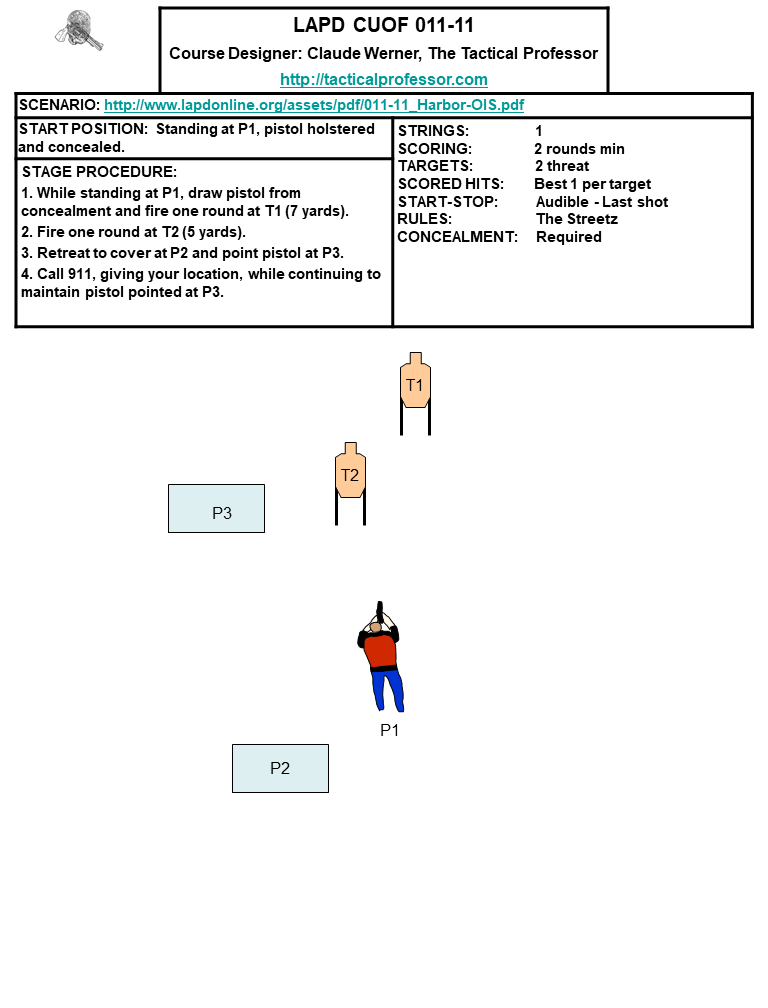
Based on the diagram, we can then replicate what Officer A had to do to keep from getting victimized or killed. While Stages created based on ‘Real Life’ tend to be much less lurid than the Stages shot in organized competition, they do give us an idea of what we might need to do to keep ourselves from being victimized or killed.
The LAPD Board of Police Commissioners made the following Findings about the actions of this Officer A.
- Tactics
The BOPC found Officer A’s tactics to warrant a Tactical Debrief. (This is required after any Officer Involved Shooting.) - Drawing and Exhibiting
The BOPC found Officer A’s drawing and exhibiting a firearm to be In policy. - Lethal Use of Force
The BOPC found Officer A’s use of lethal force to be In policy.
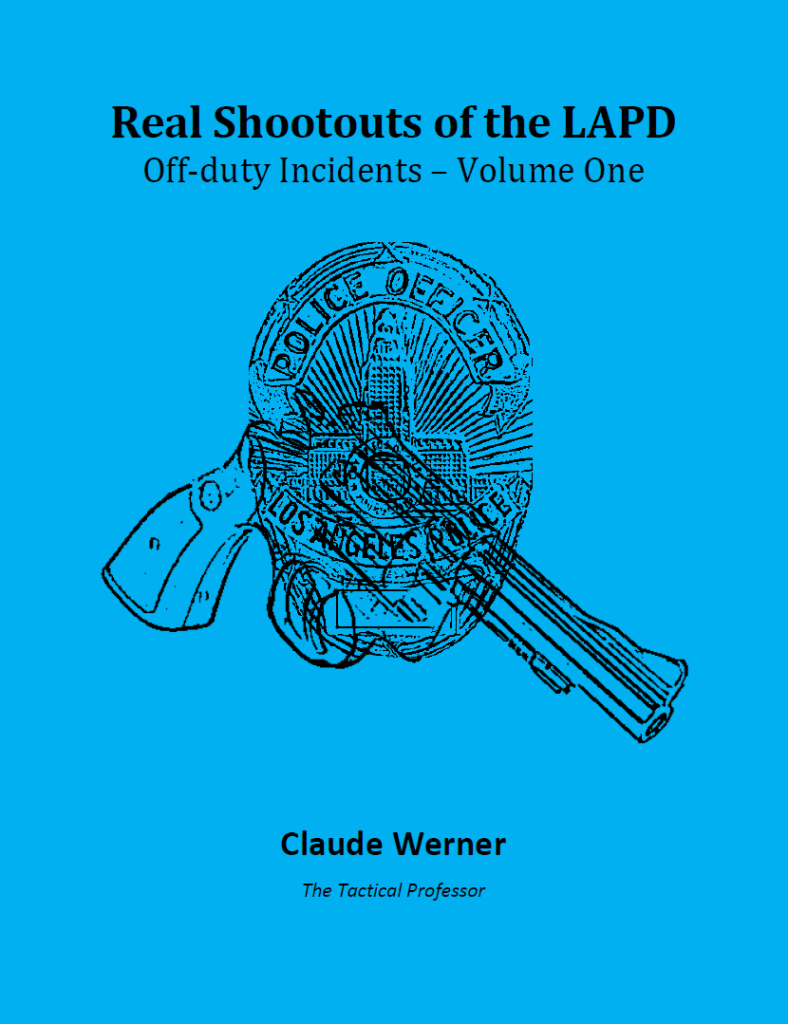
If you would like to read the book and create your own Courses of Fire from it, simply click on the book cover below.
Using Cover Effectively
#fridayfundamentals
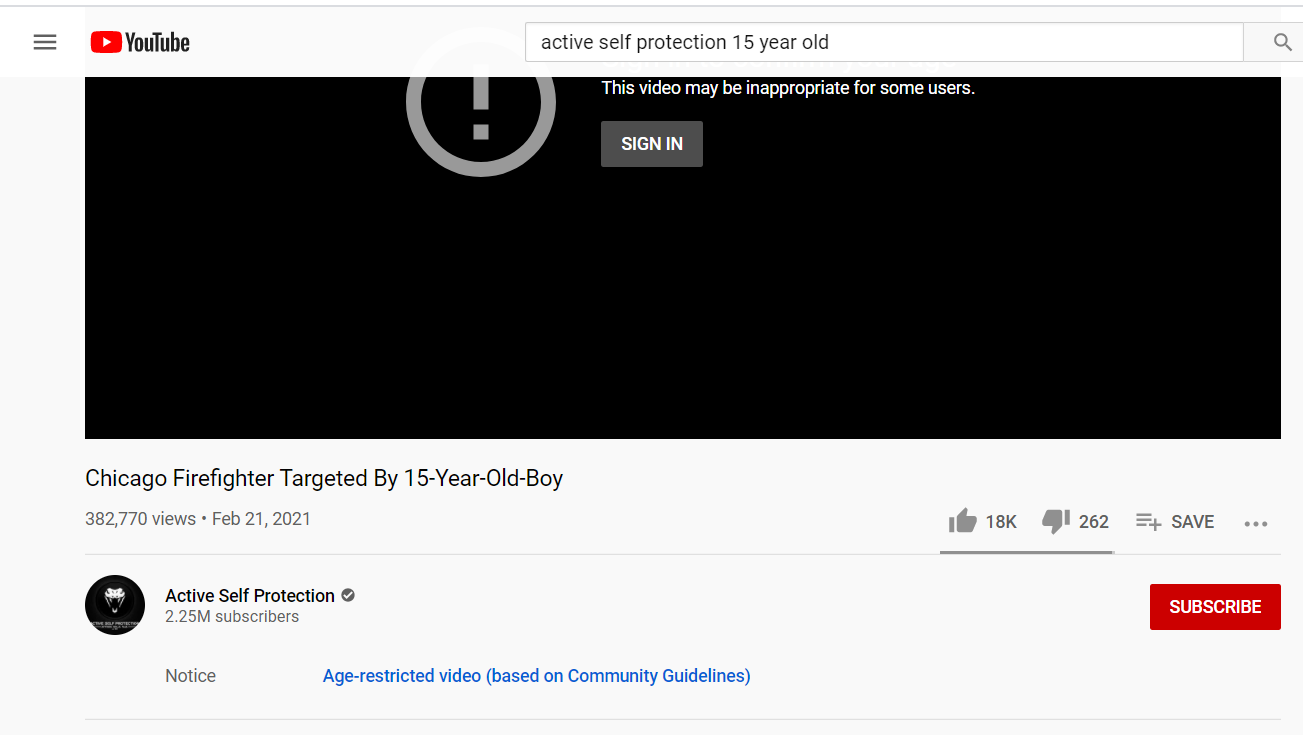
Active Self Protection recently made a good video about last December’s murder of a retired Chicargo firefighter during a carjacking.
Unfortunately it won’t embed because it’s Age Restricted. If you care to watch it, this is what to search for.
John made an important point in his video that bears reiteration and amplification.
Appropriate and effective use of cover is an important tactic in protecting ourselves.
John Correia
Things to keep in mind about using cover.
- Cover protects us from bullets and contact weapon attacks.
- Any cover can be defeated, either by adequate weaponry or by maneuver.
Here’s my initial video commentary about the situation. It wasn’t as simple as it looks at first glance.
Whether the second Carjacker would have shot LT Williams will never be known but it cannot be discounted as a possibility. There’s a good chance he was the leader of the crew and probably very dangerous. It wasn’t his first rodeo.
The incident provides a good example of the difficulties faced when dealing with multiple attackers. LT Williams was in a very difficult position as a result of this attack. We will never know if he even saw the second armed Carjacker and could have realized that he was vulnerable to being flanked. This was a well-rehearsed Carjacking crew with a good SOP. One comment on the YouTube video about the incident opined that this same crew had tried to Carjack him earlier and he had only escaped by luck.

Here’s the complete video of the incident on YouTube.
Disregard the TV station’s gauche and inappropriate invitation to Like and Subscribe at the end.
This was the funniest comment on the YouTube video. It’s unclear which person the comment is about.

Another of John’s points was that it’s important to keep in mind our mission. As Armed Citizens, we don’t need to get the bracelets on a criminal, we just need to force a Break In Contact and then go home.
My first LAPD Shootouts book is based on off-duty incidents at home. It provides a great deal more documentation and explanation of what Home Defense with a firearm really looks like than news reports. The lessons learned apply whether you’re a POlice officer or an Armed Citizen.
Crawl, Walk, Run
A discussion came up on a Firearms Instructor group that decried the fact that many indoor ranges only allow NRA training https://firearmtraining.nra.org/ and don’t teach ‘Concealed Carry’ classes. Let’s bear in mind that 999 out of 1,000 gunowners only have access to an indoor range. That’s a calculated number, not a SWAG.
More people don’t carry than do. According to John Lott, the current figure for those having some kind of weapons carry license is 18.66 million people. https://papers.ssrn.com/sol3/papers.cfm?abstract_id=3463357 The Gallup Poll indicates the 43% of US households have a gun. https://news.gallup.com/poll/264932/percentage-americans-own-guns.aspx That would be 51.4 million people, which is probably underreported as compared to licenses. My personal experience is that the demographic with the economic means to afford training is most likely to NOT have a carry license.
When we teach people, either formally or informally, we do ourselves and the gun owning public in general a disservice when we place so much emphasis on the techniques for carrying a gun. It’s unfortunate that the NRA’s philosophy of Personal Protection training is buried in the Instructor manual for the Personal Protection Outside The Home course.
A synopsis of the NRA concept as excerpted from that manual is as follows:
The NRA Basic Personal Protection Series is based on the building-block approach, moving from the simple to the complex.
The first course in this series is the NRA Basics of Pistol Shooting Course, which develops in your students the basic skills of handling, shooting, and cleaning the firearm, as well as a thorough grounding in firearm safety.
The second course in this series is the NRA Basics of Personal Protection In The Home Course, (which builds on the skills already learned in the NRA Basics of Pistol Shooting Course). In this second course, participants learn to use a defensive or flash sight picture, …
The third course in the series is the NRA Basics of Personal Protection Outside The Home (which builds on the knowledge, skills, and attitudes learned in the NRA Basics of Personal Protection In The Home Course).
A very intelligent female friend explained to me her personal journey to carrying a gun. It involved five phases over the course of three years for her to consistently carry a gun and feel comfortable with it. That’s far more common than most people who teach, either as formal instructors or just friends giving guidance, seem to realize.
The NRA philosophy has a great deal of logic behind its structure. It pains me when our training community ignores it. We spend a fair amount of time talking about the ‘Crawl, Walk, Run’ approach to training but what we actually teach is ‘Run and then Run some more,’ period. Maybe it would be a good idea if we tried to guide people through a process one step at a time instead of ‘feeding them with a firehose.’ There’s a reason I wrote Indoor Range Practice Sessions before I wrote Concealed Carry Skills and Drills.

Tactical Professor books (all PDF)
- Serious Mistakes Gunowners Make http://seriousgunownermistakes.com
- Indoor Range Practice Sessions http://indoorrangepracticesessions.com
- Concealed Carry Skills and Drills http://concealedcarryskillsanddrills.com
- Advanced Pistol Practice http://bit.ly/advancedpistolpractice
- Shooting Your Black Rifle http://shootingyourblackrifle.com
- Package deal of Serious Mistakes, Indoor Sessions, Concealed Carry, and Shooting Your Black Rifle (20% off) https://store.payloadz.com/details/2644448-ebooks-sports-shooting-drills-package.html
Making friends with other gun carriers
(second in a series)
DALE CARNEGIE’S SECRETS OF SUCCESS (nee The Golden Book) is a valuable resource for improving our relationships with other members of the gun carrying community. The hard copy I have is six pages long. I’ve kept it on my desk for over 20 years since I went through Dale Carnegie training. The book is available online as a free download.
https://www.dalecarnegie.com/en/resources/dale-carnegies-secrets-of-success
The first part of the book is a three page section called Principles from How to Win Friends and Influence People. It covers three topics.
- Become a Friendlier Person
- Win People to Your Way of Thinking
- Be A Leader
Each of the topics has a series of numbered bullet points that can guide our interactions with people. Here’s how we might apply those Principles in the situation of seeing someone whose way of carrying isn’t what we would ordinarily recommend.
Become a Friendlier Person
1. Don’t criticize, condemn or complain.
5. Smile.
2. Give honest, sincere appreciation.
- You’re carrying a gun – Excellent!
- Your holster has a safety strap.
6. Remember that a person’s name is to that person the sweetest and most important sound in any language.
- Introduce yourself
- Ask the other person’s first name if they don’t give it in return.
7. Be a good listener. Encourage others to talk about themselves.
- What kind of gun is that? (Regardless if you know what it is.)
- How long have you been carrying?
- Have you done any training?
Questions are powerful, much more powerful than criticism, condemnation, or complaints. By starting a friendly interaction with a person and then asking kindly questions, we have the opportunity to be guides to people who are less knowledgeable than ourselves. It puts us in the position to Win Friends to our community and influence them to Success. Our people skills are the single most powerful weapon in our arsenal.
We must, indeed, all hang together or, most assuredly, we shall all hang separately.
–Benjamin Franklin
Can we be a little less judgmental?
(First in a series)
There’s a picture of a woman carrying a pistol non-doctrinally (i.e., a lot of people are unhappy with the way she’s doing it) circulating on the Internet now. The pistol is in a holster attached to her yoga pants and despite being a small pistol, it’s pulling her pants down some on that side. I’m not going to post the picture because it’s unnecessary to my point. The picture has generated almost universal criticism, the following being typical.
The freedom to carry a gun is a great thing.
But you will never, EVER convince me that carrying a gun without training is smart decision. If you’re untrained[,] you do stupid things like this, which actually puts you and those around you in more danger than if you were unarmed.
Carry a gun. But don’t be an untrained fool about it.
My comment about the picture is:
At least she has a gun and her holster has a safety strap.
“Get some training” is a meme in the industry. Unfortunately, both the size and the availability of the training base are very small. This is true even if every NRA and State certified CCW instructor is included in the number. There’s also the issue in my mind of those who make statements like this but got their training from the government while in the pay of the government. That generates an ethical issue you can ponder some time.
Here’s an infographic about the availability of training to gunowners. The concept of ‘the training base’ is something that people who haven’t had to regularly conduct resource intensive training for a lot of people simply don’t understand. Once again, it’s the Tactical Professor with those pesky little numbery things again.
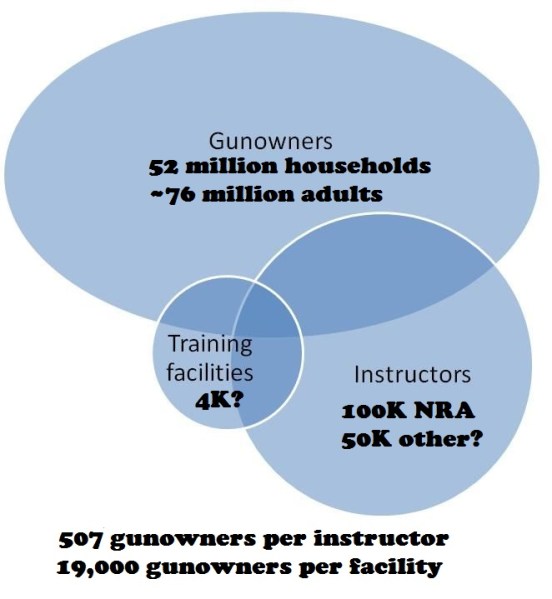
That tiny triangle where the three circles overlap is the real availability of ‘training’
And my estimate of training facilities is based on those capable of supporting at least NRA Basic Pistol not any kind of ‘meaningful’ training for carrying a weapon. Basic Pistol or its equivalent is as far as most facilities are prepared to go, for various reasons. I wouldn’t be surprised if the number where holster oriented training is allowed is less than 1,000. The good news is that the NRA Instructor base has grown to over 120,000 so we’re probably under 500 students per instructor now. Other good news is that the NRA Training Department has created a CCW course. However, that will take years to generate any significant number of CCW Certified Instructors.
Here’s my first question:
Did the person who took the picture approach the woman and offer to help her out with her knowledgebase, either personally or by referring her to someone who is a trainer?
As a community, we need to do a better job of the way we interact with beginners and novices instead of just being socially maladroit jackwagons and calling them fools.
More in the next installment.
BTW, my Concealed Carry Skills and Drills eBook would have been a nice reference to point her to or maybe even buy for her if the observer actually really cared about her welfare. Or was finger pointing, ego stroking, and shaming the real object of the exercise?
Tactical Professor books (all downloadable PDF files)
Serious Mistakes Gunowners Make http://seriousgunownermistakes.com
Indoor Range Practice Sessions http://indoorrangepracticesessions.com
Concealed Carry Skills and Drills http://concealedcarryskillsanddrills.com
Advanced Pistol Practice http://bit.ly/advancedpistolpractice
Shooting Your Black Rifle http://shootingyourblackrifle.com
Discussion about snub caliber choices
#wheelgunwednesday
Someone contacted me on my Tactical Professor Facebook page regarding selection criteria for a snub revolver. It was a good discussion and well worth reproducing. For clarity, my answers and comments are in italics.
Where can I find info on 22 mag (probably the Hornady round) in comparison to 38 special (target wadcutters) out of a sub-2 inch barrel revolver?
In terms of what criteria? Penetration, recoil, terminal effectiveness?
I guess the concern would be for ballistic performance. The 22 mag has the higher capacity.
Ballistic performance has a lot of variables. I’m not trying to be pedantic but in the gun community we frequently don’t do a good job of defining our goals.
In general, both of the rounds will achieve the desired penetration. The .22 Magnum will have much more concussion than the .38. The .38 will have more recoil. Our human performance factors are a much more important consideration than ballistic performance of any handgun. Given the opportunity, the best move would be to shoot 5^5 with both and see which one you can shoot it better with. That drill, as originally developed by Gila Hayes and extended by me, was designed as the entry level criterion for choosing a handgun.
Start Shooting Better Episode 2: 5×5 Drill – Lucky Gunner Lounge https://www.luckygunner.com/lounge/start-shooting-better-5×5-drill/
Although it carries two more rounds [in a Smith & Wesson], you should assume the .22 Magnum will be much more difficult to reload than the .38. There will also likely be issues with ignition reliability of the .22. You should assume that you will never be able to achieve a trigger pull on a .22 Magnum that you can with a .38, precisely because of ignition issues.
I agree with that. I’m looking to pick up a Ruger LCR has a back up gun. It’ll spend almost the entire life in an ankle glove or in a pocket.
The 22 mag has 3 more rounds in it but they are smaller rounds and rimfire.
I believe there is one thing incorrect in your assumptions. The LCR in .22 Magnum holds 6 rounds. The .22 LR holds 8.
I’ve read several write ups that the 38 out of those smaller barrels tends to fall short in terms of penetration.
Does the 22 mag follow that trend as well or is it worse? I may be gaining extra rounds but if the 22 mag performs less than the 38 in general then I’m not much better off than with 5 38 wad cutters.
The reliability issues you pointed out makes a lot of sense. That might be the answer I needed.
What you read is untrue. My colleague Chuck Haggard has done more ballistic gel testing for snubs than most people in the industry. His results were that .38 wadcutters penetrate more than adequately.
So you’re only gaining one round. Before I would go that route, I would personally go with a .327 Federal and load it with .32 H&R Magnum.
https://ruger.com/products/lcr/models.html
Ruger® LCR® * Double-Action Revolver Models
Big difference. I wouldn’t go that route for just one extra round. This was the conversation I needed. Again, thank you very much Claude for helping a dude out.
Summary of the discussion
After certain minimum criteria are met, caliber discussion is a relatively low level priority. Massad Ayoob’s Priorities of Survival; Mental Preparation, Tactics, Skill, and finally Equipment, are a good example of this hierarchy. Priorities of Survival is the critical tool used for this week’s Patreon Incident Analysis.
Patreon topics update
- H&K VP9SK evaluation
- Shooting test protocol for carry guns
- Store robbery with hostage taking – an in-depth analysis of the incident
- Situation – convenience store robbery. One of the employees was taken hostage immediately. Eventually, a satisfactory resolution was achieved when the cashier shot the robber. The shooting was a downrange incident, i.e., the shot had to be taken with a friendly/non-threat downrange of the shooter and in proximity to the shootee.
- Cast of character development along with 28 point play by play incident timeline.
- 17 different Personal Protection tasks identified in the incident.
- Discussion about possible improvements of the actions immediately after the shooting but before the POlice arrive.
I’m able to cover topics more in depth on my Patreon account than I can in my blog. If you’re interested, you can subscribe for $5 a month here. https://www.patreon.com/TacticalProfessor
FTC Notice: I have no relationship with Ruger nor do I receive any compensation for mentioning their product. The LCR was specifically asked about so I responded.
We’ve got to do something!
No, we don’t.
A rare editorial commentary.
In the wake of the recent ‘mass shootings,’ an amazing amount of rhetoric has arisen on both sides of the political spectrum and from the Venn diagram of those who bridge the continuum. Both sides are wrong. I’ll probably annoy some people with this commentary and lose some subscribers but so be it.
On one side, commonly referred to as the Left, we hear renewed call for various forms of gun control, ranging from Universal Background Checks to outright banning of ‘assault weapons.’ These calls are the continued extension of a propaganda campaign that would have made Nazi propaganda Minister Joseph Goebbels proud. In numerical terms, the probability of being involved in a ‘mass shooting’ is so small a possibility that it’s not even worth considering in our daily lives much less for making public policy. There were more one-on-one homicide victims last year than in all the so-called ‘mass shootings’ of the 20th and 21st Centuries combined. I feel sorry for the victims of active killers but no more so than for the Dekalb County murder victims who annually outnumber ‘active killer’ victims but who get about one minute of news coverage every few days.
The whole ‘mass shooting’ thing is an invention of the mass media elites to boost their ratings and push forward the topic of gun control. Anyone who thinks that media personalities making millions of dollars a year care one whit about the plight of the average person is seriously naïve. What they care about is their ratings and how much money and power they can accumulate.
 tacticalprofessor
You must be logged in to post a comment.