Followup on Negative Outcome (Part I)
It’s useful to track a Negative Outcome incident from start to finish. In this case, the Negative Outcome was an Unjustifiable Shooting.
Man who killed teens trespassing on property sentenced to prison
A quick summary of the events is:
- Two individuals were on a Michigan man’s property, early in the morning.
- Most likely their intent was to steal. They were on a ‘crime spree.’
- The man heard them and came out on his porch with a .22 semi-automatic rifle.
- He challenged them.
- At least one of them began to run away.
- He shot both of them and killed them.
- An investigation followed.
- Months later, he was arrested and charged with two counts of second degree murder.
- More than two years later, he was convicted and sentenced to a long prison term.
Equipment is not a proxy for skill
Yesterday, this article showed up in the search that I continually have running for personal protection incidents and I shared it on Facebook.
Prosecutor: 13 bullet holes showed self-defense for man cleared of murder charge https://www.victoriaadvocate.com/counties/dewitt/prosecutor-bullet-holes-showed-self-defense-for-man-cleared-of/article_def55934-d637-11e8-9546-637075a1ed02.html
When I share things, I often quote what I consider an important point of the story. For this incident, I thought this was important.
The number of bullets fired by Martinez [27] stood in stark contrast to the single, fatal shot from Kirkman’s antique, bolt-action .22-caliber rifle.
 Someone immediately took me to task about the .22 caliber aspect. Apparently, they thought I was advocating carrying a single shot .22 rifle for personal protection. I don’t recall saying that, I merely used the quote as an illustration of the difference between being a spray and pray artist vis-à-vis aiming and getting a good hit. Perhaps that wasn’t clear from the quote.

Lessons from the Duel at the Dumpster (Part III)

An unedited version of the Dumbster Fire video, entitled Two Fat Hillbillies Kill [Man whose mouth writes checks that his ass can’t cash] Over Garbage, is available on LiveLeak.
https://www.liveleak.com/view?t=9SIw5_1537458941
Note that the LiveLeak video is raw footage and contains language that some may find offensive. While the first minute and a half is woofing and Monkey Dancing, after that it starts getting very serious.
Deploying and Preparing for Combat
About 1:30 into the LiveLeak video, the son Deploys into a position where he can use his weapon. He still has his weapon across his shoulders. The Father and Son have at that point achieved a Position of Advantage because they can both use their weapons from where they are at but Orange Shirt can only get one of them before the other gets him. Prior to deploying to his right, the Son’s position wasn’t good because he is right handed and his Father was obliquely to his right. While this positioning isn’t exactly an L-shaped Field of Fire, it’s reasonably close considering the terrain. Being in the beaten zone of an L-shaped Field of Fire is not where you want to be when the loud noises start.
Approximately 30 seconds later (2:07), the Son takes the weapon off his shoulder and assumes a ready position with it. He is now Prepared for Combat. He has achieved a Position of Advantage and has his weapon in a position to use it quickly. Preparation for Combat doesn’t have to involve readying a weapon. The POlice often encounter criminals who take their shirts off at some point in an interview or confrontation. By doing so, the criminal has removed something that an Officer could use to restrain him or gain an Advantage. This is another example of Preparation for Combat.
When one side Deploys and Prepares for Combat, that means the situation is going to go bad VERY SHORTLY. If you have any way to withdraw at that point, you need to take it immediately because the action WILL begin within a matter of seconds, as we can see from the timeline of the incident.
- 1:30 – Son Deploys to Position of Advantage.
- 2:07 – Son brings his weapon to Ready. Preparation for Combat complete.
- 2:10 – Father fires first pistol shots.
Using weapons adequately
At 2:10, the first pistol shots are fired by the Father. At 2:13, two things happen simultaneously; the Father bends to his left, leaving a clear shot for the Son. The Son chambers a round, brings his weapon into his eye-target line and fires two rounds. The smoothness, rapidity of movement, and effectiveness of his fire leave little doubt that he had practiced this before.
The Son’s weapon was a Shockwave, a weapon that fires shotgun shells but because of a clever design, is not categorized by the BATF as a ‘Short Barreled [i.e., sawed off] Shotgun.’ The Shockwave, its Remington counterpart, and pistol gripped shotguns are almost universally ridiculed among the ‘cognoscenti’ of the firearms community. However, Orange Shirt is now in no position to either agree or disagree with that Point Of View because he took a devastating hit in the head from it.
His son fired with a shotgun [sic] and I guess it was a scattershot because it took his eye, the top of his head, his ear
–the fiancée
Say what you will about the Shockwave but the Son understood the importance of getting his weapon into the eye-target line to use it effectively. He must have worked with the gun to the point where he was competent with it.
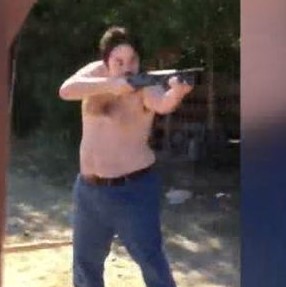
Don’t be deceived by appearances, just because someone looks like a goof doesn’t mean he can’t kill you with gear he is capable of using well. As my colleague Tamara Keel commented:
This is, however, tangentially related to the maxim that just because you’re carrying a Roland Special, [a high end pistol tuned for fighting] it don’t mean the bullets from a Hi-Point .380 are gonna bounce off you. A dumb [person] can kill you with crap gear adequately wielded.
The cost of killing
Regardless of the legal proceedings and outcome, the Father and Son will have a tough row to hoe for a long time. They’ve both been charged with murder, there is damning video evidence of the incident, and whether they win or lose in court, they’ll most likely be broke for the rest of their lives. The Cost of a Killing is always high, whether it is righteous or not.
Pride goeth before destruction, and an haughty spirit before a fall.
Pride and ego caused the whole mess. Recognize the pitfalls they can lead to ahead of time and stay out of trouble.
I’ve written two different eBooks for those who are interested in improving their skill with handguns. They provide a roadmap to improving your competency at your own pace and within the resources you have available to you. For less than the price of a box of ammo, you’ll be able to use your time and other resources much more effectively.
For those who carry a concealed firearm, Concealed Carry Skills and Drills, is appropriate for you. The link to the downloadable eBook is here. http://concealedcarryskillsanddrills.com
For those who don’t carry a concealed firearm but keep a handgun for home defense, Indoor Range Practice Sessions, is appropriate for you. The link to the downloadable eBook is here. http://indoorrangepracticesessions.com
My downloadable recording, Serious Mistakes Gunowners Make, http://seriousgunownermistakes.com is particularly appropriate when analyzing this incident.
Previous posts about the Duel at the Dumpster
Serious Mistakes – Unjustified Killings
https://tacticalprofessor.wordpress.com/2018/09/20/serious-mistakes-unjustified-killings/
Lessons from the Duel at the Dumpster (Part I)
https://tacticalprofessor.wordpress.com/2018/09/21/lessons-from-the-duel-at-the-dumpster-part-i/
Lessons from the Duel at the Dumpster (Part II)
https://tacticalprofessor.wordpress.com/2018/09/22/lessons-from-the-duel-at-the-dumpster-part-ii/
Lessons from the Duel at the Dumpster (Part II)

There are even more lessons we can take away from the Duel at the Dumpster, which we probably could also call the Dumbster Fire. Perhaps the most important lesson of them all relates to the human dynamics of confrontations.
You’re always on video
We have to assume we’re always going to be on video. This is especially true when there are other parties nearby, whether they’re Seconds or just bystanders.
Here is a reasonably good transcript of the first minute of the confrontation.
Lessons from the Duel at the Dumpster (Part I)
The dictionary defines ‘duel’ as a contest with deadly weapons arranged between two people in order to settle a point of honor. While the Abilene confrontation wasn’t pre-arranged, it certainly turned into a duel. The ‘Monkey Dance’ is a more commonly used term nowadays but the degree of outward emotion is the only difference between the two terms.

The Duel at the Dumpster in Abilene https://ktxs.com/news/local/caught-on-camera-abilene-father-son-kill-neighbor-over-trash can provide us with a number of lessons. Some of them relate to avoidance but other aspects of personal protection can also be learned.
- Murder definitions
- Emotional Hijacking
- Dealing with the mentally ill
- The role of Seconds or Partners
- Options – especially withdrawal
- Stand Your Ground (or not)
- Preparation and Deployment for Combat
- Using weapons adequately
- The cost of killing
- You’re always on video
It’s rare that we have video that shows most of an incident that covers from almost the beginning to the very end. Looking at it closely and objectively can show us some valuable lessons. Although one title for the video is “Two fat rednecks kill Father over Garbage,” we shouldn’t assume that any of us couldn’t get caught up in an equally consequential incident.
Serious Mistakes – Unjustified Killings
Going away for all day; i.e., will probably spend the rest of their lives in prison.
Father and son kill neighbor over trash
Aaron Howard was shot and killed Sept. 1 in the alley behind his home on Don Juan Street. His two neighbors, Johnnie and Michael Miller, have been charged with the murder.
Howard’s fiancee, Kara Box, shot the deadly dispute on her cell phone and released it to KTXS.
How do you win a gunfight? Don’t be there.
–John Farnam
DBAD – Don’t be a wanker
MYOB – Mind your own business
SYP – Swallow your pride
FSYG – Forget stand your ground
–a very smart attorney friend
Just one of the categories of Negative Outcomes.
- Brandishing or showing
- Chasing and shooting
- Downrange failures (the only one on the list that relates to marksmanship)
- Intervention
- Lost/stolen guns
- Mistaken identity shootings
- Negligent discharges
- Self-inflicted GSW
- Unintentional shootings
- Police Involvement – e.g., getting needlessly arrested
- Poor judgement
- Unauthorized access
- Unjustifiable shootings
- Warning shots
Learn to control your emotions and to walk away.
Armed Citizen® – July 2018 Analysis – Part III
Posts Part I and Part II broke out the circumstances and tasks of the incidents of this month’s (July 2018) Armed Citizen® column. Today let’s discuss the implications of the circumstances and tasks for those who own firearms for personal protection.
The most common task (all six incidents) accomplished was:
- Retrieve the firearm from storage.
There were no incidents this month in which the firearm was carried on the person’s body. This is a subjective call on the part of editors as to which of the plethora of Defensive Gun Uses to include in a monthly column. However, only 6 percent of the adult population has a license or permit to carry a weapon outside the home, according to John Lott’s Crime Prevention Research Center. It’s also commonly acknowledged that among those who have a license or permit to carry, actually carrying on the person is sporadic, at best. Accordingly, it is not surprising that the majority, perhaps vast majority, of Defensive Gun Uses do not occur in public places.
One implication of this fact is that a certain amount of emphasis should be placed on retrieving a firearm from its actual storage location, be it home or vehicle, and then putting it into operation. This is especially true if the firearm is kept in some sort of safe, whether it is large or small. If an autoloader is stored with the chamber empty, the need to be able to place the weapon into a fully fireable condition is also implied. Avoiding Negligent Discharges in the process is desirable.
Armed Citizen® Tasks – July 2018
JULY 2018 AMERICAN RIFLEMAN
Yesterday’s post broke out the circumstances of the incidents of this month’s Armed Citizen® column. Today’s post breaks out the tasks involved.
Task Analyses
Tucson
Women have been buying an increasing number of firearms in recent years, and that trend is starting to make itself felt against those who try to commit criminal acts. In Arizona, for example, a shopper was getting ready to get into her car and drive home. While she was attempting to close the door of her vehicle, a man armed with a hatchet approached her vehicle, demanded that she hand over her keys and get out of the car. The woman drew a sidearm and told the man to back off. Instead, the assailant raised the hatchet. The shopper proceeded to shoot him, holding him at gunpoint until the police and medics arrived. The suspect was hospitalized, and charges were to be filed later. (Tucson News, Tucson, Ariz., 4/14/18)
Tasks accomplished by Citizen
- Retrieve from car (handgun)
- Challenge from ready
- Engage from ready (handgun)
- Shoot with handgun
- Hold at gunpoint until police arrive
Circumstances
Location of Incident
- In or around Vehicle
Citizen action
- Challenge criminal
- Shot(s) fired
- Held at gunpoint
Result to Criminal
- Criminal wounded
- Captured
Gun Type
- Handgun
Firearm Location
- In Vehicle
Number of Shots fired
- 1
Number of adversaries
- 1 adversary
Gaffney Continue reading →
Analyzing the Armed Citizen® – July 2018
JULY 2018 AMERICAN RIFLEMAN
Looking at circumstances and tasks involved in the Monthly Armed Citizen® column of the NRA Official Journals provides us with some food for thought about personal protection. The incidents are summarized in the column for copyright reasons. I have provided links to the original stories for further study.
We can look at the incidents from two perspectives; circumstances and the tasks involved for the defender. This post will categorize the circumstances for each incident. Tomorrow will analyze the tasks involved.
Circumstances Analyses
Reasonableness and Stopping the threat
“While [Appellant’s] belief may have been real to him, it was not reasonable and therefore the use of force used by [Appellant] was not justified.”
That distinction is lost on many people, to their legal peril. Just because someone thinks they’re in danger of serious bodily injury or death doesn’t mean the court is going to accept that state of mind. State of mind has to be reasonable. “In fear for my life,” a subjective test, has become something of a mantra but in the absence of other objective factors, it may be unreasonable.


You must be logged in to post a comment.