Standards (Part III – Who Sets the Standards?)
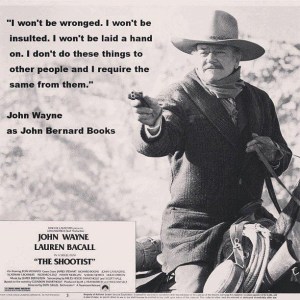
I won’t be wronged, I won’t be insulted, I won’t be laid a hand on. I don’t do these things to other people and I require the same from them.
–J.B. Books
When discussing Standards, we should keep in mind that Standards come from several sources.
- Ourselves (personal standards)
- Private Sector (social values and employment criteria)
- Public Sector (legal requirements)
Of those, the standards we set for ourselves are the most important. For instance, I don’t drink if I’m driving. I enjoy having a cocktail but I either have one at home or in the company of a designated driver. That’s my personal standard. In most cases, I could probably ‘get away with’ driving home after I’ve had a drink. However, even if I wasn’t close to the legal limit of intoxication, alcohol consumption reduces the margin of safety I consider acceptable for operating a two ton potential manslaughter machine. Not only is my personal safety at stake but the safety of others. It’s the same reason we accept not handling firearms after consuming alcohol as personal and community standards; to maintain an acceptable margin of safety.
What are some other personal standards that might apply to aspects of personal protection and shooting? A few come to mind immediately:
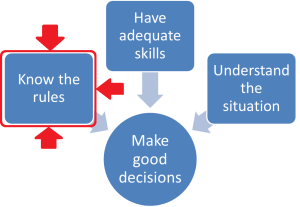
- Know the rules (law) of where we live and places we travel to.
- Shoot only at positively identified threats.
- Shoot only in a manner we can make 100 percent hits on a threat, thus not endangering innocents downrange. Factors affecting this include:
- Personal skill
- Distance
- Cadence (rate) of fire
- Relationship of the weapon to the eye-target line
My presentation at the Rangemaster Tactical Conference last week was titled Strategies, Tactics, and Options for Personal Protection (STOPP). Since many of us were not from Arkansas, I asked the audience how many of them from out of state had researched the Arkansas statutes about the Use of Force and Deadly Force. Not everyone had. Researching this piece of information took me less than 30 seconds on my phone before I entered the State. Was it a prudent decision to do so? I think so.
Arkansas Code Title 5. Criminal Offenses § 5-2-607. Use of deadly physical force in defense of a person
I’ve harped quite a bit about Identifying Friend or Foe already so, for the moment, Point 2 requires no further elaboration . Please remember that the Flashlight Practice Session of Indoor Range Practice Sessions is available as a free download.
Let’s consider point 3. My colleague Darryl Bolke’s presentation at the Conference included an important tidbit about the rate of shooting. The LAPD SWAT Team, one of the most highly trained and experienced shooting units in the world, practices to shoot at .5 (½) seconds per shot, no faster. They do this regardless of whether they are on the square range, in the shoothouse, or in actual confrontations with criminals. Why? Because that’s the rate they can identify threats and make decisions about using or continuing to use (follow up shots) deadly force.
The Force Science Institute has found that it takes about .3 seconds or more for the ‘stop shooting’ decision. That’s considerably longer than the splits we consider important in the world of competition shooting. There is a tension inherent between those two situations.
We all like to consider ourselves to be responsible gunowners. Is it prudent for us to practice shooting faster than we can guarantee a hit and whether it’s necessary to shoot at all? That’s an open question in my mind. I shot the Match at the Conference very deliberately and relatively slowly. I’m okay with that. All my hits were exactly where I wanted them to be and nowhere else. In the measured environment, that’s now become my personal standard.
Claude, I’m haunted by that last shot because I don’t know where it went.
–A friend who is both an Expert competitive shooter and a practitioner of personal protection.
Going to public sector standards, a fear is periodically raised that the standard will be set too high for gunowners to meet. The State of Illinois was the last State in our Nation to allow concealed carry because its political elite has a pathological fear of firearms (hoplophobia) in the hands of private citizens. Consequently, that State makes an interesting case study regarding Standards for private citizens. Let’s compare the standards Ill-Annoy has established for police officers v. private citizens.
| Tested Criterion | Police | Citizen |
| Rounds | 30 | 30 |
| Strings of fire | 12 | 3 |
| Furthest distance | 15 yards | 10 yards |
| Time Limits | 6 – 10 seconds | None |
| Target | 8.5″ x 14″ (119 sq. in.) | Entire B-27 (~700 sq. in.) |
| Starting Position | Holster | Ready |
| Hit Requirement | 23/30 (77%) | 21/30 (70%) |
Strings of fire is a useful criterion to include because less skilled shooters tend to ‘walk’ their rounds into the center of the target during a longer string. Having more strings reduces the effectiveness of this technique and makes a given course of fire more difficult for an equal number of rounds fired.
The qualification requirements of some States are so low that a reasonably skilled shooter can literally pass them blindfolded. For instance, the State of Michigan requirement is to hit an 11×25 inch target (three sheets of paper) at four yards with five rounds, two times out of three tries, starting from a ready position. It should be noted that although this seems like a large target, it has roughly the same area as the FBI ‘Q’ target; 281 square inches v. 275 square inches, respectively. The fear of established marksmanship criteria being excessively high seems unfounded in reality.
It should also be noted that reflexively firing a number of rounds can be a legal liability. In the Mike Kimball case in Maine, the first shot was deemed by the medical examiner to be deadly. The two additional rounds fired by Kimball were raised as an issue by the Judge in his trial. Kimball was ultimately convicted of murder and will most likely spend the rest of his life in prison. There were additional factors in his conviction, but the number of shots was definitely a question.
A lawyer friend pointed out recently an aspect of the California jury instructions regarding self-defense cases. The wording can be interpreted to mean that shots fired after the threat has ceased could be viewed as excessive force and no longer reasonable self-defense. Whether we like it or not, the rules are the rules. We need to be cautious about parroting and then internalizing memes such as ‘shoot him to the ground.’
When you start [and continue] shooting at someone, you have to assume you’re going to kill them. That’s why we call it ‘deadly force.’ Doing so needs to be a decision not a reflex.
–The Tactical Professor
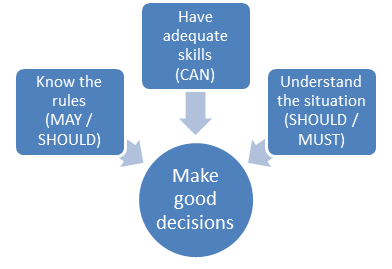
Should we settle for having mediocre personal standards and being able to only do the bare minimum? It’s true that ‘getting better is not for everyone.’ Especially if that is the case, having an objective benchmark of how we can and cannot perform is worthwhile information. That’s the main reason there is a benchmark test included in Indoor Range Practice Sessions. link to purchase all 24 Sessions
People skills and personal protection
While reviewing some files in my reading list, I came across this gem. It’s from an article called The best advice for today’s music industry was written 80 years ago
In his closing keynote presentation [at the DIY Musicians Conference] called “How to Make an Extra $100,000 from Your Music Next Year,” Martin [Atkins] ran down a long list of creative cost-saving and money-making suggestions, peppered with commandments like “Don’t be an asshole” and “Whatever the fuck it is, get the fuck over it.”
At the heart of Martin’s talk, though, was this quote:
“You can make more friends in two months by becoming interested in other people than you can in two years by trying to get other people interested in you.”
Dale Carnegie wrote that in 1936, in his book How to Win Friends and Influence People.
Martin’s first suggestion brought to mind a comment one of my first bosses in the real estate business made about one of the brokers in our office. “That guy needs to take a Dale Carnegie Course. Twice!”
Dale Carnegie Training has an excellent eBook abstract of Dale Carnegie’s writings available for download on its website. The eBook is called Dale Carnegie’s Secrets of Success. Here’s the link to it. I have two well-worn hard copies, from when it was called Dale Carnegie’s Golden Book, one of which I keep on my desk.

Secrets of Success is recommended reading for everyone, regardless of what you do or your personal philosophy. Those who are churned up about recent political events, on both ends of the spectrum, should take note especially.
What does Dale Carnegie have to do with personal protection? Let’s keep in mind that unlike natural disasters, personal protection against criminality involves a social transaction between two people. Those two people might be:
- You and a Violent Criminal Actor
- One of your loved ones and a Violent Criminal Actor
- A trainer and you
- You and someone you are trying to teach, either formally or informally
- You and someone you are trying to influence to make decisions about personal protection
Since I am a trainer and educator, I’ll address the last two points first. Recently, a trainer and blogger posted a 4,128 word rant about numerous shortcomings an acquaintance of his had. The rant was very pompous and disdainful. Some of the shortcomings related to personal protection and some were general life ‘flaws.’ No doubt the trainer’s object was to give his readers some food for thought about how they might have shortcomings similar to the acquaintance’s. However, Atkins’ first comment, “Don’t be an asshole” immediately came to mind as I read it. The overall tone of the blogger’s post was “this guy’s an idiot and I’m sooooo much smarter and better than him.”
No one likes or is influenced by a pompous asshole. Unfortunately, I see a lot of pompous assholiness in the training community. I’m not immune to being that way, either.
The Be a Leader section of Secrets of Success makes several germane points.
- Call attention to people’s mistakes indirectly.
- Ask questions instead of giving direct orders.
- Use encouragement. Make the fault seem easy to correct.
Another aspect of the training community I often see is a lack of connection to the everyday lives that our students live. There are several worthwhile items from Secrets of Success in this regard.
Become a Friendlier Person
- Be a good listener. Encourage others to talk about themselves.
- Talk in terms of the other person’s interests.
Win People to Your Way of Thinking
- Try honestly to see things from the other person’s point of view.
- Be sympathetic with the other person’s ideas and desires.
- Throw down a challenge.
So, I’m going to throw down a challenge to the training community.
Get a job; a real job where you have to fill out a W-4 when you get hired. Just like the jobs your students have.
Right now is a golden opportunity, no pun intended. The end of the year is a relatively slow time for training and there are numerous seasonal positions available in the retail sector. Target, WalMart, and Sears, among others, are all hiring for temporary positions through the end of the year. If you don’t like wearing a uniform, Macy’s and other high end retailers are hiring and will give you an even better environment to test your hypotheses. Get a temporary job in a retail store for a couple of months. Walk a mile in your students’ moccasins while carrying the heater and all the gear you tell them to EDC. See how it works out for you.
If you get fired (or arrested) for a weapons violation or you decide you can’t carry all that crap while working and interacting with people all day without getting made, you owe me a drink. If you work at least 30 hours a week for six weeks in the retail environment with your full EDC loadout, I’ll buy you dinner. Full time sworn LEOs, 16 hours a week will fulfill the challenge. Totally on the honor system; I’ll accept whatever outcome you tell me you had.
In our Violent Criminal Actors class last month, William Aprill talked about the difference between odds and stakes. The payout odds for my offer are about 5 to 1 in your favor. The stakes; well that’s a different story.
Next time, we’ll discuss the relevance of people skills to The Deadly Mix and Law Enforcement Officers Killed and Assaulted 2015. Until then:
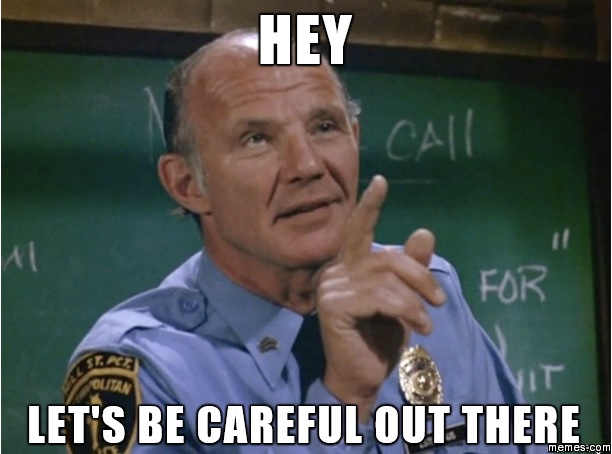
Pride and fear
“when pride arrives, logic [leaves].” –Samurai Rising
I would say the same is true of fear, which is one reason I don’t care for the “I was in fear for my life” mantra. When we in the industry teach fear to our students, I am concerned we are setting them up to make bad decisions.
Following through
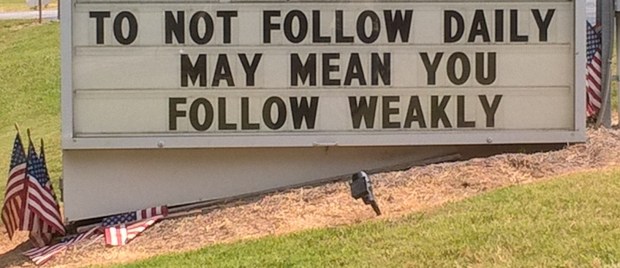
Although this sign was at a church, it’s applicable to many aspects of our lives. Interestingly, I saw it while thinking about the 1,000 Days while driving a surveillance detection route I don’t usually take. Synchronicity, as Jung would say.
Working the 1,000 Days has brought a clarity to me about the value of following through on what we start. One of the things that I have noticed is that training classes frequently don’t include a followup program for students to follow. Insights Training Center and Mid-South Institute of Self Defense Shooting are the only two I can recall that gave me a takeaway. I include the NRA Marksmanship Qualification Program Defensive Pistol I course of fire as a followup for people who take my short classes.
I want to make sure that the students who come to our Violent Criminal Actors and You course have a followup program also. Since it’s not a physical skills class, I have to approach the followup program in a different way.
This is how I’m going to do it: the next 10 people who sign up for the class will get a personal one hour telephone consultation with me about how to develop their individual program. Since everyone’s situation is different, each consultation will be personalized. I ordinarily charge $125/hour with a two hour minimum for training and consultation, so I think this is an offer that has value.
Those who have signed up already will also receive the one hour consultation. I want to get the consultations finished within a month after the class, so that will probably be as many people as I can accommodate. This will be an interesting way to me to followup on what the students gain from the class and how they plan to implement their education.
James Yeager‘s philosophy that training is just a down payment has always appealed to me. So, I’m going to put my money where my mouth is and help our students follow-through.
1000 Days of Practice (Part III)
Many people find it difficult to dryfire every day because they don’t have access to a firearm. Airline pilots and business people whose job require frequent air travel have a hard time of it. There are different ways of dealing with it.
The first would be to practice every day you do have access to your firearm and start counting. Doing that means you wouldn’t have a consecutive progression of the 1,000 Days but you would still get in 1,000 Days, it would just take longer.
Another approach would be to broaden the focus of your practice, as I mentioned in Part I. That’s one reason I entitled this series 1,000 Days of Practice.
Other skills appropriate to personal protection could be included as part of your mission statement for the 1,000 Days. This wouldn’t be 1,000 Days of Dryfire but it could be 1,000 Days of Personal Protection practice. Many of the most important Personal Protection Skills are soft skills that don’t require equipment to practice. Some that come to mind are:
- situational awareness
- the decision-making process
- incident analysis
- wargaming and decision exercises
- proxemics, and
- human communication and interaction
The memory aid I use for personal protection is RADAR.
- Ready – being prepared, mentally and physically
- knowledge,
- skills,
- tools
- Aware – eyes on the horizon, ears not plugged up
- Where am I?,
- Who is around me?,
- What are they doing?,
- What is going on?,
- Points Of Likely Concealment
- What is wrong in my right world?
- Decide – based on your decision criteria
- options,
- priorities, and
- the situation
- Act – do what you need to do
- Ready Again – be ready for your plan to need adjustment or the police to arrive.
Dryfire is one component of the Ready stage but it’s certainly not the only one. Understanding the criminal mindset and their methods of operation is also key. How about spending a few minutes periodically reviewing criminal victimizations that occurred to others and wargaming how to either avoid or deal with the situation? I have taken this so far as to go on a field trip to the location of a particularly bad incident and actually observe the lay of the land.

There are games that smart cops used to play to tune up their situational awareness. How common they are anymore, I don’t know. For instance, when in a waiting area, look around the room, then close your eyes and try to describe everyone in the room; clothes, height, weight, etc. That would be Aware practice.
Or, let’s say you encountered something that caused your to Alert and then realized it wasn’t a problem. You could mentally wargame what you thought the original problem and your solution. Take it all the way through to Ready Again, including your interaction with the authorities afterward.
There are many different ways to approach the 1,000 Days and tailor the focus to your personal needs and circumstances.
I’ll be going through a more in-depth explanation of RADAR, including some decision exercises, in the Violent Criminals and You class that William Aprill and I are teaching next month. William will be giving his extensive presentation on the criminal mindset and how differently criminals think.
Practicing Awareness – Part III
How do you do ‘situational awareness?’ You can’t ‘do’ a noun.
First of all, let’s distinguish between training and practice. My definition of training is something you do under the guidance and supervision of someone else. Practice is something you do on your own to maintain or hone skills you have or are developing.
Although Jeff Cooper’s Color Codes (White, Yellow, Orange, and Red) are the most popular way to describe states of awareness, I prefer to use the NRA format. As a sidenote, Cooper did not include Black as part of his system and actually objected to its inclusion.
The NRA format is described in the Personal Protection In The Home course and book. Military and police personnel tend to use insider jargon to describe things. Jargon is both a shorthand and, linguistically, also a way of excluding outsiders from the group. Shorthand can be useful in some circumstances but to a trainer exclusion is not, so I prefer the NRA terms.
- Unaware (Doi, doi, doi, doi, doi, doi, doi; as we used to say in Chicago)
- Aware (I know who and what is around me and what is going on)
- Alert (Something has caught my attention and makes me uneasy)
- Alarm (Something is definitely wrong in my right world)
Wearing earphones and listening to music automatically put us into the Unaware state. Constant talking on the phone does the same thing, as does concentrating on watching your dog take a dump. If you want to be Aware, you have to be mentally present where you are, not in a musical venue or someone else’s location. Sorry, there’s no way around that.
Tom Givens of Rangemaster mentions two things he thinks are relevant to situational awareness.
1. Who is around me?
2. What are they doing?
To those, I would add three more:
3. Where am I?
4. What is going on? (Not necessarily at this moment)
5. Points Of Likely Concealment (a component of Positioning to be discussed later)
When walking or running, we have an excellent opportunity to practice our situational awareness and positioning. It’s also a good habit for your safety.
You know how they say running is good for your health? In my neighborhood, it can save your life.
–old Chicago joke
To start the practice regimen, the default position for your eyes is on the horizon. It’s true that when walking or running we have to look down periodically to watch out for dog turds and other hazards on the ground. However, most people walk around like they’re continually playing the game “Step on a crack, break your mother’s back.” Having the eyes down makes it very difficult to see anything outside of the Near Phase of Social Space, in terms of proxemics. The boundary between the Near and Far phases (~7 feet) of Social Space is where untrained people will tend to make their final Force decision (Critical Distance). Being fixed on that point makes it impossible to do any information gathering prior to having to react. It’s a failure to follow Items 1 and 2 and a self setup for disaster. There is a discussion of proxemics and its implications in an earlier blog post Situational Awareness and Positioning (part III).
To get into the information gathering mode, something I do when out is to read every sign or anything that has words on it. I do this whether I’m walking or driving because it keeps my head up. As Tom says, most drivers stopped at a traffic signal tend to watch the signal with rapt fascination as if they expected it to start to sing and dance. Reading everything around you keeps your head moving and your mental focus outward.
There are many apartment complexes and residential subdivisions along my walk route. There are also numerous small cross streets with street signs. I make it a habit to read each of these signs every time I pass them, even though I’ve read them hundreds of times before. This accomplishes two things. First, it puts me in an outwardly directed mental state. Second, it makes sure I know exactly where I am at all times; Item 3 on the list. If I had to call 911, being able to say “I’m at the entrance to the Wyndham Hills apartment complex on Nesbitt Ferry Road” or “I’m at the intersection of Peachtree Road and Sequoia Trace” gives any responders a good idea of where I’m at. I also read the address number of every mailbox I pass. This gives a precise location if I’m not near a complex, cross street, or subdivision. Don’t depend on the GPS locator of your phone to give your exact location; it may not.
As I approach and pass the complexes and subdivisions, I look as far as I can past the entrance. What I’m looking for is outgoing traffic and any changes or construction. This is mostly just mental exercise for Item 4 but has helped me avoid being run over by distracted soccer mom drivers on several occasions. Heavy construction equipment near the entrance can also be a Point Of Likely Concealment, Item 5, for criminals, especially at night.
Graffiti is another thing to look for. The appearance of graffiti where it didn’t exist before can be an indicator of a new gang presence. The presence of beer cans is another detail worthy of note. The detritus of cans tossed out the windows of drunken drivers’ cars is not that much of a concern, unless you’re in their path. However, a quantity of cans noticed in a single location over a period of time is. That could be an indicator of nighttime party spot that is best avoided.
Another thing I look for is Small Dead Animals (SDAs) and Large Dead Animals (LDAs), as we called them when I was in the City Planning program at Georgia Tech. Once again, this is mostly mental exercise. However, as the deer presence in my area has increased, I’ve had occasion to call Public Works several times to report dead deer that were hit by cars.
Checking out the drivers in cars waiting to turn when you approach an intersection is mandatory. Any doofus who has their turn signal on and is talking on the phone or texting is a potential assassin. I never make the assumption they’re going to see me and not run me down when I get in the crosswalk. That’s not to say the ones who don’t have their turn signal on won’t try to kill you, either.
Of course, we want to scrupulously follow Item 1 and be aware of other persons around us.
- Walkers and joggers
- People in their yards
- Workers
- Low-lifes
Engaging the normal people is something I always try to do. Just saying ‘Good Morning’ helps engender a small sense of community. Be aware that it’s also a good way to seem like you’re part of the neighborhood, even if you’re not. This technique is used extensively in surveillance work and criminals use it too. It’s also fun to wave at people you don’t know and have them wave back. They go home thinking “Maybe that person knows me but I can’t remember who he is.” This is also another technique for establishing a false neighborhood identity. Workers can be fun because they’re often working in obscure locations and require active work on my part to locate and identify them.
I don’t mind walking past low-lifes but it’s important to be mentally prepared to deal with them and fail the interview. Someone once said that I give my students permission to be rude; that’s totally true. There’s a difference between rude and mean, though. In my vernacular, being rude relates to enforcing my boundaries. Being mean is encroaching on someone else’s boundaries. That can set you up for trouble. If you don’t like the look of them, though, there’s nothing wrong with crossing the street or changing direction to avoid them. Don’t hesitate to turn on your heel and go back the way you came if that seems appropriate.
Earlier posts about Situational Awareness
- Practicing Awareness
- Practicing Awareness – Part II
- Situational Awareness and Positioning Part I
- Situational Awareness and Positioning Part II
- Situational Awareness and Positioning Part III
- Situational Awareness and Positioning Part IV
- Situational Awareness and Positioning Part V
- Situational Awareness in Social Settings
As the real Dr. House mentioned at the Hebrew Hogger last weekend, it’s better to have an option to avoid a situation than to have a tool to get out of a situation.
Hebrew Hogger 2016
Hebrew Hogger 2016, held in Nashville, has come and gone. It was a great one day training event held to defray the costs associated with a justified self defense shooting by a member of our community. There were 58 attendees, some of whom came from other States to attend. Six presentations were given, both in the classroom and hands-on. There was no livefire firearms training at all. Following are a few of my notes from the speakers. If I have butchered anything they said, it’s my responsibility.
Dr. William Aprill – Violent Criminal Actors
- Get VCAs to pick someone else; fail the interview.
- Too much eye contact with VCAs can trigger their aggression.
Dr. Sherman House – Becoming the Civilian Defender
- Better to have an option to avoid a situation than to have a tool to get out of a situation.
- The importance of Defensive Driving training.
Dana McLendon, Esq. – Dealing with the aftermath of a shooting
- The goal is to go home without dealing with law enforcement or emergency medical services.
- Mitigation of risk.
- Very few people will attend training events like Hebrew Hogger because they don’t think deeply enough about the issues associated with personal protection.
- Assume everything is being recorded. He noted how often recordings of incidents include a shout about being posted to WorldStar.
- A shooting may happen in an area where you are unsafe afterward. You may need to arrange to meet the police at some place they specify. Do NOT simply flee the scene.
- Trials are now about stories and narratives.
- A shooting is likely to have at least a five figure cost, assuming it doesn’t have to go to trial. The incident leading to the Hogger is a perfect example.
- “You will rarely regret having said too little.”
- His favorite movie lawyer movie is My Cousin Vinny because he thinks it’s the most realistic.
Eli Miller – emergency wound treatment. I wasn’t able to attend this one because of all that was going on.
Dr. William Aprill – disarms. I couldn’t attend this one, either.
Andrew Branca attended and contributed copies of his book the Law of Self Defense to the cause. He and I had an interesting discussion about the tortured nature of personal protection law in some areas of the country.
My presentation was a small segment from our upcoming class, Violent Criminal Actors and You. Given the situation, I thought Strategies, Tactics, and Option for Personal Protection (STOPP) would be the most appropriate. Some of the highlights were:
- “Immature strategy is the cause of grief.” –The Book of Five Rings
- Parallels exist between the Book of Five Rings and Boyd’s work
- “…timing of cunning by knowing the enemies’ timing, and thus using a timing which the enemy does not expect.” – The Book of Five Rings. This is a more succinct way of expressing Boyd’s O-O-D-A Loop.
- This is a link to a free download of Five Rings
- If you have any weapon at all and aren’t familiar with the law about self defense of your State or any State you travel to, “You are wrong as two left legs.” One of my First Sergeants was fond of saying that to our Beetle Baileys.
- At least be able to cite the number of the code section for your State. Don’t assume the police will even know it exists, much less know where to find it.
- 16-3-21 for Georgia
- 39-11-611 for Tennessee
- I provided several references – ACLDN pamphlet on What Every Gun Owner Needs to Know about Self Defense Law, The Law of Self Defense, Deadly Force – Understanding Your Right to Self Defense.
- The importance of Defensive Driving training (echoed from Sherman’s presentation)
A lady who attended and I had an interesting discussion about the differences between 20th Century feminism and 21st Century feminism. Her interpretation is that 20th Century feminism was based on actual empowerment and the desire for true equality. She contrasted this with 21st Century feminism, which she feels is based on inherent victimhood and the need for safe spaces, which she cannot identify with. The discussion came about from the Woman’s Gun Pamphlet I posted a while ago. She and her husband had driven 14 hours to attend the one day training event.
Without going into details, the event was necessitated by the unfortunate politics a shooting resulted in. It’s a great case study of how a very justifiable response can be muddied when the recipient is politically connected or a prosecutor is politically motivated. Even justifiable shootings can have enormous consequences. It emphasized to me the need to think ahead of time about the third battle ahead of time.
The extremely cool morale patch for the event is available for sale, for those who would like to make a contribution to the cause but couldn’t attend. I will post an update with the purchase link when it’s available.

Sidenote: I have made a small update to my Indoor Range Practice Sessions eBook. The download now also includes a separate Excel worksheet for logging the results of your practice. The Excel worksheet is included in the price. I will be emailing it to previous purchasers shortly.

The cost of killing
‘too bad they didn’t kill him’
‘needs to get more practice at the range so they have better aim [to kill him]’
–Internet common-taters
Often when a story surfaces in which an armed citizen wounds but doesn’t kill an attacking criminal, statements such as that will quickly show up in the comments section on the Internet. Persons who make such comments have no clue about the cost of killing someone. Even when there are no legal and financial costs, the emotional, psychological, and social costs will be considerable.
As in every class I attend or teach, I learn something from the students. Yesterday was no exception. I attended, as a student, the Proactive Mindset class taught by The Complete Combatant. The trainers graciously allowed me to give a short presentation at the end. One of the things I mentioned was the psychological cost of killing. The incident I cited was that of the citizen near Chattanooga who shot an old man with Alzheimer’s. The killing was ruled justifiable and he was not prosecuted. Coincidentally, someone who knows him was in the class. When the class was over, she came up and filled me in on how things developed after the incident. Suffice it to say that the emotional costs to him were enormous and continue to this day.
The cost is not only borne by the individual who does the shooting but also by their family. At some point their children are going to go to school and one of their classmates is going to taunt them with ‘my daddy says your daddy is a murderer!’ No matter how justifiable the shooting may be, someone in the community who feels that self-defense is an unacceptable concept will express their feelings to their children and the children will pass it on to your children.
Even one of the great police gunfighters of our time, the late great Jim Cirillo, bore the cost. Despite the fact that all his shootings were eminently justifiable and he didn’t suffer psychologically, he still had to pay the social cost. When his superiors recognized his bravery and devotion to duty, they recommended him for promotion. The promotion was turned down in the upper echelons of the NYPD because they said it would send the wrong message to the department and the public. ‘We don’t promote people for killing.’ This is one example of what Massad Ayoob calls the ‘Mark of Cain syndrome.’
Now imagine what it’s like for people who unintentionally kill a member of their own family. A parent who kills their child or someone who kills their spouse will probably never get another good night’s sleep as long as they live. The saddest part of these incidents is how avoidable they are. A flashlight and the ability to verbalize ‘who’s there?’ would have prevented almost all of them. A small flashlight was included in the goodie bag given out for Proactive Mindset. Great idea; everyone should have a couple of flashlights. Good ones are very inexpensive now.
That’s why our priorities should always be:
- Avoid,
- Escape,
- Confront,
- Resist
When we jump to Confront and Resist before we absolutely need to, we’re being emotionally hijacked by the situation, our pasts, our current influences, and our egos. Allowing an emotional hijacking is no more a recipe for success than going along with any other kidnapping attempt. There’s always going to be a very high cost.
Internet common-taters take note; you’re not the ones who will pay the cost.
Mindset and Decision Making
Then I guess it will just be time for him and me to be with Jesus.
Caleb Causey of Lone Star Medics related a mind-boggling story recently about one form of mindset. He posed questions to some friends in the context of encountering two burglars in their home. The concept of giving scenarios and asking people questions about their anticipated reactions is often far more effective than pontificating about what they ‘need’ to do.
The friends are a couple who have a 10 year old son. The wife is a petite woman who is a practitioner of boxing; good for her. What Caleb did was to posit a scenario of initial violence and asked her what she would do. She replied she would fight them. Since the scenario was two burglars whose combined weight was three to four times hers, he continued escalating the scenario in his questions. In the event her resistance was overcome by the two burglars, the sequence of escalation he gave was:
- her being badly beaten in the fight,
- her being raped,
- her child being raped,
- both of them being murdered.
The lady’s reply to the escalation of murder was the above quote about ‘being with Jesus.’ She apparently had accepted that as an outcome. However, her husband, who was listening to the conversation, did not find that acceptable. At the time of the conversation, they owned no weapons, other than perhaps a butcher knife. While butcher knives can be used to defend one’s family, especially when wasp spray doesn’t work, it’s unpleasant and quite messy. The questions and subsequent conversations led to a better understanding of their options and possible decisions for defending themselves.
A few days later, I related the story at dinner to another friend. His comment was “people with that kind of mindset really don’t understand what the events leading up to ‘being with Jesus’ are going to be like.” The beginning (assault) and end (being with Jesus) can be grasped but the process in the middle is much harder for people to understand. The Petit family murders are an example of just how horrible the process can be. I’m not sure if Caleb had the Petit murders in mind as he was talking to the couple but his sequence of events was very similar to the horrors the Petits were subjected to.
It’s hard for good people to understand the depravity that exists inside many criminals. That’s the main reason I teamed up with William Aprill for our Violent Criminals and YOU course. The more decent a person is, the harder it is for them to grasp just how evil and FITH some criminals are. A mental health professional is in a better position to describe that than a trainer who teaches physical skills. It’s also why we’re offering a discount when bringing a family member; family members are part of the decision process.
My friend at dinner also made the comment “Two days sitting in a classroom is a long time and might be tiresome.” That’s understandable, which is why William and I are teaching in alternating two hour blocks of instruction. I’ve taken many many weekend classes and I know hearing the same voice continually for 16-20 hours can be a chore, regardless of how engaging the instructor is. Splitting it up will help keep things from being monotonous in our class.
He and I also talked about teaching decision-making. For a long time, I have had reservations about how the industry teaches decision-making. He’s been to a Force on Force class I was a role player in for many years, so I asked him “In the crawl/walk/run training progression paradigm, where does Force on Force fit?” “Run” “How many repetitions of decision-making did you get in those eight hours of training?” “Six or seven”
His answers reflect my reservations about our current methodology. Giving students a few ‘Runs’ with a simulated gun in a FATS machine or with live role players does not represent a particularly effective adult teaching methodology, in my opinion. What we essentially do is throw someone in the deep end of the pool a couple of times and then call them a combat swimmer. ‘What’s wrong with that picture?’ as the saying goes.
To improve on this, I have devised a process where students will get dozens of repetitions of decision-making with the full range of the personal protection options available to them in a few hours. The patent application for the process is not yet complete, so I’m not at liberty to disclose more than that. I can say it will be an experience unlike anything else in the industry. Because the full range of options will be available, the process is NOT limited to gun owners. Excluding the full range of options is a major weakness in our current methodologies and my process corrects that. Family members may have a different opinion about what the appropriate options and decisions are, at least for them.
Mindset and decision-making; think about them hard, regardless of what training you choose or choose not to take. My research into Negative Outcomes has made me realize how much more important they are than the weapon or caliber debates the gun community loves to indulge in.
I have a friend who will kill you with a .25 Lorcin and there’s nothing you’ll be able to do to stop him.
–a well-known and respected trainer
Sheepdogs almost get bitten
[Seven soldiers] said they had witnessed a disturbance between [the couple] in a parking lot, and they said they intervened. They said they believed they had deescalated the situation and began to walk back to their vehicle.
Police said Gallegos and Garzes are boyfriend and girlfriend. As the soldiers started to leave, they said Garzes [the girlfriend] ran to her boyfriend’s truck and pulled out a handgun.
She handed it to Gallegos [the boyfriend], and the soldiers told police he began firing the weapon.
Pair arrested after firing at Fort Hood soldiers
One possible strategy in the context of personal protection is ‘being a hero.’ This is one of the underlying motives for ‘sheepdogism.’ However, it’s useful to remember that the highest award given by our country for heroism is the Medal of Honor, which is often awarded posthumously.


You must be logged in to post a comment.