Thinking ahead
If we get carjacked, as long as you and I can both get out of the car, they can have it; I have insurance. But if either of us can’t get out of the car because we get hung up in the seat belts or something, turn your face away from me and close your eyes because I am going to start shooting. I don’t want his loathsome blood-borne pathogens to get in your eyes.
–my personal policy/Standard Operating Procedure, as related to a former girlfriend who lived near Murder Kroger in Atlanta
A California man shot the carjacker of his van Friday as the carjacker drove away. The carjacker died shortly thereafter and the shooter was arrested for Murder. Once the threat of Death or Serious Bodily Injury has passed, the time for gunfire has ended.
“Nice people lock their doors.” –my mother
‘Don’t sit around in unsecure parking lots working on your czechbook, writing reports, texting, or talking on the phone.’ –paraphrased from Bill Rogers and Craig Douglas
“Firearms shall not be discharged at a moving vehicle unless a person in the vehicle is immediately threatening the officer or another person with deadly force by means other than the vehicle. The moving vehicle itself shall not presumptively constitute a threat that justifies an officer’s use of deadly force.” —LAPD Manual Volume 1 Section 556.10 POLICY ON THE USE OF FORCE
Policies, SOPs, or whatever you wish to call them are simply committing to memory, or writing down, actions that you have thought about ahead of time. For some reason, the word ‘policy’ evokes a great deal of resistance on the part of people I talk to about it. Not thinking about things ahead of time is probably the most Serious Mistake Gunowners Make and I will have to add that to the next edition.
In a crisis, the conscious mind has an extremely short life span, probably less than a second. Once the conscious mind expires, either training/practice or the amygdala will take over. Trying to make up a plan on the spot is an extraordinarily difficult task.
Perhaps the inability or lack of desire to think ahead is the reason for the popularity of the OODA Loop. Relying on the OODA Loop implies that you can out-think the situation in the moment. This is just being lazy and an excuse for not thinking ahead. No plan survives the test of combat, as the saying goes, but it is ALWAYS easier to modify a pre-existing plan than to make one up on the spot.
Fighter pilots have been at the forefront of developing policy and procedure for ‘in the moment’ encounters. Their creations over the past century have shown increasing sophistication as they have evolved.
- Dicta Boelcke, a list of principles, was formulated during WWI by Hauptmann Oswald Boelcke, a German fighter pilot and squadron commander. It is interesting to note that he was killed when he violated one of his own dicta, never close in on a single combatant when others are also pursuing it.
- Lieutenant Commander Jimmy Thach recognized the superiority of Japanese fighter aircraft in the early days of WWII. To counter them, he developed, using matchsticks on a tabletop, the Thach Weave as a defensive maneuver. Then he tested the maneuver under conditions simulating the disadvantages US Navy fighters would face.
- No Guts, No Glory, a USAF training document, was written by Major General (then Major) Frederick C. Blesse shortly after the Korea Conflict. It was an explanation of his experiences flying F-86 Sabres against MIG fighters and how to defeat them.
- Colonel John Boyd wrote the Aerial Attack Study, which is the most comprehensive manual on fighter combat ever written, in 1959. In it, he methodically worked out all the possible attacks and counters a fighter could make in relation to both bombers and other fighters. His study was heavily based on a thorough understanding of the flying and weapons capabilities of both US and Soviet aircraft.
In every one of these documents, specific principles, procedures, and pitfalls are worked out in advance. Speed of decision in tactical situations is achieved by picking from a list of possible options to best solve an unfolding incident rather than trying to ‘think faster,’ which is physiologically impossible. The distinction between ‘thinking faster’ and picking from a menu of possible decisions escapes many common taters about the OODA process. Boyd’s description of the process is much more involved than generally assumed and explained using a simplistic circular diagram. That circular graphic does no justice to the concepts that Colonel Boyd developed.
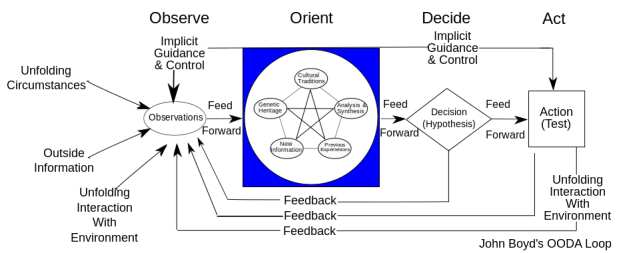
In order to make decisions in advance, it’s necessary to think about likely scenarios, at least, ahead of time and decide how to solve them. This includes the legal ramifications of your possible actions. Thinking ahead is a key component of avoiding becoming a victim or incurring a Negative Outcome in the criminal justice system.
John Johnston and I will be discussing this timely topic in more depth on Ballistic Radio tonight. Ballistic Radio is available over the Internet.
Serious Mistakes now available as a download
There have been many requests for the Serious Mistakes Gunowners Make recording as a download. Despite being something of a Luddite, I figured out a way to do it.
The recording is now available as a download for $9.95. Link
Practicing for your real world
This morning, I had an opportunity to do some work on putting my money where my mouth is. I’ve been haranguing about Negative Outcomes and wanted to come up with some actionable practice. If you’re not part of the solution, you’re part of the problem, as the saying goes.
Around 5 a.m., someone was loading a pickup in the parking lot outside my apartment. There was quite a bit of ‘bumping,’ which woke me up. Everything was still dark and otherwise quiet. I was satisfied that it was indeed a truck being loaded and what was being loaded wasn’t mine. While lying in bed, I realized I had been awakened by a ‘bump in the night.’ So, I decided to clear my apartment as a dry run.
First, I cleared my pistol and put an orange dummy round in the chamber. I then dryfired it once. If I hadn’t done that sequence correctly, I would have had a Negligent Discharge in my apartment. At 5 a.m., that would have been a Serious Mistake. No doubt an ND would have led to the Negative Outcome of Police Involvement when police officers showed up shortly thereafter. Putting an actual possible consequence into the equation makes it a little more realistic as a practice exercise. Being exposed to real consequences is something most gunowners don’t allow themselves to experience very often.
From this clearing task came my first observation; if one isn’t awake enough to competently perform a simple unload, load, and verify manipulation, is it wise to go through the house in the dark making life and death decisions? Probably not. One of things John Farnam taught in his classes I’ve attended is that it’s a good idea to be awake before you start handling firearms. His counsel is that having a pistol right next to your bed may not be the best idea if you are the type of person who requires a minute to wake up. Having your gun a few steps away might be a better idea. One incident in my Negative Outcomes database is of a man who shot himself in the foot when he picked up his bedside pistol before he was completely awake.
Having cleared the pistol and sterilized it, I then picked up my flashlight. Just to get out of my bedroom, I have to unlock and open the door while holding a pistol and flashlight. As I do this, it’s important that I scrupulously observe Rules 3 and 2, Finger off trigger and Don’t point the gun at [myself] while my support hand is extended in front of my body and holding a flashlight. Using the gun’s laser to check, it was clear that avoiding sweeping my hand is not as easy as might be thought. If there actually was an intruder, the worst possible case would be that he was on the other side of the door when I opened it. How to handle that is something many people don’t think about.
As I worked my way through the apartment, the night lights I have in every room were sufficient for me to see if someone was there. However, I would have needed the flashlight to make an identification. I do have some entertainment signs in my home, so I used them as substitutes for making a suspect identification.
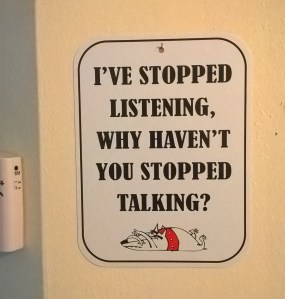 The first thing I did upon encountering a sign was to practice the Challenge, “Who’s there?” It doesn’t have to be loud when practicing, but it’s important to get into the habit of verbalizing. If the ambient light wasn’t sufficient for me to read the sign, then it’s probably not going to be enough for me to make an identification. By lighting it up with the flashlight, I could read the sign, so I can probably make a good ID.
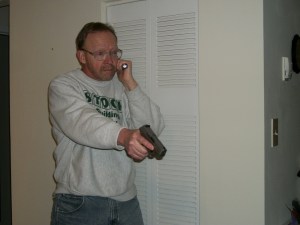
Maybe this seems like a somewhat involved exercise but let’s keep in mind, there are competing sets of probabilities in a home defense situation. The most likely probability is that the 3 a.m. bump you hear or shadow you see is, in fact, a member of your household.
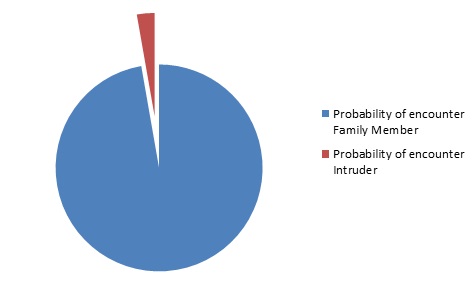
It’s advisable to practice under conditions that resemble the ones you will encounter in YOUR real world, which is different than everyone else’s. Those who have been through shoothouse training will probably notice that the above exercise doesn’t even begin to look like making entry into the shoothouse with your carbine and shooting everything you see. There’s a reason for that, I’ll let you figure it out.
The importance of gunhandling
Over the course of the holidays, I had several short notice taskings, one of which was to provide initial firearms training to a woman who has a stalker problem. Although it was a short session, she and I were both pleased with the outcome, so I shared my notes and outline with a few of my colleagues.
A colleague made the following comment:
One, it’s your usual excellence, and most likely as good as it gets for focused firearms training for the civilian … I do notice that the vast majority of what you present is focused on manipulation, handling, live fire, and some lecture/interactive discussion about legal aspects.
He is a very high level thinker and we exchange thoughts regularly with no reservations about defining and challenging each other’s views. My response to his query was that I have been immensely changed by my Negative Outcomes research over the past two years. I have come to question much of what I thought was important before. One thing that I have become sure of is that at the raw beginner level, which is where this lady was, teaching students how to avoid Serious Mistakes is of primary concern. My list of firearms incidents with Negative Outcomes, gathered over the past two years without even a serious research effort, is seventeen pages long single spaced. That’s a lot of Serious Mistakes.
In addition, I have become even more aware of how dangerous complacency is. The more often the gun is manipulated, the more it is likely to discharge. This has its basis not only in statistical reasons but also in the natural human process of ‘familiarity breeds complacency.’ When complacency is combined with incompetence and/or ignorance, the seeds of disaster have been sown.
The story mentioned “His injuries are not life-threating but he is receiving treatment from a hand surgeon.” Shooting oneself in the hand at close range with modern service ammunition carries a high probability of being permanently crippled. One of the things that I notice in the Self Inflicted Gunshot Wound section of my database is how often the person involved is a high level Law Enforcement Officer, either Sheriff or Police Chief.
There are two possibilities for this strong correlation: 1) it’s just more newsworthy when a higher up experiences a Negligent Discharge, or 2) higher ups, who are administrators, tend to be not that interested in firearms and perhaps a little more complacent than line officers whose gun is a tool of their work. It could be either, there’s no way for me to say.
Firearms ownership is somewhat like a minefield. You might take one step and get blown up, you might negotiate it quite a while before getting blown up, or you might get lucky and make it through. Putting your fingers in your ears will not protect you one bit from the consequences, that’s for sure.

When using a firearm, regardless of the circumstances, always follow the Four Rules of Safe Gunhandling
- Treat all guns as if they are ALWAYS loaded.
- Never let yourself point a gun at something or someone you don’t want to be shot.
If the situation forces a choice, point the gun at something not someone. - Keep your finger out of and above the trigger guard until the gun is pointed at your target and you are ready for the gun to fire.
- Be sure of what you are shooting at and what is behind it.
In addition,
- Store weapons where they are not accessible to unauthorized persons
- Know the law
- Immediately check the readiness status any weapon you handle
Whether in a morning Private Lesson or in my six month Total Immersion Program, I find that both new and experienced gunowners frequently don’t have an appreciation for the nuances of the mechanical complexities of firearms manipulation. A firearm is a mechanical device that has more moving parts in it than almost anything else you can hold in your hand. There are definite sequences and multiple conditional values that have to be observed with them. Some people dread hand tools as much as Kryptonite. Folks like that need to be shown, and then practiced, on how to operate complex mechanical devices, such as firearms.
In addition, smart people tend to assume there is logic involved in the making of laws. Nothing could be further from the truth. Consequently, the vagaries of the legal system are an alien concept to many well educated and intelligent people. I have personally known of several very smart people who got into a fair amount of legal problems in the course of trying to apply logic to both the Code of Federal Regulations and the Official Code of Georgia Annotated. Some things we can figure out ourselves; the law is not one of them. It requires research and/or specific education.
That’s why I am currently prioritizing my training efforts the way I do. It’s also why I created the Serious Mistakes Gunowners Make audio presentation. Many of the events in Serious Mistakes did not happen to novices but rather to gunowners of long standing who became complacent or finally ran into a situation they had never encountered before. The link for Serious Mistakes is at the top of my page. It’s now available on a Flash Drive, for those who prefer that format.

Friday Fundamentals – Biases and Changes
My colleague Grant Cunningham posed two interesting questions on his blog, which led to a lengthy Facebook discussion.
Question #1: “what are your biases or preconceptions?”
Question #2: “what have you changed your mind about in the last year?”
I gave a brief answer to #2 but I think they both deserve some elaboration.
Question #1: “what are your biases or preconceptions?”
I am very reluctant to design training for myself or others that is rooted purely in hypothesis or conjecture. I.e., I am very biased toward following the scientific method, as much as possible, when developing training paradigms.
The overall process of the scientific method involves making conjectures (hypotheses), deriving predictions from them as logical consequences, and then carrying out experiments based on those predictions. — https://en.wikipedia.org/wiki/Scientific_method

It’s important to note that testing is an inherent part of the scientific method. Testing implies some form of measurement. As a result, I believe that having performance standards is an important part of training. I think of training as ‘outcomes based’ rather than ‘input based.’
We have at our fingertips, via the Internet, an enormous amount of data available to us. At the top of this blog are links to a number of sources that I regularly read to gather information about armed encounters, shootings, gunfights, and gunbattles. I use each of those terms in a very defined way because I consider many terms used in the training community to be fuzzy and ill-defined. Fuzzy and ill-defined terminology does not fit particularly well in the scientific method.
One of the often parroted phrases I hear about gathering information from the Internet is “The plural of anecdote is not data.” I rebut this with the words of one of my accounting professors, “Accounting information is expensive to gather and is sometimes not worth it.” What he meant was that, at some point, you have to accept whatever information you have been able to collect and work with it to form an opinion.
Something I try to avoid is ‘cherry picking’ data that supports my hypotheses. Cherry picking is not always an intentional process, either; it can require a significant amount of intellectual rigor to avoid. I learned this years ago when I was Research Director of a large commercial real estate brokerage company. The brokers all worked specific geographical areas and the Vice President asked me to analyze the Zip Codes of their contact lists. As it turned out, only about 20 percent of the brokers actually had the majority of their contacts in their assigned areas, even though they thought they did. That was when I became a believer in writing things down and checking them periodically to eliminate unconscious errors. A while later, I created a database of five years of data from the Armed Citizen and found some patterns and trends I hadn’t anticipated.
To sum up my bias, I might say:
I’m not interested in conjecture. Tell me where your hypothesis originated, what data supports it, and how you measure the outcome(s) you expect your students to achieve as a result of this training.
Question #2: “what have you changed your mind about in the last year?”
My short answer to this question on Facebook was “The importance of manipulation skills vis–à–vis decision-making.”
I’ve been thinking about this for many years. In 2011, my presentation at the Rangemaster Tactical Conference was entitled The Myth of the Lone Gunman: Working with Family, Friends, and Significant Others.
At the Conference in 2014, my colleague Craig Douglas made the suggestion that I do a presentation about ‘Bad Shootings’ for the 2015 Conference. The results of my research changed me forever.
As many people know, I was part of the Rogers Shooting School for ten years, culminating with being Chief Instructor for five years. Rogers is the most elite and difficult shooting school in the world. Many police and military special units go there to train every year and get to eat a piece of Humble Pie every day of the five day Course. “We’re the best shooters in our Department, by far. Then we come here and find out we suck!” The Handgun Testing Program has no peer for difficulty in the entire training community. It is training on a level that only a select few shooters will ever get to experience. I am enormously proud of my association with the School and maintain a relationship to Bill and Ronnie to this day.
That being said, once I started doing my research on ‘Bad Shootings,’ which eventually morphed into ‘Negative Outcomes,’ I saw a vastly different set of priorities were important. Although I still believe performance standards are important, the level of those standards has changed in my mind. The NRA Defensive Pistol standards, probably at the Sharpshooter level, will suffice to solve almost every confrontation I have been able to find between an Armed Private Citizen and a marauding criminal. Truth be told, those standards would work for most police shootings also. The kicker about the NRA standards is twofold; 1) competence must be demonstrated repetitively and 2) the standard is 100 percent hits.
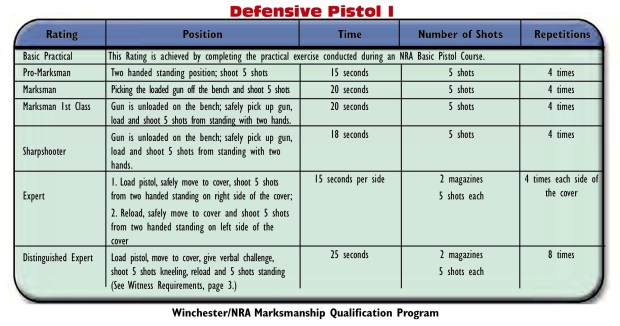
Once a person can shoot a pistol to a reasonable standard, it’s time to move on to thinking about the circumstances of personal protection and becoming proficient at decision making in that context. Decision making can be a very difficult task, especially when we are armed. Lack of proficiency, not just at marksmanship, but at gunhandling under stress, complicates this. Persons who are not Unconsciously Competent can easily become focused on the firearm rather the situation. Focusing on the wrong thing can lead to Bad Decisions, which in turn can result in Negative Outcomes.
These are the Negative Outcome categories I identified in my research. There are probably more.
- Brandishing/showing
- Chasing and shooting
- Downrange failures (shot an innocent while shooting at a threat)
- Intervention
- Lost/stolen guns
- Mistaken identity shootings
- Negligent discharges
- Self-inflicted GSW
- Unintentional shootings
- Police Involvement (arrests for non-shooting related incidents)
- Poor judgement
- Unauthorized access (generally by small children)
- Unjustifiable shootings
- Warning shots
As an example of one category, Unintentional Shootings, here’s a screencap of some of the stories I have collected.
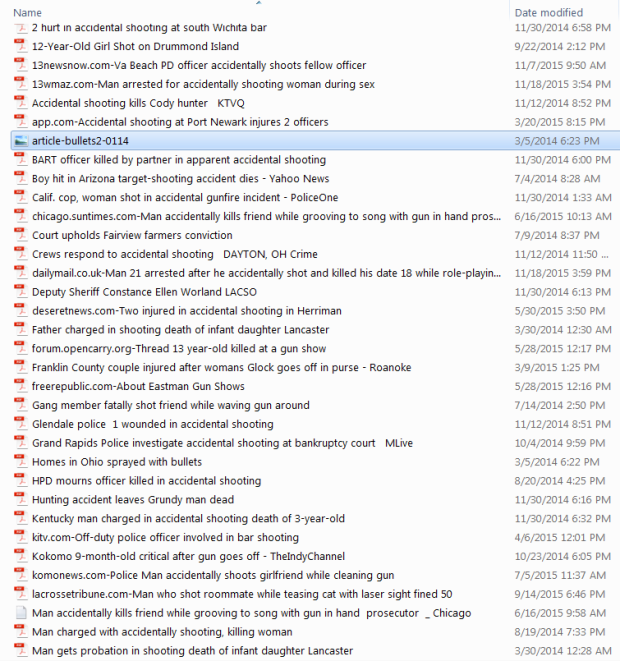
Bad decisions have serious consequences and end up being punished in a variety of ways, some legal and some social. The legal consequences are obvious; the shooter goes to court and sometimes thence to prison. The social consequences of Negative Outcomes are less obvious. If a person accidentally shoots a family member, whether the criminal justice system gets involved or not, I doubt that family relationship will ever be the same. The particular incident I am thinking of occurred when a police officer shot his daughter, thinking she was an intruder.
Decision making has many aspects to it that people don’t often consider. Where you point a gun anytime you handle it is a decision that has to be made. Consider that the next time you’re in a gun shop; where are you going to point the gun as you pick it up to ensure that you don’t muzzle anyone? This relates to another reason I am not fond of the overhand method of slide manipulation. During administrative gunhandling, which happens far more than shooting, the overhand method simply does not give the same level of muzzle control that the slingshot method does. I regularly have to correct students about muzzling themselves when using the overhand method. Using the slingshot technique, not at all.
Note that the Decision Making Process starts long before an incident. For instance, having a flashlight and then practicing with it is a decision. Not having one and/or not practicing with it is a Bad Decision. There are many other possibilities too. Failing to devise emergency plans and then discuss them with your family is a Bad Decision.
Look at the list of Negative Outcomes. The category ‘Downrange Failures’ is the only one that is marksmanship driven. All the rest relate to Decision Making and gunhandling. That’s why I changed my mind.
Friday Fundamentals – Getting our priorities straight
The attacks in Paris by Radical Islamists have captured the attention of the world and obviously people in the United States. Over 100 people were killed and several hundred more were wounded. Along with many people, I mourn for the casualties of these horrific and barbaric events.
In the aftermath, numerous articles are being written about surviving active shooter events, etc. In addition, some folks are saying they’re going to make some massive changes in the way they socialize. It’s always good to examine our vulnerabilities. However, let’s look at things in perspective.
In 2014, the estimated number of murders in the [United States] was 14,249.
In 2014, there were an estimated 741,291 aggravated assaults in the [United States].
There were an estimated 84,041 rapes (legacy definition) reported to law enforcement in 2014.
The FBI definition of Aggravated assault is:
An unlawful attack by one person upon another for the purpose of inflicting severe or aggravated bodily injury. This type of assault usually is accompanied by the use of a weapon or by means likely to produce death or great bodily harm. Simple assaults are excluded.
As my colleague Tom Givens has mentioned, one reason the murder rate has declined in the past few years is because of the advancement of emergency medicine. People who would have been murder statistics a few years ago are often aggravated assault statistics now. That doesn’t mean their bodies and lives haven’t been changed forever because of the assault.
While it’s popular to believe that most murders are committed by gangbangers killing each other and we should just say ‘good riddance,’ that’s not necessarily the case. Where the data is available, the Bureau statics indicate that strangers or unknown persons accounted for 57 percent of murders.
When considering clearances of violent crimes, 64.5 percent of murder offenses, 39.3 percent of rape offenses (legacy definition), 38.5 percent of rape offenses (revised definition), 29.6 percent of robbery offenses, and 56.3 percent of aggravated assault offenses were cleared.
‘Cleared’ means someone was arrested for the crime, not necessarily even convicted. Fully one-third of murders in this country don’t even result in an arrest. Nearly half of aggravated assaults don’t even result in an arrest. Almost two-thirds of the reported rapes don’t result in an arrest. If you become the victim of a violent crime, there’s a good chance the only ones affected will be you and your loved ones.
Relatively speaking, our chances of being criminally victimized are massively higher than becoming a casualty of a terroristic attack. Over 800,000 people in this country had their lives changed forever last year by ‘ordinary’ crime. That’s what we need to maintain our focus on.
For instance:
- Are all your doors and windows locked at night and do you keep your security system on all the time?
- Do you always make people aware you’re in the house when they knock?
- Have you ever opened your door to someone without checking the peephole to see who it is?
- Do you walk or run with your earphones in while listening to music?
- Is there a safe or lockbox in your car to put your pistol in when you can’t take it in with you to the courthouse?
- Do you make a short security halt to observe the parking lot when you come out of a store?
- How often do you text or check Facebook on your phone while you’re in a transitional environment like a parking lot?
- Do you ever park your car in the closest spot to the door of a store without regard to who’s around or what kind of vehicle you’re parking next to?
- You know all the little security violations that you make. Eliminating them is probably more useful than starting to carry an another magazine of ammo.
Another thing to consider is our usage of automobiles and just how much danger we place ourselves in when we drive. Being in a motor vehicle may well be the second most statistically significant voluntary danger we face, exceeded only by going to the hospital.
According to the National Highway Transportation Safety Administration, US car crashes killed 22,383 vehicle occupants in 2013 and injured 2,099,000.
Tactical firearms training is a lot of fun. Tactical medicine classes are very informative and might be more useful than a firearms course. But when was the last time you took a Defensive Driving Course? Some insurance companies offer online versions for free. Most insurance companies lower your premium for taking the DDC. In my state of Georgia, the class is 6 hours and costs less than $40 if you don’t have to take it because of getting a ticket. You put your life in danger every time you get in your vehicle. Don’t you owe it to yourself and your family to become a safer driver? The Situational Awareness tuneup will carry over into other areas of your life, as well.
It’s easy to get caught up in the latest horror of the week that the Lame Stream Media shoves down our throats and we then propagate among ourselves. Let’s use it as a reminder to examine all the safety risks we face. The latest event is probably way down the priority list if we dispassionately look at the many dangers we face every day.
Friday Fundamentals – Boundaries
Up until now, Friday Fundamentals has focused on mechanical issues. This issue is going to focus on mental processes. An incident that was in the news recently drives the discussion.
“It scared me absolutely to death,” said Sherry McLain. She was loading groceries into her car this past Saturday in the crowded Walmart parking lot on Old Fort Parkway in Murfreesboro.
That’s when a strange man approached, surprising her, and she pulled her revolver. “I have never been so afraid of anything in my whole life I don’t think,”
Woman Arrested After She Said She Pulled Gun In Self-Defense
There are a number of problems here that led to her arrest.
- Her level of fear was irrational. Witnesses and surveillance cameras confirmed that the man simply spoke to her from 10 feet away.
- Being startled and being legitimately rationally afraid are two entirely different things.
- She doesn’t understand the difference between setting boundaries and enforcing boundaries.
- Because she doesn’t understand the difference, she didn’t comprehend that when we are defending ourselves, there’s a hierarchy involved. First, we set the boundary and then we enforce it, not vice versa.
- As a result, she now has another issue; the criminal justice system. She was arrested for aggravated assault and reckless endangerment. Based on the current information, I doubt that will go well for her.
Let’s make something clear at the outset, when you pull a gun on someone, you’re threatening to kill them. It doesn’t matter whether you say a word or not, you’re threatening to kill them. Some people apparently don’t understand that and the gravitas it carries. You better have a good reason for doing so. Irrational fear is not a good reason. Simply being startled is not a good reason.
The question of how this might have been avoided brings us to the issues of controlling fear, setting boundaries, and enforcing boundaries.
Controlling fear is a complex topic that is not often discussed in the training community. If anything, the community tends to promote fear, “I was in fear for my life” having become almost a mantra. The woman in the incident invoked it but the police were unimpressed. The difference between reasonable fear and irrational fear is frequently left out of that discussion. It’s somewhat pathetic that there’s better literature in the competitive swimming community about how to control fear than there is in the self-defense community. Learning to control fear is a process beyond the scope of a single blog post. It behooves those who carry deadly weapons to do some research on the topic.
The next issue is boundary setting and boundary enforcement. This is a process more easily trained than controlling fear. Boundary setting and enforcement are simply elements of a process. All we need to do is understand the process and practice it.
It’s important to understand that we set boundaries with communication and barriers, not with tools. The communication can be either verbal or non-verbal. The most obvious form of barriers are the homes we live in, assuming the doors and windows are closed and locked. If a criminal fails to respect the boundaries we set, then we use tools, in this case weapons, to enforce the boundaries. We don’t use tools at the outset to set our boundaries.
One of the biggest issues we have as a society is that we have forgotten or gotten out of the habit of saying NO! That can be done either verbally or non-verbally. Training to say NO! should be a primary lesson in every class on personal protection and people should practice it on a regular basis. Simply raising an outstretched hand and shaking the head can accomplish a lot. Keep in mind that a great deal of communication is non-verbal; we can use that fact to our advantage.
A proper sequence that would have kept this woman out of trouble might be as follows:
Recognize that being startled is not the same as being afraid. She was startled because she was task fixated on loading her groceries in the car, i.e., she had not one bit of situational awareness. Most people are like that. In this sort of a situation, looking around before you get to the car, as you arrive at it, and then after loading each bag goes a long way toward avoiding being startled. Positioning the car for safety helps too. In the sense of color or awareness codes, she was in White or Unaware.
If she had been in Yellow or Aware and seen him approach, there’s nothing wrong with being proactive and raising the hand in the ‘stop’ gesture. That’s the first step in setting a boundary. Her mental state at that point could be described as Orange or Alert.
And yes, at this point, we could invoke the boogeyman of ‘The 21 foot rule’ that Dennis Tueller himself says has become terribly misconstrued. But the circumstances where a criminal runs up to someone in a WalMart parking lot and slashes their throat are far less common than ‘incrementing,’ which is a standard way for criminals to operate. Whether those throat slashings are in fact, reality or figbars of overactive imaginations remains to be seen.
If the person continued to advance, a default verbal response of ‘Stop, don’t come any closer’ clearly sets the boundary. Any decent person would stop at that point. If the person doesn’t stop, it’s an indicator that something nefarious is developing. The mental state shifts to Red or Alarm. Once the intent of the other party becomes more clear, then we can make a decision about which tool we want to employ to enforce the boundary. We can also determine what barriers we might employ in the process. That, too, is a discussion for another time. The boundary setting and enforcement decision process is what’s important in this particular case.
Another thing to consider is that any time we get a gun out for defensive purposes; be that from a holster, purse, nightstand, safe, or whatever, there’s a possibility it’s going to be fired, either intentionally or unintentionally. The more scared we are, the higher that possibility. Therein lays one of my chief objections to brandishing, which is what the lady did; the possibility it will culminate in a Negligent Discharge.
Since thinking about the ‘worst case’ is something many people like to do, let’s examine the possibility of a Negligent Discharge in this situation. Say the woman had an ND as she pointed her revolver at the man or the other people present. It’s probably a good thing for all of the parties involved that she had a revolver and not a striker fired autoloader. If her irrational fear had caused her to have an ND, what would be her eventual statement in court? Something to the effect of “He asked me for a light, I was scared so I drew my pistol, I had an Accidental Discharge, which resulted in a death. It was an accident.” Most likely, she’d go up the river for Manslaughter. Fortunately, that particular Negative Outcome didn’t happen. What did happen was the Negative Outcome of ‘Police Involvement,’ to wit, getting arrested.
If this lady had understood the awareness and boundary processes and then used them properly, she probably would have gone home instead of getting arrested. That’s something for all of us to consider.
Why many Americans insist on owning weapons
A friend posted a comment on his Facebook page about police response policies and times today. His post related to the hypocrisy of politicians who are protected by armed guards around the clock but desire to have the populace disarmed and at the mercy of the criminal element.
In the wake of the Umpqua Community College and Northern Arizona University shootings, there have been renewed calls by Mr. Obama for increased gun control, along with other politicians. The implication of these calls is that law enforcement authorities are always available to protect the citizenry at a moment’s notice. If the government will not allow the citizenry to protect itself, as is now the case in Lesser Britain, then that responsibility must fall to the organized government. A frequently validated saying in the Army is
If no one in particular is responsible for something, then no one is responsible for it at all.
There are several problems with making the government responsible for our safety in the United States, two in particular.
First, the Supreme Court ruled in 1989 and again in 2005 that the government does not have the duty to protect us as individuals. Government in general, and the police in particular, only have the duty to preserve a general sense of order in the US. Only society at large is owed a duty of protection.
Second, there are practical considerations. The following was how I responded to my friend’s post:
I have a recording of an actual 911 call by a woman whose home is broken into while she is on the phone with 911. It is not fiction and was used as an exemplar in 911 dispatcher training.
The dispatcher is shocked into silence by the events, which allows hearing the gruesome sounds and screams as the woman is murdered. It is 2 minutes and 51 seconds long from the time she calls when he is outside until the murderer calmly hangs up the phone after the woman is dead. She is screaming “Who are you?” and has no idea of her attacker’s identity. To my knowledge, the murderer has never been identified, much less caught and brought to justice.
The recording is so horrible and shocking that I am very judicious about whom I play it for. I have listened to it many times and it still turns my stomach every time I hear it.
It’s not the only such macabre recording like that in my collection. They range in length from 1 minute 1 second to 3 minutes 3 seconds.
Every scumbag politician, including police chiefs who serve as mouthpieces for their political masters, should be required to play it at the conclusion of their spiels about how they will protect us and a five to eleven minute response time is plenty. It would be the end of that [you know what].
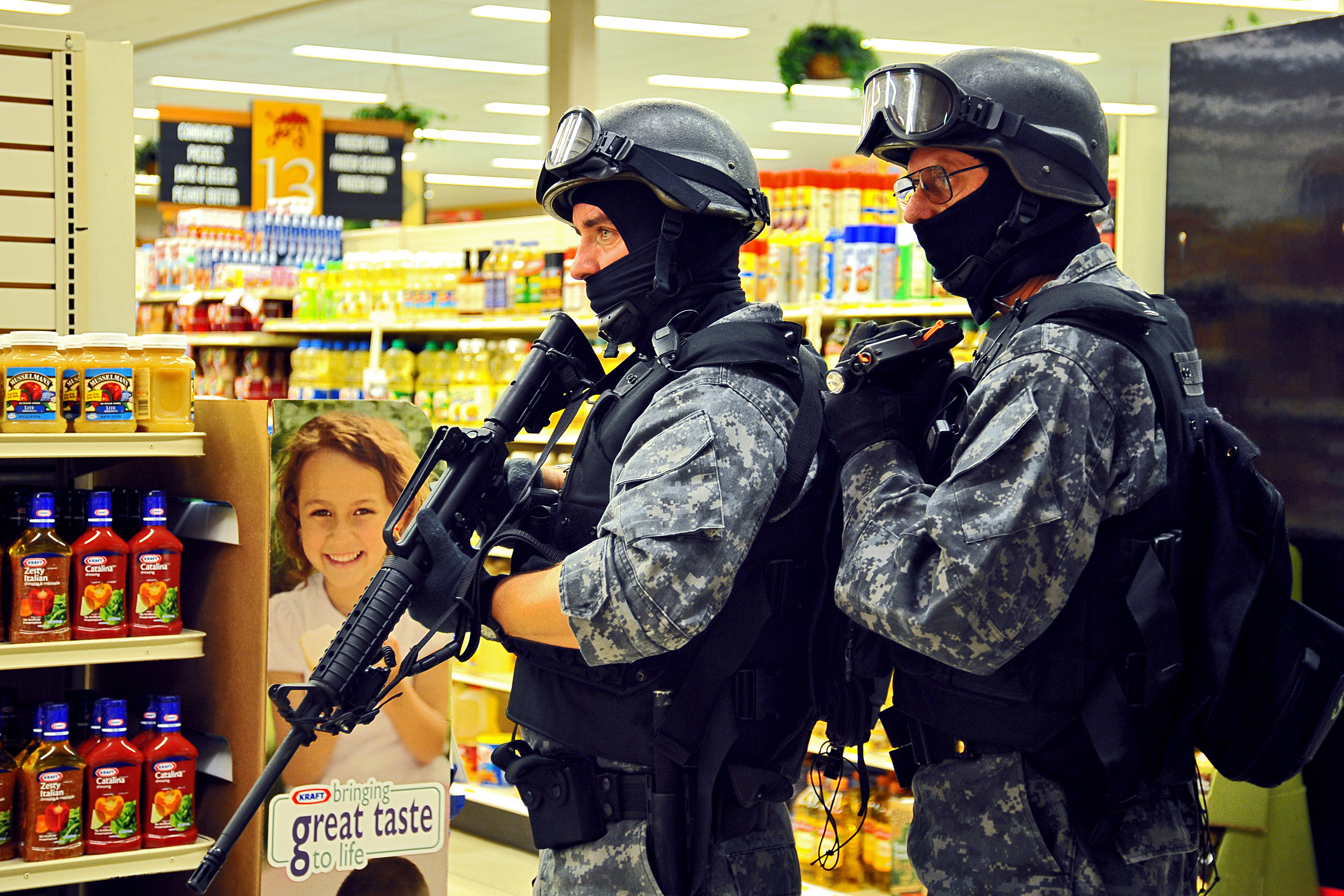
090928-N-1783P-005
(U.S. Navy photo by Machinist’s Mate 3rd Class Juan Pinalez/Released)
Double trouble: Media bias and downrange incident
I follow the stories in The Armed Citizen column of the NRA Journals each month. For copyright reasons, the stories have to be re-written. With the more interesting ones, I try to track down the original story to see if there is more detail. A story in the August 2015 issue involves a downrange incident and piqued my interest to find out more about it. The results were interesting. The Armed Citizen entry is as follows:
Breaking up before the big dance carried a price for several people. Two Wisconsin teens had a lovers’ spat before the prom, after the girl’s parents had spent $500 on a dress. The girl’s parents asked the boy to partially reimburse them since he backed out of the date. The Madison boy stewed about the request and became enraged. He returned to his girlfriend’s house in the wee hours of the morning and tried to break in. The girl’s father caught the boy and called him to task, prompting the boy to draw a knife and stab the man seven times. While the two males were grappling, the girl’s mother came out and fired a handgun into the air. The gunfire distracted the youth, and the man wrestled the teen to the ground. The boyfriend faces multiple charges, including attempted homicide. The girl’s father was airlifted to a hospital to have his wounds treated. (Wisconsin State Journal, Madison, Wis., 5/8/15)
One of the first links I found was to the original Wisconsin State Journal article. It did indeed provide more details, such as how the boy attempted to make entry into the house and the fact that he first of all nailed the father with a shovel. Several other links I found, for instance CBS News, referenced the Associated Press edition of the original article. Somehow, the fact that a handgun had been involved in stopping the incident was left out of the AP edition I found at CBS. At first I thought CBS had edited it but I decided to check. I found other outlets carrying the exact same words from AP, so it was the Associated Press that omitted the handgun detail, not CBS. I’m sure that was unintentional due to brevity requirements or somesuch. Yeah, yeah, brevity requirements, that’s the ticket.
There are several things I find worthy of consideration regarding the event itself. First, incidents where there is a family member or other innocent person in between an Armed Citizen and a criminal attacker are what I call downrange incidents. These are much more common than people like to think. The reason is simple. We’re around our families and friends at lot, typically at least half of each day. But the amount of forethought and practice gunowners tend to give this fact tends to be minimal. Part of that represents the way the indoor range practice environment is set up. It doesn’t lend itself well to practicing for downrange incidents. Unless someone is very confident of their skills, downrange incidents are probably going to be resolved at very close range as Meghan Brown did after a man broke into her home and began fighting with her fiance.
The two rolled around, breaking the dining room table and chairs. Planthaber [the fiance] said it lasted about two minutes. Hill [the invader] had a good 80 pounds on him and was winning.
While they were fighting, Brown got her gun from the bottom drawer of her nightstand.
She trained the weapon [a pink .38-caliber revolver] on the man, but was unable to shoot because Planthaber was too close. [I am willing to bet money she positioned herself as close to them as she possibly could.] She followed his movements.
‘I had my gun drawn, focused in on him; as he moved, my gun moved,’ she said. ‘I waited for my shot, and when I saw an opening, I fired.’
Unfortunately, I don’t have a really good answer about how you practice for this, especially in the indoor range environment. If your range will allow you to place a hostage type target at 1 yard, you could practice single shots starting from a ready position off the target. Many ranges will not permit this though, so ask first. You may have to explain what your objectives are and perhaps allow the staff to supervise you.
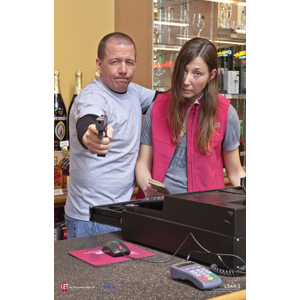
LSAR-2 target from Law Enforcement Targets
At the very least, some mental preparation and mental rehearsal is in order. DO NOT dryfire practice this with a real gun and real people, even if you think the gun is unloaded. That’s a recipe for a Negative Outcome.
If you have access to an outdoor range, here’s a practice drill you could do. If your situation permits it, you could also try this with Airsoft in your backyard.

Another aspect worth considering is the possibility that the male of the household will end up in a physical struggle with a criminal attacker and a female member of the household will end up doing the shooting. Both of the above incidents are examples of that dynamic. I have dozens more in my database. Knowledge of how to operate a firearm and having the will to use it will probably work out better than having a stab a man to death with a butcher knife. Note also that wasp spray didn’t have any effect in this incident.
At some point, ‘the husband was having trouble controlling the suspect and called out to his wife,’ [the Sheriff’s Office spokesperson] said. That’s when the woman ran to the kitchen and retrieved a [butcher] knife, fatally stabbing [the attacking criminal].
For those couples who are serious about personal protection, thinking about it ahead of time may pay off. This is an article I wrote about Protecting Your Family: Training for Mutual Defense.
Closing with the enemy
Soulis had planned to shoot through the back window if Palmer drew a weapon, but for reasons he still doesn’t fully understand, he moved forward and to his right, stopping alongside the passenger door, not more than two feet from the window. Instantly, he realized he’d made a grievous blunder.
Officer Down: The Peter Soulis Incident One of Brian McKenna’s excellent analyses.
Unconsciously closing with an adversary is something I have seen many times in Force on Force. The response was so uniform and so prevalent that it is one of the few things I feel sanguine in saying the probability of people doing it borders on 100%. We need to train ourselves rigorously to hold position or to retreat unless there is a valid purpose for closing. Closing with an enemy needs to always be a conscious decision, never an unconscious one.
When I was an infantryman, the stated mission of the Infantry was to “Close with and destroy the enemy by means of fire and maneuver.” Infantry units consist of numerous men, who are capable of mutually supporting each other with automatic weapons fire and explosive munitions. Private Citizens rarely have those resources available and law enforcement officers generally don’t. Our desired outcome and tactics have to be different.
It’s very common to see in news reports where Armed Citizens have pursued criminals after the criminal has broken off from the crime. Pursuit is fraught with hazards, both legal and tactical. Dependent on the laws of the particular State, pursuing a robber or attacker could result in losing the ‘mantle of innocence.’ This could result in charges being brought against the original victim. It also could put you in a position leading to becoming the victim of a mistaken identity shooting by a responding police officer. Keep in mind that although you know the victim/aggressor roles of the parties involved, the police have to sort that out upon arrival and it’s not always easy.
One of my students was involved in a shooting during the course of an invasion of his home. Despite the fact that he is an excellent marksman, he closed with the invader and the final shot was fired at contact distance. Closing with the enemy causes the defender to give up distance, which favors the marksman, and barriers/cover, which favor whomever is behind them, at least temporarily.
At home or in your place of business, decide ahead of time where your Limits of Advance are located. This is probably no further than your front door, perhaps even further in. The stairwell in your home or the counter in your store may be as far as it is advisable to go.
Palmer flinched as two more rounds hit center mass, and then started backpedaling toward the Toyota. He was still holding his gun, but never raised it to fire.
After reaching the car, Palmer dove over the trunk and dropped out of sight. Soulis paused, and then cautiously started forward again.
Outside the home, pick a spot, preferably something tangible. Then stick to your decision unless a good reason to change it arises. Keep in mind that all cover is temporary until it is defeated by fire and/or maneuver. If there is imminent danger of the cover being defeated, then move. That’s a conscious decision.
You don’t have to make a terrain diagram but making your decisions ahead of time helps you pick better decisions in the moment.
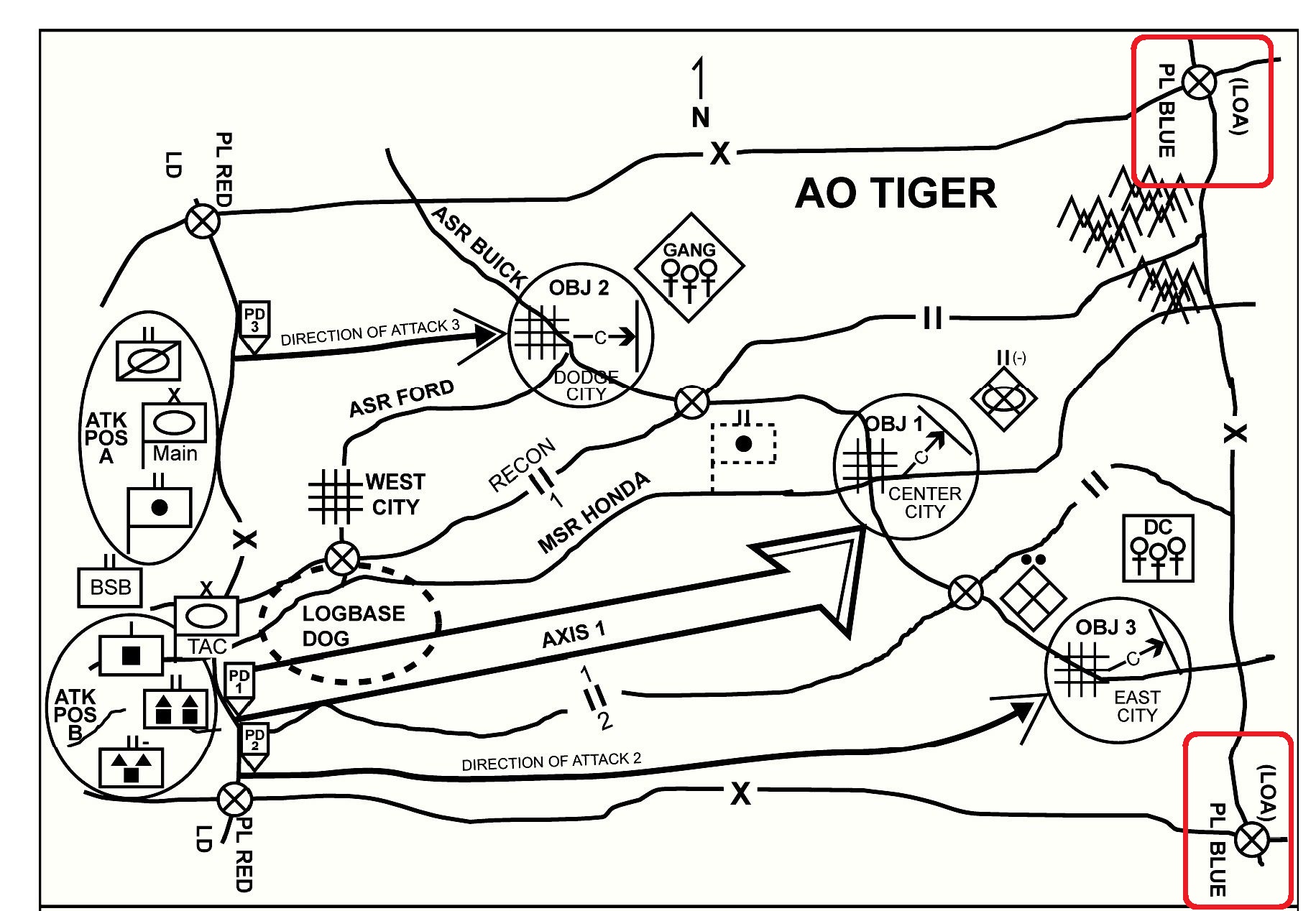
Limit of Advance
 tacticalprofessor
You must be logged in to post a comment.