Indoor Range Practice Sessions
In response to queries and comments about the Pistol Practice Program, I have created a downloadable eBook called Indoor Range Practice Sessions. It is structured as a PDF eBook that you can download to your smartphone or tablet and take with you to the range. That way you always have your practice session with you. Most (99%) gunowners only have access to an indoor range, so the Sessions are designed with this limitation in mind.
The book contains 12 Practice Sessions and 12 Courses of Fire from various States for their weapons carry licensing process. The Sessions are designed to progressively increase in difficulty so when done in sequence they challenge shooters without overwhelming them. The Courses of Fire were chosen to be complementary to a respective Practice Session. Each Session or Course of Fire is 50 rounds or less. They are all structured to maximize the effectiveness of your range time. It also contains sections on:
- Four Rules of Safe Gunhandling
- Gripping the Autoloading Pistol Properly
- Trigger Manipulation
- Using the Sights
- Use of Force philosophy
- and more!
There are considerably more restrictions placed on shooters at indoor ranges than at outdoor ranges. These Sessions were designed with those restrictions in mind. For example, most indoor ranges do not allow drawing from the holster, so the Sessions work on the general idea that no drawing is possible. Similarly, multiple target arrangements are not possible when shooting in a booth at an indoor range, so the Sessions do not include multiple targets.

These Sessions are intended for people who have purchased a firearm for personal protection. They are directed toward newer gunowners; however, ‘newer’ is a relative term. Many people who have owned, and perhaps shot, firearms for years aren’t as proficient as they think they are. Being a hunter, military veteran, security guard, or even police officer is no guarantee of being competent with a pistol. The difference in contexts is huge and often misunderstood.
Learning to shoot is an ongoing process. A misunderstanding that people have is thinking they can take a short training course, attend a seminar, or read a book and then feel they are ‘trained’ or ‘knowledgeable.’ Nothing could be further from the truth. We can only absorb so much information at one time. If we don’t practice what we’ve learned, that skill or knowledge slips away quickly. Repetitive reinforcement of our learning is key to developing and maintaining skill.
The eBook is available for download HERE.
Dryfire drills and objectives
Over the years, I have designed dozens of different dryfire drills for my practice sessions. The first was for a dryfire VHS tape that I produced almost 20 years ago. Frankly, the session and the tape weren’t that good but it was a start. I just kept creating and refining more of them. Now I have a menu of options to choose from each day. Most of them are recordings that I have on my computer and/or my cell phone.
Having a library of pre-made sessions accomplishes a number of things for me.
- Keeps me from getting bored. Since I’m close to finishing my second run of 1000 Days of Dryfire, that’s really important. Let’s face it, having to do the same thing for 1000 days would make it hard to complete the 1000 days. It’s human nature to get bored and we need to accept and anticipate that.
- Having some short sessions makes the 1000 days manageable. A number of my regimens are less than 5 minutes, including setup. Otherwise, I’d probably end up missing a day due to scheduling, fatigue, or other factors. If you want to design some longer sessions like Ben Stoeger or Steve Anderson, that’s great. It’s good practice and I encourage it. However, you should have at least two ready sessions of five minutes or less duration that you can fall back on when you’re busy or tired.
- If you’re a little fatigued, doing a short session helps prevent practicing bad form. Better to get 30 quality reps and end it there rather than doing a longer session and overlaying 70 bad reps on top of 30 good ones.
- Designing short sessions helps me re-focus my long term goals periodically. I shot IDPA heavily for over a decade and a half. During that time, my dryfire sessions were designed around that activity. Doing a lot of dryfire was one of things that helped me win six State Championships. When I became the Chief Instructor at the elite Rogers Shooting School, I created sessions that were more in tune with the skills I demonstrated and taught there. Now that I have become focused on Decision-Making and avoiding Serious Mistakes, my sessions revolve around those objectives.
- Two or three short sessions can be combined into a longer one. For instance, I could combine a timed accuracy oriented session, such as the one I created based on the LAPD Bonus Course, with a Serious Mistakes session, such as flashlight practice.
Think about your goals and what the skills that relate to them are. There are numerous references about dryfire on the Internet and YouTube. My colleague Greg Ellifritz made some very pertinent comments to me recently.
It’s so easy to be good at shooting in today’s world. It takes so little effort to obtain knowledge that was completely cutting edge (and not disseminated outside a very tight knit group of professionals) 25 years ago. A simple google search will provide all the information that took me 10-15 years of constant study to learn.
Just be sure to vet your sources to be sure that it’s not some goober who thinks pointing a pistol at a student’s face, or worse, shooting them, is okay or excusable.
Sometimes a Serious Mistake isn’t a Negative Outcome
‘The perpetrator pulled out a weapon and shot himself in the leg before shooting the victim in the chest three times,’ [Sheriff’s Office spokesman] Fortunato said.
Suspect accidentally shot self before victim
Even when committing an attempted murder, trigger finger discipline is important.
“Pew.
Damn it!
Pew, pew, pew.”
Commonalities among trainers
I had a unique opportunity this past weekend to observe two very different firearms trainers on back to back days. Sunday, I was invited to a Back Up Gun class conducted by Ken Hackathorn. Monday, I was able to observe the last two hours of Introduction to Combat Focus Shooting by Rob Pincus.
Hackathorn and Pincus have backgrounds and philosophies that are probably as different as can be found in the training community. Both are good friends of mine and I have noted that despite their quite divergent backgrounds and philosophies, neither gentleman speaks ill of the other. In fact, both have good things to say about each other.
I believe they both recognize what are commonly thought of as ‘facts’ in the training community are actually opinions. Every trainer’s opinion is based on his or her background. As a result, we are all victims of our own experiences and bring our own biases to our training curricula.
As I watched and listened to Pincus, a number of items struck me as echoing things I had heard the previous day in Hackathorn’s class. The parallels between significant parts of their expressed philosophies and desired training outcomes were quite interesting.
Pincus posed three questions to the students during the class. He wanted them to express, at least to themselves, some answers at the close of training.
- What are you capable of with your gun? (I.e., what are your limits?)
- What SHOULD you be better at?
- How do you get better at the answer to #2?
Questions 1 and 2 mirrored primary questions Hackathorn posed to his class the previous day. “What are you capable of doing with the equipment you are carrying?” “What real world problems might you have to solve?” At the end of Hackathorn’s class, he made the statement “Training teaches you what to practice.” This is philosophically not far removed from Question 3 posed by Pincus.
They spoke about it in different ways, but they both emphasized the need to be able to hit the target. Further, they both made the case that reality will dictate defensive shooting requirements. This is very different from being able to pick our cadence and circumstances when we go to the range by ourselves. Both made comments about the difference between training and competition and not confusing the two.
Often in the training community, we become obsessed with differences, sometimes minor, in style or technique. Periodically, the observation is made that it would be more productive to focus on what we have or espouse in common. Approaching both classes with an open mind was a good indicator of the latter.
Decisions about what you’re capable of
While researching personal protection incidents in 2015 involving armed females, I came across a story that I found disturbing on several levels. The incident actually took place in October of 2014 but was featured in the Armed Citizen® column of the NRA Official Journals in January 2015.
The incident began when a woman discovered a man raping her pet pit bull one morning. The NRA synopsis is as follows:
Alice Woodruff heard noises outside her home around 10:30 a.m. When she went to investigate, she found a nude man attacking her dog in the backyard. Woodruff grabbed her pistol as a family member dialed 911. She then ran to her car to retrieve the gun’s magazine. She kept her distance from the man and warned him not to come toward her as he ranted about being with ISIS and having Ebola. He then claimed to be the anti-Christ. Woodruff held the man at gunpoint until police arrived shortly thereafter. After a nearly two-hour chase, the assailant was arrested and is expected to be charged after his release from psychiatric placement in a local hospital. (/Republican American/, Waterbury, CT, 10/24/14)
Let’s leave aside the issue of raping a dog, which is disturbing enough. A friend in the animal rescue community has informed me this is far more common than any sane person in the civilized world could believe. Several other more commonplace decisional issues are apparent.
First, in an interview with a local TV station, the woman stated:
I ran in, got my [.380 pistol] out of the bedroom, and realized as usual the ammunition is in my car locked in my glove box.
This is a serious problem of mindset and decision-making. Perhaps the woman is attempting to ensure there is no unauthorized access to a loaded weapon in her home. However, her protocol carries this rule to unreasonable extremes. Fortunately, the situation allowed her to “[keep] a picnic table between herself and the man as she opened the car to grab the magazine” Then:
I showed him the clip went in but I always kept the gun at my side while I was talking to him.
This is yet another decisional issue. She should have loaded the gun the moment she had accessed the magazine. Waiting to demonstrate to the man that she was loading the gun actually demonstrated to him that 1) she wasn’t ready to respond in the first place, and 2) she was not mentally prepared to shoot him.
The standoff with the man continued for several minutes as the man made numerous irrational statements. Although she warned him not to move toward her during the standoff, he eventually did. According to the story, the man was standing about 20 feet away from her. While the intent of the Tueller Principle has become heavily misconstrued in the training community, its applicability to a situation like this is clear. As a result of his moving:
Woodruff fired into the ground nearby when he moved toward her, though she said she wasn’t going to kill him.
The warning shot didn’t deter him. He tilted his head back, stretched his arms to his sides as if he was on a cross, and told her to shoot him, she recounted.
As more people own firearms for protection, it’s likely we will encounter an extrapolation of the ‘suicide by cop’ into ‘suicide by citizen.’ While I have said in the past ‘never say never’ about warning shots, we have to also consider that they may not work and a Plan B will be necessary.
But the single most inappropriate decision by this lady was to have a gun at all. A statement she made clearly indicates a firearm is not an appropriate tool for her to own.
And now I have to be the judge and jury and god for him? That’s not fair.
There’s nothing wrong with deciding you are not able to take another person’s life. We all have unique moral principles that guide us. This is why I never proselytize about gun ownership. Having a firearm for protection purposes is a deeply personal decision of the same magnitude as deciding to lose one’s virginity, get married, or have a child. However, someone who cannot bear the thought of taking another’s life in self-defense should not have a firearm as a protection tool. Pepper spray, a Taser, or some other alternative would be indicated.
Eventually, the authorities decided that the woman will not face any charges.
“She feared for her safety,” Deputy Police Chief Christopher Corbett said. “She fired a warning shot into the dirt.”
That warning shot was a reasonable thing to do given the circumstances, Corbett said.
“Every situation is unique,” the deputy chief said. “If you fear for your life, or if you fear for someone else’s life, you can use reasonable force to defend yourself.”
A consideration is that a warning shot may be no more legally justifiable than actually shooting someone. Gunowners do sometimes face criminal charges for firing warning shots.
This incident show a number of nuances to the decision process that we as gunowners should consider ahead of time. Although things worked out in this particular case, it had the potential to turn into a Negative Outcome in a number of ways.
Thoughts about the Rangemaster 2016 Tactical Conference – Part II
The Rangemaster 2016 Tactical Conference was held March 11-13, 2016 in Memphis, Tennessee. I’m continuing to coalesce my thoughts and observations about the Conference.
A friend emailed me today with this question.
For 30 years I have heard the term Dry-fire. The term has been used in articles, in classes, on training videos. Now it is called Dry-Practice. Have we gone politically correct?
Since dryfire is something I work on quite a bit, that’s a question worth addressing in the context of the Conference. Dry Practice, to me, expands the boundaries of what we can work on beyond trigger manipulation. For instance, if you practiced clearing your house with an inert gun, there wouldn’t be any firing, so it would be dry practice.
I considered including a decision-making component, using decisional flash cards I’ve been developing, in my presentation. Due to time constraints, I had to leave it out. That would also be a form of dry practice even though there wouldn’t be any weapons, live or inert, involved; purely a thought exercise.
So, dry fire is actually a subset of dry practice. When it’s used that way, I can accept both definitions.
My class for the Conference was Developing a Dryfire Practice Regimen. I focused the class on fundamental manipulation skills of a pistol that were parallel to what could be seen on a square range. For instance, practicing trigger manipulation, presenting from ready or a holster, malfunction clearance, etc. Fundamental skills should be practiced until we are Unconsciously Competent at them. The more repetitions we have at a task, the more likely we are to develop the UC necessary to free our minds for situational input and decision-making.
Other classes at the Conference refined, extrapolated, or demonstrated the need for dry practice. For instance, John Hearne’s presentation Dry Practice: An Evidence Based Approach included several items of physiological theory about why dry practice is an effective form of practice. John’s Master’s degree concentration was in Research Methods so he was very thorough about his research and how he applied it to our Art. Larry Lindenman’s Managing the Don’t Shoot was taught using inert weapons. The students undertook a significant number of progressively complex exercises with multiple repetitions about how to take a threat at gunpoint without firing. Tom Givens’ Low Light Equipment class included considerable material about flashlight technique. All the techniques Tom presented could be practiced dry without going to the range. Low light livefire should simply be a verification of the manipulation skills developed in dry practice. That is the approach used at the elite Rogers Shooting School.
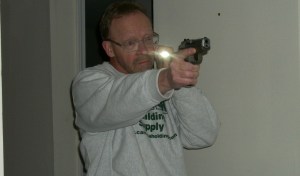
One attendee was so kind as to bring a set of Dry Fire flash cards he had purchased. It was interesting to look at them. While they might have some long term viability for a few shooters, there were some serious barriers to using them for skill development. Most notably, the cards assumed the user was familiar with the drills indicated on the cards. I.e., the creator took his subject matter knowledge for granted. Second, there really was no information provided about how to use the cards as part of a practice regimen. It’s important that we either have a logical sequence for building our skills or that we deliberately work, at random, skills we have already developed to maintain instant recall of our UC. Without a program for doing one sequence eventually followed by the other, the cards’ usefulness is limited, in my opinion.
Caleb Causey and I had an interesting conversation about non-verbal communication. It made me realize how powerful non-verbals can be between an instructor and a student. Chuck Haggard and I have discussed the non-verbal communication that goes on between predators and potential prey. One of the most important components of interacting with predators is to ‘fail the interview.’ Predators frequently observe whom they wish to prey upon in order to make a decision about whether to proceed with the predation. This observation is the initial component of the ‘interview.’ Appearing to be uncooperative from a distance may avert the need for a verbal or physical interaction at all. Being uncooperative is something that can be practiced dry, as well, and doesn’t necessarily require equipment.
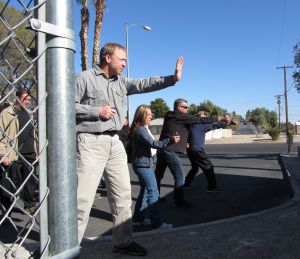
More about the Conference next time.
Initial thoughts about the Rangemaster 2016 Tactical Conference
The Rangemaster 2016 Tactical Conference is now in the record books. It was held March 11-13, 2016 in Memphis, Tennessee. The gathering included 200+ attendees, almost 30 instructors, and the fine facilities and staff of the Firearms Training Unit, Memphis Police Department Academy.
There was a great deal of material presented, more than could be attended. The Conference focuses on an inter-disciplinary approach to personal protection, so there is a lot more than just firearms and shooting involved. There was a challenging pistol match that could be shot, though; 158 people chose to shoot it.
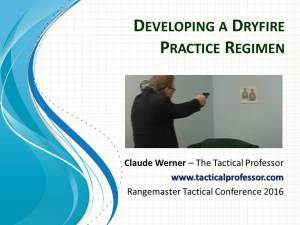
The class I gave was Developing a Dryfire Practice Regimen. I was very gratified by the turnout of 50+ students. As the saying goes, ‘The best way to learn something is to teach it.’ Over the course of creating my presentation, my dryfire techniques became even more refined. One attendee also gave me a new training aid I wasn’t aware of. As in every class I teach, I also learn from the students.
The other classes I attended were:
- Managing the Don’t Shoot – Larry Lindenman
- Gaming the Streetz – Eve Kulczar
- Low Light Equipment – Tom Givens
- Optimizing Classroom Instruction – Tiffany Johnson, Esq.
- Metro-Tactical – Julie Thomas
- Urban Insurgency – Dr. Martin Topper
- Lasers, Red Dots, Iron Sights – Karl Rehn
- FBI Research: The Deadly Mix – John Hearne
- International Terror Operations – Gary Greco/John Holschen
- Dry Practice: An Evidence Based Approach – John Hearne
One of the pleasures of going to Conferences is getting to talk and catch up with my peers. Some of the conversations I had were:
- Cecil Burch – the Venn Diagram of Realization, instructor goals in attending conferences
- Paul Sharp – human gun interaction
- Skip Gochenour – Homicide trials
- Caleb Causey – Non-verbal communication
- Tom Givens – Standards that replicate incident skills
- Richard Jenkins – Dry Fire Flash Cards and skill development
- John Farnam – Attitudes of older fighters
- Gary Greco – American soccer team development, American Mindset (competition and confront/dominate)
- John Murphy – immediacy of action
- Mark Luell – I won’t let you take this from me
- Chuck Haggard – performance of .38 Special and .22 LR in gel and adversaries, S&W metal autoloader maintenance
- Karl Rehn – iron sights, lasers, and red dots
- Julie Thomas – tuning a class presentation
I’ll have more to report about the Conference in future posts.
Serious Mistakes now available as a download
There have been many requests for the Serious Mistakes Gunowners Make recording as a download. Despite being something of a Luddite, I figured out a way to do it.
The recording is now available as a download for $9.95. Link
Serious Mistake Again
I harp on Serious Mistakes because I get sick of reading about this kind of incident. Needless and completely preventable tragedy. In this case, an ounce of prevention would have been better than a lifetime of no cure.
The Serious Mistakes research I’ve done over the past two years has completely changed me in terms of how I prioritize things. Bad things happen too often, frequently because carelessness and incompetence.
If you own guns, you need a plan to secure them when children are around. Even if you don’t have kids, people bring theirs over to your home, especially your grandchildren.
Like many aspects of firearms, this needs to be thought of ahead of time. If you’re not willing to spend a little bit of time, money, and effort to keep firearms out of unauthorized hands, then get rid of your guns.
Knowledge
I’ve had several parallel annoyance tracks running this week.
1) .22s for personal protection
2) .38 snub nose revolvers for personal protection
3) The ‘OODA Loop’
4) The value of knives versus guns for personal protection.
Here is my advice to the gun community:
Unless you have primary source information about a topic, meaning you have personally seen it, or better yet experienced and tested it, then don’t talk about the subject. Just keep your piehole shut and don’t spread misinformation. Everything you have been TOLD about the subject by someone else was TOLD to them by someone else, who HEARD it from someone else, etc, etc, etc. The ‘information’ was either bad in the first case, got badly distorted by six degrees of separation, or both.
This applies to gunshop commandos, law enforcement officers, gun manufacturers, firearms trainers, Internet Lounge Lizards, and anyone else who has ever seen a gun or seen a picture of one.
I know this will fall on deaf ears but I’m going to put it out there anyway.
 tacticalprofessor
You must be logged in to post a comment.