The Good, the Bad, and the Ugly – June 2024
Unsurprisingly, my hometown of Chicargo leads the post this month. Fortunately, the incidents fell in the Good category. Safety and mindset are fundamental in the other incidents.
https://www.patreon.com/posts/good-bad-and-107216506
The Good, the Bad, and the Ugly – June 2024
The Good – Shenanigans from Chicargo
Chicago concealed carry holder scares off armed carjackers in Irving Park
Bonus! The second happened a few blocks from the gas station (probably gone by now) where I worked after school in my Senior year. It wasn’t a great neighborhood then but apparently has gotten much worse now.
Chicago concealed carry holder shoots 3 men who attacked him in Belmont Cragin
The Bad
School District of Palm Beach County employee accidentally [shoots himself] during ‘training exercise.’
This story points out the importance of safe gunhandling at all times. Guns are relentlessly unforgiving of carelessness.
The Ugly
Minnesota dad told landlord he ‘already dug a hole’ before executing daughter’s boyfriend for suspected abuse
The number of people who feel that gunfire is the solution to most every problem astounds me. Many tools are only for a very specific task and guns are one of those tools.
Enjoy!
If you like my work, join me on Patreon where I post more in-depth articles about shooting, marksmanship, and incident analysis.
https://www.patreon.com/TacticalProfessor
The GBU isn’t drawn from The Armed Citizen column of the official NRA Journals but the June edition of The Armed Citizen is attached. Rather than an obsessive interest in ‘the worst case scenario,’ it shows what the vast majority of Defensive Gun Uses really look like.
Keep Your Hand Away From the Muzzle
A friend of mine sent this link to me today.
Instagram video of Serious Mistake followed by Negative Outcome. https://www.instagram.com/reel/C4LsHBArwtl
In the video, the person holding the gun is trying to get the laser to come on and repeatedly muzzles his own hand looking for the laser dot. Shortly after this frame, the gun discharges and shoots a hole in his hand, which was a definite Negative Outcome.
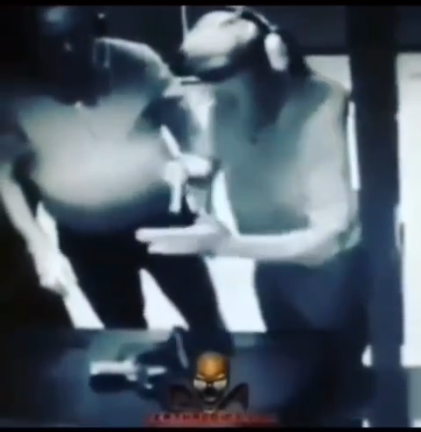
Sadly, the examples of dangerous gunhandling that gunowners and new shooters see while watching TV and movies are horrific. In the latest debacle by the ATF’s “expert” on the talking head TV show Face The Nation, he muzzles his own hand repeatedly. https://www.cbsnews.com/video/atf-director-and-firearms-expert-show-some-of-the-weapons-being-found-on-the-streets/

The ‘unboxing’ shows on YouTube by so-called wannabe gun ‘influencers’ are universally heinous, too. And before we get to feeling all righteous and self-congratulatory, even people we in the industry would consider legitimate Subject Matter Experts muzzle their own hands regularly when doing demonstrations on YouTube.
Probably the best firearm safety device that could be produced would be an extremely sharp Fairbairn Sykes British Commando Dagger with a 3 inch long 9mm diameter tang and no handle. If any knife producer wants to use this idea, feel free, no license or royalty required.
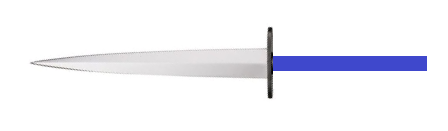
The 9mm tang could then be inserted all the way into the muzzle of a pistol so the dagger blade would be directly in front of the muzzle. It would teach the importance of keeping one’s hand away from the muzzle. In an emergency, it could also serve as a bayonet. 😊
Keep your hand away from the muzzle, PERIOD. It doesn’t matter if you think the gun is unloaded, keep your hand away from the muzzle. Rule 1: “All guns are always loaded” is a philosophical rule unlike Rules 2 through 4, which are operational rules. Not many people really understand this distinction.
Competition, Practice, Training, and Testing – Redux
#mindsetmonday
In this case, I am using Redux not to mean “Redux is an open-source JavaScript library for managing and centralizing application state” but rather “redux describes things that have been brought back—metaphorically, that is.”
Ten years ago, I wrote this post about Competition, Practice, Training, and Testing, https://thetacticalprofessor.net/2014/09/29/competition-practice-training-and-testing/
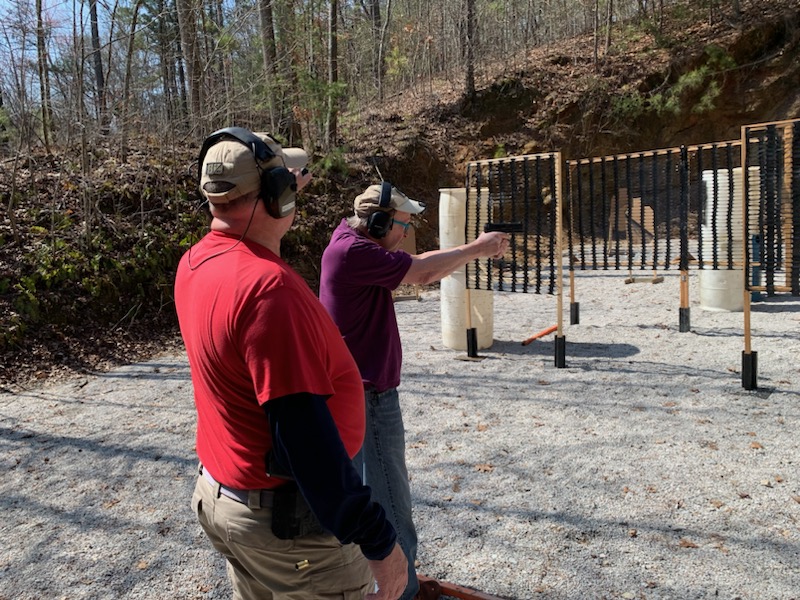
The subject has reared its ugly head once again, so I’m revisiting it. For personal reasons, I stopped competing for a number of years but recently rejoined IDPA and got back into it. Yesterday, I had the opportunity to shoot a thoroughly enjoyable and challenging match at my gun club. It featured a variety of start positions, had scenarios in which required or allowed shooting on the move, reloading on the move, shooting either with the Support Hand or Primary Hand, and various other skills. While many of these skills are not entry level skills, they are skills that someone who is an Intermediate or Advanced shooter should be at least capable of, if not proficient at.

Here’s a video of the entire match from the shooter’s (mine) perspective.
What did the match cost me? About 40 minutes’ drive, $10 entry fee, two boxes of ammo, and three hours of my time on the range. I also had the opportunity to hang out with friends and people who are on my same sheet of music. It’s also an ego investment, good or bad. That’s a pretty good value for the experience I received. It was a good investment with, to me at least, a high Return On Investment.
Many years in the real estate industry taught me the value of ROI. I submit that shooting in competition may have a much higher ROI, in addition to being fairly accessible, than is generally acknowledged by the training community.
I’m very rusty, as is obvious in the video, but it was a really good TEST for me. One of my benchmarks is how well I can hit the mini-poppers, and I’m pleased that I hit them all with one shot. The skill of being able to transition to a precision target quickly and make the hit is something that every Intermediate and Advanced shooter should be capable of, on demand.
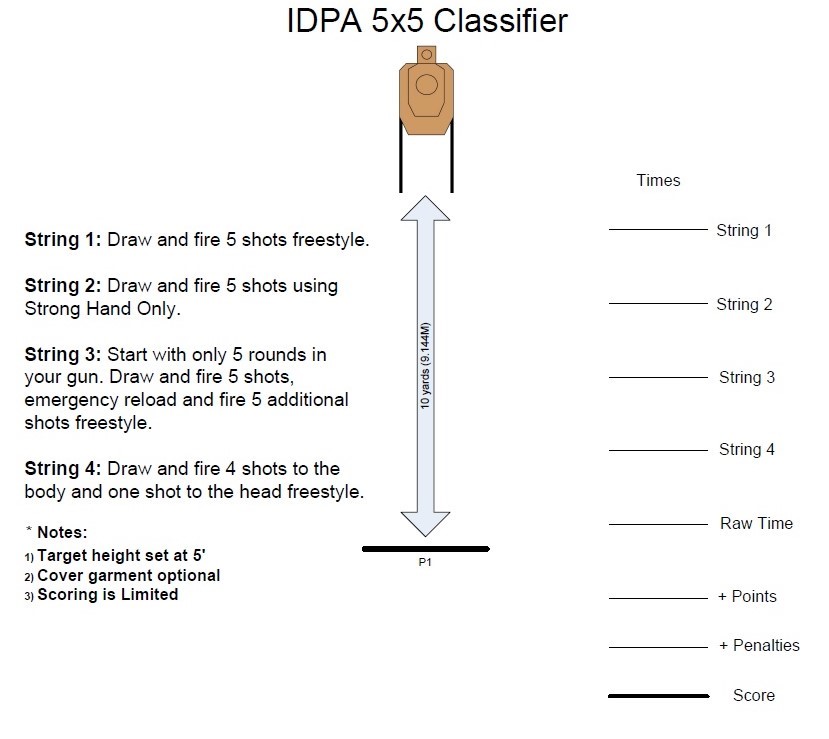
Afterward, I shot the IDPA 5×5 Classifier on my own to get a benchmark of where my skills are at. They’re pretty sad (Sharpshooter) compared to where they used to be (4 gun Master) but at least I have a solid and repeatable measure of my marksmanship skills. My plan for the year is to shoot the 5×5 every month and shoot the full Classifier once a quarter.
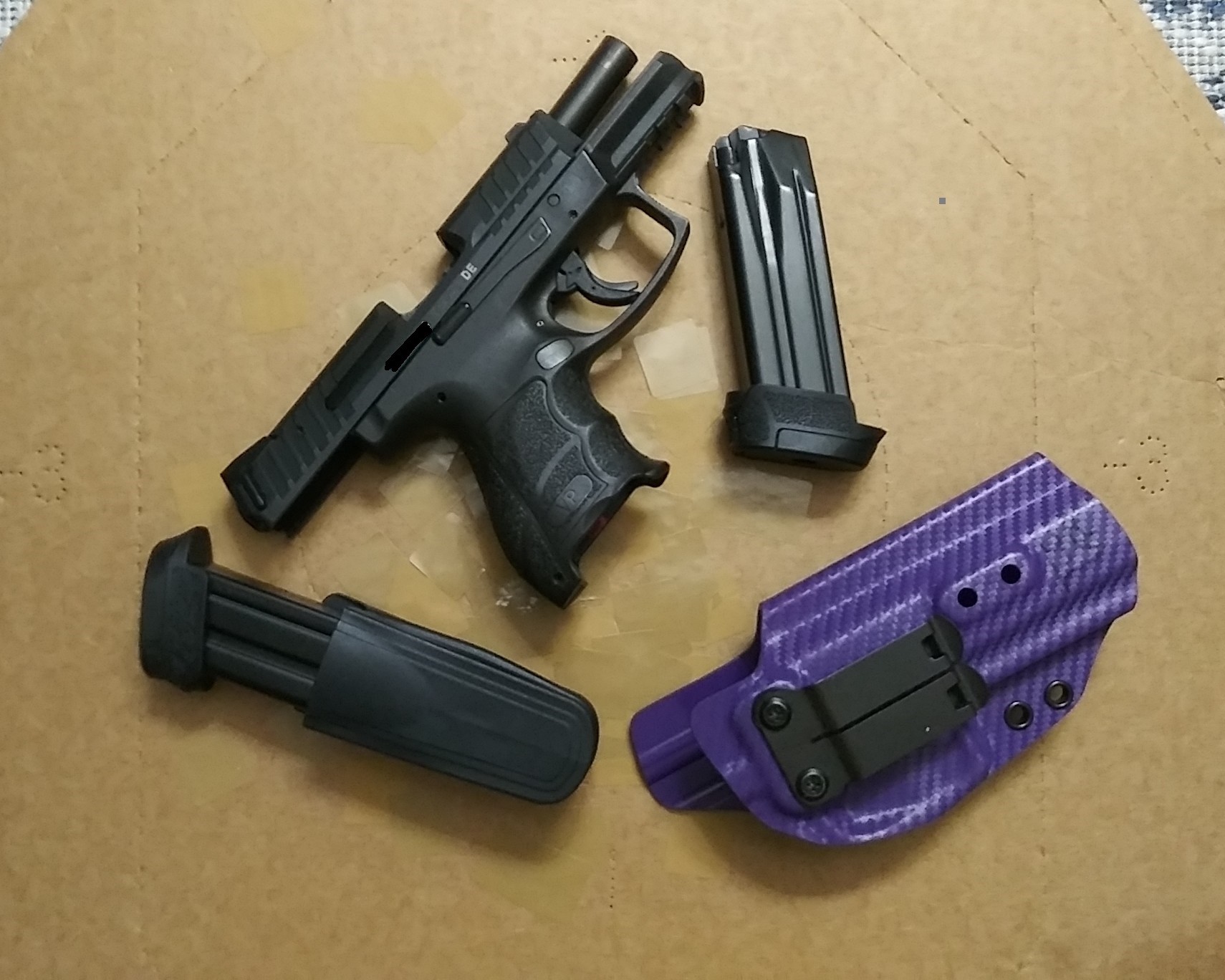
I’m looking forward to improving this year. The VP9SK is a great pistol that I really enjoy shooting. The Assassin mentioned that he’s confining himself to one pistol, his Pizza gun, for six months and I’ll probably do the same with the VP9SK.
Shooting Practice for a Criminal Encounter
The second installment of my Shooting Illustrated series about organizing your shooting practice is now online.
https://www.shootingillustrated.com/content/shooting-practice-for-a-criminal-encounter

I always include more photos with my article submissions than can be used. After this paragraph in the article, I included what is possibly my favorite shooting photo of all time.
Shooters often blast an entire box of ammunition at the target without checking and then marking it consistently. This is one of the worst mistakes that can be made when practicing for marksmanship development and self-defense.
Sadly, along with several others, it was cut for space reasons. The photo is of a target that was left up at my gun club years ago. Every time I look at it, I literally Laugh Out Loud. I call it the ‘goober target.’
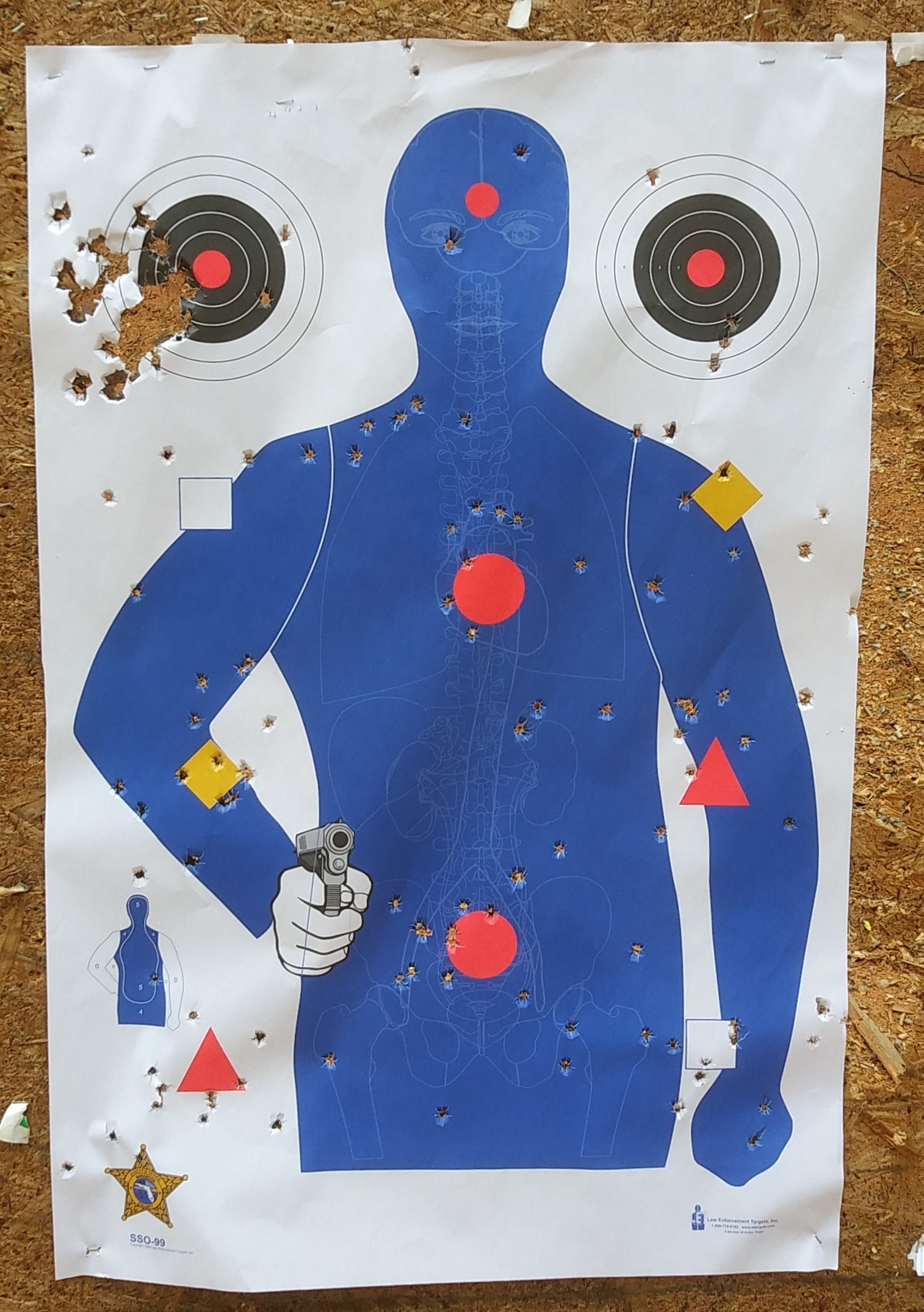
That is not the way to learn how to shoot to hit anything. Another photo that was cut shows how to mark your target with masking tape every few shots.

As mentioned in the article, checking and marking your target regularly will help you improve your marksmanship. Blasting away and creating a goober target will not.
Here is the Pump target. No one can say you’re practicing to shoot unarmed people if you have a representation of a gun on your target.
It’s getting to be a wild world out there; be ready.
Fundamentals and Training Aids (Part 1)
#fridayfundamentals
Revisiting the series about the Fundamentals of Pistol Shooting https://tacticalprofessor.wordpress.com/2021/11/05/fundamentals-of-pistol-shooting-part-1/ brings to mind the subject of training aids. Training aids are other pieces of equipment you will find useful for marksmanship and gunhandling practice. Your pistol shouldn’t be your only practice tool. There are a wide variety of readily available and inexpensive training aids.
An Inert pistol replica is the most valuable training aid you can own. Having a replica of your real gun is the best but it’s not absolutely necessary. This picture shows a small portion of my collection of inert pistols. No trainer worth his or her salt lacks at least one inert pistol for demonstration purposes.
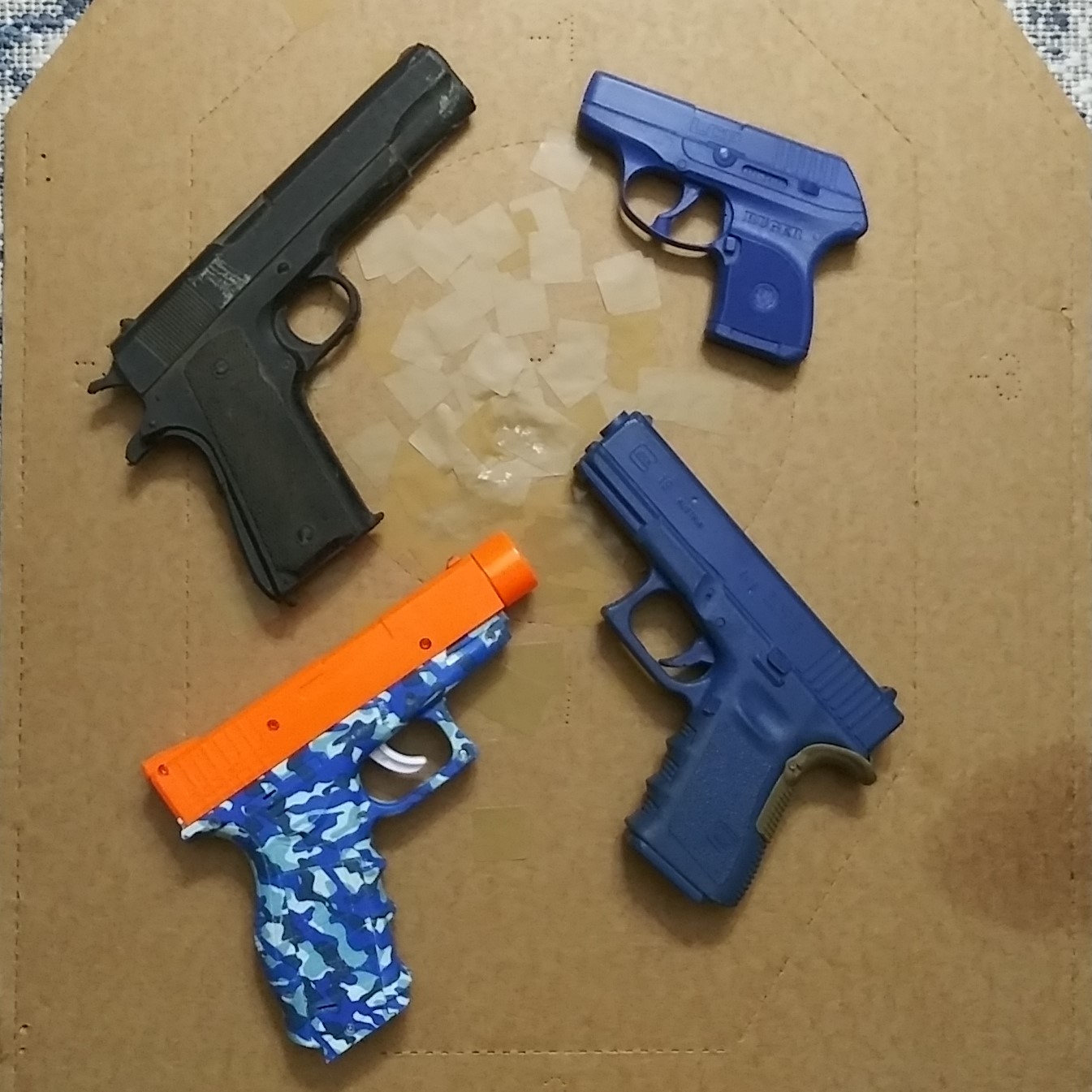
The rubber 1911 is the first training aid I ever acquired. I carried it on field exercises when I was a 90mm M67 Recoilless Rifle Gunner in the Army and didn’t want to clean two weapons every time I came back from the field. I’ve had it for 50 years now.
The orange and blue camo inert pistol was purchased from WalMart for less than $10. If no replica of your personal pistol is readily available, at least there’s something that can be used. It also makes a satisfying pew-pew noise when the trigger is pressed.
A SIRT Pistol is a useful option but expensive. Only three models are available; Glock 17, S&W M&P, and a generic subcompact model that reportedly only fits a holster for a Springfield XD-S.
An inert pistol can be used in a variety of ways. Among other things:
- Draw practice, especially for those who are reluctant to practice with their real pistol at home.
- Checking the solidity of your grip by having a partner hold the front of the slide and try to move it around.
- Practice getting your pistol out of its safe storage location quickly.
- Introducing others to holding a pistol without intimidating them.
- Doing demonstrations without endangering others.
There are also a number of other training aids that can improve your shooting.
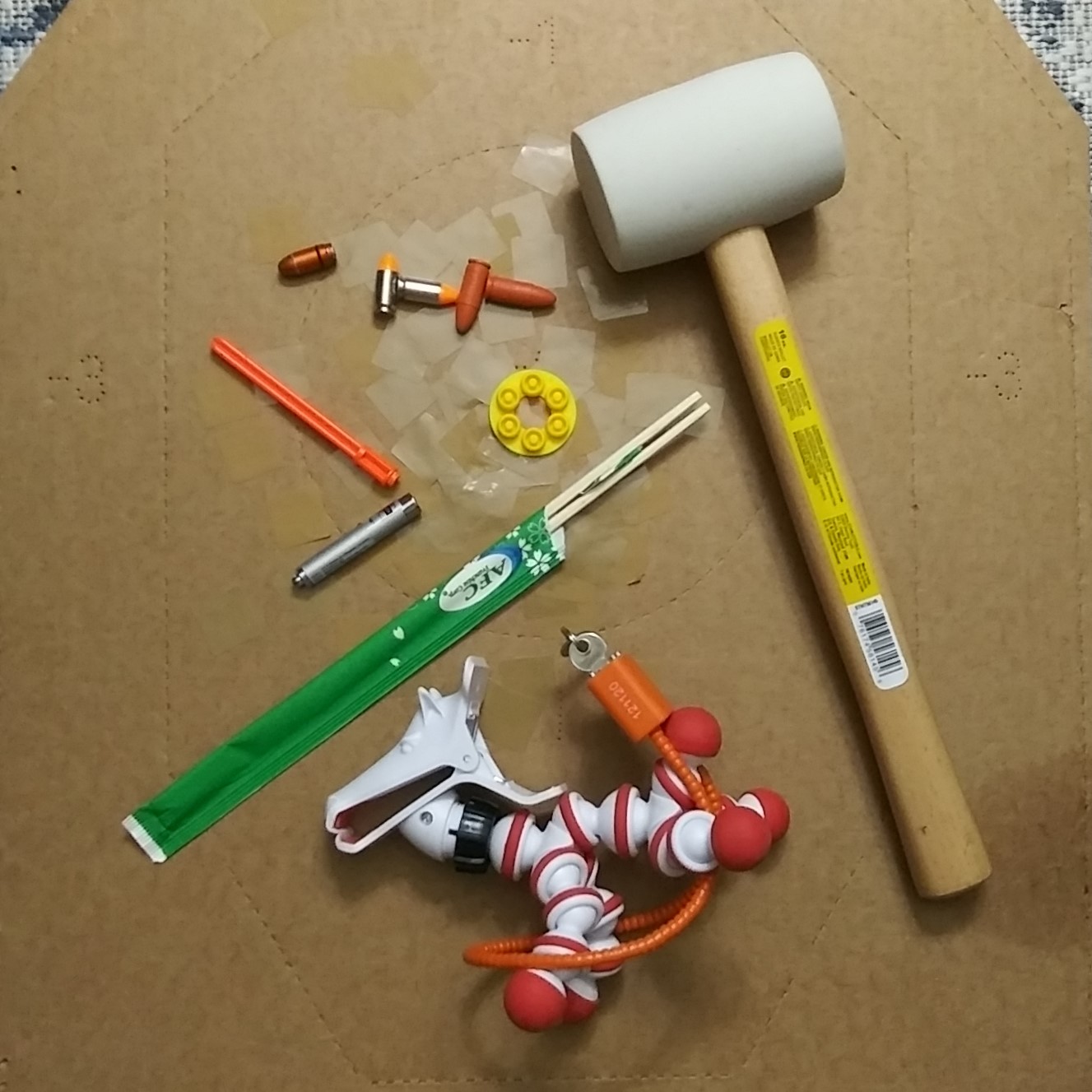
How to use these other training aids will be covered in future installments of this series.
Tactical Professor books (all PDF)
https://store.payloadz.com/results/337896-tactical-professor

A Way of the Wheelgun
#wheelgunwednesday
In 2022, I created a four month Patreon series for developing shooting and gunhandling skills with snub nosed revolvers. There are a total of 65 articles in the series and it is the online equivalent of a book. All the articles are now available as a Collection on my Patreon page. Unlike a book, you can read it at your leisure on your Smartphone.
The basis for the Series is the principles and techniques of the Snub Nose classes I taught for decades and the two DVDs I made about snubs. Also included are examples of what went right and wrong in several real life incidents involving snubs.
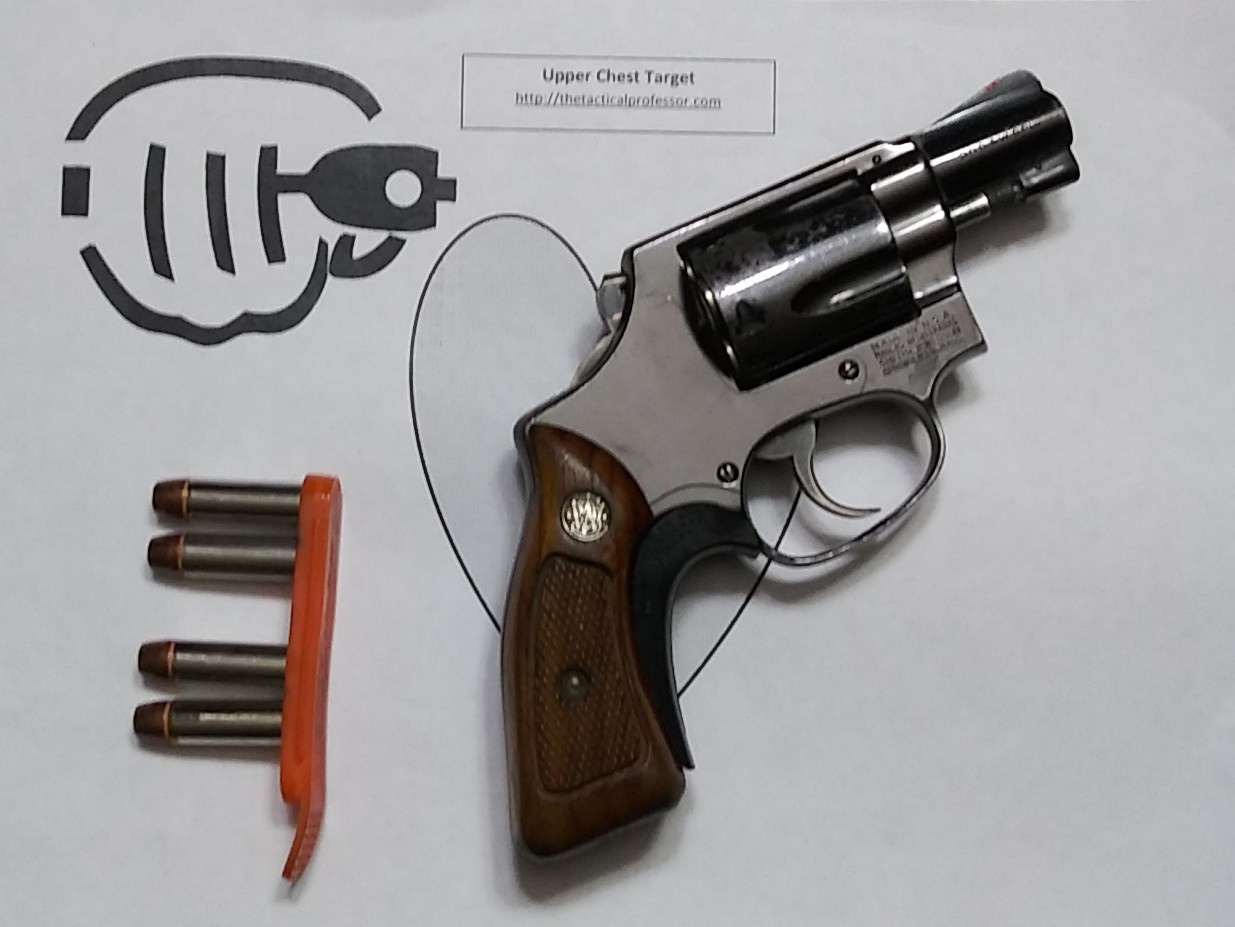
There is a great deal of emphasis in the Series on ‘dry practice,’ i.e., practice without ammunition. There is also periodic live fire (originally monthly) of no more than 50 rounds. The live fire is compatible with either indoor or outdoor ranges because the vast majority (999/1000 by my calculation) of gunowners only have access to indoor ranges.
The first three posts in the Collection are unlocked and available for anyone to read. These initial posts describe Safety Protocols during dry practice to avoid putting bullet holes in people, places, and things where they are undesirable. Tragedies can and do take place during dry practice and we want to avoid those at all costs.
For anyone who owns and/or carries a snub, this is a good program. Anyone who does any dry practice, whether with a revolver or autoloader, will benefit from at least reading the first three posts about Safety Protocols.
https://www.patreon.com/posts/snub-revolver-97045992
Subscribers to my Concealed Carry Skills Tier ($3/month) https://www.patreon.com/TacticalProfessor have access to all the articles in the Collection plus all the articles I write on Patreon about marksmanship and gunhandling. In the financial industry, we’d say the Return On Investment (ROI) is very high.
Empty Chamber Carry – I
#fridayfundamentals
Empty Chamber Carry is strongly opposed by the US private sector training community and the ‘cognoscenti’ of the firearms community. However, carrying with the chamber empty is still a very common practice by large swathes of gun owners. Regardless of opposition to the concept, it is what it is. Some discussion beyond “Don’t Do It” is in order.
This is the first in a series of Fridayfundamentals posts about carrying with an empty chamber. The series is intended neither to advocate nor oppose empty chamber carry but rather to discuss aspects of it not typically examined. A sidenote is that many aspects of the discussion also apply to hammer down carry (Condition Two) with 1911 pistols but that is for another time.
First consider the advocates of carrying with an empty chamber.
- Fairbairn/Sykes in Shooting To Live.
- Israeli military/POlice, although it’s reported that this has relaxed in the past decade.
- Many foreign militaries and POlice forces.
- The US Army until the publication of the May 2017 version of TC 3-23.35 Pistol.
As one commentator noted when the May 2017 TC was published:

Since many people do carry with an empty chamber, let’s work with what we’ve got from the standpoint of instruction.
The single biggest problem with the method is the technique that new gunowners usually employ to load the chamber. The most common technique seen is to hold the pistol in the shooter’s workspace and pull the slide inward toward the body and out of the workspace. Most often the slide is held during the entire operation, retarding the strength of the recoil spring.
This is exactly opposite of what needs to occur. Pulling the slide inward significantly increases the possibility of not fully loading the chamber. This could be a disaster. At least one surveillance video shows an armed robber whose pistol didn’t load completely, which led to his demise.
Here’s a graphic from TC 3-23.35 that illustrates the workspace and its relationship to pistol operation.

Both Shooting To Live and the classic Israeli technique advocate holding the pistol in the workspace and then pushing the pistol forward to the outer limit of the workspace. The slide is held in place while the pistol is pushed outward.
Here’s a series of updated sketches from Chapter 3 of the edited and annotated edition of Shooting To Live that I will be publishing this year. A number of the original Shooting To Live sketches had to be redone due to finger in the trigger guard violations.


Similarly, the classical Israeli technique is to hold the pistol parallel to the ground in the workspace. The slide is held stationary and the pistol is pushed forward toward the enemy and fired.
Note that both Shooting To Live and classic Israeli use the slingshot method of grasping the slide rather than hand over the top of the slide.
The discussions of Empty Chamber Carry rarely include any commentary about what to do after the pistol is loaded, regardless of whether it is fired or not. One of the few comments ever seen was “If I don’t have to shoot, I’ll immediately download the chamber when I get back to my car.” Downloading or unloading afterward is an important enough topic for Shooting To Live to include it as part of the initial 30 round Recruit Training Program. Chapter IV states:
“In all practices at surprise targets, opportunity must be found for the performance of two very essential operations. In order of importance, these are:—
1. Making safe after firing only a portion of the contents of the magazine.
2. Inserting a second magazine after totally expending the contents of the first and continuing to fire without delay.
In the first instance, after firing one or two shots from a fully charged magazine, the instructor should give the order to cease fire. The shooter should then come to the ‘ready,’ remove the magazine, eject the live round from the breech, work the slide back and forth several times and finally pull the trigger, all as described [in] (Figs. 9 and 10).”
Note the order of importance Shooting To Live placed on unloading and reloading. Making the pistol safe after an incident was considered of greater importance than reloading during an incident. It’s probable to assume this priority came from their observation of hundreds of gunfights. Concerns and technique for After Contact actions will be covered in the next post.
WWII Helicopter Rescue Mission – Unintentional Discharge Related
Dr. Mark Felton never ceases to amaze with his recounts of wartime exploits. The elaborate efforts made by the US Army to rescue a soldier involved a journey three-quarters of the way around the globe.
“A soldier based in a weather station atop a 4700 foot tall mountain [in Burma] had accidentally shot himself in the hand and infection had set in. He needed immediate evacuation to hospital.”
“On the 24th of January 1945, a helicopter undertook the first combat medical evacuation in history.”
Ironically, the first helicopter Medevac mission in history was not due to combat action but rather because of an Unintentional Discharge.

The Value of Historical Methods
A viewer of my Shooting to Live Advanced Methods demo YouTube video asked an interesting question.
“Do you think that there is any value added by practicing the WWII Combatives shooting methods beyond learning historical training firsthand?”
In a conversation with him, he further elaborated that he was asking from his perspective as a competent shooter who practices regularly using demanding time and accuracy standards. From that perspective, my answer was NO. The only value to him would be for historical academic interest. There is nothing that will be learned of practical value for someone with his level of proficiency.
However, I continued on by saying that to the millions of first time gun buyers of the past few years, MAYBE. Only a miniscule fraction of those people will ever take a class on gun safety and learn how to shoot to some standard, whatever that standard might be.
For those millions of first time gun buyers, studying actual WWII shooting combatives, such as Shooting to Live and Field Manual 23-35 Pistols and Revolvers (1946), could have some value. Shooting to Live and its immediately successor, US Army Combat Firing, at least provide some structure and standards for brand new pistol shooters. Any system based on real combat is preferable to going to an indoor range and randomly blasting away based on what’s shown on TV.
I began the long term series about ‘Unsighted Fire’ aka Point Shooting on Patreon for a very specific reason. It is that obviously the vast majority of people who write about point shooting or make YouTube videos on “Fairbairn Method” shooting have never really read or studied any of the literature about it, including Shooting to Live. From the perspective of an historian and researcher, this lack of fact based information is both annoying and disturbing.
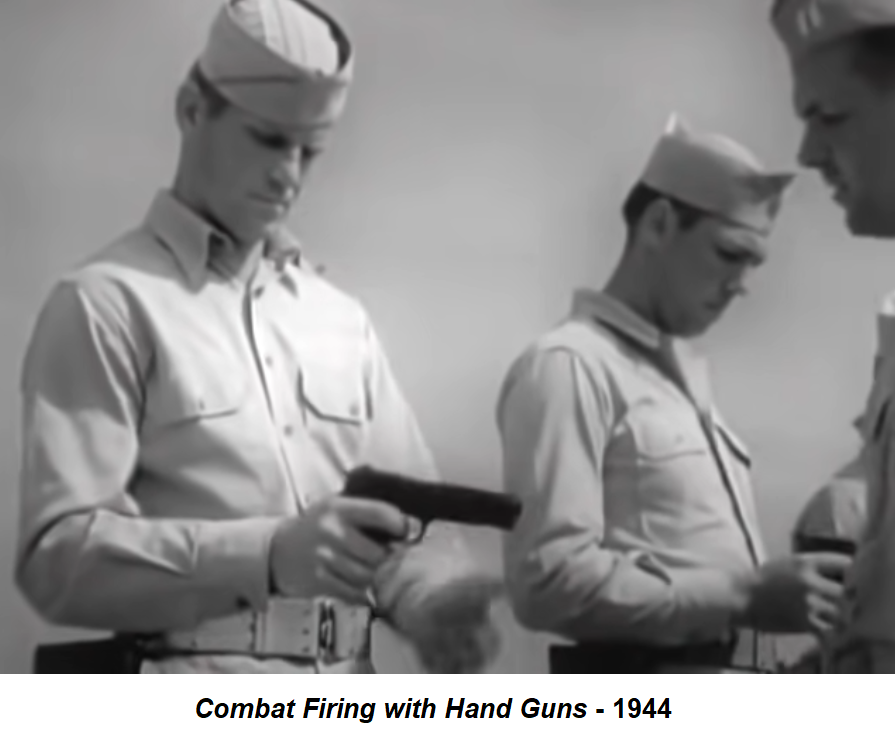
The gunhandling and safety aspects of WWII pistol combatives alone have a great deal of merit. Gripping the pistol properly. A strong emphasis on practical gunhandling in addition to marksmanship. Including malfunction clearance in early stages of Live Fire. Equal weight on Dry Practice as Live Fire, especially prior to the initial firing practice. Highlighting the concept of treating a pistol as always loaded. Emphasizing the importance of muzzle direction when handling a pistol. Practicing clearing and making the pistol safe when less than a magazine has been fired. Those are all highly useful skills, probably even more so than the marksmanship standards, which were not very high.
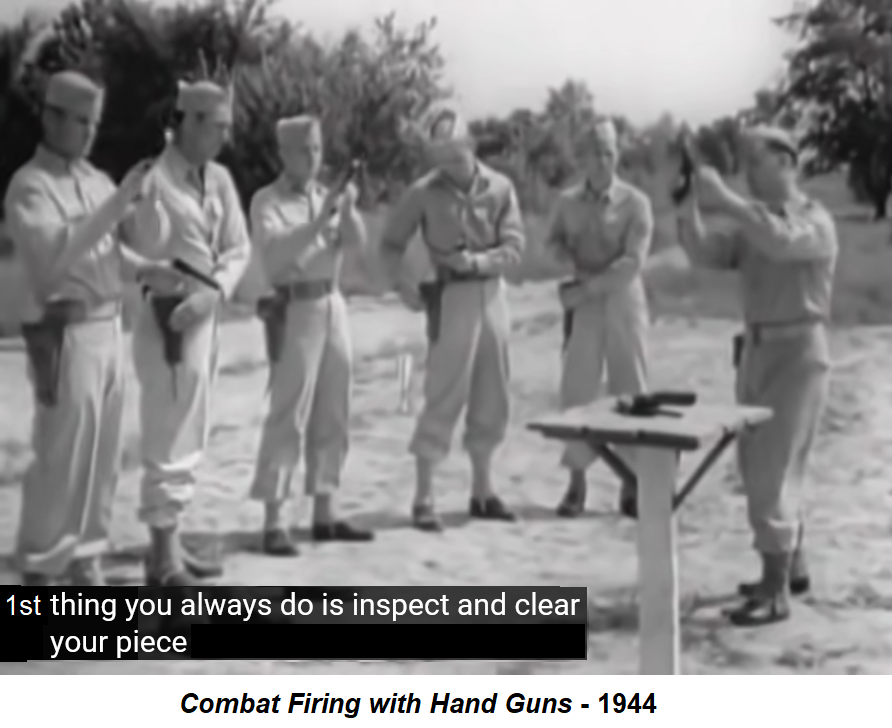
But please avoid muzzling your instructors. We won’t be happy about that. We will try to keep away from putting ourselves in a position where you can.
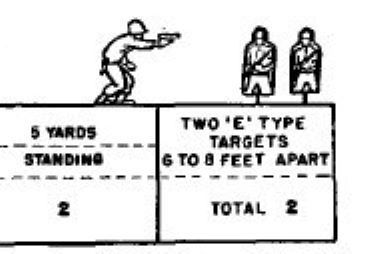
While the hit standards Shooting to Live and Field Manual 23-35 Pistols and Revolvers (1946) establish are rudimentary, they do give new shooters an idea that they’re supposed to actually hit something when shooting. The standard in Shooting to Live is 50 percent hits on a silhouette for single presentations within Social Space (4 yards). The 1946 US Army standard was 100 percent hits for single presentations on an E Silhouette at 5 yards.
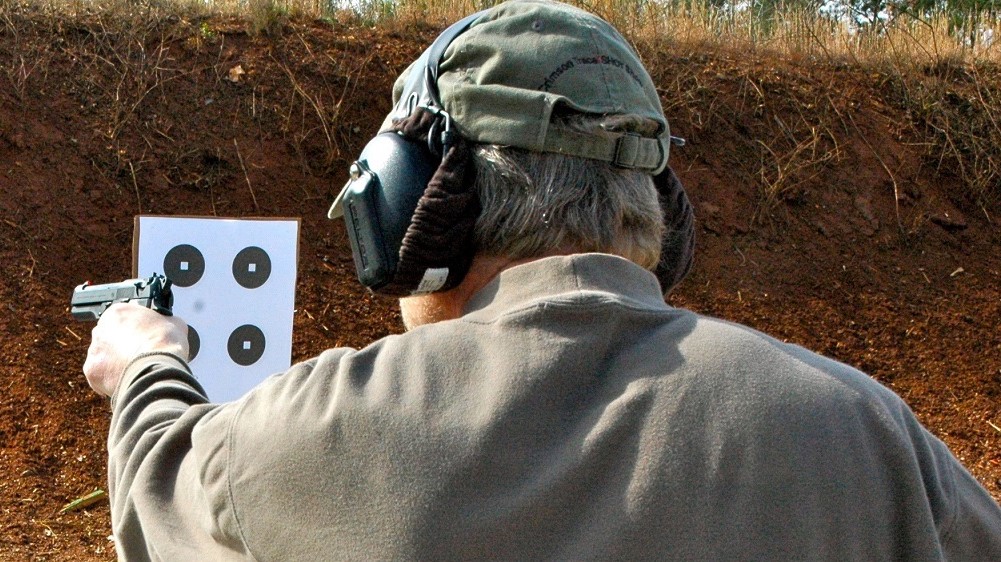
Although most proficient shooters today would consider the techniques obsolete and the standards mediocre, at best, they’re still better than practicing what’s seen on TV and in movies. TV and movies are where most gunowners’ training takes place and that’s bad news.
If you would like to follow my Patreon page to go into more depth about point shooting and personal protection incidents, click on the image below.
Safety Notes
Don’t shoot yourself in the leg when drawing your pistol.
According to authorities, Officer Charles Hamilton was responding to a potential burglary in progress at a residence on Lind Ave. around 10:06 AM. As he approached the scene on foot, Hamilton drew his service weapon, which subsequently discharged and struck him in the right leg.
On the same page, there’s an interesting display of handguns seized during a drug raid.

And another Revolver Handgun to the Rescue. Revolver Handgun To the Rescue
Jones went into her room to get her revolver for protection. When Jones exited her bedroom, Turner advanced towards her and she fired on[e] shot out of fear for her life. Turner was pronounced dead at the scene.
I don’t understand how can anyone possibly defend themselves with a revolver handgun and kill someone with only one shot but apparently it happens.
If you are interested in more in-depth writing about Point Shooting or Personal Defense Incidents and Analysis, please subscribe to my Patreon page by clicking on the image below.
 tacticalprofessor
You must be logged in to post a comment.