He Saved My Life!
#mousegunmonday #win
The victim of the robbery wouldn’t go on camera but said, “He saved my life!” Customer’s mousegun comes to the rescue. The surveillance video of this incident shows a customer in a Michigan convenience store react to an armed robbery of the store clerk.
The customer draws a pocket carried, probably laser equipped, mousegun from his pocket, activate the laser, and fire seven shots in three volleys at the robber. His initial volley of three shots is taken at the closer end of the Near Phase of Public Space, probably about 12-15 feet. He made at least three hits for the seven shots; a minimum of a 43% hit rate. The firing solution required him to shoot past the clerk who is downrange and in close proximity to the robber. He was able to do this despite shooting with his Primary Hand Only.
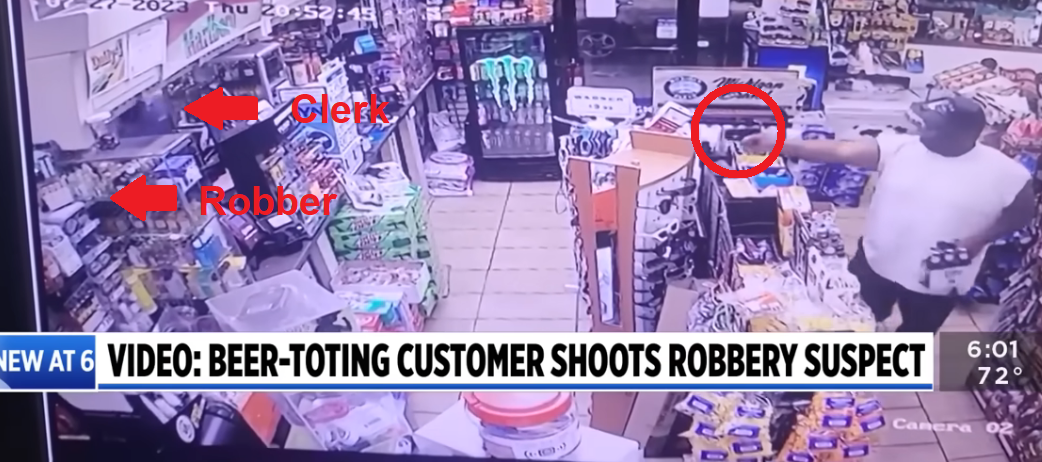
The robber was neutralized by the customer’s bullets and the clerk was unharmed. #WIN It wasn’t a 25 yard headshot but it was beyond “arm’s length.”
Legal post-mortem: The District Attorney ruled that the shooting was Justified as a Defense of Another Individual.
SELF-DEFENSE ACT (EXCERPT)
Act 309 of 2006
780.972 Use of deadly force by individual not engaged in commission of crime; conditions.
Sec. 2.
(1) An individual who has not or is not engaged in the commission of a crime at the time he or she uses deadly force may use deadly force against another individual anywhere he or she has the legal right to be with no duty to retreat if either of the following applies:
(a) The individual honestly and reasonably believes that the use of deadly force is necessary to prevent the imminent death of or imminent great bodily harm to himself or herself or to another individual.
Note that some common taters to the video were outraged that charges would even be considered. In any use of deadly force against someone, a decision will have to be made about the legality of the use of force. The news story was published three weeks after the shooting and the decision had not yet been made, pending the completion of the POlice investigation. Anyone who shoots at someone else for any reason is going to have a period of sweating it out waiting for the decision about prosecution. Be ready for that.
The robber was arraigned for three charges including armed robbery. He could face up to life imprisonment because he’s a three-time loser.
I’ll do a more in-depth analysis of this incident on the Incidents and Walkbacks Tier of my Patreon page in a day or two.
Thoughts On ‘The Distance Issue’
#mousegunmonday
Rich Grassi of The Tactical Wire recently posted an article about distances at which Defensive Gun Uses can be successfully resolved. https://www.thetacticalwire.com/features/a45b09c4-5997-4cd2-b959-a15df74293ac
One of his comments is well put and bears remembering in all cases of personal protection. It applies regardless of the implement used, whether personal weapons, impact tools, or firearms.
“Anyone who tells you that ‘if you shoot beyond (whatever) distance, you’ll have a lot to explain,’ forgets to add, ‘if you ever use deadly force to stop an immediate deadly threat, you’ll have a lot to explain.’”
This is an interesting topic and bears some further testing. Here’s my unlocked Patreon post about it.
https://www.patreon.com/posts/thoughts-on-140908907
To quantify his questions a little further for myself, the LCP II .22 provided a good platform. The standard I chose was well established and very basic, no pun intended. The NRA Basics of Pistol Shooting standard is to put five hits out of five shots into a four inch circle. Coincidentally, four inches is also the size of the -0 head zone on the IDPA target. To apply this standard to the question of ‘maximum effective range,’ two circles were shot at 10, 15, 20, 25, and 30 feet. The question was at what distance did I fail to meet the standard.

If you would like to read more in-depth information about shooting and personal protection, consider subscribing to my Patreon page.

LCP II Hogue Handall Grip Sleeve
#mousegunmonday
Many people comment that the LCP and LCP II are not particularly pleasant guns to shoot. Putting a Hogue HandALL® Hybrid Grip Sleeve on my LCP made it much more comfortable. I purchased (with my own money: FTC) a HandALL® Beavertail Grip Sleeve for my LCP II to see if the result was comparable.
The Handalls are rubber and much wider than the naked backstrap of the LCP. Consequently, they spread the recoil across a broader area and reduce its impact on the hand.

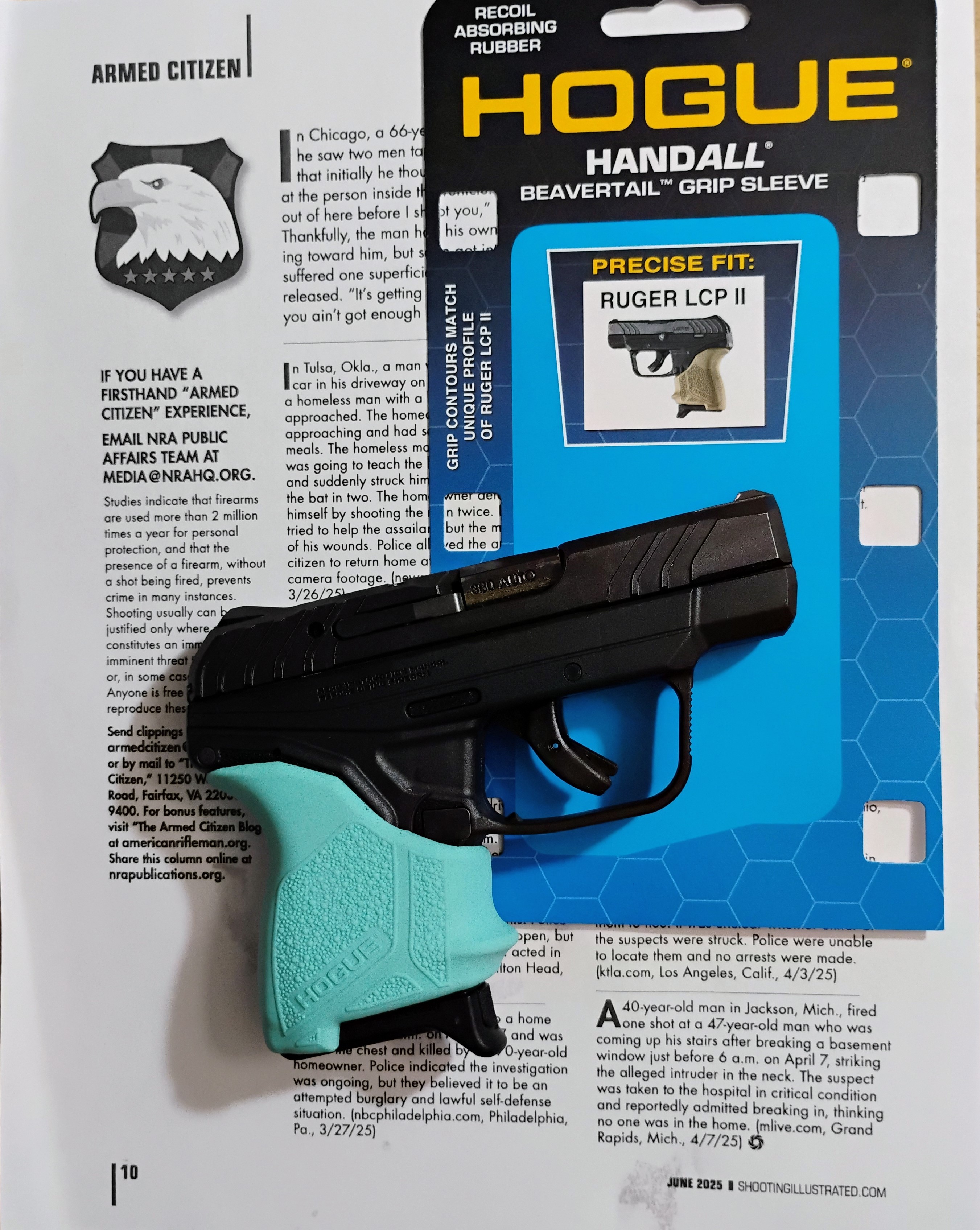
The instructions for installing the Grip Sleeve say to warm it with a hair dryer prior to the installation. I found this to be very helpful. As an experiment, I tried putting it on without warming. This didn’t work at all. Warming it with the hair dryer worked much better and I was able to get it on per the instructions.
Note also that the front sight of my LCP II is painted with orange model paint on top of a white undercoat. This makes the sight picture much improved and shooting more accurate.
At my local indoor range, I shot two different courses of fire. The ammo was a mixed bag of different types I wanted to shoot up and I didn’t bother keeping track of what I shot when. The total for the two CoF was 48 rounds, which is a decent practice session for a small pistol.
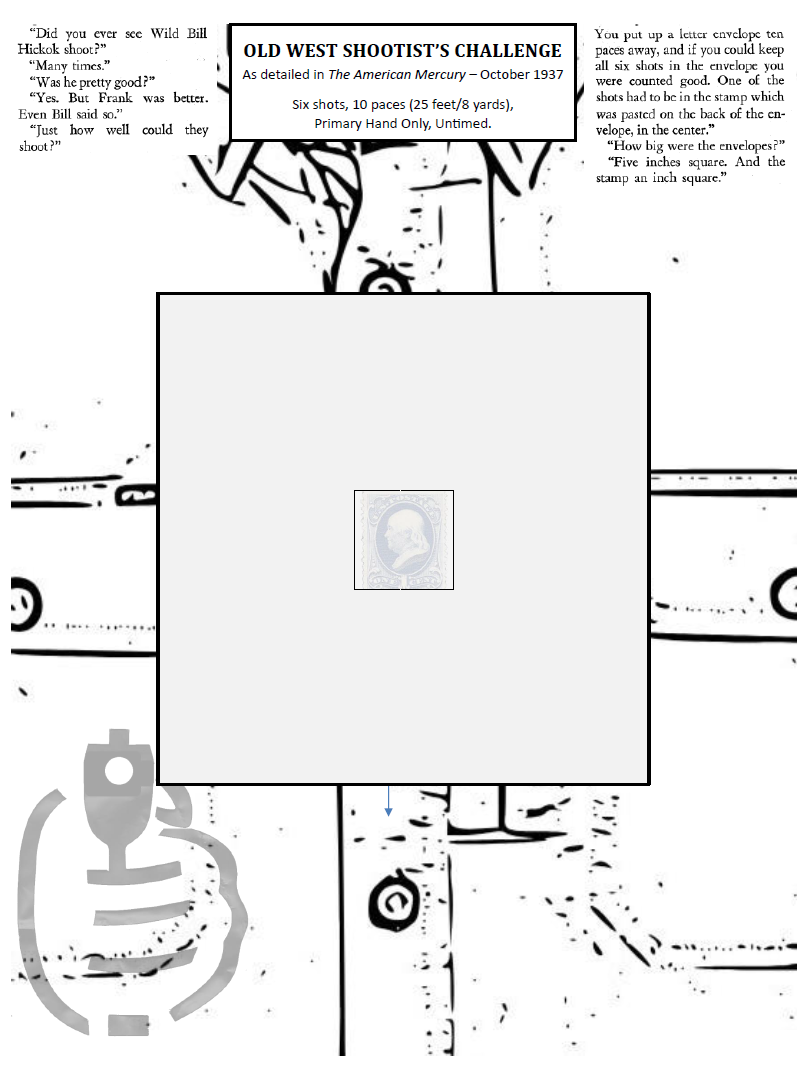
The first thing I shot was my Old West Shootist’s Challenge. https://thetacticalprofessor.net/2025/02/05/shootists-challenge-the-final-word/ with a second string inspired by Marty Robbins’ song Big Iron. “There was 40 feet between them when they stopped to make their play.”
The Shootist’s Challenge now consists of two strings, one at 25 feet and the other at 40 feet.
1) Six shots, 10 paces (25 feet/8 yards), Primary Hand Only, Untimed. I shot this twice because I obviously need more practice.
2) Six shots, 40 feet/13 yards, Two Hands, Untimed.
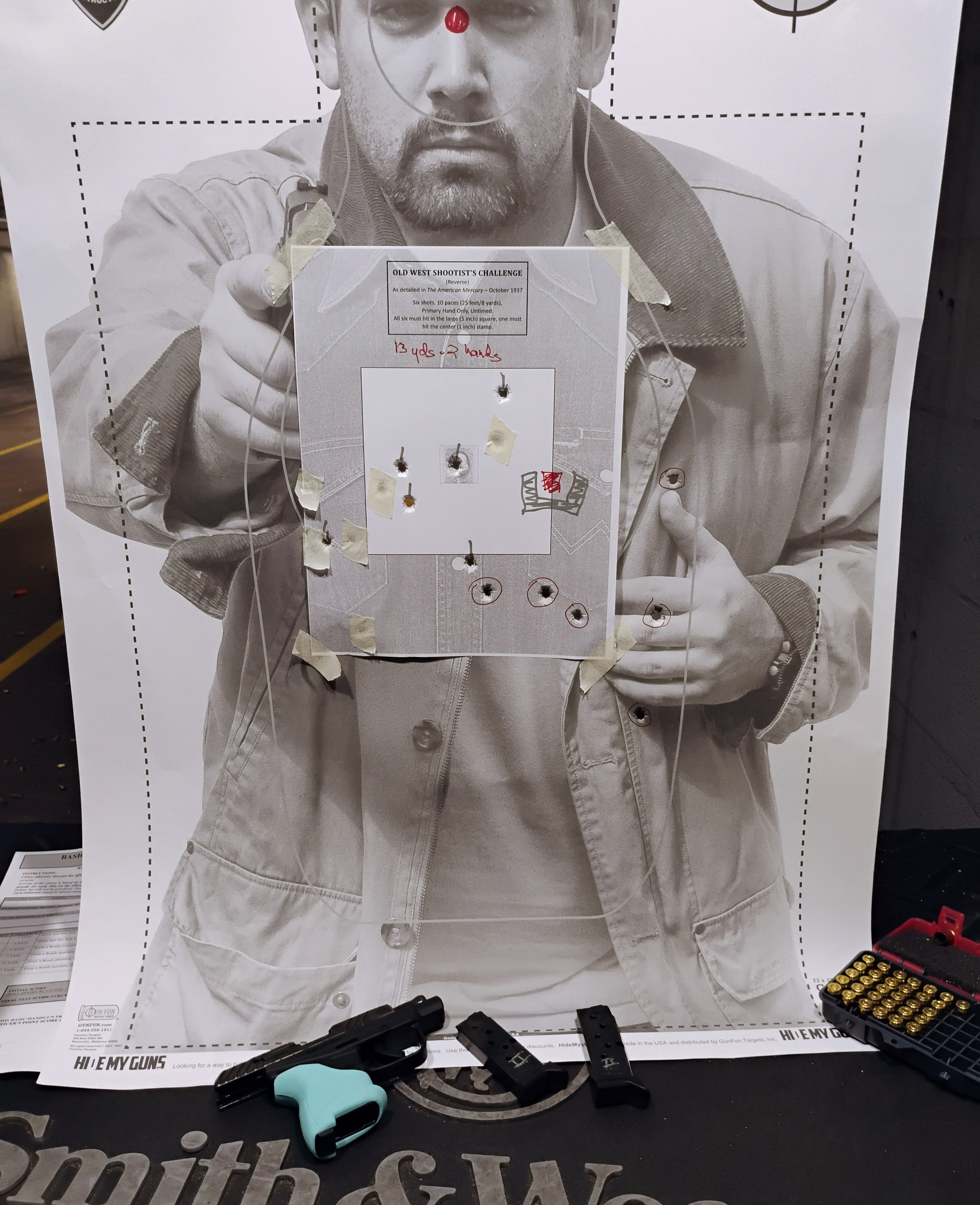
The second Course of Fire I shot was a modified version of the Warshington State Basic Covert Carry/Off-Duty Proficiency Course. Because the range doesn’t permit drawing from a holster, I used a bench start for the strings that are specified as holster starts. I didn’t time it because other people were shooting and a shot timer would have been useless. Times for qual courses have never been an issue for me so I don’t worry about them. Unless the shooter is dawdling, I’m not convinced timing is as important as is generally regarded in the community.
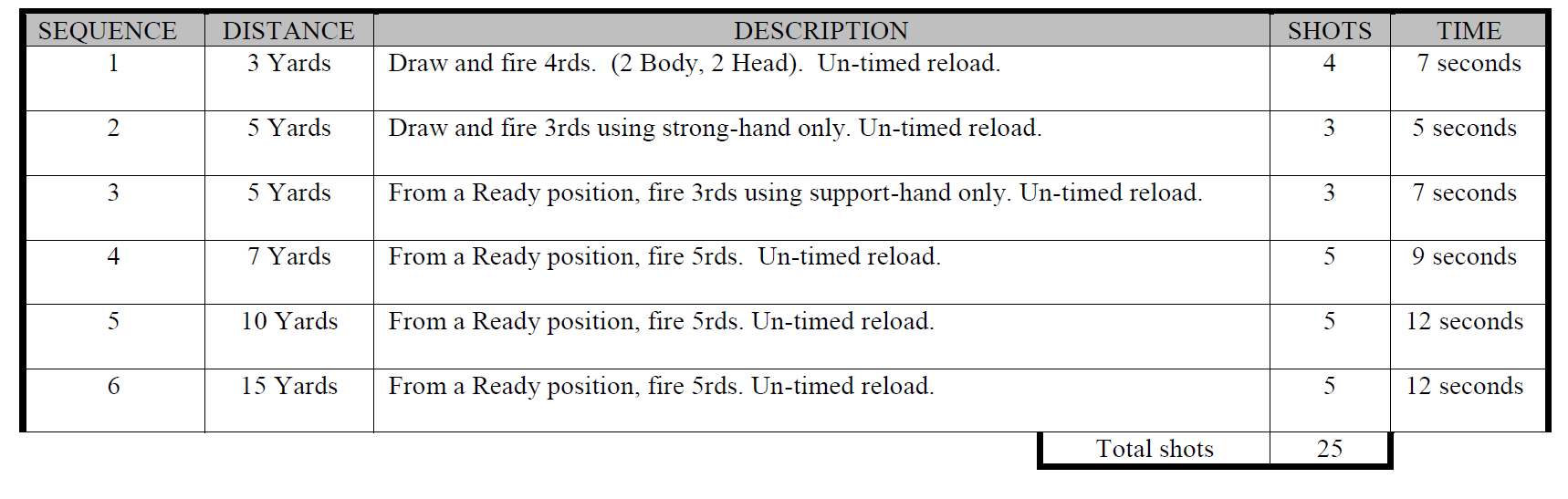
There were four modifications added. The first was shooting Sequence 1 as a pair of 3 shot Failure Drills. Failure Drill, as I use the term, is as taught by Larry Mudgett and John Helms to the LAPD after returning from Gunsite. https://thetacticalprofessor.net/2022/12/20/failure-drill/ Two shots to the chest, bring the pistol down to Low Ready at the target’s waist level, a pause to assess, and then a face shot. This Sequence was six shots as I did it.
Sequences 2 and 3 were shot as described in the Course of Fire, except using a bench start for Sequence 2. All the subsequent five shot Sequences were increased to six rounds. The six round Sequences were shot in three strings using 1 shot, then 2 shots, then 3 shots, as taught by Jim Cirillo. https://www.shootingillustrated.com/content/jim-cirillo-s-1-2-3-6-drill/ For the 3 shot strings, I once again did them as Failure Drills and marked on the target where the face shot went for each Sequence.
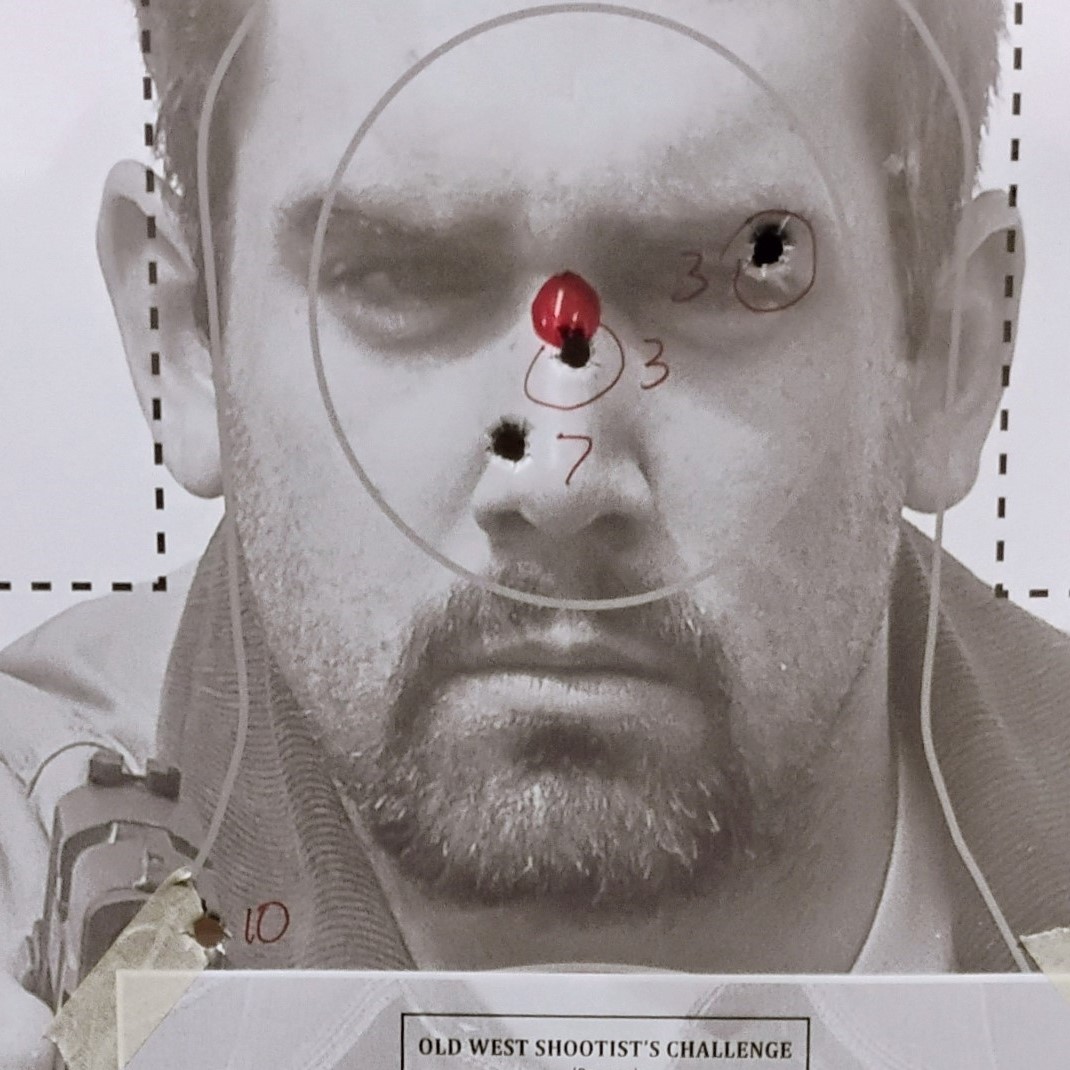
The end result was that I met the standard for the Course of Fire.
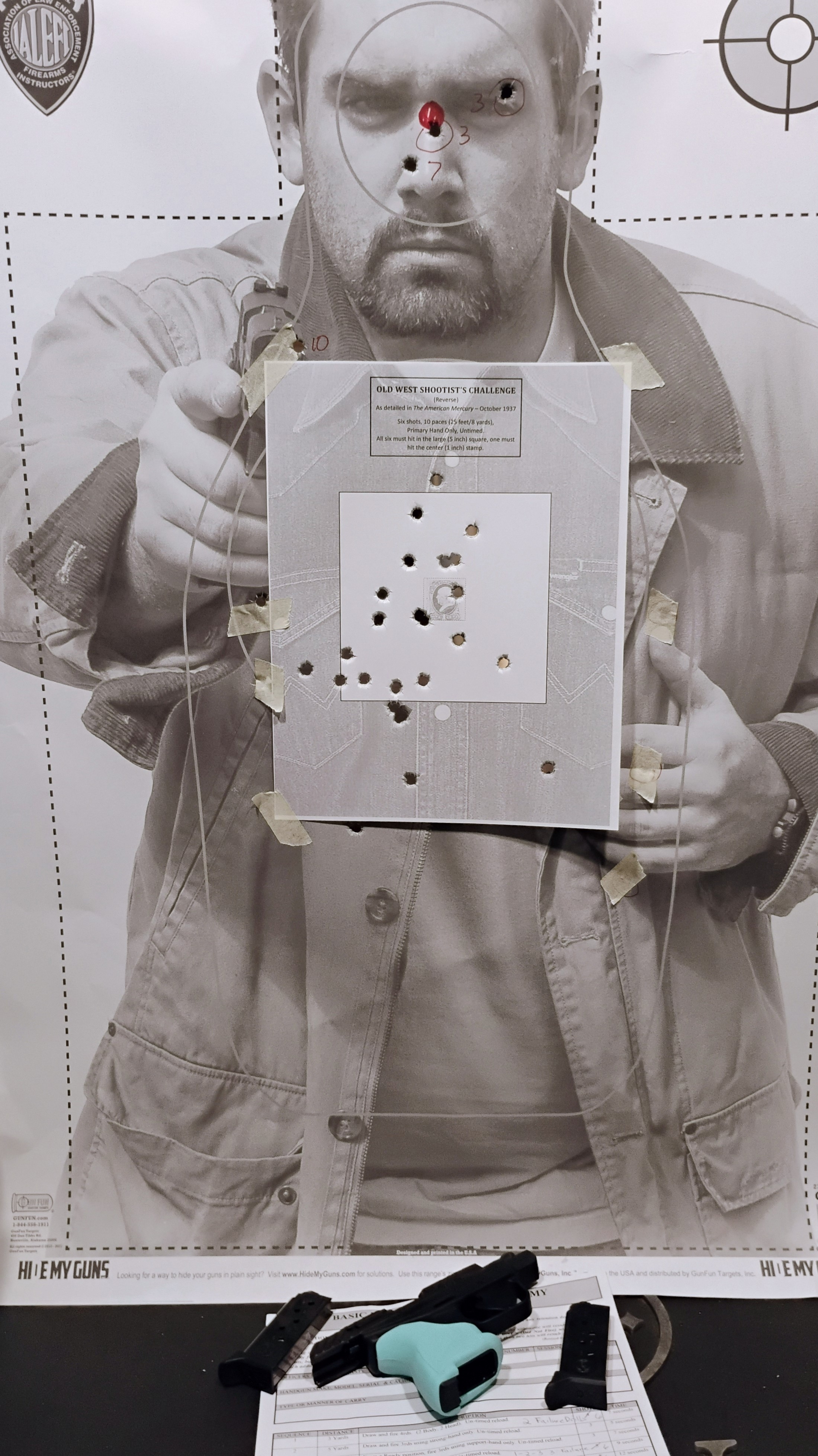
Qualification Courses are structured to efficiently cycle numerous officers through as quickly as possible. We can use them as practice regimens but that doesn’t mean we have to blast long strings of fire that provide little in the way of marksmanship practice. Breaking longer strings down gives us more accountable practice on our sight picture and trigger manipulation.
I found 48 rounds through the Handall equipped LCP II to be much more pleasant than it would have been with the bare gun. It’s a worthy and inexpensive modification.
If you would like to read more in-depth information about shooting and personal protection, consider subscribing to my Patreon page.
Small Gun Accuracy
#mousegunmonday
The Washington State Basic Covert Carry/Off-Duty Proficiency Course for Law Enforcement Officers includes shots out to 15 yards. This is perfectly workable with small guns like a Ruger LCP, even though it has a double action trigger.
Here’s my YouTube video of the Course of Fire.
If you would like to read more in-depth information about shooting and personal protection, consider subscribing to my Patreon page.

Armed Citizen Scenarios
#scenariosunday
I was nostalgic today for older style IDPA Scenarios like we used to shoot in the sport’s early days. Twenty-five years ago, there wasn’t much reloading on the clock and stages often consisted of multiple strings having six shots or less. It’s a different sport now.
My nostalgia caused me to write a new stage and redesign an older one. One is based on an Armed Citizen incident and the other on an actual car burglary and murder. The stages are called the Chicargo Practical Event and Muffler Thieves.

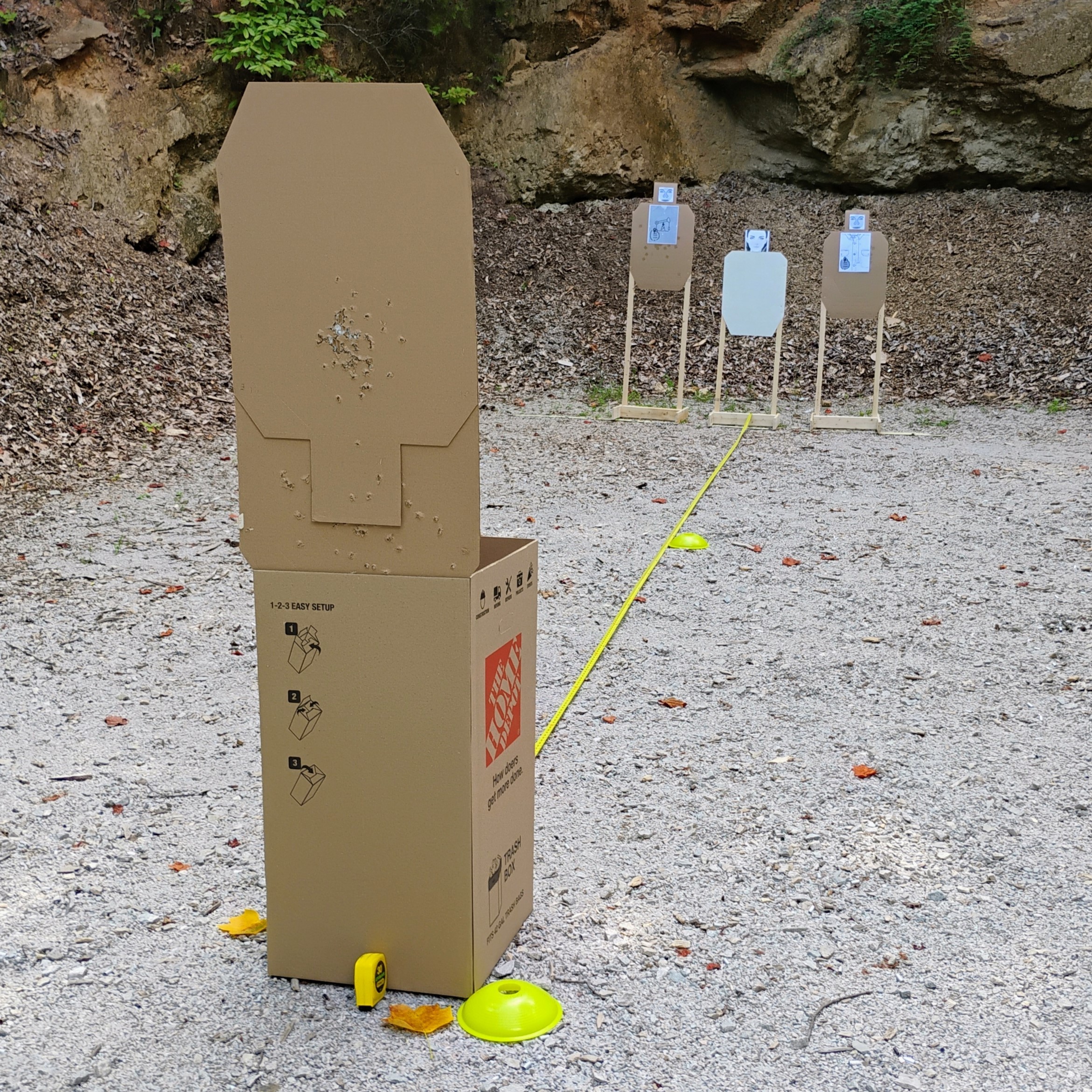
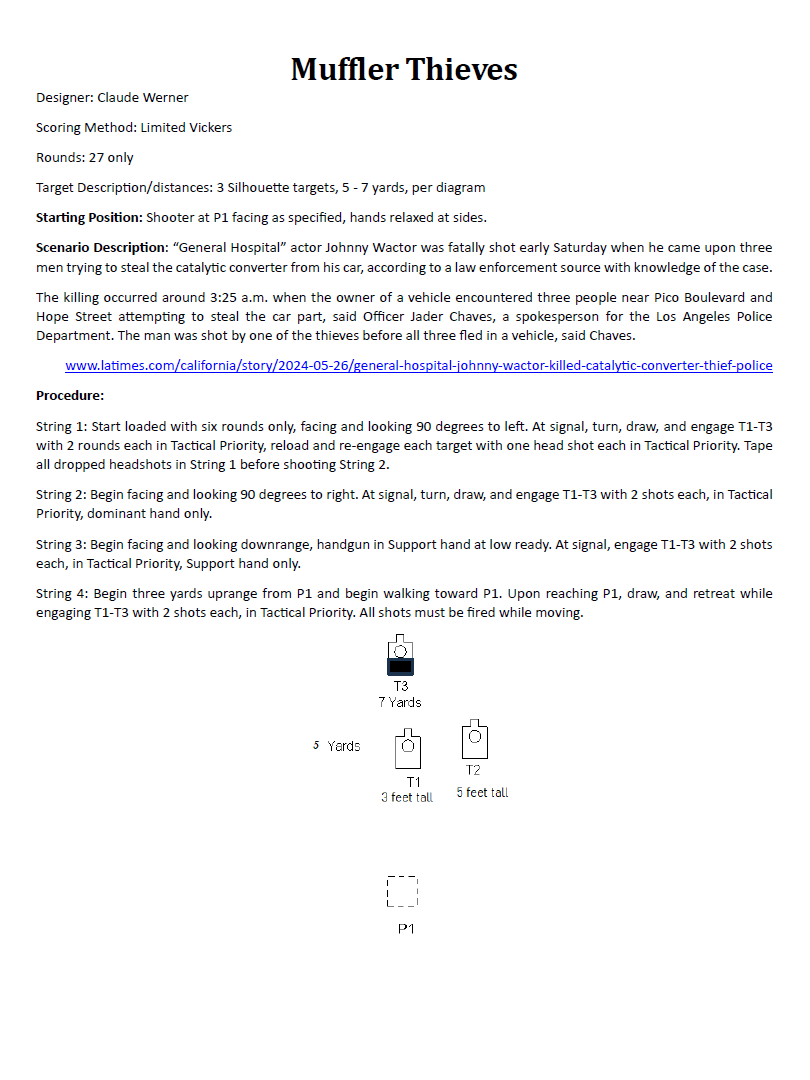
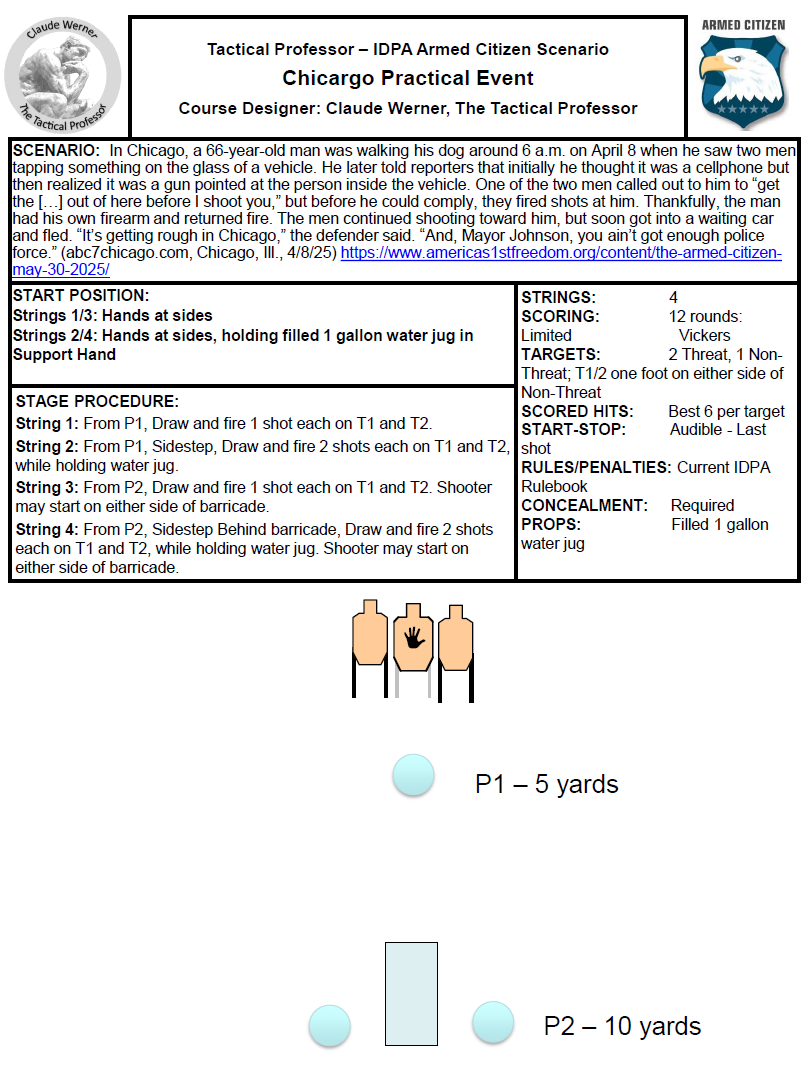
I finished up with the Old West Shootist’s Challenge. My Little Crappy Pistol (LCP) did just fine.
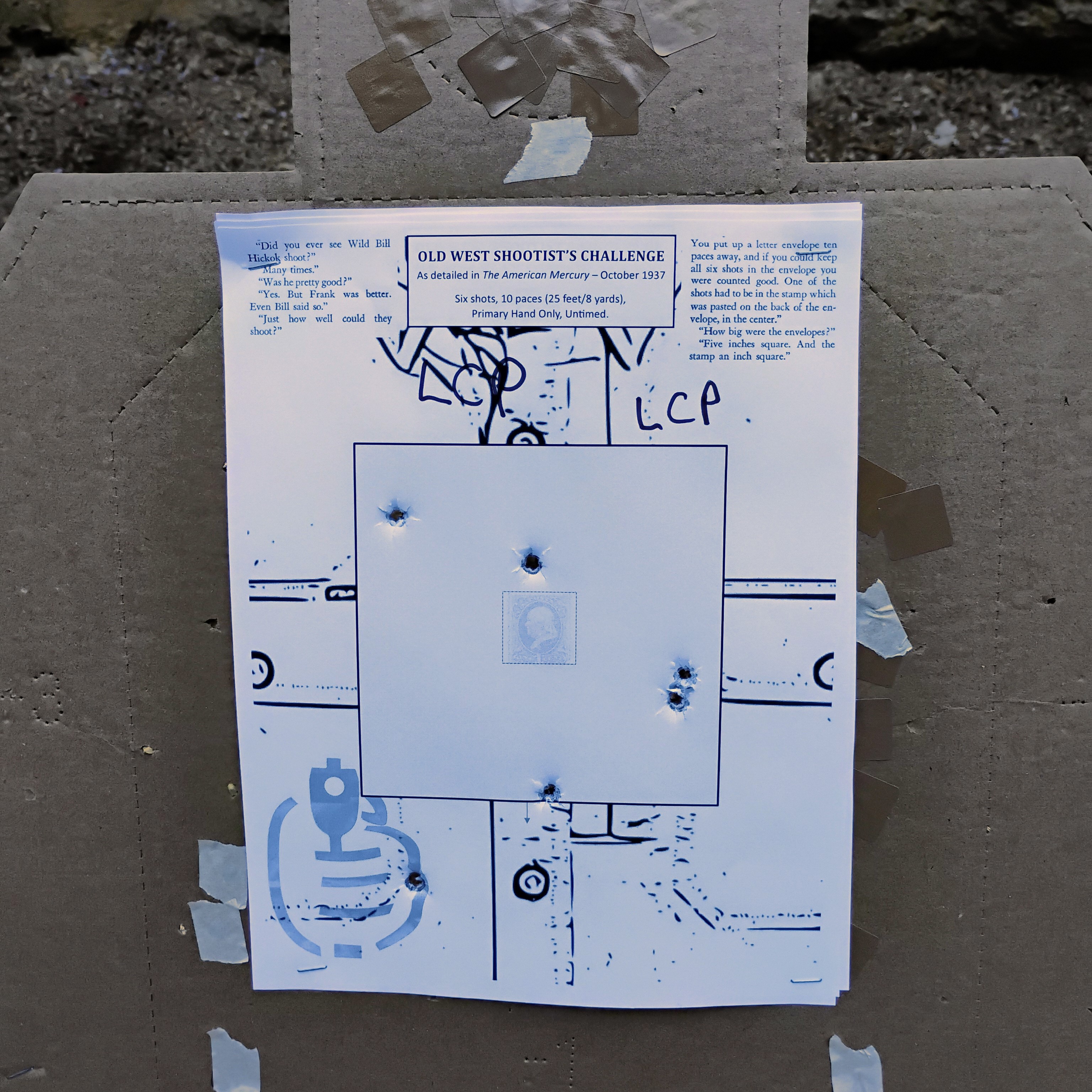
It was a fun afternoon. I’m going to do it every month, as if it was my own private match.
If you are interested in more in-depth commentary about shooting and Personal Protection incident analysis, please consider subscribing to my Patreon page. https://www.patreon.com/c/TacticalProfessor
Pushing The Limits of Smaller Guns
#LCPproject
Pushing The Limits of Smaller Guns is my October 2024 article in Shooting Illustrated.
https://www.shootingillustrated.com/content/pushing-the-limits-of-smaller-guns/
I shot the entire program with my Ruger LCP Max, which I bought with my own money. The gun is stock out of the box.

The results contradict the myth that smaller guns as being suitable for only “arm’s length” encounters. Pictures tell the story of the results of the three courses that were shot.
Kansas Concealed Carry License Qualification
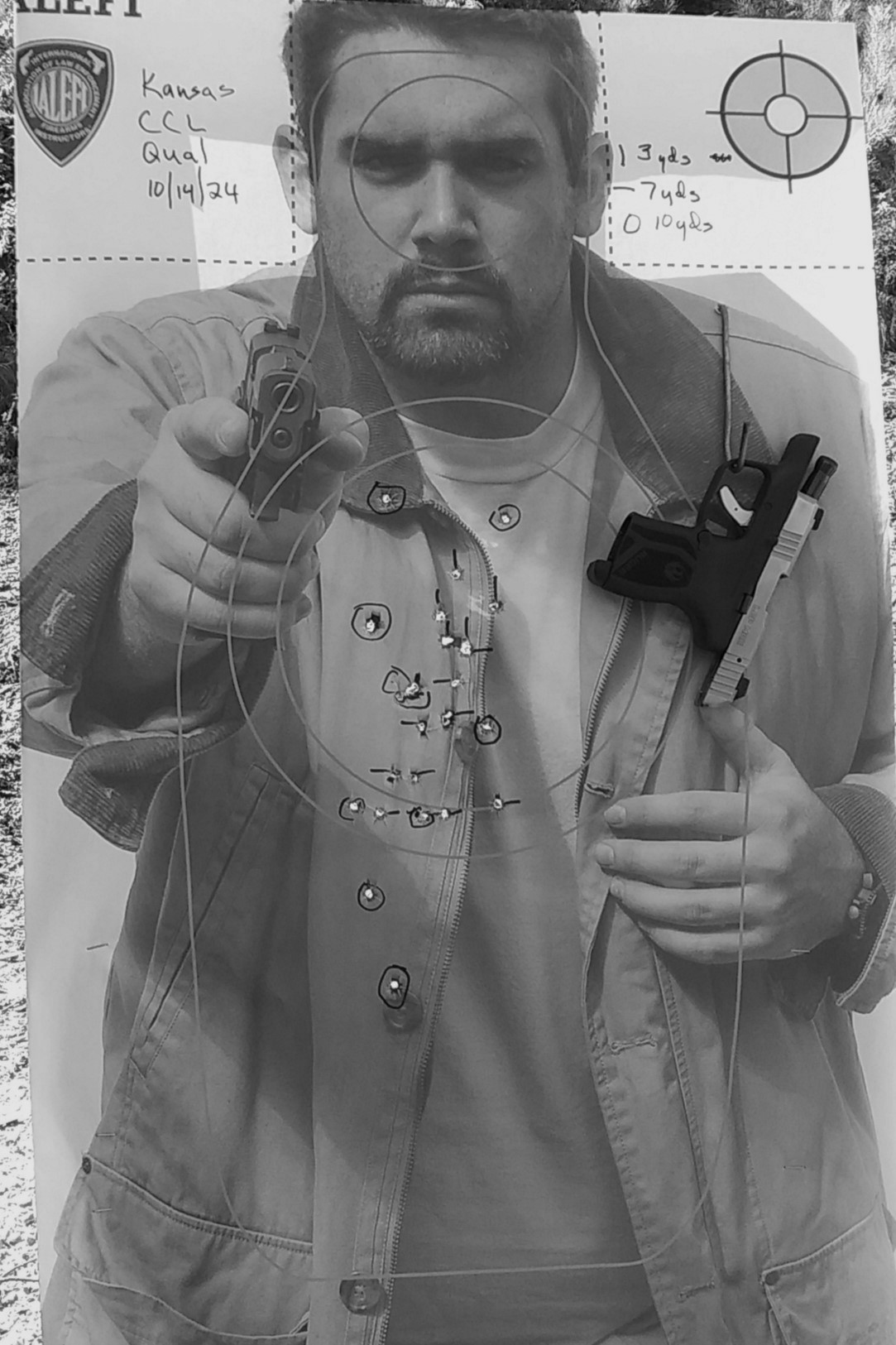
Twenty-five hits out of 25 shots. Pass.
Shootist’s Challenge

All hits inside the square, two hits on the stamp. ‘Good’ by Wild Bill and fellow Shootists’ standard.
Bakersfield Police Qualification

Bakersfield Stage Times
- 2.01
- 2.27
- 6.96
- 2.78
Bakersfield Scores
- 10 point (A) zone – 7 70 points
- 9 point (C) zone – 2 18 points
- 6 point (D) zone – 1 6 points
94 points total – Pass
It’s only an “arm’s length gun” if you’re don’t know how to shoot it.
If you like my work, join me on Patreon where I post more in-depth articles about shooting, marksmanship, and incident analysis.
Practicing With Small Handguns
My latest article for Shooting Illustrated is up. This one has a good 50 round practice session for small guns such as the LCP and J frames.

https://www.shootingillustrated.com/content/practicing-with-small-handguns/
If you like my work, join me on Patreon where I post more in-depth articles about shooting, marksmanship, and incident analysis.
Pocket Carry
Now that cold weather is upon us, pocket carry in an overcoat pocket has some advantages. Pocket carry has both upsides and downsides.
Upsides
- It’s far easier to access a gun in a coat pocket than to undo the coat and draw a holstered pistol. This is especially true when you’re seated in a vehicle with a seat belt on.
- You can put your hand on your gun as soon as you perceive trouble or even walk around with your hand on your gun in general.
- A draw from the pocket, starting with hand on gun, is faster for most people than drawing from a concealed holster.
Downsides
- Pocket carry usually requires a smaller and more compact handgun.
- A separate pocket holster is advisable.
- You may be wearing gloves.
- If you come in from outside and have to hang up your coat in an unsecured area, you’ll need to do something with the pocket pistol to secure it.
- The pocket draw is a little different than drawing from a belt holster.
- Said smaller and more compact handgun will probably become your primary tool in an incident.
Most people don’t practice as much with their smaller guns as they do larger ones. Pocketable pistols are usually both ego challenging and uncomfortable to shoot. Nonetheless, some familiarization is a good idea.
The CCW Practical Exercise from Switzerland is short and uncomplicated familiarization drill. The Swiss are a very practical people.
All shooting is done wearing a concealment garment with a holstered weapon.
- 2 shots at 7 meters in 4 seconds. 3 times.
- 2 shots at 5 meters in 3.5 seconds. 3 times
- 2 shots at 3 meters in 3.0 seconds. 3 times.
18 rounds total. 14 hits required to pass. The hit area (dark area) of their target is roughly equivalent to the IDPA -1 zone. Hits on the silhouette outside the hit area don’t count. They penalize 1 hit for any impacts outside the silhouette.
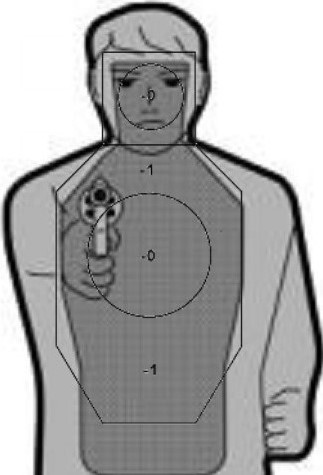
If you decide to pocket carry, it’s worth doing at least a short tuneup with your pocket pistol. A dry practice session for your draw is a must. A short live fire session to get the lint out of your gun and be sure it works is also in order.
How Do I Choose Which Carry Gun?
One of my Patrons https://www.patreon.com/TacticalProfessor?fan_landing=true&view_as=public sent me the following message. With his permission, I’m going to answer it for a broad audience.
My question for you is how do you decide which gun you carry most often. … I know from following you over the years that you carry various pistols and revolvers from time to time. I’m just curious how you decide which gun you carry most often.
That’s a pertinent and insightful question.
The short answer is that I don’t change guns very often. My EDC handguns all are sufficient to deal with what I consider my most likely threat profile. Because that’s so, I don’t feel the need to scale my armament up and down.
I will change my gun to fit different mission profiles. As a professional trainer, my mission profile is based on what I’m teaching not a varying threat profile. For instance, when I was working on my LCP Project, I carried an LCP for almost a year. When I began the Snub Nose Revolvers – Hands-on Shooting program on Patreon, I switched back to carrying a J frame. During the program, I would occasionally alternate between a S&W 317 and Taurus 856 to evaluate their differences, but that was about all.
When I end the Snub Nose Revolvers program at the end of this year, I will start the Subcompact Pistols – Hands-on Shooting program. For that program, I’ll switch from a J Frame to a Glock 42 that Glock sent me for evaluation in the program. The LCP will also go back into service as another example of subcompacts.
Handguns have different triggers, index onto the target at different points, and even draw differently. The difference between where the Glock 42 indexes onto the face of a target vis-à-vis the 317 is quite noticeable. Obviously, the triggers are different, even with the NY1 trigger spring I installed in the 42.
For simplicity sake, I prefer to stay with the same system day to day. When I do change, I do an hour’s worth of dry practice before venturing out with a new carry piece. How I can make the gun perform is much more important to me than aspects of caliber and ‘firepower.’ It’s just a handgun, folks. As John Farnam says, in the end they’re all just pathetic popguns. I’m a firm believer that “It’s the ‘finest light cavalryman in the world,’ not the arrow,” even when one arrow isn’t quite as pointy as the other.
The LCP Project – Ill-Annoy CCL Qualification (5 yard stage)
Continuing The LCP Project, this video shows the 5 yard stage of the Illinois (Ill-Annoy) Concealed Carry License Qualification shot with a Ruger LCP. This stage was shot by drawing from a concealed holster, although a concealed draw is not required when shooting the Qualification to obtain a CCL. The 10 required shots were fired as 3 shots in 3 seconds 3 times. The 10th shot was a shot to the face in 3 seconds.
The 5 yard face shot reminds me of something my Dad once said to a would be robber, “Do you want it in the belly or the teeth?” The robber suddenly remembered an appointment he was late for and left. No shooting was necessary in that incident. My shot placement on the Qual was unintentional but brought back a memory.
Ammo for the LCP Project was furnished by Ammoman https://www.ammoman.com/
The 10 yard stage video can be seen at https://youtu.be/3EKAoExWDE0
Tactical Professor books (all PDF)
- Thinking Clearly about Self-defense and Personal Protection https://www.payloadz.com/go?id=3377208
- Real Shootouts of the LAPD https://realshootoutsofthelapd.com/
- Serious Mistakes Gunowners Make http://seriousgunownermistakes.com
- Indoor Range Practice Sessions http://indoorrangepracticesessions.com
- Concealed Carry Skills and Drills http://concealedcarryskillsanddrills.com
- Advanced Pistol Practice http://bit.ly/advancedpistolpractice
- Shooting Your Black Rifle http://shootingyourblackrifle.com
- Package deal of Thinking Clearly about Self-defense and Personal Protection, Serious Mistakes, Indoor Sessions, Concealed Carry, and Shooting Your Black Rifle (50% off) https://store.payloadz.com/details/2644448-ebooks-sports-shooting-drills-package.html
Purchase of any book includes Serious Mistakes Gunowners Make.
 tacticalprofessor
You must be logged in to post a comment.