Tactical Conference 2026 – I
The 2026 Rangemaster Tactical Conference, aka TacCon https://taccon.info/, wrapped up last Sunday evening. It was three full days of training focused on personal development for self-defense and personal protection. A wide variety of subjects were presented in a buffet format. The classes ranged from live fire with pistols and shotguns to hands-on encounters without firearms to theoretical and philosophical seminars. Friday’s schedule gives a glimpse of the classes that are available.

I gave my presentation A Deep Dive into Boyd’s Process aka the O-O-D-A Loop twice. It seemed to be fairly well received. My object was to dispel some myths and give a more detailed analysis of what Colonel John Boyd actually said.
In Memory of Chuck Norris concluded my presentation.

Good Guys Wear Black Airport fight
Although I spent much of the Conference in discussions with my colleagues, I attended two classes; Concealment Workshop by Jon and Sarah Hauptman and Target, Bullets, and Body Parts by Chuck Haggard. With a lineup of dozens of classes, it’s not possible to take them all in. I also observed or sat in for a bit on several others. What You Should Know About Defensive Shooting by John Farnam, Hardest State Carry Quals by Karl Rehn, Low Round Count Evaluations by Lee Weems, and Defensive Knife for Concealed Carriers by Greg Ellifritz were worthwhile additions to my schedule.
An important part of the Conference to me is the Pistol Match because it is a rare opportunity to shoot at turning targets. Visual cues are rather different than an audio cue such as a shot timer. The staff graciously consented to allow me to shoot it twice, once for record with my Glock 19 and a second time the next day with my LCP II .380 for comparison. The results will be in my next post.
More (Again) about Boyd and OODA
Since my coffee hadn’t set in yet this morning, I unwisely became involved in another discussion about O O-D-A and Colonel John Boyd. What most people refer to as the O-O-D-A Loop, I refer to as Boyd’s Process because it’s much more involved than some simplistic circular diagram. Since I typed the whole reply out, I may as well reproduce it.
The foundation of O-O-D-A is Boyd’s Aerial Attack Study. The premise of the AAS is diametrically opposite of what 99% of people think about O-O-D-A. The common interpretation of O-O-D-A is that it somehow involves ‘thinking faster,’ which is physiologically impossible.
O-O-D-A is an analytical concept that Boyd spoke about and mentioned in passing late in his career. The neat extensive diagram sometimes seen was developed by one of Boyd’s acolytes, not Boyd, although he did approve it while he was in the throes of prostate cancer. This is Boyd’s original hand drawn sketch of the process. It is rather complex and doesn’t look anything like the circular models seen in current discussions.

The simplistic circular bastardized diagram that is commonly seen was not part of Boyd’s repertoire and is not even worth mentioning in relation to any serious discussion of O-O-D-A.
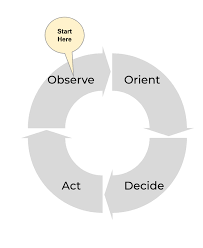
The concept of O-O-D-A Loops is mentioned only briefly a few times in Boyd’s multi-hour presentations. Even then he mentioned it in relation to strategy not tactics.
The AAS describes an operational tactical concept that Boyd developed during his time as an instructor at the USAF Fighter Weapons School. He was known as ‘Forty Second Boyd’ because of his ability to defeat any aerial opponent in 40 seconds or less.
However, this ability came from an understanding of possible attack and defense patterns and the capabilities of his aircraft’s weapons systems. He had pre-planned his counters to every move his opponent might make and then vigorously executed the counter faster than his opponent could avoid it.
Because Boyd was a talker and not a writer (he dictated the entire AAS to his boss’s secretary), whether he placed any value on ‘O-O-D-A Loops’ as anything other than a descriptive metaphor is unclear. Nothing in his presentations leads to the conclusion that he thought of it as a tactical decision making template.
Here is an example of Boyd’s thinking in the AAS.
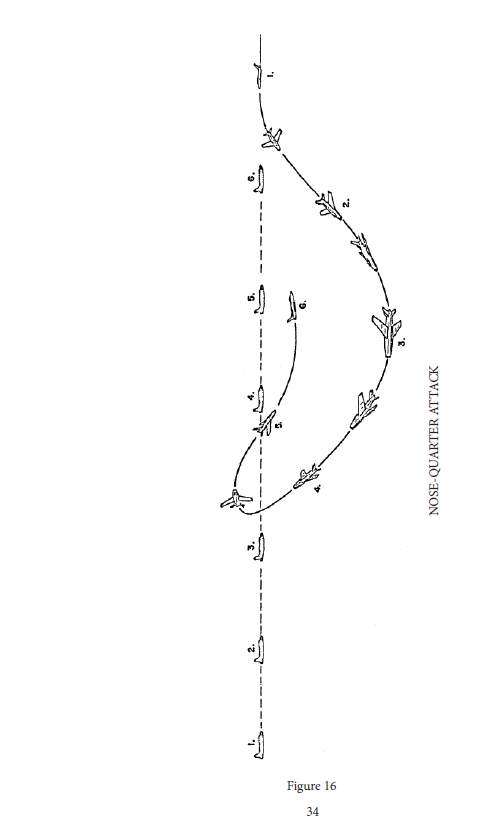
This is the kind of tactical and weapon analysis that was the foundation for tactical execution in the AAS.

Another aspect of Forty Second Boyd is that he was willing to push his aircraft, the F-100, to limits no one else would. He brutalized his plane so badly that at times it required significant rebuilding after he landed.
The Aerial Attack Study is readily available on the Internet. It’s essential reading for anyone who wants to talk about Boyd’s Process from an informed perspective.
Tend To Your Own Business
#fridayfundamentals
Tend to your own business
the Assassin
That’s a sage comment the Assassin made while he and I were talking years ago. His comment was about the perils of intervention. I had my own experience with it a couple of days ago and learned some important lessons about the entire concept.
While at a large retailer, I observed a low level criminal teaching his son how to be a vandal. The criminal was not merely watching but was actively guiding his son through the process of how to vandalize the inside of the store. The boy was about ten years old. It was clear that he was being groomed in a similar way to the youth who tried to rob one of my University professors many years ago was being taught the trade of robbery by his uncle.
The criminal and his son were right next to me and the brazenness of the criminality surprised me so I reflexively asked them to stop. The criminal immediately threatened me for saying something about their criminal act. At that point, I realized he was a seasoned criminal and my conscious mind took over so I withdrew.
Upon reporting the incident to the store’s management, they asked me if he was still in the store and if I could point him out. The criminal and his entire family were only two aisles away so I indicated who he was. The manager and a security person asked me to step away and then they went over to speak to the criminal.
A few minutes later, they came back to me and said there was nothing they could do even though he admitted committing the vandalism. Further, they said they were not even going to ask him to leave the store. I pointed out that he had threatened me, to which they said since it hadn’t been a physical battery they wouldn’t be able to do anything about it and the local POlice wouldn’t even respond to a call.
Rather than choosing to stick my head further in the lion’s mouth, I immediately left the store. As a precautionary measure, I took a Surveillance Detection route [Surveillance Detection post] home. Although a remote possibility, I didn’t want to a take a chance on the criminal deciding to follow me to escalate the situation.
Lessons from the incident
First lesson. It takes two or three seconds to make a conscious decision. As soon as things began to escalate, my conscious mind kicked in and I decided to withdraw. Before that, I had been acting reflexively as most decent people would; i.e., “Please don’t commit crimes in my presence.” I said it despite the fact that I have been preaching about the perils of intervention in criminal acts not involving ourselves for well over a decade.
Second Lesson. The incident was clear example that Boyd’s Process [link to OODA category] is not about making decisions in the moment. Boyd’s best work, the Aerial Attack Study [link] is about not only making decisions in advance but also formulating a plan for how to implement the decision. My plan now is to immediately turn on my heel and walk away from such a situation. This replaces my previous and more nebulous idea of “don’t get involved.”
Third Lesson. It is extremely unlikely that the benefactor of an intervention will appreciate it or even support the intervention. It’s just not worth it. As a fellow student commented to me years ago:
“What is the benefit? NO BENEFIT!”
Falah Al-Mutairi
Setting Boundaries and Communication
One of the most important personal protection skills we can develop is to set boundaries and clearly communicate them. Simply saying NO! in a firm voice is the most concise method of doing it.
Although the comment has been made that I give my clients permission to be rude, that has evolved in my mind to simply giving permission to say NO! As a society, we have placed so much emphasis on consensus and negotiation that our ability to firmly set boundaries and communicate them has become sadly neglected.
When someone refuses to respect a boundary that you have set very clearly, their intent becomes immediately clear. That clarity allows us to make definitive decisions about our own course of action.
Practice saying NO! every day in your normal daily activities. You don’t have to be mean or discourteous about it, simply say it firmly and with conviction. Often, when you say it, the other party will physically react and rock back on their heels. You have utterly reset their OODA Loop at that point.
Nuances
The Spirit of the Bayonet

“The will to meet and destroy the enemy in hand-to-hand combat is the spirit of the bayonet. It springs from the fighter’s confidence, courage, and grim determination, and is the result of vigorous training. Through training, the fighting instinct of the individual soldier is developed to the highest point. The will to use the bayonet first appears in the trainee when he begins to handle it with facility, and increases as his confidence grows. The full development of his physical prowess and complete confidence in his weapon culminates in the final expression of the spirit of the bayonet — fierce and relentless destruction of the enemy.”
Field Manual 23-25 Bayonet –October 1943 edition
Note the subtle distinction between the ‘spirit’ of the bayonet, “The will to meet and destroy the enemy in hand-to-hand combat” and the ‘final expression’ of the spirit of the bayonet, “fierce and relentless destruction of the enemy.” The first is philosophical, the second operational.

Recognizing how to put a concept into operation is an important step in turning information into knowledge. For instance, how can we operationalize the “O-O-D-A Loop?” My colleague Melody Lauer once asked me:
How do I use the OODA Loop? That’s not clear to me.
At the time, I didn’t have a good answer for her.
Now, I would say that the basis for making Boyd’s process operational is to dig deep into Orient. Boyd himself said:
Orientation is the schwerpunkt. It shapes the way we interact with the environment–hence orientation shapes the way we observe, the way we decide, the way we act. [emphasis mine] –Organic Design for Command and Control, slide 16
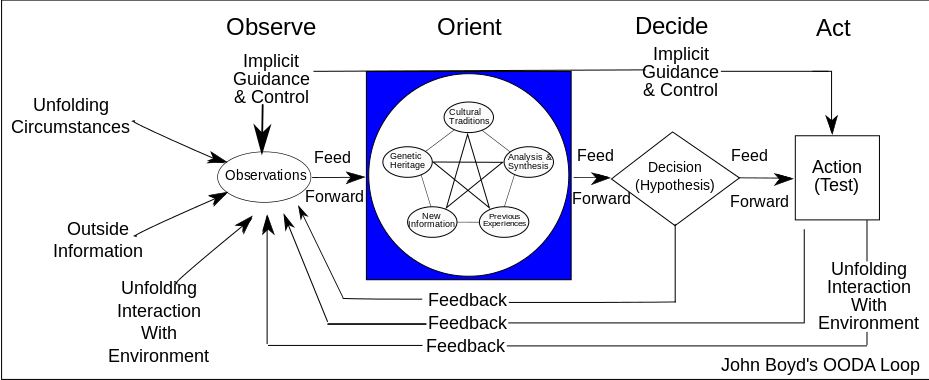
“I’ll shoot anyone I find in my house” is an example of an input to Orientation, probably a Cultural Heritage artifact from English common law of centuries ago. When we acquire New Information through training, observation, or experience, that also becomes an input to our Orientation. Then comes the hard part, Analysis / Synthesis. All the other inputs to Orientation coalesce through Analysis / Synthesis into decision-making that occurs ahead of an incident rather than during the incident. We may need to modify the plan and decisions as an incident unfolds, but that’s much easier and faster to do than making a plan up on the spot.
Examining, expanding, and integrating all of our Orientation inputs is what allows us to ‘make’ good decisions quickly. When we have formed a solid Orientation, we are actually not making decisions in the moment, rather we are ‘choosing’ from a menu of pre-made decisions available to us because we’ve already considered the benefits, objectives, and consequences and made a rational decision about what’s in our best interests. It’s how we avoid making Serious Mistakes. http://seriousgunownermistakes.com/

My thanks to Melody and Joseph Edward Timbs for provoking me to write this post. Also thanks to Steve Moses, Shawn Vincent, and Don West of CCWSafe for inviting me to participate in a thought provoking podcast about the topic.
We’ll get through this
The Assassin and I had White Pizza at Mellow Mushroom in Mayretta for lunch. It was good. The place wasn’t crowded with small disease vectors, i.e., children, which made our visit even more pleasant. A couple was sitting at the bar having drinks and a quiet conversation and a few other people were ordering calzones.
He and I talked about Personal Protection stuff, as we usually do. I showed him a new target I’ve designed and a Baseline Evaluation and Monitoring Course of Fire for new shooters I’m developing. Then I asked his input about the overlap and intersection between Steve Harris’ CAN/MAY/SHOULD/MUST paradigm, Ayoob’s Priorities of Survival; Mindset, Tactics, Skill, and Equipment, and my Making Good Decisions model.
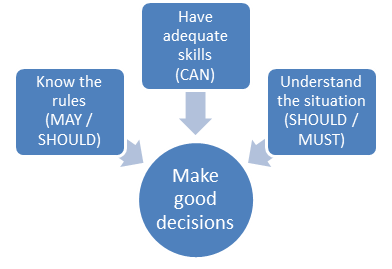
After buying a new pair of jeans, I brought some pizza home for further feasting. Since I’m recovering from open double hernia surgery and was hurting a little, I took a couple of Tynols and then a nap.
When I got up, I decided to have a little more pizza. I don’t ordinarily drink beer but I like beer with pizza, so I broke out a Blue Moon. It was a very nice evening so I decided to finish my beer on the deck. Thanks to Daylight Savings Time, I was able to watch the sun dip below the treeline, which was pretty. The clouds were moving slowly, so I enjoyed watching them for a while. I also savored the sights and sounds of normalcy in the neighborhood. People were taking their walks, a neighbor was chipping some tree limbs he had cut down, a few cars drove by, and quite a few birds were chirping. As I sat there, I contemplated Werner’s Pentagon of Performance, particularly the ‘Stifle Yourself’ corner.
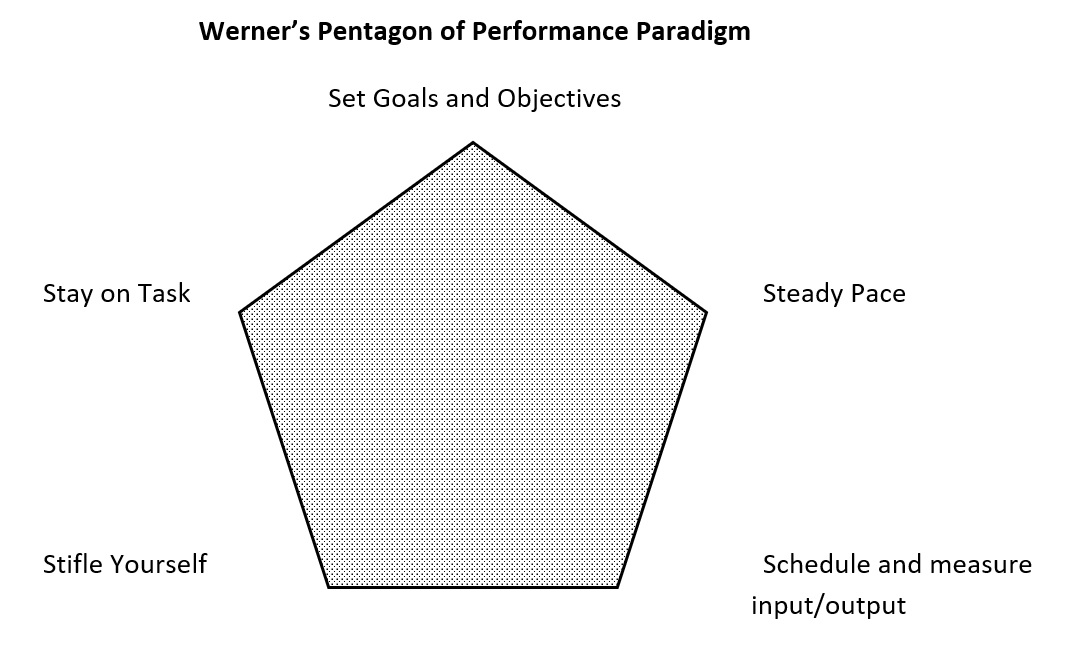
Then I came inside, fed the dogs, and let them out to run around for a bit. After they had finished their business, I let them back in and gave them each a small dog biscuit.
Since I hadn’t quite finished up my latest Patreon https://www.patreon.com/TacticalProfessor article, The Forgotten Teachings of John Boyd, I decided to knock that out and post it. It’s my second article this week about Boyd’s work, the first being A Tale of Two OODAs. Boyd’s scholarship is so superficially understood that I periodically have to address aspects of it. I decided to spend this month doing that since I have several weeks of convalescence ahead.
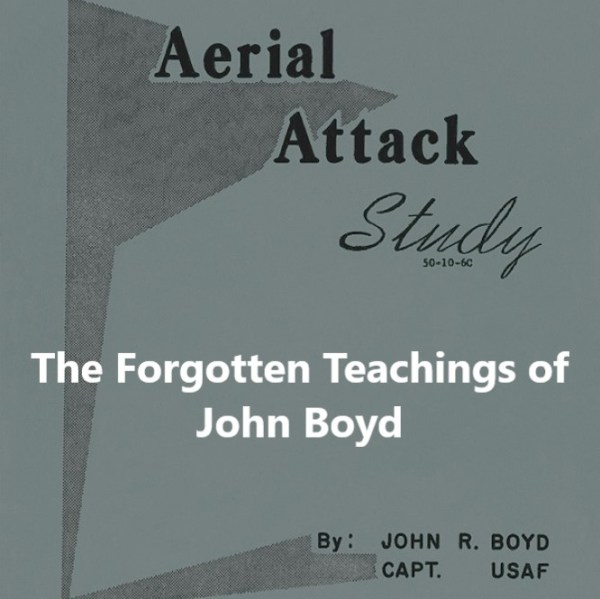
Being very averse to chaos and drama, I decided to write a short post here about my nice quiet day. Something other than the CV drivel that seems to be pervading every aspect of our lives right now might be pleasant for my subscribers and friends.
We’ll get through this. We live in the United States of America, the most wonderful place in the world and the best place that has ever existed on the Planet Earth. I give thanks every single day that I am so fortunate as to live here.
I have a question …
A friend sent me an email today that I think is very worthy of sharing. He is a twice retired POlice Officer, graduate of the elite Rogers Shooting School, and very seasoned firearms and tactics trainer.
What is your overall opinion of competition preparing you for a real gunfight?
I published my response on my Patreon page, which is generally limited to my subscribers there. It’s an important topic so I decided to make it publicly available. https://www.patreon.com/posts/33975252
Updated version of Boyd’s Aerial Attack Study
The link for the updated version of the AAS changed slightly but is now correct.
Boyd’s Aerial Attack Study is the most useful of all his documents in terms of tactical theory. Hardly anyone has read it, though.

Thanks to Rob Pincus, I have found a cleaner copy of Colonel John Boyd’s Aerial Attack Study (AAS). It was recreated by Mr. Mark Hart from the declassified 1964 version. The recreation is much easier on the eyes than the reproductions of the original mimeographed edition that are generally available.
Prior to Colonel Boyd’s AAS, fighter combat was viewed by the majority of fighter pilots as an intuitive skill rather than one that could be codified. Some conceptual principles had been developed along with elementary tactics such as the Thach Weave, but Boyd was the one who wrote the definitive book. Only Major General Frederick “Boots” Blesse had preceded Colonel Boyd in writing a book, No Guts No Glory, about jet fighter combat. Major General Blesse’s book wasn’t the exhaustive treatise on the subject that the AAS was.
View original post 90 more words
Get Ready (part 2)
Why do people carry an autoloader with an empty chamber? Because they’re concerned about having an Unintentional Discharge.
Sheriff’s gun goes off inside Walmart during a ‘Shop with a Sheriff’ event
One of the comments about the incident on Facebook sums up many people’s feelings about it.

Which is more likely to save your life? Carrying an autoloader with the chamber empty or carrying a revolver ready to go? Active Self Protection provides us with some food for thought.
A Stark Reminder to Keep Your Defensive Firearm Chambered
Armed Robber Kills Store Owner Whose Gun Wasn’t Ready
Another Reminder to Carry Chamber Full
Podcast list
I was the guest on another podcast last night. Knowing that many people like to listen to podcasts, I compiled a list of the podcasts and topics that the hosts have been so kind to invite me to join.
Eye On The Target – Book philosophy and Dry Practice drill, July 14, 2019
http://www.podcastgarden.com/episode/071419-one_146861
P(rimary) &S(econdary) 168 – Mouse Guns, October 14, 2018
https://www.spreaker.com/user/primaryandsecondary/p-s-168-mouse-guns
Safety Solutions Academy – Decision Making, September 20, 2018
https://safetysolutionsacademy.com/441-claude-werner-the-tactical-professor/
Ballistic Radio – The Neediest of Pre-Needs, July 8, 2018
Ballistic Radio – Dear Instructors, Get a Real Job, February 11, 2018
Civilian Carry Radio – December 28, 2017
Ballistic Radio – Whose Standards?, May 7, 2017)
Ballistic Radio – 50 Shades Of Werner, September 25, 2016
Ballistic Radio – The Boyd Part About The OODA Loop, February 7, 2016
Handgun Radio 118 – SHOT Show 2016 Handgun Preview, January 5, 2016
https://firearmsradio.squarespace.com/handgun-radio/118
Gun Guy Radio 189 – LAPD Use of Force Reports, November 10, 2015
https://firearmsradio.tv/gun-guy-radio/189
Handgun Radio 102 – Handgun Comparison Testing Protocols, – July 14, 2015
https://firearmsradio.tv/handgun-radio/102
Ballistic Radio – Training, Practice, and Shooting Standards, May 10, 2015
Ballistic Radio – Negative Outcomes 101, Part 2, March 15, 2015
Ballistic Radio – Negative Outcomes 101, March 1, 2015
Ballistic Radio – The Rise of the Sentinel (Event), September 16, 2014
http://ballisticradio.com/2014/09/16/the-rise-of-the-sentinel-event/
Ballistic Radio – Threat Management For The Armed Citizen, August 24, 2014
Ballistic Radio – Gunfight Analysis, Understanding the Threat YOU Are Most Likely To Face, April 20, 2014
http://ballisticradio.com/2014/04/21/podcast-season-2-ballistic-radio-episode-58-april-20th-2014/
Ballistic Radio – The Efficacy of Pocket Guns, Misconceptions, June 30, 2013
http://ballisticradio.com/2013/06/30/ballistic-radio-episode-17-june-30-2013/
 tacticalprofessor
You must be logged in to post a comment.