Shooting Practice for a Criminal Encounter
The second installment of my Shooting Illustrated series about organizing your shooting practice is now online.
https://www.shootingillustrated.com/content/shooting-practice-for-a-criminal-encounter

I always include more photos with my article submissions than can be used. After this paragraph in the article, I included what is possibly my favorite shooting photo of all time.
Shooters often blast an entire box of ammunition at the target without checking and then marking it consistently. This is one of the worst mistakes that can be made when practicing for marksmanship development and self-defense.
Sadly, along with several others, it was cut for space reasons. The photo is of a target that was left up at my gun club years ago. Every time I look at it, I literally Laugh Out Loud. I call it the ‘goober target.’
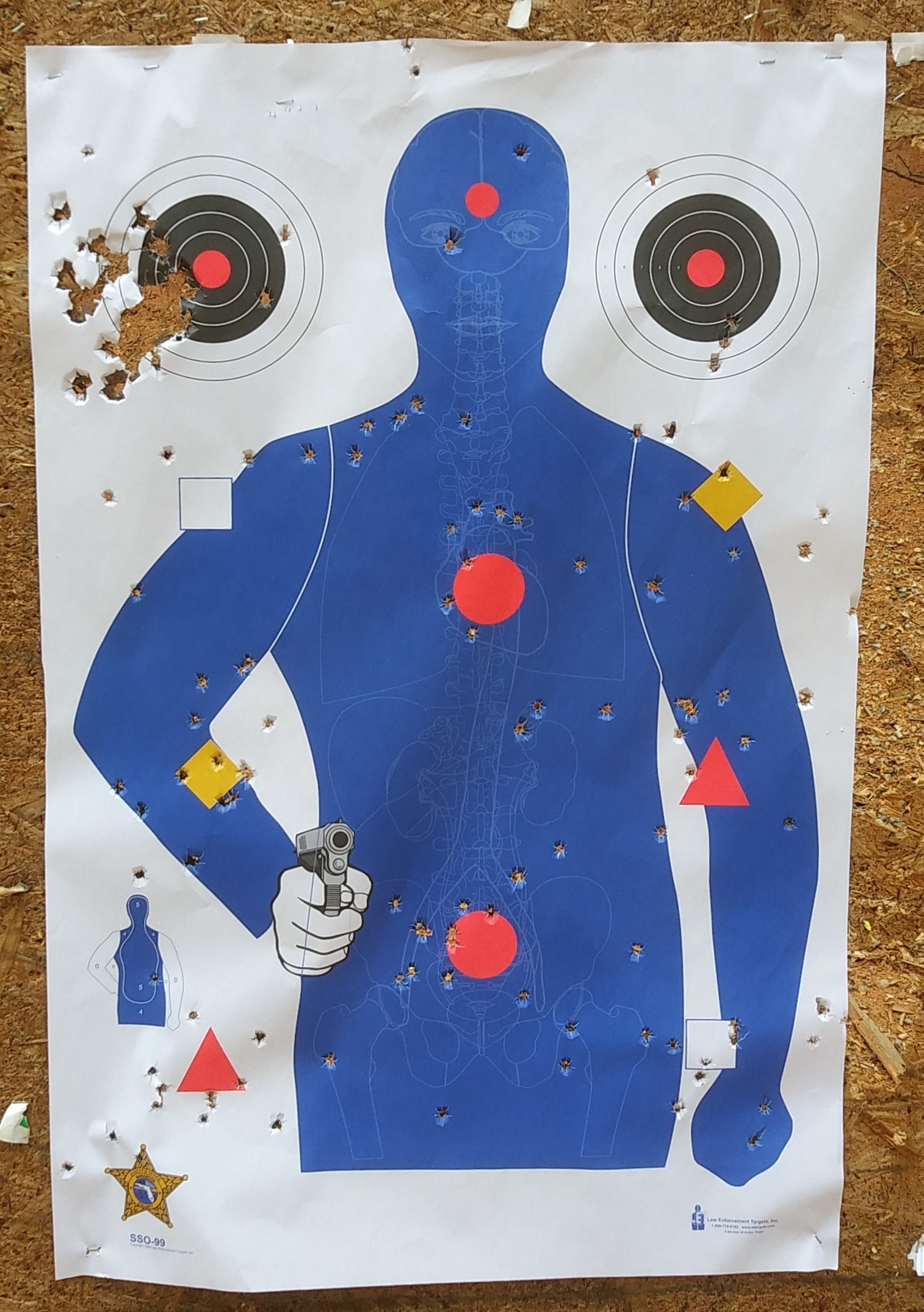
That is not the way to learn how to shoot to hit anything. Another photo that was cut shows how to mark your target with masking tape every few shots.

As mentioned in the article, checking and marking your target regularly will help you improve your marksmanship. Blasting away and creating a goober target will not.
Here is the Pump target. No one can say you’re practicing to shoot unarmed people if you have a representation of a gun on your target.
It’s getting to be a wild world out there; be ready.
Fundamentals and Training Aids (Part 1)
#fridayfundamentals
Revisiting the series about the Fundamentals of Pistol Shooting https://tacticalprofessor.wordpress.com/2021/11/05/fundamentals-of-pistol-shooting-part-1/ brings to mind the subject of training aids. Training aids are other pieces of equipment you will find useful for marksmanship and gunhandling practice. Your pistol shouldn’t be your only practice tool. There are a wide variety of readily available and inexpensive training aids.
An Inert pistol replica is the most valuable training aid you can own. Having a replica of your real gun is the best but it’s not absolutely necessary. This picture shows a small portion of my collection of inert pistols. No trainer worth his or her salt lacks at least one inert pistol for demonstration purposes.
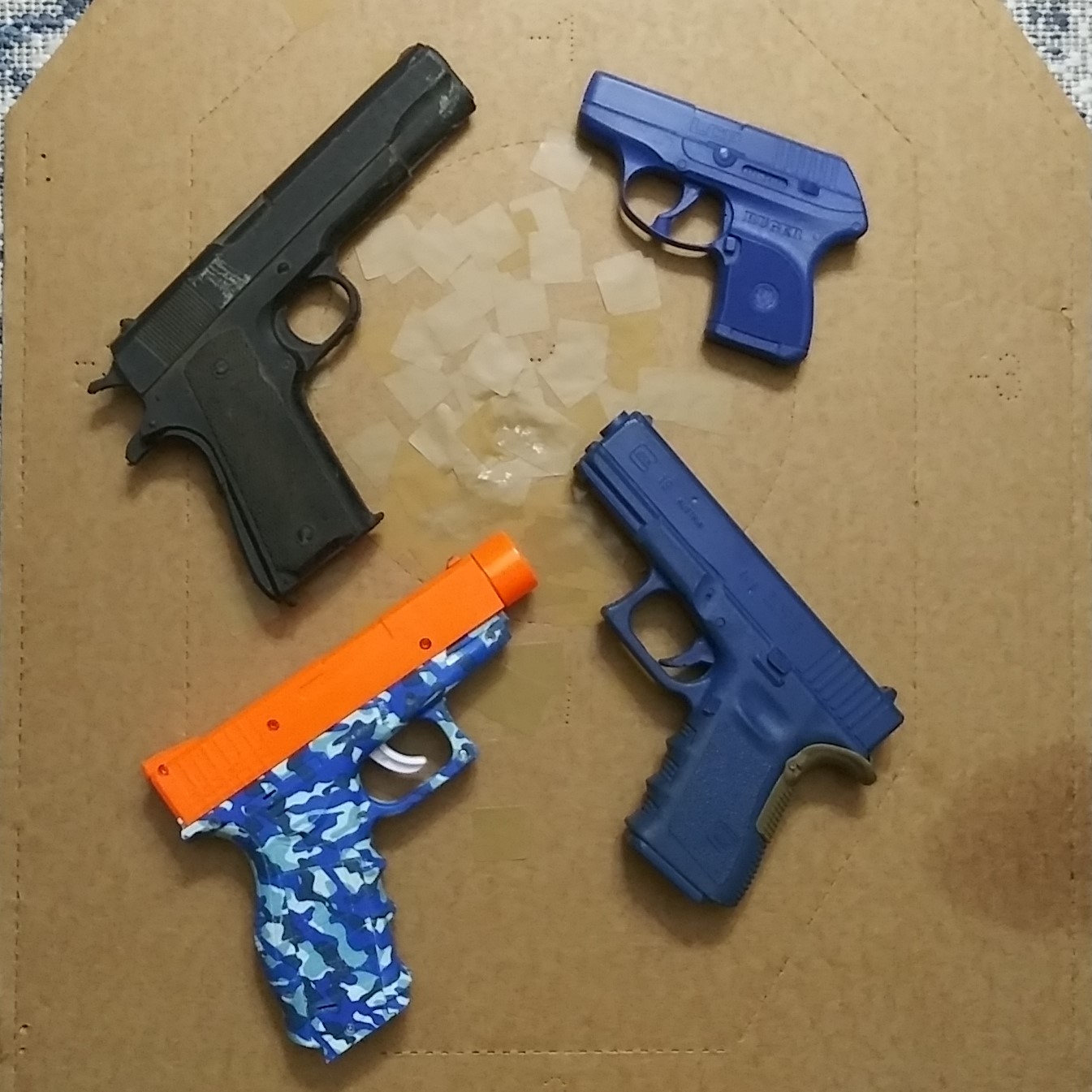
The rubber 1911 is the first training aid I ever acquired. I carried it on field exercises when I was a 90mm M67 Recoilless Rifle Gunner in the Army and didn’t want to clean two weapons every time I came back from the field. I’ve had it for 50 years now.
The orange and blue camo inert pistol was purchased from WalMart for less than $10. If no replica of your personal pistol is readily available, at least there’s something that can be used. It also makes a satisfying pew-pew noise when the trigger is pressed.
A SIRT Pistol is a useful option but expensive. Only three models are available; Glock 17, S&W M&P, and a generic subcompact model that reportedly only fits a holster for a Springfield XD-S.
An inert pistol can be used in a variety of ways. Among other things:
- Draw practice, especially for those who are reluctant to practice with their real pistol at home.
- Checking the solidity of your grip by having a partner hold the front of the slide and try to move it around.
- Practice getting your pistol out of its safe storage location quickly.
- Introducing others to holding a pistol without intimidating them.
- Doing demonstrations without endangering others.
There are also a number of other training aids that can improve your shooting.
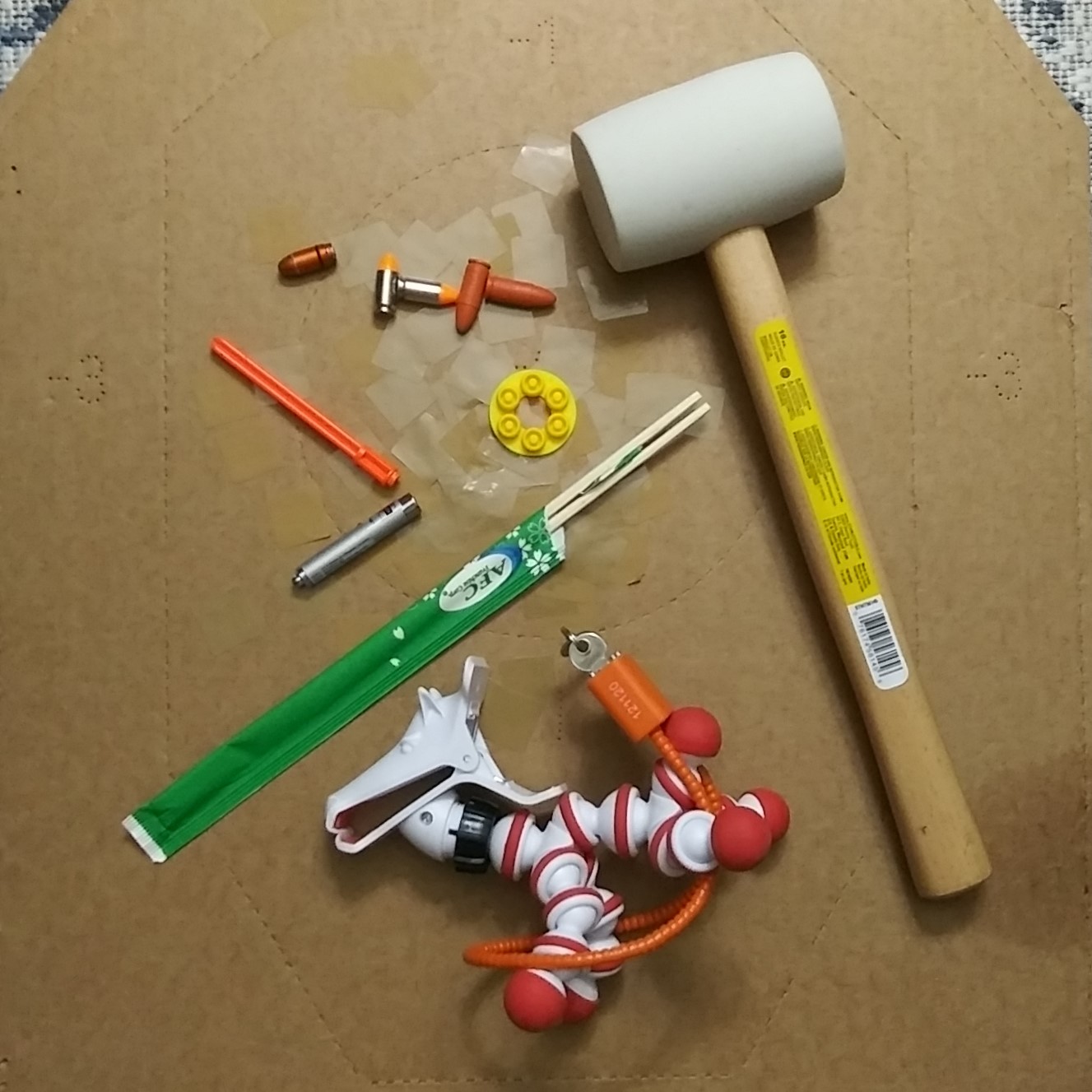
How to use these other training aids will be covered in future installments of this series.
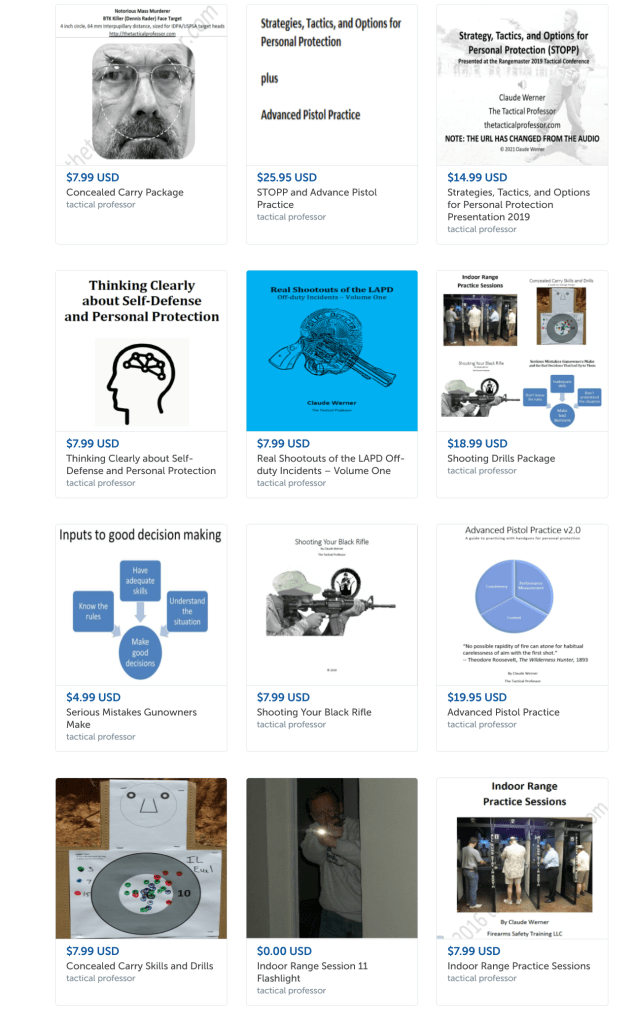
Tactical Professor books (all PDF)
https://store.payloadz.com/results/337896-tactical-professor
A Way of the Wheelgun
#wheelgunwednesday
In 2022, I created a four month Patreon series for developing shooting and gunhandling skills with snub nosed revolvers. There are a total of 65 articles in the series and it is the online equivalent of a book. All the articles are now available as a Collection on my Patreon page. Unlike a book, you can read it at your leisure on your Smartphone.
The basis for the Series is the principles and techniques of the Snub Nose classes I taught for decades and the two DVDs I made about snubs. Also included are examples of what went right and wrong in several real life incidents involving snubs.
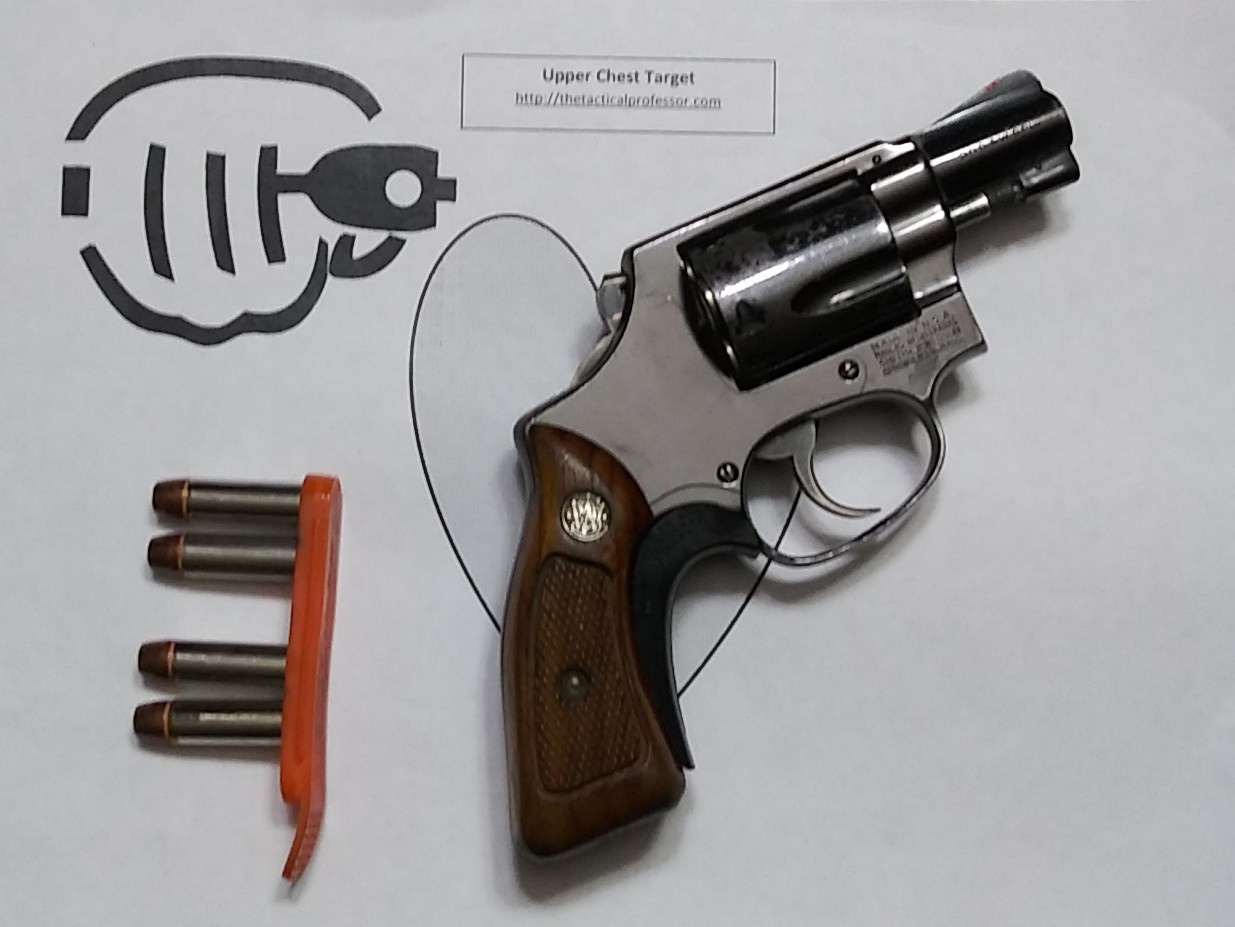
There is a great deal of emphasis in the Series on ‘dry practice,’ i.e., practice without ammunition. There is also periodic live fire (originally monthly) of no more than 50 rounds. The live fire is compatible with either indoor or outdoor ranges because the vast majority (999/1000 by my calculation) of gunowners only have access to indoor ranges.
The first three posts in the Collection are unlocked and available for anyone to read. These initial posts describe Safety Protocols during dry practice to avoid putting bullet holes in people, places, and things where they are undesirable. Tragedies can and do take place during dry practice and we want to avoid those at all costs.
For anyone who owns and/or carries a snub, this is a good program. Anyone who does any dry practice, whether with a revolver or autoloader, will benefit from at least reading the first three posts about Safety Protocols.
https://www.patreon.com/posts/snub-revolver-97045992
Subscribers to my Concealed Carry Skills Tier ($3/month) https://www.patreon.com/TacticalProfessor have access to all the articles in the Collection plus all the articles I write on Patreon about marksmanship and gunhandling. In the financial industry, we’d say the Return On Investment (ROI) is very high.
Organizing Your Shooting Practice – I
Start the new year off right with this easy to shoot, easy to practice drill.
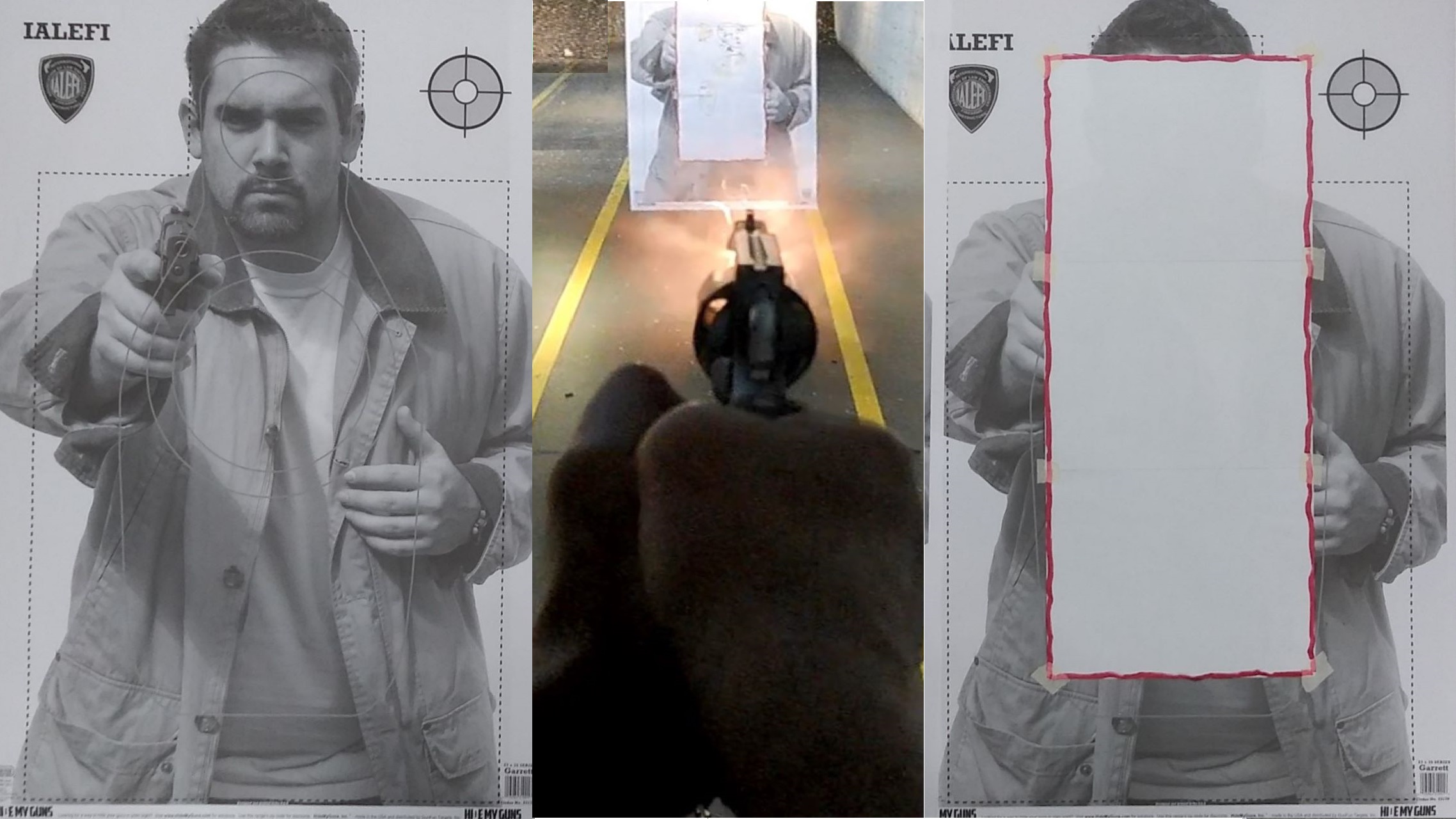
The NRA online website Shooting Illustrated has published the first of my series of articles about using the framework of State Level CCW Qualification Courses as marksmanship drills. The series is geared toward the new gunowner audience but even experienced shooters can gain something from it.
https://www.shootingillustrated.com/content/organizing-your-shooting-practice/
The philosophy behind the series is to give new gunowners at least a small idea of what they can do to gain some degree of proficiency with their guns. While “Do the work” has become a mantra in the training community in the 21st Century; what trainers mean by that is simply unrealistic in the context of most people’s busy lives. The goal of the Organizing Your Practice series is ‘Do Something.’ As my late colleague Paul Gomez said, “Shoot Yor Guns.”
Each of the monthly sessions can be accomplished by going to an indoor range for an hour, buying one box of ammunition, and getting in a short but meaningful practice session. If a shooter doesn’t even shoot the whole Session of the article; that’s okay. At least they know what it’s like when the gun goes off and what the sound of gunfire and the feel of recoil are like. The majority of adults are visual learners. For them, there’s also a YouTube Short about the session at https://youtu.be/AV4HSnAj_rw?si=pSbB0lNG5jILyrmM.
The purpose of the video isn’t really to provide a guide to the session. It’s mostly to show what real shooting looks like as opposed to the foolishness that is usually seen on TV and movies. Although Jennifer Garner frequently looked great on Alias, the shooting was always utterly ridiculous.
As a guide for staying on task at the range, I created an Aide-mémoire (Cheat Sheet) that can be folded up and brought along in a pocket.

If you would like to download the Cheat Sheet and/or cool Upper and Middle Target Sheets, they’re attached.
Attachments
- MCOLES Cheat Sheet
- Upper Target Sheet
- Middle Target Sheet
Since gear is always of interest, the demonstration for this article was done with a Taurus 856 .38 Special snub nose revolver and Blazer ammunition. The laser wasn’t used during the shooting. Reloads were done using the Zeta6 K-Pak2 Speedloader https://zetasix.com/product/k-pak2/ equipped with a Retention ring https://retentionring.com/ .

Very Good Shooting and Enjoy!
Downrange Incident During Home Invasion
From the Armed Citizen http://graphics.nra.org/ac/ac-138.html this month.
Authorities say a man opened fire on a suspected burglar who attacked his wife at their home
Deputies said [the intruder] encountered a 74-year-old woman inside the residence and ‘began to struggle with her physically.’ Her husband heard her screams and saw her struggling with Jackson. The man then retrieved his firearm and shot Jackson in the right shoulder.
This is what I call a ‘downrange incident.’ I.e., there’s an innocent party downrange and in close proximity to the attacker. Incidents where close range precision is required are more common than is realized.
A downrange drill is part of all my private sessions above the beginner level. The shooter has only one round in the pistol. Two IDPA targets downrange with one placed directly to the side of the -0 zone. The shooter can advance to any distance they feel they can make a -0 hit, either head or body, on the first shot without hitting the hostage. Even experienced shooters tend to get somewhere within Social Space (4-12 feet).
It doesn’t have to be an IDPA match scenario
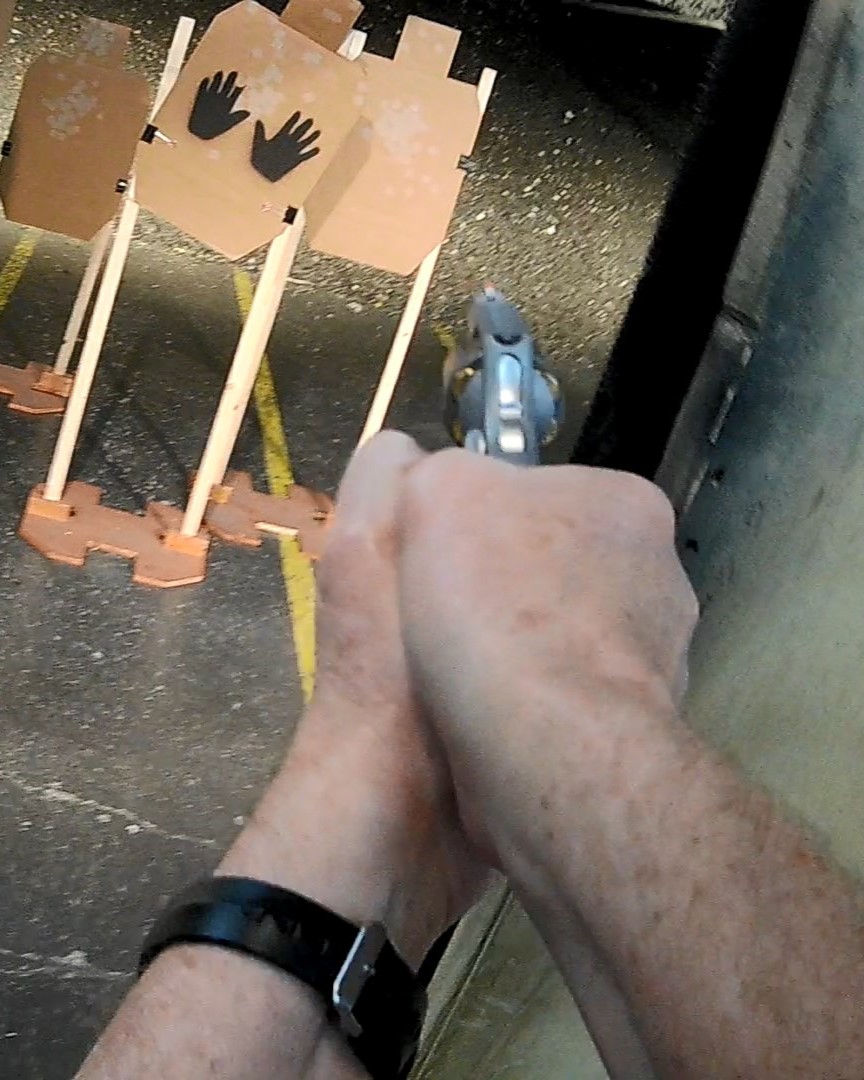
but practicing the ‘downrange shot’ occasionally is worthwhile.
Surveillance Detection Principles
#walkbackwednesday
In the April 1996 edition of the FBI Law Enforcement Bulletin https://leb.fbi.gov/file-repository/archives/april-1996.pdf/view , Supervisory Special Agent John C. Hall wrote:
“Realistic training does not state general platitudes and then leave officers to figure the rest out for themselves. It provides clear principles to govern the application of deadly force and then illustrates appropriate application through practical examples.” – p25
This could be paraphrased for Private Citizens as:
Realistic [education] does not state general platitudes and then leave [Citizens] to figure the rest out for themselves. It provides clear principles to govern [personal protection] and then illustrates appropriate application through practical examples.
Therefore, let’s consider Surveillance Detection. Surveillance Detection is a preemptive action that we can take to prevent getting into ugly situations at all. The following story is a reminder of its value.
Woman shot in the face in ambush as she’s followed home from store
https://news.yahoo.com/woman-shot-face-ambush-she-153809301.html
“Investigators say the women were driving home from a neighborhood market, and as they pulled into the driveway, they noticed a vehicle had followed them , KTRK reported.
A man got out of the vehicle and fired a single shot, striking the woman in the face, police told the outlet.”

There’s more to this story than stated in the article but that’s irrelevant in the educational context. These are some ‘clear principles’ and ‘practical examples’ of how to perform surveillance detection.
Principle 1
The time to notice that someone is following you is NOT when you turn into your driveway/parking spot as you a sitting duck. You should be aware of their presence long before then.
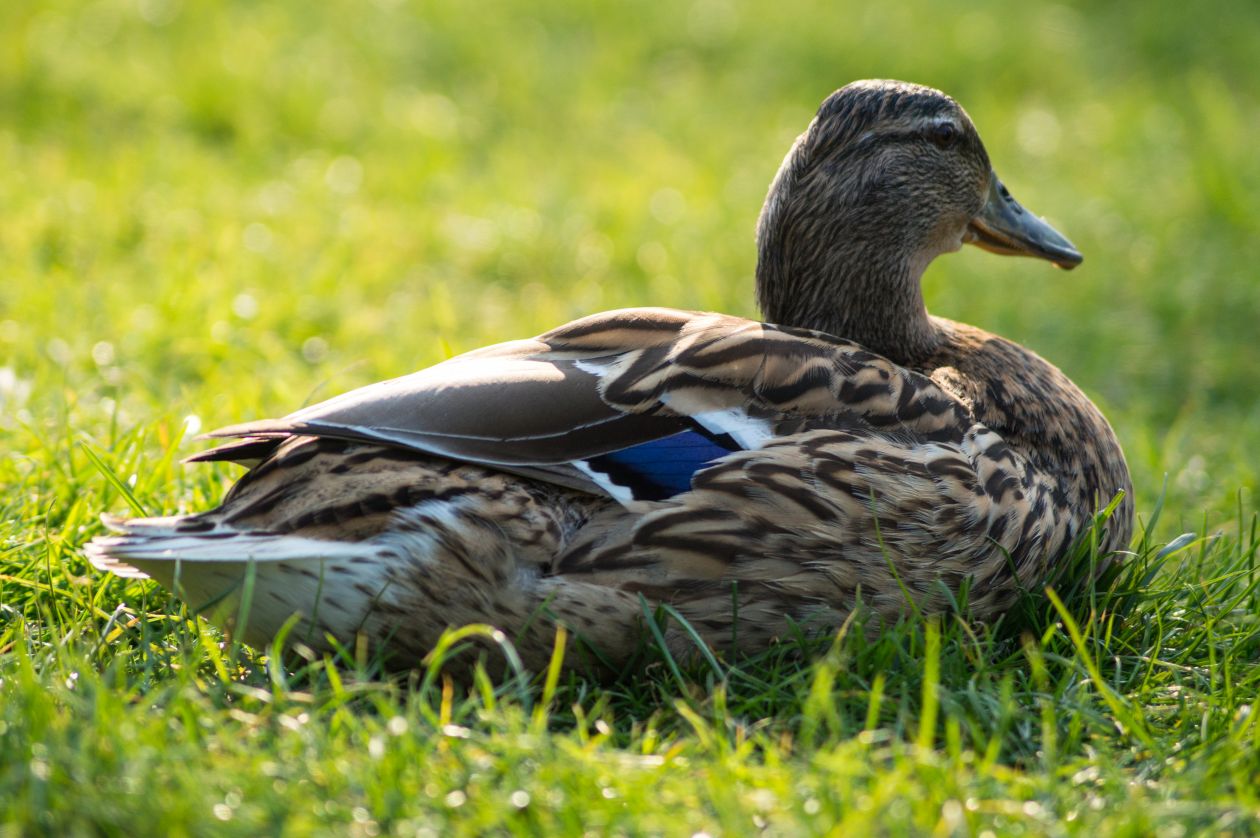
Look in your mirrors at least three times during turns as you drive home. All three times should be before you make the last turn onto your final approach, i.e., the street you live on. If you see the same vehicle behind you three times, you may have a problem.
Principle 2
If someone is following you, DON’T GO HOME. Or any other place where you will be a sitting duck either. One comment on the article was to go to a POlice station. Especially in the days of officer shortage and defunding the POlice, this isn’t a good idea. Call 911 and keep driving. If you’re in a ‘Hands-free’ State, maybe a POlice will pull you over and then you can explain why you’re on your phone. That should solve the problem right now. Other ideas are in this post. https://thetacticalprofessor.net/2023/09/29/surveillance-detection-after-a-confrontation/
As this poor woman found out, “Just because you’re paranoid doesn’t mean they are NOT out to get you.”
If you like my work, please consider supporting me on Patreon. https://www.patreon.com/TacticalProfessor I post a lot of content there that doesn’t go on my blog.
Pocket Carry
Now that cold weather is upon us, pocket carry in an overcoat pocket has some advantages. Pocket carry has both upsides and downsides.
Upsides
- It’s far easier to access a gun in a coat pocket than to undo the coat and draw a holstered pistol. This is especially true when you’re seated in a vehicle with a seat belt on.
- You can put your hand on your gun as soon as you perceive trouble or even walk around with your hand on your gun in general.
- A draw from the pocket, starting with hand on gun, is faster for most people than drawing from a concealed holster.
Downsides
- Pocket carry usually requires a smaller and more compact handgun.
- A separate pocket holster is advisable.
- You may be wearing gloves.
- If you come in from outside and have to hang up your coat in an unsecured area, you’ll need to do something with the pocket pistol to secure it.
- The pocket draw is a little different than drawing from a belt holster.
- Said smaller and more compact handgun will probably become your primary tool in an incident.
Most people don’t practice as much with their smaller guns as they do larger ones. Pocketable pistols are usually both ego challenging and uncomfortable to shoot. Nonetheless, some familiarization is a good idea.
The CCW Practical Exercise from Switzerland is short and uncomplicated familiarization drill. The Swiss are a very practical people.
All shooting is done wearing a concealment garment with a holstered weapon.
- 2 shots at 7 meters in 4 seconds. 3 times.
- 2 shots at 5 meters in 3.5 seconds. 3 times
- 2 shots at 3 meters in 3.0 seconds. 3 times.
18 rounds total. 14 hits required to pass. The hit area (dark area) of their target is roughly equivalent to the IDPA -1 zone. Hits on the silhouette outside the hit area don’t count. They penalize 1 hit for any impacts outside the silhouette.
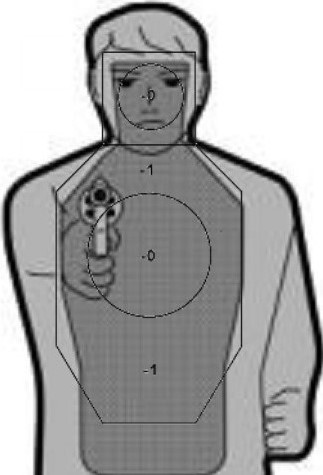
If you decide to pocket carry, it’s worth doing at least a short tuneup with your pocket pistol. A dry practice session for your draw is a must. A short live fire session to get the lint out of your gun and be sure it works is also in order.
P-Press the Trigger Smoothly
My friend and colleague Greg Ellifritz kindly mentioned this post in his Weekly Knowledge Dump https://www.activeresponsetraining.net/weekend-knowledge-dump-december-1-2023 and it is worth repeating.
https://thetacticalprofessor.net/2018/11/16/press-the-trigger-smoothly/
Calling the Shot
#Fridayfundamentals
Last week, I shot the IDPA Match at my gun club. Oddly enough, the shot I was happiest with the whole day was one I missed.
The lighting in one bay illuminated the smoke and cloudiness of each shot during the shooting. This added to the difficulty of transitioning between targets and immediately establishing a sight picture.

When I transitioned to the far left target, my view was still obscured by the smoke from the previous shot.
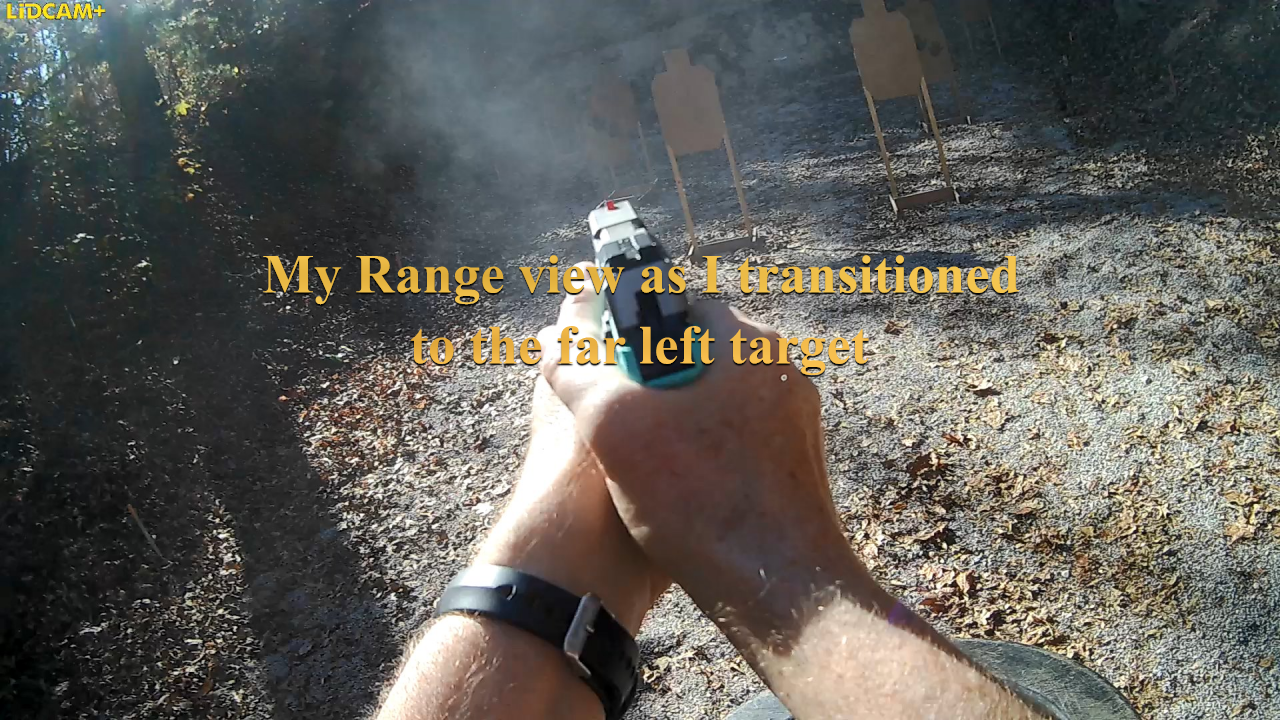
But at the moment the shot fired, the smoke had cleared and I had a decent view of my sight picture in relation to the target. I called it low and moved on.
When the targets were scored, sure enough there it was, low in the -3 Zone.

Calling that shot correctly during a challenging stage was the single best aspect of the match to me. It occurred to me later that in competition we only fire one, two, or three shots per target. Because of that, we have the opportunity to evaluate our shot calling for most of our shots. It’s an advantage competitive shooting has that never occurred to me before.
Shot calling with iron sights is an important skill to work on. When you can do it, it means you’re seeing your sight alignment and its relation to the target at the moment of the shot. That is sight picture in the moment and leads to good marksmanship.
Empty Chamber Carry – II
#fridayfundamentals
As mentioned last week, the discussions of Empty Chamber Carry rarely include any commentary about what to do after the pistol is loaded during an incident. A simplistic explanation of what the person will do often reduces to this.
“If I don’t have to shoot, I’ll immediately download the chamber when I get back to my car.”
There are several contextual issues with this.
- The car may be some distance away. Is the person going to walk to the car with gun in hand? Or are they going to holster a loaded pistol, something that they’re not used to doing, before they walk to the car?
- Once they reach the car, are they going to unload outside or inside the car?
- What procedure will be used to unload the pistol? Doing it standing outside the car? If so, is the pistol pointing at the car or away from the car? If the idea is to unload after entering the car, is the pistol in hand when getting in, placed on the seat before entering, or holstered?
- What direction is the pistol pointed inside the car during the unload process? There is no direction inside the car that doesn’t violate Rule #2 “Never point your pistol at anything you’re not prepared to destroy.” However, pointing it at yourself is the worst possible direction.
- Has the person ever practiced their unloading procedure with dummy ammunition?
If the incident occurs while the defender is in the car, the situation becomes even more complicated. The February 2022 Armed Citizen page
of the official NRA publications contains this incident in which a woman foiled a carjacking attempt. https://www.americas1stfreedom.org/content/the-armed-citizen-january-24-2022/
Woman With Concealed Carry License Fires At Would-Be Carjackers
https://www.cbsnews.com/chicago/news/ccw-holder-fires-gun-attempted-carjacker-roseland/
“I had just come out of the bank and was sitting in my car about to lock my door to pull off [and] leave, and he opened my door and put a gun in my face”
In a situation like this, both loading the gun and later unloading it come into play. Complicating the issue is that ‘workspace’ behind the steering wheel of a car is extremely limited.
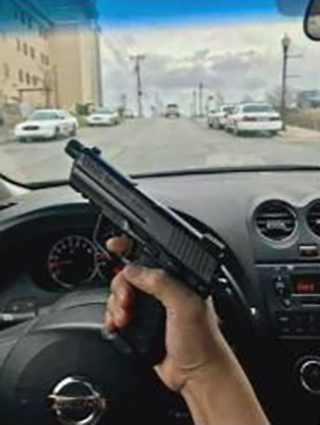
If she hadn’t fired at the carjacker and had carried Empty Chamber, she would have then had to unload her pistol. However, she fired and then went for help.
“She reversed her Nissan Versa, and pulled up right outside the Chase Bank – then ran inside for help.”
If there was no malfunction, the chamber was now loaded. She then chose to go to a place of safety, the bank she just left. Obviously, running into a bank with a gun in hand wouldn’t be a great idea. Her choices at that point were:
- Holster the loaded gun or put it back in her purse. Her carry method wasn’t specified so it’s possible she just leaves the gun in the car in general. In that case, she would only have options 3 or 4.
- Unload the gun while sitting in the car, secure it somewhere on her person, and then go into the bank.
- Run into the bank and leave the gun in the car loaded.
- Unload the gun, leave it in the car, and run into the bank.
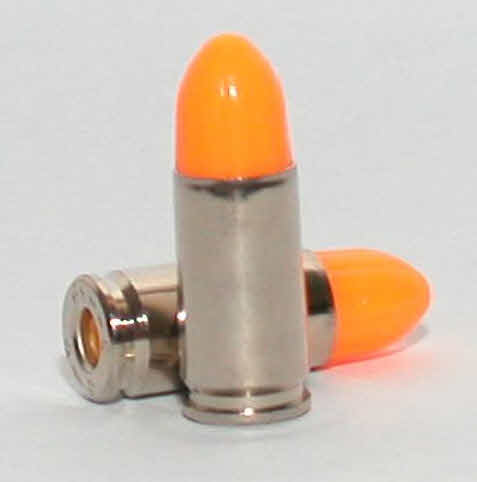
For those who choose to carry with an Empty Chamber, practice at gun manipulation is vital. Dummy rounds are a very useful training aid and every gunowner should have some. Empty Chamber carriers in particular should use them regularly to practice loading and unloading under realistic conditions.
Empty Chamber Carry – I
https://thetacticalprofessor.net/2023/10/13/empty-chamber-carry-i/
 tacticalprofessor
You must be logged in to post a comment.