Friday Fundamentals – Ball and Dummy
My last post about shooting Dots https://tacticalprofessor.wordpress.com/2021/09/24/marksmanship-practice-shooting-dots/ generated a few questions about whether my ammo was bad. No, I incorporated random Ball and Dummy into the Dot Drill, just as I do in most of my practice sessions. Ball and Dummy, both random and alternating, is an excellent method for evaluating how smooth your trigger press is and if you are refining your sight picture adequately. This is not the same as practicing malfunction clearance, as mentioned in the article.
Highly recommended. My favorite dummies are from ST ACTION PRO. They are inexpensive, highly visible, and don’t get lost on the range as much as others do.
Tactical Professor Information Products
STOPP Presentation at Rangemaster Tactical Conference
https://tacticalprofessor.wordpress.com/2021/09/14/stopp-presentation-now-available/https://www.payloadz.com/go?id=3381307
Books (all PDF)
- Thinking Clearly about Self-defense and Personal Protection https://www.payloadz.com/go?id=3377208
- Real Shootouts of the LAPD https://realshootoutsofthelapd.com/
- Serious Mistakes Gunowners Make http://seriousgunownermistakes.com
- Indoor Range Practice Sessions http://indoorrangepracticesessions.com
- Concealed Carry Skills and Drills http://concealedcarryskillsanddrills.com
- Advanced Pistol Practice http://bit.ly/advancedpistolpractice
- Shooting Your Black Rifle http://shootingyourblackrifle.com
- Package deal of Thinking Clearly about Self-defense and Personal Protection, Serious Mistakes, Indoor Sessions, Concealed Carry, and Shooting Your Black Rifle (50% off) https://store.payloadz.com/details/2644448-ebooks-sports-shooting-drills-package.html

What is ball and dummy?
Sometimes, we instructors take our subject matter knowledge for granted. A friend posted that she was pulling a few of her shots low and left. She’s right handed. My reply was ‘ball and dummy.’ She then asked me what that meant.
Ball and dummy means interspersing dummy (inert) ammunition among your live ammunition during a practice session. It’s a key training tool at the elite Rogers Shooting School. The dummies can be random, e.g., three or four dummies in a 15-17 round magazine. They can also be alternating; i.e., live, dummy, live, dummy, live, dummy, etc. for the entire magazine.
The purpose of ball and dummy is to watch the sights when the dummy round is clicked on to learn how smoothly, or not, you are pressing the trigger. Ball and dummy for marksmanship training is NOT the same as an Immediate Action Drill…
View original post 277 more words
Marksmanship practice – shooting dots
#fridayfundamentals
I’ve written about shooting dots and the history of dot shooting in a previous post. https://tacticalprofessor.wordpress.com/2018/07/27/the-origin-and-evolution-of-dot-torture/
This is a video I made a decade ago about how to shoot dots. The Course of Fire details are in my previous post.
Tactical Professor Information Products
STOPP Presentation at Rangemaster Tactical Conference
https://tacticalprofessor.wordpress.com/2021/09/14/stopp-presentation-now-available/
https://www.payloadz.com/go?id=3381307
Books (all PDF)
- Thinking Clearly about Self-defense and Personal Protection https://www.payloadz.com/go?id=3377208
- Real Shootouts of the LAPD https://realshootoutsofthelapd.com/
- Serious Mistakes Gunowners Make http://seriousgunownermistakes.com
- Indoor Range Practice Sessions http://indoorrangepracticesessions.com
- Concealed Carry Skills and Drills http://concealedcarryskillsanddrills.com
- Advanced Pistol Practice http://bit.ly/advancedpistolpractice
- Shooting Your Black Rifle http://shootingyourblackrifle.com
- Package deal of Thinking Clearly about Self-defense and Personal Protection, Serious Mistakes, Indoor Sessions, Concealed Carry, and Shooting Your Black Rifle (50% off) https://store.payloadz.com/details/2644448-ebooks-sports-shooting-drills-package.html
The Sandra Ochoa Incident (Shooting Analysis II)
In a previous post https://tacticalprofessor.wordpress.com/2021/08/17/the-sandra-ochoa-incident-shooting-analysis/, I discussed Officer A’s shooting performance during the incident. The weapon system manipulation aspects also bear discussion.
This incident forced Officer A to manipulate two different flashlights in rapid succession. He approached the scene with a hand held light, which most industry professionals would consider a best practice. At the gate, he immediately had to make a SHOOT decision and held onto his handheld light while shooting using his weapon mounted light. His shooting grip was compromised as a result. This image capture is from immediately after his sixth shot.
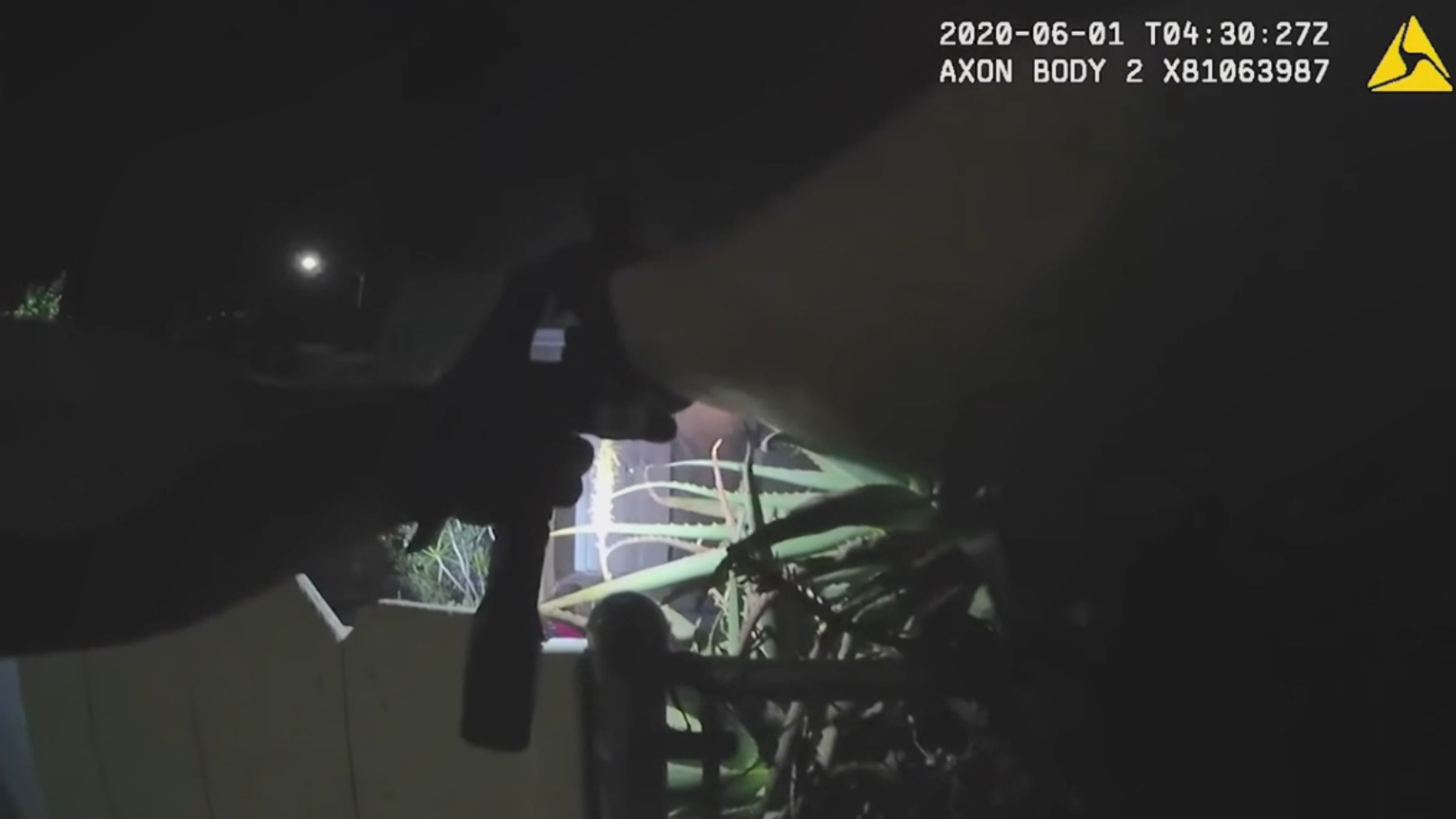
It’s apparent he is holding onto his handheld light with the ring and little fingers of his Support (left) Hand and trying to wrap his index and middle fingers around his pistol. The compromised grip may have been part of the reason for his low hit rate with the first five shots. This observation is not a criticism of Officer A, rather it’s a recognition of the complexity of the manipulation problem he encountered. Having and rapidly using two different types of flashlight in succession is not a training drill we often practice, myself included.
As is often the case, technology has advanced more rapidly than practical doctrine for using it. Several possibilities arise for using the two lights.
- Simply do the best you can with what you’ve got, as Officer A was forced to do.
- Shoot one handed, while maintaining control of the handheld light in the Support Hand.
- Drop the handheld, shoot with the weapon mounted light, and then retrieve the handheld light when necessary or feasible.
- Have the handheld on a large flexible ring that allows it to be dropped without losing total control of it. This is the approach I am currently experimenting with.
It’s worth noting that one incident in Real Shootouts of the LAPD involved the use of a flashlight. Also, some of the tragedies referenced in Serious Mistakes Gunowners Make could have been averted by the use of a flashlight. The Ochoa Incident gives us some food for thought about the need for doctrine and practice with flashlights.
Other Tactical Professor books (all PDF)
- Thinking Clearly about Self-defense and Personal Protection https://www.payloadz.com/go?id=3377208
- Serious Mistakes Gunowners Make http://seriousgunownermistakes.com
- Indoor Range Practice Sessions http://indoorrangepracticesessions.com
- Concealed Carry Skills and Drills http://concealedcarryskillsanddrills.com
- Advanced Pistol Practice http://bit.ly/advancedpistolpractice
- Shooting Your Black Rifle http://shootingyourblackrifle.com
- Package deal of Thinking Clearly about Self-defense and Personal Protection, Serious Mistakes, Indoor Sessions, Concealed Carry, and Shooting Your Black Rifle (50% off) https://store.payloadz.com/details/2644448-ebooks-sports-shooting-drills-package.html
How useful are sights on a pistol?
Since I’ve gathered some data on the topic in the past, I am going to link to a Lucky Gunner article about using the sights on a pistol.
I did an experiment years ago in which 10 different experienced shooters tried point shooting a single round at a silhouette starting at one yard. Then the distance was increased one yard at a time for the group. To test whether some form of visual indexing to the pistol was necessary, each shooter had a piece of cardboard placed horizontally in front of him at neck level so there was absolutely no visual reference to the pistol’s orientation. There was no time limit, the shooters were free to adjust their pointing until they thought they were on target.
The bullets starting hitting the ground at two yards. Only one shooter was able to make a hit anywhere on the silhouette at 5 yards and that was a peripheral hit. I discontinued the experiment at that point.
I figured out everything I needed to know about hitting a target without visual reference to the gun and with the gun below the eye-target line from that experiment.
Using the sights (i.e., getting the pistol into the eye-target line) is how we learn to kinesthetically index the handgun. Ask someone to point their finger at any object. Notice they don’t do it outside of their ‘workspace’ the more or less basketball sized space in front of the chest, properly called the ‘ipsilateral visual field.’
We may not always use the sights in a fight but training with them is how we learn to correctly index the pistol kinesthetically.

Training the trigger finger
#fridayfundamentals
The trigger finger should move back as parallel to the bore as possible when pressing the trigger. Here’s a little exercise I designed at the elite Rogers Shooting School to help our clients practice moving the finger correctly. It requires no equipment and gives biofeedback on your performance. It is also the safest form of dry practice, other than from quizzical looks by others.
For revolver shooters, this is a powerful learning exercise.
I enjoy wearing my NRA Certified Instructor cap when I’m teaching, even when it’s not an NRA class. 🙂
Weight transfer and stance

A good stance helps us minimize the effect of recoil on our ability to deliver multiple shots quickly. It also prepares us to rapidly move to another position, should that be necessary.
The entire post and YouTube link is available on my Patreon page.
https://www.patreon.com/posts/52312807

Tactical Professor books (all PDF)
- Real Shootouts of the LAPD https://realshootoutsofthelapd.com/
- Serious Mistakes Gunowners Make http://seriousgunownermistakes.com
- Indoor Range Practice Sessions http://indoorrangepracticesessions.com
- Concealed Carry Skills and Drills http://concealedcarryskillsanddrills.com
- Advanced Pistol Practice http://bit.ly/advancedpistolpractice
- Shooting Your Black Rifle http://shootingyourblackrifle.com
- Package deal of Serious Mistakes, Indoor Sessions, Concealed Carry, and Shooting Your Black Rifle (20% off) https://store.payloadz.com/details/2644448-ebooks-sports-shooting-drills-package.html
Downrange Incident in Rock Hill
This story is about what I call a “downrange incident,” meaning that innocent parties are downrange and in close proximity to the criminal when the shot needs to be fired.
During the initial investigation process, officials learned the 19-year-old allegedly initiated a verbal altercation with others in the apartment. Authorities said the altercation then escalated when the 19-year-old began assaulting those in the apartment and threatened to kill them. The 19-year-old strangled a male who[m] he assaulted, officials said, and was then shot by another person in the apartment in an attempt to stop the attack. Officers said the 19-year-old then turned and started strangling a female in the apartment. He was then shot a second time, then collapsed.
These types of situations happen more often than is commonly thought. Having it happen twice in one incident, such as this one, is rare however. Making a clean close range precision shot should be part of our practice regimen.
From my old YouTube Channel that I can’t access anymore.
The Magic of Knowing that You Can Shoot Quick and Straight
#mindsetmonday
J. Henry Fitzgerald’s book Shooting was published in 1930. Some things in it are dated but most of the book is still very worthwhile. The entire book is available online, courtesy of Sportsman’s Vintage Press.
http://sportsmansvintagepress.com/read-free/shooting-table-contents/
The chapter on The Magic of Knowing that You Can Shoot Quick and Straight is an example of practical mindset. Many times, explanations of ‘mindset’ are vague and nebulous but Fitzgerald’s is straightforward and actionable.
http://sportsmansvintagepress.com/read-free/shooting-table-contents/shoot-quick-and-straight/
Some things related to human nature and performance haven’t changed one bit. Fitzgerald’s commentary on the Dunning-Kruger Effect https://en.wikipedia.org/wiki/Dunning%E2%80%93Kruger_effect is a hilarious example.
I have listened to many officers explaining how good they could shoot and when they got on the firing line they couldn’t hit a cow in the head with a snow shovel.
J. Henry Fitzgerald
It’s not necessary to be a great shot to defend yourself but having a degree of demonstrated competence is a valuable asset to your mindset. Drills like 3x3x3 are one way to demonstrate your competence to yourself. Shooting some of the drills from Indoor Range Practice Sessions and Concealed Carry Skills and Drills are another. Click on the images to purchase either or both books.


FTC notice: I am not affiliated with Sportsman’s Vintage Press and receive no commissions from them.
3X3X3 – Level One
Three Shots, Three Seconds, Three Yards has been discussed in the context of gunfights since the 1970s. It is the most commonly cited statistic about gunfights.
Practicing to hit the silhouette every time using the 3X3X3 basis is Level One of learning to shoot the drill well. It is a good baseline for entry level shooters and those who have never measured their performance.
Level One – hit a silhouette consistently
Level Two – hit a sheet of paper consistently
Level Three – hit a half sheet of paper consistently
Level Four – hit a quarter sheet of paper consistently
The dry practice drill was discussed in a previous post.
Here’s the live fire version.
When I wrote Real Shootouts of the LAPD, I wasn’t surprised that NYPD Lt. Frank McGee was pretty much on the mark when he first described it. Almost all of the off-duty shootouts fit into that statistic.
A related note is that I fired about 100 .22 Long Rifle rounds through my 317 snub with a standard (8.5 lb) mainspring. There was not one Failure to Fire during the session. Ammunition for my .38 is precious and hard to come by so I used the .22 for demo purposes. For those who think that was cheating, I also shot with my SCCY CPX-2 9mm.

If you would like to purchase my book about actual shootouts that are not a figbar of someone’s imagination, click on the image below.
Occupational Hazards
#mindsetmonday
The training community is often obsessed with and overestimates the value of what we do and say. The Most Dangerous Man in the World cautioned me about becoming too enthused about hearing myself talk (not me personally but rather as an occupational hazard) as a firearms instructor. More and more, I appreciate his wisdom in that regard.
Is training a substitute for practice and experience? Even bad practice will generally lead to some action.
Doing anything, even the wrong thing, is better than doing nothing.
Ranger saying
I’m not sure the same is true for training, especially when it occurred more than 30 days ago. That’s the half-life of hands-on training, according to Army Medical Department studies.
If you would like to purchase my book, click on the image below.
I’m working on the next volume, Tales of the Gauge, about LAPD shotgun shootouts. It’s very interesting.


You must be logged in to post a comment.