Shootist’s Challenge Target
#Fridayfundamentals
“Do you have a link or PDF for the “Shootist’s Challenge” target?”
I enjoy the Shootist’s Challenge more every time I shoot it. For any gun, that’s a worthwhile wrapup to a range session. It really makes me focus on the four fundamentals I developed at the elite Rogers Shooting School. https://rogersshootingschool.com/
- Grip the pistol firmly.
- See the sights.
- Press the trigger smoothly.
- Follow through.
The target is available in a previous post, Gunfighter Challenge.
https://thetacticalprofessor.net/2024/08/02/gunfighter-challenge/
If you like my work, join me on Patreon where I post more in-depth articles about shooting, marksmanship, and incident analysis.
Pushing The Limits of Smaller Guns
#LCPproject
Pushing The Limits of Smaller Guns is my October 2024 article in Shooting Illustrated.
https://www.shootingillustrated.com/content/pushing-the-limits-of-smaller-guns/
I shot the entire program with my Ruger LCP Max, which I bought with my own money. The gun is stock out of the box.

The results contradict the myth that smaller guns as being suitable for only “arm’s length” encounters. Pictures tell the story of the results of the three courses that were shot.
Kansas Concealed Carry License Qualification
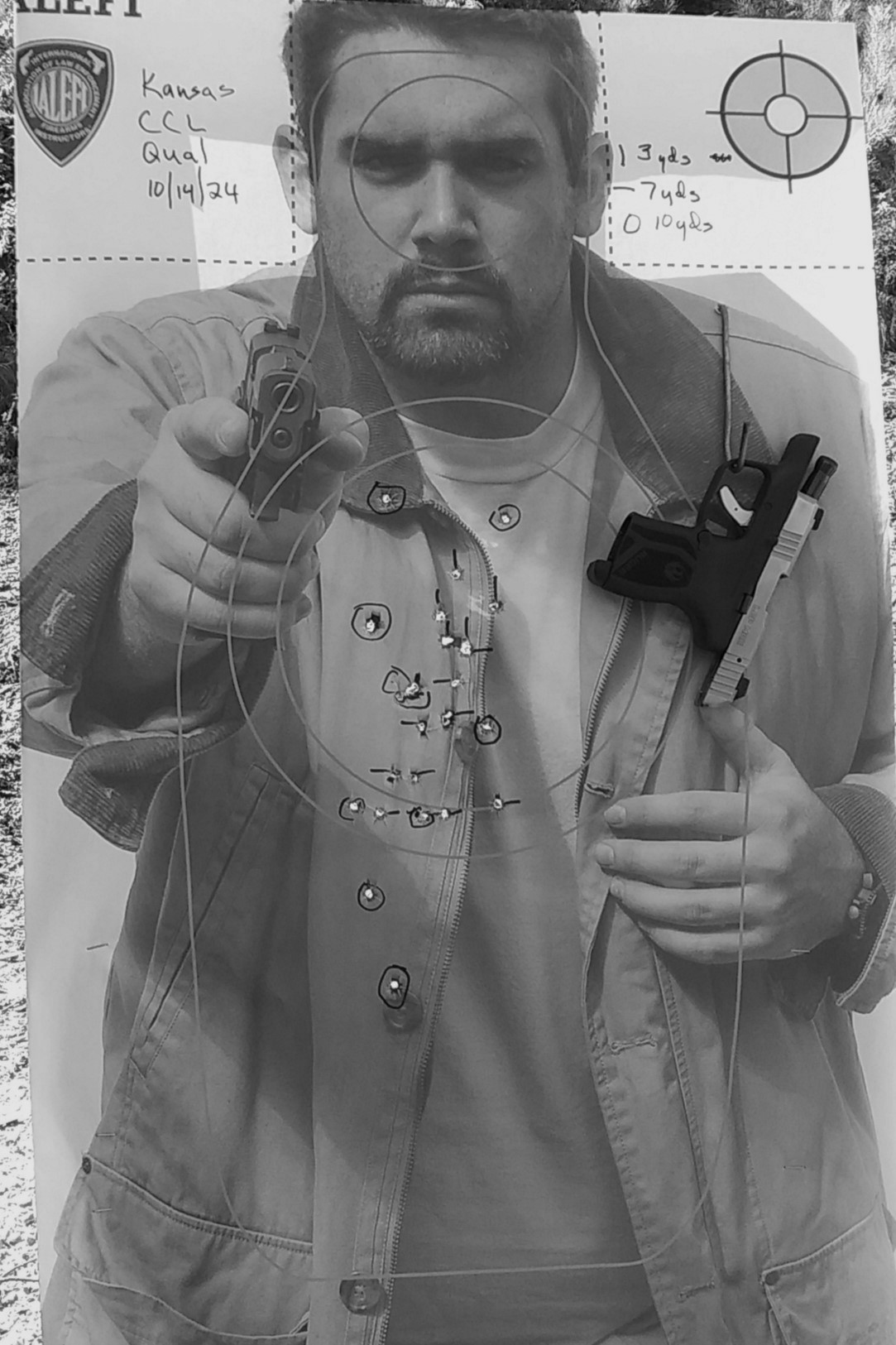
Twenty-five hits out of 25 shots. Pass.
Shootist’s Challenge

All hits inside the square, two hits on the stamp. ‘Good’ by Wild Bill and fellow Shootists’ standard.
Bakersfield Police Qualification

Bakersfield Stage Times
- 2.01
- 2.27
- 6.96
- 2.78
Bakersfield Scores
- 10 point (A) zone – 7 70 points
- 9 point (C) zone – 2 18 points
- 6 point (D) zone – 1 6 points
94 points total – Pass
It’s only an “arm’s length gun” if you’re don’t know how to shoot it.
If you like my work, join me on Patreon where I post more in-depth articles about shooting, marksmanship, and incident analysis.
Gunfighter Challenge
#fridayfundamentals
James Butler Hickok, better known as ‘Wild Bill’ Hickok, https://en.wikipedia.org/wiki/Wild_Bill_Hickok# was murdered on August 2, 1876. https://www.legendsofamerica.com/we-jackmccall/ He was one of the best known of the Old West gunfighters and his shooting prowess was well recognized. But what did being a ‘good shot’ exactly mean in those days?
The American Mercury, a now defunct magazine, published an article in October 1937 titled “The Myth of the Two-Gun Man.” In it was a first hand account of what the Old West gunfighters actually considered ‘good’ shooting. The account came from Luther North, a contemporary of Wild Bill’s, and it is a far cry from hip shooting and unsighted fire.
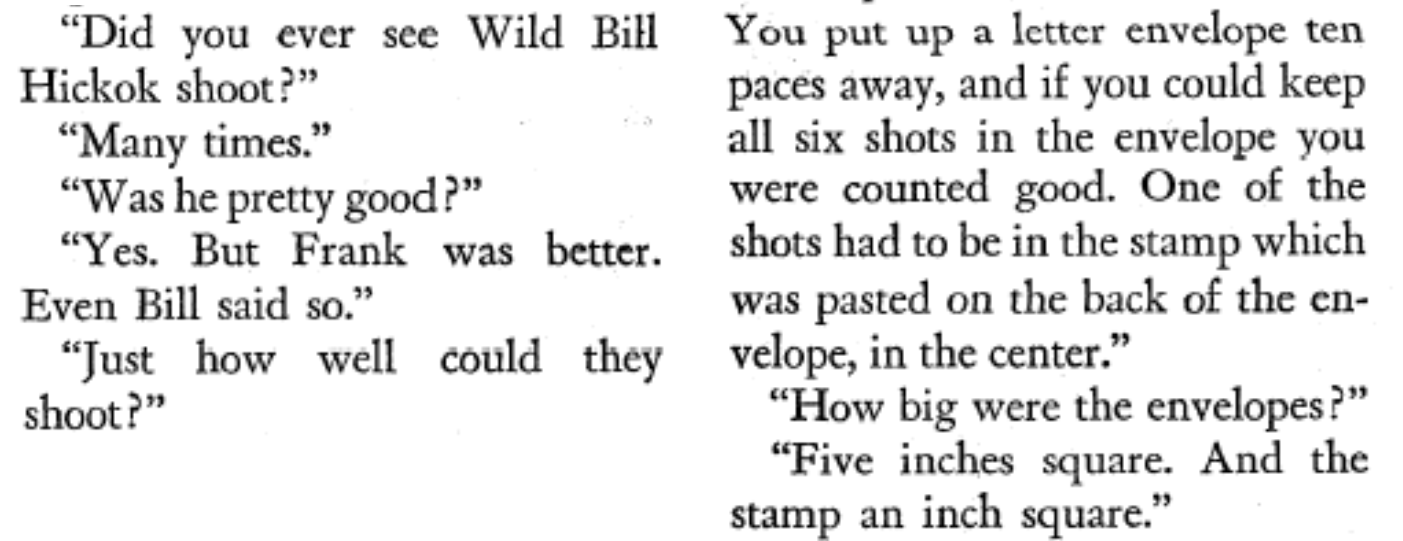
Frank was Luther’s brother Major Frank North, https://en.wikipedia.org/wiki/Frank_North another contemporary of Wild Bill’s. So the gunfighters’ test was six shots at 10 yards using the Primary Hand Only, untimed. To be considered ‘good,’ the gunman had to hit all six shots in a 5 inch square target. At least one of the six had to hit an unseen one inch square dead center of the target. That’s an interesting contrast to the mythology of the Wild West gunfight.
Put on a sheet of paper, it would look like this.

A PDF of the target is attached. This short challenge is easily shot at almost any indoor range. Try it out and see how your marksmanship compares to an Old West gunfighter like Wild Bill.
If you like my work, please join me on Patreon where I post more in-depth articles about shooting, marksmanship, and incident analysis.
Tightening Your Accuracy and Performance Standards
My latest Shooting Illustrated article is up.
https://www.shootingillustrated.com/content/tightening-your-accuracy-and-performance-standards
The New Mexico Competency Demonstration was the final exercise in my Revolver Operator Course. Those who had snubs were encouraged to shoot it with their little guns. Shooters can put variations in it to make it even more relevant for Personal Protection practice. In ROC, I made it simple; five shots with two hands, five shots with the Primary Hand Only, and five shots with the Support Hand Only. For the article, I put a little different spin on it.
Here are the images that weren’t used.


Friday Fundamentals – Terminology
#fridayfundamentals
In reply to the Back to Basics WheelgunWednesday post, a pertinent question came up.
“I was ‘hammering’ instead of firing a ‘controlled pair.’
What do you mean by hammering?”
Great question – thanks for asking. Sometimes we trainers take our subject matter knowledge for granted. Several concepts developed by Jeff Cooper have remained constant despite having been formulated nearly half a century ago.
Fundamental Terminology
- Flash Sight Picture
- Controlled Pair
- Hammer
Flash Sight Picture
The concept of accepting that perfect sight alignment is not necessary to achieve an acceptable hit. Shooters often assume that they need to obtain a perfect sight picture for acceptable hits.

That’s not necessarily the case, depending on the distance to target.
https://thetacticalprofessor.net/2015/02/06/89081/
https://thetacticalprofessor.net/2015/10/02/friday-fundamentals-segment-2/
Controlled Pair
Achieving an acceptable sight picture on a target, firing a shot, bringing the pistol down in recoil, obtaining a second acceptable sight picture, and firing a second shot.
Hammer
Achieving an acceptable sight picture on a target, firing a shot, bringing the pistol down in recoil, and firing a second shot using only a physical index to the target without regard to achieving a second sight picture.
Note that the term ‘double tap’ is obsolete because it could refer to either a controlled pair or a hammer and so is inadequate as a description. Others have written in-depth articles about Cooper’s concepts so I will just link to them.
Flash Sight Picture
Chris Baker
Jim Wilson
https://www.americanrifleman.org/content/sheriff-s-tips-understanding-the-flash-sight-picture
Hammer v. Controlled Pair
Jim Wilson
https://www.americanrifleman.org/content/whatever-happened-to-the-double-tap
Darryl Bolke via Greg Ellifritz
Chgowiz wins a free book of mine for asking a great question.
Back to Basics WheelgunWednesday
#wheelgunwednesday
Going back to basics occasionally helps me get back in the groove. Two basic exercises I like for the snub revolver are the LAPD Retired Officer Qualification Course and the NRA Basics of Pistol Shooting Level 1 test.
The LAPD course is described in the LAPD Manual.
“The starting position for this qualifying course of fire will begin at the 7 Yard Line. When the target faces, the shooter will draw and fire 10 rounds at a single silhouette target. A score of 70 percent is required to pass the qualification. All rounds impacting anywhere on the body and head will receive full value and rounds impacting upon the arms are half value.”
Basics of Pistol Shooting Level 1 test consists of shooting five shots into a circle that is four inches in diameter at a distance of 10 feet. All five shots must hit or cut the circle. It must be done four time, not necessarily consecutively, to pass BOPS.

For both tests, I include opening and spinning the cylinder periodically to create ball and dummy practice. In the LAPD Course, I also include a few initial dry practice draws, a la the NY State CCL Qualification, staggered loading with loose rounds during the first five shots, presenting from Low Ready, firing different numbers of rounds, and a reload with a loading device for the second five.
During my initial run of LAPD (I did four), I noticed that a couple of my shots went high. Upon repeating it, I realized that I was ‘hammering’ instead of firing a ‘controlled pair.’ That was probably the reason I had a couple of high hits during the Rangemaster Pistol Match https://thetacticalprofessor.net/2024/04/10/tactical-conference-2024-pistol-match/.
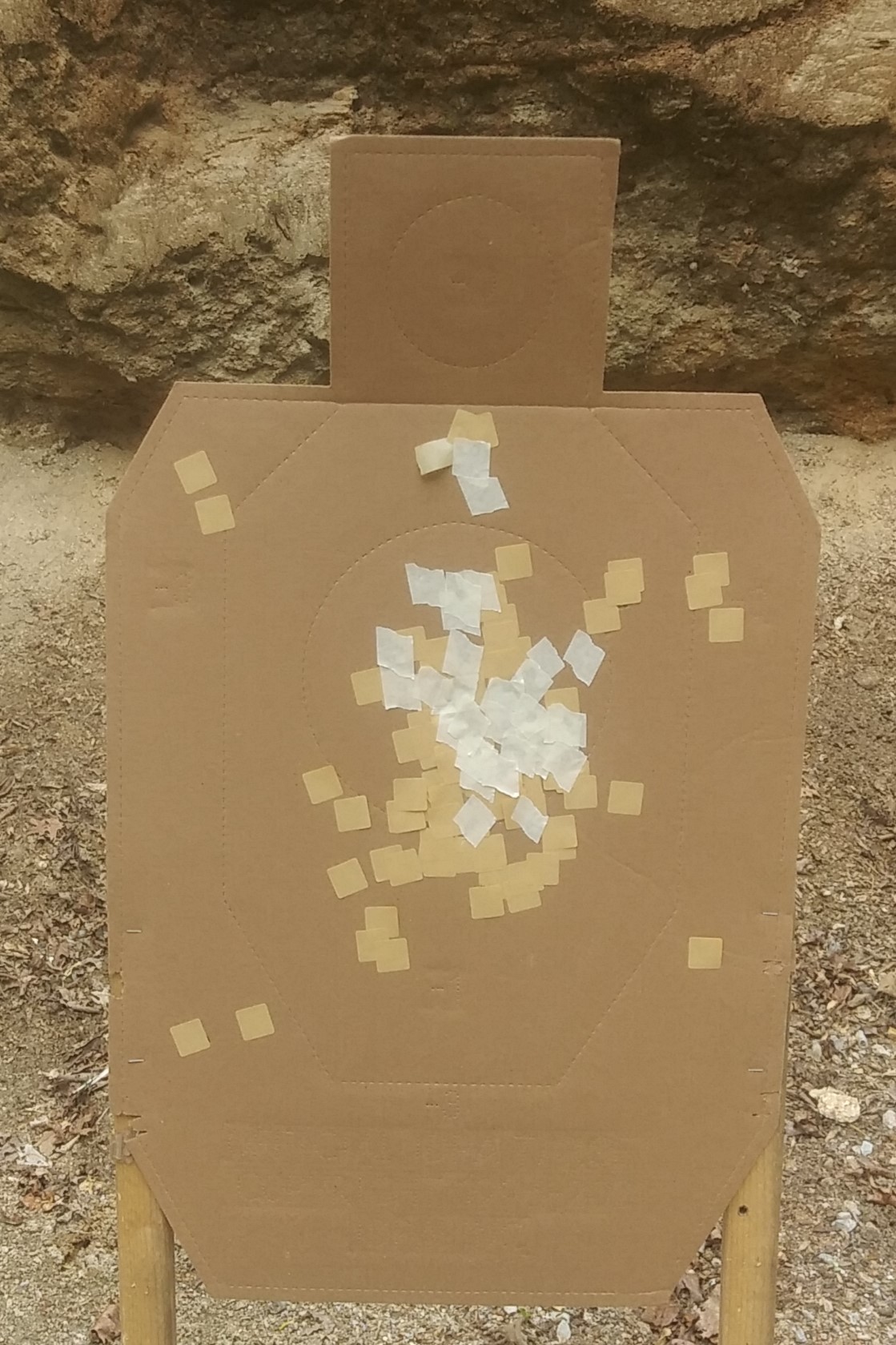
I used a target that I found on the range. The hits covered with masking tape are mine. The ones with pasters are from the previous and unknown shooter. The two hits just below the neck line were the ones probably the result of hammering.
Since BOPS has four strings, I used the opportunity to tune up with several different loading devices. One was an HKS speedloader and the others were various tools from Zeta6 that I like. All the Zeta6 devices are modified with Retention Rings. I find the Retention Ring is a handy addition for getting the device out of my pocket.

It was a nice little tuneup. The day was nice and the results were satisfying.
Tactical Conference 2024 – Loot and Looted
At every Conference, Seminar, or industry gathering, the attendees always return with items given away by Presenters and other attendees. TacCon 2024 was no exception; I call this ‘Loot’ and I returned with some good items.
Loot
Books
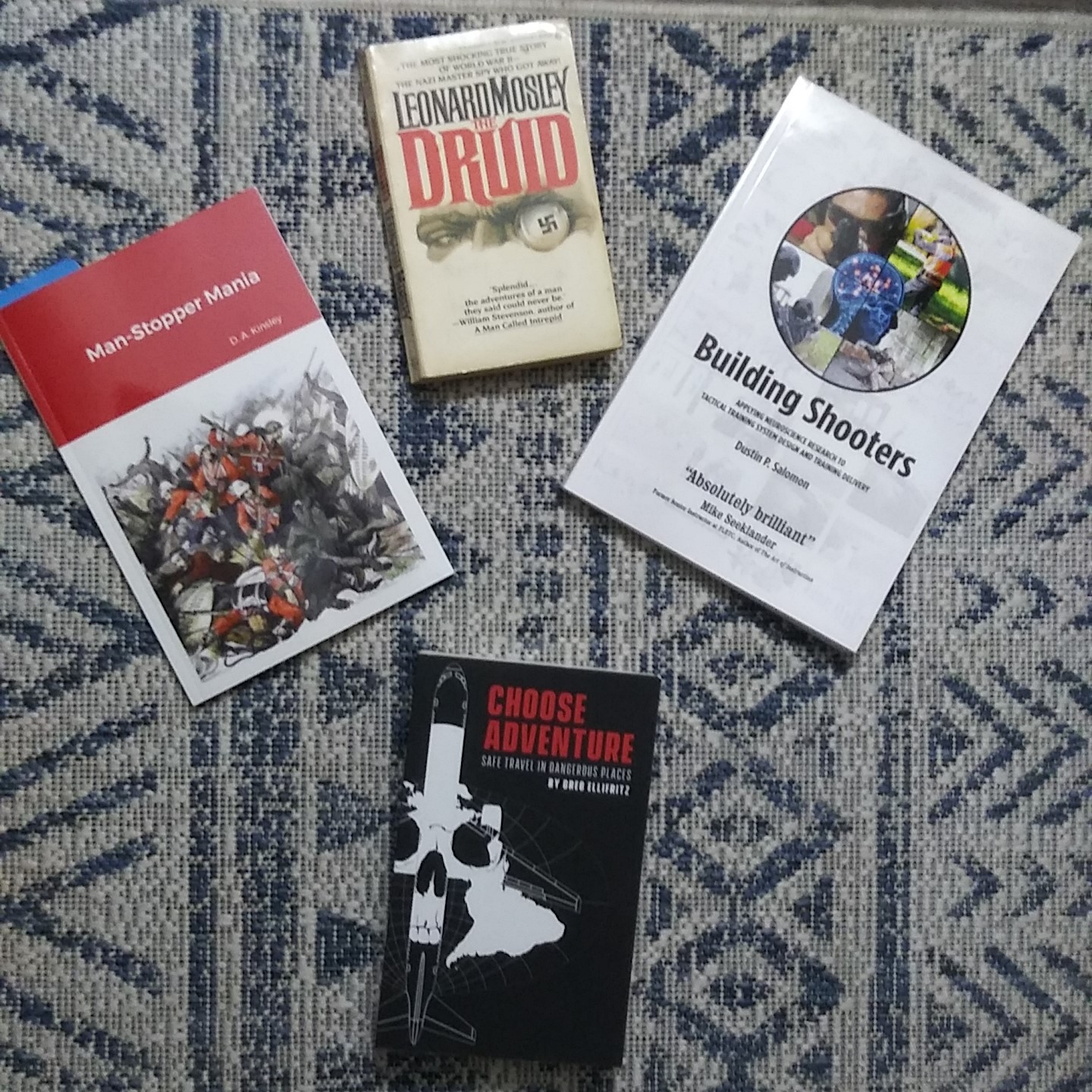
Good reading material courtesy of Chuck Haggard, my hostess for the weekend, Andy Stanford, and Greg Ellifritz.
Targets and Drills
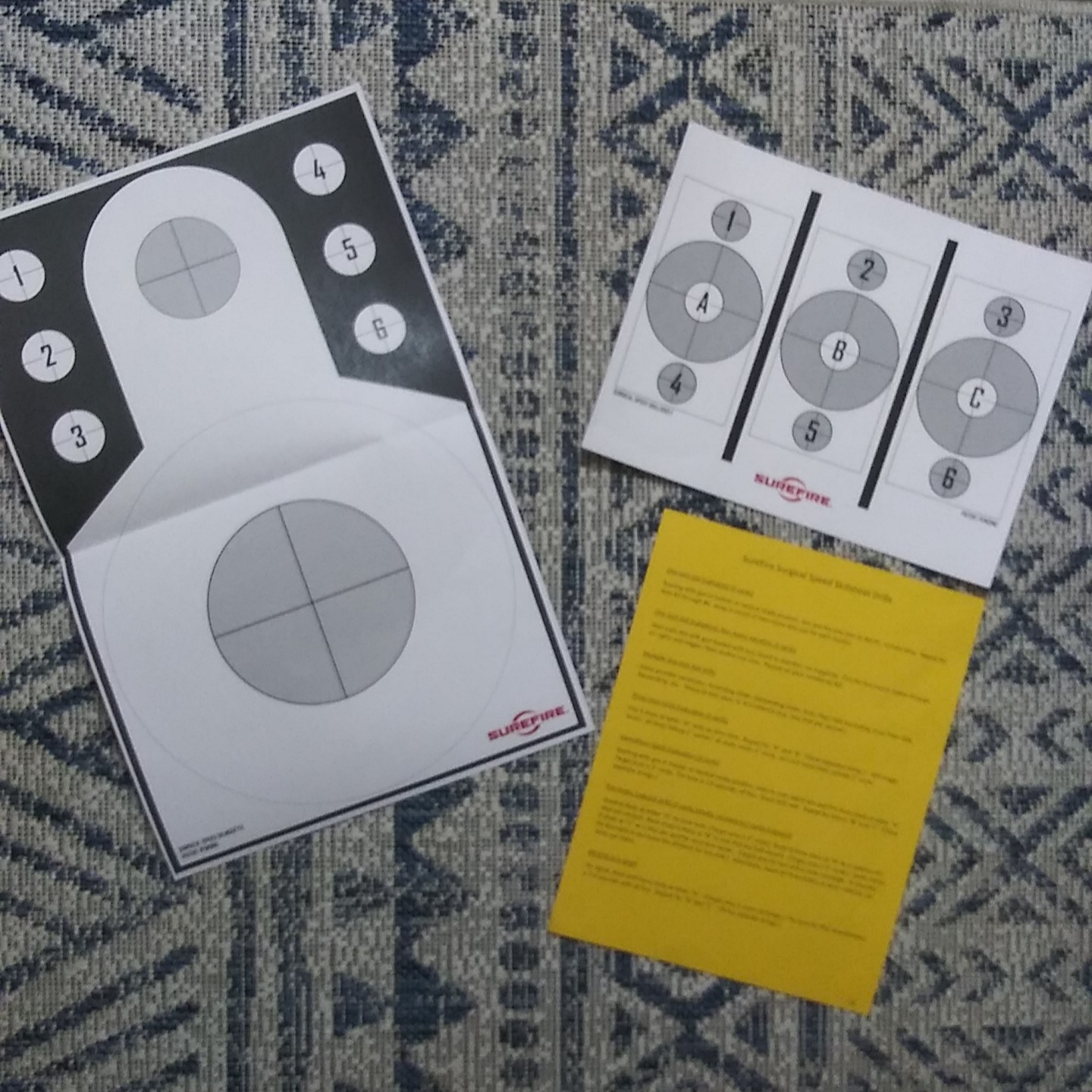
At the end of Andy Stanford’s Practical Handgun Drills class, he gave us laminated copies of the Surefire targets and a double sided sheet of drills for using them.
Cool Stuff

Yet another doubloon from Andy Stanford was a Surefire Stiletto flashlight, given to all the trainers at the event. Retention Ring gave me a nice laminated card as an aid for adjusting pistol and rifle optics. A friend in the Air Marshal Service presented me with a cool pin and Chuck gave me a unique and apparently one off revolver inert gun.
Looted
Notice that there is no picture of the package of Narcan gifted to me by Greg Ellifritz. That’s because it was ‘liberated’ from my suitcase while in the custody of Frontier Airlines on the trip home. Whether a sticky fingered baggage handler got it or it was ‘seized’ without notice or an inspection tag by the TSA is unknown to me. Sunny Hostin might think the Total Eclipse disintegrated it while in the aircraft’s hold. When I opened the suitcase, I thought things were arranged a little differently. A bit later I realized that the Narcan had taken a walk.
That’s the last time I’ll ever fail to secure my suitcase with a TSA lock and a zip tie. I didn’t feel it was necessary this time because I didn’t have a pistol in my suitcase but it’s a lesson learned.
Many thanks to my friends for their generosity. Whether presenting or attending, there’s always interesting stuff given out at conferences. I’m looking forward to duplicating the Surefire targets and shooting Andy’s drills for them.
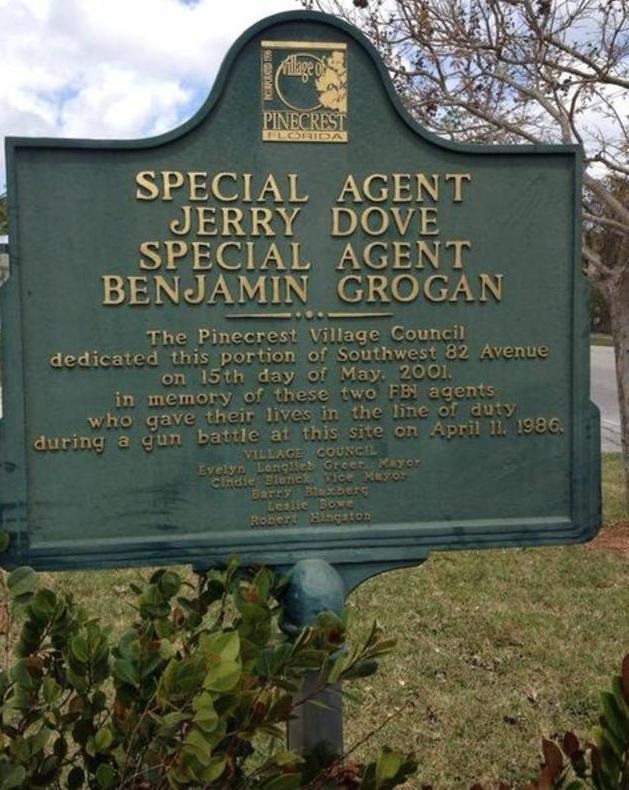
In Memoriam to all the heroes of the Miami Massacre, April 11, 1986. https://en.wikipedia.org/wiki/1986_FBI_Miami_shootout
Tactical Conference 2024 Pistol Match
#wheelgunwednesday
I shot the match with my Taurus 856 snub.

Here’s a video short of the Pistol Match https://youtube.com/shorts/uFh9EogmeAY?feature=share
Course of fire
All strings were shot at turning targets in 4 seconds.
3 yards
- 6 shots from concealed holster (6/6)
5 yards
- 5 shots from concealed holster (5/11)
- 5 shots from concealed holster (5/16)
- 4 shots Primary Hand Only from Low Ready (4/20)
- 3 shots Support Hand Only from Low Ready (3/23)
7 yards
- 4 shots from concealed holster (4/27)
- 4 shots from concealed holster(4/31)
10 yards
- 2 shots from concealed holster (2/33)
- 2 shots from concealed holster (2/35)
5 yards
- 5 timed {3.53} face shots from Low Ready (5/40) These shot were scored with Comstock scoring.
This was my final target score. I pulled a few out of the circle but none below the belt or off the silhouette.

McGee’s Paradigm

“Three shots in three seconds at three yards.” That was Lt. Frank McGee’s iconic summation (McGee’s Paradigm) of the typical gunfight of New York City police officers in the 1970s. Lt. McGee was the head of the NYPD Firearms and Tactics Section at that time. His analysis came from the Department’s SOP-9 report, which began compiling statistics about the gunfights of its officers in 1969. Although the scope and name of the report has evolved over time, it is still published by the NYPD and available online. McGee’s Paradigm hasn’t changed much over the past 50 years.
Since most gunowners are limited to shooting at indoor ranges, learning to shoot against a time standard has always been an issue. Shot timers usually work by tracking the noise from each shot and are therefore not always useful in the indoor-range environment because of adjacent shooters. Besides this, casual shooters are generally unwilling to spend over $100 for a shot timer.
The widespread nature of smartphones and Bluetooth earbuds have given us a solution to this problem. There are several timing apps for Smartphones available online. Used in conjunction with Bluetooth earbuds underneath earmuff-based hearing protection, practicing marksmanship with a par time is now easily accomplished.
https://www.shootingillustrated.com/content/three-shots-in-three-seconds
A demonstration video is available at https://youtu.be/8kL0bUQWsfI
Here’s a target for the final 20 rounds of the 50 round session.
SixFerShur
I will be conducting the 2024 Revolver Operator Course this May in North Georgia.
May 4, Dahlonega, Georgia – Home Range of The Complete Combatant
One Day – $199 plus $20 Range fee
Important: Although a few exercises will be shot with small (J Frame ish) revolvers, this is NOT a J Frame course. You will need a full size (K frame or equivalent) revolver to attend. Shooting 300 rounds in a day through an Airweight J Frame only teaches one thing; how to flinch.
https://www.shootingclasses.com/thecompletecombatant/course/?courseId=4493
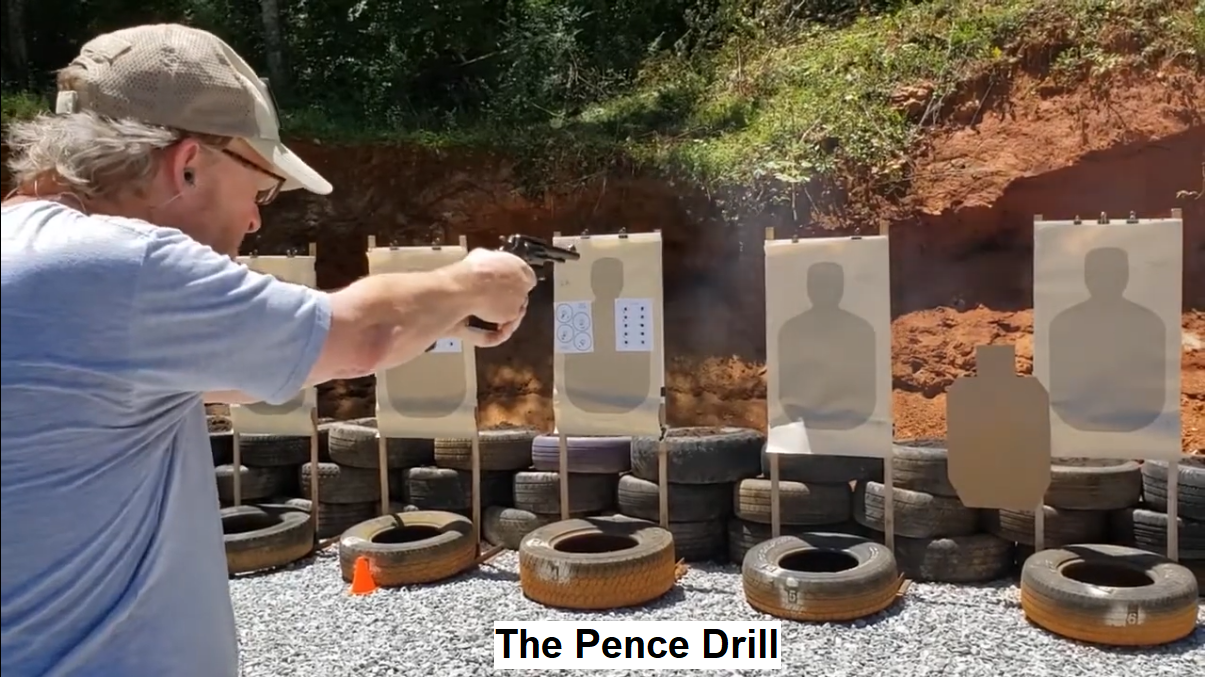
The Pence Drill is one of the two keystone drills of the Revolver Operator Course.
Fair attribution: I liberated the SixFerShur title from Tamara Keel’s blog post because it’s hilarious.
https://booksbikesboomsticks.blogspot.com/2024/03/narrow-focus-cartridge.html
That’s probably what I’ll call the class from now on because “Revolver Operator Course” sounds so mundane by comparison.
 tacticalprofessor
You must be logged in to post a comment.