Children are creative
The statement was that the child put a speaker next to (the shelf) to crawl up and get (the gun)
Crawford County Prosecutor Matt Crall
Grandmother charged after her 4-year-old Galion grandson shoots himself dead with her unsecured pistol.
The woman had left a loaded.22 caliber, semi-automatic pistol on top of a shelf.
Leaving loaded and unsecured guns lying around, even on a top shelf, is irresponsible. I’ve known a number of people who think that’s an acceptable practice but it’s actually idiotic. When children live in the household, as the boy did in this case, it’s even worse, if that’s possible.
I’ve been encouraged to write a Second Edition of Serious Mistakes Gunowners Make. Sadly, I’ve acquired a lot of new material, although all of it follows the same pattern.
OTOH, this murderer should simply be thrown into an active volcano forthwith.
According to police, the shooter fired bullets at a residence from a nearby alleyway, and one of those bullets struck Trinity, who was jumping [on a trampoline] with friends.
Minn. Girl, 9, Is Fatally Shot While Jumping on Trampoline with Her Friends
https://people.com/crime/minnestota-girl-fatally-shot-jumping-trampoline/
Breaking Contact (Part 5)
#mindsetmonday
Our goal in personal protection is to force a break in contact. We want them to go away, or we want to go away. One or the other.
The final segment of the CCW Safe Series about my concept of Breaking Contact is posted.
https://ccwsafe.com/blog/breaking-contact-pt-5
This edition focuses on success stories. I like those.
[W]hen a concealed carrier enters a self-defense situation with the goal of breaking contact — as opposed to a goal of killing or disabling an attacker — the defender has a substantially higher likelihood of avoiding a deadly shooting or making a successful self-defense claim when all else fails.
Shawn Vincent
Leg shots
Initial investigation revealed several individuals were in the home watching tv and playing games through the night. A 37-year-old Ridgely, Maryland man became enraged and began attacking the other occupants with a knife. At some point during the altercation, one of the stabbing victims retrieved a shotgun and shot the male subject in the leg.
The 37-year-old Ridgely man was transported by EMS to Bayhealth Kent General where he was pronounced dead.
https://abcnews.go.com/US/man-stabbing-spree-home-shot-killed-victims/story?id=77936754
So much for the idea that shooting someone in the leg isn’t the application of deadly force. The Village Idiot JRB has no clue but that’s no surprise.
The Delaware State POlice initial report for the incident.
https://dsp.delaware.gov/2021/05/26/update-homicide-investigation-police-activity-hartly/
Cover is your friend
The teen ducked behind a tree. The prosecutor’s report said one of the rounds fired by the deputy was recovered later from that tree, and several other rounds were recovered from other trees between the teen and the deputy.
A deputy and a trooper mistakenly fired 8 rounds at an innocent boy.
Be aware of not only who is around you but what is around you, including things that can prevent you from getting ventilated.
Trooper 1 stated to investigators that at the time he exited his patrol vehicle he believed the gunshots he was hearing (Deputy 1’s gunshots) were actually that of LEATHERMAN towards himself. He stated he fired in self-defense at LEATHERMAN believing he was being shot at.
My Battalion Commander made the comment during Civil Disturbance training that the POlice are, at most, used to operating in pairs. Pairs generally only exist in large urban areas. When an ad hoc group of POlice come together, such as in this case, it’s very easy for things to go South quickly. The LAPD has very strict requirements for a supervisor to assume command as Incident Commander when groups of officers assemble. In cases such as this no such control mechanism is possible and things can easily get out of hand, as they did. My advice is that if you see a group of POlice from different agencies gathering, leave the area immediately.
Note also that Officer 1 was downrange of Deputy 1 and Trooper 1 while they were firing at the innocent bystander. Struggling with Subject 1 on the ground to take him into custody might have saved that Officer’s life.
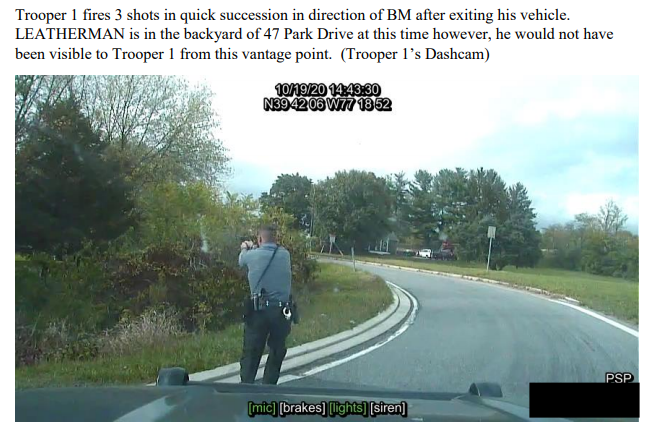
The full 27 page report from the State’s Attorney about the incident is available to download from the news article.
Another of my rules is that if I were to hear shots fired, I am going the other way as quickly as I can. Nothing good comes from ‘running to the sound of guns’ as a Private Citizen. Something something, curiosity killed the cat, something something.
Being Mindful Of and Avoiding Danger
#mindsetmonday
Dr. Sherman House, the Real Dr. House™, https://civiliandefender.com/ was an armored truck guard for quite a while. He turned me on to the fact that such robberies often begin with unannounced gunfire by the robbers. When I see an armored truck at a grocery store or other place, I wait in my car until after it leaves.
Armored truck guard shot in the face during robbery attempt at NE Houston bank, HPD says
Tactical Professor books (all PDF)
Real Shootouts of the LAPD https://realshootoutsofthelapd.com/
Serious Mistakes Gunowners Make http://seriousgunownermistakes.com
Indoor Range Practice Sessions http://indoorrangepracticesessions.com
Concealed Carry Skills and Drills http://concealedcarryskillsanddrills.com
Shooting Your Black Rifle http://shootingyourblackrifle.com
Advanced Pistol Practice http://bit.ly/advancedpistolpractice
Package deal of Serious Mistakes, Indoor Sessions, Concealed Carry, and Shooting Your Black Rifle (20% off) https://store.payloadz.com/details/2644448-ebooks-sports-shooting-drills-package.html
Dry Practice Essentials – Part 1

‘Dryfire is boring AF’ is a common complaint in the firearms community. Paradoxically, Abraham Lincoln addressed that issue with his comment. Preparation is the way to make dry practice more interesting and productive. Doing some preparation for your dry practice session is the essential first step. As the late William Aprill was fond of saying:
Spontaneity is overrated.
To keep it from being boring, make your sessions into a creative endeavor. Have a plan for the session, include something other than pure dry practice, e.g., make a target, and use some outside stimuli to add to the experience. Having a specific target that you use only for dry practice and then conceal or take down also contributes to improving the safety aspect of your sessions. Dry practicing on light switches, TVs, the dog, etc. is dangerous and can lead to a Negative Outcome.
Your plan might consist of nothing more than practicing your State’s (or any State’s) Carry License qualification course. As an example, here’s what the Louisiana Qualification Course looks like.
The session itself, without the explanations in the video, takes about five minutes. Although this session looks simplistic, there are 10 different skills practiced. They’re explained in the post What does effective Dry Practice actually look like?
It also helps to keep in mind Tom Givens‘ comment about the recency of your practice; whether dry or live:
How much you last practiced isn’t as important as when you last practiced.
Tactical Professor books (all PDF)
Real Shootouts of the LAPD https://realshootoutsofthelapd.com/
Serious Mistakes Gunowners Make http://seriousgunownermistakes.com
Indoor Range Practice Sessions http://indoorrangepracticesessions.com
Concealed Carry Skills and Drills http://concealedcarryskillsanddrills.com
Shooting Your Black Rifle http://shootingyourblackrifle.com
Advanced Pistol Practice http://bit.ly/advancedpistolpractice
Package deal of Serious Mistakes, Indoor Sessions, Concealed Carry, and Shooting Your Black Rifle (20% off) https://store.payloadz.com/details/2644448-ebooks-sports-shooting-drills-package.html
Breaking Contact (Part 4)
Breaking Contact Part 4 is up.
https://ccwsafe.com/blog/breaking-contact-pt-4
Marissa Alexander, Alexander Weiss, and Jerome Ersland are the cases discussed in the post.
The lesson for concealed carriers is that if you manage to break contact with a perceived aggressor, do not re-engage.
Training during uncertain times
My friend David Yamane has an interesting blog post about training last year.
https://gunculture2point0.wordpress.com/2021/05/14/shooting-lessons-during-and-from-covid-times/
The NRA Pistol Marksmanship Simulator Training is a really good course. I’ve taught it several times as private lessons and found the results to be very worthwhile. I’m glad David and Sandy got something out of it.
Breaking Contact (Part 3)
#fridayfundamentals
The CCW Safe https://ccwsafe.com/ series about my concept of Breaking Contact continues with Part 3.
https://ccwsafe.com/blog/34532
Part 2 of the series focused on situations where the concealed carrier initiated contact. Part 3 focuses on incidents where the carrier was initially approached and failed to take the opportunity to Break Contact.
I hate platitudes when they’re used in an attempt to simplify a complex topic into a sound bite. “Better to be tried by twelve than carried by six” is one of the most commonly parroted sayings in the firearms community. While many times we are presented with the optometrist’s question, “Which is better, A or B?,” decisions that are made in advance and are going to affect the rest of our lives seldom are binary. I like to think we’re smarter than parrots that have been trained to say one or two things.

As Shawn points out, the decision process has several more options.
When the goal is not necessarily to kill or disable a would-be attacker, a defender is open to other options that carry less legal risk and may produce more positive outcomes.
When breaking contact is the goal, sometimes it is better to disengage rather than attempt to de-escalate.
My personal paradigm is:
- Avoid
- Escape
- Confront
- Resist
Any attempt at de-escalation, even when benign, is a part of Confront. Disengage is part of Escape. Escaping is higher on my priority list than Confronting.
Similarly, in the Gerald Strebendt incident, he unnecessarily moved up the paradigm from Escape to Confront. A confrontation inherently carries more risk associated with it than an escape. As John Hall, former head of the FBI Firearms Training Unit put it:
Any encounter carries with it an element of chance.
My initial post about Breaking Contact (Part I) is located here:
The second is here.
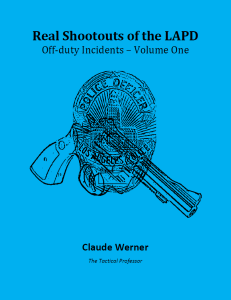
If you would like to purchase my book, click on the image below. The detailed investigations and reports of incidents involving off-duty LAPD officers are very instructional for understanding the differences between Avoiding, Escaping, and Confronting.
Downrange Incident in Rock Hill
This story is about what I call a “downrange incident,” meaning that innocent parties are downrange and in close proximity to the criminal when the shot needs to be fired.
During the initial investigation process, officials learned the 19-year-old allegedly initiated a verbal altercation with others in the apartment. Authorities said the altercation then escalated when the 19-year-old began assaulting those in the apartment and threatened to kill them. The 19-year-old strangled a male who[m] he assaulted, officials said, and was then shot by another person in the apartment in an attempt to stop the attack. Officers said the 19-year-old then turned and started strangling a female in the apartment. He was then shot a second time, then collapsed.
These types of situations happen more often than is commonly thought. Having it happen twice in one incident, such as this one, is rare however. Making a clean close range precision shot should be part of our practice regimen.
From my old YouTube Channel that I can’t access anymore.
 tacticalprofessor
You must be logged in to post a comment.