FREE gun books
Many basic aspects of rifle marksmanship are a completely mystery to new gun owners and often long time owners. While not all the information in FM 3.22-9 is applicable to civilians, there’s a lot that’s worthwhile. If nothing else, read the sections about Trajectory (exterior ballistics) and Zeroing Procedures. People who have only worked with handguns and not rifles probably don’t have any notion of how important those things are when shooting a rifle. The truth is that many soldiers and veterans don’t understand them either.
There are a bewildering array of handguns and techniques out there. A decent reference is:
Since these are FREE, at least for now, there’s no excuse for not upping your knowledge about your weapon and how to use it.
You might even be interested in putting your new found knowledge to use by shooting the drills in my books. They’re written specifically to take you from the theoretical to the practical.
Tactical Professor books (all PDF) – Not FREE
- Serious Mistakes Gunowners Make http://seriousgunownermistakes.com
- Indoor Range Practice Sessions http://indoorrangepracticesessions.com
- Concealed Carry Skills and Drills http://concealedcarryskillsanddrills.com
- Advanced Pistol Practice http://bit.ly/advancedpistolpractice
- Shooting Your Black Rifle http://shootingyourblackrifle.com
- Package deal of Serious Mistakes, Indoor Sessions, Concealed Carry, and Shooting Your Black Rifle (20% off) https://store.payloadz.com/details/2644448-ebooks-sports-shooting-drills-package.html
Responsibly Armed Radio Podcast
We had a great inaugural episode of Responsibly Armed Radio. Lou Ann Hamblin and I were the guests. Tatiana Whitlock and Judi Wells were the hosts with Special Guest Appearance by Dave Stall.
Our topics were definitions of Use of Force, Critical Decision-Making, Reasonableness, and Next Steps for those new to our Art.
Here is the link to the show: https://responsiblyarmedradio.libsyn.com/responsibly-armed-radio-season-1-episode-1
I wasn’t nearly as serious as the picture looks. 🙂
Tactical Professor books (all PDF)
- Serious Mistakes Gunowners Make http://seriousgunownermistakes.com
- Indoor Range Practice Sessions http://indoorrangepracticesessions.com
- Concealed Carry Skills and Drills http://concealedcarryskillsanddrills.com
- Advanced Pistol Practice http://bit.ly/advancedpistolpractice
- Shooting Your Black Rifle http://shootingyourblackrifle.com
- Package deal of Serious Mistakes, Indoor Sessions, Concealed Carry, and Shooting Your Black Rifle (20% off) https://store.payloadz.com/details/2644448-ebooks-sports-shooting-drills-package.html
Crawl, Walk, Run
A discussion came up on a Firearms Instructor group that decried the fact that many indoor ranges only allow NRA training https://firearmtraining.nra.org/ and don’t teach ‘Concealed Carry’ classes. Let’s bear in mind that 999 out of 1,000 gunowners only have access to an indoor range. That’s a calculated number, not a SWAG.
More people don’t carry than do. According to John Lott, the current figure for those having some kind of weapons carry license is 18.66 million people. https://papers.ssrn.com/sol3/papers.cfm?abstract_id=3463357 The Gallup Poll indicates the 43% of US households have a gun. https://news.gallup.com/poll/264932/percentage-americans-own-guns.aspx That would be 51.4 million people, which is probably underreported as compared to licenses. My personal experience is that the demographic with the economic means to afford training is most likely to NOT have a carry license.
When we teach people, either formally or informally, we do ourselves and the gun owning public in general a disservice when we place so much emphasis on the techniques for carrying a gun. It’s unfortunate that the NRA’s philosophy of Personal Protection training is buried in the Instructor manual for the Personal Protection Outside The Home course.
A synopsis of the NRA concept as excerpted from that manual is as follows:
The NRA Basic Personal Protection Series is based on the building-block approach, moving from the simple to the complex.
The first course in this series is the NRA Basics of Pistol Shooting Course, which develops in your students the basic skills of handling, shooting, and cleaning the firearm, as well as a thorough grounding in firearm safety.
The second course in this series is the NRA Basics of Personal Protection In The Home Course, (which builds on the skills already learned in the NRA Basics of Pistol Shooting Course). In this second course, participants learn to use a defensive or flash sight picture, …
The third course in the series is the NRA Basics of Personal Protection Outside The Home (which builds on the knowledge, skills, and attitudes learned in the NRA Basics of Personal Protection In The Home Course).
A very intelligent female friend explained to me her personal journey to carrying a gun. It involved five phases over the course of three years for her to consistently carry a gun and feel comfortable with it. That’s far more common than most people who teach, either as formal instructors or just friends giving guidance, seem to realize.
The NRA philosophy has a great deal of logic behind its structure. It pains me when our training community ignores it. We spend a fair amount of time talking about the ‘Crawl, Walk, Run’ approach to training but what we actually teach is ‘Run and then Run some more,’ period. Maybe it would be a good idea if we tried to guide people through a process one step at a time instead of ‘feeding them with a firehose.’ There’s a reason I wrote Indoor Range Practice Sessions before I wrote Concealed Carry Skills and Drills.

Tactical Professor books (all PDF)
- Serious Mistakes Gunowners Make http://seriousgunownermistakes.com
- Indoor Range Practice Sessions http://indoorrangepracticesessions.com
- Concealed Carry Skills and Drills http://concealedcarryskillsanddrills.com
- Advanced Pistol Practice http://bit.ly/advancedpistolpractice
- Shooting Your Black Rifle http://shootingyourblackrifle.com
- Package deal of Serious Mistakes, Indoor Sessions, Concealed Carry, and Shooting Your Black Rifle (20% off) https://store.payloadz.com/details/2644448-ebooks-sports-shooting-drills-package.html
Conducting a Defense – Terrain Analysis for the Homeowner
The AR-15 rifle has become popular as a tool for Home Defense. However, there hasn’t been much discussion about how to use rifles to deal with deadly threats outside and yet threatening one’s home. The escalation of Civil Disorder has heightened our awareness of a broader range of necessary home defense. Conceptually, this might be considered FORWARD Home Defense.
One of the first aspects of preparing for such a Forward Defense is to conduct a terrain analysis of the area outside the home. This analysis should consider both the Area of Influence (where a homeowner could actually disrupt an attack) and the Area of Interest (where a homeowner could detect an attacker’s intent outside of the Area of Influence.) We can use the Terrain component of METT-TC as a structure for our terrain analysis. The 1992 edition of Field Manual 7-8 INFANTRY RIFLE PLATOON AND SQUAD https://www13.shu.edu/offices/rotc/upload/FM-7-8.pdf describes the analysis as follows:
(3) Terrain. The leader considers the effect of terrain and weather on enemy and friendly forces using the guidelines below (OCOKA):
(a) Observation and fields of fire. The leader considers ground that allows him observation of the enemy throughout his area of operation. He considers fields of fire in terms of the characteristics of the weapons available to him; for example, maximum effective range, the requirement for grazing fire, and the arming range and time of flight for antiarmor weapons.
(b) Cover and concealment. The leader looks for terrain that will protect him from direct and indirect fires (cover) and from aerial and ground observation (concealment). (Author’s note: Cover and Concealment also applies to what the Enemy might use.)
(c) Obstacles. In the attack, the leader considers the effect of restrictive terrain on his ability to maneuver. In the defense, he considers how he will tie in his obstacles to the terrain to disrupt, turn, fix, or block an enemy force and protect his own forces from enemy assault.
(d) Key terrain. Key terrain is any locality or area whose seizure or retention affords a marked advantage to either combatant. The leader considers key terrain in his selection of objectives, support positions, and routes in the offense, and on the positioning of his unit in the defense.
(e) Avenues of approach. An avenue of approach is an air or ground route of an attacking force of a given size leading to its objective or key terrain in its path. In the offense, the leader identifies the avenue of approach that affords him the greatest protection and places him at the enemy’s most vulnerable spot. In the defense, the leader positions his key weapons along the avenue of approach most likely to be used by the enemy.
(f) Weather. In considering the effects of weather, the leader is most interested in visibility and trafficability.
Some aspects of the terrain analysis may surprise you. For instance, Google Maps can be used to measure distances around your home. You might find that the distance from your front porch to the furthest Avenue of Approach and Point of Likely Cover is 236 feet (79 yards).
Doing a terrain analysis gives you an idea of the area you need to defend and also what tools you might use to defend the approaches to your home.
There will be further explanation on my Patreon page https://www.patreon.com/TacticalProfessor but this is worthwhile food for thought to start.
Tactical Professor books (all PDF)
- Serious Mistakes Gunowners Make http://seriousgunownermistakes.com
- Indoor Range Practice Sessions http://indoorrangepracticesessions.com
- Concealed Carry Skills and Drills http://concealedcarryskillsanddrills.com
- Advanced Pistol Practice http://bit.ly/advancedpistolpractice
- Shooting Your Black Rifle http://shootingyourblackrifle.com
- Package deal of Serious Mistakes, Indoor Sessions, Concealed Carry, and Shoot Yor Rifle (20% off) https://store.payloadz.com/details/2644448-ebooks-sports-shooting-drills-package.html
Things you should know about body armor
I have body armor and am a firm believer in keeping it close. Since I’m not an expert, here’s better information than I could provide.
https://www.activeresponsetraining.net/seven-things-you-dont-know-about-body-armor
You won’t be able to fire that ammo or eat all that stored food if you get shot and die because you didn’t have body armor.
The package deal for my books is still going. The package is available as an immediate download of all four ebooks at this link:
https://store.payloadz.com/details/2644448-ebooks-sports-shooting-drills-package.html
Get some structured practice in
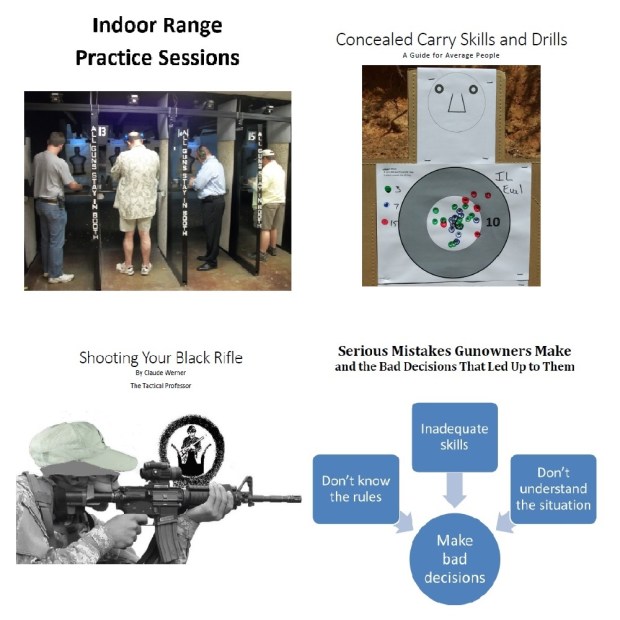
Things are starting to open back up, so we can get back to the range. To help you use your time and other resources productively when you go to shoot, here’s a package deal of my three most popular shooting workbooks:
- Indoor Range Practice Sessions
- Concealed Carry Skills and Drills
- Shooting Your Black Rifle
Ordinarily, these three together would sell for $23.97 but as a package, they are 20% off at only $18.99.
As an added Bonus, the ebook Serious Mistakes Gunowners Make is included at no extra charge. It’s a free gift with a value of $7.99.
The package is available as an immediate download of all four ebooks at this link:
https://store.payloadz.com/details/2644448-ebooks-sports-shooting-drills-package.html
At one time, shooting was the American pastime, let’s get back to it.
Why we test our equipment
As part of my Purse Carry Project (PCP), I picked up a small purse a neighbor was giving away.

The purse had a canister of OC in it.

When I tried the canister at the range, this is what happened.
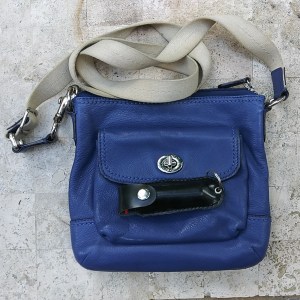
There are numerous other problems that were associated with the setup but being non-functional was the primary one. My colleague Brian Hill of The Complete Combatant http://www.thecompletecombatant.com/ remarked:
Think of what would have happened if that can was the only method for Personal Protection the woman had and it failed when she needed it.
That’s the same reason we test our guns. The majority of guns purchased for Personal Protection in the past few months will never be fired at all. The purchaser really has no idea what will happen. Just shooting one or two exercises from Indoor Range Practice Sessions http://indoorrangepracticesessions.com would go a long way.
Law Officers Killed FBI Report (2019)
As reported on The Tactical Wire https://www.thetacticalwire.com/releases/78c296b0-c471-40f8-a6d0-0627f774292f today, the FBI has released the 2019 Law Enforcement Officers Killed in 2019 report. This is a section of the annual Law Enforcement Officers Killed and Assaulted Report. https://ucr.fbi.gov/leoka/2019 The Assaulted section is due to be released in the fall of this year.
The report is filled with statistical data about how Law Officers are killed in the Line of Duty, both intentionally (Feloniously) and accidentally. However, the most valuable part of the report is what is called Summaries: Officers Feloniously Killed. https://ucr.fbi.gov/leoka/2019/resource-pages/summaries-officers-feloniously-killed The statistical data, while slightly interesting, provides no information about the circumstances that led to the murder of the officers. Reading about the circumstances is what provides insight into how we might avoid a similar Negative Outcome. The off-duty incidents should be particularly of interest to Private Citizens, especially those who believe that Intervention in the affairs of others is an appropriate action.
Tactical Professor books (all PDF)
- Serious Mistakes Gunowners Make http://seriousgunownermistakes.com
- Indoor Range Practice Sessions http://indoorrangepracticesessions.com
- Concealed Carry Skills and Drills http://concealedcarryskillsanddrills.com
- Advanced Pistol Practice http://bit.ly/advancedpistolpractice
- Shooting Your Black Rifle http://shootingyourblackrifle.com
Mr. Happy/Frowny Face Decisional Drill
For this drill you will need paper plates, a silhouette target, a deck of cards, and a table or platform to put the cards on. The object of this drill is to practice thinking with a gun in hand.
Draw faces on two paper plates. One plate with a happy face (no shoot), one with a frowny face (shoot). Different color markers for each plate, one Red and one Black.
Put the two paper plates on a silhouette.

Place the silhouette at 4 yards
Use only the Ace, Two, and Three cards of all suits from a deck of cards and then shuffle those cards.

Place the cards face down on the table in front of you.
Sequence 1
Turn a card over.
If the card is the color on the frowny face, draw or present the pistol and then shoot the frowny face plate with the number of rounds indicated by the number of the card. I.e., if the card is the 3, then shoot 3 shots. The Ace is one shot.
If the card is the color on the happy face, don’t draw or present, i.e., no shooting.
Pistols having a capacity of less than 12 rounds will require reloading. This is a good opportunity to practice reloading skills under a bit of stress. Pistols with capacities more than 12 rounds can start loaded with less than 12 rounds to gain this additional practice opportunity.
After all 12 cards have been turned over, there should be 12 hits on Mr. Frownyface and NO hits on Mr. Happyface.
This drill can also be done at home using a SIRT pistol, a toy pistol, a water pistol, or some other simulation. The marksmanship might not be measured but the decision-making and thinking skills are the primary purpose of the drill.
The drill has several variations but for most people, this is a good start to work on decision-making.
Tactical Professor books (all PDF)
- Serious Mistakes Gunowners Make http://seriousgunownermistakes.com
- Indoor Range Practice Sessions http://indoorrangepracticesessions.com
- Concealed Carry Skills and Drills http://concealedcarryskillsanddrills.com
- Advanced Pistol Practice http://bit.ly/advancedpistolpractice
- Shooting Your Black Rifle http://shootingyourblackrifle.com
 tacticalprofessor
You must be logged in to post a comment.