Situational Awareness and Positioning (part III)
When he got within 5 or 6 feet… Lawler leveled the Glock and fired once, hitting DeCosta in the groin.
Man pulls 13-inch knife during fight, gets shot
A previous post discussed The Tueller Principle, or as Dennis put it originally “How Close Is Too Close?” In light of the above incident, The Tueller Principle and two related concepts bear further clarification and quantification.
A concept that is seldom discussed in the personal protection community, among either instructors or practitioners, is proxemics. The term proxemics was originated by a cultural anthropologist, Edward Hall, in his book The Hidden Dimension. Its meaning is how we, as humans, interpret and manage the physical space around us. This should be an integral part of planning for personal protection, but usually is not.
Professor Hall’s work breaks out several spatial zones that we perceive around us. Most important to us regarding the realm of personal protection is that we make instinctive judgments about whom we allow into these zones and what our reactions are to those who enter, or try to enter, the zones.
- Intimate Space – where we only allow loved ones to be.
- Personal Space – the area in which we are comfortable having people we know and trust.
- Social Space – the zone where we communicate and/or interact with others generally.
- Public Space – an area where we accept that people in general can be, regardless of whether we know them or are interacting with them.
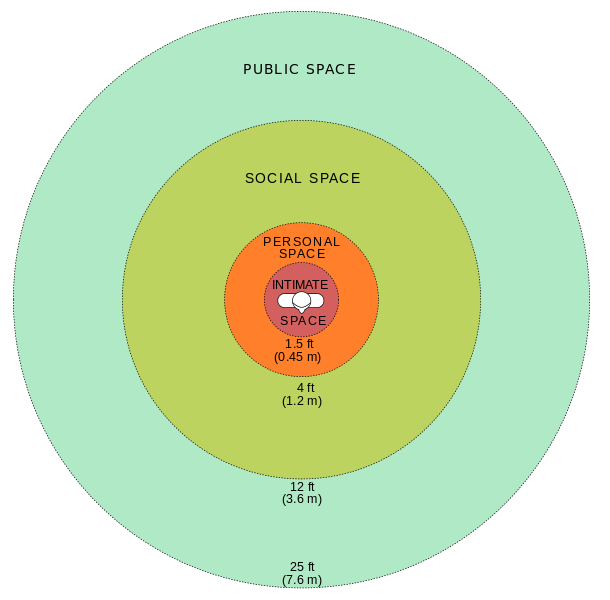
Diagram by WebHamster
It is also important to note that Hall’s work was preceded and partially inspired by the work of a Swiss zoologist, Dr. Heini Hediger. After extensive study of animals in the wild, Dr Hediger, in his book Wild Animals in Captivity, introduced several concepts about predator-prey behavior that are particularly relevant to the personal protection community.
- Flight distance – the distance at which prey will seek to escape the approach of a predator.
- Defense distance – the point at which pursued prey, which is being overtaken by a predator, will have a ‘defense reaction,’ in the words of Dr. Hediger.
- Critical distance – the boundary at which prey that is cornered, or feels it is, will initiate a counter-attack on the predator. I.e., the prey has lost its ability to maneuver or escape (decisively engaged) and then reacts in an emergency mode.
Dr. Hediger states that these distances “are specific, within certain limits, and may be accurately measured, often within inches.” p20 When he says inches, he is referring to very small animals; larger animals will generally be measured at intervals of feet or yards/meters. The larger the animal, the greater each distance will be, generally speaking.
The questions that then arise are: 1) what is the overlap between the works of Tueller, Hall, and Hediger and 2) why is that overlap important? Hall theorized that Hediger’s concepts of flight, defense, and critical distance are no longer applicable to humans. However, I do not believe that is true. Human behavior during a criminal predation tends to follow Dr. Hediger’s concept quite closely.
The incident described in the first paragraph is an excellent example of a phenomenon I observed in my long term study of The Armed Citizen and other reports of armed self-defense by private citizens. My impression after the study of thousands of incidents was that people tended to allow human predators to encroach not quite to arm’s length before shooting. When I say encroach, I do not mean actually shoot at, as in a gunfight, but rather attempt to close the distance, whether armed or unarmed.
Encroaching is actually more dangerous than a full throttle attack. If an armed predator runs at us at full speed, it’s obvious what his intent is and our decision becomes fairly simple. On the other hand, an encroachment induces uncertainty into the encounter, in the form of the question “How Close Is Too Close?” Of course, if gunfire is being exchanged, then typical spatial boundaries and zones no longer apply.
Shooting a human predator, especially when he is encroaching, is a communication and social transaction. It is the strongest form of communicating “Stop, don’t come any closer!” Dr. Hediger would term this the critical reaction that occurs at ‘Critical Distance.’ My impression is that it will most likely occur in what Hall termed the ‘near phase of Social Space.’ For North Americans, this zone is between four and seven feet. In other words, our Critical Distance lies within that zone. We will do what we need to do to prevent a predator from crossing the boundary between Social Space and our Personal Space.
How does this relate to The Tueller Principle? The minimum safe boundary established by Tueller is 21 feet. However, the boundary that Hall theorized between public space and social space is only 12 feet. What this means is that we will have an inherent tendency to allow people, and specifically predators, to approach us well with the boundary of safety established by Tueller. That 12 foot boundary for Social Space may be the maximum boundary of our Flight Distance, even with a sketchy character. If our Critical Distance is only 4-7 feet, that could represent a major problem when dealing with a predator.
My late colleague Paul Gomez periodically quizzically commented that “people don’t shoot criminals far enough away.” The relationship between the concepts of Tueller, Hall, and Hediger may be the reason why. It’s something we in the training community need to do a better job of explaining and training.
Situational awareness is not just about seeing what’s going on; it’s also about interpreting that information and what to do about it.
At least a half-dozen times, I ordered him to stop.
Another of my colleagues commented to me “We only say ‘Drop the gun’ once around here.”
Shooting yourself by accident
I’m not so sure about the empirical reality of the Farnham [sic] idea: “The person most likely to shoot you is YOU. Why? Because you’re always there.” It just seems incorrect to say, so I am wondering what the broader idea he is conveying is supposed to be.
Since John’s statement generated some incredulity, I will elaborate on it. His comment referred to the often atrocious gunhandling he sees, not people committing suicide. Improper and dangerous gunhandling regularly results in gunowners turning themselves into casualties, although not necessarily fatalities.
The reason I included John’s quote began with a statement he made in the first DTI class I took. The statement was “Eighty percent of police officers who are shot shoot themselves.” Once again, he was not referring to suicide but rather negligent shootings where the officer injured himself or herself. Whether that is still true, I don’t know. I do know that holster manufacturers are sued numerous times each year, unsuccessfully, by police officers who shoot themselves in the process of drawing or holstering. However, given the multiplicity of reports I have about private citizens who accidentally shoot themselves, I wouldn’t be surprised. It happens a lot more often than we like to think. The two casualties I have had on ranges I have been running were self-inflicted non-fatal wounds. One was a highly trained and experienced police officer who had a momentary lapse of concentration and technique.
Here are a few recent examples:
Man shoots himself in hand while driving in Portsmouth
Utah teacher accidentally shoots self in leg at school
Woman Accidentally Shoots Herself While Scaring off Intruder
This is an excerpt from a detailed incident report by the LAPD Board of Police Commissioners.
Incident Summary
Officer A was off-duty and inside his residence. Officer A was seated alone in the living room of the residence cleaning and putting tactical lights on his personally owned handguns. Officer A indicated that he had completed cleaning his .40 caliber Springfield Arms semi-automatic pistol and during this process he had inadvertently seated a partially loaded magazine and released the pistol slide that chambered a round. Officer A mistakenly believed the weapon was not loaded, so he pulled the trigger and caused the weapon to discharge.
Officer A received a through and through bullet wound to his left hand just below the little finger. The bullet traveled through Officer A’s hand, then through the back of a couch [the interior decorator in me thinks it was a sofa and not a couch], and the living room wall adjacent to the couch, entering the garage and striking the metal back of a clothes dryer before falling to the garage floor.
Officer A was treated and released from the hospital the day of the shooting.
The BOPC found that Officer A’s use of force was negligent, requiring Administrative Disapproval.
Unfortunately, some incidents prove fatal. Gunshot wounds to the upper leg can sever the femoral artery, resulting in rapid death. RIP Sgt. Davis, who was an experienced officer with 8 years of service, including on SWAT.
This video of Tex Grebner shooting himself contains explicit language. I give him credit for taking responsibility and showing how easily this can happen.
There is an image I see used on Internet websites that makes me cringe whenever I look at it.
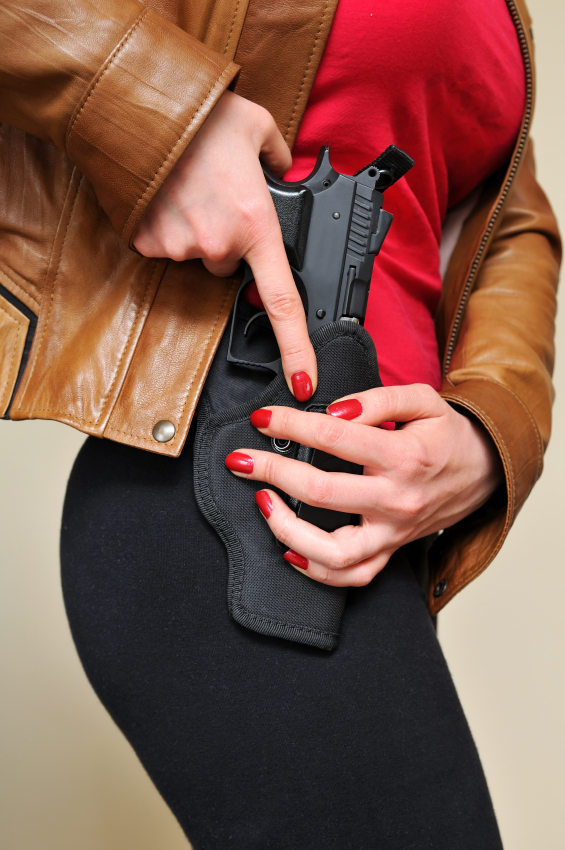
That’s a good way to shoot yourself in the support hand. The number of beginners I see doing this at IDPA matches is legion. I warn them immediately to stop doing that. If your holster doesn’t allow you to draw from it with one hand, then you need to stop using it immediately and get a new holster.
If IDPA and USPSA Production Class do nothing else other than to train people to draw their gun without putting their support hand on the holster, that’s a great contribution to the shooting community. For those who say IDPA isn’t training, I would counter that it’s excellent training in safe gunhandling. There’s nothing like getting disqualified for a safety violation to make the point that someone’s gunhandling needs work.
So the point of John’s Master Lesson is twofold:
- Proper gunhandling has to be at the forefront of our minds anytime we handle a firearm. Firearms are mechanical devices; they do no more and no less than we make them do. Consequently, they are relentlessly unforgiving of carelessness and/or stupidity.
- Pointing your weapon at yourself can have serious consequences. Some holsters force us to point our weapons at ourselves. But placing your hand in front of the muzzle when the pistol is out of the holster is a prescription for an unhappy outcome. One of my personal peeves is the devices that shotguns shooters put on their shoes to rest the muzzle on. I have some really nasty pictures of feet with holes from shotguns in them. Those people are unlikely to ever walk right again. Similarly, taking a high performance anti-personnel bullet in the hand at point blank range is unlikely to enhance your ability to play the piano.
Things I learned from the Masters
Reflecting on Shunryu Suzuki’s comment – “In the beginner’s mind there are many possibilities, but in the expert’s there are few,” some frequently ignored or overlooked fundamentals taught by people who have been at this a long time come to mind. My research on ‘bad shootings’ has reinforced some things to me.
Jeff Cooper – The Four Rules
1. ALL GUNS ARE ALWAYS LOADED.
2. NEVER LET THE MUZZLE COVER ANYTHING YOU ARE NOT PREPARED TO DESTROY.
3. KEEP YOUR FINGER OFF THE TRIGGER UNTIL YOUR SIGHTS ARE ON THE TARGET.
4. BE SURE OF YOUR TARGET AND WHAT IS BEYOND IT.
John Farnam
The person most likely to shoot you is YOU. Why? Because you’re always there.
Bill Rogers
• Muzzle direction is the primary safety; always has been and always will be.
• Identify your target at night, preferably with a flashlight, before you shoot it.
The Most Dangerous Man
• Shooting isn’t always the optimal solution.
• Holding someone at gunpoint isn’t as easy as it seems.
Ken Hackathorn –
It’s a downrange world
Massad Ayoob
Avoiding the problem (implied task) is a lot easier than fixing the problem, either at the moment or in the legal system later.
Concealed Carry and Printing
Do you even follow Michael Kors and Kate Spade, bro?
Yet another uninformed and ignorant discussion about clothing, guns, and ‘dressing around the gun’ came to my attention today. Here was one of the comments.
People are so unaware of what is around them, they never notice printing. The only time I really worry about it is when I am entering a non permissive environment. I make sure to readjust and cover with my under shirt and top shirt, instead of just my top shirt.
And another.
Nobody has ever noticed when I’ve carried, as far as I know. Nobody has ever said anything, anyway.
When the story about the Arkansas Realtor® who was recently murdered surfaced, I did some texting with a friend about Louis Vuitton handbags and knockoffs. She packs her heater in her purse every day. Although it’s long, I am going to put her commentary here in its entirety because the level of detail is important to observe and understand. My original question was “When I see women carrying Louis Vuitton handbags, are they actually paying $1-3K for them or are those knockoffs?” Here was her response:
Wow… that’s a good question. If you put a[n] authentic bag beside a replica, you can easily tell. Here are a few other ways to tell…Authentic bags follow a pattern and are continuous. There’s never a bottom seam. So, on 1 side of the bag, the LV is upside down because it is cut from a single canvas. The pattern across the bag and on the ends will touch a seam, but the pattern should mirror itself and be even across the sides or end.
The hardware on the bags are always brass. The thread used on the handle is always a mustard yellow and the top stitching shows 5 stitches across. The inside of the handle has burgundy piping, and over time the handle will turn dark brown because it is made from vachetta cowhide leather. The LV monogram will never be broken in a pattern and the V sits a little higher than the L in the monogram. The date stamp is underneath the pocket on the inside of the bag and is always evenly spaced.
The tag on the bag has the LV logo as well as Louis Vuitton Made in Paris. The mustard yellow stitching will create a V shape and almost touches the top of the LV logo. The size of the bag is also on a leather tab…25, 35, etc. That’s the width of the bottom of the bag.
Oh, and the inside of the bag is a solid chocolate leather.
Guys, if you think a woman like that, and there are many, doesn’t notice everything that is the slightest bit out of place with your clothing, you are ignorant and uninformed about how conscious most women are about clothing and style. Now, I have no doubt that People of Walmart don’t notice your T-shirt is pulled down over your full size service pistol. OTOH, the moment you walk into any White Collar business environment, you may as well assume you’re busted. That woman might not say anything to you because she MAY want your business, at least initially. However, don’t labor for one second under the illusion that she doesn’t notice something out of place, even if she’s not quite sure what it means. It’s as obvious to her as a Hi-Point at an IPSC match would be to us. It’s funny how many people who carry weapons tend to assume that the only type of “worst case scenario” is running into some meth head who is trained in mixed martial arts and is carrying a brace of Glock 22s with another brace of Glock 27s on his ankles for backup.
With the escalating number of signs prohibiting weapons, whether they have the force of law or not, and the amount of public hoopla about active shooters, getting made while carrying is going to become more of an issue in the future. Sooner, more likely than later, businesses are going to start calling the police if they suspect someone is packing a gun in violation of their company’s posted policy. Even if the sign doesn’t have force of law, having several police officers come up to you out of the Blue and escort you off the property will be unpleasant. It also has the potential for an Officer Involved Shooting with you as the shootee.
One of the major problems in the training community is that almost every trainer with a Mil or LE background has not spent one single day actually working in the White Collar or Retail Business environments. Unfortunately, what this means is that although they can teach you how to run a pistol well, they are utterly unqualified to even speak about Concealed Carry, as it pertains to most people, much less teach it. Even Jeff Cooper admitted that when he wore a suit, he carried a J frame revolver, not a 1911. Of course, Jeff actually owned suits and knew how to tie a tie.
If we really want to extend the opportunity to ‘always carry’ to an expanding percentage of the American populace, we’re going to have to come up with a better concept than ‘dress around the gun.’ Every time I hear that phrase, it makes me cringe. Whenever the vast majority of people who don’t buy their clothes at WalMart hear it, they think “that’s not me,” as my psychologist friend William Aprill clued me in to several years ago.
Competition, Practice, Training, and Testing
Driven by hunger, a fox tried to reach some grapes hanging high on the vine but was unable to, although he leaped with all his strength. As he went away, the fox remarked ‘Oh, you aren’t even ripe yet! I don’t need any sour grapes.’ People who speak disparagingly of things that they cannot attain would do well to apply this story to themselves.
–Aesop’s Fables, The Fox and the Grapes,
Periodically, I see comments in the tactical/concealed carry community downplaying the value of competition for someone interested in personal protection. The commentary usually revolves around “the stress isn’t the same as a two way range” or “competition isn’t realistic; the targets don’t move, you don’t move” or some other blah, blah, blah. Oftentimes, the person making the statement is from the ‘tactical training’ side of the house.
In my role as the Georgia/Alabama Area coordinator for IDPA, I was recently reviewing some tweaked stages for the upcoming 2014 GADPA Georgia State Match Championship. As I was doing so, I was struck by the complexity and marksmanship challenges presented in the match. Some of the aspects of the Championship include:
- Moving targets
- Shooting on the move
- Shooting Strong Hand Only with holding something with the Support Hand
- Shooting from inside and around vehicles
- Head shots at distance
- Steel targets with a concealed hit zone that have to be knocked down to count
- Engaging targets while moving through a structure
Those tasks have to be accomplished with a limited supply of ammunition, requiring a minimum hit rate of about 60%, just to finish. To be competitive at all, the hit rate on a torso sized target (-0/-1) better be 100% or you’re out of luck. Rapid reloading is an integral part of each stage, requiring a high degree of weapons manipulation skills.
In short, it’s a very demanding test of one’s ability to effectively manipulate a handgun. Hitting the target with a high degree of regularity, while being confronted by awkward shooting positions and scenarios is an integral part of it.
I think of Preparation for Personal Protection as having three components; Training, Practice, and Testing. Training is something you get from someone else. The other person or group structures your experience, almost always outside your comfort zone. Practice is something you do on your own, hopefully with some kind of structure, based on training or re-creation of actual incidents. Then there’s the nasty little question: “Where is my skill level at?” Testing is the only way that question can be answered. In his book POLICE PISTOLCRAFT, Mike Conti mentions Police Officers who are so intimidated by firearms qualification that they become physically ill, simply from the thought of having to do it. That’s a good example of how daunting the testing process can be. Those of us active in the competition world often look at police qualification courses in a bemused way because they are so simple compared to the tests we are used to.
Bill Rogers once said to me “You and I are from the last generation that is comfortable being tested.” I’m not sure if that’s true, but it is quite obvious to me that there is a great deal of cognitive dissonance and ego defense that goes on when discussions about competition v. ‘training’ start. The next time you hear someone disparaging competition, keep The Fox and The Grapes fable in mind. And for those who make negative statements about competition, I invite you to come out and test yourself and see what it’s like. Firearms competition has evolved a great deal since the original Columbia Conference. One of the most ridiculous statements I have ever heard is “I never saw a timer in a gunfight.” It was there every time; it’s called your lifeclock and it’s running all the time, at least until someone stops it.
Holster retention systems and sloppy research
A few people drink from the fountain of knowledge but most only gargle.
Gun Digest recently published an online article about holster retention systems. The article begins by referencing Safariland’s retention holster rating system as being the standard. Unfortunately, the author, Corey Graff, should have done a little research and contacted Safariland about their retention rating system before writing about it.
That system, devised by Bill Rogers, the inventor of the modern security holster, has nothing to do with the number of mechanisms that the holster has. Corey’s interpretation is a common misconception in the industry. Safariland’s system is based on a series of hands-on performance tests in which the holster is physically attacked and tested. The holster must pass, in sequential order, each test to achieve a given level of rating. A holster can have several mechanisms on it and still not achieve any rating at all if it doesn’t pass the hands-on (literally) tests.
In point of fact, the Blackhawk Serpa holster pictured in the article will not pass even a Level I rating test, regardless of the number of mechanisms it might possess. The reason is that the holster must remain attached to the belt while attacker is pulling on it with a given amount of force. Because of its relatively small mounting area where the screws attach to the belt plate, the entire Serpa holster will pull off the belt when subjected to a Level I test. Unless, of course, the holster itself breaks, which has also been known to happen, when subjected to a hands-on test.
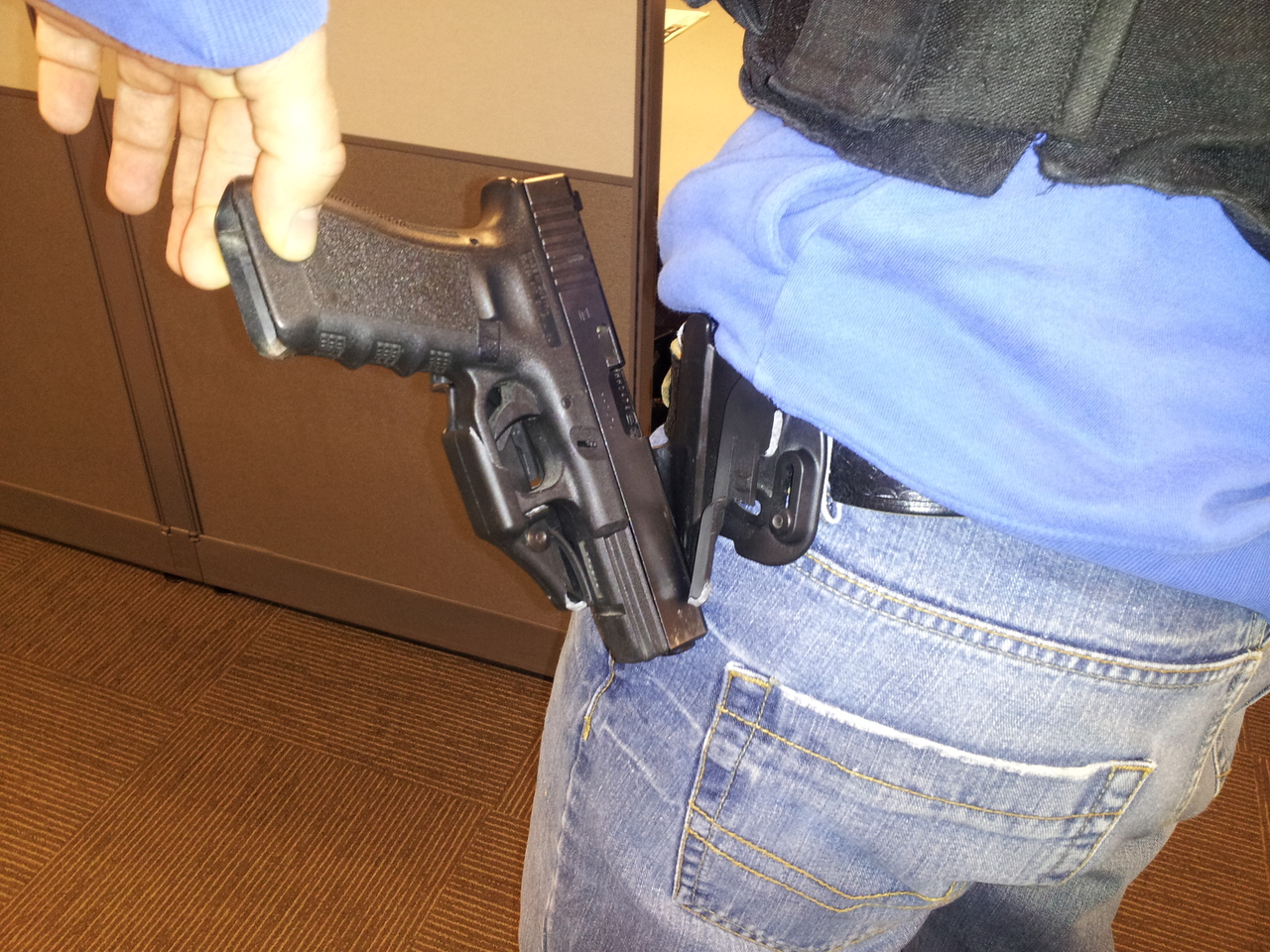
I won’t go into the plethora other unsatisfactory aspects of the Serpa holster.
Unreinforced leather holsters, such as the Blackhawk leather slide holster pictured, will not pass a Level I test either. They lack rigidity in the strap holding the pistol in place and the pistol will simply pull out of the holster when subjected to a significant amount of force. This is why true security holsters must be made from a rigid synthetic material.
It’s interesting that the author used Blackhawk holsters as illustrations despite the fact that they don’t pass the Safariland rating system. What is up with that, I don’t know, but it’s certainly poor research and understanding of the topic. Since this article is an excerpt from a book about Concealed Carry Holsters, I certainly hope the rest of the book is better researched and based on factual information rather than common misconceptions.
A lesson from Jimmy Cirillo and the Stakeout Squad
I don’t want to burst any bubbles among the broad public but I have a different take on a very unfortunate incident than the family and the news reporter do.
A little background is in order. The NYPD Stakeout Unit, unofficially called the Stakeout Squad, was formed in 1968 and existed until 1973. Its formation was due to the large number of retail robberies occurring in New York City at the time, many of which resulted in the brutalization or murder of shopkeepers. The Squad was disbanded in 1973, allegedly for ‘efficiency’ reasons but the members generally conceded that it was because the Squad shot so many robbers, whom they caught red-handed and who decided to shoot it out rather than surrender. Jimmy Cirillo was one of the founding members and a good friend of mine. Jimmy died in a motor vehicle accident in 2007. His wit and wisdom will always be remembered by those of us who knew him.
Here is an incident synopsis from the full article:
Hero mom dies protecting her baby daughter
She was young, beautiful and tragically killed by her daughter’s father early Sunday morning. Now, Jessica Arrendale, 33, is being hailed by her family as a hero for saving her six-month old daughter’s life, even as she died from a bullet to the head.
It began Saturday night when Jessica and Cobie’s father, 30-year old Antoine Davis, went out for the evening. At some point, Ionniello said, Davis, a former Marine who served in Iraq, became belligerently drunk and abusive. It had happened many times, Ionniello said, but her daughter did not seem able to turn Davis away no matter how often he abused her.
Davis chased Arrendale up the stairs of her three-story townhome in the Oakdale Bluffs subdivision sometime around midnight, she said….
Arrendale locked herself in a bathroom. Davis got his gun, an assault rifle outfitted with a suppressor. He burst into the bathroom and, while Arrendale was still holding Cobie in her arms, shot the young mother in the head, Ionniello said…..
“He shot her and they (police) don’t know how she was able to twist her body and fall literally in the opposite direction,” Ionniello said. Instead of falling onto the floor, Ionniello said her daughter fell over the toilet, dropping little Cobie into the water-filled bowl….
The baby remained in the toilet, covered by her mother’s body, for 13-hours before officers finally stormed the townhouse and rescued her. She was cradled in the arms of an officer who rushed her outside to a waiting ambulance.
No one ‘makes decisions’ when they’ve been shot in the head, probably brain, with a 5.56mm bullet at point blank range. That’s an instant shutoff. In a macabre way, I would like to see the coroner’s report as to the extent of the damage to her brain. However, this immediately brought to mind something Jimmy Cirillo told me about his experiences in the Stakeout Squad shootings.
He observed that every time a perpetrator was instantly killed by Stakeout Squad gunfire, they fell where they stood and their legs were crossed as they fell. Usually, they were facing the opposite direction from the way they had been standing. Jimmy’s hypothesis was that one side of the brain shut off before the other causing one side of the body to collapse before the other, resulting in the turning of the body and the crossing of the legs.
He didn’t indicate he had any medical basis for his opinion. Therefore, I regard it as a hypothesis based on his observations of the numerous men he and the other members of the Stakeout Squad had killed.
My opinion is that the same thing happened to this poor young woman; her brain shut off sequentially, which caused her body to twist as it fell. It was random chance that protected her infant son from the crazed father. While I would like to accord her ‘hero’ status, I don’t see it that way. No offense to her is intended, I am sure she would have protected her child any way she could, had she been capable.
The lesson is this: be cautious about approaching predators after they’ve been shot; they might not be completely disabled. With handguns, the mechanism causing the opponent to stop is largely exsanguination, meaning blood loss. When someone falls after being shot and bleeding profusely, they may regain consciousness when the brain comes level with the heart. Central Nervous System (CNS) stops, such as this unfortunate young lady experienced, are the only really sure anchors.
For those interested in reading more about the Stakeout Squad, I recommend Paul Kirchner’s excellent book, Jim Cirillo’s Tales of the Stakeout Squad.
Challenging human predators
Pointing guns at people you have no intention of shooting to force compliance with your demands is poor business.
–Ed Head in his article Pistol Provocation
I agree with this statement and feel it can be even further amplified from the perspective of training people how to Control a Confrontation. The statement can be, and has been, misconstrued by the inexperienced into “I believe that the first time any bad guy should know you are armed is when he sees the muzzle flash.” As a philosophy, reluctance to display a firearm without firing is a mistake. The majority of criminals are looking for a victimization not a fight. The display of a firearm by the intended victim, along with the obvious intent to use it if necessary, is an indicator that the victimization has the potential to turn into a fight. That’s not what economic predators are looking for.
Let’s consider the Policy (556.80) of the Los Angeles Police Department for DRAWING OR EXHIBITING FIREARMS.
Officers shall not draw or exhibit a firearm unless the circumstances surrounding the incident create a reasonable belief that it may be necessary to use the firearm in conformance with this policy on the use of firearms.
Stated as a positive action when adjudicating Use of Force incidents, the LAPD Board of Police Commissioners generally uses language similar to the following, when the Drawing/Exhibiting was ruled justifiable.
The BOPC determined that all personnel had sufficient information to believe the situation might escalate to the point where deadly force may become necessary. Therefore drawing the weapon was in policy.
Armed Citizens need to practice two Presentations; 1) Challenge and 2) Shoot. I use the term Presentation in a broad sense because the pistol might be in a container other than a holster, for instance, someone at home may have a pistol in a container or safe. The principle still applies. While some trainers would say this violates Hick’s Law, the fact is that the effect of Hick’s Law has been proven to dissipate when training in the various options has been undertaken.
Challenging should be done from a Ready position that does not involve pointing the pistol at the aggressor, just as Ed states. If the necessity to shoot arises, the pistol is then brought on target and fired.
Contrary to popular opinion, there is no time difference between bringing the weapon onto target to fire vis-à-vis having the weapon already aimed at the target. Nor is there any demonstrable difference of starting out with the finger on the trigger v. off the trigger.
My experience is that very few gunowners practice the Presentation to Challenge nor firing beginning from a Challenge position. This is a major weakness in their skill sets. Challenging can easily be practiced at home with an inert (blue) gun. Anyone who is serious about improving their skillset should own a bluegun of their real defensive gun.
There is a caveat to this doctrine. A friend of mine lives and works in Central America as a security consultant and trainer. His counsel to me is that, in his experience over the past three decades, Latins rarely find the presence of a pistol unsettling “unless they are looking down the bore.” With the heavy influx of Central Americans into the United States lately, this may be a consideration.
Having a personal code
I won’t be wronged. I won’t be insulted. I won’t be laid a-hand on. I don’t do these things to other people, and I require the same from them.
— John Bernard Books in The Shootist
Mine is somewhat more complex than that, but the principles remain fairly simple. They guide me every day.
“Son, try to get along with everyone; but don’t let anyone hurt you.” – my Father, Jerry Werner
“An officer is responsible for his own morale.” – General of the Armies John J. Pershing
“When they get the duct tape out, it’s time to make your move, ready or not.” – The Most Dangerous Man in the World
“Stupid people, stupid places, stupid things. Avoid them and you’ll probably be all right.” –John Farnam
“In the beginner’s mind there are many possibilities, but in the expert’s there are few.” ― Shunryu Suzuki
“Thinking ‘I’ll solve it when I get there’ has gotten a lot of people killed.” –Bill Rogers
“Look good, be right, control and dominate, avoid being controlled and dominated. Those are the things that run most people’s lives.” – Lifespring
“There are two kinds of people in the world, those who eat to live and those who live to eat.” – my ex-wife
“When you leave your car, don’t forget your Mace. That is unless you want to get stabbed in the face.” – Attractive Eighties Women
“Son, when you park the car, face the rear end into the Sun so you won’t have to sit on a hot seat when you get in.” – my Father, Jerry Werner
“You can do a lot of aiming and squeezing in a second and a half.” – Mike Benedict
“Don’t ever march home the same way. Take a different route so you won’t be ambushed.” – Major Robert Rogers
“Begin to attrit the enemy at the maximum effective range of your weapons.” – The Infantry School
“Auditing is intellectually rigorous and is not for everyone.” – Nick Crooks, Senior Manager, Deloitte & Touche
“Guns and knives, sir, you can never have enough of them.” – CSM Autrail Cobb
“Little things I should’ve said and done, I never took the time. You were always on my mind.” – Pet Shop Boys
“Surrender is not a Ranger word.” – the Ranger Creed
Wargaming v. brainstorming (Part II)
Thinking ‘I’ll solve it when I get there’ has gotten a lot of people killed.
My friend and I had a serious disagreement over his tactics. “The cops, Gunsite grads and others, who’ve contacted me over it agreed with what I did.” Contrary to the feedback my friend received, the comments I received were universally negative toward his post-escape actions.
This then leads to a further issue involving his friend, who was in the car with him. What do you do when someone else makes a tactical decision that involves you? I frequently mention that anytime we are with another person, the complexity of decision making goes up seriously.
You, as a passenger or bystander, can be put in a situation by someone else quite easily. Sometimes, it is a situation with possibly severe negative outcomes. Many times in ten years of Force on Force exercises, I saw how easy it is to get dragged into situations and Courses of Action not of your choosing. Not to mention the many times I have personally gotten sucked into situations that I later thought “Wow, I’m glad I got out of that one in one piece.” Other people can get you killed, without asking your permission.
Let’s examine some of the possible options. Even when we are with friends and family, our options remain. Some of them are Flight, Withdraw, Fight, Submit, and Negotiate. We are conscious beings and capable of making our own decisions. Just because someone else makes a decision to place themselves in jeopardy, doesn’t mean we have to go along with it. Nor does it mean that even if we choose to participate we necessarily have to do it in a way that entails maximum risk.
Let’s examine a case from the LAPD files as an example.
Officer Involved Shooting 030-05.
Officer A was watching television when he heard his wife shout that someone was out front. Officer A’s wife also believed she told her husband the people outside were vandalizing the family vehicle.
Officer A, with his pistol held alongside his leg, moved across the front lawn of his residence to obtain a view of the individuals [he suspected of vandalizing his car] in the street. Unknown to Officer A, his wife had followed him from the residence to the curb of the street.
Two things occurred here. 1) Officer A elected to go outside to Confront the vandals. It is unknown whether this was habit as a Police Officer [LAPD discourages its Officers from taking enforcement action off-duty unless life is at risk] or because he felt compelled by the presence of his family. 2) His wife followed in into the Danger Zone, perhaps due to family bonding aspects or because she felt it was appropriate for her to confront the vandals herself.
Officer A directed his wife to return to the residence and to call the police.
Once inside the residence, Officer A’s wife instructed another nephew to call 911. She then returned to the street with her husband [.]
The wife continued to be sucked in the dynamic of the situation, perhaps because of her husband’s presence outside. If he had remained inside and called the police himself, it is less likely she would have gone outside, especially the second time.
Eventually, a scuffle between the vandal and Officer A’s wife ensued and Officer A separated them. The vandal then approached with an ambiguous weapon and Officer A fired a warning shot into the ground. This resulted in the vandal fleeing.
Here’s what the Board of Police Commissioners ruled.
Findings
- Tactics
The BOPC found Officer A’s tactics deficient warranting administrative disapproval.
Basis for Findings
- Tactics
…Officer A elected to confront the subjects… The BOPC observed that Officer A’s tactical decisions left him with few tactical options and placed him at a tactical disadvantage… The BOPC would have preferred that Officer A had remained inside his residence, stayed with his family, [and] personally notified the local law enforcement agency … The BOPC was also concerned that when Officer A exited his residence, his wife accompanied him outside.
The BOPC determined that Officer A’s tactics were seriously deficient warranting administrative disapproval.
The evidence later disclosed that the vandal was ‘armed’ with a dinner fork. While Officer A received only ‘administrative disapproval’ for firing the warning shot, I have little doubt that an Armed Citizen in the same circumstances would have been charged with Aggravated Assault.
Let’s now return to the brainstorming v. wargaming issue. Brainstorming by Officer A gave a rudimentary Course of Action of going outside and Confronting the vandal. I’m not sure that any brainstorming by his wife was involved, other than to accompany him. Wargaming might have resulted considering alternate Courses of Action for either or both of them. He might have elected to Remain In Place and call the police. Even if he went out to Confront, she might have elected to RIP. Even during the Confrontation, after considering all her options, she might have decided to RIP after she had returned to the house, instead of re-inserting herself into the situation.
If my friend’s friend had done some wargaming, he might have considered, and perhaps chosen, some different options. It would be presumptuous of me to say what he was thinking when he chose to join the Pursuit. However, his options were: Pursue, Submit, Withdraw, Flight, and ultimately Fight using deadly force. If he agreed with following the criminals, then the option he chose was Pursue. Fortunately, the situation did not escalate to the Fight option but this has to be considered as a consequence of the Pursuit. If he did not agree with the decision to Pursue, then he chose the Submit option, only he was submitting to my friend’s choice. ‘To take no action is to take an action,’ as the saying goes.
He could have said “I’m not going with you over to their vehicle. Let me out of the car.” That would be the Withdraw option. If the car got into motion before he could say anything, he could have gotten out of the car when it stopped behind the criminals and then he could have moved off. That would be Flight. And if the criminals produced guns, he would have been forced into the Fight using deadly force Course of Action, which at that point is not an option but a necessity. The military term would be Decisively Engaged. Decisive Engagement means we have no other options left, which is never a good position to be in.
All those options have consequences. Withdraw or Flight could have serious repercussions on their friendship. Pursuit, under the wrong set of actions and reactions, could result in an unpleasant encounter with Law Enforcement. Fight using deadly force carries the possible consequence of death, which would affect not only him but all his loved ones and associates.
The choices we make are based on our personal moral values and ties to others. But they should be made with a clear understanding of what our options are and also the possible consequences thereof.
I would have said “I’m not going with you over to their vehicle. Let me out of the car.” But that’s just my choice, you’ll make your own.
 tacticalprofessor
You must be logged in to post a comment.