Practicing Awareness – Part III
How do you do ‘situational awareness?’ You can’t ‘do’ a noun.
First of all, let’s distinguish between training and practice. My definition of training is something you do under the guidance and supervision of someone else. Practice is something you do on your own to maintain or hone skills you have or are developing.
Although Jeff Cooper’s Color Codes (White, Yellow, Orange, and Red) are the most popular way to describe states of awareness, I prefer to use the NRA format. As a sidenote, Cooper did not include Black as part of his system and actually objected to its inclusion.
The NRA format is described in the Personal Protection In The Home course and book. Military and police personnel tend to use insider jargon to describe things. Jargon is both a shorthand and, linguistically, also a way of excluding outsiders from the group. Shorthand can be useful in some circumstances but to a trainer exclusion is not, so I prefer the NRA terms.
- Unaware (Doi, doi, doi, doi, doi, doi, doi; as we used to say in Chicago)
- Aware (I know who and what is around me and what is going on)
- Alert (Something has caught my attention and makes me uneasy)
- Alarm (Something is definitely wrong in my right world)
Wearing earphones and listening to music automatically put us into the Unaware state. Constant talking on the phone does the same thing, as does concentrating on watching your dog take a dump. If you want to be Aware, you have to be mentally present where you are, not in a musical venue or someone else’s location. Sorry, there’s no way around that.
Tom Givens of Rangemaster mentions two things he thinks are relevant to situational awareness.
1. Who is around me?
2. What are they doing?
To those, I would add three more:
3. Where am I?
4. What is going on? (Not necessarily at this moment)
5. Points Of Likely Concealment (a component of Positioning to be discussed later)
When walking or running, we have an excellent opportunity to practice our situational awareness and positioning. It’s also a good habit for your safety.
You know how they say running is good for your health? In my neighborhood, it can save your life.
–old Chicago joke
To start the practice regimen, the default position for your eyes is on the horizon. It’s true that when walking or running we have to look down periodically to watch out for dog turds and other hazards on the ground. However, most people walk around like they’re continually playing the game “Step on a crack, break your mother’s back.” Having the eyes down makes it very difficult to see anything outside of the Near Phase of Social Space, in terms of proxemics. The boundary between the Near and Far phases (~7 feet) of Social Space is where untrained people will tend to make their final Force decision (Critical Distance). Being fixed on that point makes it impossible to do any information gathering prior to having to react. It’s a failure to follow Items 1 and 2 and a self setup for disaster. There is a discussion of proxemics and its implications in an earlier blog post Situational Awareness and Positioning (part III).
To get into the information gathering mode, something I do when out is to read every sign or anything that has words on it. I do this whether I’m walking or driving because it keeps my head up. As Tom says, most drivers stopped at a traffic signal tend to watch the signal with rapt fascination as if they expected it to start to sing and dance. Reading everything around you keeps your head moving and your mental focus outward.
There are many apartment complexes and residential subdivisions along my walk route. There are also numerous small cross streets with street signs. I make it a habit to read each of these signs every time I pass them, even though I’ve read them hundreds of times before. This accomplishes two things. First, it puts me in an outwardly directed mental state. Second, it makes sure I know exactly where I am at all times; Item 3 on the list. If I had to call 911, being able to say “I’m at the entrance to the Wyndham Hills apartment complex on Nesbitt Ferry Road” or “I’m at the intersection of Peachtree Road and Sequoia Trace” gives any responders a good idea of where I’m at. I also read the address number of every mailbox I pass. This gives a precise location if I’m not near a complex, cross street, or subdivision. Don’t depend on the GPS locator of your phone to give your exact location; it may not.
As I approach and pass the complexes and subdivisions, I look as far as I can past the entrance. What I’m looking for is outgoing traffic and any changes or construction. This is mostly just mental exercise for Item 4 but has helped me avoid being run over by distracted soccer mom drivers on several occasions. Heavy construction equipment near the entrance can also be a Point Of Likely Concealment, Item 5, for criminals, especially at night.
Graffiti is another thing to look for. The appearance of graffiti where it didn’t exist before can be an indicator of a new gang presence. The presence of beer cans is another detail worthy of note. The detritus of cans tossed out the windows of drunken drivers’ cars is not that much of a concern, unless you’re in their path. However, a quantity of cans noticed in a single location over a period of time is. That could be an indicator of nighttime party spot that is best avoided.
Another thing I look for is Small Dead Animals (SDAs) and Large Dead Animals (LDAs), as we called them when I was in the City Planning program at Georgia Tech. Once again, this is mostly mental exercise. However, as the deer presence in my area has increased, I’ve had occasion to call Public Works several times to report dead deer that were hit by cars.
Checking out the drivers in cars waiting to turn when you approach an intersection is mandatory. Any doofus who has their turn signal on and is talking on the phone or texting is a potential assassin. I never make the assumption they’re going to see me and not run me down when I get in the crosswalk. That’s not to say the ones who don’t have their turn signal on won’t try to kill you, either.
Of course, we want to scrupulously follow Item 1 and be aware of other persons around us.
- Walkers and joggers
- People in their yards
- Workers
- Low-lifes
Engaging the normal people is something I always try to do. Just saying ‘Good Morning’ helps engender a small sense of community. Be aware that it’s also a good way to seem like you’re part of the neighborhood, even if you’re not. This technique is used extensively in surveillance work and criminals use it too. It’s also fun to wave at people you don’t know and have them wave back. They go home thinking “Maybe that person knows me but I can’t remember who he is.” This is also another technique for establishing a false neighborhood identity. Workers can be fun because they’re often working in obscure locations and require active work on my part to locate and identify them.
I don’t mind walking past low-lifes but it’s important to be mentally prepared to deal with them and fail the interview. Someone once said that I give my students permission to be rude; that’s totally true. There’s a difference between rude and mean, though. In my vernacular, being rude relates to enforcing my boundaries. Being mean is encroaching on someone else’s boundaries. That can set you up for trouble. If you don’t like the look of them, though, there’s nothing wrong with crossing the street or changing direction to avoid them. Don’t hesitate to turn on your heel and go back the way you came if that seems appropriate.
Earlier posts about Situational Awareness
- Practicing Awareness
- Practicing Awareness – Part II
- Situational Awareness and Positioning Part I
- Situational Awareness and Positioning Part II
- Situational Awareness and Positioning Part III
- Situational Awareness and Positioning Part IV
- Situational Awareness and Positioning Part V
- Situational Awareness in Social Settings
As the real Dr. House mentioned at the Hebrew Hogger last weekend, it’s better to have an option to avoid a situation than to have a tool to get out of a situation.
Vet your sources
Please accept no advice or references with regard to personal protection without vetting it directly from the source. That includes anything I say. I try to cite where I get my information but anyone can be mistaken. There is no shortage of misinformation floating around and not all of it comes from gunshop commandos.
Already this morning, not one but two examples of why this is important have been brought to my attention. Another was made apparent last night.
In the first example this morning, a friend and client of mine shared some utterly incorrect advice that was given to her by a local law enforcement officer. My response came from my old website.
Only accept legal advice on firearms and/or self-defense from the POLICE or OTHER LAW ENFORCEMENT AGENCIES OR OFFICIALS if it is in writing on official letterhead signed by a sworn senior supervisory official of that department in his or her official capacity or a current official document of that department bearing the department’s insignia and signed by the current head of the department (Chief of Police, Sheriff, or Special Agent In Charge). Verbal (not in writing) advice from law enforcement personnel may be in error and will have NO standing in a court of law.
It is rare that you will ever get anything in writing and signed by a senior official of the PoPo. There’s a reason for that. The police rarely know the nuances of the law and frequently do not keep up on changes in the law. Last night’s example was the result of a Sergeant using an outdated legal codebook when developing a briefing. His Captain, a friend of mine, fortunately reviewed the briefing prior to it being given. When asked to cite his references, the Sergeant pulled out a five year old codebook. The section he was citing had been changed.
If you want legal advice, go to a legal expert or read a book by a legal expert, such as Andrew Branca or Massad Ayoob. Don’t ask the police. They probably don’t know as much as you would like them to. This also applies to firearms training.
2. This morning I read an article in one of the online NRA Journals that referenced “FBI Crime Statistics.” Whenever you hear or read something that cites “the FBI,” assume it is the result of a game of Chinese Whispers.

FBI information is so rarely cited correctly that your can generally assume what is being said about it is more likely to be wrong than right. Personal Defense Network published my article What Do FBI Statistics Really Say About “Gunfights”? It’s worth reading.
When it comes to using force or training/practicing to use force, either lethal or non-lethal, you have to know what you’re doing. That means doing your own research, not relying on someone else to do it for you. At the very least, do an internet search for “use of force [your State]” and find the statutory code for your State.
Decisions about what you’re capable of
While researching personal protection incidents in 2015 involving armed females, I came across a story that I found disturbing on several levels. The incident actually took place in October of 2014 but was featured in the Armed Citizen® column of the NRA Official Journals in January 2015.
The incident began when a woman discovered a man raping her pet pit bull one morning. The NRA synopsis is as follows:
Alice Woodruff heard noises outside her home around 10:30 a.m. When she went to investigate, she found a nude man attacking her dog in the backyard. Woodruff grabbed her pistol as a family member dialed 911. She then ran to her car to retrieve the gun’s magazine. She kept her distance from the man and warned him not to come toward her as he ranted about being with ISIS and having Ebola. He then claimed to be the anti-Christ. Woodruff held the man at gunpoint until police arrived shortly thereafter. After a nearly two-hour chase, the assailant was arrested and is expected to be charged after his release from psychiatric placement in a local hospital. (/Republican American/, Waterbury, CT, 10/24/14)
Let’s leave aside the issue of raping a dog, which is disturbing enough. A friend in the animal rescue community has informed me this is far more common than any sane person in the civilized world could believe. Several other more commonplace decisional issues are apparent.
First, in an interview with a local TV station, the woman stated:
I ran in, got my [.380 pistol] out of the bedroom, and realized as usual the ammunition is in my car locked in my glove box.
This is a serious problem of mindset and decision-making. Perhaps the woman is attempting to ensure there is no unauthorized access to a loaded weapon in her home. However, her protocol carries this rule to unreasonable extremes. Fortunately, the situation allowed her to “[keep] a picnic table between herself and the man as she opened the car to grab the magazine” Then:
I showed him the clip went in but I always kept the gun at my side while I was talking to him.
This is yet another decisional issue. She should have loaded the gun the moment she had accessed the magazine. Waiting to demonstrate to the man that she was loading the gun actually demonstrated to him that 1) she wasn’t ready to respond in the first place, and 2) she was not mentally prepared to shoot him.
The standoff with the man continued for several minutes as the man made numerous irrational statements. Although she warned him not to move toward her during the standoff, he eventually did. According to the story, the man was standing about 20 feet away from her. While the intent of the Tueller Principle has become heavily misconstrued in the training community, its applicability to a situation like this is clear. As a result of his moving:
Woodruff fired into the ground nearby when he moved toward her, though she said she wasn’t going to kill him.
The warning shot didn’t deter him. He tilted his head back, stretched his arms to his sides as if he was on a cross, and told her to shoot him, she recounted.
As more people own firearms for protection, it’s likely we will encounter an extrapolation of the ‘suicide by cop’ into ‘suicide by citizen.’ While I have said in the past ‘never say never’ about warning shots, we have to also consider that they may not work and a Plan B will be necessary.
But the single most inappropriate decision by this lady was to have a gun at all. A statement she made clearly indicates a firearm is not an appropriate tool for her to own.
And now I have to be the judge and jury and god for him? That’s not fair.
There’s nothing wrong with deciding you are not able to take another person’s life. We all have unique moral principles that guide us. This is why I never proselytize about gun ownership. Having a firearm for protection purposes is a deeply personal decision of the same magnitude as deciding to lose one’s virginity, get married, or have a child. However, someone who cannot bear the thought of taking another’s life in self-defense should not have a firearm as a protection tool. Pepper spray, a Taser, or some other alternative would be indicated.
Eventually, the authorities decided that the woman will not face any charges.
“She feared for her safety,” Deputy Police Chief Christopher Corbett said. “She fired a warning shot into the dirt.”
That warning shot was a reasonable thing to do given the circumstances, Corbett said.
“Every situation is unique,” the deputy chief said. “If you fear for your life, or if you fear for someone else’s life, you can use reasonable force to defend yourself.”
A consideration is that a warning shot may be no more legally justifiable than actually shooting someone. Gunowners do sometimes face criminal charges for firing warning shots.
This incident show a number of nuances to the decision process that we as gunowners should consider ahead of time. Although things worked out in this particular case, it had the potential to turn into a Negative Outcome in a number of ways.
Structured practice (Part II)
Part I of this series focused on Dryfire Practice. Now let’s focus on livefire practice, especially for those who are new to pistol shooting. To learn, maintain, and improve physical skills, we have to practice them regularly. We also need a plan for how we are going to practice. In that regard, shooting a gun is no different from learning to throw or hit a ball.
The problem many people have is that when they go to the range to practice, they have no plan and use no structure. At least a motivated police officer has the course required for periodic qualification as a structure for practice. Competitive shooters have courses of fire, either for Classification purposes or something that was appealing in a match. Few Private Citizens have either of these, which is why the most common ‘practice’ is blasting 50 holes in a silhouette at 5 yards. Shooting a bunch of holes in a silhouette gives familiarity with recoil and muzzle blast but not much else. Something further is needed to develop skill.
A very good starting point for new shooters is the NRA’s Marksmanship Qualification Program, which is really a marksmanship development program. This is a self-paced and self-administered program that the NRA has made available for decades. There are a number of different courses of fire available within the Program. The one I recommend for those who have just purchased a pistol for personal protection is Defensive Pistol I. DPI is designed to improve skills that contribute to a successful home defense.
Defensive Pistol I includes tasks such as:
- Hit a target to an accuracy standard
- Shoot within time limits
- Pick the loaded gun up from a bench and then engage the target
- Pick up and load an unloaded gun
- Move to a position of cover
- Shoot from behind cover
- Issue a verbal challenge
- Reload
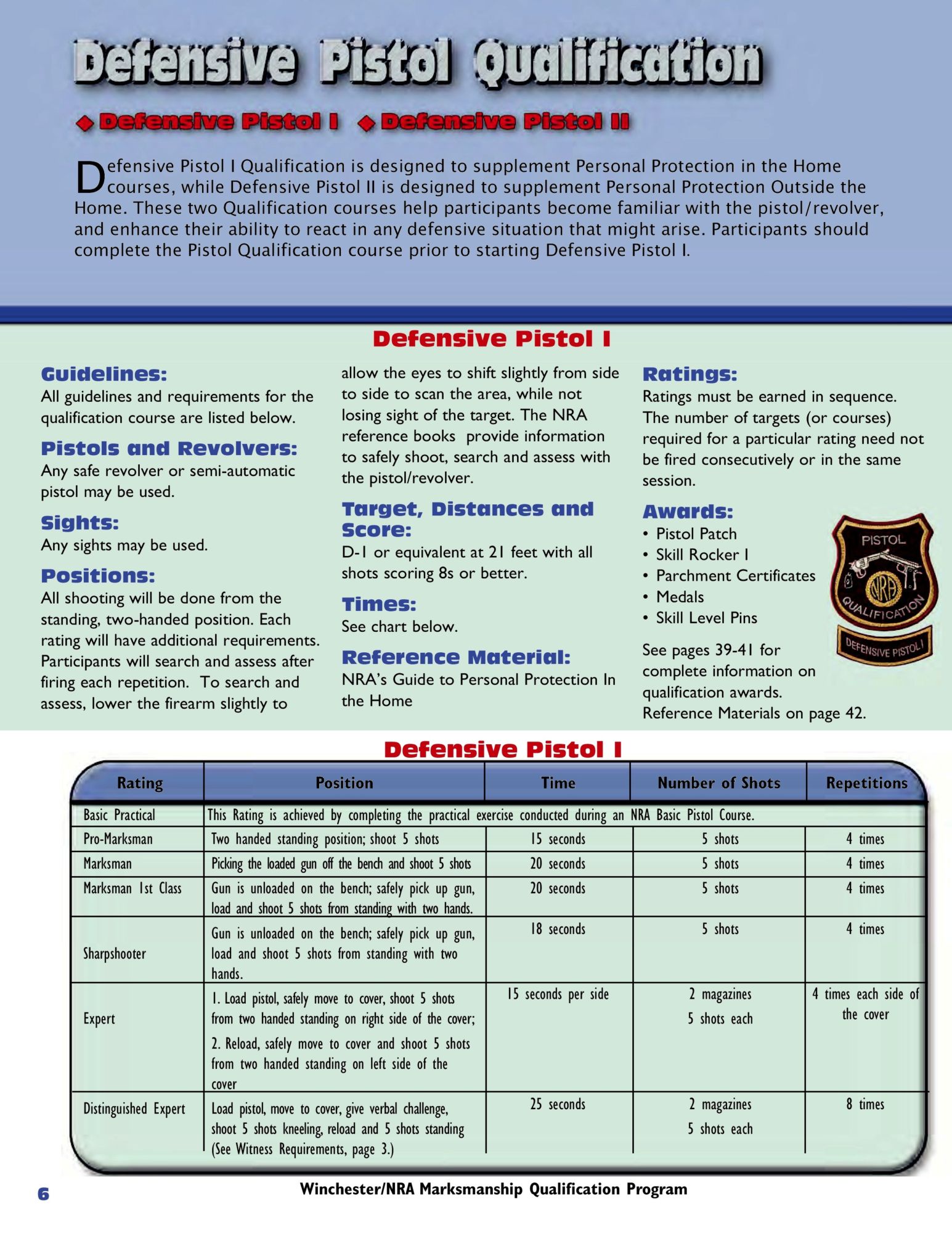
Courtesy of NRA Training Division
Something I really like about Defensive Pistol I and II is that the accuracy standard is 100%, not a fraction thereof. The allowable area and time limits are generous but you have to make every shot count. As I mention periodically, every bullet you fire in an urban area that doesn’t hit your target is heading for a busload of nuns and orphans being followed by a limousine full of personal injury lawyers on a conference call with the District Attorney. We have to get used to the idea that the only safe backstop for our bullets is the criminal’s body, period.
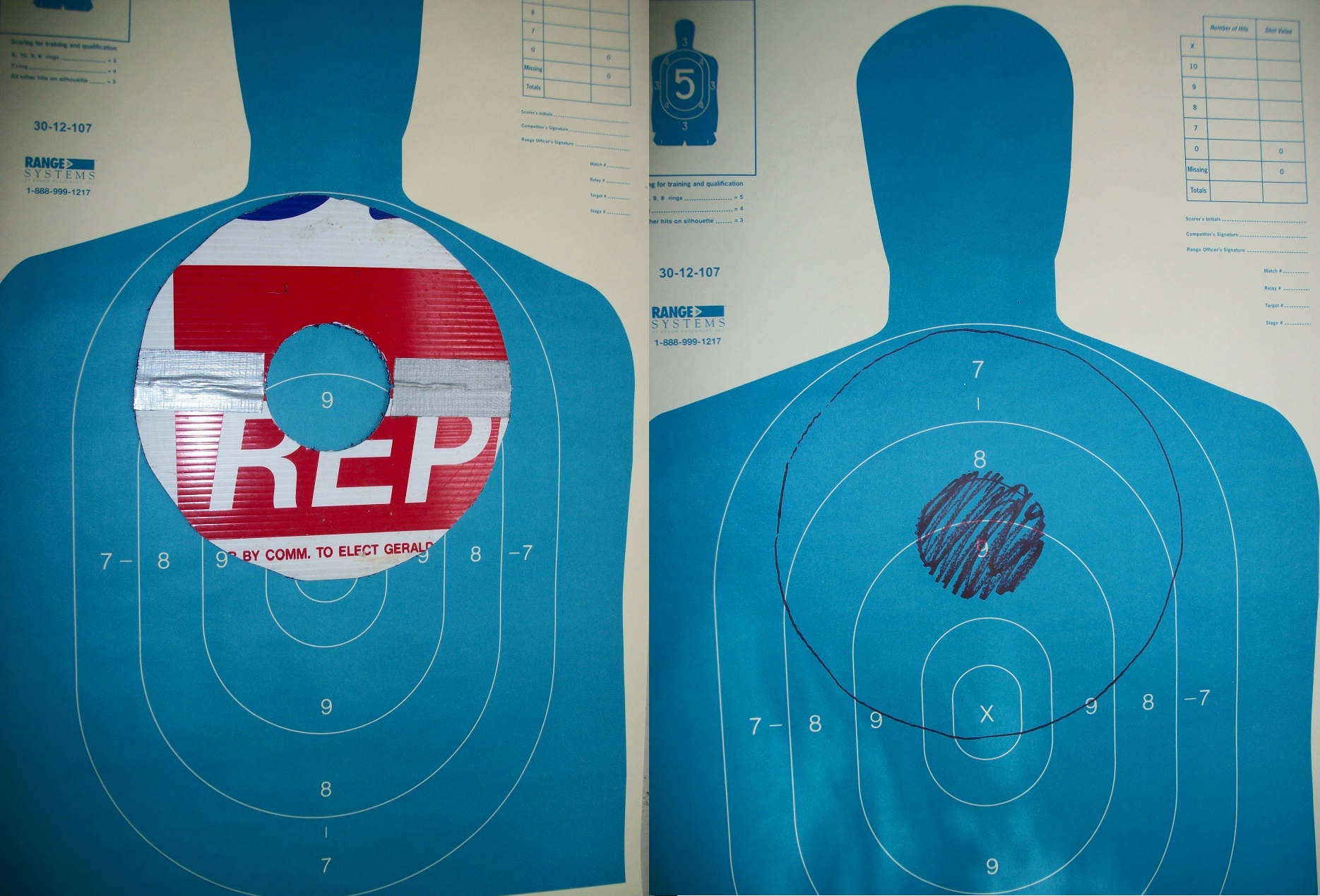
The target area specified for the NRA program is the 8 ring of the NRA D-1 (Bianchi Tombstone) or equivalent. The 8 ring of the D-1 is 12 inches in diameter. The shooter must place five shots in the 12 inch circle at 7 yards within a time limit of 15 seconds. Many shooters I talk to think this is a very simple marksmanship task. The reality is that because of the 100% standard it’s not as easy as people think. In order to meet the standard for the first level (Pro-Marksman) of the program, the task has to be done four times. Therein lies the rub. I have run over 100 people through the program and only about 10% have passed on the first attempt. What happens is that on one or two runs, one shot will not hit the 12 inch circle. Sorry, you didn’t make it.
The good news is that the four runs don’t have to be done consecutively. If you mess up a run, just shoot another until you have four that meet the standard. My experience has been that 10 percent of shooters can do it in four runs, another 40% will make it in five runs, another 40% will make it in six runs, and the final 10% need a lot of coaching to get through it.
While the Tombstone target isn’t available at all ranges, the allowance for an ‘equivalent’ means you can make a template of the 8 ring and apply it to whatever target is available. Just take your template and a marker with you to the range. I cut mine in half and then taped the halves together with duct tape so it folds and fits easily in my range bag.
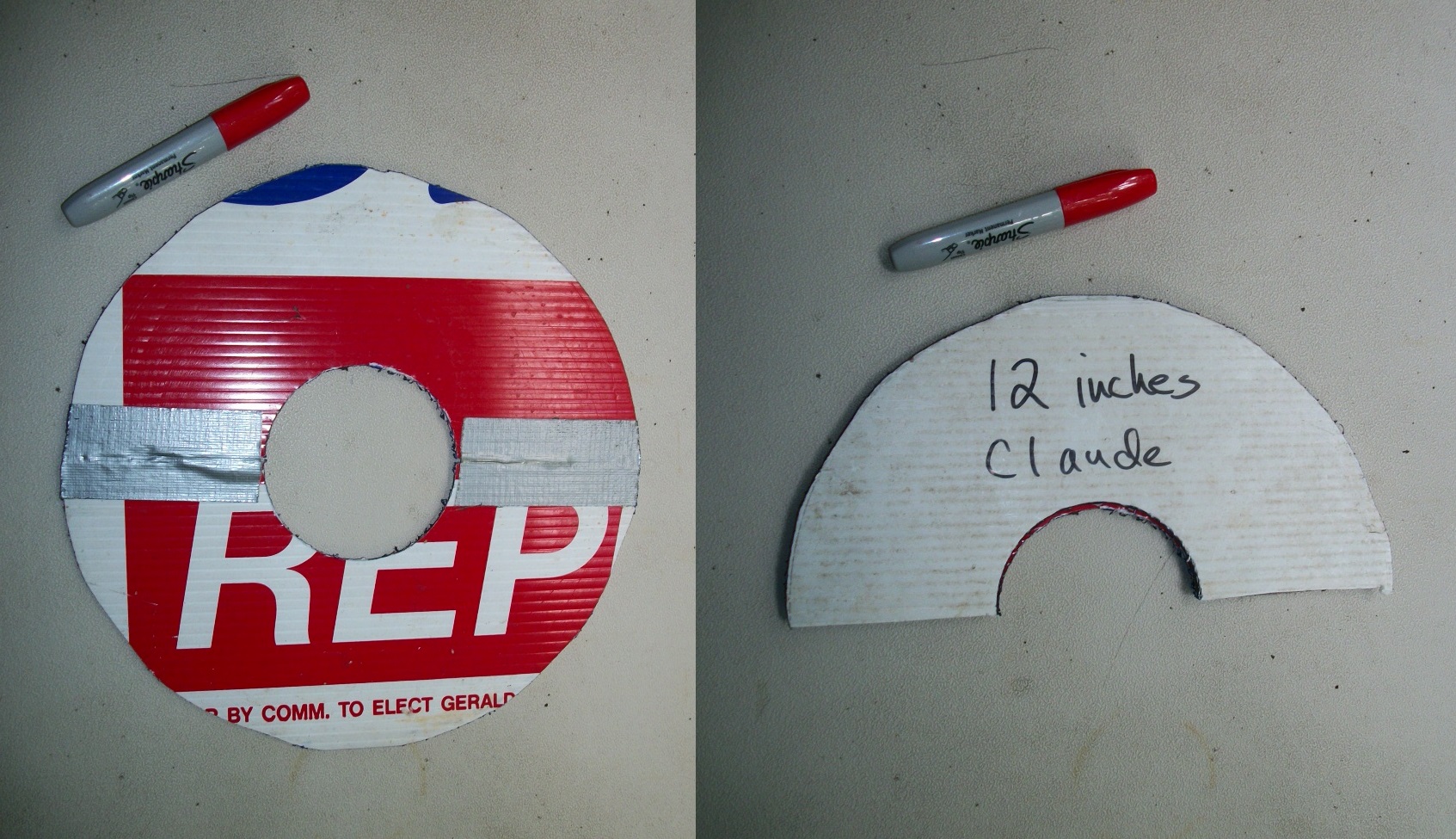
Once you get to the range, outline the template on your target and you’re ready to go. Be sure to take some kind of tape or marker with you so you can mark each run. Marking each run is how you learn to shoot well. As a general rule, I mark my targets after no more than 10 shots. When doing this program, you should mark your target after each string of fire, i.e., each five shots.
A new shooter can structure their practice sessions in many ways. What’s important is to plan what you do before you go to the range so you don’t waste your time and resources. The NRA program appeals to me because it’s already made up, it contains relevant skills, and it’s workable at most indoor ranges.
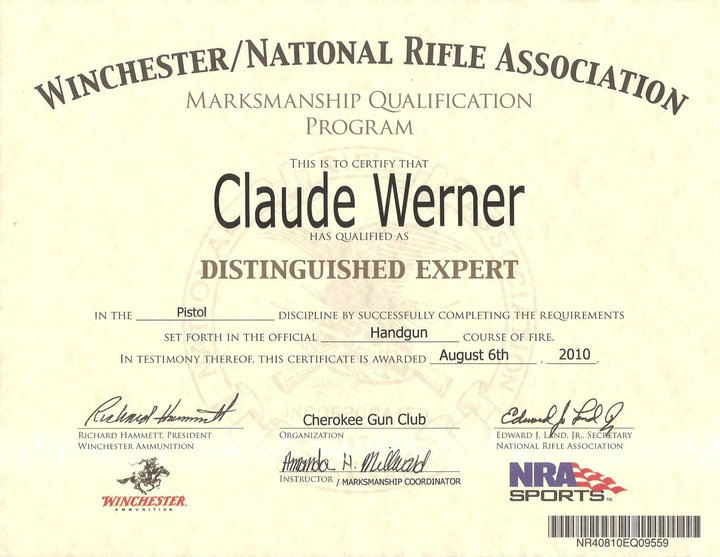
There are also awards available from the NRA for participating in the program. NRA membership is not necessary to participate. The NRA Marksmanship Qualification Program Booklet explains the entire program in detail. It is available for download from the NRA Training Division’s website.
Practice priorities for the Armed Citizen

“Sometimes it’s hard to see the forest for all the trees.”
First of all, let me say that I distinguish between ‘training’ and ‘practice.’ Training is something you do with someone else’s guidance and, hopefully, observation, if it’s a physical skill. ‘Practice’ is something you do on your own.
Training, therefore, is generally structured by the trainer. However, you as the individual decide what training program you choose to undertake. Practice, on the other hand, is generally structured by an individual, although it may include a program set up by a trainer.
In either case, we have to establish our priorities of what our program is going to be. That can be a more involved process than we realize. It’s easy to be sidetracked either by what we enjoy, regardless of its relevance, or by what others tell us is significant, without establishing its importance in our skillset.
The first shooting by an Illinois Concealed Carry License holder provides an example. It’s great that he was able to run off his attackers. It’s not so great that he launched several bullets that missed the criminals and ended up who knows where in a densely populated urban area. We really can’t hope that the “Big Sky, Little Bullet” concept is going to work out for us. How much different is that than ‘celebratory gunfire’ that sometimes has tragic consequences? Not much, in my opinion.
At the end of a recent Handgun Fundamentals course, I was asked “where do we go from here?” For the person who has recently acquired a pistol for defense, a good start is the NRA’s Defensive Pistol I Courses of Fire. It is a well structured and incremental approach to skill practice. It is self paced and can be shot on your own.
For the person new to carrying a weapon, the NRA Defensive Pistol II Course of Fire is an excellent regimen. Most State Weapons Carry Qualification Course don’t require drawing from a holster and many forbid it. The NRA course provides a standard that those who carry weapons should strive to be able to meet. What I like about it most is that it is a 100 percent standard, not 70 or 80 percent like a qualification course. We need to accustom ourselves to the concept that if we shoot at a criminal, ALL the rounds we fire must hit the target. That’s being responsible.
Most people have to limit their livefire practice to indoor ranges where drawing from the holster is not allowed. This presents an issue to those who carry pistol in holsters. There are solutions, though.
Like many of my colleagues, for a long time I said the hard part of the drawstroke is establishing grip. I’ve changed my opinion on that. The hard part of the drawstroke is getting the pistol indexed on the target enough to get a good hit with the first shot. John Shaw, a World Champion shooter, clued me in to this many years ago. Note that I didn’t say a ‘perfect’ hit.
Indexing the pistol to the target (presentation) is easily practiced from a high ready position starting at the pectoral muscle of the body’s dominant side. Starting this way is not generally a problem at an indoor range. And since I recommend practicing one shot per presentation, the ‘no rapid fire’ limitation at many indoor ranges isn’t an issue either.
The initial NRA DP II standard is to hit within the 8 ring of a D-1 target at seven yards with one shot in five seconds. The Pro-Marksman rating requires this to be done 20 times. The 8 ring is 12 inches in diameter. I personally prefer to tighten the standard to the 10 ring, which is 8 inches in diameter. If practicing from the high ready, the time standard needs to be cut down to something like four seconds, which is still very generous. Once shooters meet the initial level (Pro-Marksman) of the Defensive Pistol courses, they can work their way up the succeeding levels of the Program.
Whatever practice priorities you may choose, NRA DP or other, make a conscious decision about them. Just because you read in a gun magazine, on the Errornet, or I say it’s the thing to do, doesn’t mean it’s right for you. Look at what happens to people in your walk of life and think about your lifestyle. Then adapt your practice priorities to your life.
 tacticalprofessor
You must be logged in to post a comment.