Mindset and Decision Making
Then I guess it will just be time for him and me to be with Jesus.
Caleb Causey of Lone Star Medics related a mind-boggling story recently about one form of mindset. He posed questions to some friends in the context of encountering two burglars in their home. The concept of giving scenarios and asking people questions about their anticipated reactions is often far more effective than pontificating about what they ‘need’ to do.
The friends are a couple who have a 10 year old son. The wife is a petite woman who is a practitioner of boxing; good for her. What Caleb did was to posit a scenario of initial violence and asked her what she would do. She replied she would fight them. Since the scenario was two burglars whose combined weight was three to four times hers, he continued escalating the scenario in his questions. In the event her resistance was overcome by the two burglars, the sequence of escalation he gave was:
- her being badly beaten in the fight,
- her being raped,
- her child being raped,
- both of them being murdered.
The lady’s reply to the escalation of murder was the above quote about ‘being with Jesus.’ She apparently had accepted that as an outcome. However, her husband, who was listening to the conversation, did not find that acceptable. At the time of the conversation, they owned no weapons, other than perhaps a butcher knife. While butcher knives can be used to defend one’s family, especially when wasp spray doesn’t work, it’s unpleasant and quite messy. The questions and subsequent conversations led to a better understanding of their options and possible decisions for defending themselves.
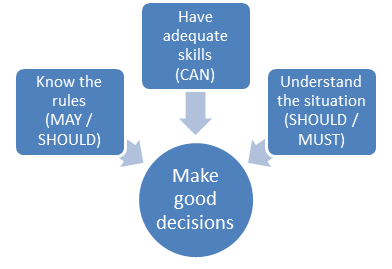
A few days later, I related the story at dinner to another friend. His comment was “people with that kind of mindset really don’t understand what the events leading up to ‘being with Jesus’ are going to be like.” The beginning (assault) and end (being with Jesus) can be grasped but the process in the middle is much harder for people to understand. The Petit family murders are an example of just how horrible the process can be. I’m not sure if Caleb had the Petit murders in mind as he was talking to the couple but his sequence of events was very similar to the horrors the Petits were subjected to.
It’s hard for good people to understand the depravity that exists inside many criminals. That’s the main reason I teamed up with William Aprill for our Violent Criminals and YOU course. The more decent a person is, the harder it is for them to grasp just how evil and FITH some criminals are. A mental health professional is in a better position to describe that than a trainer who teaches physical skills. It’s also why we’re offering a discount when bringing a family member; family members are part of the decision process.
My friend at dinner also made the comment “Two days sitting in a classroom is a long time and might be tiresome.” That’s understandable, which is why William and I are teaching in alternating two hour blocks of instruction. I’ve taken many many weekend classes and I know hearing the same voice continually for 16-20 hours can be a chore, regardless of how engaging the instructor is. Splitting it up will help keep things from being monotonous in our class.
He and I also talked about teaching decision-making. For a long time, I have had reservations about how the industry teaches decision-making. He’s been to a Force on Force class I was a role player in for many years, so I asked him “In the crawl/walk/run training progression paradigm, where does Force on Force fit?” “Run” “How many repetitions of decision-making did you get in those eight hours of training?” “Six or seven”
His answers reflect my reservations about our current methodology. Giving students a few ‘Runs’ with a simulated gun in a FATS machine or with live role players does not represent a particularly effective adult teaching methodology, in my opinion. What we essentially do is throw someone in the deep end of the pool a couple of times and then call them a combat swimmer. ‘What’s wrong with that picture?’ as the saying goes.
To improve on this, I have devised a process where students will get dozens of repetitions of decision-making with the full range of the personal protection options available to them in a few hours. The patent application for the process is not yet complete, so I’m not at liberty to disclose more than that. I can say it will be an experience unlike anything else in the industry. Because the full range of options will be available, the process is NOT limited to gun owners. Excluding the full range of options is a major weakness in our current methodologies and my process corrects that. Family members may have a different opinion about what the appropriate options and decisions are, at least for them.
Mindset and decision-making; think about them hard, regardless of what training you choose or choose not to take. My research into Negative Outcomes has made me realize how much more important they are than the weapon or caliber debates the gun community loves to indulge in.
I have a friend who will kill you with a .25 Lorcin and there’s nothing you’ll be able to do to stop him.
–a well-known and respected trainer
Interview with a future criminal
I hadn’t planned on having a real life example of Know the Rules in relation to Decision Making but sometimes life gives us opportunities. In this case, it didn’t concern legal rules but social rules.
Out on my walk this morning, I had an interesting encounter with a future criminal, perhaps several potential criminals. It brought to mind something that I mentioned in my guest lecture at The Complete Combatant last weekend. Know the Rules, including the rules of the criminal interview.
The setting was a typical suburban area with sidewalks on both sides of a two lane arterial street. Three middle school aged boys were walking toward me on the sidewalk. There’s nothing unusual about that, although the time was a little late to be going to school. They were twenty to thirty yards away from me. When I first saw them, they had just passed the traffic signal on the corner I was walking toward.

As soon as I saw them, I identified them as Green shoes, Red shoes, and Brown shoes. This is a habit I got from Jimmy Cirillo, as he mentions in his book Guns, Bullets, and Gunfights. I don’t even know if it has any general value but it’s fun to me. A variation of the technique worked very well for me during one stage of an IDPA Championship that had a multiple moving target array.
As they walked along the sidewalk, they stepped aside in the bank driveway and had a pow-wow. Right away, I knew something was up. Secretive pre-contact activity is a clue. Then they got back on the sidewalk and started walking again.

I made an immediate decision. Although I had both a pistol and pepper spray on me, this was unlikely to shape up as a situation where those would be the appropriate tools. “If he pulls a weapon, I’m going to grab it from him or grab his hand and twist his arm to give him a radial fracture.” In any criminal encounter that I can’t avoid, my primary objective has evolved into “I’m going to fuck you up. Win, lose, or draw, you’re going to have to go to the Emergency Room.” Then those difficult and uncomfortable questions by the police begin.
As we closed, Mr. Green shoes, the largest, made the approach. Mr. Red shoes and Mr. Brown shoes looked younger and were noticeably smaller. Green shoes was clearly the Alpha in the group.
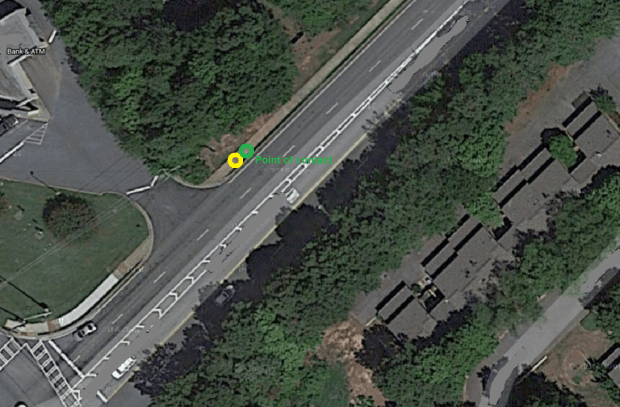
His initial approach was so tentative I couldn’t hear what he said. That set the tone for the interview. Clearly, he wasn’t practiced at his craft, so I could have a little fun with the situation.
“Excuse me?” was my response. This was in a decisive firm voice. Something criminals are looking for is indecision. If you don’t display it, they frequently don’t know what to do. As I said it, I started to rub the palms of my hands together. This isn’t an unusual gesture but it pulls the hands up into a low fence position.
“Do you have any money? I’m going to …..”
Before he could even finish, I cut him off. “No, I don’t” and put my left hand up to accentuate the point. The hand up would have allowed me to block or divert a weapon if he had produced one. Then, I immediately started back on my way and left them in the dust. Once again, decisiveness is key. I.e., ‘this interview is over.’ I kept an eye on the shadows to make sure they didn’t follow, which they didn’t. One of the reasons I like this walk route is that the sun is at my back and throws the shadows where I can see them.
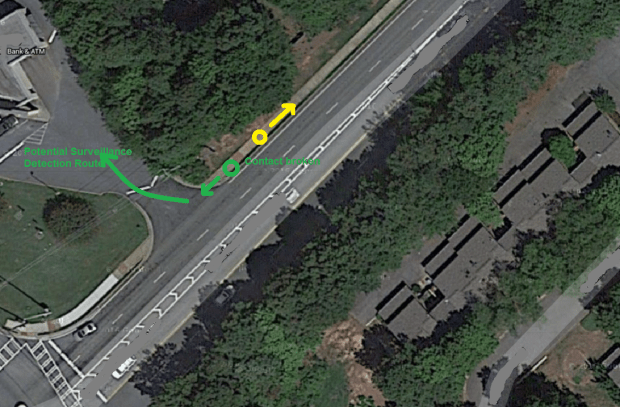
There’s no doubt in my mind that Mr. Green shoes will graduate to full-fledged robbery, either strong arm or armed, fairly soon. Probably in less than a year, he’ll go for it. He was just getting accustomed to his skills, much in the way boys play catch before they start actually playing baseball. Since I didn’t interact with Red shoes or Brown shoes, I have no opinion about their future plans.
Good points
When I walk, I don’t walk around in la-la land listening to music, talking on my cell phone, or being task fixated watching my dog take a dump. My head is up and my eyes are on the horizon. Consequently, I saw them at a distance and had time to adjust my Awareness and mental DefCon appropriately. This is also a good approach to driving, rather than being visually fixated on the rear bumper of the car in front of you.
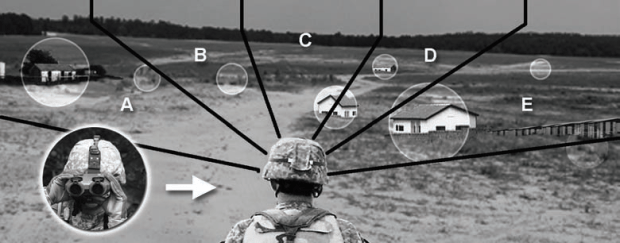
Having my hands in a low fence position would have allowed me to respond much more quickly than if they were at my sides. I prefer a low fence in general because I live in a mostly normal world. The high fence is actually a superior defensive posture but it’s weird looking and off-putting if you usually deal with benign people.
Being decisive is important to controlling the situation. If you can maintain control of the situation, you can often walk away without conflict.
Items for improvement
I let Red shoes and Brown shoes get behind me while I interacted with Green shoes. They were both small and I have no doubt I could have easily nailed either of them. But if they had weapons, the situation could have become much different. I need to practice getting into a position where I can see them all.
Taking a short ‘breather’ a few steps after breaking contact would have allowed me to maintain surveillance on them and be sure they had continued on. Or turning off route and going into the bank parking lot. If their moving off had been a feint, watching them or eluding them would have precluded them from bum rushing me from behind.
For whatever reason, the eggs I made when I returned home tasted even better than usual.
Friday Fundamentals – Getting our priorities straight
The attacks in Paris by Radical Islamists have captured the attention of the world and obviously people in the United States. Over 100 people were killed and several hundred more were wounded. Along with many people, I mourn for the casualties of these horrific and barbaric events.
In the aftermath, numerous articles are being written about surviving active shooter events, etc. In addition, some folks are saying they’re going to make some massive changes in the way they socialize. It’s always good to examine our vulnerabilities. However, let’s look at things in perspective.
In 2014, the estimated number of murders in the [United States] was 14,249.
In 2014, there were an estimated 741,291 aggravated assaults in the [United States].
There were an estimated 84,041 rapes (legacy definition) reported to law enforcement in 2014.
The FBI definition of Aggravated assault is:
An unlawful attack by one person upon another for the purpose of inflicting severe or aggravated bodily injury. This type of assault usually is accompanied by the use of a weapon or by means likely to produce death or great bodily harm. Simple assaults are excluded.
As my colleague Tom Givens has mentioned, one reason the murder rate has declined in the past few years is because of the advancement of emergency medicine. People who would have been murder statistics a few years ago are often aggravated assault statistics now. That doesn’t mean their bodies and lives haven’t been changed forever because of the assault.
While it’s popular to believe that most murders are committed by gangbangers killing each other and we should just say ‘good riddance,’ that’s not necessarily the case. Where the data is available, the Bureau statics indicate that strangers or unknown persons accounted for 57 percent of murders.
When considering clearances of violent crimes, 64.5 percent of murder offenses, 39.3 percent of rape offenses (legacy definition), 38.5 percent of rape offenses (revised definition), 29.6 percent of robbery offenses, and 56.3 percent of aggravated assault offenses were cleared.
‘Cleared’ means someone was arrested for the crime, not necessarily even convicted. Fully one-third of murders in this country don’t even result in an arrest. Nearly half of aggravated assaults don’t even result in an arrest. Almost two-thirds of the reported rapes don’t result in an arrest. If you become the victim of a violent crime, there’s a good chance the only ones affected will be you and your loved ones.
Relatively speaking, our chances of being criminally victimized are massively higher than becoming a casualty of a terroristic attack. Over 800,000 people in this country had their lives changed forever last year by ‘ordinary’ crime. That’s what we need to maintain our focus on.
For instance:
- Are all your doors and windows locked at night and do you keep your security system on all the time?
- Do you always make people aware you’re in the house when they knock?
- Have you ever opened your door to someone without checking the peephole to see who it is?
- Do you walk or run with your earphones in while listening to music?
- Is there a safe or lockbox in your car to put your pistol in when you can’t take it in with you to the courthouse?
- Do you make a short security halt to observe the parking lot when you come out of a store?
- How often do you text or check Facebook on your phone while you’re in a transitional environment like a parking lot?
- Do you ever park your car in the closest spot to the door of a store without regard to who’s around or what kind of vehicle you’re parking next to?
- You know all the little security violations that you make. Eliminating them is probably more useful than starting to carry an another magazine of ammo.
Another thing to consider is our usage of automobiles and just how much danger we place ourselves in when we drive. Being in a motor vehicle may well be the second most statistically significant voluntary danger we face, exceeded only by going to the hospital.
According to the National Highway Transportation Safety Administration, US car crashes killed 22,383 vehicle occupants in 2013 and injured 2,099,000.
Tactical firearms training is a lot of fun. Tactical medicine classes are very informative and might be more useful than a firearms course. But when was the last time you took a Defensive Driving Course? Some insurance companies offer online versions for free. Most insurance companies lower your premium for taking the DDC. In my state of Georgia, the class is 6 hours and costs less than $40 if you don’t have to take it because of getting a ticket. You put your life in danger every time you get in your vehicle. Don’t you owe it to yourself and your family to become a safer driver? The Situational Awareness tuneup will carry over into other areas of your life, as well.
It’s easy to get caught up in the latest horror of the week that the Lame Stream Media shoves down our throats and we then propagate among ourselves. Let’s use it as a reminder to examine all the safety risks we face. The latest event is probably way down the priority list if we dispassionately look at the many dangers we face every day.
Friday Fundamentals – Boundaries
Up until now, Friday Fundamentals has focused on mechanical issues. This issue is going to focus on mental processes. An incident that was in the news recently drives the discussion.
“It scared me absolutely to death,” said Sherry McLain. She was loading groceries into her car this past Saturday in the crowded Walmart parking lot on Old Fort Parkway in Murfreesboro.
That’s when a strange man approached, surprising her, and she pulled her revolver. “I have never been so afraid of anything in my whole life I don’t think,”
Woman Arrested After She Said She Pulled Gun In Self-Defense
There are a number of problems here that led to her arrest.
- Her level of fear was irrational. Witnesses and surveillance cameras confirmed that the man simply spoke to her from 10 feet away.
- Being startled and being legitimately rationally afraid are two entirely different things.
- She doesn’t understand the difference between setting boundaries and enforcing boundaries.
- Because she doesn’t understand the difference, she didn’t comprehend that when we are defending ourselves, there’s a hierarchy involved. First, we set the boundary and then we enforce it, not vice versa.
- As a result, she now has another issue; the criminal justice system. She was arrested for aggravated assault and reckless endangerment. Based on the current information, I doubt that will go well for her.
Let’s make something clear at the outset, when you pull a gun on someone, you’re threatening to kill them. It doesn’t matter whether you say a word or not, you’re threatening to kill them. Some people apparently don’t understand that and the gravitas it carries. You better have a good reason for doing so. Irrational fear is not a good reason. Simply being startled is not a good reason.
The question of how this might have been avoided brings us to the issues of controlling fear, setting boundaries, and enforcing boundaries.
Controlling fear is a complex topic that is not often discussed in the training community. If anything, the community tends to promote fear, “I was in fear for my life” having become almost a mantra. The woman in the incident invoked it but the police were unimpressed. The difference between reasonable fear and irrational fear is frequently left out of that discussion. It’s somewhat pathetic that there’s better literature in the competitive swimming community about how to control fear than there is in the self-defense community. Learning to control fear is a process beyond the scope of a single blog post. It behooves those who carry deadly weapons to do some research on the topic.
The next issue is boundary setting and boundary enforcement. This is a process more easily trained than controlling fear. Boundary setting and enforcement are simply elements of a process. All we need to do is understand the process and practice it.
It’s important to understand that we set boundaries with communication and barriers, not with tools. The communication can be either verbal or non-verbal. The most obvious form of barriers are the homes we live in, assuming the doors and windows are closed and locked. If a criminal fails to respect the boundaries we set, then we use tools, in this case weapons, to enforce the boundaries. We don’t use tools at the outset to set our boundaries.
One of the biggest issues we have as a society is that we have forgotten or gotten out of the habit of saying NO! That can be done either verbally or non-verbally. Training to say NO! should be a primary lesson in every class on personal protection and people should practice it on a regular basis. Simply raising an outstretched hand and shaking the head can accomplish a lot. Keep in mind that a great deal of communication is non-verbal; we can use that fact to our advantage.
A proper sequence that would have kept this woman out of trouble might be as follows:
Recognize that being startled is not the same as being afraid. She was startled because she was task fixated on loading her groceries in the car, i.e., she had not one bit of situational awareness. Most people are like that. In this sort of a situation, looking around before you get to the car, as you arrive at it, and then after loading each bag goes a long way toward avoiding being startled. Positioning the car for safety helps too. In the sense of color or awareness codes, she was in White or Unaware.
If she had been in Yellow or Aware and seen him approach, there’s nothing wrong with being proactive and raising the hand in the ‘stop’ gesture. That’s the first step in setting a boundary. Her mental state at that point could be described as Orange or Alert.
And yes, at this point, we could invoke the boogeyman of ‘The 21 foot rule’ that Dennis Tueller himself says has become terribly misconstrued. But the circumstances where a criminal runs up to someone in a WalMart parking lot and slashes their throat are far less common than ‘incrementing,’ which is a standard way for criminals to operate. Whether those throat slashings are in fact, reality or figbars of overactive imaginations remains to be seen.
If the person continued to advance, a default verbal response of ‘Stop, don’t come any closer’ clearly sets the boundary. Any decent person would stop at that point. If the person doesn’t stop, it’s an indicator that something nefarious is developing. The mental state shifts to Red or Alarm. Once the intent of the other party becomes more clear, then we can make a decision about which tool we want to employ to enforce the boundary. We can also determine what barriers we might employ in the process. That, too, is a discussion for another time. The boundary setting and enforcement decision process is what’s important in this particular case.
Another thing to consider is that any time we get a gun out for defensive purposes; be that from a holster, purse, nightstand, safe, or whatever, there’s a possibility it’s going to be fired, either intentionally or unintentionally. The more scared we are, the higher that possibility. Therein lays one of my chief objections to brandishing, which is what the lady did; the possibility it will culminate in a Negligent Discharge.
Since thinking about the ‘worst case’ is something many people like to do, let’s examine the possibility of a Negligent Discharge in this situation. Say the woman had an ND as she pointed her revolver at the man or the other people present. It’s probably a good thing for all of the parties involved that she had a revolver and not a striker fired autoloader. If her irrational fear had caused her to have an ND, what would be her eventual statement in court? Something to the effect of “He asked me for a light, I was scared so I drew my pistol, I had an Accidental Discharge, which resulted in a death. It was an accident.” Most likely, she’d go up the river for Manslaughter. Fortunately, that particular Negative Outcome didn’t happen. What did happen was the Negative Outcome of ‘Police Involvement,’ to wit, getting arrested.
If this lady had understood the awareness and boundary processes and then used them properly, she probably would have gone home instead of getting arrested. That’s something for all of us to consider.
Law Enforcement Officers Killed Audio CD
Annually, the FBI publishes the Law Enforcement Officers Killed and Assaulted report. A key part of this report is the written Summaries of the circumstances surrounding the death of each Officer Feloniously Killed.The FBI provides a concise account of the individual incidents where an Officer(s) was killed.
One of the things I have been unhappy about when training LEOs is finding out how few read the Summaries. I ask every LEO class how many have read LEOKA and almost all the hands go up. But when I ask how many have read the Summaries, almost all the hands go down. While the tabular data in LEOKA is interesting, the Summaries give much more insight into the circumstances of how Officer deaths occur and provide context on how to avoid becoming a victim Officer.
In order to make these Summaries more accessible to the Law Enforcement community, I’ve recorded the 2013 Summaries as audio narratives on an audio CD. Each Summary is narrated individually for your listening convenience. In addition, audio narratives of a number Officer killings not reported by the FBI are included. For supervisors, playing a few of the Summaries at roll call could be a sobering way to put your Officers in the right state mind for their shift. For individual Officers, listening to a few of them on the way to work may help you get mentally tuned up.
The LEOKA Narrative audio CD can be purchased on my webstore. There’s also a link at the top of my blog.
Putting Orient Back into OODA
The latest edition of The Tactical Wire is the Concealed Carry Special Edition. It includes an article about the OODA Cycle that I authored.
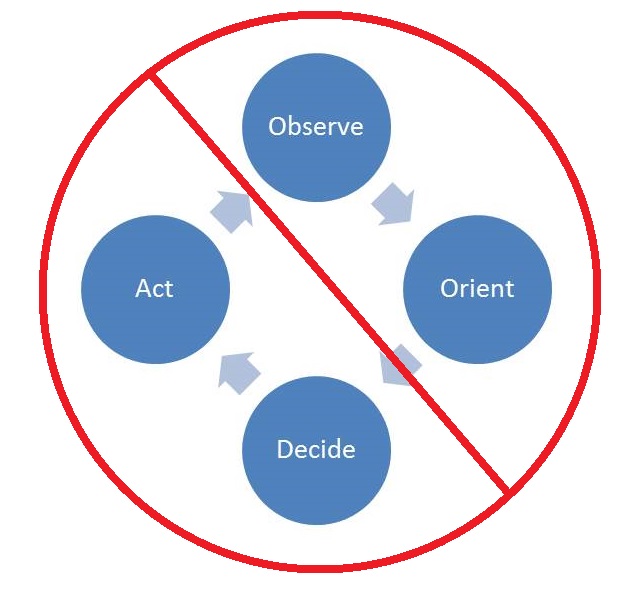
The OODA cycle, frequently referred to as the OODA Loop, was developed by the late Colonel John R. Boyd, USAF. The OODA cycle has subsequently become highly influential in thinking about how to conduct combat operations at all levels from the tactical to the grand strategic. It is often simplistically depicted with only four components in a circle, although that hardly does justice to the depth of Boyd’s thought.
What it’s not is what is so often pictured.

A better way to look at it would be this:
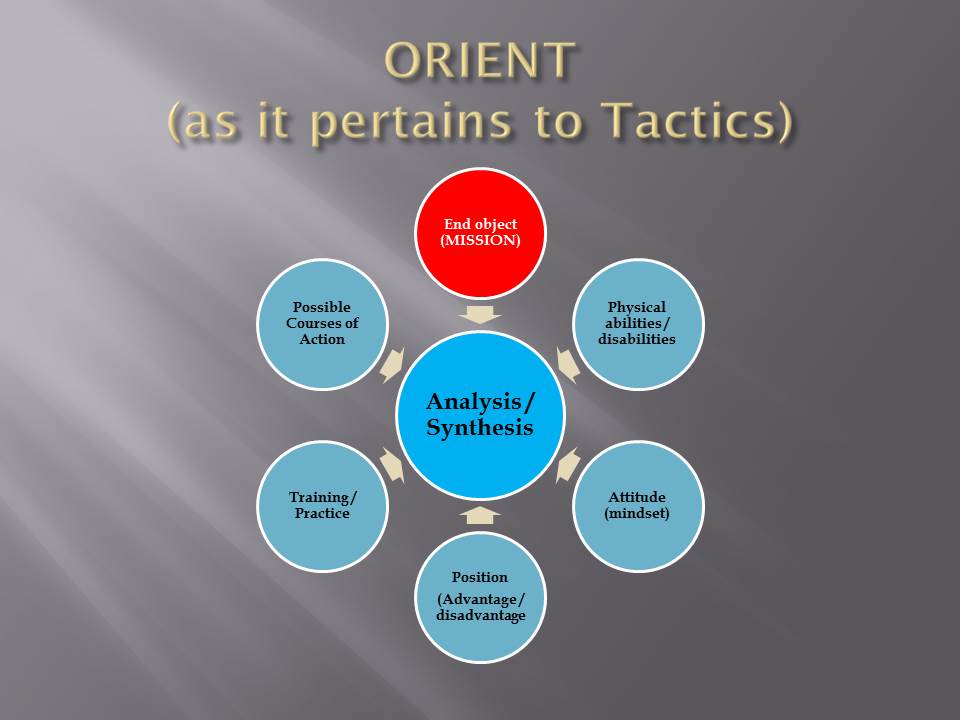
The article is my explanation of why. There are several other good articles also.
http://www.theoutdoorwire.com/specials/ccse2015/feature.php?id=229663
Situational Awareness and Positioning (part V)
In every encounter, there is an element of chance.
–John Hall, former head of the FBI Firearms Training Unit
In previous parts of this series (I-IV), the concept discussed was physical awareness and positioning in relation to an adversary or situation. A recent incident captured on video relates to a different but similar concept: emotional awareness and positioning.
In the incident, a veteran observed a bum aka ‘homeless person’ wearing a mixed service uniform while panhandling. He was justifiably incensed, as would be most veterans. “I was angry. I was frustrated. I was sad” he said. I don’t blame him. However, what resulted from his feelings was neither smart nor legally justifiable.
The veteran aggressively challenged the bum from a distance, then closed with him, pursued him across several lanes of traffic, and continued to pursue him on the other side of the boulevard. As the incident unfolds, the bum tries to disengage, is verbally apologetic, and changes direction several times attempting to escape. The entire time the veteran is loudly shouting, verbally forces the bum to remove part of his clothing, and then blocks the bum’s escape path. The incident went on for several minutes.
While I sympathize with the veteran’s frustration, the simple fact of the matter is that he let his emotions get away from him. A couple of relevant declarations made at this year’s Rangemaster Tactical Conference come to mind.
- John Hearne, in his presentation Performance Under Fire, made the statement “You’ve got to keep your emotions under control.”
- My colleague Nick Hughes mentioned to me in conversation a question he poses in his book, How To Be Your Own Bodyguard. “Are you doing this because you have to or because you want to?” He then related a personal anecdote where a person had to remind him of his own question.
When the veteran/bum video was posted on Facebook, I had two responses.
- Good way to get stabbed.
- Regardless of what I was doing, if someone acted toward me the way the veteran did toward the bum, I would have painted him orange in a New York second. And the police would have then told me to have a nice day. It was aggressive challenging behavior that anyone would be justified in feeling threatened by (although not sufficiently to employ lethal force, which is why I advocate always carrying pepper spray).
If we go looking for trouble, we had better be prepared to find it. Make no mistake: verbally challenging someone, shouting at them, chasing them, forcing them to remove their clothing, and then blocking their escape route is looking for trouble. Such a situation always has branching possibilities (if, then, else) that people don’t generally consider before jumping over the edge of the cliff.
- If the bum had pulled out a knife, then what would have been an appropriate, or even possible, response at that point? I make the assumption that all itinerants I encounter are armed with some kind of weapon.
- What if the bum had run out in front of a car and been struck and killed?
- What if a car had hit the vet while he was chasing the bum across the street?
- What if they had gotten into a physical conflict and ended up rolling around in traffic?
There are other possibilities also, but those are good examples of possible Negative Outcomes well within the realm of possibility. In any of those cases, the situation would have gone downhill for the vet like an avalanche.
So, let’s go back to Nick’s question: was the vet doing this because he had to or because he wanted to? That answer is quite clear, he wanted to. He felt the need to defend the honor of his service and the service of his fellow veterans.
Unfortunately, it’s very hard to provide a legal, or even moral, justification for using force to defend honor. Even if no legal repercussions arise, moral ones can. If the bum had run into traffic and been struck and killed, how do you think the veteran would have felt for the rest of his life, even if no charges were filed against him?
John Farnam’s saying “Avoid stupid people, stupid places, and stupid things” is definitely apropos in this situation. All three of those elements were broken. Jeff Cooper alluded many years ago to the fact that the more ‘rules’ we break simultaneously, the more possibility we will incur a problem. When we lose control of our emotions, that’s when we start unconsciously breaking rules, whether they are legal rules or just rules of good judgment and conduct.
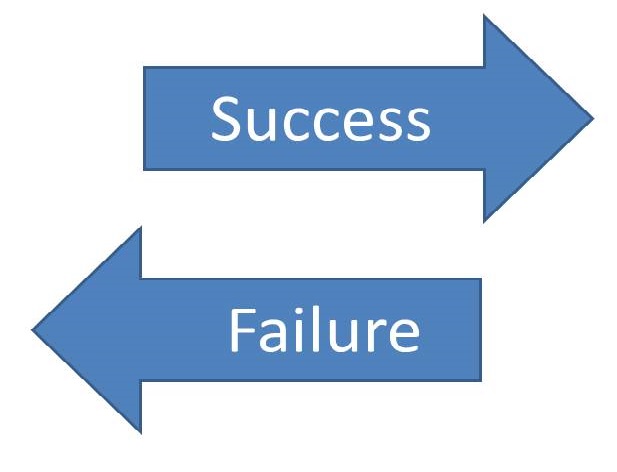
With every decision we make, we are setting ourselves up either for success or failure. Keeping a check on our emotions helps set ourselves up for success. Letting our emotions get out of control is good way to set ourselves up for failure.
Not thinking things through
A completely irrelevant post on Facebook (a new flamethrower) brought something to mind that I hadn’t thought about in a couple of decades. It relates to the concept of defining the mission, desired outcome, and possible consequences. Those are things integral, yet unstated, to the Orient phase of the OODA process and fundamental to achieving success.
Most discussions about OODA get caught up in the speed aspect, which is actually a tertiary part of the process. It’s not just a simple speed-based looping cycle, as is often depicted.
Years ago, I had a friend who didn’t care for guns but kept a flare pistol for home defense. She mentioned this to me in conversation. Her logic was that she didn’t want to kill someone. My response was “So you don’t want to kill someone but you’re okay with launching something into him that burns at several thousand degrees and might burn your house down?” She said she hadn’t thought about it that way. It certainly would have been possible for her to Act quickly but would it have been a good decision? I don’t think so.
It’s easy to get caught up in a linear process from the starting point without looking far enough down the path to a likely result and consequence. One component of Awareness is to keep your head up and look far down the road, just as you should when driving, rather than being fixated on the bumper in front of you.
It’s important to note that what is considered the most successful recent example of Boyd’s thinking was the planning of the First Gulf War. It took months and involved several different iterations of the strategic plan. In Boyd’s original hand drawn diagram of the OODA process, he actually had three different loops; one depicting planning, one depicting execution, and a third showing an overlay of the previous two. The third version is the popularized full diagram but it obscures the importance of the analysis/synthesis part of the process. There are many inputs necessary, including consequences, before an effective decision can be made. That planning is what makes rapid, effective Action possible.
Keeping in mind the desired outcome has to always be part of our decision-making. ‘Outcome Based Decision-Making’ should be an integral part of our thought process. As they said in DEA:
Focus on the object, not on the obstacle.
Lima Goes to Hollywood and The Power of the Grey Man
There’s a lot to being a grey man. Many worthwhile observations in this post.

Amidst all the media attention surrounding my Babywearing and Carrying class was a call from CBS’s show, “The Doctors.” They thought my class was interesting and wanted to fly me out to California to talk about it. It took me a few days to get to the place where I decided to take the trip. I said yes on Tuesday, had a travel itinerary on Wednesday night and was on a plane on Thursday.
This is the first solo trip I’ve taken in a very long time to a destination that doesn’t include rendezvousing with friends or family or a firearms class.
No lie, the idea of two days in Hollywood by myself was very appealing though the reminders to be careful started in earnest along with concerns of, “Aren’t you nervous to be traveling by yourself?”
I don’t subscribe to that kind of worry and fear. Lots of people…
View original post 1,365 more words
Grace at Night
[This lady]
“made a list of ten factors that can make an incident traumatic. Eight of the ten happened [in their incident]:1. In your home
2. In the presence of children
3. Prolonged
4. Death and rape threats
5. Guns
6. Theft
7. Beating
8. Shots fired
9. Rape
10. Murder”

One week ago our family went through a harrowing, life-changing experience. This is how my husband described last Tuesday evening in a prayer update:
Last night at about 9:45 pm at our house, Caleb announced to Amy and I as we worked on a paint job in the children’s room that three men had just entered our back door. When I got to the door, I saw two guns brandished among the three criminals. Though we offered all our money and goods to them they beat me and hit Amy twice.
We are praising the Lord that after about 15 minutes wherein they tore the house apart, we were able to chase them away. They took some material possessions, but our lives and honor were spared because of the good hand of our God who placed a wall between our lives and their weapons.
Tomorrow, we are taking a…
View original post 1,710 more words
 tacticalprofessor
You must be logged in to post a comment.