Decision-making in the Kimball shooting
I am 62 and not nearly as strong as I once was. So long as he is only shouting, that’s where it will stay. Touch [me], I’m too old to fight. I will shoot.
An Internet Common Tater
Merrill “Mike” Kimball encountered one of the worst Negative Outcomes, being convicted of murder. Leon Kelley experienced the worst of them all, getting killed.
There are a number of items relating to decision-making, both during the confrontation and preceding it, that bear discussion in this case. Decisions are often made based on attitude and feelings, rather than facts. Most gun control arguments are rooted in feelings and we gunowners belittle anti-gunners for that. However, don’t think that the same reliance on fact rather than feeling can’t come back to haunt us in the courtroom.
An aspect of the Kimball shooting that I find interesting is that the ‘disparity of force’ aspect swayed the jury not at all. Leon Kelly was half a foot taller and outweighed Merrill Kimball by over 100 pounds but the jury didn’t care. The above Common Tater has the same attitude Mike Kimball displayed on October 6, 2013. Unfortunately, the jury didn’t see it that as a justification. A fear of serious bodily injury has to be seen as ‘reasonable.’ As a Maine defense attorney wrote on his blog
note the use of the word ‘reasonably’ [in the Maine statute]. Whimsical or irrational beliefs attributed to the defendant do not suffice.
Just because some of us are older (I’m 60) doesn’t mean we can think every assault is cause to respond with deadly force. This is why I tell every Defensive Pistol class I teach:
Failure to have an Intermediate Force option implies that all you are willing to do to protect yourself and your family is kill someone. That’s not a position I care to put myself in, nor should any rational adult.
For now, I’m not going to address the wisdom of even going to the scene of the confrontation, all things considered. However, if Mr. Kimball had carried a can of pepper spray with him, he probably wouldn’t be facing the probability of spending the rest of his life behind bars. I hear many objections to carrying pepper spray. Without exception, they are foolish, yet speciously alluring. As the prosecutor commented about the Kimball case:
People have a right to carry firearms, but the law only provides for use of firearms in defense in very limited and particular circumstances, and this was not one of them.
I would much rather carry a can of pepper spray than a spare magazine or a defensive knife. The chances you will need a spare magazine are infinitesimal. The reasons I hear for carrying a spare magazine tend to be:
- Carrying an extra implies you know what you’re doing.
- That you know that most semi-auto malfunctions are mag-related.
- That you know to top off after the fight.
- That you know that 6 rounds of .380 isn’t that much.
- That there might be another adversary.
The chances you will need a non-lethal response to an ugly situation are much higher than any of those reasons. Being shoved, even repeatedly, is not sufficient legal provocation for a killing. Even if it was, do you want to kill someone in front of your wife and son, as Mr. Kimball did, unless it’s absolutely necessary? But if all you have is a hammer, everything looks like a nail.
Ponder the implications the next time you strap on your heater.
Cells in Alcatraz prison, San Francisco, California
Author William Warby from London, England
Anatomy of a Negative Outcome
I’m shocked because I thought the case was a question of manslaughter. Hung jury, possibly guilty of manslaughter, but more likely ‘not guilty.’ It just seemed to me that the relative sizes of the two people made it clear that my client was in a jam that he couldn’t get out of except to use a firearm.
So said the defense attorney for Merrill “Mike” Kimball after his client was found guilty of murder for fatally shooting 63-year-old Leon Kelley in 2013. Obviously, things did not come to pass the way he thought they would. Regardless of the outcome of an appeal, being convicted of murder is a Negative Outcome.
Cast of characters for the drama:
- Stan Brown – 95 year old owner of Brown’s Bee Farm
- Karen Thurlow-Kimball – shooter’s wife. Managed the farm and sold the honey
- Merrill “Mike” Kimball – shooter (5 feet 11 inches tall, 170 pounds)
- Damon Carroll – Thurlow-Kimball’s son
- Daniel Lilley – Kimball’s attorney
- Leon Kelley – victim (6 feet 4 inches tall, 285 pounds)
- Kathleen Kelley – victim’s wife, Stan Brown’s daughter, and witness
- Craig Rawnsley – Kathleen Kelley’s son (6 feet 2 inches tall, 205 pounds)
- Robin Rawnsley-Dutil – victim Kelley’s stepdaughter and witness
- Daryl Rawnsley – deputy chief of the Cumberland Fire Department
- Libby Adams – Brown’s daughter-in-law, bookkeeper for the bee business
- Matthew Crockett – Assistant Attorney General
- John Alsop – Assistant Attorney General
Events preceding the day of the shooting.
- Thurlow-Kimball begins working for Brown at the farm in 2009, when Brown’s son died.
- Thurlow-Kimball becomes manager of the bee farm.
- Brown eventually includes Thurlow-Kimball in his will, leaving the bee business and a part of his property to her. The family deeply resents this.
Oct. 6, 2013
- Around 1 p.m., Craig Rawnsley calls Thurlow-Kimball and accuses her of wrongdoing. He tells her “things were going to change at his grandfather’s farm.”
- At the time of the phone call, Merrill Kimball had just gotten off his boat and gone to a friend’s house to watch a Patriots game. He drank two rum and cokes while he was there.
- Thurlow-Kimball immediately calls Brown’s daughter-in-law, Libby Adams. Adams tells her the Kelley family plans to change the locks on the bee farm sales shop.
- The shop contains about two dozen jars of honey, totaling about 700 pounds. The honey, which contractually belongs to Thurlow-Kimball, has a value between $4,000 and $7,000.
- Rawnsley-Dutil calls her mother and Kelley, her stepfather, at their home 40 miles away, and asks them to come to the farm. The senior Kelleys then drive to the Bee Farm and arrive before the Kimballs.
- Thurlow-Kimball enlists her husband and son to help her get the honey out of the shop. They drive to the shop in two vehicles.
- Around 3 p.m., Kimball and his family arrive to load the honey jars.
- Rawnsley-Dutil and her brother follow the vehicles up the driveway on foot. Kelley drives up in his 3½-ton truck with the license plate ‘AWFUL.’
- Kelley family confronts Kimball family.
- Craig Rawnsley blocks the shop door and accuses the Kimball family of trespassing.
- Kimball asks who Kelley was. The two men had never met before that day.
- Kathleen Kelley calls the police.
- Thurlow-Kimball refused to leave the property, insisting on waiting for a police officer to arrive.
- Kelley put his hand on Kimball’s shoulders, spins him around, and follows as Kimball backs down the driveway. Kimball later states that Kelley shoved him five or six times total.
- Kimball retreats roughly 35 feet being followed by Kelley until he is in the driveway nearly to the treeline. The driveway extends to his right and left, at this point.
- Kimball, who is licensed to carry a concealed weapon, draws his Ruger LCP .380, and fires three shots into Kelley’s torso at a range of 4 -10 feet.
- Kelley falls down after being shot and clutches his abdomen.
- Robin Rawnsley-Dutil immediately takes a photograph of the scene and then begins recording a video.
- Kathleen Kelley remains on the 911 call after her husband is shot.
- Rawnsley calls his brother, Daryl Rawnsley, deputy chief of the Cumberland Fire Department, for medical assistance.
- Kelley is transported by ambulance to a hospital and dies shortly thereafter.
- The state police sergeant who was the first officer to arrive at the scene said he could “smell the odor of liquor” on Kimball. Kimball did not seem impaired, other than failing to immediately respond when when the sergeant commanded him to put his hands up and get on the ground.
- Kimball maintains the shooting was done in self-defense. “The man attacked me. The man pushed me back. I was in fear for my life. I nearly fell down, and he kept coming.” Kimball’s words were captured on a police cruiser’s onboard camera.
- Kimball is questioned but not arrested.
November 2013
- A video re-enactment is recorded by Kimball at Brown’s Bee Farm on November 4.
- Kimball is indicted on the charge of murder.
- He posts bail and remains free.
April 2015 (not necessarily in chronological order)
- Kimball rejects a plea offer to manslaughter before the start of the trial.
- The trial commences on April 6, 2015.
- The prosecution contends that Kimball could have continued to retreat by turning left or right down the driveway rather than shooting.
- Maine is one of 16 states whose self-defense laws require retreat for as long as safely possible before using deadly force.
- The prosecution alleges that Kimball took a concealed pistol and an extra clip [sic] of ammunition to Brown’s Bee Farm because he expected trouble from the Kelley family.
- Kelley family members admit in court that Thurlow-Kimball was not trespassing and that they had no right to tell her to leave.
- Members of the Kelley family make several contradictory statements about the events leading up to the shooting.
- Rawnsley-Dutil states that Kelley put his hand on Kimball’s shoulders shortly before the shooting, spun him around and followed Kimball as he backed down the driveway. She admits Kelley may have shoved Kimball additional times.
- Craig Rawnsley admits he put his hand on Carroll’s shoulder to stop him from moving and states “Damon (Carroll), he is not as big as me.”
- Assistant Attorney General Alsop describes the shooting as: “Bam. Bam. Bam. There was no pause. Merrill Kimball fired three rapid shots right in the middle of Leon Kelley.”
- The video re-enactment recorded by Kimball is played for the jury.
- The state’s chief medical examiner testifies that the first shot had most likely felled Kelley. He also stated that “All three of these were potentially fatal.”
- The cellphone photo taken after the shooting is shown to the jury.
- Craig Rawnsley testifies that Kelley wouldn’t have “escalated the situation” if he had known Kimball was armed.
- Defense Attorney Lilley says “They brought him [Kelley] along because he was mean and he was a badass. They brought him along because he was big.”
- “The issue for me in this case is there were three shots fired and whether he was acting in self-defense in all three shots or less,” said Justice Roland Cole.
- The jury deliberates for six hours over two days. They have the options of finding him guilty of murder, manslaughter or acquittal.
- The jury finds Kimball guilty of murder on April 15, 2015.
- The possible sentence is 25 years to life in prison.
- Kimball is taken into custody.
- Kimball’s lawyer indicates the intent to appeal, which cannot be filed until after Kimball is sentenced. Sentencing will be scheduled in the next six weeks.
The above account is based on the trial reporting of Scott Dolan, Staff Writer for the Portland Press Herald newspaper.
I’ll look at the implications of this over the next few days.
Putting Orient Back into OODA
The latest edition of The Tactical Wire is the Concealed Carry Special Edition. It includes an article about the OODA Cycle that I authored.
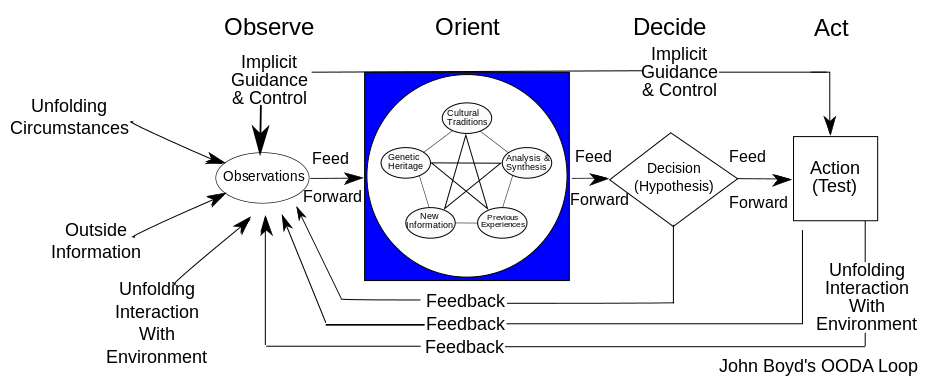
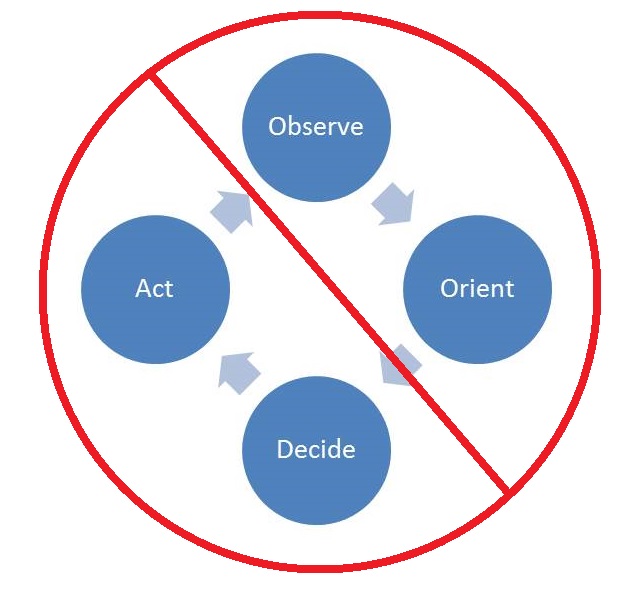
The OODA cycle, frequently referred to as the OODA Loop, was developed by the late Colonel John R. Boyd, USAF. The OODA cycle has subsequently become highly influential in thinking about how to conduct combat operations at all levels from the tactical to the grand strategic. It is often simplistically depicted with only four components in a circle, although that hardly does justice to the depth of Boyd’s thought.
What it’s not is what is so often pictured.

A better way to look at it would be this:
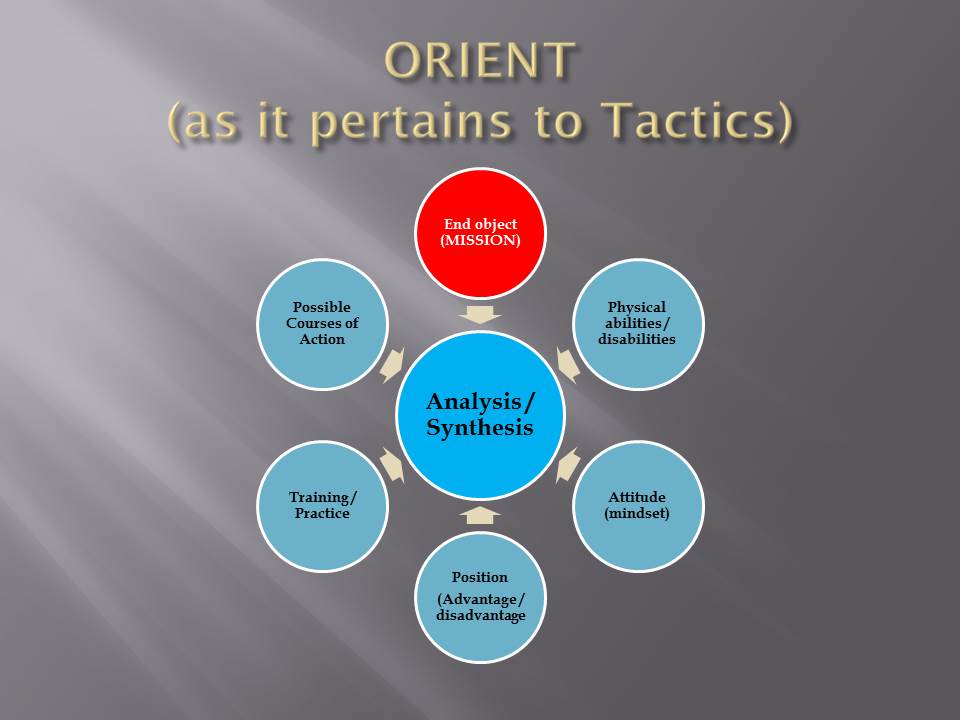
The article is my explanation of why. There are several other good articles also.
http://www.theoutdoorwire.com/specials/ccse2015/feature.php?id=229663
Situational Awareness and Positioning (part V)
In every encounter, there is an element of chance.
–John Hall, former head of the FBI Firearms Training Unit
In previous parts of this series (I-IV), the concept discussed was physical awareness and positioning in relation to an adversary or situation. A recent incident captured on video relates to a different but similar concept: emotional awareness and positioning.
In the incident, a veteran observed a bum aka ‘homeless person’ wearing a mixed service uniform while panhandling. He was justifiably incensed, as would be most veterans. “I was angry. I was frustrated. I was sad” he said. I don’t blame him. However, what resulted from his feelings was neither smart nor legally justifiable.
The veteran aggressively challenged the bum from a distance, then closed with him, pursued him across several lanes of traffic, and continued to pursue him on the other side of the boulevard. As the incident unfolds, the bum tries to disengage, is verbally apologetic, and changes direction several times attempting to escape. The entire time the veteran is loudly shouting, verbally forces the bum to remove part of his clothing, and then blocks the bum’s escape path. The incident went on for several minutes.
While I sympathize with the veteran’s frustration, the simple fact of the matter is that he let his emotions get away from him. A couple of relevant declarations made at this year’s Rangemaster Tactical Conference come to mind.
- John Hearne, in his presentation Performance Under Fire, made the statement “You’ve got to keep your emotions under control.”
- My colleague Nick Hughes mentioned to me in conversation a question he poses in his book, How To Be Your Own Bodyguard. “Are you doing this because you have to or because you want to?” He then related a personal anecdote where a person had to remind him of his own question.
When the veteran/bum video was posted on Facebook, I had two responses.
- Good way to get stabbed.
- Regardless of what I was doing, if someone acted toward me the way the veteran did toward the bum, I would have painted him orange in a New York second. And the police would have then told me to have a nice day. It was aggressive challenging behavior that anyone would be justified in feeling threatened by (although not sufficiently to employ lethal force, which is why I advocate always carrying pepper spray).
If we go looking for trouble, we had better be prepared to find it. Make no mistake: verbally challenging someone, shouting at them, chasing them, forcing them to remove their clothing, and then blocking their escape route is looking for trouble. Such a situation always has branching possibilities (if, then, else) that people don’t generally consider before jumping over the edge of the cliff.
- If the bum had pulled out a knife, then what would have been an appropriate, or even possible, response at that point? I make the assumption that all itinerants I encounter are armed with some kind of weapon.
- What if the bum had run out in front of a car and been struck and killed?
- What if a car had hit the vet while he was chasing the bum across the street?
- What if they had gotten into a physical conflict and ended up rolling around in traffic?
There are other possibilities also, but those are good examples of possible Negative Outcomes well within the realm of possibility. In any of those cases, the situation would have gone downhill for the vet like an avalanche.
So, let’s go back to Nick’s question: was the vet doing this because he had to or because he wanted to? That answer is quite clear, he wanted to. He felt the need to defend the honor of his service and the service of his fellow veterans.
Unfortunately, it’s very hard to provide a legal, or even moral, justification for using force to defend honor. Even if no legal repercussions arise, moral ones can. If the bum had run into traffic and been struck and killed, how do you think the veteran would have felt for the rest of his life, even if no charges were filed against him?
John Farnam’s saying “Avoid stupid people, stupid places, and stupid things” is definitely apropos in this situation. All three of those elements were broken. Jeff Cooper alluded many years ago to the fact that the more ‘rules’ we break simultaneously, the more possibility we will incur a problem. When we lose control of our emotions, that’s when we start unconsciously breaking rules, whether they are legal rules or just rules of good judgment and conduct.
With every decision we make, we are setting ourselves up either for success or failure. Keeping a check on our emotions helps set ourselves up for success. Letting our emotions get out of control is good way to set ourselves up for failure.
Planning for the worst case?
Living in California, I think it may be in my best interest to consider the worst-case scenario.
–a person who shall remain anonymous
I’ve previously mentioned my issue with planning for the worst case, but since ‘worst case planning’ comes up so often, the topic bears some further discussion. The essential problem is assuming that planning for the worst case is merely planning for the most likely case taken to a greater extent. Unfortunately, that’s not necessarily true. The optimum solution in worst case planning may actually be a less, or even least, optimal solution for the most likely case.
The questions of competing probabilities and definitional issues rear their ugly heads again in this decision process. As an example, the worst case scenario that people imagine in a home defense scenario consists of multiple intruders, armed with projectile weapons, with their weapons in hand, ready to shoot the defender in reaction time. While that’s certainly possible, it’s definitely not the most likely case, if the bump in the night is really a burglar. And even the definition of ‘worst possible case’ is open to question in the context of home defense, as is the definition in many contexts.
The question I posed previously was “Is ‘the worst possible case’ having a dangerous armed intruder in your house or shooting and killing a family member by mistake?” Therein lays the definitional issue. The statistical/tactical issue is that the most likely case is probably a lone intruder, not armed with a projectile weapon, who is preoccupied with stealing your stuff and not waiting in ambush for you.
Let’s address the statistical/tactical issue since I’ve already mentioned the definitional issue. In the past, I have, in fact, planned for the worst possible burglary case envisioned by people. My plan for a late night, already in bed, worst case scenario was as follows:
- Put on my M17A1 protective mask
- Place my pistol (then a 1911A1) in hand
- Open the bedroom door slightly
- Pick up an M7 CS grenade and pull the pin, using a small hook I had placed on the door frame
- Have my then wife grab onto my clothing, close her eyes, and stop breathing
- Roll the grenade out into the kitchen and let it fill the house with CS gas
- My house was small and
- would have completely filled with CS gas within a few seconds
- Go out the door and move toward the back door as an exit
- Shoot anyone who was in my way in the head, whether they were standing or laying on the ground prostrate from the effects of the gas
- I’ve been in a confined cloud of CS from a grenade; it’s incredibly incapacitating.
- That’s where I got the idea.
- It’s not like the CS chamber most veterans have been exposed to.
- Exit the house, regroup, and plan my next move to a safer location
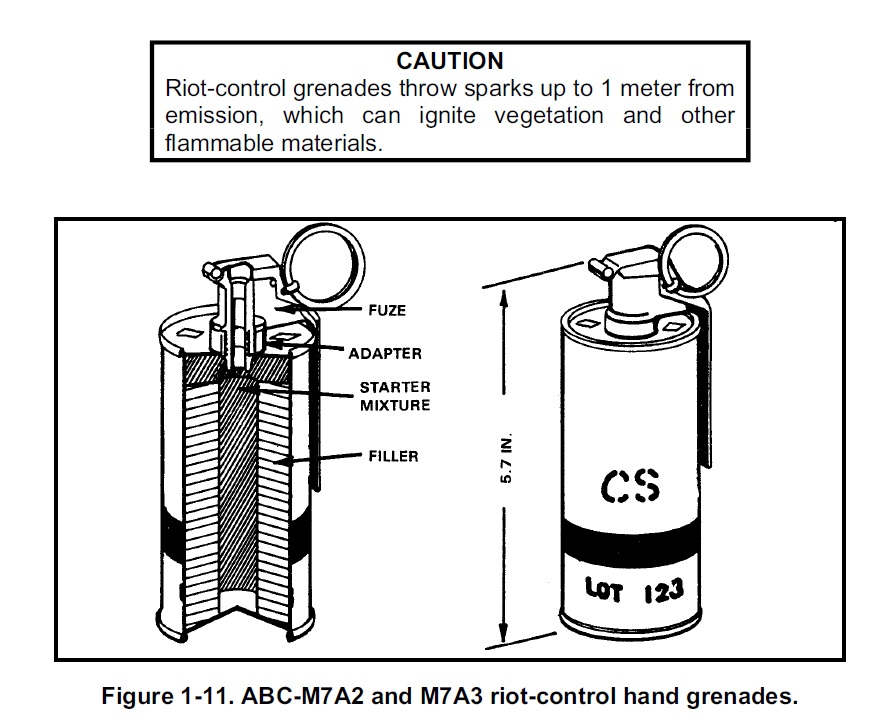
I was certain of the efficacy of this plan, since even a hardened group of assassins would be unlikely to expect a counterattack that would have made John Wick look like an Eagle Scout. However, I did consider that there were several downsides to the plan.
- Most likely, the grenade would have set the house on fire and burned it down. My landlord would have been unhappy and the couple who lived upstairs might have burned to death.
- The authorities probably would probably take a dim view of my executing a bunch of people, even if they did have nefarious intent.
- If my then wife had been accidently overcome by the gas, I would have been faced with the choice of finding her, picking her up, and carrying her out of the house, or leaving her behind with the rest of the deaders while the house was burning. (I would have carried her out, but that is a decision, not a given, in a serious house fire.)
I had also planned a lower intensity response for the more likely scenario of one guy with a screwdriver stealing my stuff. That plan was to challenge him from whatever concealment was available and tell him to get out. If he took one step toward me, I would have shot him. If I could see he had a projectile weapon, in hand or not, I would have shot him immediately.
Note that even in a simple scenario, there’s a decision tree (if, then, else). Those kinds of decisions are best made ahead of time. Making decisions before the situation arises is part of the Orient phase of the OODA process. Forward looking decisions are what allow you to speed up decision-making in the moment, not trying to think faster on the spot. Trying to construct a decision process in the midst of an incident will force you back into the Orient phase and actually slow down your decision-making.
The issue with worst case planning is that it usually ignores both the direct and opportunity costs implicit in the plan. Worst case planning also frequently lacks any branching or contingency aspects, which is not the way life works. Consider carefully ALL the ramifications of worst case planning in light of most likely case possibilities. What you may find is that it’s best to plan and prepare for the most likely case. Then, think of how that plan can be adapted to a much smaller probability of the worst case scenario.
Not thinking things through
A completely irrelevant post on Facebook (a new flamethrower) brought something to mind that I hadn’t thought about in a couple of decades. It relates to the concept of defining the mission, desired outcome, and possible consequences. Those are things integral, yet unstated, to the Orient phase of the OODA process and fundamental to achieving success.
Most discussions about OODA get caught up in the speed aspect, which is actually a tertiary part of the process. It’s not just a simple speed-based looping cycle, as is often depicted.
Years ago, I had a friend who didn’t care for guns but kept a flare pistol for home defense. She mentioned this to me in conversation. Her logic was that she didn’t want to kill someone. My response was “So you don’t want to kill someone but you’re okay with launching something into him that burns at several thousand degrees and might burn your house down?” She said she hadn’t thought about it that way. It certainly would have been possible for her to Act quickly but would it have been a good decision? I don’t think so.
It’s easy to get caught up in a linear process from the starting point without looking far enough down the path to a likely result and consequence. One component of Awareness is to keep your head up and look far down the road, just as you should when driving, rather than being fixated on the bumper in front of you.
It’s important to note that what is considered the most successful recent example of Boyd’s thinking was the planning of the First Gulf War. It took months and involved several different iterations of the strategic plan. In Boyd’s original hand drawn diagram of the OODA process, he actually had three different loops; one depicting planning, one depicting execution, and a third showing an overlay of the previous two. The third version is the popularized full diagram but it obscures the importance of the analysis/synthesis part of the process. There are many inputs necessary, including consequences, before an effective decision can be made. That planning is what makes rapid, effective Action possible.
Keeping in mind the desired outcome has to always be part of our decision-making. ‘Outcome Based Decision-Making’ should be an integral part of our thought process. As they said in DEA:
Focus on the object, not on the obstacle.
Rangemaster 2015 Tactical Conference (II)
Continuing on about the Rangemaster 2015 Tactical Conference held annually in the Memphis area, I would like to cover the high points of some sessions I attended.
John Hearne’s Performance Under Fire presentation was so packed with information that it’s hard to take it all in. He does a fine job of refuting the pseudo-science that pervades the personal protection training community. His research is thorough, up to date, and can document fully what he says. An aspect of his approach I like is the way he tracks the original science to see if it has subsequently been refuted. John is one of the few people in the community besides myself who has any clue about how to do research. Here’s a clue; taking information from a firearms or martial arts trainer at face value is not a valid approach. I found numerous points in his presentation quite useful.
He stated that there are actually 21 documentable ‘flinch responses,’ most of which do not involve throwing one’s hands up in the air. So if there are a variety of responses, how do you know which one you will exhibit and is it going to be the same one every time? Years ago, Ken Hackathorn told me to watch surveillance video of convenience store robberies to see how many people threw their hands up in the air when they were startled. The answer is ‘not many.’
One of my personal pet peeves is the continuing blathering about Hick’s Law in the community. John made the point that Hick’s Law was largely discredited in the scientific community decades ago. For those unfamiliar, Hick’s Law states that the more options you have, the longer it will take to make a decision, by a square of the number of choices. The original study was sort of iffy anyway and subsequent research has shown that it’s only true in the absence of any familiarity with the task and absent any practice on the decision making.
The subsequent power law of practice states that the more practice you have at making the decision, the faster you get at making it. There’s some question as to whether the practice/speed relationship is logarithmic or exponential but there’s no question about the validity of the power law. Think about it in terms of when you are driving. When you see the brake lights of the car in front of you come on, there’s no conscious decision making about whether you’re going to hit the gas or the brake, unless you’re a 15 year old student driver.
An important point John made was about the career time of when law enforcement officers were feloniously assaulted. The average time was about eight years. I believe John referenced this from the 2006 FBI study Violent Encounters, A Study of Felonious Assaults on Our Nation’s Law Enforcement Officers, but I don’t recall for sure. This was important to me because it highlighted the factor of complacency in Negative Outcomes.
Although I lack the rigorous methodology that the FBI used, it’s my feeling this is also a factor in Negative Outcomes by Armed Private Citizens. Complacency can be a killer. We see it every day at gun ranges, gun shops, and shooting clubs. Complacency is why some people have one year of experience 20 times instead of 20 years of experience and is closely related to the “I know it all” syndrome. We have all had to deal with ‘know-it-alls’ and ‘spring-butts’ and never like it. It’s up to us individually to make sure we don’t fall into the trap and challenge others who have.
Just to show that John can put his money where his mouth is, he won the High Lawman and Second Place overall in the shooting contest.

Photo courtesy of Tiffany Johnson
I’ll have more about the Conference next time.
Rangemaster 2015 Tactical Conference (I)
The Rangemaster 2015 Tactical Conference is over and I am processing the things I observed and learned from it. The Conference has a long history, dating back to the early days of IDPA in 1998, when it was a sanctioned IDPA indoor Championship. Over the years, it has evolved into the foremost tactical training conference for private citizens in the United States. It is held annually, early in the year, in the Memphis area. The venue for the 2015 Conference was the Memphis Police Training Academy, a truly fine and modern facility.
This year, three dozen of the top personal protection trainers in the country, many of whom are referred to as “T-Rexes,” came together to present or conduct training blocks of two to six hours over a period of three days. The agenda has grown so large that it’s not possible to take in all the training that is available, since sometimes five blocks are going on simultaneously. Some of the training is classroom lecture, some is hands-on with sterile weapons, and some is livefire. There is also a shooting match, for those who choose to participate.
There were a wide variety of topics, ranging from psychology and communications to contact based skills to firearms manipulation. I was able to attend nine sessions.
- Yes, I Shoot Like a Girl, Would You Like a Lesson?
- Surviving Lethal Encounters
- The Law of Self-Defense
- Practical Small Knife Principles
- Performance Under Fire
- Rehabilitating the Experienced Shooter
- The Training/Reality Mismatch
- Kneeling Positions and Combining Them with the Use of Cover
- Women’s Holsters and Accessories
In addition, I was able to make two classroom presentations.
- Tactical Communications for Couples, with my co-presenter Linda Hoopes, President of the Resilience Alliance.
- Negative Outcomes of Firearms Ownership
Upon my return, several people have asked me what my most significant takeaways were. As usual, I learned a great deal, so it’s difficult to say what were the most significant, but here are a few that stand out in my mind, in no particular order.
- A conversation with a mentor of mine, John Farnam, elicited from both of us the experience that when approached for help in a parking lot, it’s almost always a scam or criminal ambush. Fellow trainer Melody Lauer pointed out that there are a few legitimate exceptions, but John and I both feel they are the exception rather than the rule. This indicates that a default response should be formed to immediately and firmly decline the invitation to be a victim and then rapidly vacate the area. Exceptions to that rule should be based on specific articulable reasons and conscious decision-making, rather than by default.
- The T-Rexes are constantly working along the path to excellence. That path includes attitude, skills development, tactics, and a host of other areas. Recognizing that there is an element of chance in every encounter, we work hard on stacking the deck in our favor. ‘Doing the work’ means training regularly and practicing on a daily basis. ‘Good enough’ is never good enough for us. That’s probably why we’re regarded as T-Rexes.
- There is an enormous amount of erroneous, misapplied, or misinterpreted information floating around in the broad firearms and personal protection community. This is especially true in relation to prioritization, legal issues, and skills development.
- The community has a lot to learn about integrating women into it. There was a record turnout of female attendees and women trainers at the Conference this year, my co-presenter being one. Conversations with them, as well as the presentations, were highly enlightening. Many male paradigms either don’t apply at all or don’t work particularly well when used by women. My own presentation was an eye-opener to me in that regard. The Women’s Holsters and Accessories presentation, which was presented by a woman, gave several good examples. A pet peeve expressed by several T-Rexes is men who have women shoot excessively powerful firearms and then laugh when they fail. Our universal attitude is along the lines of the desire to give such jerks a knee lift in the crotch followed by a crack in the jaw and then laugh when they fall down writhing in pain.
I have several pages of notes but those jump out at me. Undoubtedly, more will occur to me as I reflect on the event. I will have more thoughts on specific topics in the near future. There is a photo gallery of the Conference training blocks available on the Rangemaster website.
Identify before you shoot
The house alarm sounded and the wife shot her husband through a closed bedroom door thinking he was an intruder, according to Fayetteville police.
http://whnt.com/2015/01/09/soldier-shot-while-trying-to-surprise-wife-with-breakfast/
Obviously, that was a ‘negative outcome.’ Therein lays the problem with simply having a gun without doing any scenario training with it. My research has brought me to the point where I am less concerned with the marksmanship aspects of personal protection than I am with 1) proper gunhandling and 2) appropriate decision-making. Those two items are almost completely absent from most gunowners’ repertoire.
There are a competing set of probabilities we have to consider in a home defense situation. If you have anyone else living in your home, the most likely probability is that the 3 a.m. bump you hear or shadow you see is, in fact, a member of your household. For sake of argument, let’s put that probability at nearly 100%. There is, however, a competing probability that it is an intruder. That probability is much lower, somewhat above 0%, depending on where you live. The Bureau of Justice Statistics reports that the burglary rate in the US was 27.6 victimizations per 1,000 households in 2011, or 2.76%, so let’s round it up to 3%. Assuming it’s an either/or situation, which it’s not, that would make the likelihood of encountering a family member, rounded, at 97%. Graphically, this is what those competing probabilities look like.
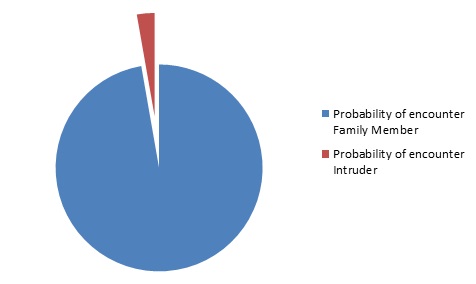
Looking at it this way makes a very strong case for why we have to positively identify before we shoot. It is 32 times more likely that the sound or shadow is a member of the household than it is an intruder. Las Vegas would really like those odds. If we’re going to be the slightest bit responsible, we have to look at ALL the possibilities, not just the ones that scare us the most. Shooting through the door without doing any kind of identification is just plain wrong.
Verbalization is so important in personal protection scenarios. And it’s something very few people practice on the range, or any other time, for that matter. I’ve had female clients tell me “I can’t say that.” Well, you better learn to say something. At home, the verbalization doesn’t have to be complicated. “Who’s there?” will probably suffice. You do have to be able to talk with a gun in your hand, though. Once again, hearing “Honey, it’s me” should immediately trigger a stand-down response on our part.
Stand-down is another thing that’s uncommon for people to practice but really important when you look at the probabilities. In a home defense encounter, ‘Stand-down’ should most likely mean immediately physically placing the gun down and moving away from it to avoid unpleasant after-effects of a startle response. Having to do so brings up those proper gunhandling and muzzle direction issues again.
This also bears on the issue of ‘training for the worst possible case.’ A serious definitional issue has now arisen in my mind regarding that concept. Is ‘the worst possible case’ having a dangerous armed intruder in your house or shooting and killing a family member by mistake? I don’t have an answer for that question but it has now become a relevant issue for me, as it should be for you, too.
The Aftermath – you’re not in it just by yourself
That’s both good and bad. Your family will be intimately involved in the aftermath of any shooting you are in. They will probably support you but they will also suffer just as much as you do. What I call ‘The Myth of the Lone Gunman‘ is about as far from reality as it can be.
Following last weekend’s MAG20 course, taught by Massad Ayoob, that I hosted here in Atlanta, Armed American Radio broadcast its weekly show from the host facility. A surprise call-in came from George Zimmerman. His comments were heartfelt, sobering, and bear listening to by anyone who is armed. They are something to consider in your decision about whether a shooting is absolutely necessary.
 tacticalprofessor
You must be logged in to post a comment.