Mistaken identity shootings
None of us can imagine the feelings that must occur in the case of a mistaken identity shooting of a family member. We don’t like to talk about this sort of thing in the gun community but it happens on a regular basis. Don’t let it happen to you, on either end.
I’ve written about this before and probably will again. It’s an avoidable tragedy.
Negative Outcomes: Unintentionally Shooting Someone Else
It’s a sad fact that people shoot other people unintentionally. I’m not talking about mistaken identity shootings but completely unintentional shootings. Probably the most famous incident was when Vice President Dick Cheney shot his hunting partner. However, that was far from an isolated occurrence. Reading the news reports provides plenty of such incidents.
We absolutely don’t want to shoot someone unintentionally nor let someone get shot unintentionally. A firearm is an instrument of ultimate personal responsibility. It’s not like a car, where sometimes we can blame someone else for negative outcomes. When a firearm we are handling goes off, we have to bear the consequences, period. If we leave it sitting around unsecured and someone else makes it goes off, we have to the bear the consequences, period. Sometimes, the consequences are tragic, in either case.
The Armed Citizen
A writer from Gun Digest contacted me about the Five Year Armed Citizen study TAC 5 year w tables I did a while back. He asked if I would give him a quote about it, so this was my reply.
“Analyzing incidents involving Armed Private Citizens, rather than LE/MIL situations, leads to different conclusions. Common discussion topics among Armed Private Citizens, such as equipment and caliber issues, rarely are the cause of Negative Outcomes. Negative Outcomes result from 1) lack of conceptual understanding leading to poor decision-making, and 2) lack of appropriate and necessary skills, techniques, and tactics.
Carrying and being capable of using a small gun adequately will yield much better results than owning a large pistol that isn’t carried or shot well. More criminals have been planted in the ground by .22s that hit than by .45s that miss.”
Legal defense plans
Periodically, I am asked to opine about the various plans available to cover the expenses of a legal defense after a personal protection incident. This article by Marty Hayes covers it in much better detail than I could explain.
The [plans] can be categorized into four types:
1) Insurance
2) Insurance backed
3) Pre-paid legal services
4) The Armed Citizens’ Legal Defense Network, Inc., a membership organization.
http://www.armedcitizensnetwork.org/buyersguide
Fair disclaimer: I am a member of ACLDN and have a relationship with them.
What is the value of training?
Firearms instructors are periodically asked the question “Why should I take training?” The answer often comes in the form of a list of skills that are taught or the reasoning behind using a certain technique. However, these do not address the underlying fundamental reasons for taking firearms training at all.
- You don’t know what you don’t know.
- Much of what you know is wrong.
- It’s good to have some of the answers to the test before taking it.
These issues relate to both technical competency with using a firearm (gun safety and marksmanship) and the ability to use the firearm correctly in a personal protection situation (legal and tactical).
You don’t know what you don’t know.
Shooters who only take their gun to an indoor range once a year “to sight it in” generally have a highly ‘cocooned’ knowledge of firearms. They know how to operate a firearm in a very restricted set of conditions. As soon as they leave that set of conditions, the stage is set for bad things to happen. Although ‘bad things’ can include unintentional and negligent gunshot wounds, it doesn’t have to be anything that newsworthy. A fellow NRA Instructor was once asked by a long time shooter why the shooter should take the NRA Basic Pistol course. The Instructor responded “Do you wear safety glasses when you’re cleaning your firearms? You do know, of course, that most cleaning fluids can irritate or even damage your eyes, don’t you?” The longtime shooter decided to take the class, after all.
Much of what you know is wrong.
Training can mitigate the Dunning–Kruger effect, which is rampant among the shooting community.
The Dunning–Kruger effect is a cognitive bias in which unskilled individuals suffer from illusory superiority, mistakenly rating their ability much higher than average. This bias is attributed to a metacognitive inability of the unskilled to recognize their mistakes.
–Wikipedia
Almost every firearms instructor has had numerous students who think they are “good” with a firearm but are not. Among these misinformed shooters are most police officers and, even many SWAT units. Typical longtime gunowners are too. When subjected to a standardized skills evaluation, most of these “good” shooters receive a rude awakening.
We’re the best shooters in our department, by far. That’s why we’re the firearms instructors. Then we come here and find out that we suck.
— A police officer attending the elite Rogers Shooting School
Many of these skills evaluations are not even particularly difficult. In one class I taught, the test was to shoot, starting from a ready position, five shots into a 12 inch circle at seven yards in 15 seconds four times in a row. Only one student out of ten was able to do it. And none of those shooters were beginners; most of them were longtime shooters. This test is the baseline level of the NRA Defensive Pistol I Marksmanship Qualification Program.
More advanced, yet still not terribly difficult, competency standards are beyond the ability of 99 percent of self trained shooters, in my experience., For example, the ability to shoot five shots into a five inch circle in five seconds at five yards five times in a row, a drill I call 5^5.
When a friendly competition was held on a local gun forum for the 5^5 drill, no one was able to do it. Several dozen people thought this test would be easy but even after multiple, in some cases, attempts they found out otherwise.
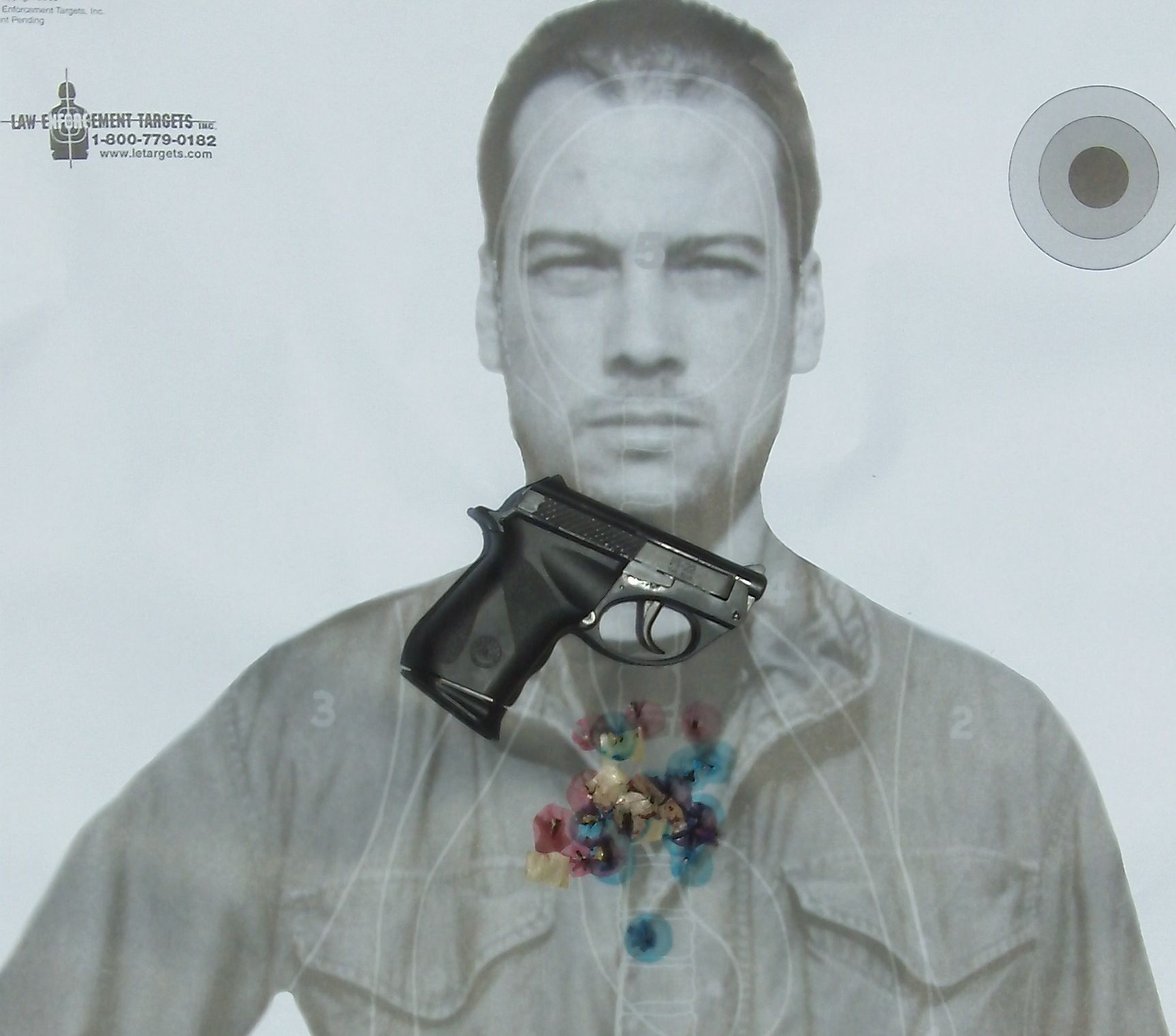
Every round that doesn’t hit is heading straight for a busload of nuns and orphans being followed by a limousine full of personal injury lawyers on a conference call with the District Attorney. At least, that’s the assumption I make and teach. It’s the reason I make my students account for every round they fire in my classes. And I point out the misses as seen in the cover photo of my blog.
It’s good to have some of the answers to the test before taking it.
Any decent class on the legalities of using deadly force will counsel students about things to do and not to do. An example of things not to do would include chasing a fleeing intruder down an alley and shooting at him while he is running away. In that particular incident, the shooter was lucky to only receive 60 days in jail.
The most significant value of training is that it places someone else, the instructor, in control of the flow of events, either physically or mentally. A criminal encounter will not be initiated in the time sequence desired by the would-be victim, which would be NONE. Nor will the skills required to solve the incident be dictated by the defender. However, by definition, self trained individuals control the flow of their actions when they practice, assuming they practice. This is exactly the opposite of criminal encounters. That’s not how it happens in real life. Good instruction will provoke thinking and questions beyond the student’s own expectations and experience. This helps prepare students to make decisions that can and will affect them for the rest of their lives, either positively or negatively.
The conscious mind does not function particularly well under stress. It tends to revert to subconscious background information and patterns, some of which are primeval. Many of these patterns are counterproductive in personal protection situations and require re-programming. Training helps replace them with background knowledge and patterns that are appropriate. Having appropriate knowledge helps avoid negative outcomes.
You don’t fire guns at people’s houses,” [Judge] Ludy said. “You kept saying you really didn’t know what was going on. If that’s the truth, why in the world would you fire a gun? … It really doesn’t matter if it was (at) Mr. Bailey or the mayor of Dunkirk. You just can’t do that.
— Judge Max Ludy Jr.
Shockingly, some people thought this case should not have come to trial. I know I wouldn’t have been too happy had I been the homeowner down the alley who had bullets launched in my direction. “Judge Max Ludy said he found McLaughlin’s firing of a gunshot in the direction of a neighbor’s home especially reprehensible.”
Instructors, as a group, are constantly looking for examples of situations and incidents that went both right and wrong. And other students in the class ask questions about situations that concern them. Inevitably these discussions become class material, either formally or as side conversations. Because training is our vocation, we tend to analyze those incidents in greater detail than does the average gunowner. Our analysis may not necessarily be what the student wants to hear, or even correct, but relating the analysis provides food for thought that merely reading about an incident in the news will not.
The value of training is to make you think and perform outside of the cocoon that most gunowners are in, the same way real life frequently does. It’s not so much that we instructors have all the answers, because we don’t. However, most of us have a good idea of the questions to ask and that’s a strong start.
Negative outcomes (part I)
It’s easy to ignore the potential negative outcomes of having a firearm for personal protection. The topic is easily overlooked or put on the back burner. I think that’s a mistake. This is the first of a series of articles I’m writing for The Tactical Wire about it.
Claude Werner begins his exploration of the ‘software’ component of defensive firearms with this piece on negative outcomes. This begins a multi-part series that disposes of trite sayings from instructors and gunshop commandos, pushes aside the common trends, and brings serious thought to preparation, planning, and what we should avoid. Fighting is a “game” of minds.
Situational Awareness and Positioning (part IV)
There are so many times in a day when you have to let people into your space. I think we have to accept it. My tolerance changes radically when I’m in transitional areas like parking lots etc.
–DTOM
It’s important to take context into account when speaking about SAP. There’s been some commentary about my post that I must not live in a big city or ever take the subway. Since I grew up in Chicargo and live in Atlanta, that’s not true. I ride public transportation quite often, even when I don’t have to.
The comment about transitional areas is on point. Rarely are we concerned about being robbed or beaten up in line at Starbucks. The video of the dude getting mugged in NOLA recently is more our concern and representative of the positioning I’m getting at.

While public places, e.g., the coffee shop in Lakewood WA, and crowds are not totally risk free, I think my colleague William Aprill would say our risk profile for violent crime is lower there than in transitional areas or when we are alone. The criminal incidents that I personally have had to deal with all fell in those two categories. Either positioning or awareness, along with will, allowed me to control those situations. Controlling the situations allowed them to conclude without anyone getting shot or stabbed, which is my desired outcome.
In fact, one of my encounters took place at a MARTA train station in Atlanta at 9 a.m. I was alone and midway through the station on my way to work, so both criteria (alone and in transition) were met. It was what I call an “opportunistic meeting engagement.” Three individuals coming from another direction apparently liked the fact I was on crutches and in a boot from a recent surgery. It was the first time in my life I experienced Clint Smith’s saying “Predators look at you like you’re food.” But I saw their look, change of demeanor, and change of direction from the full width of the upper platform while they were still about 15 yards away. That immediately put me into Condition Orange and I initiated my reaction. Because I had seen them so far away, I had time to react on my terms, rather than theirs. There was no escape for me since I could barely hobble on my crutches. So I faced them, put my hand in my overcoat pocket on my snub revolver and said to myself “Guys, this isn’t going to turn out the way you think it is.” I don’t believe I said it out loud and no words were exchanged between us. At the moment I thought it though, the Marine Corps Drill Team could not have done a better Right Flank, March than those guys did, in unison. Clearly, this was not their first rodeo.
What happened was that they targeted me in an obvious fashion. When a sketchy character, or three of them, changes direction and begins to close with you, it’s an indicator that an incident is developing. As a police officer friend says “Nothing good is coming of that.” However, I failed to act in the way I was supposed to. In John Farnam’s vernacular, I ‘failed the interview.’ Most criminal predations on the street begin with an evaluation by the predator as to whether it has the potential for being a successful victimization, as opposed to turning into a fight. Economic predators are not generally interested in a fight. They know all too well that there is an element of chance in every violent encounter. That is not to say they won’t fight, but rather given the choice between a victimization and a fight, they will pick the victimization.
So our object is to see them early enough and understand what is happening such that we can set ourselves up to fail the interview. The criminal then moves on to find another victim. I would prefer that they pick an undercover police officer and then get dealt with.
However, what happens afterward is not my problem. I am not a police officer; my weapons and tactics are for protecting me and mine, not society at large. That’s the way our legal system is structured; I understand it and abide by it.
Situational Awareness and Positioning (part III)
When he got within 5 or 6 feet… Lawler leveled the Glock and fired once, hitting DeCosta in the groin.
Man pulls 13-inch knife during fight, gets shot
A previous post discussed The Tueller Principle, or as Dennis put it originally “How Close Is Too Close?” In light of the above incident, The Tueller Principle and two related concepts bear further clarification and quantification.
A concept that is seldom discussed in the personal protection community, among either instructors or practitioners, is proxemics. The term proxemics was originated by a cultural anthropologist, Edward Hall, in his book The Hidden Dimension. Its meaning is how we, as humans, interpret and manage the physical space around us. This should be an integral part of planning for personal protection, but usually is not.
Professor Hall’s work breaks out several spatial zones that we perceive around us. Most important to us regarding the realm of personal protection is that we make instinctive judgments about whom we allow into these zones and what our reactions are to those who enter, or try to enter, the zones.
- Intimate Space – where we only allow loved ones to be.
- Personal Space – the area in which we are comfortable having people we know and trust.
- Social Space – the zone where we communicate and/or interact with others generally.
- Public Space – an area where we accept that people in general can be, regardless of whether we know them or are interacting with them.
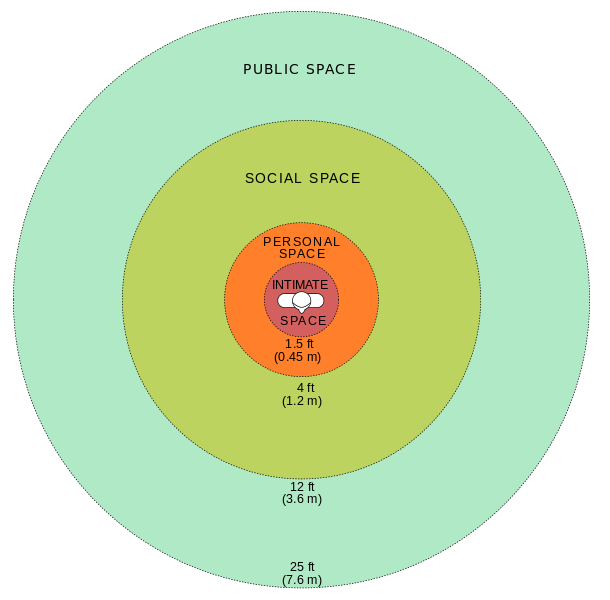
Diagram by WebHamster
It is also important to note that Hall’s work was preceded and partially inspired by the work of a Swiss zoologist, Dr. Heini Hediger. After extensive study of animals in the wild, Dr Hediger, in his book Wild Animals in Captivity, introduced several concepts about predator-prey behavior that are particularly relevant to the personal protection community.
- Flight distance – the distance at which prey will seek to escape the approach of a predator.
- Defense distance – the point at which pursued prey, which is being overtaken by a predator, will have a ‘defense reaction,’ in the words of Dr. Hediger.
- Critical distance – the boundary at which prey that is cornered, or feels it is, will initiate a counter-attack on the predator. I.e., the prey has lost its ability to maneuver or escape (decisively engaged) and then reacts in an emergency mode.
Dr. Hediger states that these distances “are specific, within certain limits, and may be accurately measured, often within inches.” p20 When he says inches, he is referring to very small animals; larger animals will generally be measured at intervals of feet or yards/meters. The larger the animal, the greater each distance will be, generally speaking.
The questions that then arise are: 1) what is the overlap between the works of Tueller, Hall, and Hediger and 2) why is that overlap important? Hall theorized that Hediger’s concepts of flight, defense, and critical distance are no longer applicable to humans. However, I do not believe that is true. Human behavior during a criminal predation tends to follow Dr. Hediger’s concept quite closely.
The incident described in the first paragraph is an excellent example of a phenomenon I observed in my long term study of The Armed Citizen and other reports of armed self-defense by private citizens. My impression after the study of thousands of incidents was that people tended to allow human predators to encroach not quite to arm’s length before shooting. When I say encroach, I do not mean actually shoot at, as in a gunfight, but rather attempt to close the distance, whether armed or unarmed.
Encroaching is actually more dangerous than a full throttle attack. If an armed predator runs at us at full speed, it’s obvious what his intent is and our decision becomes fairly simple. On the other hand, an encroachment induces uncertainty into the encounter, in the form of the question “How Close Is Too Close?” Of course, if gunfire is being exchanged, then typical spatial boundaries and zones no longer apply.
Shooting a human predator, especially when he is encroaching, is a communication and social transaction. It is the strongest form of communicating “Stop, don’t come any closer!” Dr. Hediger would term this the critical reaction that occurs at ‘Critical Distance.’ My impression is that it will most likely occur in what Hall termed the ‘near phase of Social Space.’ For North Americans, this zone is between four and seven feet. In other words, our Critical Distance lies within that zone. We will do what we need to do to prevent a predator from crossing the boundary between Social Space and our Personal Space.
How does this relate to The Tueller Principle? The minimum safe boundary established by Tueller is 21 feet. However, the boundary that Hall theorized between public space and social space is only 12 feet. What this means is that we will have an inherent tendency to allow people, and specifically predators, to approach us well with the boundary of safety established by Tueller. That 12 foot boundary for Social Space may be the maximum boundary of our Flight Distance, even with a sketchy character. If our Critical Distance is only 4-7 feet, that could represent a major problem when dealing with a predator.
My late colleague Paul Gomez periodically quizzically commented that “people don’t shoot criminals far enough away.” The relationship between the concepts of Tueller, Hall, and Hediger may be the reason why. It’s something we in the training community need to do a better job of explaining and training.
Situational awareness is not just about seeing what’s going on; it’s also about interpreting that information and what to do about it.
At least a half-dozen times, I ordered him to stop.
Another of my colleagues commented to me “We only say ‘Drop the gun’ once around here.”
Challenging human predators
Pointing guns at people you have no intention of shooting to force compliance with your demands is poor business.
–Ed Head in his article Pistol Provocation
I agree with this statement and feel it can be even further amplified from the perspective of training people how to Control a Confrontation. The statement can be, and has been, misconstrued by the inexperienced into “I believe that the first time any bad guy should know you are armed is when he sees the muzzle flash.” As a philosophy, reluctance to display a firearm without firing is a mistake. The majority of criminals are looking for a victimization not a fight. The display of a firearm by the intended victim, along with the obvious intent to use it if necessary, is an indicator that the victimization has the potential to turn into a fight. That’s not what economic predators are looking for.
Let’s consider the Policy (556.80) of the Los Angeles Police Department for DRAWING OR EXHIBITING FIREARMS.
Officers shall not draw or exhibit a firearm unless the circumstances surrounding the incident create a reasonable belief that it may be necessary to use the firearm in conformance with this policy on the use of firearms.
Stated as a positive action when adjudicating Use of Force incidents, the LAPD Board of Police Commissioners generally uses language similar to the following, when the Drawing/Exhibiting was ruled justifiable.
The BOPC determined that all personnel had sufficient information to believe the situation might escalate to the point where deadly force may become necessary. Therefore drawing the weapon was in policy.
Armed Citizens need to practice two Presentations; 1) Challenge and 2) Shoot. I use the term Presentation in a broad sense because the pistol might be in a container other than a holster, for instance, someone at home may have a pistol in a container or safe. The principle still applies. While some trainers would say this violates Hick’s Law, the fact is that the effect of Hick’s Law has been proven to dissipate when training in the various options has been undertaken.
Challenging should be done from a Ready position that does not involve pointing the pistol at the aggressor, just as Ed states. If the necessity to shoot arises, the pistol is then brought on target and fired.
Contrary to popular opinion, there is no time difference between bringing the weapon onto target to fire vis-à-vis having the weapon already aimed at the target. Nor is there any demonstrable difference of starting out with the finger on the trigger v. off the trigger.
My experience is that very few gunowners practice the Presentation to Challenge nor firing beginning from a Challenge position. This is a major weakness in their skill sets. Challenging can easily be practiced at home with an inert (blue) gun. Anyone who is serious about improving their skillset should own a bluegun of their real defensive gun.
There is a caveat to this doctrine. A friend of mine lives and works in Central America as a security consultant and trainer. His counsel to me is that, in his experience over the past three decades, Latins rarely find the presence of a pistol unsettling “unless they are looking down the bore.” With the heavy influx of Central Americans into the United States lately, this may be a consideration.
Having a personal code
I won’t be wronged. I won’t be insulted. I won’t be laid a-hand on. I don’t do these things to other people, and I require the same from them.
— John Bernard Books in The Shootist
Mine is somewhat more complex than that, but the principles remain fairly simple. They guide me every day.
“Son, try to get along with everyone; but don’t let anyone hurt you.” – my Father, Jerry Werner
“An officer is responsible for his own morale.” – General of the Armies John J. Pershing
“When they get the duct tape out, it’s time to make your move, ready or not.” – The Most Dangerous Man in the World
“Stupid people, stupid places, stupid things. Avoid them and you’ll probably be all right.” –John Farnam
“In the beginner’s mind there are many possibilities, but in the expert’s there are few.” ― Shunryu Suzuki
“Thinking ‘I’ll solve it when I get there’ has gotten a lot of people killed.” –Bill Rogers
“Look good, be right, control and dominate, avoid being controlled and dominated. Those are the things that run most people’s lives.” – Lifespring
“There are two kinds of people in the world, those who eat to live and those who live to eat.” – my ex-wife
“When you leave your car, don’t forget your Mace. That is unless you want to get stabbed in the face.” – Attractive Eighties Women
“Son, when you park the car, face the rear end into the Sun so you won’t have to sit on a hot seat when you get in.” – my Father, Jerry Werner
“You can do a lot of aiming and squeezing in a second and a half.” – Mike Benedict
“Don’t ever march home the same way. Take a different route so you won’t be ambushed.” – Major Robert Rogers
“Begin to attrit the enemy at the maximum effective range of your weapons.” – The Infantry School
“Auditing is intellectually rigorous and is not for everyone.” – Nick Crooks, Senior Manager, Deloitte & Touche
“Guns and knives, sir, you can never have enough of them.” – CSM Autrail Cobb
“Little things I should’ve said and done, I never took the time. You were always on my mind.” – Pet Shop Boys
“Surrender is not a Ranger word.” – the Ranger Creed
 tacticalprofessor
You must be logged in to post a comment.