Situational Awareness and Positioning (part IV)
There are so many times in a day when you have to let people into your space. I think we have to accept it. My tolerance changes radically when I’m in transitional areas like parking lots etc.
–DTOM
It’s important to take context into account when speaking about SAP. There’s been some commentary about my post that I must not live in a big city or ever take the subway. Since I grew up in Chicargo and live in Atlanta, that’s not true. I ride public transportation quite often, even when I don’t have to.
The comment about transitional areas is on point. Rarely are we concerned about being robbed or beaten up in line at Starbucks. The video of the dude getting mugged in NOLA recently is more our concern and representative of the positioning I’m getting at.

While public places, e.g., the coffee shop in Lakewood WA, and crowds are not totally risk free, I think my colleague William Aprill would say our risk profile for violent crime is lower there than in transitional areas or when we are alone. The criminal incidents that I personally have had to deal with all fell in those two categories. Either positioning or awareness, along with will, allowed me to control those situations. Controlling the situations allowed them to conclude without anyone getting shot or stabbed, which is my desired outcome.
In fact, one of my encounters took place at a MARTA train station in Atlanta at 9 a.m. I was alone and midway through the station on my way to work, so both criteria (alone and in transition) were met. It was what I call an “opportunistic meeting engagement.” Three individuals coming from another direction apparently liked the fact I was on crutches and in a boot from a recent surgery. It was the first time in my life I experienced Clint Smith’s saying “Predators look at you like you’re food.” But I saw their look, change of demeanor, and change of direction from the full width of the upper platform while they were still about 15 yards away. That immediately put me into Condition Orange and I initiated my reaction. Because I had seen them so far away, I had time to react on my terms, rather than theirs. There was no escape for me since I could barely hobble on my crutches. So I faced them, put my hand in my overcoat pocket on my snub revolver and said to myself “Guys, this isn’t going to turn out the way you think it is.” I don’t believe I said it out loud and no words were exchanged between us. At the moment I thought it though, the Marine Corps Drill Team could not have done a better Right Flank, March than those guys did, in unison. Clearly, this was not their first rodeo.
What happened was that they targeted me in an obvious fashion. When a sketchy character, or three of them, changes direction and begins to close with you, it’s an indicator that an incident is developing. As a police officer friend says “Nothing good is coming of that.” However, I failed to act in the way I was supposed to. In John Farnam’s vernacular, I ‘failed the interview.’ Most criminal predations on the street begin with an evaluation by the predator as to whether it has the potential for being a successful victimization, as opposed to turning into a fight. Economic predators are not generally interested in a fight. They know all too well that there is an element of chance in every violent encounter. That is not to say they won’t fight, but rather given the choice between a victimization and a fight, they will pick the victimization.
So our object is to see them early enough and understand what is happening such that we can set ourselves up to fail the interview. The criminal then moves on to find another victim. I would prefer that they pick an undercover police officer and then get dealt with.
However, what happens afterward is not my problem. I am not a police officer; my weapons and tactics are for protecting me and mine, not society at large. That’s the way our legal system is structured; I understand it and abide by it.
Situational Awareness and Positioning (part III)
When he got within 5 or 6 feet… Lawler leveled the Glock and fired once, hitting DeCosta in the groin.
Man pulls 13-inch knife during fight, gets shot
A previous post discussed The Tueller Principle, or as Dennis put it originally “How Close Is Too Close?” In light of the above incident, The Tueller Principle and two related concepts bear further clarification and quantification.
A concept that is seldom discussed in the personal protection community, among either instructors or practitioners, is proxemics. The term proxemics was originated by a cultural anthropologist, Edward Hall, in his book The Hidden Dimension. Its meaning is how we, as humans, interpret and manage the physical space around us. This should be an integral part of planning for personal protection, but usually is not.
Professor Hall’s work breaks out several spatial zones that we perceive around us. Most important to us regarding the realm of personal protection is that we make instinctive judgments about whom we allow into these zones and what our reactions are to those who enter, or try to enter, the zones.
- Intimate Space – where we only allow loved ones to be.
- Personal Space – the area in which we are comfortable having people we know and trust.
- Social Space – the zone where we communicate and/or interact with others generally.
- Public Space – an area where we accept that people in general can be, regardless of whether we know them or are interacting with them.
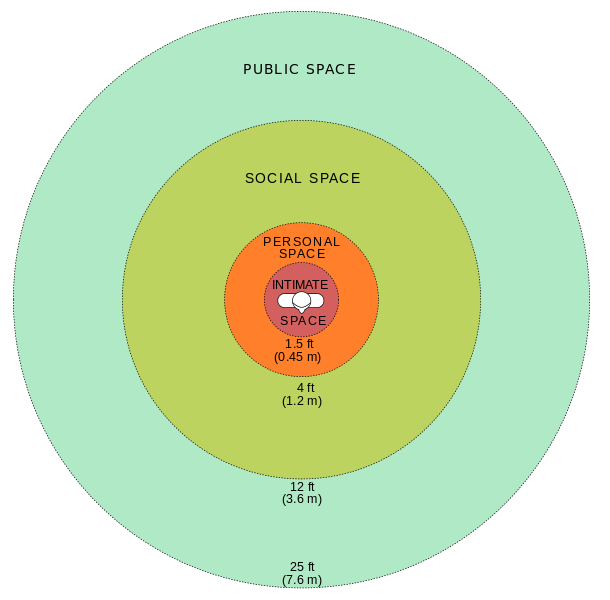
Diagram by WebHamster
It is also important to note that Hall’s work was preceded and partially inspired by the work of a Swiss zoologist, Dr. Heini Hediger. After extensive study of animals in the wild, Dr Hediger, in his book Wild Animals in Captivity, introduced several concepts about predator-prey behavior that are particularly relevant to the personal protection community.
- Flight distance – the distance at which prey will seek to escape the approach of a predator.
- Defense distance – the point at which pursued prey, which is being overtaken by a predator, will have a ‘defense reaction,’ in the words of Dr. Hediger.
- Critical distance – the boundary at which prey that is cornered, or feels it is, will initiate a counter-attack on the predator. I.e., the prey has lost its ability to maneuver or escape (decisively engaged) and then reacts in an emergency mode.
Dr. Hediger states that these distances “are specific, within certain limits, and may be accurately measured, often within inches.” p20 When he says inches, he is referring to very small animals; larger animals will generally be measured at intervals of feet or yards/meters. The larger the animal, the greater each distance will be, generally speaking.
The questions that then arise are: 1) what is the overlap between the works of Tueller, Hall, and Hediger and 2) why is that overlap important? Hall theorized that Hediger’s concepts of flight, defense, and critical distance are no longer applicable to humans. However, I do not believe that is true. Human behavior during a criminal predation tends to follow Dr. Hediger’s concept quite closely.
The incident described in the first paragraph is an excellent example of a phenomenon I observed in my long term study of The Armed Citizen and other reports of armed self-defense by private citizens. My impression after the study of thousands of incidents was that people tended to allow human predators to encroach not quite to arm’s length before shooting. When I say encroach, I do not mean actually shoot at, as in a gunfight, but rather attempt to close the distance, whether armed or unarmed.
Encroaching is actually more dangerous than a full throttle attack. If an armed predator runs at us at full speed, it’s obvious what his intent is and our decision becomes fairly simple. On the other hand, an encroachment induces uncertainty into the encounter, in the form of the question “How Close Is Too Close?” Of course, if gunfire is being exchanged, then typical spatial boundaries and zones no longer apply.
Shooting a human predator, especially when he is encroaching, is a communication and social transaction. It is the strongest form of communicating “Stop, don’t come any closer!” Dr. Hediger would term this the critical reaction that occurs at ‘Critical Distance.’ My impression is that it will most likely occur in what Hall termed the ‘near phase of Social Space.’ For North Americans, this zone is between four and seven feet. In other words, our Critical Distance lies within that zone. We will do what we need to do to prevent a predator from crossing the boundary between Social Space and our Personal Space.
How does this relate to The Tueller Principle? The minimum safe boundary established by Tueller is 21 feet. However, the boundary that Hall theorized between public space and social space is only 12 feet. What this means is that we will have an inherent tendency to allow people, and specifically predators, to approach us well with the boundary of safety established by Tueller. That 12 foot boundary for Social Space may be the maximum boundary of our Flight Distance, even with a sketchy character. If our Critical Distance is only 4-7 feet, that could represent a major problem when dealing with a predator.
My late colleague Paul Gomez periodically quizzically commented that “people don’t shoot criminals far enough away.” The relationship between the concepts of Tueller, Hall, and Hediger may be the reason why. It’s something we in the training community need to do a better job of explaining and training.
Situational awareness is not just about seeing what’s going on; it’s also about interpreting that information and what to do about it.
At least a half-dozen times, I ordered him to stop.
Another of my colleagues commented to me “We only say ‘Drop the gun’ once around here.”
Challenging human predators
Pointing guns at people you have no intention of shooting to force compliance with your demands is poor business.
–Ed Head in his article Pistol Provocation
I agree with this statement and feel it can be even further amplified from the perspective of training people how to Control a Confrontation. The statement can be, and has been, misconstrued by the inexperienced into “I believe that the first time any bad guy should know you are armed is when he sees the muzzle flash.” As a philosophy, reluctance to display a firearm without firing is a mistake. The majority of criminals are looking for a victimization not a fight. The display of a firearm by the intended victim, along with the obvious intent to use it if necessary, is an indicator that the victimization has the potential to turn into a fight. That’s not what economic predators are looking for.
Let’s consider the Policy (556.80) of the Los Angeles Police Department for DRAWING OR EXHIBITING FIREARMS.
Officers shall not draw or exhibit a firearm unless the circumstances surrounding the incident create a reasonable belief that it may be necessary to use the firearm in conformance with this policy on the use of firearms.
Stated as a positive action when adjudicating Use of Force incidents, the LAPD Board of Police Commissioners generally uses language similar to the following, when the Drawing/Exhibiting was ruled justifiable.
The BOPC determined that all personnel had sufficient information to believe the situation might escalate to the point where deadly force may become necessary. Therefore drawing the weapon was in policy.
Armed Citizens need to practice two Presentations; 1) Challenge and 2) Shoot. I use the term Presentation in a broad sense because the pistol might be in a container other than a holster, for instance, someone at home may have a pistol in a container or safe. The principle still applies. While some trainers would say this violates Hick’s Law, the fact is that the effect of Hick’s Law has been proven to dissipate when training in the various options has been undertaken.
Challenging should be done from a Ready position that does not involve pointing the pistol at the aggressor, just as Ed states. If the necessity to shoot arises, the pistol is then brought on target and fired.
Contrary to popular opinion, there is no time difference between bringing the weapon onto target to fire vis-à-vis having the weapon already aimed at the target. Nor is there any demonstrable difference of starting out with the finger on the trigger v. off the trigger.
My experience is that very few gunowners practice the Presentation to Challenge nor firing beginning from a Challenge position. This is a major weakness in their skill sets. Challenging can easily be practiced at home with an inert (blue) gun. Anyone who is serious about improving their skillset should own a bluegun of their real defensive gun.
There is a caveat to this doctrine. A friend of mine lives and works in Central America as a security consultant and trainer. His counsel to me is that, in his experience over the past three decades, Latins rarely find the presence of a pistol unsettling “unless they are looking down the bore.” With the heavy influx of Central Americans into the United States lately, this may be a consideration.
Having a personal code
I won’t be wronged. I won’t be insulted. I won’t be laid a-hand on. I don’t do these things to other people, and I require the same from them.
— John Bernard Books in The Shootist
Mine is somewhat more complex than that, but the principles remain fairly simple. They guide me every day.
“Son, try to get along with everyone; but don’t let anyone hurt you.” – my Father, Jerry Werner
“An officer is responsible for his own morale.” – General of the Armies John J. Pershing
“When they get the duct tape out, it’s time to make your move, ready or not.” – The Most Dangerous Man in the World
“Stupid people, stupid places, stupid things. Avoid them and you’ll probably be all right.” –John Farnam
“In the beginner’s mind there are many possibilities, but in the expert’s there are few.” ― Shunryu Suzuki
“Thinking ‘I’ll solve it when I get there’ has gotten a lot of people killed.” –Bill Rogers
“Look good, be right, control and dominate, avoid being controlled and dominated. Those are the things that run most people’s lives.” – Lifespring
“There are two kinds of people in the world, those who eat to live and those who live to eat.” – my ex-wife
“When you leave your car, don’t forget your Mace. That is unless you want to get stabbed in the face.” – Attractive Eighties Women
“Son, when you park the car, face the rear end into the Sun so you won’t have to sit on a hot seat when you get in.” – my Father, Jerry Werner
“You can do a lot of aiming and squeezing in a second and a half.” – Mike Benedict
“Don’t ever march home the same way. Take a different route so you won’t be ambushed.” – Major Robert Rogers
“Begin to attrit the enemy at the maximum effective range of your weapons.” – The Infantry School
“Auditing is intellectually rigorous and is not for everyone.” – Nick Crooks, Senior Manager, Deloitte & Touche
“Guns and knives, sir, you can never have enough of them.” – CSM Autrail Cobb
“Little things I should’ve said and done, I never took the time. You were always on my mind.” – Pet Shop Boys
“Surrender is not a Ranger word.” – the Ranger Creed
Wargaming v. brainstorming (Part II)
Thinking ‘I’ll solve it when I get there’ has gotten a lot of people killed.
My friend and I had a serious disagreement over his tactics. “The cops, Gunsite grads and others, who’ve contacted me over it agreed with what I did.” Contrary to the feedback my friend received, the comments I received were universally negative toward his post-escape actions.
This then leads to a further issue involving his friend, who was in the car with him. What do you do when someone else makes a tactical decision that involves you? I frequently mention that anytime we are with another person, the complexity of decision making goes up seriously.
You, as a passenger or bystander, can be put in a situation by someone else quite easily. Sometimes, it is a situation with possibly severe negative outcomes. Many times in ten years of Force on Force exercises, I saw how easy it is to get dragged into situations and Courses of Action not of your choosing. Not to mention the many times I have personally gotten sucked into situations that I later thought “Wow, I’m glad I got out of that one in one piece.” Other people can get you killed, without asking your permission.
Let’s examine some of the possible options. Even when we are with friends and family, our options remain. Some of them are Flight, Withdraw, Fight, Submit, and Negotiate. We are conscious beings and capable of making our own decisions. Just because someone else makes a decision to place themselves in jeopardy, doesn’t mean we have to go along with it. Nor does it mean that even if we choose to participate we necessarily have to do it in a way that entails maximum risk.
Let’s examine a case from the LAPD files as an example.
Officer Involved Shooting 030-05.
Officer A was watching television when he heard his wife shout that someone was out front. Officer A’s wife also believed she told her husband the people outside were vandalizing the family vehicle.
Officer A, with his pistol held alongside his leg, moved across the front lawn of his residence to obtain a view of the individuals [he suspected of vandalizing his car] in the street. Unknown to Officer A, his wife had followed him from the residence to the curb of the street.
Two things occurred here. 1) Officer A elected to go outside to Confront the vandals. It is unknown whether this was habit as a Police Officer [LAPD discourages its Officers from taking enforcement action off-duty unless life is at risk] or because he felt compelled by the presence of his family. 2) His wife followed in into the Danger Zone, perhaps due to family bonding aspects or because she felt it was appropriate for her to confront the vandals herself.
Officer A directed his wife to return to the residence and to call the police.
Once inside the residence, Officer A’s wife instructed another nephew to call 911. She then returned to the street with her husband [.]
The wife continued to be sucked in the dynamic of the situation, perhaps because of her husband’s presence outside. If he had remained inside and called the police himself, it is less likely she would have gone outside, especially the second time.
Eventually, a scuffle between the vandal and Officer A’s wife ensued and Officer A separated them. The vandal then approached with an ambiguous weapon and Officer A fired a warning shot into the ground. This resulted in the vandal fleeing.
Here’s what the Board of Police Commissioners ruled.
Findings
- Tactics
The BOPC found Officer A’s tactics deficient warranting administrative disapproval.
Basis for Findings
- Tactics
…Officer A elected to confront the subjects… The BOPC observed that Officer A’s tactical decisions left him with few tactical options and placed him at a tactical disadvantage… The BOPC would have preferred that Officer A had remained inside his residence, stayed with his family, [and] personally notified the local law enforcement agency … The BOPC was also concerned that when Officer A exited his residence, his wife accompanied him outside.
The BOPC determined that Officer A’s tactics were seriously deficient warranting administrative disapproval.
The evidence later disclosed that the vandal was ‘armed’ with a dinner fork. While Officer A received only ‘administrative disapproval’ for firing the warning shot, I have little doubt that an Armed Citizen in the same circumstances would have been charged with Aggravated Assault.
Let’s now return to the brainstorming v. wargaming issue. Brainstorming by Officer A gave a rudimentary Course of Action of going outside and Confronting the vandal. I’m not sure that any brainstorming by his wife was involved, other than to accompany him. Wargaming might have resulted considering alternate Courses of Action for either or both of them. He might have elected to Remain In Place and call the police. Even if he went out to Confront, she might have elected to RIP. Even during the Confrontation, after considering all her options, she might have decided to RIP after she had returned to the house, instead of re-inserting herself into the situation.
If my friend’s friend had done some wargaming, he might have considered, and perhaps chosen, some different options. It would be presumptuous of me to say what he was thinking when he chose to join the Pursuit. However, his options were: Pursue, Submit, Withdraw, Flight, and ultimately Fight using deadly force. If he agreed with following the criminals, then the option he chose was Pursue. Fortunately, the situation did not escalate to the Fight option but this has to be considered as a consequence of the Pursuit. If he did not agree with the decision to Pursue, then he chose the Submit option, only he was submitting to my friend’s choice. ‘To take no action is to take an action,’ as the saying goes.
He could have said “I’m not going with you over to their vehicle. Let me out of the car.” That would be the Withdraw option. If the car got into motion before he could say anything, he could have gotten out of the car when it stopped behind the criminals and then he could have moved off. That would be Flight. And if the criminals produced guns, he would have been forced into the Fight using deadly force Course of Action, which at that point is not an option but a necessity. The military term would be Decisively Engaged. Decisive Engagement means we have no other options left, which is never a good position to be in.
All those options have consequences. Withdraw or Flight could have serious repercussions on their friendship. Pursuit, under the wrong set of actions and reactions, could result in an unpleasant encounter with Law Enforcement. Fight using deadly force carries the possible consequence of death, which would affect not only him but all his loved ones and associates.
The choices we make are based on our personal moral values and ties to others. But they should be made with a clear understanding of what our options are and also the possible consequences thereof.
I would have said “I’m not going with you over to their vehicle. Let me out of the car.” But that’s just my choice, you’ll make your own.
Wargaming v. brainstorming
In every encounter, there is an element of chance.
–John Hall, head of the FBI Firearms Training Unit during the Miami Massacre timeframe.
A friend of mine had an encounter with some apparent criminals a few days ago. Fortunately, he was able to escape the initial encounter. However, he then made the all too common mistake of initiating a pursuit of said criminals ‘until the police arrived.’ In fact, he pulled in right behind their car in the parking lot after the initial incident had concluded and the criminal had walked away from him. Then the criminals began their withdrawal by driving away and he followed them. Fortunately, the police eventually arrived and placed the criminals under arrest. It all worked out OK; this time.
However, I think the incident bears some analysis. The format used by the LAPD Board of Police Commissioners is a good model for our purposes here.
In every case, the BOPC makes specific findings in three areas: [A] Tactics of the involved officer(s); [B] Drawing/Exhibiting of a firearm by any involved officer(s); and the [C] Use of Force by any involved officer(s).
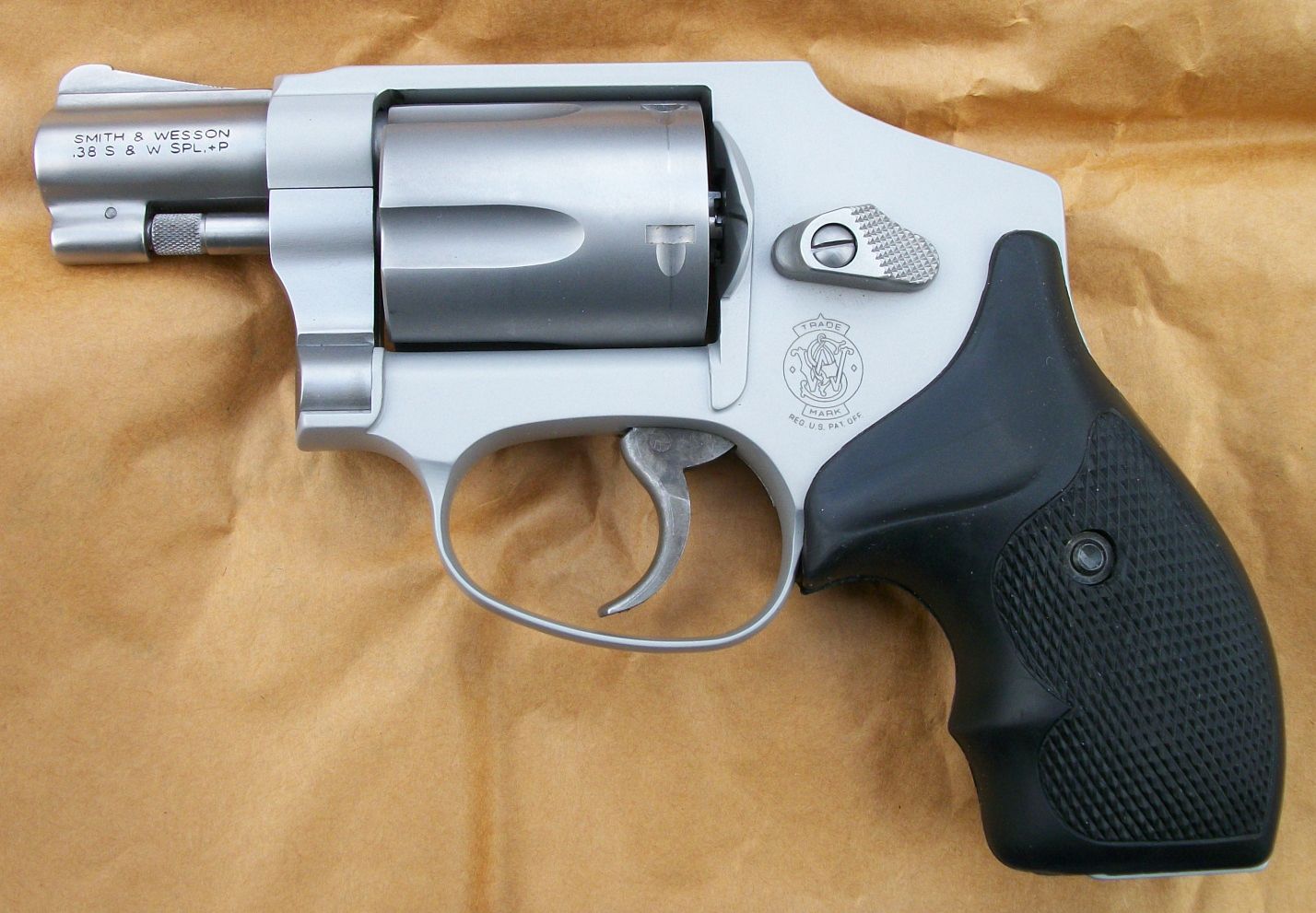
The initial incident was resolved without any Use of Force by my friend so [C] does not apply. During the initial encounter, he was approached by the criminal with an impact weapon, to wit: a tire iron. In response, my friend drew a J frame revolver that he kept below the line of sight of the criminal. I think that was a perfectly appropriate [B] response.
Let’s look at [A] Tactics.
Pulling in right behind them means he turned the initiative over to them voluntarily. I.e., he placed himself into the reactive phase (Observe, Orient, Decide) of their OODA cycle rather than them being in the reactive phase of his OODA cycle as was the case during the initial encounter. That’s BAD tactics.
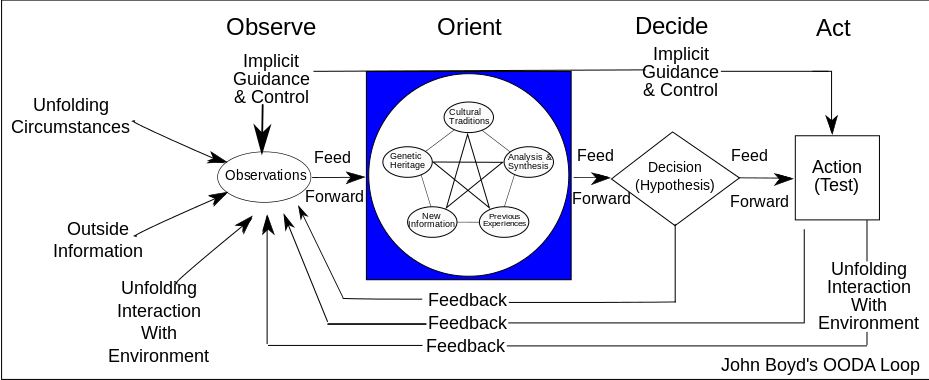
We can use this situation as an example of the difference between brainstorming and wargaming. Brainstorming means my friend developed a rudimentary Course of Action. He stated: “If I roll down this window, I’m going to have to shoot him.” Eventually, he chose to move his vehicle as an alternative. In other words, he considered what two of his options were and that’s about all. That’s brainstorming.
Wargaming the incident means we include the adversary’s options, your response to their options, and the possible consequences.
Some of the options available to the criminals upon my friend pulling up behind them were:
- Flight
- Withdraw, which is what they chose
- Confront
- Fight, either using deadly force or a lesser force level
Let’s wargame those criminal options:
If they had chosen Flight, meaning at high speed, does one then continue the Pursuit? You wouldn’t think so but there is an instinctive reaction to pursue upon an adversary’s Flight. I have observed this many times and the pursuers denied they did it until shown the video. If that happens unconsciously, then you also become a lawbreaker; speeding, reckless driving, etc.
The criminals chose to Withdraw, which then resulted in a low level pursuit, entailing no legal violations. I think this illustrates the point I made about Flight, we may choose the Pursuit option unconsciously.
What about Confront? Up to this point of the pursuit, the criminals had not committed any chargeable offense that would stand up at trial. There was enough reason for the police to initiate a Probable Cause stop, which then resulted in arrests for unrelated offenses. Prior to the arrival of the police, the criminals stopped several times and my friend stopped behind them at some distance. What if the criminals had chosen to Confront my friend about following them? Say one of them had gotten out of the car and walked purposefully toward my friend’s vehicle.
At that point, he would have had to make a decision about how to react. He could have driven away, remained in place, drawn and displayed his weapon, or perhaps used deadly force. All of those possible reactions have possible unpleasant consequences. Let’s say he tried to drive away and the individual got in front of his vehicle. That’s a potential vehicular homicide and would be very hard to defend. Say he draws his weapon and the criminal calls the police for Man With A Gun threatening me. Aggravated Assault is a felony charge. Even if you beat it, it’s unpleasant, lengthy, and expensive. You don’t get to carry a gun during the entire course of the legal proceedings and may have to surrender all your firearms until the conclusion.
Shooting the individual could easily turn into a total mess.
- “Why did you shoot the man?”
- “He did something suspicious in a parking lot a distance away, so I followed him.”
- “But why did you shoot him?”
- “Well, he stopped his car, so I stopped my car behind him. Then he got out and walked purposefully up to my car window. I felt threatened at that point, so I shot him.”
That’s going to be a very expensive and lengthy trial. I think the prospect of doing time would be high but I’ll let legal experts such as Andrew Branca or Marty Hayes chime in, if they want to.
Let’s say the criminals chose to Fight, using lethal force. My friend assumes these people were ‘gangbangers.’ Worst case scenario is that both of them pile out of their car with AK rifles and start hosing down his car. A Springfield .45 pistol and J frame revolver aren’t going to be terribly useful in that situation. And he would have been in the reactive phase of the OODA cycle, so there would probably be a lag about even moving the car to Escape. Even during the Escape, the car would have to pass by, at close distance, two individuals shooting at it with autoloading rifles. The potential for becoming a casualty, along with the friend who was in the car with him, in such a situation is very high.
So that is the difference between brainstorming and wargaming. As you can see, the wargaming process can be quite involved. It’s easier to do it ahead of time based on the experiences of others. Then if you have to do some wargaming on the spot, you already have some models to choose from rather than develop them on the ground at the time.
My feeling about the situation he encountered is rather different than his. My reaction to the initial encounter probably would have been similar to his. However, once I have escaped from a criminal, I am not reinserting myself into the situation. If I do choose to keep an eye on the situation, it will most certainly not be within the effective range of gunfire.
Threat management interview on Ballistic Radio
John Johnston of Ballistic Radio and I spoke on the air last weekend about Threat Management.
Threat Management is a topic that is woefully under-represented in most people’s skill set. Going to the range occasionally only helps develop the shooting skills. In contrast, how much time do folks spend on the skills that lead to ‘non-shooting?’ A short list would include, but is not limited to:
Verbalization,
STOP! Don’t come any closer!
Making the shoot/no shoot decision,
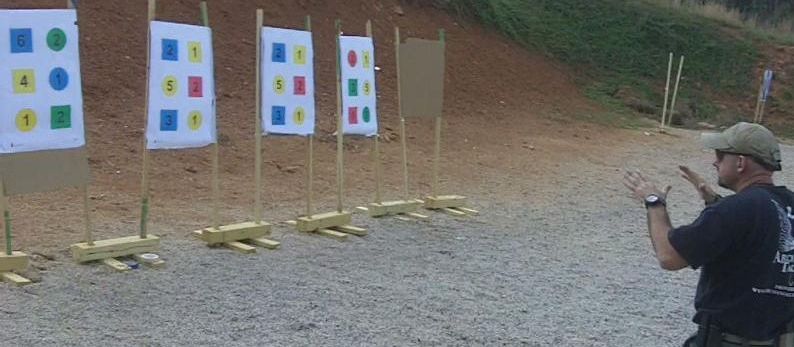
And adversary identification
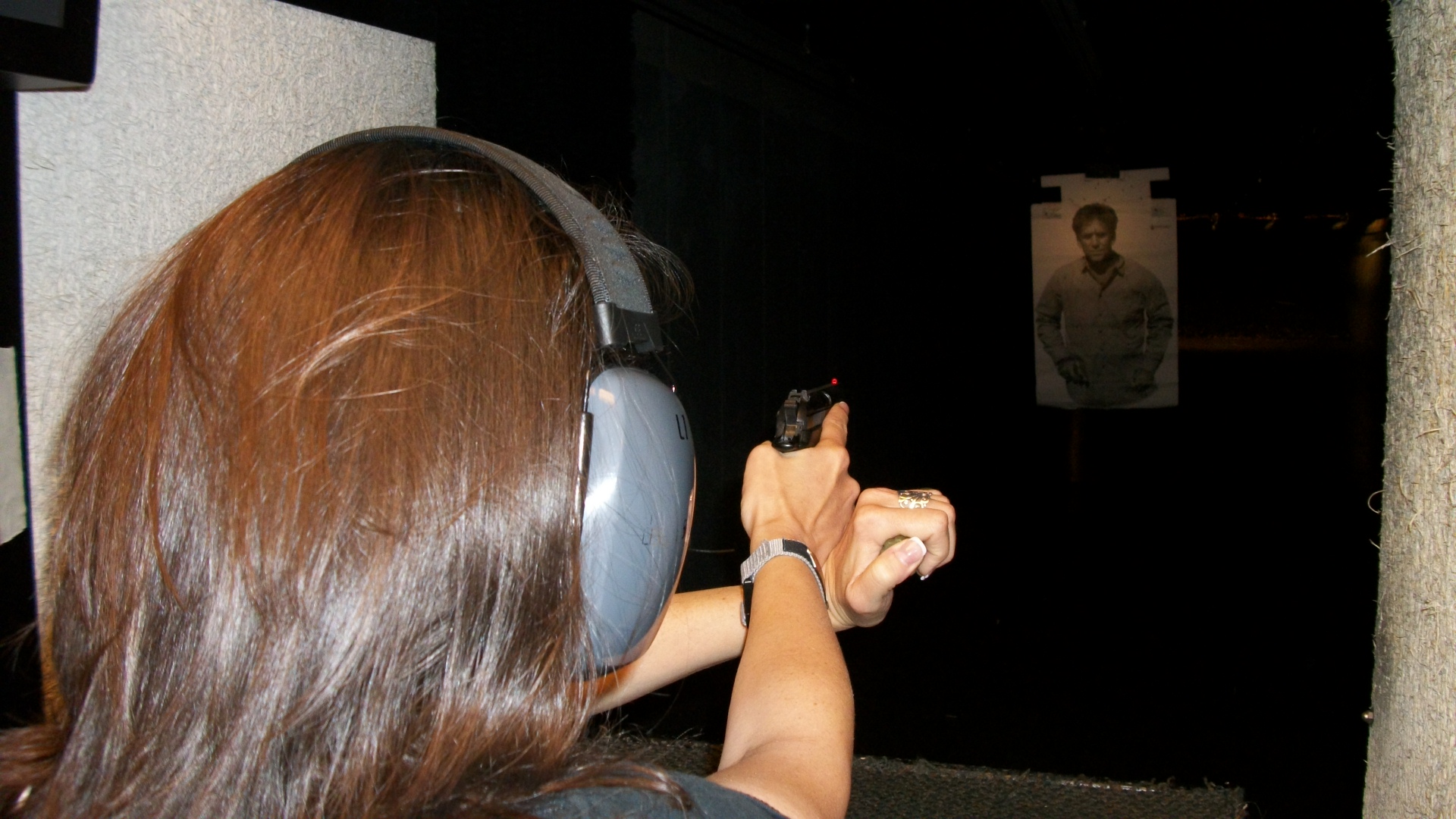
Learning and practicing those skills can help us keep a situation under control before shooting and hopefully prevent a shooting at all.
Here’s the permalink to the interview. http://content.blubrry.com/ballisticradio/140824_BALLISTICS.mp3
Using pepper spray effectively
The second class I attended at Paul-E-Palooza 2 was OC and “less-lethal” for CCW folks given by Lt. Chuck Haggard of the Topeka Police Department. There was a little humor about the class title because to many attendees, ‘OC’ means Open Carry rather than Oleoresin Capsicum. As a result Chuck had to explain he was talking about pepper spray.
Chuck has extensive training and experience with pepper spray. He is a National instructor for the National Law Enforcement Training Center and an Adjunct instructor for Strategos International. He has also been featured as a guest on Ballistic Radio. Chuck stated that he has been sprayed with OC about 60 times, in the training context, and has sprayed somewhere around 1000 people. Most of his sprayees are Police Cadets since his department has a mandatory exposure to OC policy for its officers.
I wanted to take the class because I am a firm believer in carrying what I call ‘Intermediate Force Options.’ Pepper spray is one of those weapons that give us a response to predatory behavior not requiring deadly force. As I state in all my classes “Lacking an intermediate force option while you are armed with a firearm implies that all you are willing to do to protect yourself is kill someone.” That’s not a position most reasonable people would be comfortable in taking, given a little bit of thought.
The class began with a lecture including a review of OC history, products, training and best practices. It then moved on to aspects people need to know for effective use, carry and deployment. Once the lecture was completed, the class moved into the open for practical application with inert trainers. No live weapons, ammo or OC were allowed in the practical exercises. Dummy guns and inert pepper spray canisters, which sprayed water only, were furnished. Eye protection was also furnished to the students.
Once again, as at the Rangemaster Tactical Conference, I had the distinct honor and pleasure of beginning the demonstrations by spraying Chuck in the face with an inert container. We demonstrated two scenarios. In the first, Chuck began to encroach on my personal space while I attempted verbal dissuasion. When he continued to advance, I gave him a good dose and then quickly moved away while he simulated remembering a previous appointment. In the second scenario, after I sprayed him, he became irate and threatened me with a training knife. At that point, I transitioned to my dummy gun and gave him a good cowboy “Pow, pow, pow” while maneuvering away.
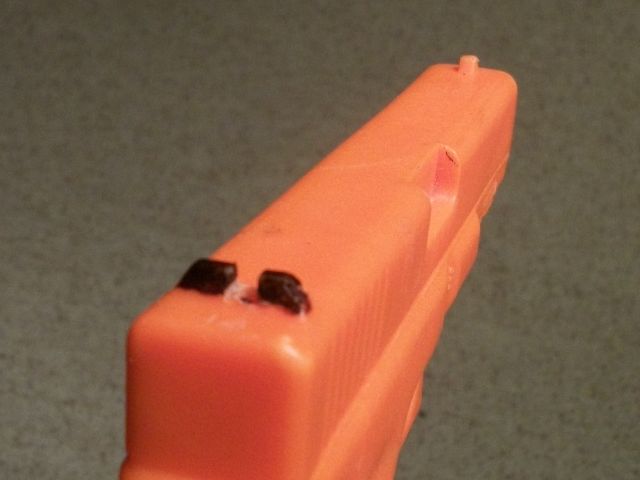
The second scenario was especially interesting for me because I ended up with the pepper spray container in my left hand and my dummy pistol in my right. I shot one handed while maneuvering away from him. I’m not sure how things ended up that way because I started with the can in my right hand. I’m curious whether I transferred the can initially or if I did a ‘Border Shift’ with the can when I started to draw my pistol. I do remember seeing my sights while I was shooting. My dummy pistol has a rear sight notch cut in it because I cannot abide a pistol without sights, even a dummy pistol.
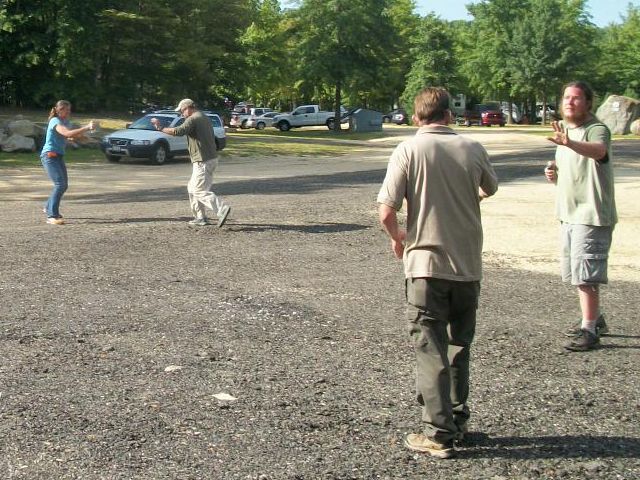
After our demonstrations, the students then split up into two groups. Initially, one group played the predator while the other played the role of the defender. Then the groups switched roles. The students enacted both the non-lethal and lethal scenarios while spraying each other. The class concluded with a critique of spraying and maneuvering.
I don’t practice as much as I would like with my personal OC, a Zombie Spitfire from Sabre. The class gave me a little tuneup, as well as some interesting background on the evolution of pepper spray as an Intermediate Force Option.
Tactical Decision Making (Part II)
There are numerous definitions of Wargaming. Most of them are too elaborate for our use. The definition I am using now is: The process of evaluating your options in light of your situation and the circumstances. Wargaming is a way determining if:
- Your tactics work.
- The tactics employed contribute to your strategic end goal.
- There are significant possible negative outcomes
Wargaming has the following characteristics:
- Evaluates a possible Course of Action against opposing adversary.
- It is an iterative process of action, reaction, and counteraction.
- At a minimum, it should start if you go to Condition Orange. When you’re on the ground, in a pre-contact situation, the wargaming will not be very in depth. But the better your grasp of your end goals, possible options, and negative outcomes, the quicker and simpler it will be.
First, you have to decide what your end goal is. This should be done before you walk out the door of your home each day. Deciding your end goal does not mean saying “I would do this.” That is just one step of the process and not the first.
In my previous post about Tactical Decision Making, I listed some end goals and some possible negative outcomes. Both of those lists, and any additions you may have to them, are worth reviewing from time to time.
It’s extremely important to take into consideration the possible negative outcomes. Failure to consider consequences is a huge gap in most people’s analysis of the situation. Some of the consequences are legal but not all of them are.
Some concrete examples of negative outcomes are:
- Zimmerman shooting – Extensive and costly interaction with legal system ($2.5 million in attorney fees)
- Theodore Wafer shooting, Detroit – Murder conviction
- Jerome Ersland, Oklahoma City pharmacist – murder conviction, life sentence in prison
- Petit murders, Connecticut – Loss of wife and daughters under horrible circumstances
- Joseph Robert Wilcox, Las Vegas – murdered trying to stop an active killer
- Joe Hendrix, Georgia – shot an elderly man with Alzheimer’s – consequences to be discovered in the future
There are three areas you must consider as part of your wargaming. They are your situation, your options, and the circumstances; i.e., your surroundings and the event. We’ll discuss these in the next installment.
Understanding the risk of violent aggression
I couldn’t believe it was happening. It didn’t seem real.
–a common statement by victims of criminal violence
The first presentation I attended at Paul-E-Palooza 2 was The 5 Ws of Risk (of Violent Aggression) given by William Aprill of Aprill Risk Consulting. William is a criminal psychologist who gives the most in-depth look into the criminal mind of anyone in the training industry. Frankly, at times, it’s rather creepy hearing how crazy criminals can be.
His presentation used the classic 5 Ws; Who, What, When, Where, and Why to structure a discussion of how risk can develop and aggregate for the Private Citizen. Using that structure allows us to look at the ways we can put ourselves at risk and, conversely, how we can reduce our risk.
Beginning with Who, he explained the value of “pre-need planning.” Then he explained his concept of a ‘risk envelope.’ This concept describes how varying circumstances we put ourselves in can increase or decrease our risk of being victimized. The levels of aggression displayed by potential Violent Criminal Actors are the flip side of ‘Who.’
What explained the difference between being a target and a victim. The concept of ‘advantaging for dominance’ was also included among various factors.
The key point of When was “not at a time of our choosing.” This unpleasant fact resounds throughout the training community. Sage support for this comes from several sources.
- “When it’s least expected, you’re selected.” –John Farnam
- “You don’t choose when you’ll need your gun; someone else does. And they will typically only inform you at the last moment.” –Tom Givens
- “Initiative Deficit – A criminal will stack the odds in his favor and usually only initiates action when there is a high probability of success.” –SouthNarc
The Where component emphasized that “there are no ‘good’ neighborhoods” where crime does not happen. Criminals prefer to choose the location of ‘highest yield.’ He also discussed the limitations of thinking that by avoiding certain situations or locations we can eliminate our risk.
William’s explanation of Why is where he gets into the inner workings of the criminal mind. He detailed the difference between ‘Instrumental Violence’ and ‘Expressive Violence.’
There were numerous concepts and explanations that he used to expand the 5 Ws explanation.
- Primacy of pre-need decision-making.
- Preparation failures
- Response failures, e.g., “I couldn’t believe it was happening. It didn’t seem real.”
- And my favorite about relying on ‘gut instinct’ “Remember, your gut has shit for brains.”
William and I will be teaching a Decision Shooting Course on September 27, in the New Orleans area. This course will introduce participants to some of the unaddressed realities of violent criminal aggression and effective defensive responses. He will be covering the 5 Ws and their implications for the Armed Citizen. My portion will be about consciously thinking while being armed, which is the exact opposite of ‘muscle memory.’ It consists of: 1) assessing one’s own skills in relation to the situation, 2) weighing the legal justification for using deadly force, and 3) consciously making appropriate decisions in the presence or absence of justification.
For more information and to register, visit the event website.


You must be logged in to post a comment.