Breaking Contact (Part 5)
#mindsetmonday
Our goal in personal protection is to force a break in contact. We want them to go away, or we want to go away. One or the other.
The final segment of the CCW Safe Series about my concept of Breaking Contact is posted.
https://ccwsafe.com/blog/breaking-contact-pt-5
This edition focuses on success stories. I like those.
[W]hen a concealed carrier enters a self-defense situation with the goal of breaking contact — as opposed to a goal of killing or disabling an attacker — the defender has a substantially higher likelihood of avoiding a deadly shooting or making a successful self-defense claim when all else fails.
Shawn Vincent
Leg shots
Initial investigation revealed several individuals were in the home watching tv and playing games through the night. A 37-year-old Ridgely, Maryland man became enraged and began attacking the other occupants with a knife. At some point during the altercation, one of the stabbing victims retrieved a shotgun and shot the male subject in the leg.
The 37-year-old Ridgely man was transported by EMS to Bayhealth Kent General where he was pronounced dead.
https://abcnews.go.com/US/man-stabbing-spree-home-shot-killed-victims/story?id=77936754
So much for the idea that shooting someone in the leg isn’t the application of deadly force. The Village Idiot JRB has no clue but that’s no surprise.
The Delaware State POlice initial report for the incident.
https://dsp.delaware.gov/2021/05/26/update-homicide-investigation-police-activity-hartly/
Breaking Contact (Part 4)
Breaking Contact Part 4 is up.
https://ccwsafe.com/blog/breaking-contact-pt-4
Marissa Alexander, Alexander Weiss, and Jerome Ersland are the cases discussed in the post.
The lesson for concealed carriers is that if you manage to break contact with a perceived aggressor, do not re-engage.
Breaking Contact (Part 3)
#fridayfundamentals
The CCW Safe https://ccwsafe.com/ series about my concept of Breaking Contact continues with Part 3.
https://ccwsafe.com/blog/34532
Part 2 of the series focused on situations where the concealed carrier initiated contact. Part 3 focuses on incidents where the carrier was initially approached and failed to take the opportunity to Break Contact.
I hate platitudes when they’re used in an attempt to simplify a complex topic into a sound bite. “Better to be tried by twelve than carried by six” is one of the most commonly parroted sayings in the firearms community. While many times we are presented with the optometrist’s question, “Which is better, A or B?,” decisions that are made in advance and are going to affect the rest of our lives seldom are binary. I like to think we’re smarter than parrots that have been trained to say one or two things.

As Shawn points out, the decision process has several more options.
When the goal is not necessarily to kill or disable a would-be attacker, a defender is open to other options that carry less legal risk and may produce more positive outcomes.
When breaking contact is the goal, sometimes it is better to disengage rather than attempt to de-escalate.
My personal paradigm is:
- Avoid
- Escape
- Confront
- Resist
Any attempt at de-escalation, even when benign, is a part of Confront. Disengage is part of Escape. Escaping is higher on my priority list than Confronting.
Similarly, in the Gerald Strebendt incident, he unnecessarily moved up the paradigm from Escape to Confront. A confrontation inherently carries more risk associated with it than an escape. As John Hall, former head of the FBI Firearms Training Unit put it:
Any encounter carries with it an element of chance.
My initial post about Breaking Contact (Part I) is located here:
The second is here.
If you would like to purchase my book, click on the image below. The detailed investigations and reports of incidents involving off-duty LAPD officers are very instructional for understanding the differences between Avoiding, Escaping, and Confronting.
Downrange Incident in Rock Hill
This story is about what I call a “downrange incident,” meaning that innocent parties are downrange and in close proximity to the criminal when the shot needs to be fired.
During the initial investigation process, officials learned the 19-year-old allegedly initiated a verbal altercation with others in the apartment. Authorities said the altercation then escalated when the 19-year-old began assaulting those in the apartment and threatened to kill them. The 19-year-old strangled a male who[m] he assaulted, officials said, and was then shot by another person in the apartment in an attempt to stop the attack. Officers said the 19-year-old then turned and started strangling a female in the apartment. He was then shot a second time, then collapsed.
These types of situations happen more often than is commonly thought. Having it happen twice in one incident, such as this one, is rare however. Making a clean close range precision shot should be part of our practice regimen.
From my old YouTube Channel that I can’t access anymore.
The Magic of Knowing that You Can Shoot Quick and Straight
#mindsetmonday
J. Henry Fitzgerald’s book Shooting was published in 1930. Some things in it are dated but most of the book is still very worthwhile. The entire book is available online, courtesy of Sportsman’s Vintage Press.
http://sportsmansvintagepress.com/read-free/shooting-table-contents/
The chapter on The Magic of Knowing that You Can Shoot Quick and Straight is an example of practical mindset. Many times, explanations of ‘mindset’ are vague and nebulous but Fitzgerald’s is straightforward and actionable.
http://sportsmansvintagepress.com/read-free/shooting-table-contents/shoot-quick-and-straight/
Some things related to human nature and performance haven’t changed one bit. Fitzgerald’s commentary on the Dunning-Kruger Effect https://en.wikipedia.org/wiki/Dunning%E2%80%93Kruger_effect is a hilarious example.
I have listened to many officers explaining how good they could shoot and when they got on the firing line they couldn’t hit a cow in the head with a snow shovel.
J. Henry Fitzgerald
It’s not necessary to be a great shot to defend yourself but having a degree of demonstrated competence is a valuable asset to your mindset. Drills like 3x3x3 are one way to demonstrate your competence to yourself. Shooting some of the drills from Indoor Range Practice Sessions and Concealed Carry Skills and Drills are another. Click on the images to purchase either or both books.


FTC notice: I am not affiliated with Sportsman’s Vintage Press and receive no commissions from them.
3X3X3 – Level One
Three Shots, Three Seconds, Three Yards has been discussed in the context of gunfights since the 1970s. It is the most commonly cited statistic about gunfights.
Practicing to hit the silhouette every time using the 3X3X3 basis is Level One of learning to shoot the drill well. It is a good baseline for entry level shooters and those who have never measured their performance.
Level One – hit a silhouette consistently
Level Two – hit a sheet of paper consistently
Level Three – hit a half sheet of paper consistently
Level Four – hit a quarter sheet of paper consistently
The dry practice drill was discussed in a previous post.
Here’s the live fire version.
When I wrote Real Shootouts of the LAPD, I wasn’t surprised that NYPD Lt. Frank McGee was pretty much on the mark when he first described it. Almost all of the off-duty shootouts fit into that statistic.
A related note is that I fired about 100 .22 Long Rifle rounds through my 317 snub with a standard (8.5 lb) mainspring. There was not one Failure to Fire during the session. Ammunition for my .38 is precious and hard to come by so I used the .22 for demo purposes. For those who think that was cheating, I also shot with my SCCY CPX-2 9mm.

If you would like to purchase my book about actual shootouts that are not a figbar of someone’s imagination, click on the image below.
Practicing the First Shot
This really should be #fridayfundamentals but I feel compelled by some recent conversations to send it.
As I mentioned previously https://tacticalprofessor.wordpress.com/2021/04/09/the-importance-of-the-first-shot/, the importance of the first shot shouldn’t be underestimated. How to practice that remains a bit of mystery when people are shooting. Shooting multiple shot, often full magazine, strings of fire is the most common way people practice. Unfortunately, that masks the result of the first sight picture and trigger press.
For new shooters, we also need to keep in mind the concept of ‘progression,’ which is a fundamental concept of two of the world’s elite shooting schools, the Rogers Shooting School https://rogersshootingschool.com/ and the Mid-South Institute of Self-Defense Shooting https://weaponstraining.com/ .
The concepts of First Shot Drill and progression can be easily combined. Consider a series of Levels for hitting with the first shot. Start out at the 3 yard distance.
- Level 1 – hit a silhouette consistently
- Level 2 – hit a sheet of paper consistently
- Level 3 – hit a half sheet of paper consistently
- Level 4 – hit a quarter sheet of paper consistently
Shoot each Level using a progressively difficult start position; Low Ready, Midpoint of the drawstroke, and from the Holster.
You can use any silhouette you like. Having a face, a weapon, and an aiming point is more important than the type of silhouette used.

For those who don’t have access to or don’t wish to purchase a silhouette, a perfectly acceptable substitute can be made out of posterboard.

Start by doing dry practice. Level 1 would look like this.
My colleague Lee Weems https://thatweemsguy.com/ made an incisive comment at the Tactical Conference.
Enough Force used soon enough means less force used later.
Lee Weems
That could also be paraphrased as ‘a good enough hit with the first shot means less shooting later.’
If you would like to purchase my book about actual shootouts that are not a figbar of someone’s imagination, click on the image below.
Breaking Contact – Our Objective
#mindsetmonday
An interesting aspect of reading Use of Force reports by different POlice departments is seeing their varying views about how to interpret the incidents. While the LAPD provides a very detailed analysis of officer marksmanship for each incident, the NYPD has a quite different view, at least in its public releases.
“Objective Completion Rate
The [NYPD] does not calculate ‘hit percentage’ when describing ID-AC [Intentional Discharge – Adversarial Conflict] incidents. The NYPD uses an ‘objective completion rate’ per incident to determine the effectiveness of police firearms discharges. When a uniformed member properly and lawfully perceives a threat severe enough to require the use of a firearm and fires properly and lawfully at a specific threat, the most relevant measure of success is whether the member ultimately stops the threat. This is the objective completion rate. Regardless of the number of shots that strike a particular subject, the objective is considered completed when the actions of the subject that threaten imminent serious physical injury or death are stopped by a member’s use of deadly physical force, i.e., a subject stops their threatening actions after being shot.
In 2019, uniformed members of the service successfully stopped the threat by discharging their weapons in 24 of the 25 ID-AC incidents, with at least one subject shot in each of those 24 incidents, for an objective completion rate of 96%. The objective completion rate is used for statistical and informational purposes, and is not a factor considered in the investigation of the individual incidents.”
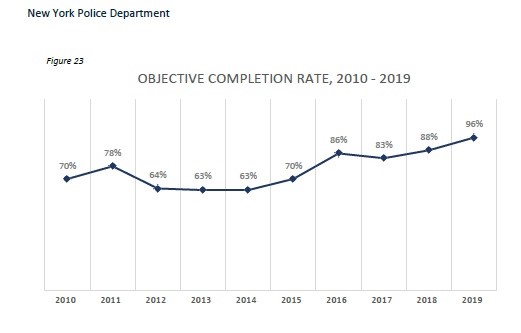
In other words, when the officer actually hit the “subject/perpetrator/assailant” with at least one round, the objective of stopping the Violent Criminal Actor’s action was achieved.
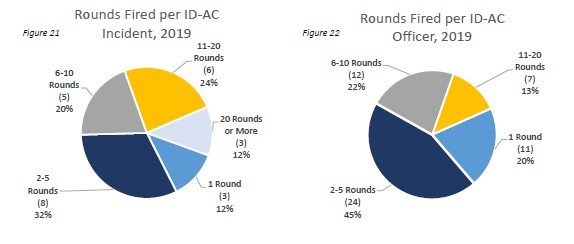
Unlike the LAPD analysis, NYPD data doesn’t provide us information that’s useful in terms of developing physical skills. However, it does provide us with an interesting philosophical viewpoint on what’s important in Defensive Gun Uses. Our ‘objective’ as Private Citizens is exactly the same as for officers of the NYPD, whether we call it “stopping the threat,” “breaking contact,” or use some other term.
The initial post about Breaking Contact (Part I) is located here:
https://tacticalprofessor.wordpress.com/2021/04/10/breaking-contact-part-i/
If you would like to purchase my book about LAPD Shootouts, click on the image below.
The Importance of the First Shot
#fridayfundamentals
Some principles are just as fundamental as is technique. One of the unintentional themes of the 2021 Tactical Conference was the importance of the first shot. One class even had that as its title. Several other instructors touched on it as part of their classes and presentations.
Rolf Penzel and Mike Treat titled their class Making the First Shot Count.
John Murphy made the comment “It’s not a ‘one shot drill,’ it’s a ‘first shot drill’” in his class.
During his presentation Secrets of Highly Successful Gunfighters, Darryl Bolke stated “training efficiency means using the sights.”
Chuck Haggard used the term “Target Picture” to illustrate the concept of placing the sight picture on the part of the target we want to hit initially.
In his AIWB Skills class, John Daub instructed his clients to “think about where you want the muzzle to end up” at the conclusion of the draw.
Scott Jedlinski’s comment “The original 1911 sights were suggestions” in his class was a humorous illustration of why point shooting was so common in days gone by. Tom Givens has also written about the dismal quality of factory sights on pistols and revolvers of yesteryear and how that affected technique training of a century ago.
One of trends that is apparent in the Categorical Use of Force Reports by the LAPD is how often one or two shots solve the problem. This is true through the entire database of over 1,000 incidents, not just the off-duty incidents chronicled in my first book about LAPD Shootouts. LAPD’s emphasis on marksmanship and frequent scored qualification is no doubt responsible for this difference from other large departments that have minimal standards.
In a gunfight, the shooter who first scores a hit above the diaphragm of his opponent is the one who seizes the initiative in the incident. Making a good hit with the FIRST SHOT fired is key to seizing the initiative and then retaining it until the incident is over. No one’s performance improves after he gets shot in a vital area.
In terms of operationalizing this principle, the fact that most common autoloaders don’t have a second strike capability during dry practice becomes irrelevant to the fundamental of making a good hit with the first shot. Your dry practice should mostly focus on the first shot anyway.
During live fire, the majority of our practice should be ‘first shot drills.’ Do a little recoil management practice but don’t overestimate its priority relative to the first shot in the real world. As John Farnam put it, “Our desired range product is victory.”
If you would like to purchase my book, click on the image below.


You must be logged in to post a comment.