Things you should know about body armor
I have body armor and am a firm believer in keeping it close. Since I’m not an expert, here’s better information than I could provide.
https://www.activeresponsetraining.net/seven-things-you-dont-know-about-body-armor
You won’t be able to fire that ammo or eat all that stored food if you get shot and die because you didn’t have body armor.
The package deal for my books is still going. The package is available as an immediate download of all four ebooks at this link:
https://store.payloadz.com/details/2644448-ebooks-sports-shooting-drills-package.html
Get some structured practice in
Things are starting to open back up, so we can get back to the range. To help you use your time and other resources productively when you go to shoot, here’s a package deal of my three most popular shooting workbooks:
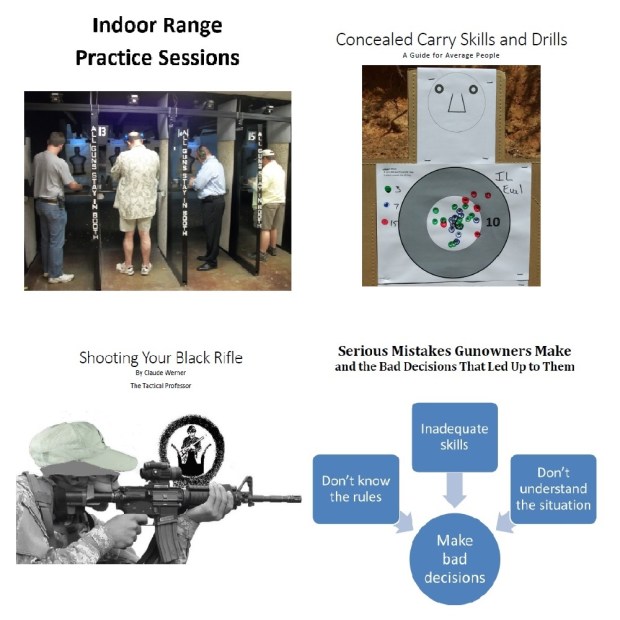
- Indoor Range Practice Sessions
- Concealed Carry Skills and Drills
- Shooting Your Black Rifle
Ordinarily, these three together would sell for $23.97 but as a package, they are 20% off at only $18.99.
As an added Bonus, the ebook Serious Mistakes Gunowners Make is included at no extra charge. It’s a free gift with a value of $7.99.
The package is available as an immediate download of all four ebooks at this link:
https://store.payloadz.com/details/2644448-ebooks-sports-shooting-drills-package.html
At one time, shooting was the American pastime, let’s get back to it.
Mr. Happy/Frowny Face Decisional Drill
For this drill you will need paper plates, a silhouette target, a deck of cards, and a table or platform to put the cards on. The object of this drill is to practice thinking with a gun in hand.
Draw faces on two paper plates. One plate with a happy face (no shoot), one with a frowny face (shoot). Different color markers for each plate, one Red and one Black.
Put the two paper plates on a silhouette.

Place the silhouette at 4 yards
Use only the Ace, Two, and Three cards of all suits from a deck of cards and then shuffle those cards.

Place the cards face down on the table in front of you.
Sequence 1
Turn a card over.
If the card is the color on the frowny face, draw or present the pistol and then shoot the frowny face plate with the number of rounds indicated by the number of the card. I.e., if the card is the 3, then shoot 3 shots. The Ace is one shot.
If the card is the color on the happy face, don’t draw or present, i.e., no shooting.
Pistols having a capacity of less than 12 rounds will require reloading. This is a good opportunity to practice reloading skills under a bit of stress. Pistols with capacities more than 12 rounds can start loaded with less than 12 rounds to gain this additional practice opportunity.
After all 12 cards have been turned over, there should be 12 hits on Mr. Frownyface and NO hits on Mr. Happyface.
This drill can also be done at home using a SIRT pistol, a toy pistol, a water pistol, or some other simulation. The marksmanship might not be measured but the decision-making and thinking skills are the primary purpose of the drill.
The drill has several variations but for most people, this is a good start to work on decision-making.
Tactical Professor books (all PDF)
- Serious Mistakes Gunowners Make http://seriousgunownermistakes.com
- Indoor Range Practice Sessions http://indoorrangepracticesessions.com
- Concealed Carry Skills and Drills http://concealedcarryskillsanddrills.com
- Advanced Pistol Practice http://bit.ly/advancedpistolpractice
- Shooting Your Black Rifle http://shootingyourblackrifle.com
Teaching children about guns
I recently had the opportunity to overhear a friend helping home school her grandchildren via telelearning while we’re under House Arrest during the Beer Plague. It was obvious that the lesson involved firearms. I was fascinated because I said to myself “Whoever wrote that lesson (I didn’t realize it was a book) actually knows something about guns.” When the lesson was finished, I asked what the source of the lesson was. It was Julie Golob’s book Toys, Tools, Guns & Rules: A Children’s Book About Gun Safety. https://www.amazon.com/dp/B078TB9RJB
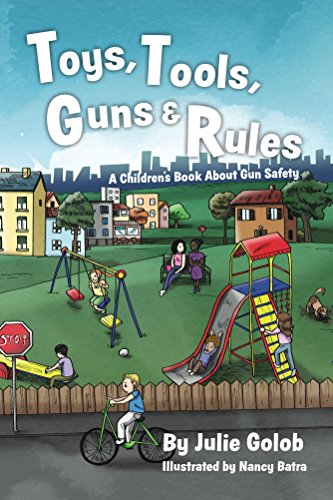
My thought was “Well duh, Tactical Professor, yes indeed Julie Golob knows something about guns.” The meat of her bio is
Julie Golob is one of the most accomplished professional shooters in the world with more than 150 championship titles and top scores in international, national and regional marksmanship competitions in 7 different shooting disciplines.
https://www.juliegolob.com/press
For new gunowners who have children in the house, this book is highly recommended. Long time gunowners will find it useful also. I was impressed by how it explained very fundamental safety rules that kids need to know. Be aware that because it is a color picture book, the Kindle version is not compatible with all Kindle devices. A list of compatible devices is on the Amazon page for the book.
https://www.amazon.com/dp/B078TB9RJB
FTC Notice: I don’t receive any compensation for mentioning Julie’s book. I just think it’s an excellent resource for gun owners, new or long time.
Store guns out of sight and inaccessible
A very recent incident related to me by a friend.
- A man (and his live-in girlfriend) were given a handgun by his grandfather during the Beer Plague.
- They live in a small apartment on the second floor in a large city.
- He placed the gun on top of the bedroom dresser.
- This week, a thief used a ladder to get to the bedroom window and cut the screen to get in.
- The handgun was immediately apparent so it was the first thing the thief picked up.
- The man, who was alone at the time, was sleeping on the sofa in the other room when the thief made entry.
- The thief awakened him at gunpoint.
- The thief stole much of the couple’s possessions, including clothes, laptop, etc. in addition to the gun.
- The thief also demanded the keys and took them.
- After the thief departed, the man called the POlice.
- The POlice Department took the report about the home invasion over the phone.
- The man arranged to have the locks changed but that will take a while.
- The next day, the thief came back and tried to unlock the front door with the keys he had stolen. The door has a cross bar that was in place so the thief was unable to get in. The man yelled at him and he went away.
- Unsurprisingly, the man and his girlfriend are concerned and frightened.
- Fortunately, the thief did not injure the man.
Lessons from the incident
- This is a clear example of a Negative Outcome.
- The purpose of this type of incident report is not to denigrate the person it happened to. Rather, it is to provide important lessons to the rest of us, our family, and our friends.
- Leaving guns in open view is NEVER a good practice.
- Store guns where they are not accessible to unauthorized persons.
- Even a small lockbox or toolbox would have prevented the thief from immediately gaining access to the handgun. The man might have then awakened on his own and been able to achieve a more Positive Outcome.
- For the mechanically handy, most nightstands can be fitted with a drawer lock. While this will not deter a determined thief for long, it will not allow a thief to immediately gain access to your weapon. Such a lock will also prevent children from gaining access to a firearm.
- Guns that are on display as heirlooms or for other reasons should be disabled.
- Some burglars are also known as ‘Second Story Men’ https://www.merriam-webster.com/dictionary/second-story%20man for a reason. Do not assume that living above the ground floor prevents unlawful entry. Even upper story windows should have devices that prevent them from being opened too far when ventilation is wanted.
- Criminals are opportunistic. This incident started out as burglary and then turned into a home invasion. If the man had struggled when he was awakened, it could easily have turned into a murder or homicide. Neither is desirable.
- Even if keys are not obviously taken, you should assume that a burglar has them. This means locks need to be changed and door locks supplemented until the change is made.
“There’s three kinds of men. The one that learns by reading. The few that learn by observation. And the rest have to touch the electric fence.” –often incorrectly attributed to Will Rogers, American humorist
Tactical Professor books (all PDF)
- Serious Mistakes Gunowners Make http://seriousgunownermistakes.com
- Indoor Range Practice Sessions http://indoorrangepracticesessions.com
- Concealed Carry Skills and Drills http://concealedcarryskillsanddrills.com
- Advanced Pistol Practice http://bit.ly/advancedpistolpractice
- Shooting Your Black Rifle http://shootingyourblackrifle.com
Guns 101 – Loading a magazine
Loading (charging) a magazine is another task that’s neither intuitive nor easy for beginners. Here’s an explanation of one way to do it.
Not everyone is going to practice with their new pistol but for those who do, this is a useful skill.
Other useful skills are listed in my book,
Concealed Carry Skills and Drills http://concealedcarryskillsanddrills.com
For those who only have access to an indoor range, which means 99.999% of new gun purchasers, my book
Indoor Range Practice Sessions http://indoorrangepracticesessions.com
is a useful resource.
Guns 101 – next episode
More correctly, the title should be Locking the Slide to the Rear. For a new gunowner, this is not nearly as simple as is often believed. Locking the slide to the rear is an integral part of checking whether an autoloading pistol is loaded or not. For new gunowners, this is worth practicing every day until it can be done readily.
My ebook, Serious Mistakes Gunowners Make is an excellent purchase for new gunowners or as a present if you know a new gunowner.
Serious Mistakes Gunowners Make http://seriousgunownermistakes.com
Guns 101 on Polite Society Podcast
The Polite Society Podcast https://www.youtube.com/channel/UCkVLaQzRB5DKDzZ05J7o2KQ on YouTube has created a series for new gun owners called Guns 101. Each segment is a short (less than 10 minutes) standalone lesson in various fundamental aspects of gun ownership and usage.
The Tactical Professor did a segment on storing guns in cars when it’s necessary. For instance, if a gunowner needed to go into a courthouse, the Post Office, or other denied area, the time to think about what to do with the gun is before you get there.
Also, my book Indoor Range Practice Sessions http://indoorrangepracticesessions.com is an excellent primer for new gunowners who actually want to shoot their guns. When the ranges start re-opening, you can have a plan for when you go.
The Newhall Incident anniversary
At 11:55 p.m., April 5, 1970, two Officers of the California Highway Patrol stopped a car for brandishing a firearm at another vehicle hours earlier. Minutes later, they and two other CHP Officers would lie dead in the parking lot of the restaurant where the stop took place. Their murderers would escape into the night, virtually unscathed in the gunfire.
https://tacticalprofessor.wordpress.com/2018/04/06/the-newhall-incident-april-1970/
RIP, Officers Frago, Gore, Alleyn, and Pence.
Dry Practice Safety Procedures
The influx of new firearms owners in the past few weeks has generated considerable interest in dry practice. For both new and long time owners, a primer on dry practice is in order.
Dry practice is the process of practicing with a firearm without using ammunition. Generally, this is done at home but can also be done at the range in conjunction with live fire practice. The purpose of dry practice is to become more familiar with the operation of a firearm without the distractions of recoil and the Overpressure Event aka muzzle blast. In times of limited or no availability of ammunition and range resources, dry practice may be the only practice method available to us.
There are very specific safety precautions that should be used to make dry practice as safe as possible. A one page sheet listing safety precautions is available here. dry practice safety procedures Note that no usage of any potentially life-threatening device, such as firearms, automobiles, chain saws, or electric outlets can be considered completely safe.
Using a chamber safety device is highly recommended when dry practicing. A number of commercially available devices are available and they work well. A field expedient device is a pipe cleaner aka ‘craft fuzzy stick’ through the bore and bent over in the ejection port.
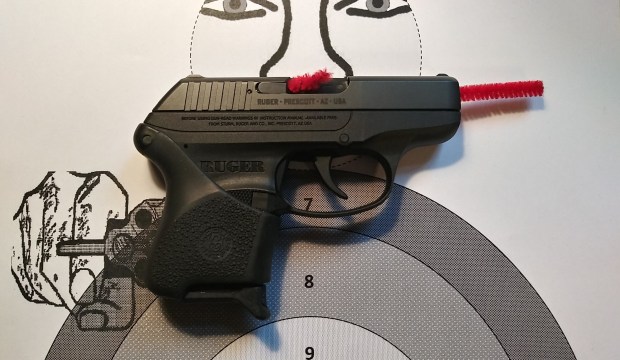 These can be purchased at Wal-Mart for less than one dollar for a large package of them.
Previous articles about dry practice, nee dryfire, can be found by clicking the ‘dryfire’ Category in the right column menu.
Practice and practice safely.


You must be logged in to post a comment.