Standards (A Series)
Standards (Part I – Introduction)
While I’ve been on hiatus, I’ve been thinking a great deal about Standards. The Free Dictionary lists the first noun definition of Standard as: An acknowledged measure of comparison for quantitative or qualitative value; a criterion.
In the area of personal protection, standards can apply to many different facets of our skills and body of knowledge. Standards imply measurement, something that many people are deathly afraid of. While ‘public speaking’ is often mentioned as being the most prominent fear, that is merely a subset of a larger body, individual performance measurement.
The most obvious and contentious type of standard regarding Private Citizens who own firearms is the concept of marksmanship standards. The discussion comes up regularly among the training and gun communities without any general consensus about what is appropriate. Generally, the topic revolves around Citizens who have some form of of License to carry a weapon. We should keep in mind that it can also apply to those who keep firearms for home defense.
Opinions vary widely about what standards are appropriate for those who carry weapons. On one end of the spectrum, some people feel there should be no standards at all. Rob Pincus of I.C.E. Training holds this view as do advocates of Constitutional Carry. On the other end of the spectrum, there are very difficult standards such as the FAST Drill developed by the late Todd Green, the Humbler popularized by Larry Vickers, or the Handgun Testing Program developed by Bill Rogers of the elite Rogers Shooting School.
In the middle are the Qualification tests used by many States as one of the prerequisites for obtaining a Weapons Carry License or whatever name the State puts on the card. For those who wish to carry a weapon in those States, the discussion of what standard is appropriate starts with what their State’s requirement is and how to meet it. No two States having a Qualification requirement are alike
The difficulty of these State Qualifications varies quite widely. Anywhere from 10 rounds to 50 rounds have been mandated. The distances shot at fluctuate from six feet to 15 yards. Some are timed but most are not. The targets may be large or much smaller. Interestingly, very few States have a test requirement that includes drawing from a holster. In fact, some States specifically prohibit the Qualification test from including drawing from a holster. While this might seem paradoxical, it is not because of liability and fairness issues.
What this series will explore is the various types of standards that exist, what skills are required to meet them, and how to choose what is appropriate for you, if anything.
People skills and personal protection
While reviewing some files in my reading list, I came across this gem. It’s from an article called The best advice for today’s music industry was written 80 years ago
In his closing keynote presentation [at the DIY Musicians Conference] called “How to Make an Extra $100,000 from Your Music Next Year,” Martin [Atkins] ran down a long list of creative cost-saving and money-making suggestions, peppered with commandments like “Don’t be an asshole” and “Whatever the fuck it is, get the fuck over it.”
At the heart of Martin’s talk, though, was this quote:
“You can make more friends in two months by becoming interested in other people than you can in two years by trying to get other people interested in you.”
Dale Carnegie wrote that in 1936, in his book How to Win Friends and Influence People.
Martin’s first suggestion brought to mind a comment one of my first bosses in the real estate business made about one of the brokers in our office. “That guy needs to take a Dale Carnegie Course. Twice!”
Dale Carnegie Training has an excellent eBook abstract of Dale Carnegie’s writings available for download on its website. The eBook is called Dale Carnegie’s Secrets of Success. Here’s the link to it. I have two well-worn hard copies, from when it was called Dale Carnegie’s Golden Book, one of which I keep on my desk.

Secrets of Success is recommended reading for everyone, regardless of what you do or your personal philosophy. Those who are churned up about recent political events, on both ends of the spectrum, should take note especially.
What does Dale Carnegie have to do with personal protection? Let’s keep in mind that unlike natural disasters, personal protection against criminality involves a social transaction between two people. Those two people might be:
- You and a Violent Criminal Actor
- One of your loved ones and a Violent Criminal Actor
- A trainer and you
- You and someone you are trying to teach, either formally or informally
- You and someone you are trying to influence to make decisions about personal protection
Since I am a trainer and educator, I’ll address the last two points first. Recently, a trainer and blogger posted a 4,128 word rant about numerous shortcomings an acquaintance of his had. The rant was very pompous and disdainful. Some of the shortcomings related to personal protection and some were general life ‘flaws.’ No doubt the trainer’s object was to give his readers some food for thought about how they might have shortcomings similar to the acquaintance’s. However, Atkins’ first comment, “Don’t be an asshole” immediately came to mind as I read it. The overall tone of the blogger’s post was “this guy’s an idiot and I’m sooooo much smarter and better than him.”
No one likes or is influenced by a pompous asshole. Unfortunately, I see a lot of pompous assholiness in the training community. I’m not immune to being that way, either.
The Be a Leader section of Secrets of Success makes several germane points.
- Call attention to people’s mistakes indirectly.
- Ask questions instead of giving direct orders.
- Use encouragement. Make the fault seem easy to correct.
Another aspect of the training community I often see is a lack of connection to the everyday lives that our students live. There are several worthwhile items from Secrets of Success in this regard.
Become a Friendlier Person
- Be a good listener. Encourage others to talk about themselves.
- Talk in terms of the other person’s interests.
Win People to Your Way of Thinking
- Try honestly to see things from the other person’s point of view.
- Be sympathetic with the other person’s ideas and desires.
- Throw down a challenge.
So, I’m going to throw down a challenge to the training community.
Get a job; a real job where you have to fill out a W-4 when you get hired. Just like the jobs your students have.
Right now is a golden opportunity, no pun intended. The end of the year is a relatively slow time for training and there are numerous seasonal positions available in the retail sector. Target, WalMart, and Sears, among others, are all hiring for temporary positions through the end of the year. If you don’t like wearing a uniform, Macy’s and other high end retailers are hiring and will give you an even better environment to test your hypotheses. Get a temporary job in a retail store for a couple of months. Walk a mile in your students’ moccasins while carrying the heater and all the gear you tell them to EDC. See how it works out for you.
If you get fired (or arrested) for a weapons violation or you decide you can’t carry all that crap while working and interacting with people all day without getting made, you owe me a drink. If you work at least 30 hours a week for six weeks in the retail environment with your full EDC loadout, I’ll buy you dinner. Full time sworn LEOs, 16 hours a week will fulfill the challenge. Totally on the honor system; I’ll accept whatever outcome you tell me you had.
In our Violent Criminal Actors class last month, William Aprill talked about the difference between odds and stakes. The payout odds for my offer are about 5 to 1 in your favor. The stakes; well that’s a different story.
Next time, we’ll discuss the relevance of people skills to The Deadly Mix and Law Enforcement Officers Killed and Assaulted 2015. Until then:
A rant about rants
In the past week, friends have pointed me to several rants in the blogosphere about ‘deficiencies’ among gunowners. “They’re not physically fit enough,” “their technique sucks,” “there should be some training requirement before they can carry a gun,” etc. (I had a little they’re, their, there wordplay fun with that. 🙂 ) I’m no different; my Serious Mistakes articles and audios are my own rants about gunowner deficiencies.
The problem with rants is that they immediately turn off the target audience. No one likes to be told they’re a buffoon or inept. Serious Mistakes has been the second poorest selling information product I’ve ever created. So, ranting is just an exercise in futility. This post will be no different; “ranters gonna rant.” But if you’re not part of the solution, you’re part of the problem, so I’m going to offer an alternate viewpoint.
My colleague William Aprill periodically says that I tend to create ‘actionable’ material. That is indeed what I try to generate, material and programs that people can actually do step by step. Indoor Range Practice Sessions and the Pistol Practice Program are examples of that. Even Serious Mistakes has some ideas in it about how to not shoot your finger off or forget your pistol in a public restroom.
For those in the blogosphere who feel like tearing off on a rant, here’s a possible structure for your rant.
- Here’s the problem. (No more than two paragraphs).
- This is a possible solution. (One paragraph)
- The first step to implementing the solution is….
- Further steps in the solution are….
- It’s going to take XXX amount of time and XXX amount of resources to make the solution work long term.
- A journey of 1,000 miles (or 1,000 Days) begins with one step (or one practice session.) –Lao Tsu
While you’re crafting your rant, also keep in mind the limitations your audience has that you might not. If someone’s been overweight all their life, they’re unlikely to drop a bunch of weight just because there’s a rant about them needing to. (More their, they’re, there wordplay fun.) Keep your solution within the realm of reachable reality. (Some alliteration wordplay.)

It’s common to talk about constructive criticism but its implementation is often forgotten. Where our own perceptions are concerned, we’re likely to forget we were beginners or uninformed or not up to snuff at one time, too. (Did it again.) Think that there are ways that you can help your target audience achieve their goals instead of just telling them they’re one of the Three Stooges (there, their, they’re and alliteration wordplay fun all in the same sentence.)

Thanks for reading this. I doubt it will do any good but I had fun writing it. As General of the Armies John J. Pershing said “An officer is responsible for his own morale.” Wordplay and philosophy are two things I don’t get to indulge in very much at the keyboard.

And no, I didn’t have a drink for breakfast. I’m saving that for lunch.
Indoor Range Flashlight Practice Session
Someone who purchased Indoor Range Practice Sessions noticed a discrepancy in Session 11 (shooting with a flashlight).
I’ve updated the downloadable eBook for future purchases, but I want existing customers to have the update also. Accordingly, I created a downloadable file with Session 11 only.
As most of my readers know, using a flashlight to avoid tragedies is one of my hot buttons. It’s important enough information that I am going to make the updated Session 11 only available as a free download to all my blog followers, as well as previous purchasers.
The link to the updated Session 11 is here: Session 11 – Shooting with a flashlight
1000 Days of Practice (Part III)
Many people find it difficult to dryfire every day because they don’t have access to a firearm. Airline pilots and business people whose job require frequent air travel have a hard time of it. There are different ways of dealing with it.
The first would be to practice every day you do have access to your firearm and start counting. Doing that means you wouldn’t have a consecutive progression of the 1,000 Days but you would still get in 1,000 Days, it would just take longer.
Another approach would be to broaden the focus of your practice, as I mentioned in Part I. That’s one reason I entitled this series 1,000 Days of Practice.
Other skills appropriate to personal protection could be included as part of your mission statement for the 1,000 Days. This wouldn’t be 1,000 Days of Dryfire but it could be 1,000 Days of Personal Protection practice. Many of the most important Personal Protection Skills are soft skills that don’t require equipment to practice. Some that come to mind are:
- situational awareness
- the decision-making process
- incident analysis
- wargaming and decision exercises
- proxemics, and
- human communication and interaction
The memory aid I use for personal protection is RADAR.
- Ready – being prepared, mentally and physically
- knowledge,
- skills,
- tools
- Aware – eyes on the horizon, ears not plugged up
- Where am I?,
- Who is around me?,
- What are they doing?,
- What is going on?,
- Points Of Likely Concealment
- What is wrong in my right world?
- Decide – based on your decision criteria
- options,
- priorities, and
- the situation
- Act – do what you need to do
- Ready Again – be ready for your plan to need adjustment or the police to arrive.
Dryfire is one component of the Ready stage but it’s certainly not the only one. Understanding the criminal mindset and their methods of operation is also key. How about spending a few minutes periodically reviewing criminal victimizations that occurred to others and wargaming how to either avoid or deal with the situation? I have taken this so far as to go on a field trip to the location of a particularly bad incident and actually observe the lay of the land.

There are games that smart cops used to play to tune up their situational awareness. How common they are anymore, I don’t know. For instance, when in a waiting area, look around the room, then close your eyes and try to describe everyone in the room; clothes, height, weight, etc. That would be Aware practice.
Or, let’s say you encountered something that caused your to Alert and then realized it wasn’t a problem. You could mentally wargame what you thought the original problem and your solution. Take it all the way through to Ready Again, including your interaction with the authorities afterward.
There are many different ways to approach the 1,000 Days and tailor the focus to your personal needs and circumstances.
I’ll be going through a more in-depth explanation of RADAR, including some decision exercises, in the Violent Criminals and You class that William Aprill and I are teaching next month. William will be giving his extensive presentation on the criminal mindset and how differently criminals think.
Indoor Range Practice Sessions
In response to queries and comments about the Pistol Practice Program, I have created a downloadable eBook called Indoor Range Practice Sessions. It is structured as a PDF eBook that you can download to your smartphone or tablet and take with you to the range. That way you always have your practice session with you. Most (99%) gunowners only have access to an indoor range, so the Sessions are designed with this limitation in mind.
The book contains 12 Practice Sessions and 12 Courses of Fire from various States for their weapons carry licensing process. The Sessions are designed to progressively increase in difficulty so when done in sequence they challenge shooters without overwhelming them. The Courses of Fire were chosen to be complementary to a respective Practice Session. Each Session or Course of Fire is 50 rounds or less. They are all structured to maximize the effectiveness of your range time. It also contains sections on:
- Four Rules of Safe Gunhandling
- Gripping the Autoloading Pistol Properly
- Trigger Manipulation
- Using the Sights
- Use of Force philosophy
- and more!
There are considerably more restrictions placed on shooters at indoor ranges than at outdoor ranges. These Sessions were designed with those restrictions in mind. For example, most indoor ranges do not allow drawing from the holster, so the Sessions work on the general idea that no drawing is possible. Similarly, multiple target arrangements are not possible when shooting in a booth at an indoor range, so the Sessions do not include multiple targets.

These Sessions are intended for people who have purchased a firearm for personal protection. They are directed toward newer gunowners; however, ‘newer’ is a relative term. Many people who have owned, and perhaps shot, firearms for years aren’t as proficient as they think they are. Being a hunter, military veteran, security guard, or even police officer is no guarantee of being competent with a pistol. The difference in contexts is huge and often misunderstood.
Learning to shoot is an ongoing process. A misunderstanding that people have is thinking they can take a short training course, attend a seminar, or read a book and then feel they are ‘trained’ or ‘knowledgeable.’ Nothing could be further from the truth. We can only absorb so much information at one time. If we don’t practice what we’ve learned, that skill or knowledge slips away quickly. Repetitive reinforcement of our learning is key to developing and maintaining skill.
The eBook is available for download HERE.
Dryfire drills and objectives
Over the years, I have designed dozens of different dryfire drills for my practice sessions. The first was for a dryfire VHS tape that I produced almost 20 years ago. Frankly, the session and the tape weren’t that good but it was a start. I just kept creating and refining more of them. Now I have a menu of options to choose from each day. Most of them are recordings that I have on my computer and/or my cell phone.
Having a library of pre-made sessions accomplishes a number of things for me.
- Keeps me from getting bored. Since I’m close to finishing my second run of 1000 Days of Dryfire, that’s really important. Let’s face it, having to do the same thing for 1000 days would make it hard to complete the 1000 days. It’s human nature to get bored and we need to accept and anticipate that.
- Having some short sessions makes the 1000 days manageable. A number of my regimens are less than 5 minutes, including setup. Otherwise, I’d probably end up missing a day due to scheduling, fatigue, or other factors. If you want to design some longer sessions like Ben Stoeger or Steve Anderson, that’s great. It’s good practice and I encourage it. However, you should have at least two ready sessions of five minutes or less duration that you can fall back on when you’re busy or tired.
- If you’re a little fatigued, doing a short session helps prevent practicing bad form. Better to get 30 quality reps and end it there rather than doing a longer session and overlaying 70 bad reps on top of 30 good ones.
- Designing short sessions helps me re-focus my long term goals periodically. I shot IDPA heavily for over a decade and a half. During that time, my dryfire sessions were designed around that activity. Doing a lot of dryfire was one of things that helped me win six State Championships. When I became the Chief Instructor at the elite Rogers Shooting School, I created sessions that were more in tune with the skills I demonstrated and taught there. Now that I have become focused on Decision-Making and avoiding Serious Mistakes, my sessions revolve around those objectives.
- Two or three short sessions can be combined into a longer one. For instance, I could combine a timed accuracy oriented session, such as the one I created based on the LAPD Bonus Course, with a Serious Mistakes session, such as flashlight practice.
Think about your goals and what the skills that relate to them are. There are numerous references about dryfire on the Internet and YouTube. My colleague Greg Ellifritz made some very pertinent comments to me recently.
It’s so easy to be good at shooting in today’s world. It takes so little effort to obtain knowledge that was completely cutting edge (and not disseminated outside a very tight knit group of professionals) 25 years ago. A simple google search will provide all the information that took me 10-15 years of constant study to learn.
Just be sure to vet your sources to be sure that it’s not some goober who thinks pointing a pistol at a student’s face, or worse, shooting them, is okay or excusable.
Creating dryfire recordings
A friend of mine emailed me the following question.
Claude, what device do you use to make a digital audio recording? How do you transfer the digital recording to your computer?
I had mentioned to him the recording I recently made for an Enhanced Standard version, i.e., not so easy I could pass it blindfolded, of the State of Ill-Annoy Police Qualification Course. I made the recording for dryfire practice but I could use it for livefire, too.
One of the few apps I have on my phone is an audio recorder called Mini Recorder Free. I have a Windows phone but the app is also available for Android. It’s very easy to use and records the input as MP3 files.
First, I look at a course of fire and write a script for the recording. When I’m happy with the script, I record the narration of the course of fire, usually as one file. Where the beeps are supposed to go, I say ‘beep beep’ as a place marker.
Then I record the beeps from my CED 6000 timer by putting the microphone next to the timer. Each of the different times is recorded as a single set of beeps. I can insert each beep file multiple times into the narrative, where that’s appropriate.
I connect my phone to my computer and copy the narrative and beep files to the computer. Finally, I edit them together with Wavepad Sound Editor, which I downloaded from the Internet. Undesirable noises get edited out and I standardize the spacing between the stages so there’s enough time to re-holster, change hands, or do other preparatory work for each string.
Since I don’t have a 15 yard range in my apartment, I create reduced scale targets to use for dryfire. I create the targets by scaling them with Excel.
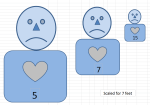
A reduced scale target also allows me to conceal my target when I’m not dryfiring, which is something I believe in very strongly. The 12 shot drill is on the back of my wall hanging.
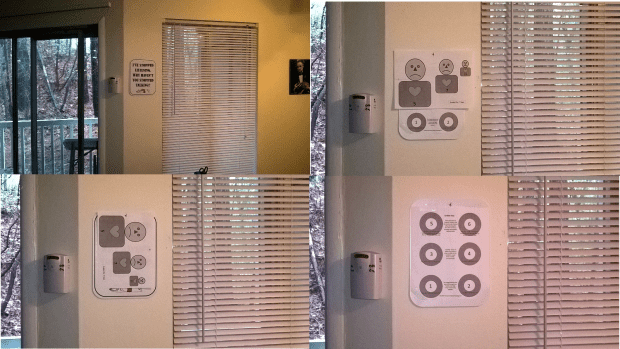
On some of my recordings, I substitute a gunshot sound for the start beep. It just depends on how involved I want to make the recording. For my dryfire recording of the LAPD Bonus Course, I downloaded an audio file of the actual course being shot on the LAPD range. I had to clean that one up a lot but it’s fun to dryfire to because there’s all the range noise, LAPD Rangemaster commands (which sound like a subway conductor), sounds of empty magazines hitting the ground, and gunfire in the background. That’s as close as I can get to an actual range experience in my living room dryfire practice area.
A few of the recordings stay on my phone to use when I’m traveling. I also keep a PDF of the target on my phone so I can print it if I forget to take one along. It fits on one page so it’s easy to print in a motel business center. ISP 7 foot target
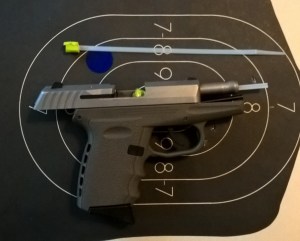
At this year’s Rangemaster Tactical Conference, someone mentioned wrapping a zip tie with a piece of colored duct tape on it as a safety insert. It’s a great idea and I’m using that now along with the Rogers Tap-Rack-Trainer. A round can’t be chambered with the tie in place. No disassembly of the gun necessary to put it in and it’s easy to take out, too. A bag of 8 inch ties costs about $2. The zip tie isn’t a snap cap, though, so keep that in mind.
The audio recording of the ISP Course I created is available as a download for 99 cents on my CDBaby store if you don’t feel like doing all that. There are a number of other recordings of interest, too.
Thoughts about the Rangemaster 2016 Tactical Conference – Part II
The Rangemaster 2016 Tactical Conference was held March 11-13, 2016 in Memphis, Tennessee. I’m continuing to coalesce my thoughts and observations about the Conference.
A friend emailed me today with this question.
For 30 years I have heard the term Dry-fire. The term has been used in articles, in classes, on training videos. Now it is called Dry-Practice. Have we gone politically correct?
Since dryfire is something I work on quite a bit, that’s a question worth addressing in the context of the Conference. Dry Practice, to me, expands the boundaries of what we can work on beyond trigger manipulation. For instance, if you practiced clearing your house with an inert gun, there wouldn’t be any firing, so it would be dry practice.
I considered including a decision-making component, using decisional flash cards I’ve been developing, in my presentation. Due to time constraints, I had to leave it out. That would also be a form of dry practice even though there wouldn’t be any weapons, live or inert, involved; purely a thought exercise.
So, dry fire is actually a subset of dry practice. When it’s used that way, I can accept both definitions.
My class for the Conference was Developing a Dryfire Practice Regimen. I focused the class on fundamental manipulation skills of a pistol that were parallel to what could be seen on a square range. For instance, practicing trigger manipulation, presenting from ready or a holster, malfunction clearance, etc. Fundamental skills should be practiced until we are Unconsciously Competent at them. The more repetitions we have at a task, the more likely we are to develop the UC necessary to free our minds for situational input and decision-making.
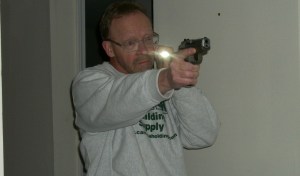
Other classes at the Conference refined, extrapolated, or demonstrated the need for dry practice. For instance, John Hearne’s presentation Dry Practice: An Evidence Based Approach included several items of physiological theory about why dry practice is an effective form of practice. John’s Master’s degree concentration was in Research Methods so he was very thorough about his research and how he applied it to our Art. Larry Lindenman’s Managing the Don’t Shoot was taught using inert weapons. The students undertook a significant number of progressively complex exercises with multiple repetitions about how to take a threat at gunpoint without firing. Tom Givens’ Low Light Equipment class included considerable material about flashlight technique. All the techniques Tom presented could be practiced dry without going to the range. Low light livefire should simply be a verification of the manipulation skills developed in dry practice. That is the approach used at the elite Rogers Shooting School.
One attendee was so kind as to bring a set of Dry Fire flash cards he had purchased. It was interesting to look at them. While they might have some long term viability for a few shooters, there were some serious barriers to using them for skill development. Most notably, the cards assumed the user was familiar with the drills indicated on the cards. I.e., the creator took his subject matter knowledge for granted. Second, there really was no information provided about how to use the cards as part of a practice regimen. It’s important that we either have a logical sequence for building our skills or that we deliberately work, at random, skills we have already developed to maintain instant recall of our UC. Without a program for doing one sequence eventually followed by the other, the cards’ usefulness is limited, in my opinion.
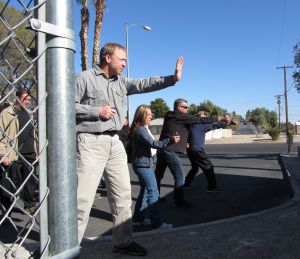
Caleb Causey and I had an interesting conversation about non-verbal communication. It made me realize how powerful non-verbals can be between an instructor and a student. Chuck Haggard and I have discussed the non-verbal communication that goes on between predators and potential prey. One of the most important components of interacting with predators is to ‘fail the interview.’ Predators frequently observe whom they wish to prey upon in order to make a decision about whether to proceed with the predation. This observation is the initial component of the ‘interview.’ Appearing to be uncooperative from a distance may avert the need for a verbal or physical interaction at all. Being uncooperative is something that can be practiced dry, as well, and doesn’t necessarily require equipment.
More about the Conference next time.
Initial thoughts about the Rangemaster 2016 Tactical Conference
The Rangemaster 2016 Tactical Conference is now in the record books. It was held March 11-13, 2016 in Memphis, Tennessee. The gathering included 200+ attendees, almost 30 instructors, and the fine facilities and staff of the Firearms Training Unit, Memphis Police Department Academy.
There was a great deal of material presented, more than could be attended. The Conference focuses on an inter-disciplinary approach to personal protection, so there is a lot more than just firearms and shooting involved. There was a challenging pistol match that could be shot, though; 158 people chose to shoot it.
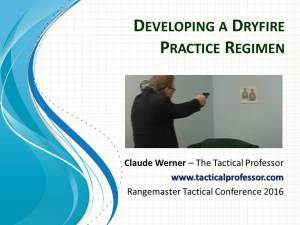
The class I gave was Developing a Dryfire Practice Regimen. I was very gratified by the turnout of 50+ students. As the saying goes, ‘The best way to learn something is to teach it.’ Over the course of creating my presentation, my dryfire techniques became even more refined. One attendee also gave me a new training aid I wasn’t aware of. As in every class I teach, I also learn from the students.
The other classes I attended were:
- Managing the Don’t Shoot – Larry Lindenman
- Gaming the Streetz – Eve Kulczar
- Low Light Equipment – Tom Givens
- Optimizing Classroom Instruction – Tiffany Johnson, Esq.
- Metro-Tactical – Julie Thomas
- Urban Insurgency – Dr. Martin Topper
- Lasers, Red Dots, Iron Sights – Karl Rehn
- FBI Research: The Deadly Mix – John Hearne
- International Terror Operations – Gary Greco/John Holschen
- Dry Practice: An Evidence Based Approach – John Hearne
One of the pleasures of going to Conferences is getting to talk and catch up with my peers. Some of the conversations I had were:
- Cecil Burch – the Venn Diagram of Realization, instructor goals in attending conferences
- Paul Sharp – human gun interaction
- Skip Gochenour – Homicide trials
- Caleb Causey – Non-verbal communication
- Tom Givens – Standards that replicate incident skills
- Richard Jenkins – Dry Fire Flash Cards and skill development
- John Farnam – Attitudes of older fighters
- Gary Greco – American soccer team development, American Mindset (competition and confront/dominate)
- John Murphy – immediacy of action
- Mark Luell – I won’t let you take this from me
- Chuck Haggard – performance of .38 Special and .22 LR in gel and adversaries, S&W metal autoloader maintenance
- Karl Rehn – iron sights, lasers, and red dots
- Julie Thomas – tuning a class presentation
I’ll have more to report about the Conference in future posts.


You must be logged in to post a comment.