Get Ready
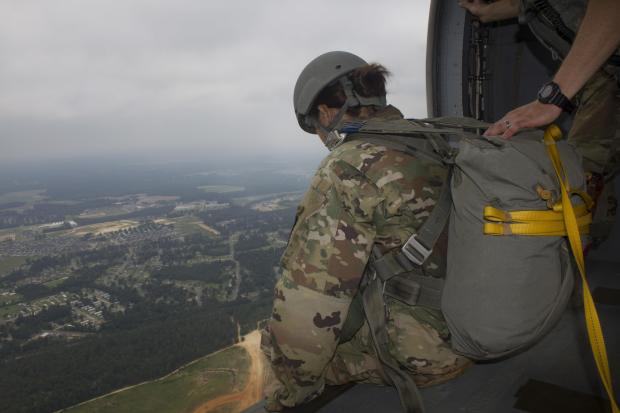
It’s often apparent in classes how much time it takes people to switch gears and ‘Get Ready.’ Transitioning our Defense Condition, both mentally and physically, from Not Ready to Ready may be the most important skill we develop. We don’t necessarily have to deal with the Tueller Principle but even if a criminal is moving at a brisk walk, we seldom have 12 seconds to ‘Get Ready.’
U.S. Army photo by Staff Sgt. Felix Fimbres
Ten to 12 seconds is a common response time to a Ready command during firing squad practice on the firing line during classes. That’s a luxury of time we will seldom have prior to a criminal attack. Often people will look around to see what others are doing before Getting Ready. When a criminal comes for you, others will seldom even notice, much do anything to give you an Alert.
Get Ready is actually what Jeff Cooper’s Color Codes are about. They describe a state of mental readiness to act.
Mental condition comes first and can be followed by increasing our physical Readiness status.
- Ready positions worth practicing
- Hands in front
- Hand on gun
- Transition from OC (OC canister at arm’s length)
- Low Ready
When is Low Ready appropriate? Avoiding Aggravated Assault charges is just as important as avoiding the assault itself. Either can change our lives forever. A good guideline comes from the Los Angeles POlice Department.
What is the value of training?

Firearms instructors are periodically asked the question “Why should I take training?” The answer often comes in the form of a list of skills that are taught or the reasoning behind using a certain technique. However, these do not address the underlying fundamental reasons for taking firearms training at all.
- You don’t know what you don’t know.
- Much of what you know is wrong.
- It’s good to have some of the answers to the test before taking it.
These issues relate to both technical competency with using a firearm (gun safety and marksmanship) and the ability to use the firearm correctly in a personal protection situation (legal and tactical).
You don’t know what you don’t know.
Shooters who only take their gun to an indoor range once a year “to sight it in” generally have a highly ‘cocooned’ knowledge of firearms. They know how to operate a firearm in a…
View original post 1,037 more words
Capable v. Likely
What are we capable of versus what are we likely to do?
John Johnston of Citizens Defense Research and I have been discussing this topic in relation to standards in a class. He and I are both believers in having standards and being able to demonstrate competent execution of those standards. Being able to demonstrate means both the instructor and the client.
One of the things I do in private sessions is to have the client take a hostage rescue shot. The target is a complete head next to and not obscured by the hostage head. Only one shot is allowed. The client gets to pick the distance. Most clients, even competent shooters, will close to 3 yards (9 feet) or less. That’s always interesting because the boundary between the near and far phases of Social Space in proxemics is 7 feet for North Americans.
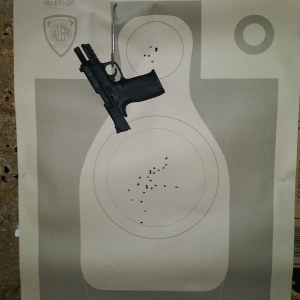
Our technical capabilities are limited by what is within our own heads. What we think we can do represents ‘likely,’ regardless of what we’re actually capable of.
As Ken Hackathorn has said for many years:
You are unlikely to do something in a stressful situation that you’re not reasonably sure you can do competently.
The real value of training and practice isn’t gaining technical competence, it’s achieving confidence in your abilities.
If you are interested in bringing your Strategies, Tactics, and Options for Personal Protection to a higher level, please subscribe to my Patreon account for $5 per month. It’s an investment in yourself. https://www.patreon.com/TacticalProfessor
If you are interested in bringing your skill level higher, please purchase one of my books about how to practice effectively. https://store.payloadz.com/results/337896-tactical-professor
METT-TC and how it applies to us
Excerpt from: FM 6-0 Mission Command: Command and Control of Army Forces – August 2003
RELEVANT INFORMATION SUBJECT CATEGORIES—METT-TC
B-10. Relevant information is all information of importance to the commander and staff in the exercise of command and control (FM 3-0 [Operations – February 2008]). In the context of information management, the six factors of METT-TC — Mission, Enemy, Terrain and weather, Troops and support available, Time available, and Civil considerations—make up the major subject categories into which relevant information is grouped for military operations. The commander and staff consider R[elevant] I[nformation] for each category in all military operations. The relative impact of each category may vary, but the commander and C2 [Command and Control] system consider them all.
MISSION
B-11. The mission is the task, together with the purpose, that clearly indicates the action to be taken and the reason therefore (JP 1-02 [Department of Defense Dictionary of Military and Associated Terms]). It is always the first factor commanders consider during decisionmaking. (See FM 5-0 [The Operations Process – March 2010].) A thorough understanding of the mission focuses decisionmaking throughout the operations process. … Commanders and staffs view all the other factors of METT-TC in terms of their impact on mission accomplishment.
B-12. The mission statement defines the who, what, when, where, and why of the operation. A thorough understanding of why the unit is conducting an operation provides the focus for planning.

In every encounter there is an element of chance.
–John Hall, former head of the FBI Firearms Training Unit
Family mourns loss of single father of two girls
The perils of Intervention are very high. The question I like to pose about mission definition is:
To whom does your primary duty and allegiance lie, a total stranger or your family?
That’s a moral decision I do not choose to answer for anyone else, only myself.
Tactical Reloading
There is still considerable disagreement about the utility of the Tactical Reload. However, whether it has utility or not, it doesn’t have to be a clumsy technique. This is how the Tactical Reload is taught at the elite Rogers Shooting School and Dodd & Associates.
The magazines are handled by the thumb, forefinger, and middle finger. For visual clarity in this photo essay, the partially depleted magazine is depicted by an empty stainless magazine and the full replacement magazine by a blue magazine with a dummy round on top.
- Draw the reload magazine as usual, forefinger along the front.
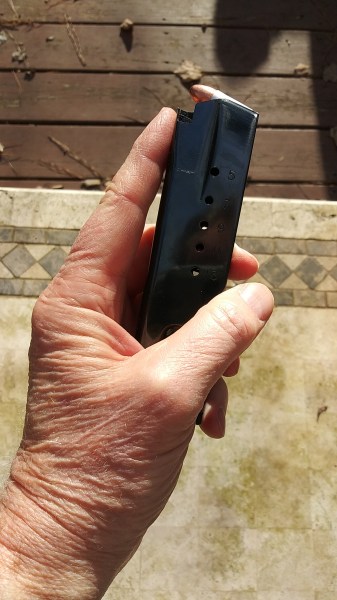
- Slip the forefinger down the magazine so the full magazine is held between the forefinger and middle finger. This leaves the thumb and forefinger available to catch the partially depleted magazine.
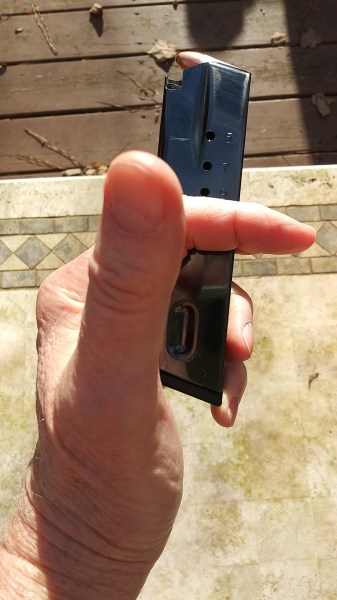
- Eject the partial magazine between the thumb and forefinger and catch it.
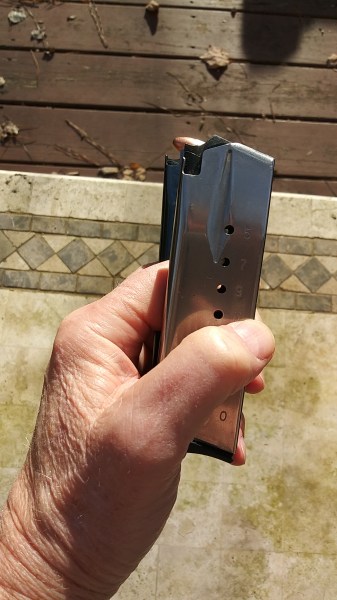
- Insert the full magazine, which is held between the forefinger and middle finger, into the pistol.
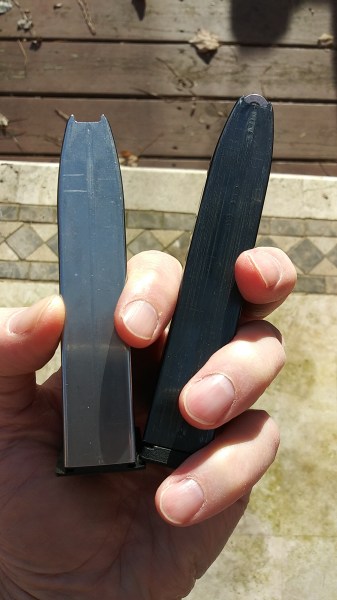
- Stow the partial magazine in a pocket, pouch, or your belt.
This method uses the hand’s two most dexterous digits, the thumb and forefinger, to catch the partially depleted magazine. Using the hand’s most dexterous digits makes it simple to handle even double column magazines.
The Role of Questions in Personal Protection
Who is around me and what are they doing? – Tom Givens
What are you capable of? – Ken Hackathorn
What’s the object of the exercise? – the Tactical Professor
What is the best use of my time right now? – Alan Lakein
METT-TC is a well developed structure for asking questions when developing plans for Personal Protection.
- Mission
- Enemy
- Terrain and Weather
- Troops and Support Available
- Time Available
- Civil (Legal and moral) Considerations
SALUTE is a good structure for gathering information in the moment.
- Size
- Activity
- Location (proximity)
- Unit
- Time
- Equipment
When we are children, we are constantly asking questions. As adults, we usually get in the habit of providing opinions, experiences, and self-promotion instead of asking question. Information gathering is a vital skill in Personal Protection. Putting ourselves back into the question asking mode requires a shift in our thinking patterns that requires practice.
My thanks to John Correia of Active Self Protection for stimulating my thinking about the topic.
My Patreon page is where I go into more depth on Personal Protection topics. https://www.patreon.com/TacticalProfessor
Muzzle direction is the primary safety
Muzzle direction is the primary safety. Always has been and always will be.
–Bill Rogers of the elite Rogers Shooting School
“He told police he was oiling a handgun and had put a magazine in it and racked the slide when it fired, hitting his wife as she sat on a couch nearby.”
Man sentenced to probation in shooting of his wife
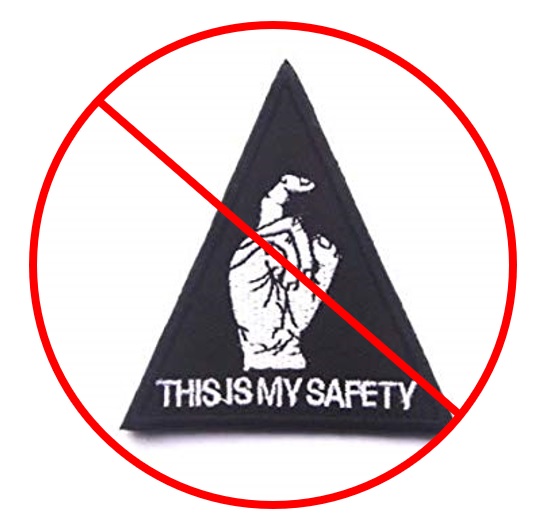
I absolutely despise the meme from Blackhawk Down that shows a trigger finger with the phrase “This is my safety.” Trigger finger discipline is a good thing but there’s a reason it’s Number 3 in the Four Rules of Gunhandling. Muzzle Direction is Number 2, as it should be in the scheme of things.
Informal Instruction
A colleague of mine had the opportunity to give a short (15 minute) informal block of instruction to a friend of hers. Most firearms instruction in the US is informally done between friends or relatives.
Their session didn’t involve any live fire and was conducted in their office. It was simply a short briefing on basic safety rules, gun handling, and model specific instructions on how to operate her handgun.
An interesting comment came up in our discussion about the session. It’s worth keeping in mind any time we teach somebody something, whether the subject is firearms related or not.
I talked with her not at her.
When we teach an adult, it’s always worth remembering to approach it that way. Even if we are a Subject Matter Authority, the person is one of our peers and deserves to be treated respectfully. They should be treated like a client in an Adult-Adult relationship, not a grade school student in a Parent-Child relationship.
Mutual respect will garner the rapport necessary for the instruction to be effective and add value to the person’s life.
The Mission
If I went out looking for bad guys for 8-10 hours a day every workday, I’d be carrying a high capacity autoloader too. And I’d be wearing a helmet.
Discussion about snub caliber choices
#wheelgunwednesday
Someone contacted me on my Tactical Professor Facebook page regarding selection criteria for a snub revolver. It was a good discussion and well worth reproducing. For clarity, my answers and comments are in italics.
Where can I find info on 22 mag (probably the Hornady round) in comparison to 38 special (target wadcutters) out of a sub-2 inch barrel revolver?
In terms of what criteria? Penetration, recoil, terminal effectiveness?
I guess the concern would be for ballistic performance. The 22 mag has the higher capacity.
Ballistic performance has a lot of variables. I’m not trying to be pedantic but in the gun community we frequently don’t do a good job of defining our goals.
In general, both of the rounds will achieve the desired penetration. The .22 Magnum will have much more concussion than the .38. The .38 will have more recoil. Our human performance factors are a much more important consideration than ballistic performance of any handgun. Given the opportunity, the best move would be to shoot 5^5 with both and see which one you can shoot it better with. That drill, as originally developed by Gila Hayes and extended by me, was designed as the entry level criterion for choosing a handgun.
Start Shooting Better Episode 2: 5×5 Drill – Lucky Gunner Lounge https://www.luckygunner.com/lounge/start-shooting-better-5×5-drill/
Although it carries two more rounds [in a Smith & Wesson], you should assume the .22 Magnum will be much more difficult to reload than the .38. There will also likely be issues with ignition reliability of the .22. You should assume that you will never be able to achieve a trigger pull on a .22 Magnum that you can with a .38, precisely because of ignition issues.
I agree with that. I’m looking to pick up a Ruger LCR has a back up gun. It’ll spend almost the entire life in an ankle glove or in a pocket.
The 22 mag has 3 more rounds in it but they are smaller rounds and rimfire.
I believe there is one thing incorrect in your assumptions. The LCR in .22 Magnum holds 6 rounds. The .22 LR holds 8.
I’ve read several write ups that the 38 out of those smaller barrels tends to fall short in terms of penetration.
Does the 22 mag follow that trend as well or is it worse? I may be gaining extra rounds but if the 22 mag performs less than the 38 in general then I’m not much better off than with 5 38 wad cutters.
The reliability issues you pointed out makes a lot of sense. That might be the answer I needed.
What you read is untrue. My colleague Chuck Haggard has done more ballistic gel testing for snubs than most people in the industry. His results were that .38 wadcutters penetrate more than adequately.
So you’re only gaining one round. Before I would go that route, I would personally go with a .327 Federal and load it with .32 H&R Magnum.
https://ruger.com/products/lcr/models.html
Ruger® LCR® * Double-Action Revolver Models
Big difference. I wouldn’t go that route for just one extra round. This was the conversation I needed. Again, thank you very much Claude for helping a dude out.
Summary of the discussion
After certain minimum criteria are met, caliber discussion is a relatively low level priority. Massad Ayoob’s Priorities of Survival; Mental Preparation, Tactics, Skill, and finally Equipment, are a good example of this hierarchy. Priorities of Survival is the critical tool used for this week’s Patreon Incident Analysis.
Patreon topics update
- H&K VP9SK evaluation
- Shooting test protocol for carry guns
- Store robbery with hostage taking – an in-depth analysis of the incident
- Situation – convenience store robbery. One of the employees was taken hostage immediately. Eventually, a satisfactory resolution was achieved when the cashier shot the robber. The shooting was a downrange incident, i.e., the shot had to be taken with a friendly/non-threat downrange of the shooter and in proximity to the shootee.
- Cast of character development along with 28 point play by play incident timeline.
- 17 different Personal Protection tasks identified in the incident.
- Discussion about possible improvements of the actions immediately after the shooting but before the POlice arrive.
I’m able to cover topics more in depth on my Patreon account than I can in my blog. If you’re interested, you can subscribe for $5 a month here. https://www.patreon.com/TacticalProfessor
FTC Notice: I have no relationship with Ruger nor do I receive any compensation for mentioning their product. The LCR was specifically asked about so I responded.
 tacticalprofessor
You must be logged in to post a comment.