The North Hollywood Shootout
In the midst of the hullabaloo recently, a major historical even has been largely overlooked.
On February 28, 1997, a huge shootout took place in North Hollywood (Los Angeles) California. On one side were two heavily armed and armored bank robbers. On the other side were hundreds of Los Angeles Police Officers. The shootout lasted about 45 minutes and estimates of the rounds fired go to almost 2,000. In the end, both robbers were killed and numerous police officers were injured, fortunately, none fatally.
In a short CNN video presentation, Rick Massa, former LAPD SWAT Officer who was on the scene, commented:
“If this were to happen today, this would be over before SWAT would get there. As a result of the shooting, there are rifles in all the police cars, in all of the stations, all police officers are trained with assault rifles, to be able to handle this type of a situation.”
However, the recent events have shown us that’s not true at all. Changing tools and tactics don’t really change policing. As with any large group or organization, culture and people are the agents of change
Practicing Awareness: An Interview
I’m very pleased to have been interviewed about Practicing Awareness in this month’s Armed Citizens Legal Defense Network Journal.
https://armedcitizensnetwork.org/practicing-awareness
It was an interesting interview that touched on a number of subjects, some old and some new. The interview builds on the series of posts I’ve written about the topic of awareness and positioning.
Bringing worthwhile content like this to its members is yet another reason I’m a member and fan of the Network.
Revolvers do break
The two loudest sounds when shooting are:
- A bang when expect a click
- A click when you expect a bang
A click when you expect a bang with centerfire revolvers often means that tools will be involved in fixing the problem. An example is a broken hammer nose on older Smith & Wesson revolvers. Until the 1990s, these revolvers had the ‘firing pin’ integral with the hammer. S&W refers to this part as the ‘hammer nose.’ If it breaks, nothing short of replacing it will make the revolver fire.
Two steel J Frame revolvers are compared in this picture. The tip of the hammer nose circled in red has broken off. It will require replacement before the snub will be functional again.
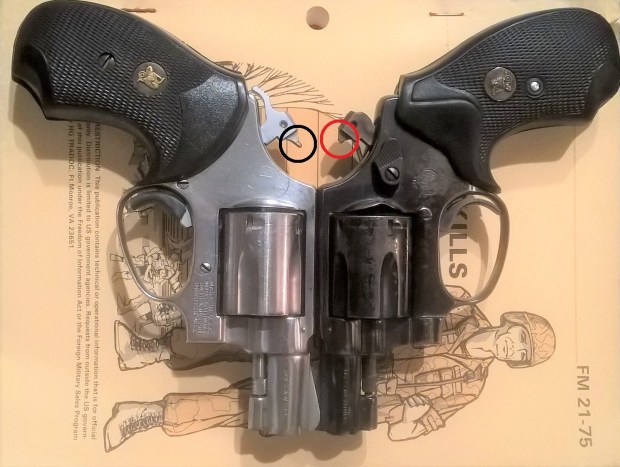
S&W changed the design of its revolvers before the Turn of the Century. The firing pin was moved to the frame from the hammer. But there are millions of older S&W revolvers that have the hammer nose design. Issues have arisen in the past because S&W has not manufactured the part in many years. They were available on the used part market but the supply was spotty. There are now two sources for newly manufactured J Frame hammer noses.
This part is best installed by a qualified gunsmith. It may require minor fitting. The hammer nose rivet that holds it in place may also need to be replaced.
The Model 36 with the broken hammer nose was manufactured sometime before 1975. It has been through considerable live fire and dry practice. When using an older gun, it’s a good idea to inspect them on a regular basis to see if any parts have broken. The hammer nose in particular will not cause an obvious change in function if it breaks but the gun will not fire.
Friday Fundamentals – Understanding Zero for Handguns
Zeroing any firearm is the process of understanding the relationship of Point Of Aim (where the shooter aims the firearm) [POA] to Point Of Impact (where the round actually strikes the target) [POI].
For Soldiers to achieve a high level of accuracy and precision, it is critical they zero their [sighting system] to their weapon correctly. The Soldier must first achieve a consistent grouping of a series of shots, then align the mean point of impact of that grouping to the appropriate point of aim.
–Appendix E – Zeroing, Department of the Army Training Circular 3-22.9 – Rifle and Carbine, May 2016
This is the process most shooters are familiar with regarding zero. However, zeroing a fixed sighted handgun is different than zeroing a rifle.
Bottom Line up front: With rifles, we zero the sights to the ammunition. With fixed sighted handguns, we zero (adjust) the ammunition to the sights.
Snubby recommendation
I was emailed the following question. It’s a good question with an involved answer.
Which snubby do you recommend?
This was my reply:
It depends on the person, their ability, their needs, and their desire to achieve an acceptable standard of performance. The S&W 642 and Ruger LCR .38 Special have become the default purchases for people who want to carry a snub. They work for some people but not everyone.
Determining Your Ability – Friday Fundamentals
The famous Chinese philosopher Lao Tzu is quoted as having said:
The journey of a thousand miles [li] begins with one step.
This is only partially correct. The journey really begins with knowing where you are in the first place. This is also true about the journey to proficiency with firearms. Especially for newer gun owners, it’s important to gain an understanding of what their current capabilities are, if they want to improve. Many people who have purchased handguns made the purchase with the intent of personal protection. In this light, a good first step in gauging proficiency is the Michigan State CCW Basic Pistol Safety Training Assessment Course of Fire. It is a simple course of fire that can easily be done at any indoor or outdoor range. It’s also extremely manageable with a J Frame revolver. The Michigan course of fire is the first evaluation in the Indoor Range Practice Sessions program. It also can serve as the basis for a more challenging evaluation.
The target consists of three 11 inch x 8½ inch letter size pieces of paper stacked vertically. The combined sheets of paper are quite close to the FBI Q target both in area (280.5 square inches v. 275 square inches, respectively) and in general shape (a target much taller than it is wide). The target is placed at 4 yards,
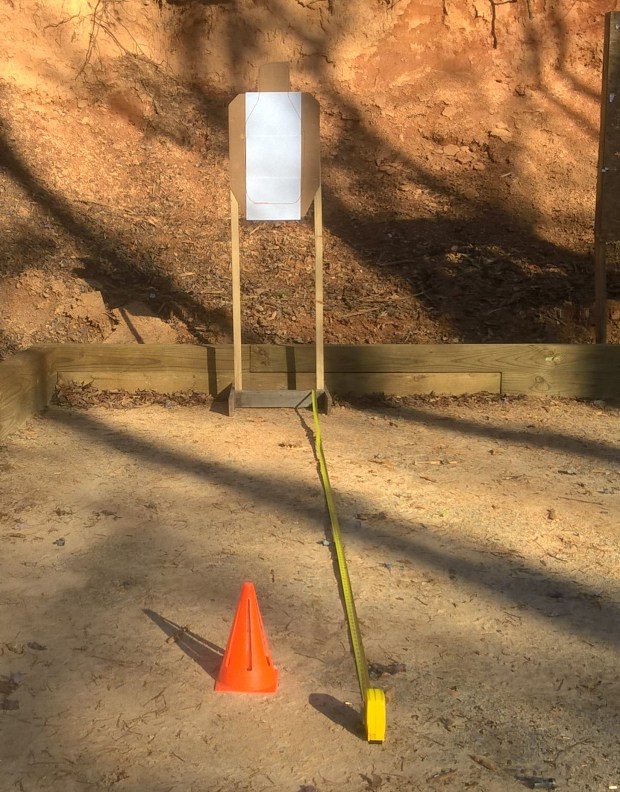
(Note: FBI Q drawn for reference)
Four yards happens to be the boundary between Public Space and Social Space in the study of proxemics. Proxemics is a subject that is worthy of study by anyone interested in the Art of personal protection.

Diagram by WebHamster
There is no time limit. Shooting is done with both hands. You will shoot 5 rounds in three separate sequences. Start with the handgun loaded with five rounds and aimed below the target.
- When ready, aim at the target and fire all 5 rounds.
- Reload with five rounds and repeat the firing sequence.
- Reload with five rounds and repeat the firing sequence one more time.
- At this point, you should have fired five shots at the target three separate times.
- To successfully complete the assessment, at least 2 out of 3 of the sequences must have had five (5) hits within the 25½ inch by 11 inch outline of the three pieces of paper.
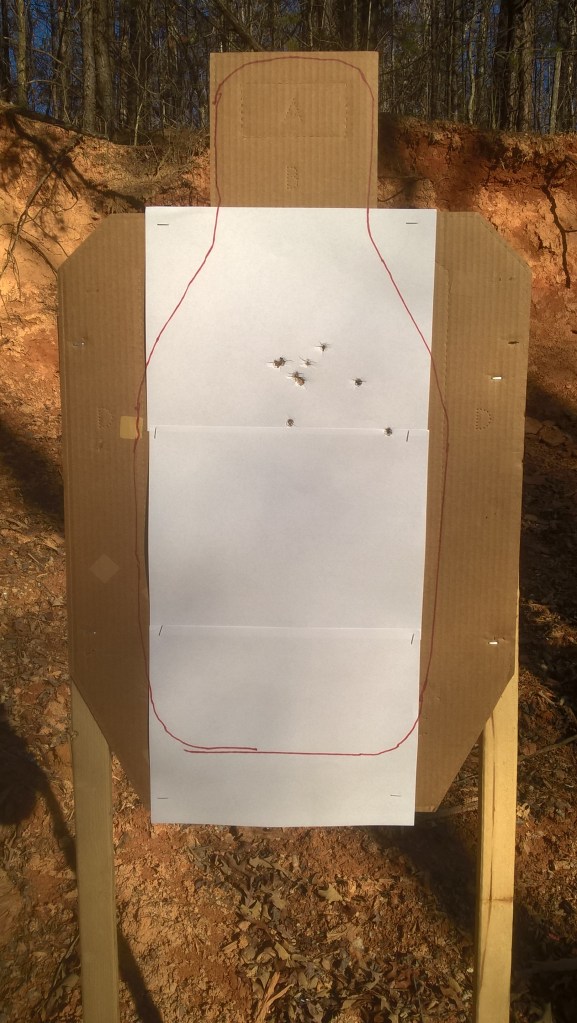
While experienced shooters will consider this course quite easy, for new owners of J Frame revolvers, it frequently is not. This course can also be used as a measure of the effectiveness of Indexed Shooting (shooting without using the sights) by taping up the sights of the gun, in this case a Model 36 S&W snub nose revolver.
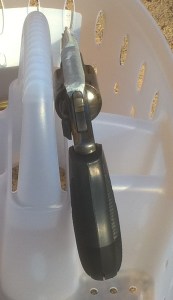
To use this method, bring the gun into the eye-target line and then place the outline of the cylinder or slide on the target. The great NYPD gunfighter Jimmy Cirillo taught this technique to NYPD Officers as a way of effectively using their revolvers at close range in situation where the sights could not be seen. It’s sometimes referred to as ‘metal on meat.’
If the group shot in the first three sequences meets the requirement, then try reshooting the exercise with only one piece of paper. Taking the tape off and using the sights may yield better results.
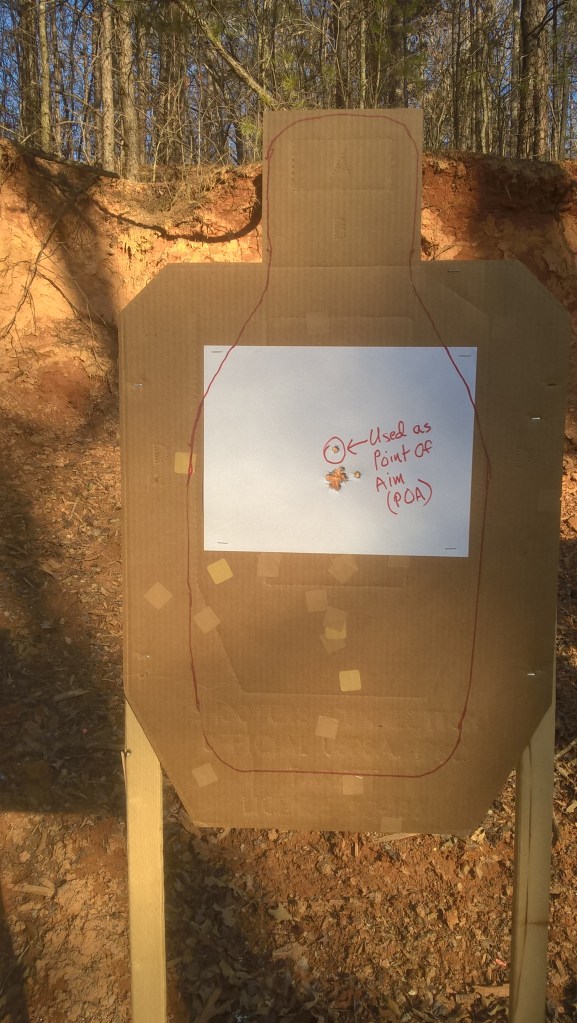
While this course of fire is simple, many newer gun owners may find it challenging. As can be seen in the pictures, the target is smaller than the silhouette target that many Private Citizens and POlice Officers are accustomed to shooting at. It also has the requirement of a 100% standard for the sequences. The 100% standard is the start of having a mindset of being accountable for every round.
Dear Instructors, Get a Real Job
In this Ballistic Radio interview, I offer some opinions about problems and solutions with the firearms training industry. The industry needs to do some real work if it expects to get in touch with normal people.
Dear Instructors, Get a Real Job
The Medina, North Dakota Shootout
Thirty-five years ago today, on February 13, 1983, a violent gunbattle took place in Medina, North Dakota. Although less well known than the Miami Massacre in 1986, it was every bit as bloody and violent. Something it had in common with the Miami Massacre was preparation for conflict and the decisiveness of long guns at pistol ranges.
On one side was a task force of US Marshals and local law enforcement officers. On the other side were members of a local Posse Comitatus group. Casualties were high on both sides. Four months later, a second related encounter, hundreds of miles away, brought more loss of life.
The Prelude
Gordon Kahl was a Midwestern farmer and Federal tax resister. He was a member of a loosely knit organization called the Posse Comitatus. The Posse recognizes no authority above the county level and held many hateful beliefs. He had been imprisoned for Federal tax evasion but had been released on probation. However, he failed to report to his Probation Officer and a Federal warrant for his arrest was issued.
Can’t help you
This email arrived from a friend today. Things like this are why I do what I do.
Yesterday I was filling my vehicle with gas at my neighborhood Shell station and out of the corner of my eye I saw an unkempt person lurking around the building and heading to the gas pumps. I lost sight of him for a moment due to vehicles entering and exiting the station. Suddenly, he was on the other side of my pump, headed in my direction.
My first visual image was Claude Werner, hand up, saying I can’t help you, followed by me doing the same thing, as I moved around the corner of my car to get an object and distance between the fellow and me. He did not even finish his opening line, he turned and looked for someone else to approach.
Claude, you taught me well! Thank you very much!
Note that this was a decision made in advance (to be aggressively uncooperative) and then chosen as a response in the moment. That’s the best way.
Lessons from an Armed Robbery
Barry Fixler, former Marine and Viet Nam veteran, owns a jewelry store in New York State. On Valentine’s Day 2005, a couple of criminals decided to relieve him of his merchandise. It didn’t turn out the way they planned. We are fortunate that much of the incident was captured on video. There are numerous lessons we can draw from the incident. Let me preface all my commentary by saying that I greatly admire Mr. Fixler’s courage and how he handled the situation.
Bottom Line Up Front: Good Guy 1, Bad Guys 0; that’s clearly a commendable victory.
 tacticalprofessor
You must be logged in to post a comment.