Personal Protection Products and the Big Picture
I wanted to actually handle a VersaCarry holster and talk to someone from the company prior to saying anything about it. The results were what I expected. I haven’t addressed the durability issues other people have mentioned because I was not in a position to evaluate it.
The magazine carrier actually is workable, though. I may pick up one up for more testing, although I rarely carry a spare magazine.
My thoughts about the VersaCarry are in my PDN article Personal Protection Products and the Big Picture.
Putting Orient Back into OODA
The latest edition of The Tactical Wire is the Concealed Carry Special Edition. It includes an article about the OODA Cycle that I authored.
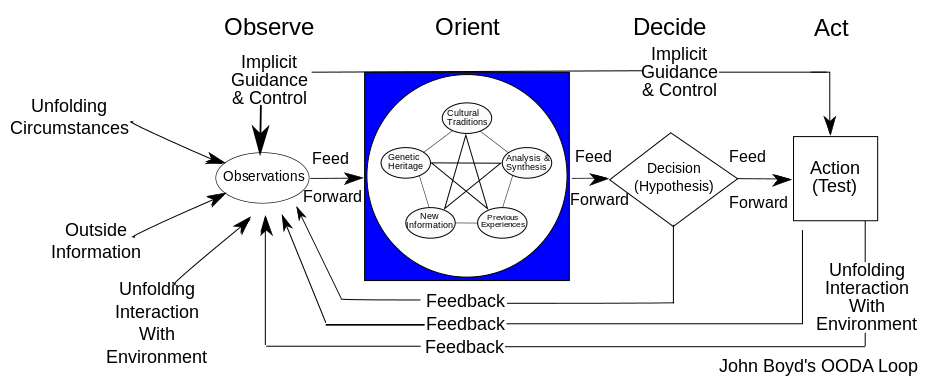
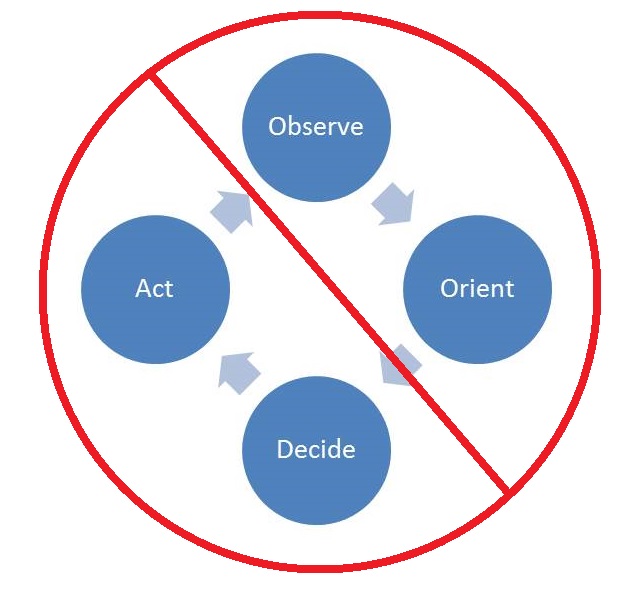
The OODA cycle, frequently referred to as the OODA Loop, was developed by the late Colonel John R. Boyd, USAF. The OODA cycle has subsequently become highly influential in thinking about how to conduct combat operations at all levels from the tactical to the grand strategic. It is often simplistically depicted with only four components in a circle, although that hardly does justice to the depth of Boyd’s thought.
What it’s not is what is so often pictured.

A better way to look at it would be this:
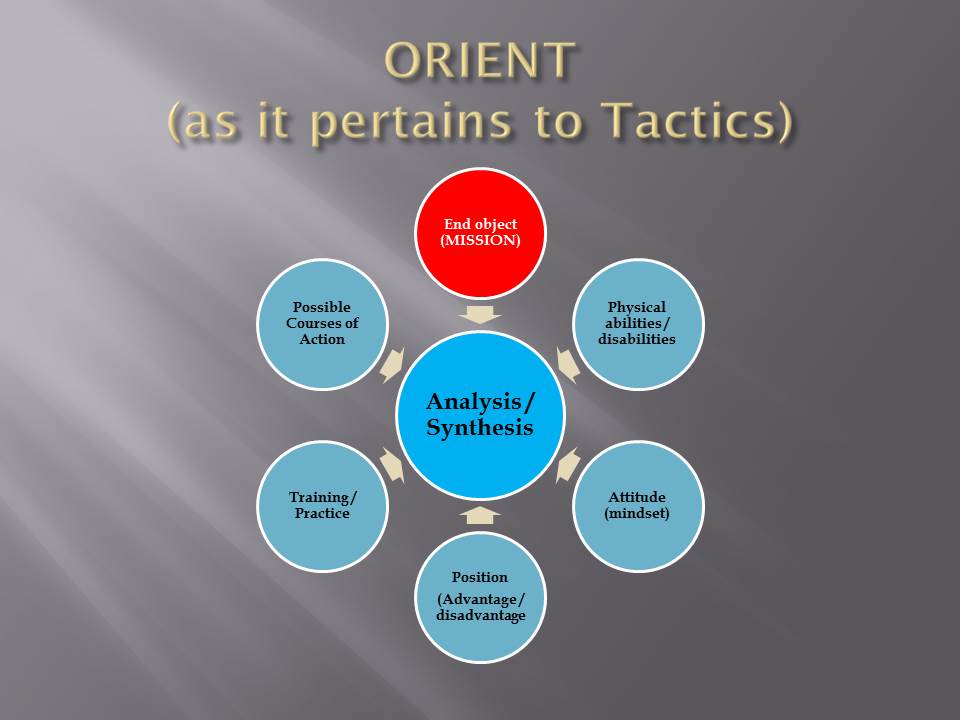
The article is my explanation of why. There are several other good articles also.
http://www.theoutdoorwire.com/specials/ccse2015/feature.php?id=229663
Situational Awareness and Positioning (part V)
In every encounter, there is an element of chance.
–John Hall, former head of the FBI Firearms Training Unit
In previous parts of this series (I-IV), the concept discussed was physical awareness and positioning in relation to an adversary or situation. A recent incident captured on video relates to a different but similar concept: emotional awareness and positioning.
In the incident, a veteran observed a bum aka ‘homeless person’ wearing a mixed service uniform while panhandling. He was justifiably incensed, as would be most veterans. “I was angry. I was frustrated. I was sad” he said. I don’t blame him. However, what resulted from his feelings was neither smart nor legally justifiable.
The veteran aggressively challenged the bum from a distance, then closed with him, pursued him across several lanes of traffic, and continued to pursue him on the other side of the boulevard. As the incident unfolds, the bum tries to disengage, is verbally apologetic, and changes direction several times attempting to escape. The entire time the veteran is loudly shouting, verbally forces the bum to remove part of his clothing, and then blocks the bum’s escape path. The incident went on for several minutes.
While I sympathize with the veteran’s frustration, the simple fact of the matter is that he let his emotions get away from him. A couple of relevant declarations made at this year’s Rangemaster Tactical Conference come to mind.
- John Hearne, in his presentation Performance Under Fire, made the statement “You’ve got to keep your emotions under control.”
- My colleague Nick Hughes mentioned to me in conversation a question he poses in his book, How To Be Your Own Bodyguard. “Are you doing this because you have to or because you want to?” He then related a personal anecdote where a person had to remind him of his own question.
When the veteran/bum video was posted on Facebook, I had two responses.
- Good way to get stabbed.
- Regardless of what I was doing, if someone acted toward me the way the veteran did toward the bum, I would have painted him orange in a New York second. And the police would have then told me to have a nice day. It was aggressive challenging behavior that anyone would be justified in feeling threatened by (although not sufficiently to employ lethal force, which is why I advocate always carrying pepper spray).
If we go looking for trouble, we had better be prepared to find it. Make no mistake: verbally challenging someone, shouting at them, chasing them, forcing them to remove their clothing, and then blocking their escape route is looking for trouble. Such a situation always has branching possibilities (if, then, else) that people don’t generally consider before jumping over the edge of the cliff.
- If the bum had pulled out a knife, then what would have been an appropriate, or even possible, response at that point? I make the assumption that all itinerants I encounter are armed with some kind of weapon.
- What if the bum had run out in front of a car and been struck and killed?
- What if a car had hit the vet while he was chasing the bum across the street?
- What if they had gotten into a physical conflict and ended up rolling around in traffic?
There are other possibilities also, but those are good examples of possible Negative Outcomes well within the realm of possibility. In any of those cases, the situation would have gone downhill for the vet like an avalanche.
So, let’s go back to Nick’s question: was the vet doing this because he had to or because he wanted to? That answer is quite clear, he wanted to. He felt the need to defend the honor of his service and the service of his fellow veterans.
Unfortunately, it’s very hard to provide a legal, or even moral, justification for using force to defend honor. Even if no legal repercussions arise, moral ones can. If the bum had run into traffic and been struck and killed, how do you think the veteran would have felt for the rest of his life, even if no charges were filed against him?
John Farnam’s saying “Avoid stupid people, stupid places, and stupid things” is definitely apropos in this situation. All three of those elements were broken. Jeff Cooper alluded many years ago to the fact that the more ‘rules’ we break simultaneously, the more possibility we will incur a problem. When we lose control of our emotions, that’s when we start unconsciously breaking rules, whether they are legal rules or just rules of good judgment and conduct.
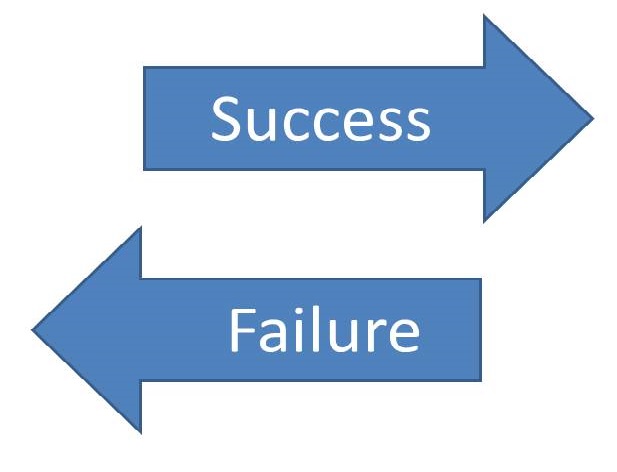
With every decision we make, we are setting ourselves up either for success or failure. Keeping a check on our emotions helps set ourselves up for success. Letting our emotions get out of control is good way to set ourselves up for failure.
Planning for the worst case?
Living in California, I think it may be in my best interest to consider the worst-case scenario.
–a person who shall remain anonymous
I’ve previously mentioned my issue with planning for the worst case, but since ‘worst case planning’ comes up so often, the topic bears some further discussion. The essential problem is assuming that planning for the worst case is merely planning for the most likely case taken to a greater extent. Unfortunately, that’s not necessarily true. The optimum solution in worst case planning may actually be a less, or even least, optimal solution for the most likely case.
The questions of competing probabilities and definitional issues rear their ugly heads again in this decision process. As an example, the worst case scenario that people imagine in a home defense scenario consists of multiple intruders, armed with projectile weapons, with their weapons in hand, ready to shoot the defender in reaction time. While that’s certainly possible, it’s definitely not the most likely case, if the bump in the night is really a burglar. And even the definition of ‘worst possible case’ is open to question in the context of home defense, as is the definition in many contexts.
The question I posed previously was “Is ‘the worst possible case’ having a dangerous armed intruder in your house or shooting and killing a family member by mistake?” Therein lays the definitional issue. The statistical/tactical issue is that the most likely case is probably a lone intruder, not armed with a projectile weapon, who is preoccupied with stealing your stuff and not waiting in ambush for you.
Let’s address the statistical/tactical issue since I’ve already mentioned the definitional issue. In the past, I have, in fact, planned for the worst possible burglary case envisioned by people. My plan for a late night, already in bed, worst case scenario was as follows:
- Put on my M17A1 protective mask
- Place my pistol (then a 1911A1) in hand
- Open the bedroom door slightly
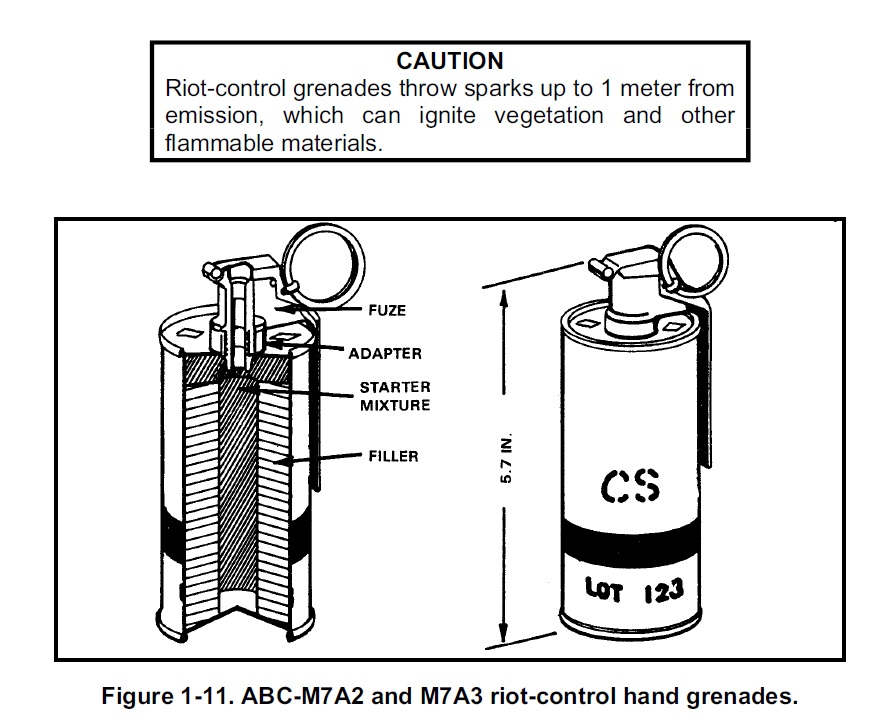
- Pick up an M7 CS grenade and pull the pin, using a small hook I had placed on the door frame
- Have my then wife grab onto my clothing, close her eyes, and stop breathing
- Roll the grenade out into the kitchen and let it fill the house with CS gas
- My house was small and
- would have completely filled with CS gas within a few seconds
- Go out the door and move toward the back door as an exit
- Shoot anyone who was in my way in the head, whether they were standing or laying on the ground prostrate from the effects of the gas
- I’ve been in a confined cloud of CS from a grenade; it’s incredibly incapacitating.
- That’s where I got the idea.
- It’s not like the CS chamber most veterans have been exposed to.
- Exit the house, regroup, and plan my next move to a safer location
I was certain of the efficacy of this plan, since even a hardened group of assassins would be unlikely to expect a counterattack that would have made John Wick look like an Eagle Scout. However, I did consider that there were several downsides to the plan.
- Most likely, the grenade would have set the house on fire and burned it down. My landlord would have been unhappy and the couple who lived upstairs might have burned to death.
- The authorities probably would probably take a dim view of my executing a bunch of people, even if they did have nefarious intent.
- If my then wife had been accidently overcome by the gas, I would have been faced with the choice of finding her, picking her up, and carrying her out of the house, or leaving her behind with the rest of the deaders while the house was burning. (I would have carried her out, but that is a decision, not a given, in a serious house fire.)
I had also planned a lower intensity response for the more likely scenario of one guy with a screwdriver stealing my stuff. That plan was to challenge him from whatever concealment was available and tell him to get out. If he took one step toward me, I would have shot him. If I could see he had a projectile weapon, in hand or not, I would have shot him immediately.
Note that even in a simple scenario, there’s a decision tree (if, then, else). Those kinds of decisions are best made ahead of time. Making decisions before the situation arises is part of the Orient phase of the OODA process. Forward looking decisions are what allow you to speed up decision-making in the moment, not trying to think faster on the spot. Trying to construct a decision process in the midst of an incident will force you back into the Orient phase and actually slow down your decision-making.
The issue with worst case planning is that it usually ignores both the direct and opportunity costs implicit in the plan. Worst case planning also frequently lacks any branching or contingency aspects, which is not the way life works. Consider carefully ALL the ramifications of worst case planning in light of most likely case possibilities. What you may find is that it’s best to plan and prepare for the most likely case. Then, think of how that plan can be adapted to a much smaller probability of the worst case scenario.
Not thinking things through
A completely irrelevant post on Facebook (a new flamethrower) brought something to mind that I hadn’t thought about in a couple of decades. It relates to the concept of defining the mission, desired outcome, and possible consequences. Those are things integral, yet unstated, to the Orient phase of the OODA process and fundamental to achieving success.
Most discussions about OODA get caught up in the speed aspect, which is actually a tertiary part of the process. It’s not just a simple speed-based looping cycle, as is often depicted.
Years ago, I had a friend who didn’t care for guns but kept a flare pistol for home defense. She mentioned this to me in conversation. Her logic was that she didn’t want to kill someone. My response was “So you don’t want to kill someone but you’re okay with launching something into him that burns at several thousand degrees and might burn your house down?” She said she hadn’t thought about it that way. It certainly would have been possible for her to Act quickly but would it have been a good decision? I don’t think so.
It’s easy to get caught up in a linear process from the starting point without looking far enough down the path to a likely result and consequence. One component of Awareness is to keep your head up and look far down the road, just as you should when driving, rather than being fixated on the bumper in front of you.
It’s important to note that what is considered the most successful recent example of Boyd’s thinking was the planning of the First Gulf War. It took months and involved several different iterations of the strategic plan. In Boyd’s original hand drawn diagram of the OODA process, he actually had three different loops; one depicting planning, one depicting execution, and a third showing an overlay of the previous two. The third version is the popularized full diagram but it obscures the importance of the analysis/synthesis part of the process. There are many inputs necessary, including consequences, before an effective decision can be made. That planning is what makes rapid, effective Action possible.
Keeping in mind the desired outcome has to always be part of our decision-making. ‘Outcome Based Decision-Making’ should be an integral part of our thought process. As they said in DEA:
Focus on the object, not on the obstacle.
Lima Goes to Hollywood and The Power of the Grey Man
There’s a lot to being a grey man. Many worthwhile observations in this post.

Amidst all the media attention surrounding my Babywearing and Carrying class was a call from CBS’s show, “The Doctors.” They thought my class was interesting and wanted to fly me out to California to talk about it. It took me a few days to get to the place where I decided to take the trip. I said yes on Tuesday, had a travel itinerary on Wednesday night and was on a plane on Thursday.
This is the first solo trip I’ve taken in a very long time to a destination that doesn’t include rendezvousing with friends or family or a firearms class.
No lie, the idea of two days in Hollywood by myself was very appealing though the reminders to be careful started in earnest along with concerns of, “Aren’t you nervous to be traveling by yourself?”
I don’t subscribe to that kind of worry and fear. Lots of people…
View original post 1,365 more words
Why don’t people train?
Owning a handgun doesn’t make you armed any more than owning a guitar makes you a musician.
–Jeff Cooper
Of all the things Jeff Cooper said, the above saying has become the most prevalent mantra within the firearms training community. It has been memed in many ways. The latest I saw was ‘Without training, you are just pretending.’ The original saying and its various memes allude to the need for gun owners to be trained, ‘regulated’ in the sense of the Second Amendment, in order to be able to effectively use their weapons for personal protection. Why, then, don’t more gunowners pursue training beyond the bare legal minimum, where required?
First of all, let’s confront the validity of the statement itself. We should note that there are quite a few capable musicians and singers who are self-trained. With regard to firearms, the firearms training industry has really only existed since the mid-1970s, when Jeff Cooper founded the American Pistol Institute at Gunsite. Before then, even many police officers didn’t receive much in the way of training. There were virtually no venues available for formal training for Private Citizens, other than the Boy Scouts or Camp Perry. Does this mean that in the 200 years of US history preceding the foundation of API, the American people were ‘unarmed?’ Of course not. Americans have a rich history of shooting predatory no-goods without a moment’s hesitation, even before the foundation of the Republic.
On an almost daily basis, we read and circulate reports of Armed Private Citizens defending themselves, their families, and their neighbors with firearms. The vast majority of these incidents are successfully solved by people who have not one bit of formal training. What this means is we trainers can’t have our cake and eat it, too. Every time we celebrate a successful defense, and rightfully so, we essentially invalidate Cooper’s saying.
What are the reasons a gunowner might cite for not taking training, assuming it’s available, which is a separate issue? There are any number of reasons, such as:
- Time
- Expense
- Accessibility
- Scheduling
- Lack of motivation
- Lack of incentive
- Lack of understanding
Time and expense should be discussed together because they are both personal resource constraints. The time demands on most people are extensive, especially in a single parent family. Similarly, money is tight for the majority of Americans. The question “How much is your life worth?,” another popular meme in the training community, is moot when the rent is due tomorrow and your kids want to eat.
Accessibility and scheduling are another pair of related issues. According to the US Census, 80.7 percent of Americans live in urban areas. Where are most training facilities? Out in the boonies, in what the Census describes as ‘rural areas.’ While there is some instruction that goes on at indoor ranges, my experience is that it is best described as ‘familiarization’ rather than training. This is a huge disconnect. The location of training facilities is a factor that impacts the time issue I previous mentioned. If a person has to budget several additional hours or days, just for travel purposes, that becomes yet another resource constraint.
To its credit, the NRA Training Division is trying to address this issue through the use of a ‘Blended Training Model’ of both online and in-person training. The result among the NRA Instructor community has been mostly anger and serious pushback. Much of the dissension is based on pure economics. I’ll let you draw your own conclusions about that.
With regard to scheduling, when do trainers tend to schedule training mostly? I submit that we schedule when it’s convenient for us, not for the students. That’s one reason I have gone exclusively to short evening classes and one day only weekend classes. Asking people to spend both days of a weekend, out in the sticks, is simply an unreasonable demand on their time.
Lack of motivation, incentive, and understanding are allied factors, as well. About them I will say we in the community simply haven’t made a good case for what we teach and why we teach it. This is especially true in light of the regular reports of people who successfully defend themselves and their families without any training. Although we trainers spend a certain amount of time talking about what we teach, we still haven’t made a good overall business case for “What is the value of training?” Until we do, folks just aren’t going to come. I think the training community might benefit from some Dale Carnegie training for itself.
Rangemaster 2015 Tactical Conference (II)
Continuing on about the Rangemaster 2015 Tactical Conference held annually in the Memphis area, I would like to cover the high points of some sessions I attended.
John Hearne’s Performance Under Fire presentation was so packed with information that it’s hard to take it all in. He does a fine job of refuting the pseudo-science that pervades the personal protection training community. His research is thorough, up to date, and can document fully what he says. An aspect of his approach I like is the way he tracks the original science to see if it has subsequently been refuted. John is one of the few people in the community besides myself who has any clue about how to do research. Here’s a clue; taking information from a firearms or martial arts trainer at face value is not a valid approach. I found numerous points in his presentation quite useful.
He stated that there are actually 21 documentable ‘flinch responses,’ most of which do not involve throwing one’s hands up in the air. So if there are a variety of responses, how do you know which one you will exhibit and is it going to be the same one every time? Years ago, Ken Hackathorn told me to watch surveillance video of convenience store robberies to see how many people threw their hands up in the air when they were startled. The answer is ‘not many.’
One of my personal pet peeves is the continuing blathering about Hick’s Law in the community. John made the point that Hick’s Law was largely discredited in the scientific community decades ago. For those unfamiliar, Hick’s Law states that the more options you have, the longer it will take to make a decision, by a square of the number of choices. The original study was sort of iffy anyway and subsequent research has shown that it’s only true in the absence of any familiarity with the task and absent any practice on the decision making.
The subsequent power law of practice states that the more practice you have at making the decision, the faster you get at making it. There’s some question as to whether the practice/speed relationship is logarithmic or exponential but there’s no question about the validity of the power law. Think about it in terms of when you are driving. When you see the brake lights of the car in front of you come on, there’s no conscious decision making about whether you’re going to hit the gas or the brake, unless you’re a 15 year old student driver.
An important point John made was about the career time of when law enforcement officers were feloniously assaulted. The average time was about eight years. I believe John referenced this from the 2006 FBI study Violent Encounters, A Study of Felonious Assaults on Our Nation’s Law Enforcement Officers, but I don’t recall for sure. This was important to me because it highlighted the factor of complacency in Negative Outcomes.
Although I lack the rigorous methodology that the FBI used, it’s my feeling this is also a factor in Negative Outcomes by Armed Private Citizens. Complacency can be a killer. We see it every day at gun ranges, gun shops, and shooting clubs. Complacency is why some people have one year of experience 20 times instead of 20 years of experience and is closely related to the “I know it all” syndrome. We have all had to deal with ‘know-it-alls’ and ‘spring-butts’ and never like it. It’s up to us individually to make sure we don’t fall into the trap and challenge others who have.
Just to show that John can put his money where his mouth is, he won the High Lawman and Second Place overall in the shooting contest.

Photo courtesy of Tiffany Johnson
I’ll have more about the Conference next time.
Lowlight dryfire practice
- At night, have a flashlight next to your gun.
- Pick them both up at the same time and identify the person before making the shoot decision
- Flashlight usage implies the need for one handed shooting
- Competing probabilities are in favor of it being a family member
- Thinking the light is a ‘lead magnet’ is a problem
I emphasized very strongly about the need for keeping a flashlight next to your ‘nightstand gun’ during my Negative Outcomes presentation at the Rangemaster 2015 Tactical Conference. Although I practice dryfire with a flashlight regularly, it occurred to me that I don’t have a structured regimen for doing so. Tonight, I thought I would work on that a bit.
At first, I started doing my 12 shot drill on my dryfire range with the flashlight. I used the left column to practice with the Harries technique as my ‘outside’ technique. For a general search and ‘inside’ technique, I used the right side column. I just did it this way due to habit because that’s similar to the way I shoot the drill livefire.
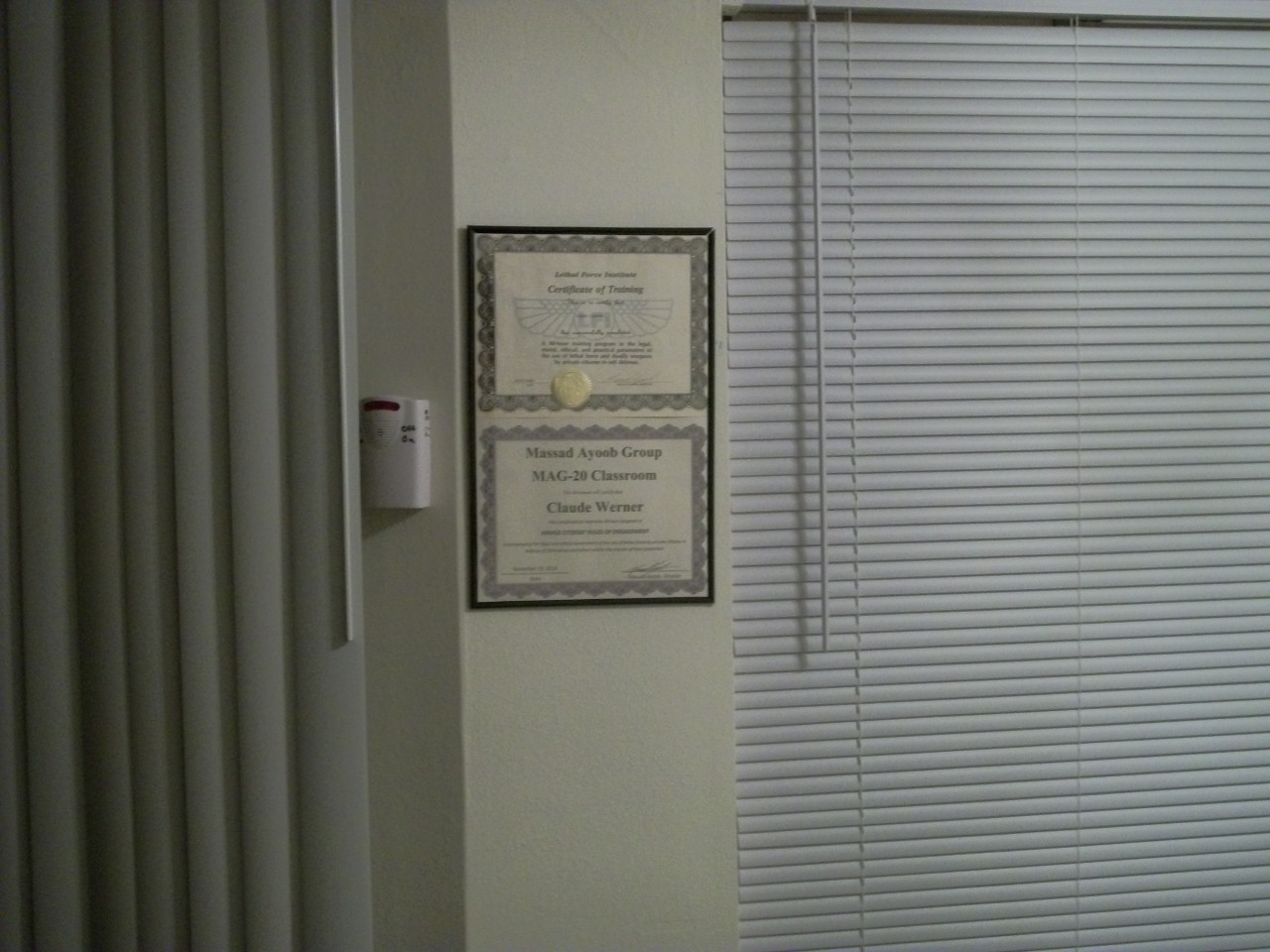
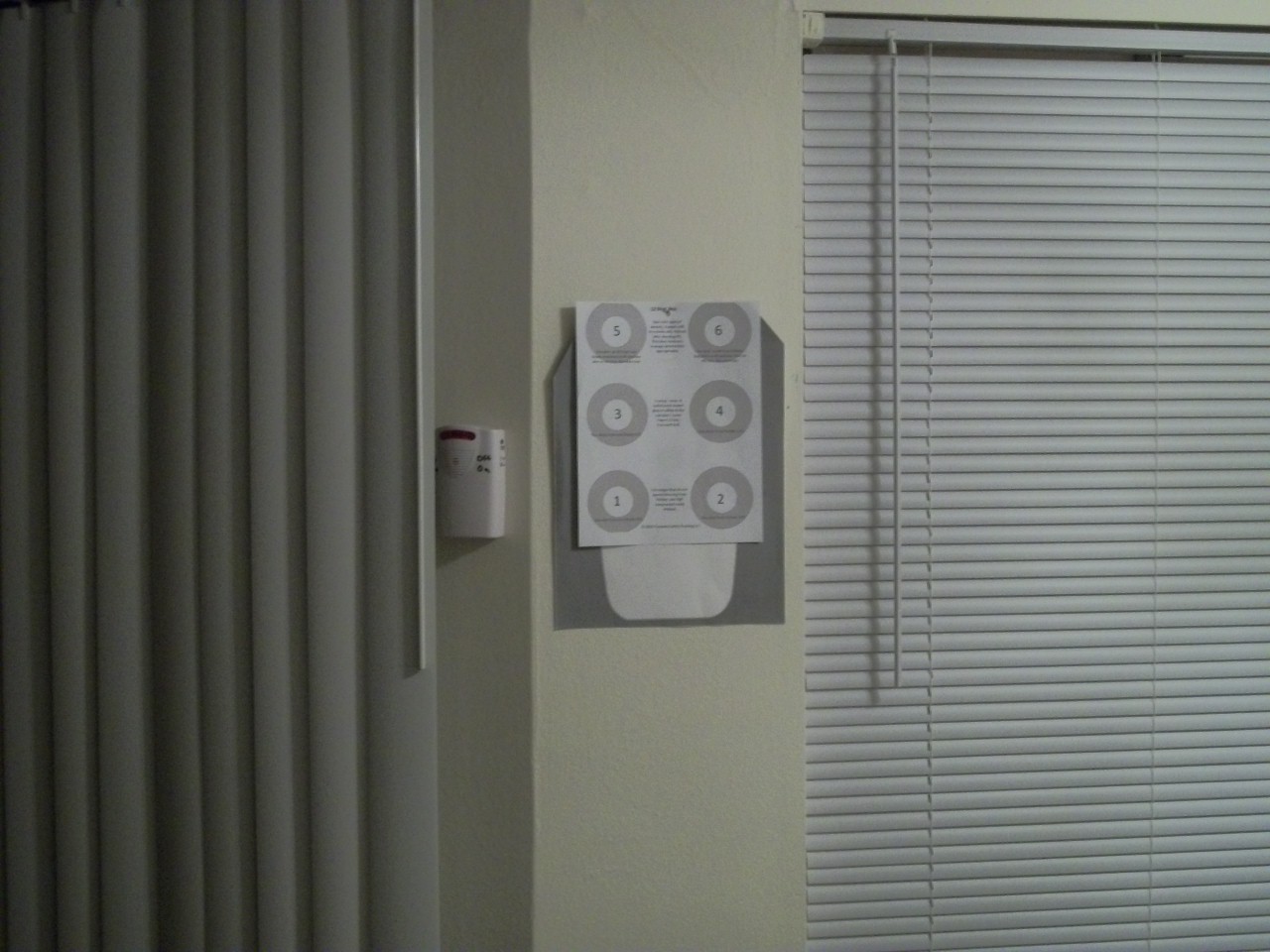 By ‘outside,’ I mean the flashlight is outside both my body and the pistol. ‘Inside’ means the flashlight is inside of the gun and toward my body. It’s necessary to have both an inside and outside technique so that you can use the light on either side of a piece of cover or concealment. For a right hander, the outside technique is used when using the light around the right side of cover and the inside technique is used around the left side. Left handers reverse that.
It occurred to me that I could use the same setup I use for the Air Marshal Tactical Pistol Course. I’ve modified that target setup slightly so I get more traverse on the multiple target strings. My setup also allows me to use both inside and outside techniques because of the arrangement of my apartment.
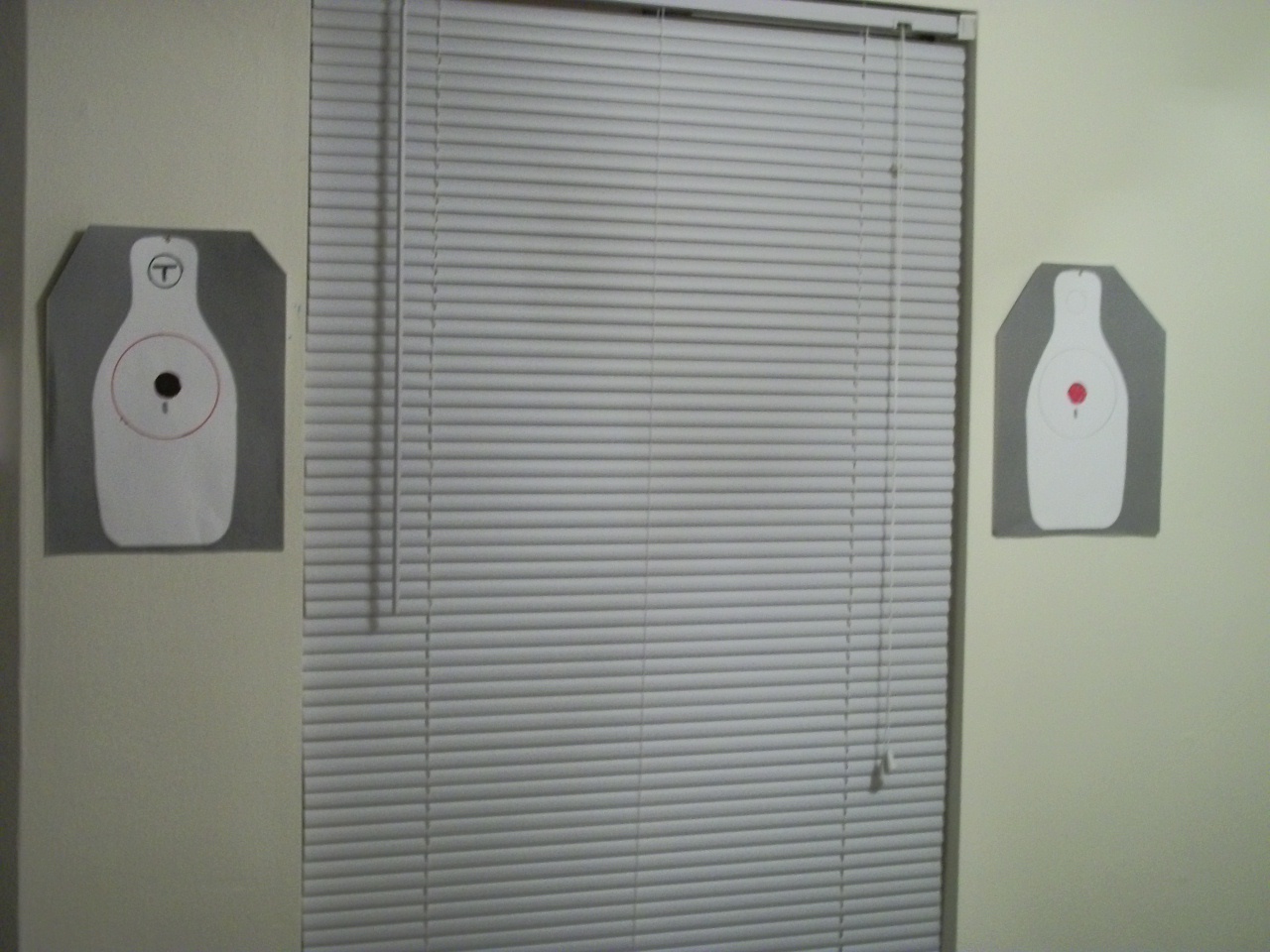
I started the Harries practice with the light pointing toward the target but the pistol down at low ready. Even when we’re identifying a target, we don’t want to muzzle them until the shoot decision is made. Then I practiced bringing the pistol up on target while keeping the light pointed at the target. At first, I did this in the hallway, just to get my mechanical movement correct.
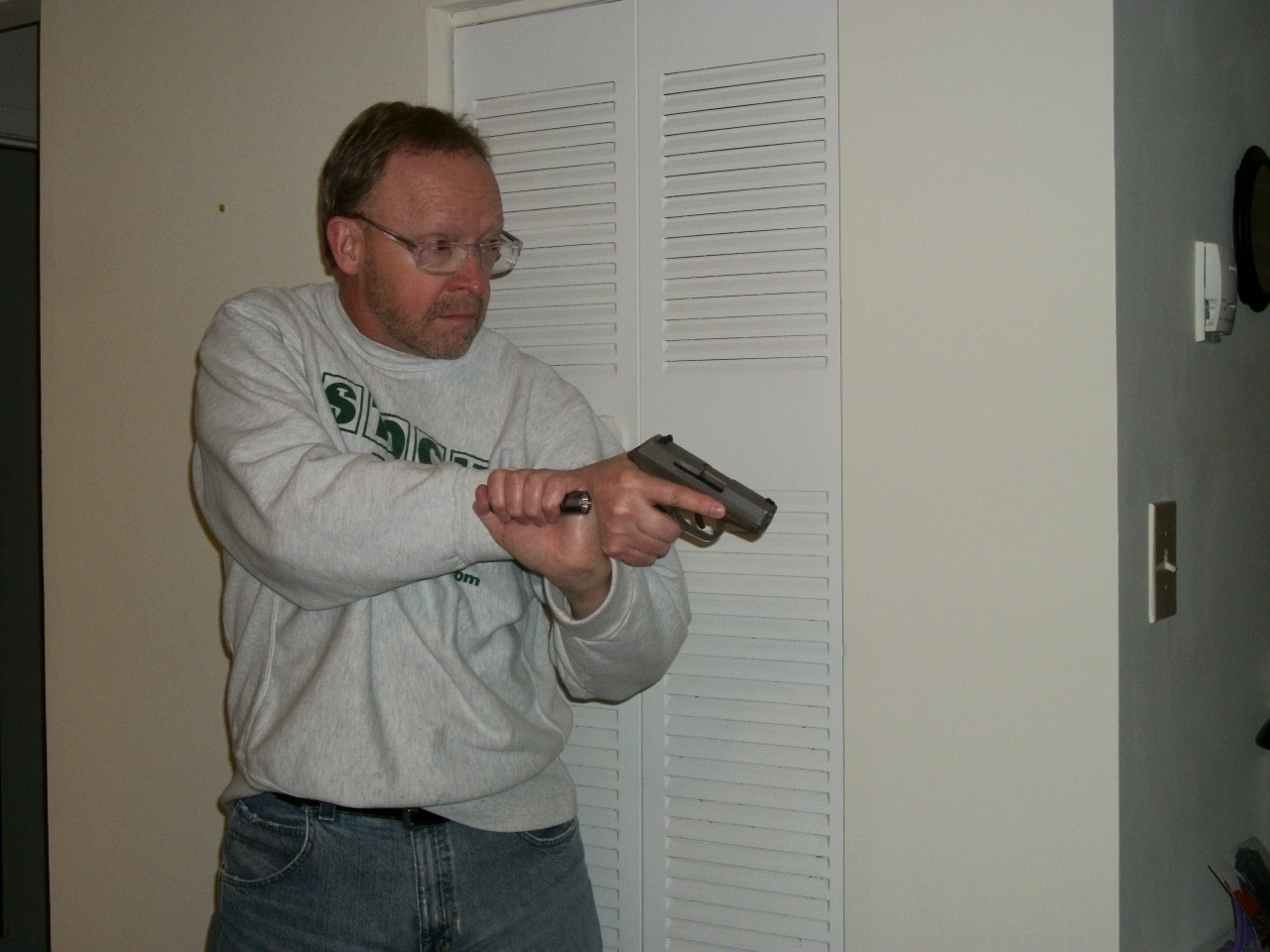
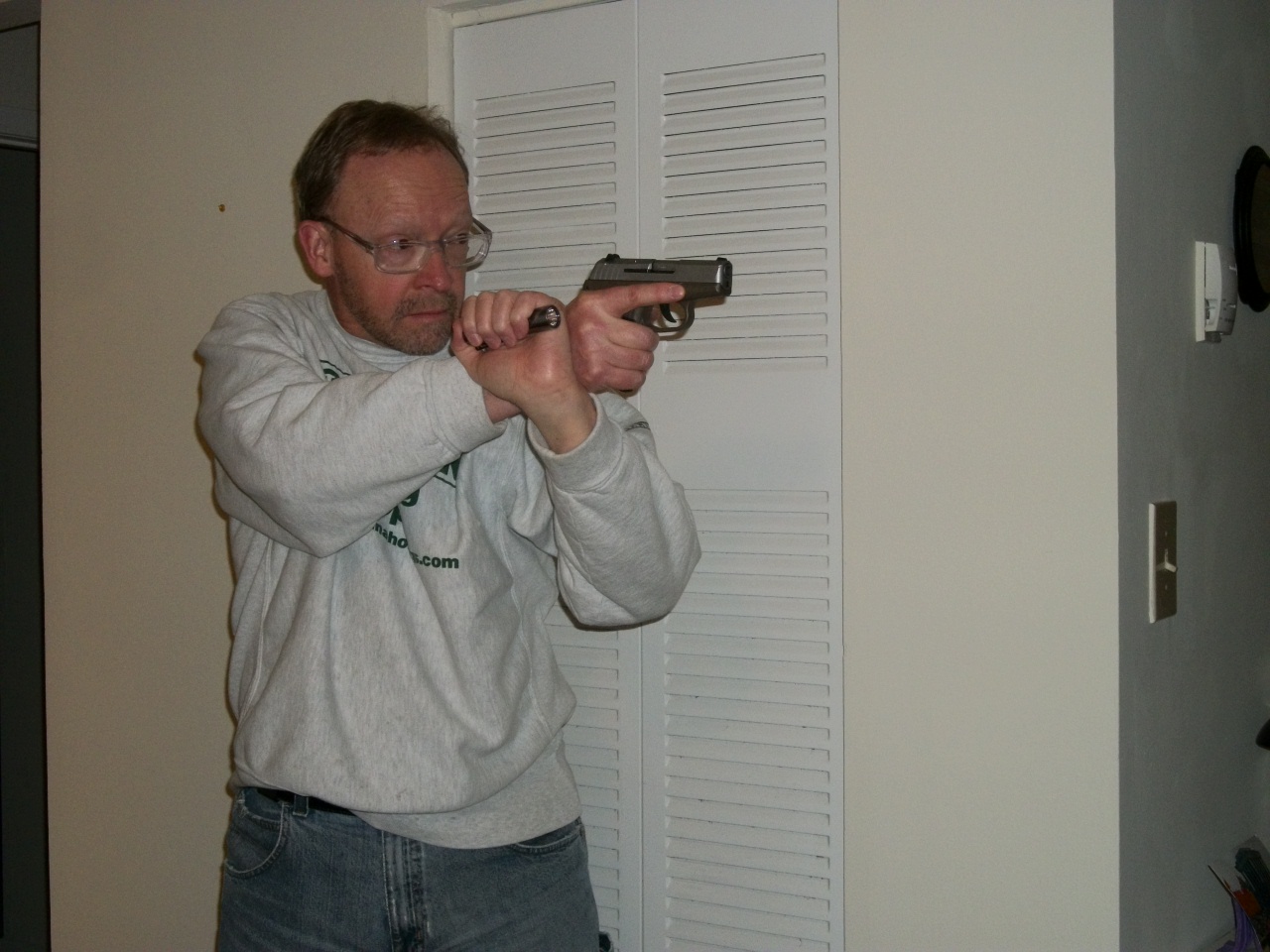
For the cheek practice, once again, I started with the light pointing toward the target but the pistol down at low ready. Since I use the cheek technique as a general search technique, this means I’m going to be shooting one handed, if the shoot decision is made. I like the cheek technique as a general search technique because it allows me to use the light as an impact tool, if necessary. Because there is a possibility during a general search, I would be in a hallway when shooting started, I incorporated turning off the light after the shot and taking a sidestep. But, there’s not much maneuver room in a hallway, so don’t think this is some magic potion that prevents getting shot.
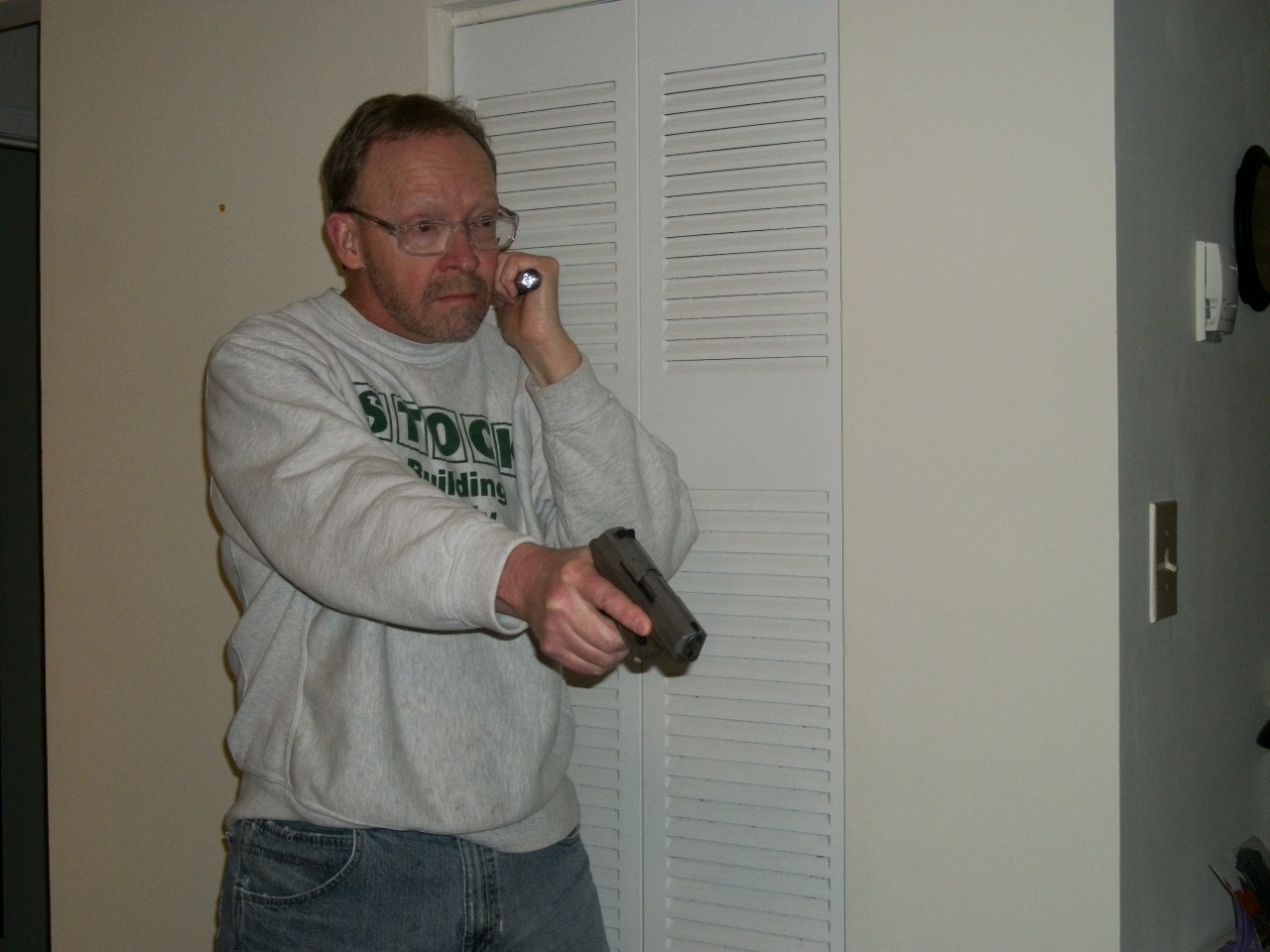
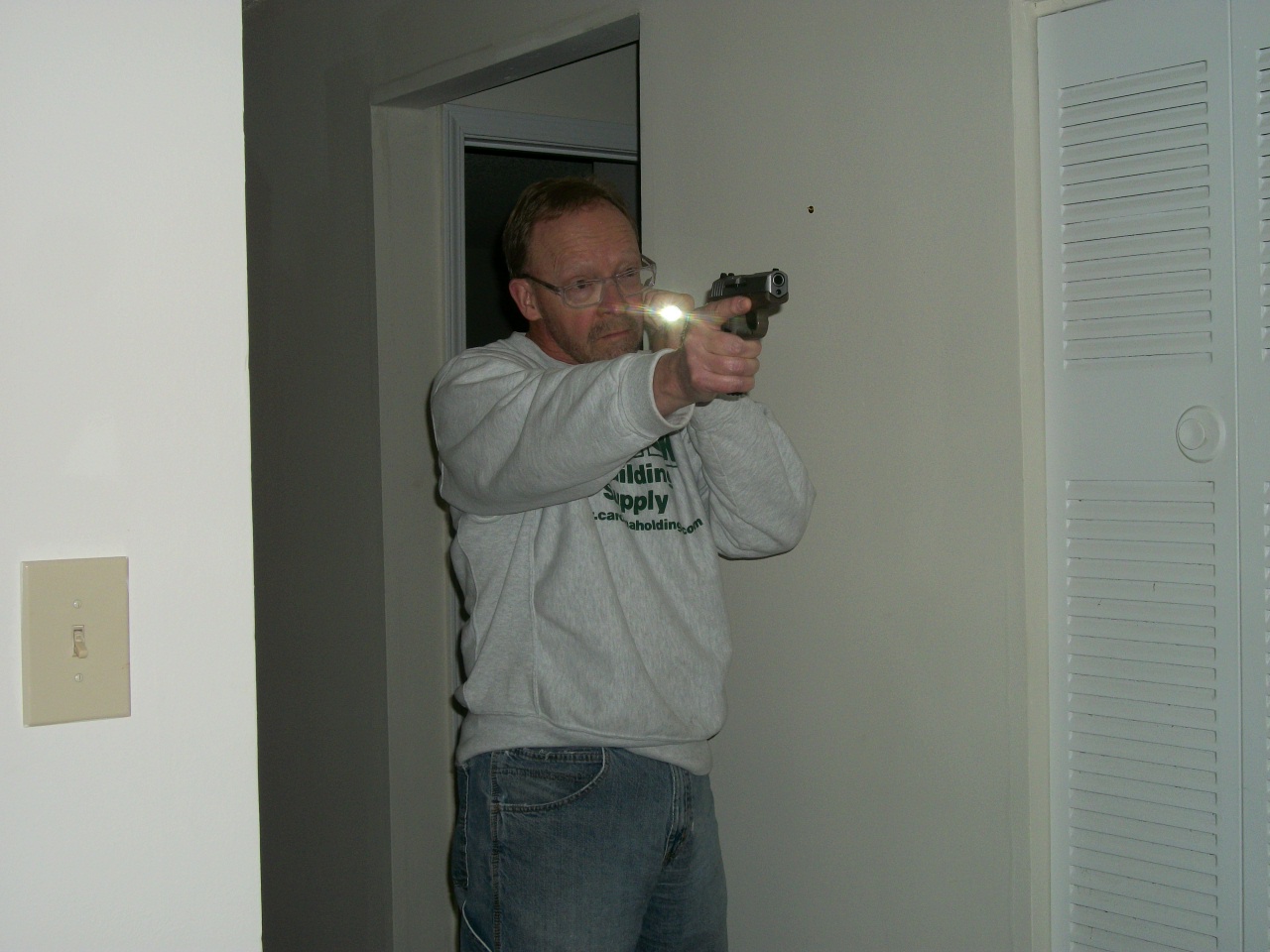
Once I was satisfied I had the mechanicals down pat, I moved to positions of cover, both left side and right side. I practiced on both sides, making sure I didn’t splash the light off the wall and into my face.
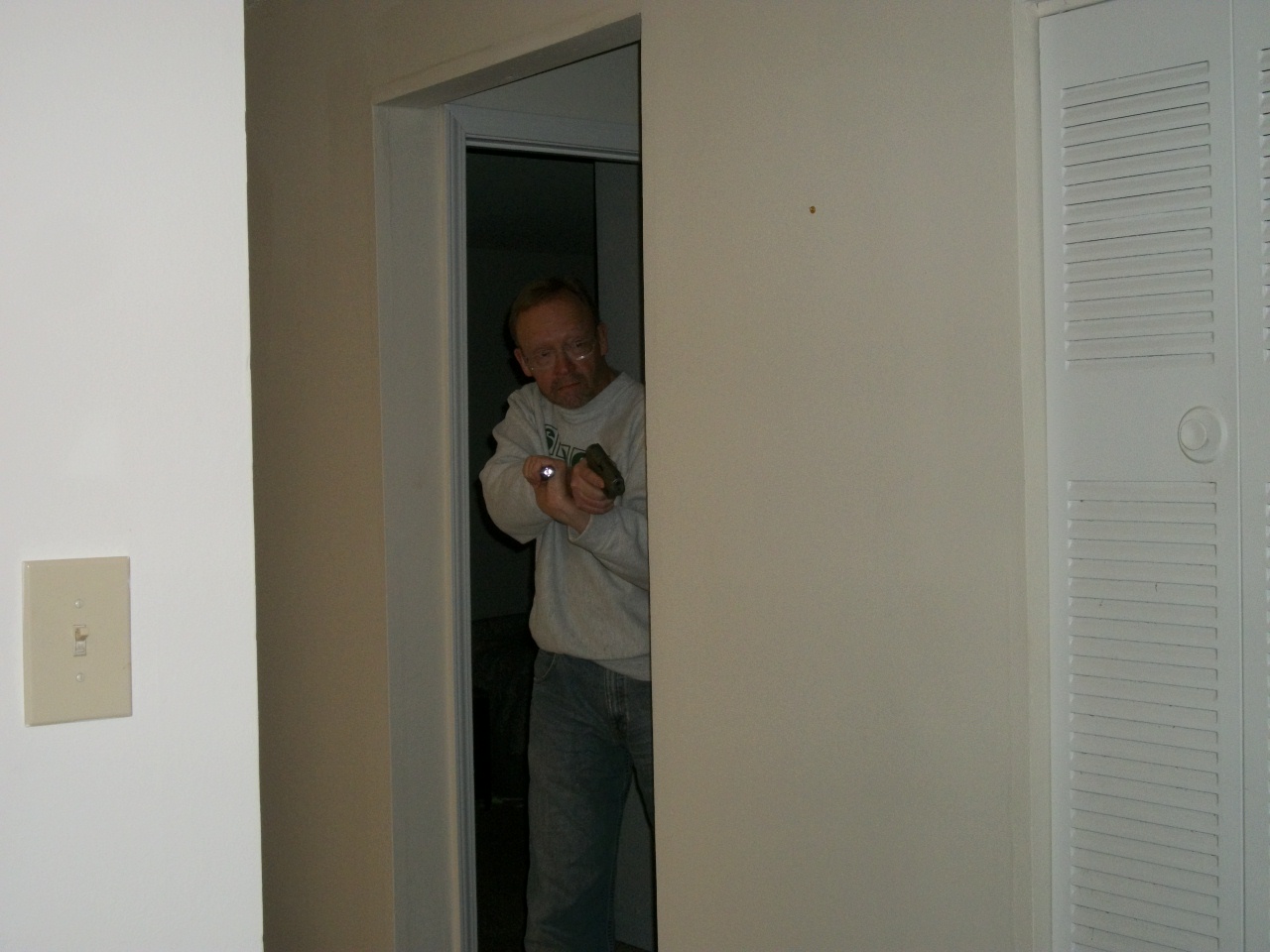
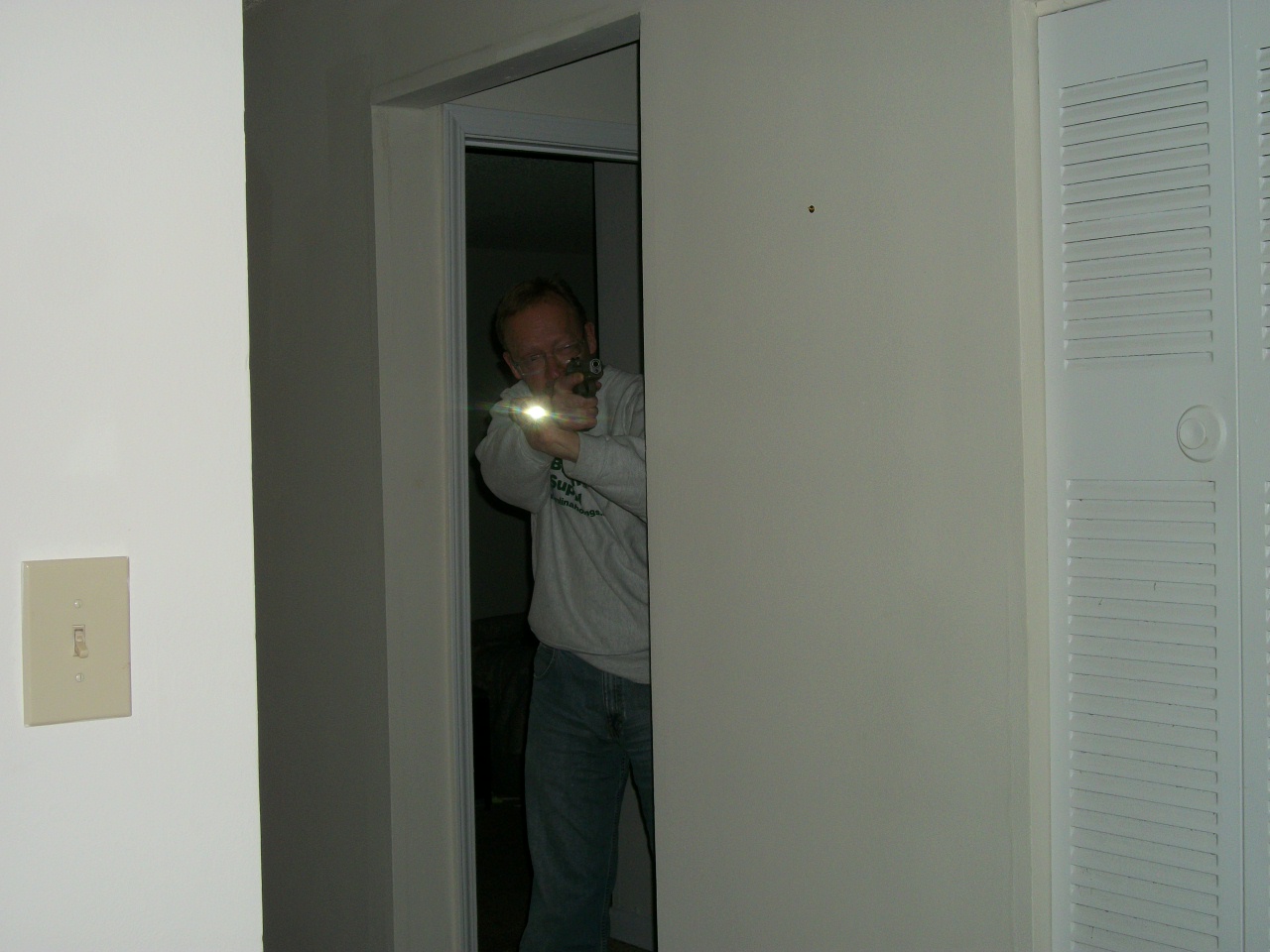
Note that in the photographs I took, I was using a flash or the regular lighting for clarity. When practicing, the place was completely dark. Also note that the camera wasn’t positioned exactly where the target was, so I look more exposed than I actually was.
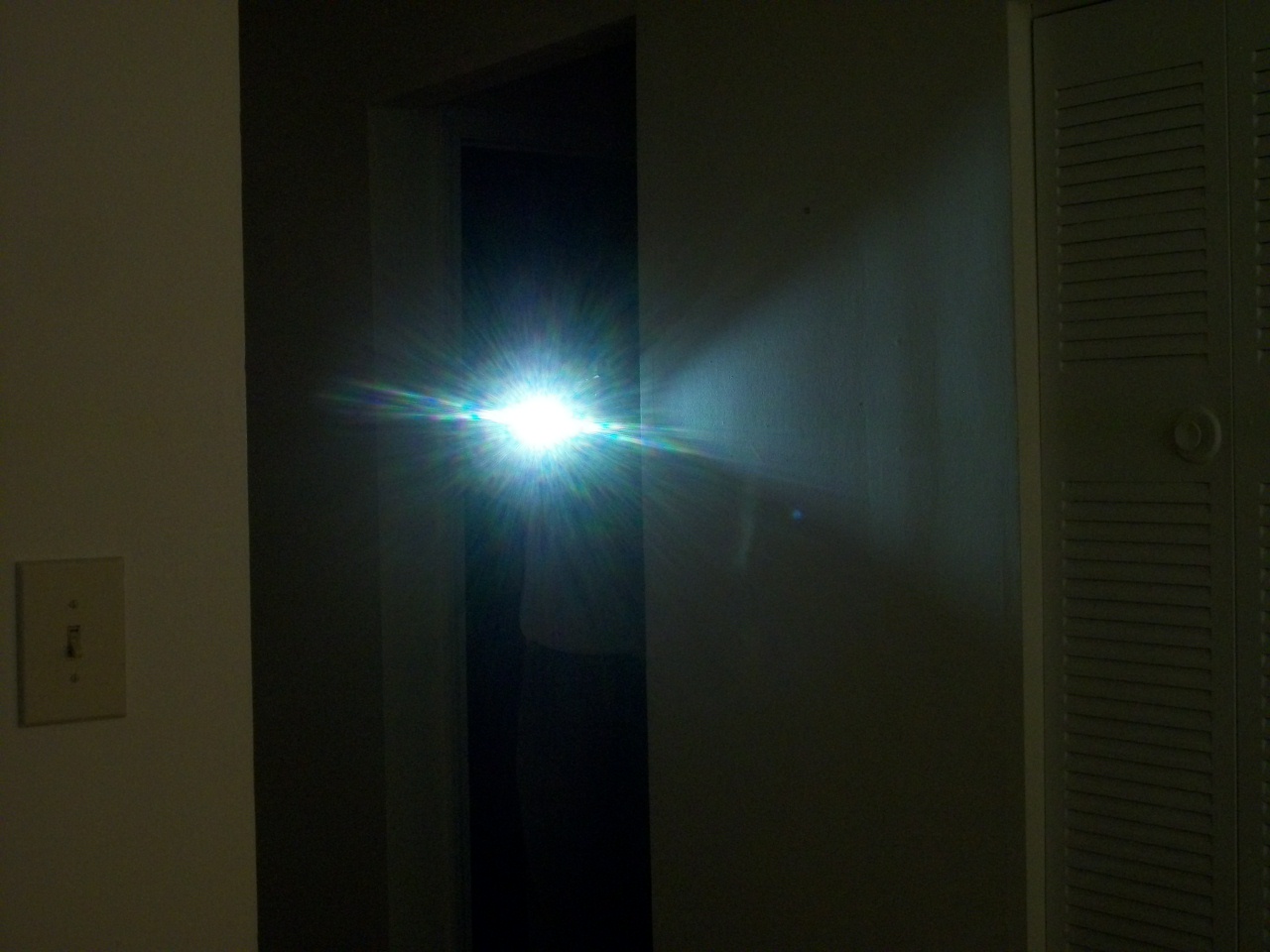
I’m glad I developed this as a more formal program. I’ll be doing it at least once a week from now on as part of my 1000 days of dryfire.
Rangemaster 2015 Tactical Conference (I)
The Rangemaster 2015 Tactical Conference is over and I am processing the things I observed and learned from it. The Conference has a long history, dating back to the early days of IDPA in 1998, when it was a sanctioned IDPA indoor Championship. Over the years, it has evolved into the foremost tactical training conference for private citizens in the United States. It is held annually, early in the year, in the Memphis area. The venue for the 2015 Conference was the Memphis Police Training Academy, a truly fine and modern facility.
This year, three dozen of the top personal protection trainers in the country, many of whom are referred to as “T-Rexes,” came together to present or conduct training blocks of two to six hours over a period of three days. The agenda has grown so large that it’s not possible to take in all the training that is available, since sometimes five blocks are going on simultaneously. Some of the training is classroom lecture, some is hands-on with sterile weapons, and some is livefire. There is also a shooting match, for those who choose to participate.
There were a wide variety of topics, ranging from psychology and communications to contact based skills to firearms manipulation. I was able to attend nine sessions.
- Yes, I Shoot Like a Girl, Would You Like a Lesson?
- Surviving Lethal Encounters
- The Law of Self-Defense
- Practical Small Knife Principles
- Performance Under Fire
- Rehabilitating the Experienced Shooter
- The Training/Reality Mismatch
- Kneeling Positions and Combining Them with the Use of Cover
- Women’s Holsters and Accessories
In addition, I was able to make two classroom presentations.
- Tactical Communications for Couples, with my co-presenter Linda Hoopes, President of the Resilience Alliance.
- Negative Outcomes of Firearms Ownership
Upon my return, several people have asked me what my most significant takeaways were. As usual, I learned a great deal, so it’s difficult to say what were the most significant, but here are a few that stand out in my mind, in no particular order.
- A conversation with a mentor of mine, John Farnam, elicited from both of us the experience that when approached for help in a parking lot, it’s almost always a scam or criminal ambush. Fellow trainer Melody Lauer pointed out that there are a few legitimate exceptions, but John and I both feel they are the exception rather than the rule. This indicates that a default response should be formed to immediately and firmly decline the invitation to be a victim and then rapidly vacate the area. Exceptions to that rule should be based on specific articulable reasons and conscious decision-making, rather than by default.
- The T-Rexes are constantly working along the path to excellence. That path includes attitude, skills development, tactics, and a host of other areas. Recognizing that there is an element of chance in every encounter, we work hard on stacking the deck in our favor. ‘Doing the work’ means training regularly and practicing on a daily basis. ‘Good enough’ is never good enough for us. That’s probably why we’re regarded as T-Rexes.
- There is an enormous amount of erroneous, misapplied, or misinterpreted information floating around in the broad firearms and personal protection community. This is especially true in relation to prioritization, legal issues, and skills development.
- The community has a lot to learn about integrating women into it. There was a record turnout of female attendees and women trainers at the Conference this year, my co-presenter being one. Conversations with them, as well as the presentations, were highly enlightening. Many male paradigms either don’t apply at all or don’t work particularly well when used by women. My own presentation was an eye-opener to me in that regard. The Women’s Holsters and Accessories presentation, which was presented by a woman, gave several good examples. A pet peeve expressed by several T-Rexes is men who have women shoot excessively powerful firearms and then laugh when they fail. Our universal attitude is along the lines of the desire to give such jerks a knee lift in the crotch followed by a crack in the jaw and then laugh when they fall down writhing in pain.
I have several pages of notes but those jump out at me. Undoubtedly, more will occur to me as I reflect on the event. I will have more thoughts on specific topics in the near future. There is a photo gallery of the Conference training blocks available on the Rangemaster website.
 tacticalprofessor
You must be logged in to post a comment.