Lessons for the Armed Citizen from the Dorner Incidents
A defensive gun use (DGU) by an Armed Citizen is a balance of doing the right things, doing things right, and not doing the wrong things.
Christopher Dorner was a former LAPD Officer who went crazy in February 2013, murdered several people, and eventually committed suicide when surrounded by the authorities. During the manhunt for Dorner, two mistaken identity shootings by police occurred in the Los Angeles area. One shooting, by Torrance Police Officers, occurred near a checkpoint and the other in the vicinity of a LAPD Captain’s home. The home was being protected by a detail of LAPD Officers because the Captain may have been a specific target of Dorner’s.
A recent settlement for the Torrance Police shooting has revived commentary about the ‘trigger happy police,’ etc. I will be the first to admit I wouldn’t want to be downrange during such an episode but there are also lessons to be learned from the mistaken identity shootings. And those lessons don’t just apply to the law enforcement community.
First of all, note that both shootings occurred during periods of limited visibility, i.e., early morning. Humans have a natural apprehension of the dark. Couple this natural fear with the possibility of dealing with a dangerous criminal and our emotional trigger mechanisms can get stretched pretty tight. In the case of the LAPD shooting, the Officers had been on station for several hours already. They had also been recently informed that Dorner had engaged two police officers nearby and murdered one of them.
How does this apply to the Armed Citizen? Think about how you might feel if you hear a crash in your home in the middle of the night. Likely, you will have been awakened from sleep, you will not know what the situation is, and very probably your spouse will be providing you with a sense of urgency to determine and fix the problem. If you are like most people, your interior lights are not on, so you are operating in conditions of limited visibility. Now throw in the possibility of a heightened sense of danger, for instance, having a daughter who has recently obtained a Protection Order staying with you for safety reasons. The possibility is high that you will not have the same sense of ease and self-control you do when you go to the indoor range and casually prepare to practice shooting some rounds at a bullseye target.
Second, the Police do not train very much to work in groups larger than two. This point was made very succinctly by my Battalion Commander when we were practicing riot control in the National Guard. Watch any multi-officer takedown of a criminal and it’s obvious they do not operate with a sense of military coordination. Police Officers spent almost all of their time working independently, not as part of a team. Only SWAT units generally are trained to work in groups larger than two.
What does the lack of teamwork have to do with the Armed Citizen? Just as the Police don’t spend much time practicing teamwork with each other; neither do Armed Citizens tend to spend much time practicing teamwork with their families and friends. The probability that your spouse and/or children are not going to do what you want them to or what you tell them to do is high. So don’t be surprised if an incident involving more than one potential victim turns out to be a complicated problem to solve.
Third, communications among the Officers left something to be desired. In the case of the Torrance Police shooting, the victim had been identified as a non-threat just a few seconds before. Unfortunately, this had evidently not been communicated to Officers right down the street. When I conduct training for couples, one of the main concerns they express is their ability to communicate during a criminal encounter. The couples I work with tend to already be ‘switched on’ so this is an area that deserves considerable emphasis in our personal practice.
All this is not to defend or justify the mistaken identity shootings. The LAPD Board of Police Commissioners found the LAPD Officers’ actions ‘out of policy’ and rightly so. Rather, it is to point out that a defensive gun use (DGU) by an Armed Citizen, just as by a Law Enforcement Officer, is a balance of doing the right things, doing things right, and not doing the wrong things.
When we take a gun into our hands for defensive purposes, we have a goal in mind, that being to avoid death or serious bodily injury. At the same time, there’s a good possibility we are threading our way through a series of physical and emotional obstacles while trying to reach that goal. Just as soldiers whose objective is on the far side of a minefield must work their way through the minefield carefully, we, as Armed Citizens, must be cautious of our paths and moves, as well.

The full report of the Los Angeles Police Department Board Of Police Commissioners is available here.
Gunhandling
Marksmanship, gunhandling, mindset. –The Combat Triad originated by Jeff Cooper.
I had two interesting experiences relating to gunhandling last week. Gunhandling is an often overlooked component of the Combat Triad.
The first was the result of shooting the Swiss concealed weapons qualification test. A friend of mine lives there and recently obtained his license. The Swiss don’t have a training requirement, per se; rather they have a testing process consisting of a written test on legal aspects and a practical test (what we would call a qualification course). They are both administered by the Swiss Polizei. The written test must be passed before the practical test can be taken.
He sent me the qualification course that is required to get the license. The material he sent me is in French, so I may have mistranslated it, but I believe all the strings start with empty chamber. Since whether to carry with a round in the chamber or not is frequently a topic of discussion among new weapons carriers, I decided to shoot it that way even if my translation was incorrect.
The course is shot at 7 meters, 5 meters, and 3 meters. At each distance, three strings of two shots each are fired. The time limits are 4.0 seconds, 3.5 seconds, and 3.0 seconds for each string, respectively. Each string starts with the pistol holstered and concealed. The target is a silhouette with a bottle shape on it, which appears to be roughly the size of an FBI ‘Q’ or the IDPA -0/-1 zone. The Swiss score this with a points system. Shots in the bottle count as one point, shots on the silhouette outside the bottle receive zero points, and shots that miss the silhouette result in a one point penalty. Shots over the allotted time also received one penalty point. Fourteen points are required to pass the test.
To get an initial feel for the difference between chamber empty and loaded chamber start, I did five one shot unconcealed draws using each technique. Overall, chamber empty was slower to the tune of .48 seconds average. I was shooting my Beretta 92G Centurion from a Safariland 567 open top holster.
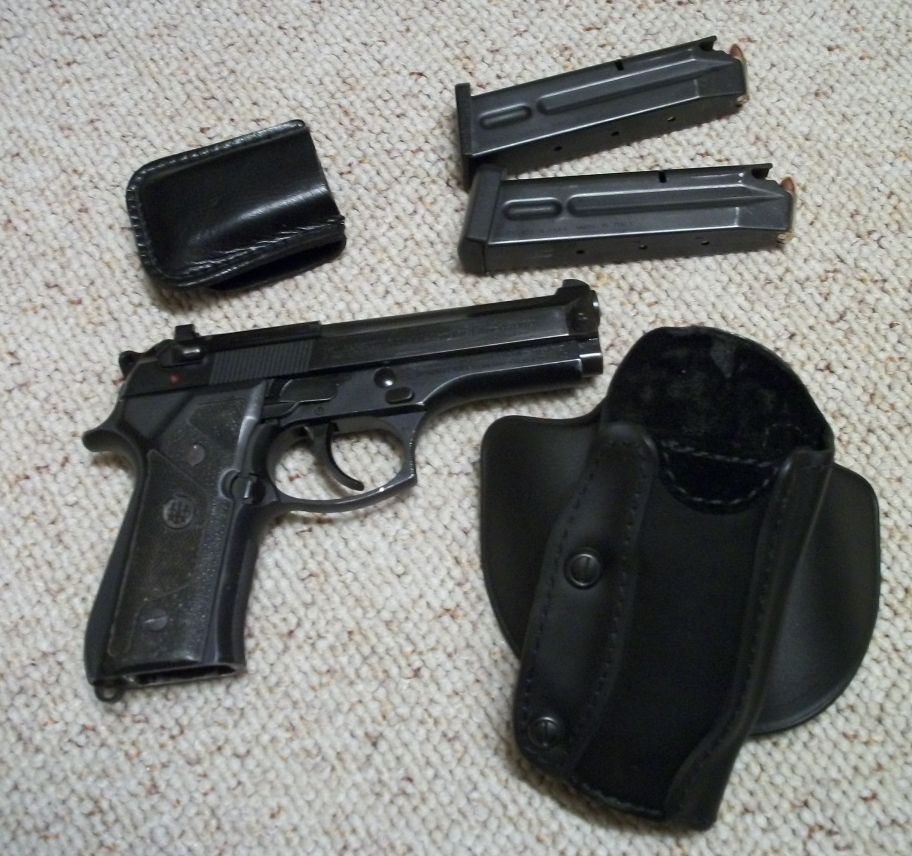
Having established a baseline difference, I proceeded to shoot the Swiss qual course twice, once with the chamber empty and once with a loaded chamber. I used the same gear but also my favorite concealment vest, a construction worker’s fluorescent vest. What I found was that chamber empty was not only slower (0.48-0.67 seconds) but somewhat less accurate than having a round in the chamber. I had to work really hard to get the front sight on target after loading the chamber. Unlike a smooth loaded chamber drawstroke, there’s a lot of rotational movement of the pistol going during the period of driving the gun to the target. I didn’t have any trouble making the times, but it’s not exactly a cakewalk, either. Not long into the course, the safety ears were beginning to hurt my fingers, which may have had some effect on the results, too.
Unchambered
Distance 1 2 3 Average
7m 2.84 2.67 2.77 2.76
5m 2.50 2.60 2.47 2.52
3m 2.17 2.46 2.07 2.23
Years ago, I took a pistol course from Kelly McCann. He said that the Israelis just accept that they are going to throw away the first shot when using the chamber empty technique. After doing this exercise, I can see why. With all the gun movement, and if using the strict Israeli technique, 90 degrees of rotating of the gun, it’s hard to get even the muzzle indexed on target, much less get the front sight on it. Notice also the inclined to the low left classic group, indicating the trigger jerking that was going on. I expect this is because of the amount of complex (gross simultaneous with fine) motor skills that are involved.
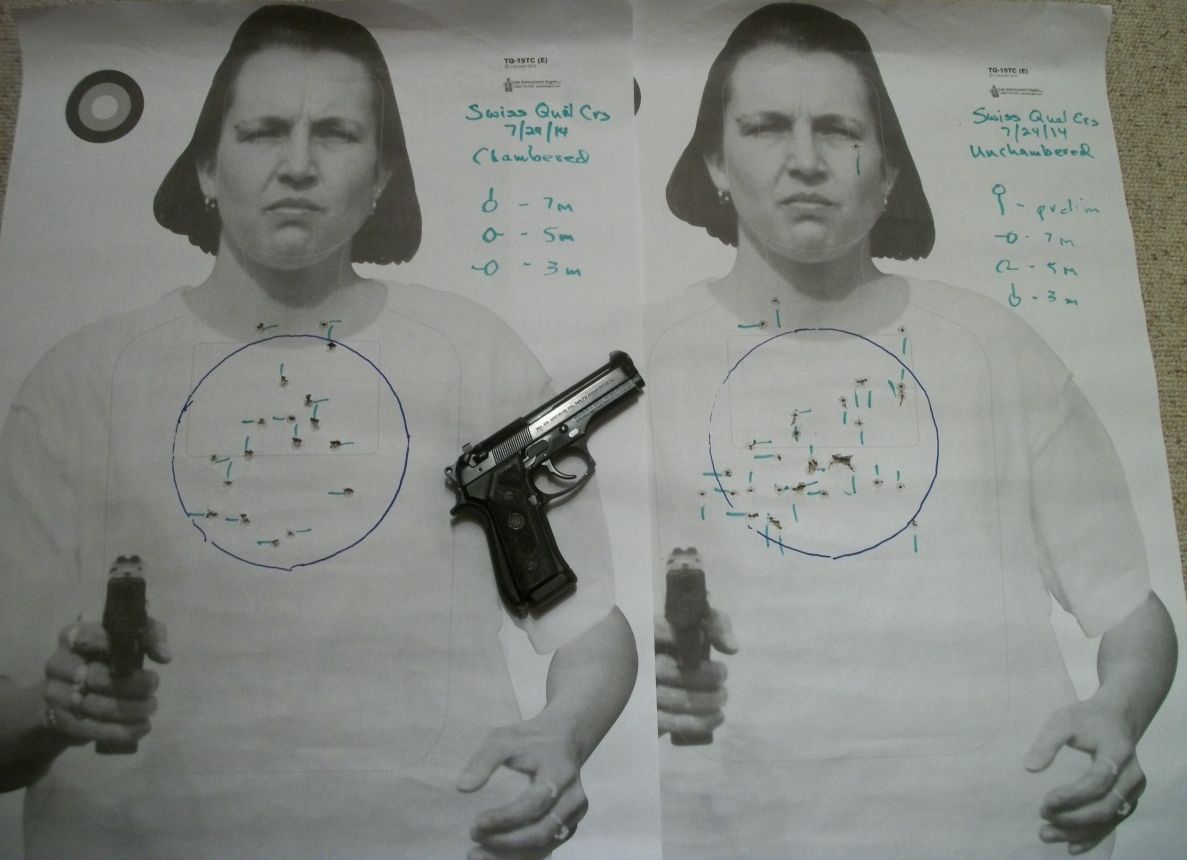
Note that I drew the IDPA -0 zone on the target after the shooting for analytical purposes.
The second observation occurred at an indoor IDPA match. There was a blind stage in which the shooter’s gun had a dummy round randomly inserted in the magazine, without being told it was there. While this isn’t strictly legal for IDPA, it did provide an interesting laboratory when watching the shooters’ reactions. I watched about 20 iterations of the stages, so it gave me a decent view across the range of shooter abilities, Novice through Master.
There was a wide range of reactions. Unfortunately, many people were positively flummoxed upon encountering the click. They would just look at their gun and not do anything. The Safety Officer had to tell several to 1) clear the malfunction and 2) how to do it. What I found disturbing was how many people immediately ejected that magazine and reloaded with a fresh one. The follow-on action to the reload was about evenly divided. Half would then work the slide to eject the dummy and resume shooting. The other half would attempt to fire the pistol again without clearing the dummy, which resulted in nothing happening. Then they would work the slide and resume shooting.
After the initial malfunction, which was set up to occur within the first few rounds, many shooters experienced a series of subsequent malfunctions. I wondered about this, so I asked the Safety Officer who was placing the dummy if he was doing anything else to their guns to mess them up. His answer was: “The first one is on me, the rest are all them.”
So, having a malfunction early in the string then produced a cascade of malfunctions for some shooters. Perhaps, this was due to grip issues or incorrect shooting posture, I’m not really sure. Observing this phenomenon gave me some serious food for thought. It’s well known that I don’t think spare ammunition is as necessary for Armed Citizens as is often made out to be the case. But if someone’s first reaction to a malfunction is to jettison their only magazine, that could be a big problem.
These two sets of observations reinforce to me that those who carry or keep pistols for personal protection need to do more practice than simply go to an indoor range and shoot a box of ammo periodically. Pistols are complex mechanical devices that require proper manipulation skills as well as acceptable marksmanship ability. I will talk about practice possibilities in the future.
Spot shooting
“Do you want it in the belly or in the teeth?” –my father, to a would-be robber, who suddenly remembered a previous appointment.
My dad’s eyesight was pretty bad by then, so he couldn’t aim at the eye. However, the teeth remained a viable aiming point for him. At age 83, he and I took the training to get our Nevada Concealed Handgun Permits. He outshot everyone in the class except me. One reason was he knew to aim at something.
One of the biggest problems I see in current training methods is the concept of “aim for center of mass.” Coupled with the blank targets used, it’s no wonder that people have a hard time learning to hit anything. That’s the equivalent of what’s called an “area target” in the Army. Area targets are best engaged with some form of area weapon, such as a machinegun, grenade launcher, mortar, or artillery. However, we don’t carry area weapons for self-defense.
One of the greatest handgun shooters ever, Ed McGivern, was asked how he could hit playing cards so quickly and with such tight groups. His answer was “I’m not aiming at the card, I’m aiming at a spot on it.” Ed established some speed records that have never been broken, so this is does not have to be a slow process, either. The idea that aiming at a spot on a target is too slow is a common misconception. It does require practice, though.
To facilitate this when I am dryfiring, I have targets with spots on them. The one I am using now has a variety of spots on it. There is a face, a cut out area of the IDPA -0 zone with a spot in it, and a series of circle and dots on the back. When I’m shooting IDPA, I do my best to pick out a spot on the target to aim at, such as a paster or group of pasters. So, I’m not aiming at ‘center of mass,’ I’m aiming at a spot.
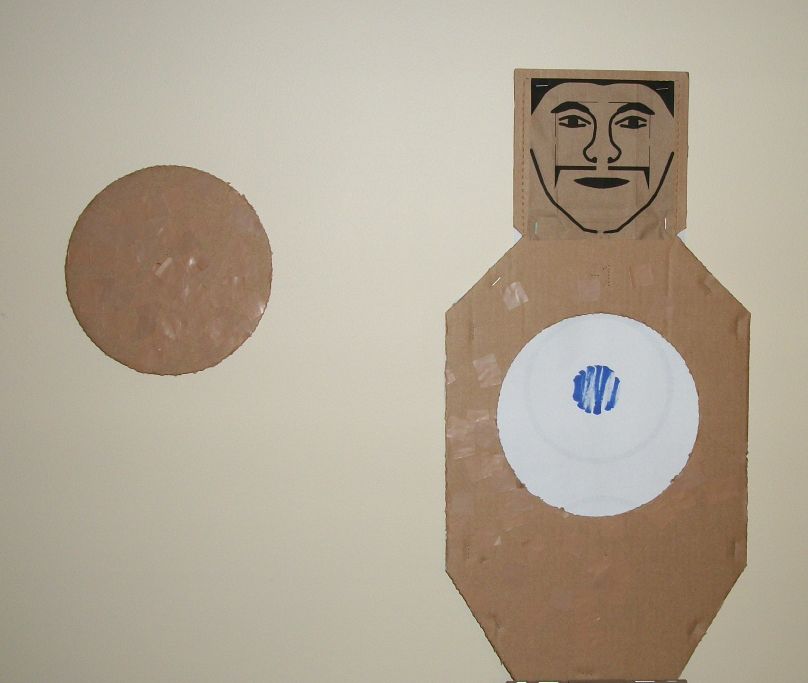
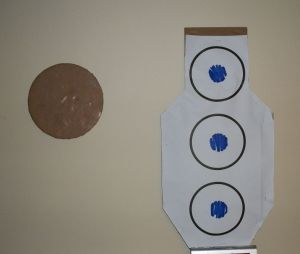
When I explain this concept to students in my Defensive Pistol classes, I reference the Internet meme “Be polite, be professional, but have a plan to kill everyone you meet.” Whenever I hear that meme, I ask “What are the elements of your plan?” I have yet to receive any meaningful response; it’s just a platitude that people repeat to sound like they’re ‘switched on.’ I tell my students that one element of my plan is that as soon as I meet someone, I pick out the spot on their body that I am going to aim at, should it become necessary to shoot them. Then I describe to each person in the class what the aiming point for them would be. This tends to generate considerable discomfort but makes the point very clear. Most of the class is shot on dot targets. Only when the students shoot the qualification course do they shoot at a silhouette, which has a discernible aiming spot on it.
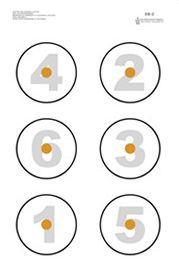
Spot shooting is a fundamental part of the instruction at the elite Rogers Shooting School. There is always a spot on the body plates at the School. When practicing recoil control via the ‘Bill Drill,’ aiming at that spot is key to firing a good group.
What we are trying to achieve when aiming at a spot is not necessarily to hit the spot but rather to get our bullet very close to it. As I explain to my students, our groups are always going to be larger than what we are aiming at. This is true because guns are not generally capable of putting all the bullets in the same hole, nor are we Terminators who can hold and press the trigger exactly the same way every time. However, by aiming precisely, we minimize the amount of error induced by mechanical tolerances and our human fallibilities.
This is the fundamental problem with ‘aiming at center of mass.’ In that philosophy, the entire silhouette is the target. So if the group is larger than the target, misses become an inevitable part of the result. Throw in poor trigger manipulation and you end up with a 20% hit rate.
Try this out the next time you go to the range, I think you will notice a difference.
Stress Inoculation
I was thinking about Trevor‘s comment regarding “keep showing up” today.
I’ve found that there are three rules to successfully getting into a new discipline, and these rules have proven true across martial arts, shooting sports, Crossfit, and other endeavors:
Rule 1: Show up ready to learn and give good effort.
Rule 2: Keep showing up. Show up more than anyone else. If you don’t feel like going, see rule 2.
Rule 3: Put in the work and measure your progress honestly.
One of the ways I used to keep my mind occupied during road marches in the Army was to calculate how times I had done something. For instance, I was marching around Korea in 1980 and calculated I had already spent well over 1000 days in the field. That is one reason I have not the slightest interest in camping. At that point, I was about 1/3rd of the way through my career. I stopped counting after that.
Tonight’s exercise was figuring out the extent of my measured shooting performance when others were watching. There are two quantities I can calculate; IDPA stages shot and demos in front of classes I have taught.
Roughly, I shot about 200 stages a year for the first 12 years I shot IDPA. Quite a bit less per year since then but I’m working on increasing it. So let’s say some 2500 stages where I’m in front of a group.
Demos in classes would be Rogers classes and my FST classes. Rogers demos are grueling because the class oftentimes is looking for the instructor to screw up. I taught roughly 60 or so classes at Rogers. Probably at least 12 to 15, perhaps more, demos per day for 3 of the 5 days. So, let’s say 40 demos per class. That’s another 2400 exercises while I’m being watched and graded.
Then we have my Firearms Safety Training LLC classes and seminars. I believe in demonstrating most of the drills for the students unless the drill is really simple. Over the course of 16 years, I’ve taught 4 to 6 classes per year, plus quite a few seminars. Let’s say 100 total classes and seminars with around 12 demos per, average. So another 1200 evaluations in front of a group.
Overall, it looks like I’ve stepped up to the plate over 6000 times to stand and deliver while people are watching and, in many cases, waiting for me to screw up.
The value of that much experience at problem solving and having to perform to a standard is incalculable to me. I wouldn’t trade it for anything and I feel sorry for those who deprive themselves of that opportunity. It’s a very valuable form of stress inoculation, readily available to anyone who wants it. But you have to be willing to fall on your face for awhile because I certainly did.
What Strategies should we train (or train not to)?
“He that passeth by, and meddleth with strife belonging not to him, is like one that taketh a dog by the ears.” — Proverbs 26:17
In my analysis of The Armed Citizen column, two things that I noticed have broader implications than ‘skills,’ although there are both skills and tactics involved in their execution. To me, they are strategic considerations about what to do vis-à-vis how to do it. I’m not hung up on the strategic/tactical terminology, so call it whatever suits you.
Intervene in another’s situation 15%
Hold at gunpoint until police arrive 12%
As many of my friends know, I’m not a fan of intervention in others’ affairs. I won’t say I would never do it, but I would need a really good reason. Even some police agencies, such as the LAPD, discourage officers from taking ‘enforcement action’ when they are off-duty.
Los Angeles Board of Police Commissioners’ Findings
Although it is preferred that an off-duty officer refrain from taking enforcement action and instead act as a good witness, the rapidly unfolding circumstances warranted immediate intervention to preserve life.
Therefore, it was reasonable for Officer A to take immediate action to safeguard the lives of the public.
Even when the LAPD BOPC finds an officer’s “use of force to be in policy, requiring no action” in such a situation, it sometimes recommends additional training that the officer must undergo to remedy tactical deficiencies noted.
Board of Police Commissioners’ Findings
A. Tactics
The BOPC found that … Officer A (7 years, 8 months service) would benefit from additional tactical training at the Training Division (formal training) level.
In one incident that took place in the Atlanta area 3 years ago, the person who intervened was shot in the back and killed by a seeded backup man in the liquor store. There were a whole series of tactical and marksmanship issues and errors associated with that tragic incident.
In addition to the tactical considerations, Andrew Branca’s excellent book The Law of Self Defense discusses a number of legal considerations about intervention. For example, if a weapons carrier intervenes of behalf of someone who is not innocent in the encounter, then neither is the one who intervenes.
Intervention opens a big can of worms and I’ve never been much interested in fishing. Many years ago, Evan Marshall, a very savvy and experienced Detroit street cop, espoused a philosophy of being a good witness until “they start searching people, making people get down on the floor, or herding people into a back room.” At that point, he felt gunfire was in order. I haven’t come across anything I find more apropos, so that’s the personal strategy I have in mind.
The risk/reward aspect of ‘Hold at gunpoint until police arrive’ is a separate and involved topic that we’ll discuss in the future.
What skills should we train and practice?
“What is the best use of my time right now?” —How to Get Control of Your Time and Your Life by Alan Lakein
As many people know, I like to read The Armed Citizen column of the NRA Journals in detail each month. Years ago, I did a Five Year Analysis of The Armed Citizen to give me an idea of what actual incidents really looked like. Revisiting that concept appealed to me, so I did a short version for the first six months of 2014.
What I was looking for this time was the skills and techniques that were used by The Armed Citizens to solve their problems. Each incident was looked at from the perspective of skills that could or might be taught in an entry level to intermediate level firearms training class. Here’s what the list and usage rates ended up looking like from 10% up and 0%:
- Retrieve from Storage (handgun) 32%
- Move safely from place to place at ready 22%
- Draw to shoot 20%
- Challenge from ready 15%
- Intervene in another’s situation 15%
- Draw to challenge 12%
- Engage from ready (handgun) 12%
- Hold at gunpoint until police arrive 12%
- Retrieve from Storage (unknown) 10%
- Shoot with non-threats downrange 10%
- Retrieve from Storage (rifle) 0%
- Reload 0%
How often do we, as firearms trainers, ask our students to bring their home storage containers to class with them? Probably not 32 percent of the time. Or do we at least provide some kind of drawer for them to get their roscoe out of to show they can do it safely? I know a lot of people keep their chamber, or even the gun, empty when it’s off their person, so do we make them demonstrate loading it safely? Something I really like about the NRA Defensive Pistol I Marksmanship Qualification Program is that it includes those type of skills and incorporates both a time and accuracy standard for performing them.
How about moving safely from place to place with a loaded gun in hand, especially with innocents around? This is one of the biggest challenges that new IDPA and USPSA shooters encounter. Almost inevitably, a new shooter will run around with finger on trigger and then is taken to task about it by the match staff. While they’re not training, those shooting sports are providing a lot more realistic practice on a critical skill than most training classes are. Does that mean that the shooting sports are more relevant, at least in that aspect, than training classes are?
Challenging criminals is another skill I see rarely. John Farnam emphasizes it in his classes but I don’t see verbalization prior to using deadly force in many other classes. I personally think the concept “the gun isn’t coming out until I decide to shoot” is one of the most ill-considered ideas in the firearms community. But I still hear it quite a bit. If we can convince a criminal that the victimization has gone South and turned into a conflict, the chances are quite good they will break off. If they break off the attack without us firing a shot, I consider that a big WIN. Verbalization is another skill that is included in the NRA MQP. But a number of my students have found it hard to do without considerable coaching.
We’ll discuss the other skills in the future, but I want to draw attention to the percentage of reloads involved in these incidents, to wit: ZERO. As I mentioned in a Personal Defense Network interview, I’ve completely de-emphasized reloading in my classes for Armed Citizens. It’s a useful exercise for practicing good gunhandling but as a tactical skill, I just don’t consider it important anymore. Some folks spend a lot of time on thinking about how much spare ammunition to carry, how to carry it, and how to reload quickly. I think that time and effort would be better spent on practicing to make a good first shot, which is a skill many people need a lot of practice on.
Tactical and Operational Relativism
Fortunately, over the course of my life, I have been around and been associated with some of the most dangerous men in the world. Early on, I came to the conclusion that compared to them, I am a Boy Scout. There are no illusions on my part about where I stand in relation to the really focused and competent among them. All of them, in some way, serve as inspirations and examples to me.
The principle in this is that no matter how good a shooter, fighter, or trainer you might think you are, there’s somebody, perhaps a lot of somebodies, better than you. Competency and capability are always relative.
In addition, as SSA John Hall, former head of the FBI Firearms Training Unit put it: “In every encounter, there’s an element of chance involved.”
Situational Awareness and Positioning (part II) The Tueller Principle
place yourself in the best tactical position.
Positioning
In 1983, Dennis Tueller wrote a groundbreaking article entitled How Close is Too Close? As a result, the terms the “Tueller Drill” and the “21 Foot Rule” have become well known. The Tueller Drill is even incorporated into the NRA Personal Protection In The Home Course.
However, in a 2008 interview, Dennis notes that he doesn’t use those terms, instead referring to it as the Tueller Principle. His original article relates the concept of a ”Danger Zone” and the need to “place yourself in the best tactical position.” The revolutionary, for the time, concept he came up with was to measure Distance/Time Relationships of Armed Encounters. By doing so, he brought about a much greater understanding of the concept that distance is your friend.
The article also emphasized using cover and placing obstacles between yourself and an attacker. The context used in the article is what I think of as ‘reactive positioning.’ I.e., you see something that puts you in an alert status and then initiate movement to place an obstacle between you and the attacker. By thinking ahead, we can achieve ‘proactive positioning,’ where the attacker is already at a disadvantage when the encounter begins.
Granted, proactive positioning is not always possible. As a friend of mine put it:
I’m always amused by the ‘I’m never in condition White and never let anyone get within 6 feet of me!’ types. I guess they never wait in line at fast food joints or grocery stores, go to malls or other crowded places, etc.
What we want to do is to minimize our exposure to situations where we have no advantage. This is especially true when our situational awareness is likely to be lowered. Our mental processing power is finite; we need to be aware of the inverse correlation between situational awareness and positioning. When SA is likely to go down, proactive positioning needs to go up.
How does this tie into the LVMPD murders in Cici’s? Since I had never been in a Cici’s, I visited one near my home and took a picture from the back of the room. If the location in Las Vegas is anything like it, it is a positioning nightmare. Like most fast food places, it has a distinctly linear orientation. Sorry folks, but a linear orientation is the most efficient use of space and most real estate is therefore designed that way. The concept of ‘moving off the line of attack’ by ‘buttonhooking,’ maneuvering to an oblique flank, or sidestepping is not viable in a place like that. It’s a ‘square range’ concept, for the most part. Forward or backward, those are your options in most interior spaces and a lot of urban spaces, in general. There also was no option with regard to ‘sitting with your back to the wall.’ The only wall seat available backed up to the restrooms. Anyone wanting to nail you only need go to the restroom door, turn around, and within two steps would have the oblique back of your head for a target.
Moreover, because it was a buffet, people were constantly moving along every aisle in the store. Try maintaining your situational awareness for 20 minutes when someone is going by you every 15 seconds while you’re trying to stuff you piehole. Good luck with that. I counted over 20 people who approached me from three different directions in the first five minutes I sat down. The radar system on an F-35 would have a hard time keeping track of that. I’m not that good and no one else is either.
And then periodically I had to go to the pizza bar and make observations about what was there, what was the staff in the process of bringing out, and then decide what did I want to put on my plate. All the while, people are milling around me doing the exact same thing I was. My situational awareness was non-existent and I was specifically there to test it as an exercise.
One the biggest tragedies of incidents like the Lakewood murders is not critically analyzing the event, its prelude, and its aftermath. Statements like “In reviewing this incident there was not any one thing that we found could have been done that would have prevented the murders” are all too common. Brian McKenna did an analysis of the Lakewood incident that is definitely worth reading. The video reenactment is stark and provides a good visual depiction of how situational awareness can only go so far to make up for being in a position of disadvantage. That incident took place in Lakewood, Washington on November 29, 2009 and echoed in Las Vegas, Nevada on June 8, 2014.
In the next installment of this series, we’ll discuss the military concepts of Terrain Analysis and Intelligence Preparation of the Battlespace and how they relate to positioning.
Carrying Snub Revolvers
Could you share your thoughts on carry of snub in pocket holster versus with Desantis hip grip, iwb, or owb holster for discreet carry?
These four methods have pros and cons each. These are the ones I can think of, off the top of my head, in no particular order.
Pocket
Pros
- Given an appropriately sized gun, this is probably the method that will seem most ‘natural’ to men who are new to carrying guns. Men are used to carrying things in their pockets.
- Doesn’t require much of a concealment garment.
- It’s fast and convenient to arm yourself. Stick the gun in your pocket and out the door you go. That’s more important than many instructors are willing to give credence to.
- You can have your hand on your gun in an iffy situation without being obvious about it.
Cons
- Hard to access when you’re sitting down.
- Requires a pocket of sufficient size and construction. Neither of those considerations is a given.
- Doesn’t work well in well fitting slacks or pants.
- Slower to access than a belt holster if you don’t have your hand on the gun.
- Still requires a holster.
DeSantis Clip grip
Pros
- It’s fast and convenient to arm yourself. Stick the gun in your belt and out the door you go.
- Very concealable even with a light overgarment. Less likely to print than any other belt based system.
- Easily accessible in the appendix position. Even when grappling, this is an easy method to access.
Cons
- The DeSantis unit is the size of the round butt J frame. It’s unfortunate they didn’t make it larger; the boot grip profile is unnecessary when carrying a belt gun. I much prefer to use a Barami Hip-Grip in the square butt configuration, along with a grip adapter, even on a round butt gun. The square butt gives me a full three finger grip on the revolver, which I can shoot better.
- Carries the gun next to your body, without protection. Some people will find this uncomfortable and even with a stainless gun, it will require regular maintenance to avoid rust.
- Requires a certain amount of practice to get the draw consistently efficient. I dig my extended thumb behind the gun as the initial step of forming the grip. This is a little different from the typical drawstroke.
- It’s not as secure as a good holster. I fell down once, while on crutches, and had my Hip Grip equipped gun come loose and end up inside my pants. Fortunately, I was able to recover it with no one around being the wiser.
Inside the Waistband (IWB)
Pros
- It’s very concealable. The risk of printing is low.
- There’s one IWB holster, from PHLster, that actually aids in one handed reloading of the gun. The snub revolver is as hard a gun to reload one handed as exists. This clever design is really helpful for those who are concerned about that possibility.
- The amount of friction between the gun and body provides a degree of retention, not necessarily from grab attempts, but rather from becoming dislodged accidently. J frames are small and don’t provide a lot for a holster to hold on to, compared to a service pistol.
Cons
- Requires a good attachment method to secure it to the belt. I am less concerned about a clip on holster coming out on the draw than most of my colleagues. However, the clips on most of the cheap nylon holsters do not secure the holster well to the belt.
- Kydex IWB holsters are often even more uncomfortable than having a bare gun in your belt.
- Slightly slower and less consistent draw than an OWB holster. It’s not necessarily a lot, but if you work with a timer, the difference is measureable.
Outside the Waistband (OWB)
Pros
- Probably the most consistent method in terms of drawstroke. A good OWB holster will hold the gun in the same position all the time and provide the most consistent draw of any method of carrying a handgun.
- Also, usually the most comfortable method. A J frame can be carried all day easily in a good OWB holster with no discomfort. After a while, you may forget you’re packing a gun.
Cons
- Least concealable of all the methods. That’s a relative term because an OWB J frame may still be more concealable than an IWB service pistol.
- Unless using a paddle holster, it requires threading the belt through the holster, in most cases. For those who have to put on and take off their sidearm several times a day, this is annoying and time consuming.
In addition, I should mention three other methods; belly bands, shoulder holsters, and ankle holsters.
Belly bands
Pros
- Very concealable, even in business attire. The deepest concealment method of them all.
- Doesn’t require a belt. Some women find this a good carry method because they don’t wear belts.
Cons
- Draw is probably the slowest and most obvious of any method.
- Requires a certain amount of practice to get the draw consistently efficient.
Shoulder holsters
Pros
- Excellent method in a car. Comfortable and easy to access.
- Doesn’t require a belt. This is another method some women like.
- A well designed one is easy to put on and take off.
Cons
- Draw tends to sweep the support arm. This can be mitigated but seldom eliminated.
- Requires a certain amount of practice to get the draw consistently efficient.
- Most shoulder holsters are terrible. If it costs less than $50, don’t buy it, it’s a POS.
Ankle holsters
Pros
- The last place people are going to look for a gun on you. Probably the most discreet method of carrying a gun there is.
- Easy to access discreetly when you’re sitting down.
Cons
- Most ankle holsters are terrible. If it costs less than $50, don’t buy it, it’s a POS.
- Takes some getting used to. Most people will require some time to feel comfortable with it.
- Can be uncomfortable. Wear the holster behind the ankle bone, not on top of it.
- Have to be careful how you cross your legs.
There’s no perfect solution. I have methods I use more than others, but I use all these methods, depending on the situation.
Situational Awareness and Positioning (part I)
“Son, always park the car so the rear end is facing the sun. Then you won’t have to sit on a hotseat when you get back in.”
That was one of my father’s dictums to me, while spending the summers in Phoenix with him. It was my earliest instruction about the value of positioning. The dictionary gives several relevant definitions for the noun form of the word position:
• a place occupied or to be occupied; site: a fortified position.
• the proper, appropriate, or usual place.
• situation or condition, especially with relation to favorable or unfavorable circumstances.
Now that emotions and internet commentary have quieted down about the recent Las Vegas murders of two police officers and a private citizen with a concealed weapon, it’s useful to discuss the relationship between ‘situational awareness’ and positioning. The two concepts are interrelated and complementary but not identical. Unfortunately, the concept of ‘situational awareness’ receives much more attention. This is probably due to the popularization of ‘The color codes’ by Jeff Cooper.
Unfortunately, situational awareness will not make up for poor positioning. If a person, group, or unit occupies an indefensible position, no amount of situational awareness will overcome that weakness, other than to become aware that the enemy is about to or has overwhelmed them. Military history is replete with examples of untenable positions, Ðiên Biên Phú being one of the most famous.
The relationship between positioning and situational awareness for the individual or small group involves time and distance. Proper positioning allows us to use situational awareness to react to a threat in time. Improper positioning makes situational awareness useless because there is no time to formulate and execute a defense or counter to the attack. Is it useful to be aware that my partner has just been shot in the head and a gun is pointed at my throat across the width of a table? Not really.
Our best option for avoiding or prevailing in any threat situation is to avoid becoming decisively engaged. Joint Publication 1-02, The DOD Dictionary of Military and Associated Terms, defines decisive engagement as follows:
In land and naval warfare, an engagement in which a unit is considered fully committed and cannot maneuver or extricate itself. In the absence of outside assistance, the action must be fought to a conclusion and either won or lost with the forces at hand.
Note that maneuver is an integral part of the definition. Maneuver takes time; if we don’t position ourselves adequately, there won’t be time. The problem the Metro police officers faced was that when the attack occurred, their position was such that they were decisively engaged.
In the next installment of this series, we’ll discuss some principles and examine their implications in the Las Vegas incident.
 tacticalprofessor
You must be logged in to post a comment.