Negative Outcomes: Self-Inflicted Gun Shot Wounds (Part II)
Unfortunately, once we covered up the trigger guard, the path was paved for negligent discharges going back into the holster. Carelessly leaving the finger inside the trigger guard when reholstering will result in the holster helping the finger press the trigger. That’s not the holster’s fault, it’s the user’s.
Gun tests
Taurus Manufacturing has officially released the Curve, a small, polymer .380 pistol with a distinct curved frame, meant to comfortably wrap around your hip or thigh when carrying inside the waistband or in a pocket, respectively.
http://gunsmagazine.com/exclusive-curve-ahead/
Here’s my gripe about ‘range tests’:
First, some quick range notes: After handling and firing the Curve I can straight away can [sic] tell you that the 100 or so rounds I fired through the gun fed well and the empty cases ejected perfectly. The long trigger was decently smooth and the recoil, while sharp, was manageable. And not only was the gun a reliable shooter, it also hit where I aimed, thanks in part to its integrated light and laser.
How much meaningful information does that convey? What distance, what was the target, what speed, what anything? How about putting a trigger pull gauge and ruler to it? Then we might know what ‘long’ means, in a couple of dimensions.
I’m actually interested in doing a comparative test of the Curve. Anything that has generated so much hate without even being seen, handled, or fired deserves a second look. Perhaps I’ll do something even slightly scientific, such as firing it on the same course of fire as a full size gun or perhaps a competitive gun, e.g., an LCP.
If they’re going to fire 100 rounds anyway, why not do something meaningful with it? For example, “I fired the XX State weapons carry qualification course with the Curve and an LCP. With the Curve, I was able to make a score of XX in a time of XX. The LCP gave me a score of XX in XX seconds. So, XX produced better results, for me, than the XX. Then I fired the same course with a Glock 17, which produced XX results. So the smaller guns gave up XX percentage of performance.”
Larry Potterfield, of MidwayUSA, even developed his own analysis protocol for testing handguns. His procedure is not what I would use but I give him credit for doing something original, measured, and somewhat informative.
C’mon guys, this isn’t that hard if you think about it just a bit. You don’t have to put on a Top Gear show to provide some kind of meaningful information for people to use in decision-making.
Negative Outcomes: Self-Inflicted Gunshot Wounds (Part I)
This is the second installment of my Negative Outcomes series. I’ve already been taken to task for commenting about imprecise language and I understand where he’s coming from. The fact of the matter is, however, that we, in the instructional community, take a lot of our subject matter knowledge for granted.
Frequently, I hear comments to the effect that NRA courses go too much into depth about things like the individual components of ammunition, etc. I disagree with that completely. The influx of new gunowners requires that we educate them thoroughly. Many of the new owners have never operated any hand held device more complicated than an electric toothbrush.
As I commented to a student last night, I previously had a student in a class who was using a Sig pistol. He had owned and been shooting it regularly for almost two years. When I told him to ‘decock,’ he looked at me and said “What does that mean?” He had never used the decocking lever before and didn’t understand what its function was. He was actually a good shot, too. But elements of the pistol’s manual of arms had never been explained to him.
When dealing with deadly weapons, we can leave nothing to chance, including our vocabulary and students’ understanding thereof.
Negative outcomes (part I)
It’s easy to ignore the potential negative outcomes of having a firearm for personal protection. The topic is easily overlooked or put on the back burner. I think that’s a mistake. This is the first of a series of articles I’m writing for The Tactical Wire about it.
Claude Werner begins his exploration of the ‘software’ component of defensive firearms with this piece on negative outcomes. This begins a multi-part series that disposes of trite sayings from instructors and gunshop commandos, pushes aside the common trends, and brings serious thought to preparation, planning, and what we should avoid. Fighting is a “game” of minds.
SCCY pistol update
So far, I have 175 rounds through the SCCY CPX-2 that they sent me for T&E. It had a Failure to Chamber on the fourth round I fired but no malfunctions since then.
I shot it at an IDPA match today and was able to do reasonably well (5th overall) against full size service pistols. One of the stages was a true El Presidente (10 yards with targets 2 yards apart). I finished 2nd on that one with an overall time of 11.73 (10.73 with 2 down).
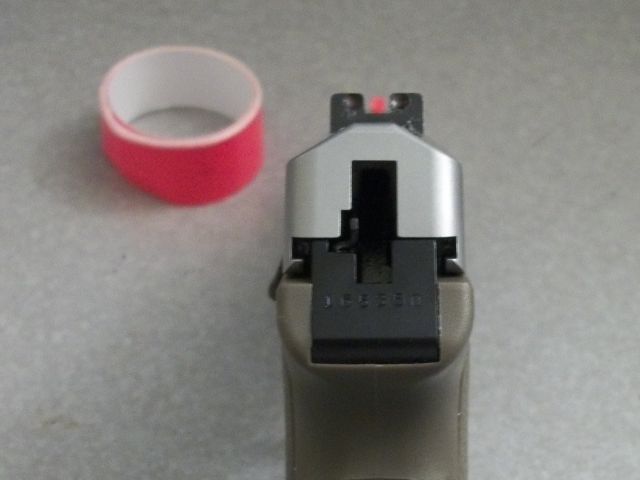
The front sight now has 3M Reflective Tape on it and I was able to remove the horribly distracting white dots from the rear sight. The three dot system does nothing for me, especially the way most manufacturers implement it. One of my friends commented that the front sight is visible from behind the shooting line, i.e., in the peanut gallery.
The trigger takes some getting used to because of the length of pull and reset. Shooters used to riding the reset/catching the link will probably not care for it. Flip and press works well though. I am not wild about it being flat all the way across and may do something about that.
Although the gun has noticeable muzzle flip, as might be expected from a 15 ounce 9mm, it isn’t painful to shoot the way I found the PF-9. It’s definitely more pleasant than shooting an LCP.
I did several tactical reloads and did not get pinched at all.
Yesterday, I shot the old FBI Double Action Course with it and was able to make 96%. This is properly shot on a Q target but I used an IDPA -1/-0 scoring zone. The pistol’s accuracy seems to drop off quite a bit past 15 yards. That’s something I will have to verify further.
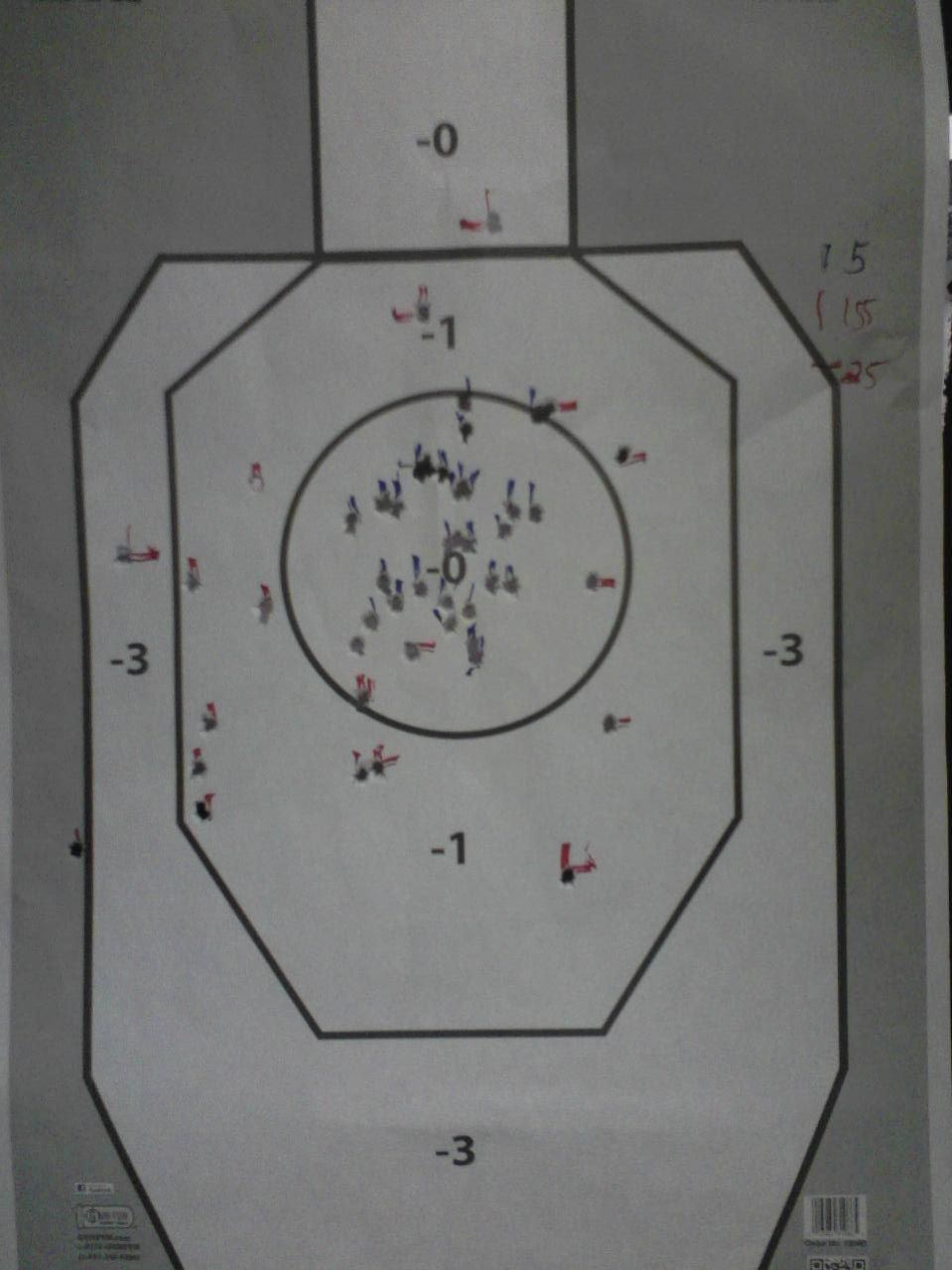
Most of my shooting with it has been with locally remanufactured ball ammo. However, I shot one stage today with Winchester 147gr SXT and had no problems.
So far, so good.
Shooting yourself by accident
I’m not so sure about the empirical reality of the Farnham [sic] idea: “The person most likely to shoot you is YOU. Why? Because you’re always there.” It just seems incorrect to say, so I am wondering what the broader idea he is conveying is supposed to be.
Since John’s statement generated some incredulity, I will elaborate on it. His comment referred to the often atrocious gunhandling he sees, not people committing suicide. Improper and dangerous gunhandling regularly results in gunowners turning themselves into casualties, although not necessarily fatalities.
The reason I included John’s quote began with a statement he made in the first DTI class I took. The statement was “Eighty percent of police officers who are shot shoot themselves.” Once again, he was not referring to suicide but rather negligent shootings where the officer injured himself or herself. Whether that is still true, I don’t know. I do know that holster manufacturers are sued numerous times each year, unsuccessfully, by police officers who shoot themselves in the process of drawing or holstering. However, given the multiplicity of reports I have about private citizens who accidentally shoot themselves, I wouldn’t be surprised. It happens a lot more often than we like to think. The two casualties I have had on ranges I have been running were self-inflicted non-fatal wounds. One was a highly trained and experienced police officer who had a momentary lapse of concentration and technique.
Here are a few recent examples:
Man shoots himself in hand while driving in Portsmouth
Utah teacher accidentally shoots self in leg at school
Woman Accidentally Shoots Herself While Scaring off Intruder
This is an excerpt from a detailed incident report by the LAPD Board of Police Commissioners.
Incident Summary
Officer A was off-duty and inside his residence. Officer A was seated alone in the living room of the residence cleaning and putting tactical lights on his personally owned handguns. Officer A indicated that he had completed cleaning his .40 caliber Springfield Arms semi-automatic pistol and during this process he had inadvertently seated a partially loaded magazine and released the pistol slide that chambered a round. Officer A mistakenly believed the weapon was not loaded, so he pulled the trigger and caused the weapon to discharge.
Officer A received a through and through bullet wound to his left hand just below the little finger. The bullet traveled through Officer A’s hand, then through the back of a couch [the interior decorator in me thinks it was a sofa and not a couch], and the living room wall adjacent to the couch, entering the garage and striking the metal back of a clothes dryer before falling to the garage floor.
Officer A was treated and released from the hospital the day of the shooting.
The BOPC found that Officer A’s use of force was negligent, requiring Administrative Disapproval.
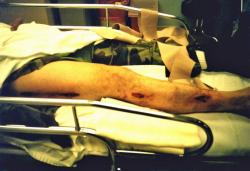
Unfortunately, some incidents prove fatal. Gunshot wounds to the upper leg can sever the femoral artery, resulting in rapid death. RIP Sgt. Davis, who was an experienced officer with 8 years of service, including on SWAT.
This video of Tex Grebner shooting himself contains explicit language. I give him credit for taking responsibility and showing how easily this can happen.
There is an image I see used on Internet websites that makes me cringe whenever I look at it.
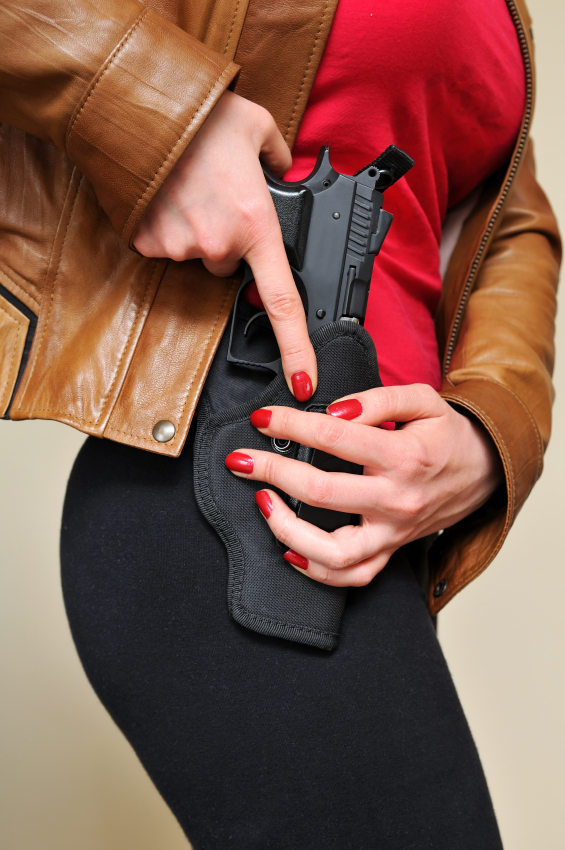
That’s a good way to shoot yourself in the support hand. The number of beginners I see doing this at IDPA matches is legion. I warn them immediately to stop doing that. If your holster doesn’t allow you to draw from it with one hand, then you need to stop using it immediately and get a new holster.
If IDPA and USPSA Production Class do nothing else other than to train people to draw their gun without putting their support hand on the holster, that’s a great contribution to the shooting community. For those who say IDPA isn’t training, I would counter that it’s excellent training in safe gunhandling. There’s nothing like getting disqualified for a safety violation to make the point that someone’s gunhandling needs work.
So the point of John’s Master Lesson is twofold:
- Proper gunhandling has to be at the forefront of our minds anytime we handle a firearm. Firearms are mechanical devices; they do no more and no less than we make them do. Consequently, they are relentlessly unforgiving of carelessness and/or stupidity.
- Pointing your weapon at yourself can have serious consequences. Some holsters force us to point our weapons at ourselves. But placing your hand in front of the muzzle when the pistol is out of the holster is a prescription for an unhappy outcome. One of my personal peeves is the devices that shotguns shooters put on their shoes to rest the muzzle on. I have some really nasty pictures of feet with holes from shotguns in them. Those people are unlikely to ever walk right again. Similarly, taking a high performance anti-personnel bullet in the hand at point blank range is unlikely to enhance your ability to play the piano.
Concealed Carry and Printing
Do you even follow Michael Kors and Kate Spade, bro?
Yet another uninformed and ignorant discussion about clothing, guns, and ‘dressing around the gun’ came to my attention today. Here was one of the comments.
People are so unaware of what is around them, they never notice printing. The only time I really worry about it is when I am entering a non permissive environment. I make sure to readjust and cover with my under shirt and top shirt, instead of just my top shirt.
And another.
Nobody has ever noticed when I’ve carried, as far as I know. Nobody has ever said anything, anyway.
When the story about the Arkansas Realtor® who was recently murdered surfaced, I did some texting with a friend about Louis Vuitton handbags and knockoffs. She packs her heater in her purse every day. Although it’s long, I am going to put her commentary here in its entirety because the level of detail is important to observe and understand. My original question was “When I see women carrying Louis Vuitton handbags, are they actually paying $1-3K for them or are those knockoffs?” Here was her response:
Wow… that’s a good question. If you put a[n] authentic bag beside a replica, you can easily tell. Here are a few other ways to tell…Authentic bags follow a pattern and are continuous. There’s never a bottom seam. So, on 1 side of the bag, the LV is upside down because it is cut from a single canvas. The pattern across the bag and on the ends will touch a seam, but the pattern should mirror itself and be even across the sides or end.
The hardware on the bags are always brass. The thread used on the handle is always a mustard yellow and the top stitching shows 5 stitches across. The inside of the handle has burgundy piping, and over time the handle will turn dark brown because it is made from vachetta cowhide leather. The LV monogram will never be broken in a pattern and the V sits a little higher than the L in the monogram. The date stamp is underneath the pocket on the inside of the bag and is always evenly spaced.
The tag on the bag has the LV logo as well as Louis Vuitton Made in Paris. The mustard yellow stitching will create a V shape and almost touches the top of the LV logo. The size of the bag is also on a leather tab…25, 35, etc. That’s the width of the bottom of the bag.
Oh, and the inside of the bag is a solid chocolate leather.
Guys, if you think a woman like that, and there are many, doesn’t notice everything that is the slightest bit out of place with your clothing, you are ignorant and uninformed about how conscious most women are about clothing and style. Now, I have no doubt that People of Walmart don’t notice your T-shirt is pulled down over your full size service pistol. OTOH, the moment you walk into any White Collar business environment, you may as well assume you’re busted. That woman might not say anything to you because she MAY want your business, at least initially. However, don’t labor for one second under the illusion that she doesn’t notice something out of place, even if she’s not quite sure what it means. It’s as obvious to her as a Hi-Point at an IPSC match would be to us. It’s funny how many people who carry weapons tend to assume that the only type of “worst case scenario” is running into some meth head who is trained in mixed martial arts and is carrying a brace of Glock 22s with another brace of Glock 27s on his ankles for backup.
With the escalating number of signs prohibiting weapons, whether they have the force of law or not, and the amount of public hoopla about active shooters, getting made while carrying is going to become more of an issue in the future. Sooner, more likely than later, businesses are going to start calling the police if they suspect someone is packing a gun in violation of their company’s posted policy. Even if the sign doesn’t have force of law, having several police officers come up to you out of the Blue and escort you off the property will be unpleasant. It also has the potential for an Officer Involved Shooting with you as the shootee.
One of the major problems in the training community is that almost every trainer with a Mil or LE background has not spent one single day actually working in the White Collar or Retail Business environments. Unfortunately, what this means is that although they can teach you how to run a pistol well, they are utterly unqualified to even speak about Concealed Carry, as it pertains to most people, much less teach it. Even Jeff Cooper admitted that when he wore a suit, he carried a J frame revolver, not a 1911. Of course, Jeff actually owned suits and knew how to tie a tie.
If we really want to extend the opportunity to ‘always carry’ to an expanding percentage of the American populace, we’re going to have to come up with a better concept than ‘dress around the gun.’ Every time I hear that phrase, it makes me cringe. Whenever the vast majority of people who don’t buy their clothes at WalMart hear it, they think “that’s not me,” as my psychologist friend William Aprill clued me in to several years ago.
 tacticalprofessor
You must be logged in to post a comment.