The OODA Loop and Negative Outcomes – Part I
Proverbs 26:17 English Standard Version (ESV)
Whoever meddles in a quarrel not his own is like one who takes a passing dog by the ears.
Our Decisions usually determine our Outcomes as I’ve mentioned in a previous post. Many, if not most, of our decisions are made ahead of time. When we make the same decision repeatedly over time, that is obviously the case. If we have made bad decisions ahead of time, the likelihood we WON’T select that decision from our list of options is minuscule.
Practicing Awareness: An Interview
I’m very pleased to have been interviewed about Practicing Awareness in this month’s Armed Citizens Legal Defense Network Journal.
https://armedcitizensnetwork.org/practicing-awareness
It was an interesting interview that touched on a number of subjects, some old and some new. The interview builds on the series of posts I’ve written about the topic of awareness and positioning.
Bringing worthwhile content like this to its members is yet another reason I’m a member and fan of the Network.
The Medina, North Dakota Shootout
Thirty-five years ago today, on February 13, 1983, a violent gunbattle took place in Medina, North Dakota. Although less well known than the Miami Massacre in 1986, it was every bit as bloody and violent. Something it had in common with the Miami Massacre was preparation for conflict and the decisiveness of long guns at pistol ranges.
On one side was a task force of US Marshals and local law enforcement officers. On the other side were members of a local Posse Comitatus group. Casualties were high on both sides. Four months later, a second related encounter, hundreds of miles away, brought more loss of life.
The Prelude
Gordon Kahl was a Midwestern farmer and Federal tax resister. He was a member of a loosely knit organization called the Posse Comitatus. The Posse recognizes no authority above the county level and held many hateful beliefs. He had been imprisoned for Federal tax evasion but had been released on probation. However, he failed to report to his Probation Officer and a Federal warrant for his arrest was issued.
Can’t help you
This email arrived from a friend today. Things like this are why I do what I do.
Yesterday I was filling my vehicle with gas at my neighborhood Shell station and out of the corner of my eye I saw an unkempt person lurking around the building and heading to the gas pumps. I lost sight of him for a moment due to vehicles entering and exiting the station. Suddenly, he was on the other side of my pump, headed in my direction.
My first visual image was Claude Werner, hand up, saying I can’t help you, followed by me doing the same thing, as I moved around the corner of my car to get an object and distance between the fellow and me. He did not even finish his opening line, he turned and looked for someone else to approach.
Claude, you taught me well! Thank you very much!
Note that this was a decision made in advance (to be aggressively uncooperative) and then chosen as a response in the moment. That’s the best way.
Lessons from an Armed Robbery
Barry Fixler, former Marine and Viet Nam veteran, owns a jewelry store in New York State. On Valentine’s Day 2005, a couple of criminals decided to relieve him of his merchandise. It didn’t turn out the way they planned. We are fortunate that much of the incident was captured on video. There are numerous lessons we can draw from the incident. Let me preface all my commentary by saying that I greatly admire Mr. Fixler’s courage and how he handled the situation.
Bottom Line Up Front: Good Guy 1, Bad Guys 0; that’s clearly a commendable victory.
Why think ahead and why practice?
Today’s news contains an article with several lessons in it for the Armed Private Citizen.
Police: Man outside Walmart shot [his gun] in self-defense
The lessons cut across an array of topics relevant to Personal Protection. Let’s use the CAN/MAY/SHOULD/MUST paradigm as a basis for the discussion.
Review: The Complete Combatant (and Sundry Others)
This was a great course. I got a lot out of it just by auditing to aid Brian and Shelley with a little curriculum guidance. I’ll be posting my own lessons learned from observation but Chief Weems gives a good overview of the class.
I first became aware of The Complete Combatant due to their hosting Caleb Causey of Lone Star Medics for one of his medical courses. Caleb is a a regular presenter at the Rangemaster Tactical Conference, and that is how I met him. I attended the course, that is how I met Brian and Shelley Hill, the owners of The Complete Combatant. This introduction resulted in Brian and Shelley hosting two of my Police-Citizen Contacts courses. They have another class with Caleb coming in September; so, be sure to check their schedule IF you aren’t planning to spend that weekend with me at Social Levergun. Quality medical training should be a part of your personal safety plan, and Caleb has a solid program.
Another example of the classes that they are bringing in to augment their own offerings, they hosted Andrew Branca’s Law of Self Defense course. Andrew’s material…
View original post 449 more words
Scientific Theory v. Legal Theory
For example, the theory of plate tectonics is a scientific theory. There is ample evidence, which is indisputable, that the surface of the Earth is divided into solid plates that have moved over geological timescales.
Scientific theory is much different than legal theory but those who casually study personal protection often confuse the two. “Legal theory refers to the principle under which a litigant proceeds, or on which a litigant bases its claims or defenses in a case.” Legal theory is much closer to being a hypothesis, in the scientific sense. In some ways, legal theories are not even hypotheses but are, in fact, merely speculation by an attorney.
We ignore this distinction at our peril. A recent court decision in Pennsylvania provides good examples of why. Among those with a casual knowledge of personal protection concepts, the phrase ‘disparity of force’ is parroted as an almost ironclad defense if a much larger person has been shot. However, ‘disparity of force’ is merely a legal theory that one’s defense attorney can raise at trial. While the defense might be bolstered in this effort by expert witnesses, the shooter cannot take it for granted this theory will have any effect on the outcome.
Similarly, the concept of ‘shoot him to the ground’ is often blathered on about. This idea is rooted in the notion that ‘if the first shot was justified, the rest won’t matter.’ As can be seen in the Pennsylvania case, courts may find this idea unconvincing.
The Kimball case in Maine gives another example of how these two often regurgitated legal theories failed to sway either the jury or the court. “Kimball’s attorneys argue Cole made a mistake by not instructing the jury that it could find that Kimball had been adequately provoked by Kelley, who was 6-foot-4 and 285 pounds, after being repeatedly struck as he retreated away from Kelley.” The Maine Supreme Judicial Court found this argument unconvincing and rejected it. Merrill Kimball, 74 years old, will spend the rest of his life in prison, an unpleasant prospect. The fact he fired three shots rather than just one was raised at trial by the judge.
There are other legal theories I periodically hear that, while they sound good, similarly cannot be counted on to prevail in a courtroom. We need to be cautious about using potential legal theories an attorney could raise in our defense when formulating the doctrine we will use for our decision-making.
The law is not logical and does not necessarily ‘make sense’ to the uneducated. We are best served by being knowledgeable, rather than speculating, about what it is or assuming what we think it should be. The one assumption we can make is that nearly everything we read on the Internet about the law is wrong.

For those who carry weapons of any kind, including personal weapons (hands, feet, etc. as the FBI defines them), obtaining some real legal training is well worthwhile. Law Of Self Defense, Massad Ayoob Group, the Armed Citizens’ Legal Defense Network, and other organizations provide information, not speculation, about what we can and cannot do in our defense and the defense of our loved ones. The cost is about equal to one hour of a criminal defense attorney’s time; that’s a good tradeoff.
Note: I am not a lawyer and by no means am I giving legal advice. I am merely pointing out fallacies in thinking that I often observe.
Fair disclaimer: I have taken training from Law Of Self Defense, Massad Ayoob Group, and am a local affiliate trainer for the Armed Citizen Legal Defense Network.
The Telephone Game and the Training Industry
Telephone [in the United States] –is an internationally popular game, in which one person whispers a message to the ear of the next person through a line of people until the last player announces the message to the entire group. Although the objective is to pass around the message without it becoming misheard and altered along the way, part of the enjoyment is that, regardless, this usually ends up happening.
Often, a message that starts out like “My uncle shook hands with the Mayor once” eventually turns into “President Reagan’s grandmother slept with Batman for years” or something equally mistransmitted.
Telephone game issues plague the firearms training industry and are a problem. Several occurrences of it have been brought to my attention just this week. One of the most important things I’ve learned in the training industry is to assume everything that anyone tells me secondhand is wrong. Whenever possible, I go back to the source or vet the information through several other sources, if necessary.
Items that are most vulnerable to mistransmission are intellectual, statistical, or theoretical concepts. These include items such as:
- Lt. Col. Jeff Cooper’s Color Codes
- Statistics from ‘the FBI’
- Legal issues
- Hick’s Law without the power law of practice refutation
- My personal favorite, Col. John Boyd’s work, aka ‘the OODA Loop’
What first brought this to my attention this week was reviewing an article a friend wrote about Situational Awareness. In my review, I pointed out that Cooper himself said that even while he was actively teaching, the Color Codes were being grossly misinterpreted. He explicitly stated that they are NOT a system of Situational Awareness but rather stages of Mental Preparation and triggers for Personal Defense. Upon mentioning this to my friend, he said:
And I think it says quite a bit about how misunderstood the concept is that you’re literally the only person to point out that Cooper never intended the colors as situational awareness levels, but rather mental preparedness. Out of a dozen people giving me feedback.
Cooper’s writings on the subject are readily available on the Internet with just a small amount of research. In Volume 13, No. 1 of his Commentaries, he says:
The Color Code refers not to a condition of peril, but rather to a condition of readiness to take life.
He elaborates on the meaning of the Color Codes in no less than six of his Commentaries over the years. All his Commentaries are available on the Internet. There is even a video of his entire lecture about the Color Codes available on YouTube.
He makes a point at 15:20 in the lecture about the distinction explicitly.
In the course of doing the review, I came across a blog post that purported to explain Cooper’s Codes. While the cursory overview given wasn’t awful, the post stated that the Codes were contained in the ‘Awareness’ chapter of Cooper’s book Principles of Personal Defense. Unfortunately, there is no such chapter. Principle One in the book is Alertness but no mention of the Color Codes is contained therein. False memory at work.
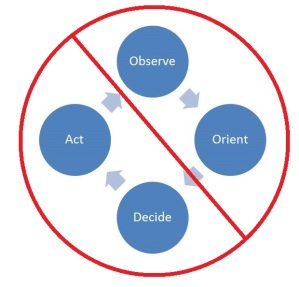
In that sense, the Color Codes are similar to Boyd’s work, which has been mostly butchered into unusability by the training community. Not an hour after making my comments to my friend, I came across yet another recently published article about ‘the OODA Loop’ that grossly oversimplified Boyd’s work. The ways I have seen Boyd’s work grotesquely misstated are legion. We can easily portray the oversimplification of John Boyd’s work in a graphic.

One article last year by a member of a well-known and regarded training company claimed that Boyd had developed ‘the OODA Loop’ during the Korean War to counter the ‘shocking losses’ of F-86s at the hands of Mig pilots. In fact, Boyd’s first mention of ODA [only one O] was in 1976 after he had transitioned to strategic acquisition planning and no longer even flew aircraft. Estimates of the kill ratio in Korea for the Sabre jet has dropped from 10 Migs for each Sabre to 5.6/1 but this isn’t a ‘shocking loss’ statistic in the slightest. Clearly, the author hadn’t done one bit of research on the topic but was just regurgitating a distorted and false memory.
Despite the readiness of information in the Internet age, there is often a tremendous amount of intellectual laziness within the training community. Doing research isn’t as much fun as shooting. Hearing someone regurgitate important concepts in a class or even a side conversation and then failing to go back to the source to vet and understand it is poor scholarship. It would get a college freshman an F on a simple term paper. If we in the community can’t even get a passing grade on a college term paper, should we be teaching people how to defend their lives and the lives of their loved ones?
Let’s turn to the research and vetting issue from the standpoint of the practitioner. Someone who wants to defend their own life and the lives of their loved ones ought to be able to get that passing term paper grade, too. When you hear something ‘important’ attributed to a third party, don’t accept it at face value. Research it on your own and find out what was actually said or published. It’s rarely hard and usually doesn’t take much time. You may be surprised at how different the two versions are.
Line in the sand
Begin to attrit the enemy at the maximum effective range of your weapons.
That was one of the most important things I learned as a young Infantry Lieutenant during the Cold War. We would have almost certainly been facing Soviet forces larger than our own. We had to wear them down as they closed with us in order to destroy them before they could reach us. This is every bit as true today in the context of personal protection.
“Don’t fire until you see the whites of their eyes” is a famous saying from the Battle of Bunker Hill during the Revolutionary War. Very few people understand that ‘the whites of their eyes’ basically represented the maximum effective range of the smoothbore musket. That’s the underlying concept of the order.
No matter what our weapons are, we need to understand their maximum effective range. Maximum effective range is sometimes limited by the weapon, as in the case of the smoothbore musket or pepper spray. In other cases, it is limited by the capability of the user. The firearms instructors and SWAT team members of the Los Angeles Police Department are capable of using their weapons at a greater distance than the average patrol officer. That’s not a slam on the patrol officers, rather it is a result of training, practice, and experience.
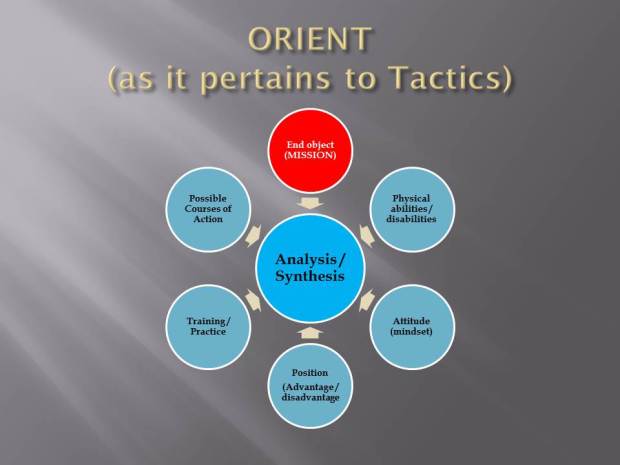
In order to know the maximum effective range of your weapons, you have to understand them and test them. This testing and understanding is a key component of John Boyd’s Aerial Attack Study. An integral part of ‘Orient’ is knowledge of the capabilities (Previous Experience) of your weapons.

Keep in mind that ‘line in the sand’ is both a chronological concept as well as a geographic point. If a situation goes on for a while, it’s time to put an end to it, one way or another.
You must be logged in to post a comment.