Rangemaster 2015 Tactical Conference (II)
Continuing on about the Rangemaster 2015 Tactical Conference held annually in the Memphis area, I would like to cover the high points of some sessions I attended.
John Hearne’s Performance Under Fire presentation was so packed with information that it’s hard to take it all in. He does a fine job of refuting the pseudo-science that pervades the personal protection training community. His research is thorough, up to date, and can document fully what he says. An aspect of his approach I like is the way he tracks the original science to see if it has subsequently been refuted. John is one of the few people in the community besides myself who has any clue about how to do research. Here’s a clue; taking information from a firearms or martial arts trainer at face value is not a valid approach. I found numerous points in his presentation quite useful.
He stated that there are actually 21 documentable ‘flinch responses,’ most of which do not involve throwing one’s hands up in the air. So if there are a variety of responses, how do you know which one you will exhibit and is it going to be the same one every time? Years ago, Ken Hackathorn told me to watch surveillance video of convenience store robberies to see how many people threw their hands up in the air when they were startled. The answer is ‘not many.’
One of my personal pet peeves is the continuing blathering about Hick’s Law in the community. John made the point that Hick’s Law was largely discredited in the scientific community decades ago. For those unfamiliar, Hick’s Law states that the more options you have, the longer it will take to make a decision, by a square of the number of choices. The original study was sort of iffy anyway and subsequent research has shown that it’s only true in the absence of any familiarity with the task and absent any practice on the decision making.
The subsequent power law of practice states that the more practice you have at making the decision, the faster you get at making it. There’s some question as to whether the practice/speed relationship is logarithmic or exponential but there’s no question about the validity of the power law. Think about it in terms of when you are driving. When you see the brake lights of the car in front of you come on, there’s no conscious decision making about whether you’re going to hit the gas or the brake, unless you’re a 15 year old student driver.
An important point John made was about the career time of when law enforcement officers were feloniously assaulted. The average time was about eight years. I believe John referenced this from the 2006 FBI study Violent Encounters, A Study of Felonious Assaults on Our Nation’s Law Enforcement Officers, but I don’t recall for sure. This was important to me because it highlighted the factor of complacency in Negative Outcomes.
Although I lack the rigorous methodology that the FBI used, it’s my feeling this is also a factor in Negative Outcomes by Armed Private Citizens. Complacency can be a killer. We see it every day at gun ranges, gun shops, and shooting clubs. Complacency is why some people have one year of experience 20 times instead of 20 years of experience and is closely related to the “I know it all” syndrome. We have all had to deal with ‘know-it-alls’ and ‘spring-butts’ and never like it. It’s up to us individually to make sure we don’t fall into the trap and challenge others who have.
Just to show that John can put his money where his mouth is, he won the High Lawman and Second Place overall in the shooting contest.

Photo courtesy of Tiffany Johnson
I’ll have more about the Conference next time.
Rangemaster 2015 Tactical Conference (I)
The Rangemaster 2015 Tactical Conference is over and I am processing the things I observed and learned from it. The Conference has a long history, dating back to the early days of IDPA in 1998, when it was a sanctioned IDPA indoor Championship. Over the years, it has evolved into the foremost tactical training conference for private citizens in the United States. It is held annually, early in the year, in the Memphis area. The venue for the 2015 Conference was the Memphis Police Training Academy, a truly fine and modern facility.
This year, three dozen of the top personal protection trainers in the country, many of whom are referred to as “T-Rexes,” came together to present or conduct training blocks of two to six hours over a period of three days. The agenda has grown so large that it’s not possible to take in all the training that is available, since sometimes five blocks are going on simultaneously. Some of the training is classroom lecture, some is hands-on with sterile weapons, and some is livefire. There is also a shooting match, for those who choose to participate.
There were a wide variety of topics, ranging from psychology and communications to contact based skills to firearms manipulation. I was able to attend nine sessions.
- Yes, I Shoot Like a Girl, Would You Like a Lesson?
- Surviving Lethal Encounters
- The Law of Self-Defense
- Practical Small Knife Principles
- Performance Under Fire
- Rehabilitating the Experienced Shooter
- The Training/Reality Mismatch
- Kneeling Positions and Combining Them with the Use of Cover
- Women’s Holsters and Accessories
In addition, I was able to make two classroom presentations.
- Tactical Communications for Couples, with my co-presenter Linda Hoopes, President of the Resilience Alliance.
- Negative Outcomes of Firearms Ownership
Upon my return, several people have asked me what my most significant takeaways were. As usual, I learned a great deal, so it’s difficult to say what were the most significant, but here are a few that stand out in my mind, in no particular order.
- A conversation with a mentor of mine, John Farnam, elicited from both of us the experience that when approached for help in a parking lot, it’s almost always a scam or criminal ambush. Fellow trainer Melody Lauer pointed out that there are a few legitimate exceptions, but John and I both feel they are the exception rather than the rule. This indicates that a default response should be formed to immediately and firmly decline the invitation to be a victim and then rapidly vacate the area. Exceptions to that rule should be based on specific articulable reasons and conscious decision-making, rather than by default.
- The T-Rexes are constantly working along the path to excellence. That path includes attitude, skills development, tactics, and a host of other areas. Recognizing that there is an element of chance in every encounter, we work hard on stacking the deck in our favor. ‘Doing the work’ means training regularly and practicing on a daily basis. ‘Good enough’ is never good enough for us. That’s probably why we’re regarded as T-Rexes.
- There is an enormous amount of erroneous, misapplied, or misinterpreted information floating around in the broad firearms and personal protection community. This is especially true in relation to prioritization, legal issues, and skills development.
- The community has a lot to learn about integrating women into it. There was a record turnout of female attendees and women trainers at the Conference this year, my co-presenter being one. Conversations with them, as well as the presentations, were highly enlightening. Many male paradigms either don’t apply at all or don’t work particularly well when used by women. My own presentation was an eye-opener to me in that regard. The Women’s Holsters and Accessories presentation, which was presented by a woman, gave several good examples. A pet peeve expressed by several T-Rexes is men who have women shoot excessively powerful firearms and then laugh when they fail. Our universal attitude is along the lines of the desire to give such jerks a knee lift in the crotch followed by a crack in the jaw and then laugh when they fall down writhing in pain.
I have several pages of notes but those jump out at me. Undoubtedly, more will occur to me as I reflect on the event. I will have more thoughts on specific topics in the near future. There is a photo gallery of the Conference training blocks available on the Rangemaster website.
Identify before you shoot
The house alarm sounded and the wife shot her husband through a closed bedroom door thinking he was an intruder, according to Fayetteville police.
http://whnt.com/2015/01/09/soldier-shot-while-trying-to-surprise-wife-with-breakfast/
Obviously, that was a ‘negative outcome.’ Therein lays the problem with simply having a gun without doing any scenario training with it. My research has brought me to the point where I am less concerned with the marksmanship aspects of personal protection than I am with 1) proper gunhandling and 2) appropriate decision-making. Those two items are almost completely absent from most gunowners’ repertoire.
There are a competing set of probabilities we have to consider in a home defense situation. If you have anyone else living in your home, the most likely probability is that the 3 a.m. bump you hear or shadow you see is, in fact, a member of your household. For sake of argument, let’s put that probability at nearly 100%. There is, however, a competing probability that it is an intruder. That probability is much lower, somewhat above 0%, depending on where you live. The Bureau of Justice Statistics reports that the burglary rate in the US was 27.6 victimizations per 1,000 households in 2011, or 2.76%, so let’s round it up to 3%. Assuming it’s an either/or situation, which it’s not, that would make the likelihood of encountering a family member, rounded, at 97%. Graphically, this is what those competing probabilities look like.
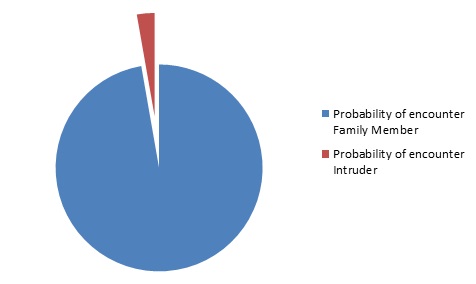
Looking at it this way makes a very strong case for why we have to positively identify before we shoot. It is 32 times more likely that the sound or shadow is a member of the household than it is an intruder. Las Vegas would really like those odds. If we’re going to be the slightest bit responsible, we have to look at ALL the possibilities, not just the ones that scare us the most. Shooting through the door without doing any kind of identification is just plain wrong.
Verbalization is so important in personal protection scenarios. And it’s something very few people practice on the range, or any other time, for that matter. I’ve had female clients tell me “I can’t say that.” Well, you better learn to say something. At home, the verbalization doesn’t have to be complicated. “Who’s there?” will probably suffice. You do have to be able to talk with a gun in your hand, though. Once again, hearing “Honey, it’s me” should immediately trigger a stand-down response on our part.
Stand-down is another thing that’s uncommon for people to practice but really important when you look at the probabilities. In a home defense encounter, ‘Stand-down’ should most likely mean immediately physically placing the gun down and moving away from it to avoid unpleasant after-effects of a startle response. Having to do so brings up those proper gunhandling and muzzle direction issues again.
This also bears on the issue of ‘training for the worst possible case.’ A serious definitional issue has now arisen in my mind regarding that concept. Is ‘the worst possible case’ having a dangerous armed intruder in your house or shooting and killing a family member by mistake? I don’t have an answer for that question but it has now become a relevant issue for me, as it should be for you, too.
The Aftermath – you’re not in it just by yourself
That’s both good and bad. Your family will be intimately involved in the aftermath of any shooting you are in. They will probably support you but they will also suffer just as much as you do. What I call ‘The Myth of the Lone Gunman‘ is about as far from reality as it can be.
Following last weekend’s MAG20 course, taught by Massad Ayoob, that I hosted here in Atlanta, Armed American Radio broadcast its weekly show from the host facility. A surprise call-in came from George Zimmerman. His comments were heartfelt, sobering, and bear listening to by anyone who is armed. They are something to consider in your decision about whether a shooting is absolutely necessary.
Mistaken identity shootings
None of us can imagine the feelings that must occur in the case of a mistaken identity shooting of a family member. We don’t like to talk about this sort of thing in the gun community but it happens on a regular basis. Don’t let it happen to you, on either end.
I’ve written about this before and probably will again. It’s an avoidable tragedy.
Negative Outcomes: Unintentionally Shooting Someone Else
It’s a sad fact that people shoot other people unintentionally. I’m not talking about mistaken identity shootings but completely unintentional shootings. Probably the most famous incident was when Vice President Dick Cheney shot his hunting partner. However, that was far from an isolated occurrence. Reading the news reports provides plenty of such incidents.
We absolutely don’t want to shoot someone unintentionally nor let someone get shot unintentionally. A firearm is an instrument of ultimate personal responsibility. It’s not like a car, where sometimes we can blame someone else for negative outcomes. When a firearm we are handling goes off, we have to bear the consequences, period. If we leave it sitting around unsecured and someone else makes it goes off, we have to the bear the consequences, period. Sometimes, the consequences are tragic, in either case.
The Armed Citizen
A writer from Gun Digest contacted me about the Five Year Armed Citizen study TAC 5 year w tables I did a while back. He asked if I would give him a quote about it, so this was my reply.
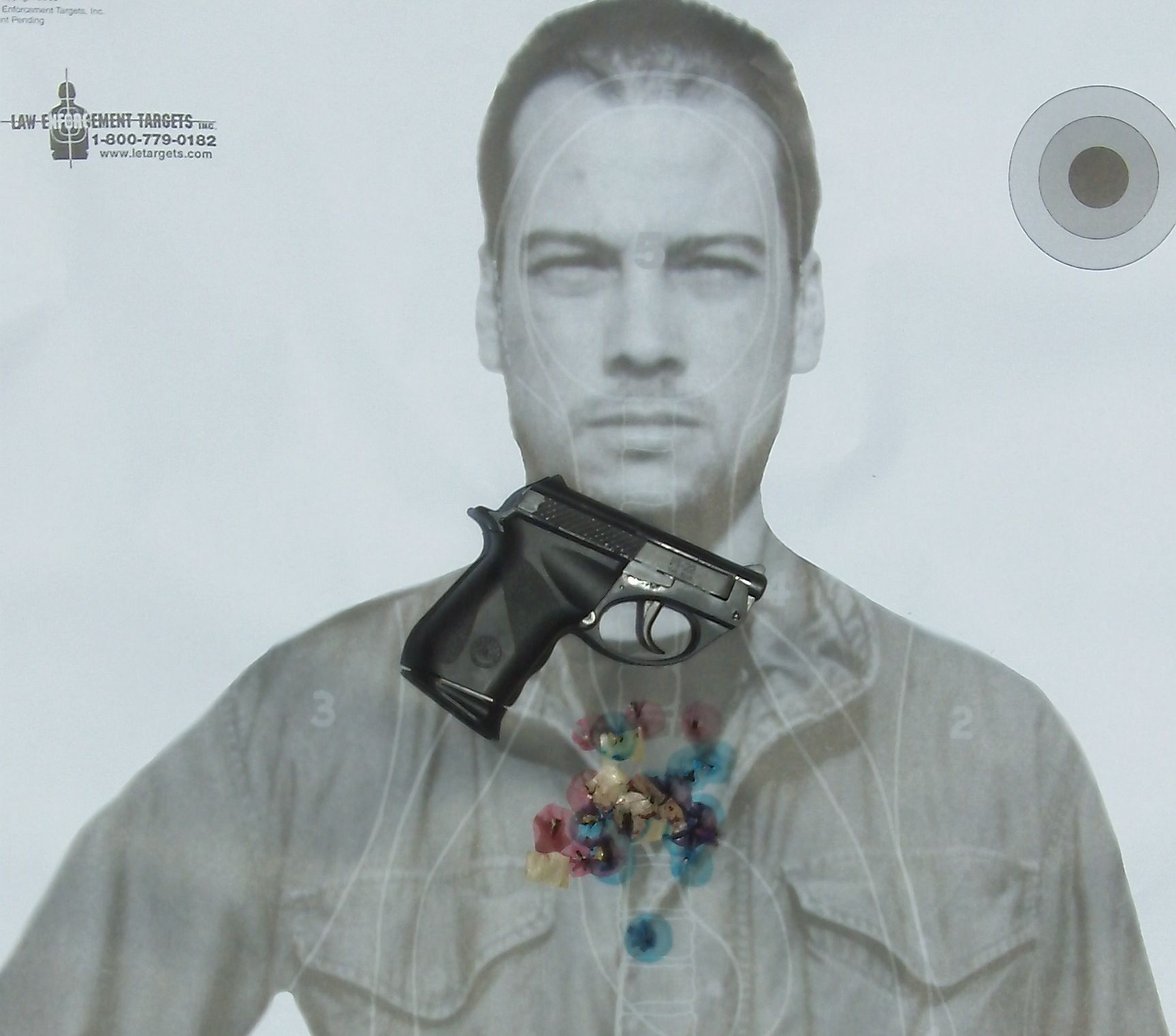
“Analyzing incidents involving Armed Private Citizens, rather than LE/MIL situations, leads to different conclusions. Common discussion topics among Armed Private Citizens, such as equipment and caliber issues, rarely are the cause of Negative Outcomes. Negative Outcomes result from 1) lack of conceptual understanding leading to poor decision-making, and 2) lack of appropriate and necessary skills, techniques, and tactics.
Carrying and being capable of using a small gun adequately will yield much better results than owning a large pistol that isn’t carried or shot well. More criminals have been planted in the ground by .22s that hit than by .45s that miss.”
Legal defense plans
Periodically, I am asked to opine about the various plans available to cover the expenses of a legal defense after a personal protection incident. This article by Marty Hayes covers it in much better detail than I could explain.
The [plans] can be categorized into four types:
1) Insurance
2) Insurance backed
3) Pre-paid legal services
4) The Armed Citizens’ Legal Defense Network, Inc., a membership organization.
http://www.armedcitizensnetwork.org/buyersguide
Fair disclaimer: I am a member of ACLDN and have a relationship with them.
What is the value of training?
Firearms instructors are periodically asked the question “Why should I take training?” The answer often comes in the form of a list of skills that are taught or the reasoning behind using a certain technique. However, these do not address the underlying fundamental reasons for taking firearms training at all.
- You don’t know what you don’t know.
- Much of what you know is wrong.
- It’s good to have some of the answers to the test before taking it.
These issues relate to both technical competency with using a firearm (gun safety and marksmanship) and the ability to use the firearm correctly in a personal protection situation (legal and tactical).
You don’t know what you don’t know.
Shooters who only take their gun to an indoor range once a year “to sight it in” generally have a highly ‘cocooned’ knowledge of firearms. They know how to operate a firearm in a very restricted set of conditions. As soon as they leave that set of conditions, the stage is set for bad things to happen. Although ‘bad things’ can include unintentional and negligent gunshot wounds, it doesn’t have to be anything that newsworthy. A fellow NRA Instructor was once asked by a long time shooter why the shooter should take the NRA Basic Pistol course. The Instructor responded “Do you wear safety glasses when you’re cleaning your firearms? You do know, of course, that most cleaning fluids can irritate or even damage your eyes, don’t you?” The longtime shooter decided to take the class, after all.
Much of what you know is wrong.
Training can mitigate the Dunning–Kruger effect, which is rampant among the shooting community.
The Dunning–Kruger effect is a cognitive bias in which unskilled individuals suffer from illusory superiority, mistakenly rating their ability much higher than average. This bias is attributed to a metacognitive inability of the unskilled to recognize their mistakes.
–Wikipedia
Almost every firearms instructor has had numerous students who think they are “good” with a firearm but are not. Among these misinformed shooters are most police officers and, even many SWAT units. Typical longtime gunowners are too. When subjected to a standardized skills evaluation, most of these “good” shooters receive a rude awakening.
We’re the best shooters in our department, by far. That’s why we’re the firearms instructors. Then we come here and find out that we suck.
— A police officer attending the elite Rogers Shooting School
Many of these skills evaluations are not even particularly difficult. In one class I taught, the test was to shoot, starting from a ready position, five shots into a 12 inch circle at seven yards in 15 seconds four times in a row. Only one student out of ten was able to do it. And none of those shooters were beginners; most of them were longtime shooters. This test is the baseline level of the NRA Defensive Pistol I Marksmanship Qualification Program.
More advanced, yet still not terribly difficult, competency standards are beyond the ability of 99 percent of self trained shooters, in my experience., For example, the ability to shoot five shots into a five inch circle in five seconds at five yards five times in a row, a drill I call 5^5.
When a friendly competition was held on a local gun forum for the 5^5 drill, no one was able to do it. Several dozen people thought this test would be easy but even after multiple, in some cases, attempts they found out otherwise.
Every round that doesn’t hit is heading straight for a busload of nuns and orphans being followed by a limousine full of personal injury lawyers on a conference call with the District Attorney. At least, that’s the assumption I make and teach. It’s the reason I make my students account for every round they fire in my classes. And I point out the misses as seen in the cover photo of my blog.
It’s good to have some of the answers to the test before taking it.
Any decent class on the legalities of using deadly force will counsel students about things to do and not to do. An example of things not to do would include chasing a fleeing intruder down an alley and shooting at him while he is running away. In that particular incident, the shooter was lucky to only receive 60 days in jail.
The most significant value of training is that it places someone else, the instructor, in control of the flow of events, either physically or mentally. A criminal encounter will not be initiated in the time sequence desired by the would-be victim, which would be NONE. Nor will the skills required to solve the incident be dictated by the defender. However, by definition, self trained individuals control the flow of their actions when they practice, assuming they practice. This is exactly the opposite of criminal encounters. That’s not how it happens in real life. Good instruction will provoke thinking and questions beyond the student’s own expectations and experience. This helps prepare students to make decisions that can and will affect them for the rest of their lives, either positively or negatively.
The conscious mind does not function particularly well under stress. It tends to revert to subconscious background information and patterns, some of which are primeval. Many of these patterns are counterproductive in personal protection situations and require re-programming. Training helps replace them with background knowledge and patterns that are appropriate. Having appropriate knowledge helps avoid negative outcomes.
You don’t fire guns at people’s houses,” [Judge] Ludy said. “You kept saying you really didn’t know what was going on. If that’s the truth, why in the world would you fire a gun? … It really doesn’t matter if it was (at) Mr. Bailey or the mayor of Dunkirk. You just can’t do that.
— Judge Max Ludy Jr.
Shockingly, some people thought this case should not have come to trial. I know I wouldn’t have been too happy had I been the homeowner down the alley who had bullets launched in my direction. “Judge Max Ludy said he found McLaughlin’s firing of a gunshot in the direction of a neighbor’s home especially reprehensible.”
Instructors, as a group, are constantly looking for examples of situations and incidents that went both right and wrong. And other students in the class ask questions about situations that concern them. Inevitably these discussions become class material, either formally or as side conversations. Because training is our vocation, we tend to analyze those incidents in greater detail than does the average gunowner. Our analysis may not necessarily be what the student wants to hear, or even correct, but relating the analysis provides food for thought that merely reading about an incident in the news will not.
The value of training is to make you think and perform outside of the cocoon that most gunowners are in, the same way real life frequently does. It’s not so much that we instructors have all the answers, because we don’t. However, most of us have a good idea of the questions to ask and that’s a strong start.
Negative outcomes (part I)
It’s easy to ignore the potential negative outcomes of having a firearm for personal protection. The topic is easily overlooked or put on the back burner. I think that’s a mistake. This is the first of a series of articles I’m writing for The Tactical Wire about it.
Claude Werner begins his exploration of the ‘software’ component of defensive firearms with this piece on negative outcomes. This begins a multi-part series that disposes of trite sayings from instructors and gunshop commandos, pushes aside the common trends, and brings serious thought to preparation, planning, and what we should avoid. Fighting is a “game” of minds.
 tacticalprofessor
You must be logged in to post a comment.