Ego defenses
The maximum effective range of an excuse is zero meters.
While comparing notes from our experiences at Paul-E-Palooza 2, a friend of mine noted how many excuses for poor hits he heard during the live fire block he attended. “I haven’t gotten used to the sights on my gun.” “The offset I have to use at this distance is throwing me off.” “When I shoot pistol in 3 Gun, I smoke it, but I can’t seem to hit these little targets.” Etc., etc., etc. Those are all ego defenses shooters use to avoid saying “When put to the test, it’s clear I’m not as proficient as I like to think I am.”
Let’s compare that with the Facebook commentary of a very smart and honest lady I coached a little during the same block.
After this class I had a live fire with Dr. [Sherman] House. He did dot drills and eye targets. We shot at 3 and 5 yards at these tiny targets. Fact from Dr. House, under stress your shot pattern will double in size. [So,] We might as well practice on targets 1 ¾ inches big. Out of the 30 shooters, I suck because I anticipated recoil. [Obviously, from my point of view, she was far from being the only one whose performance could stand some improvement.] I got a private lesson by “THE PROFESSOR Claude Werner”. … Professor Werner taught me to focus on a slow trigger press. [Actually, I was trying to emphasize a smooth trigger press] When Doc Werner pressed my trigger while I had the sights aligned[,] I hit the target dead center. I know what to work on. I need to dry fire weekly.
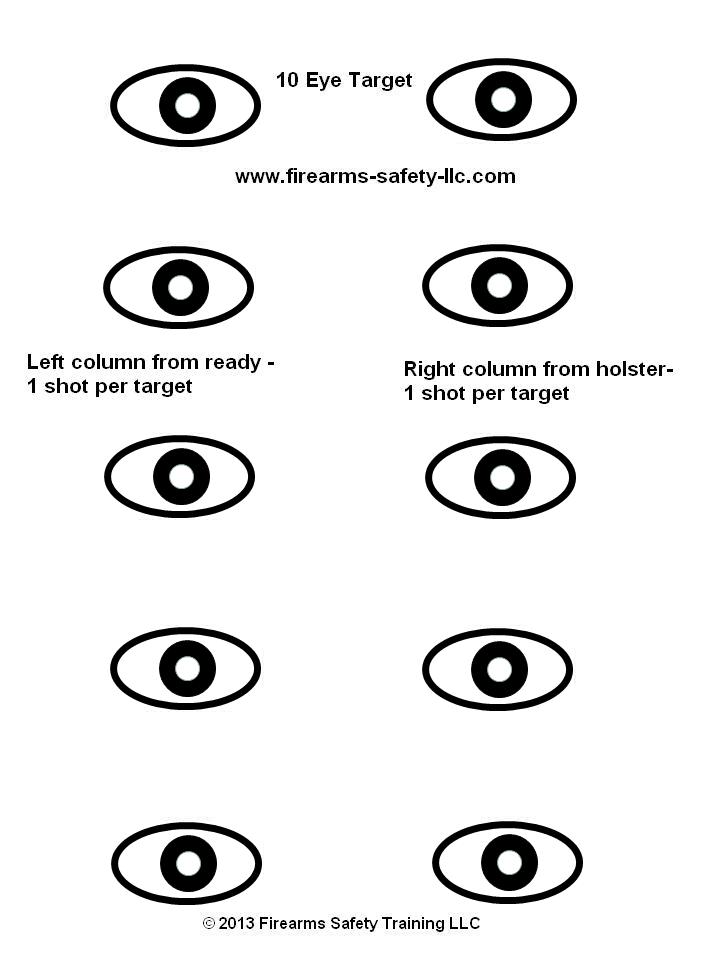
At times, we all suck, on a relative basis. The way to get past it is to figure how to “shoot better,” as Bill Rogers puts it. Then accept that we need to do some work on our weakness and get to it without using a lame excuse as an ego defense.
A little coaching can help determine what the problem is. In the above lady’s case, she was very good at using her sights; when I pressed the trigger for her, the round struck exactly where it was supposed to. She just needs to work on her trigger manipulation. She self-identified the problem and the solution. I have no doubt she will work on it vigorously.
Many shooters spend a lot of time, money, and effort refining and changing their equipment in an attempt to improve their performance. It was interesting that even at a training conference like Paul-E-Palooza, during the charity auction, ‘cool’ equipment items sold at a premium to retail while training items sold at a discount to retail. My observation is that the solution usually resides inside the shooter rather than in a hardware solution. As one of my colleagues puts it: “I have a friend who will kill you with a Lorcin and there’s nothing you’ll be able to do about it.”
Scaling targets
Math is like going to the gym for your brain. It sharpens your mind.
“Claude, how do I shrink an IDPA target so it appears as though it is 25 yards away when my dry fire range is 7 yards? Thank you.”
Many people think they will never use elementary algebra once they leave high school but sometimes it still comes in handy. The above question can be simply solved through the use of cross-multiplication.
The first part of the problem is we have to determine the ratio of the two distances and then solve for the correct size (height) of the target. The IDPA target is 30 inches tall and would be full size at 25 yards. How tall would it be at seven yards?
| Height | 30 | x |
| yards | 25 | 7 |
Cross multiplication means the product of the upper left and lower right will be the same as the product of the lower left and upper right. So, 30 times 7 will equal 25 times x. This works out to 210 equals 25x. But we only want 1x, so we then divide both sides by 25. Our answer is 8.4. I.e., a target 8.4 inches tall at seven yards will have the same size ratio as a full size (30 inch) target at 25 yards. Granted, there are depth perception and visual acuity issues that come into play but it’s an imperfect world and we just do the best we can.
The second part of the problem is to make a target 8.4 inches tall out of the images available to us. I did this using crude methods but effective. Using an IDPA target image captured from the internet, I sent it to Print Preview.
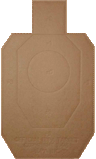
The original size was way too small so I took a guess and enlarged it to 400 percent. I then took a ruler and measured the preview pane, which was 2.25 inches tall. This makes a relationship of 2.25 inches to an actual print page of 11 inches. The target image height is 8.4 inches so the task is to find the representative size on the screen. Cross multiples again can provide the answer.
| Actual height | 11 | 8.4 |
| Screen height | 2.25 | x |
This gives us 2.25 times 8.4 equal 11x. 18.816 equal 11x. 18.816 divided by 11 gives us 1.72, the desired screen height. However, the 400 percent image on the screen only measured 1.375, so I needed to find the correct print percentage. Doing another cross-multiplication answers that question.
| Screen height | 1.375 | 400 |
| Desired height | 1.72 | x |
Solving for x gives 500 percent, which I then printed and verified.
Since I do this regularly, I have a scaling spreadsheet set up in Excel. It allows me to do this kind of scaling in less time than it probably takes to read this post.
 tacticalprofessor
You must be logged in to post a comment.