The Value of Standards
When planning any journey, knowing where you’re starting from is a necessity. For those new to Concealed Carry and for those who have been carrying for a while, having some kind of Standard to benchmark your ability against is the way to determine where you’re at, skills wise.
Marksmanship skill is not the be all and end all of the skills involved in Concealed Carry, as my Serious Mistakes and Negative Outcomes commentary shows. However, understanding where your capability fits in the big picture helps decision‑making more than is often realized. Some degree of skill helps a gunowner focus on the solution to the problem of a criminal encounter instead of focusing on possession of the gun as the solution.
Repetition and Progression
#fridayfundamentals
A client asked for a private lesson as preparation for an upcoming class at the elite Rogers Shooting School. Rogers is a very structured learning environment, so the format for the lesson was obvious. Fundamental to learning to shoot at a high level are Repetition and Progression, which are the underlying structure at Rogers. You don’t learn to shoot well by thinking about it, you learn by doing it. Visualization is a useful learning technique but you have to know what to visualize before visualization can have any value.
Running the Snub – Recoil Management
First in a series about ‘Running the Snub.’
In a discussion of revolver reloading techniques on my 1000 Days of Dryfire Facebook group, I posted a video of myself shooting the Alabama State IDPA Championship with a snub revolver.
The video generated the following question, which I think is worth some discussion and explanation.
Claude, I watched your video, and to me, you display amazing recoil management – the gun hardly moves. I was under the impression that snubbies are especially hard to shoot and control, particularly in this skill area. Can you share what you are doing to control recoil so well? Maybe details on how you grip the gun, and what kind of load you are firing?
Let’s deal with the simple questions first. I was shooting a two inch K frame at the Championship, which weighs almost twice what an Airweight J Frame does. That has some effect on the recoil management. The load I was using was my IDPA handload, which is ballistically equivalent to 158 grain Round Nose Lead standard pressure. I prefer not to use lead bullets so my load used a plated bullet.
The next issue to deal with is “snubbies are especially hard to shoot and control.” That’s been ‘common knowledge’ among the shooting community for as long as I can remember but how true is it? Like many other aspects of ‘common knowledge’ among gun industry common taters, I’m skeptical about that. So, I decided to do a little more Comparative Testing.
The test I chose was 5^4 (5 rounds in no more than 5 seconds at 5 yards into a 5 inch or less group). The 5^4 protocol was originally developed by Gila Hayes of the Armed Citizens’ Legal Defense Network for her book, Effective Defense: The Woman, the Plan, the Gun and subsequent later editions. .
In Pursuit of Better Practice
Gila Hayes of the Armed Citizens’ Legal Defense Network was kind enough to do an interview with me about Better Practice in this month’s Network Journal. Her interest was piqued because many members of the Network had said that ongoing training wasn’t possible for them due to resource constraints. Gila said that she wanted to give the members an option for maintaining and improving their skills that fit their budgets.
How far, I wondered, could the armed citizen proceed in his or her skill development through self-guided practice alone?
She’s an excellent interviewer. You will probably find it interesting reading.
https://www.armedcitizensnetwork.org/september-2018-front-page
She also did a book review of Concealed Carry Skills and Drills.
https://www.armedcitizensnetwork.org/september-2018-book-review
If you would like to purchase Concealed Carry Skills and Drills, the link to the downloadable ebook is here. http://concealedcarryskillsanddrills.com
If you would like to purchase Indoor Range Practice Sessions, the link to the downloadable ebook is here. https://store.payloadz.com/details/2501143-ebooks-education-indoor-range-practice-sessions.html
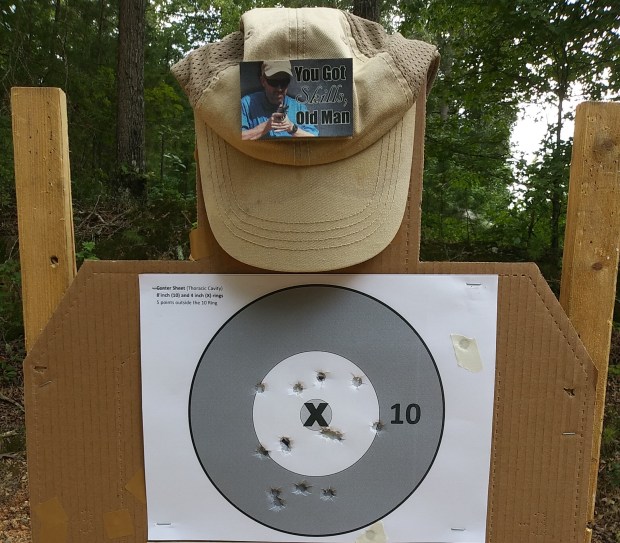
Morale patch courtesy of Chris North
Any tool will do if you will do
Retro posts bring to mind how often the same issues and the same interpretations arise. In this case, someone referenced my post about How many rounds to carry. https://tacticalprofessor.wordpress.com/2016/11/28/how-many-rounds-to-carry/
A comment referenced Tom Givens’ statement “I have never met someone, who has been in a gunfight, tell me they wish they’d had a lot less ammunition”.
My reply to that is something else Tom often says.
“It’s not how much you last practiced, it’s when you last practiced.”
To that, I would add “And how you last practiced and what you got out of it.” It’s easy to pick out one snippet of someone’s philosophy because it fits your purposes and ignore other integral parts of the philosophy. Even if you can’t get to range three times a week, can you spare five minutes those three days to do five draws, five aimed trigger presses with two hands, five with your dominant hand, and five with your support hand? If you can’t be bothered to expend fifteen minutes a week in dry practice, two extra magazines on your person are most likely meaningless.
Another way of looking at it is that it’s not the ammunition on your body that will save your life, it’s the ammunition that you’ve fired in practice that will save you. This is a corollary to something that’s taught in survival training; “It’s not the water in your canteen that will save your life, it’s the water in your body.”
I wish I hadn’t practiced my shooting so much said no one ever.
If you get the ‘go signal,’ you will find that your confidence in your own capabilities is far more important than your confidence in your tools. I am reminded of the police officer who got into a gunfight and had to tell himself “Hey, I need to … shoot better.” Shooting better solved the problem not expending more ammo fruitlessly. But then he drew the wrong lesson and started to carry 133 rounds. I don’t know if he decided to start practicing more and making his practice more meaningful, too. I certainly hope so.
The Miami Massacre is probably the most researched gunfight in history. One of the things that gets glossed over in the analyses was the solution. Ed Mireles pulled out his six shot revolver, used the front sight to aim at his targets, pressed the trigger smoothly, and made six hits that killed Platt and Matix. Ed’s draw was probably not sub-one second, either, but it was fast enough.
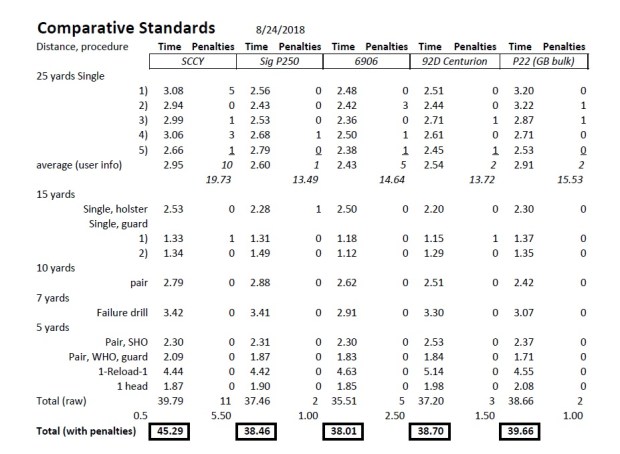
The Comparative Standards I’ve been writing about are a good example of “Know your capabilities.”
- What is your gun’s zero at 25 yards?
- What is your ability to hit the -1 zone at that distance?
- What exactly does your front sight look like at that distance?
- How smoothly do you have to press the trigger to make that hit?
- Can you hit the -0 zone (thoracic cavity above the diaphragm) unerringly at 15 yards and in?
I regularly gather metrics about the number of people who are interested in getting a status report of their capability with the handgun they own or carry. The number is extremely small. People would rather place their faith in ‘firepower.’ That’s an incredible mistake because when the firepower is gone, you’ve got nothing left. Your capabilities, if you have them, will solve the problem before your ammo load, whatever it may be, is exhausted. That’s the endgame we’re looking for; solving the problem before our ammunition is gone.
If you would like to purchase my eBook Concealed Carry Skills and Drills, the link to the downloadable ebook is here. http://concealedcarryskillsanddrills.com One of the metrics I gather is how many people are willing to spend the price of a box of ammo to get their personal status report and then increase their personal capability. As I said, it’s not many. Ninety-nine and 44/100ths percent are perfectly comfortable with carrying two spare magazines instead.
#Wheelgunwednesday – Comparative Standards
The Editor of a publication I occasionally write for asked me to participate in a project about comparing different handguns. Being the revolver guy I am, he asked me for some input about how wheelguns fared. His concept is:
[R]each an objective: identifying a short (20-rounds) base of standards for defense handguns to (1) compare similar format guns, one to another, (2) compare formats of handguns (small, single stack or subcompact), (3) “shoot out” duty/defense ammo for replacement while evaluating personal skills, (4) yet another “cold course” of fire to identify skills areas that need attention.
This is the Course of Fire he developed.
- Basis: 3-second strings
- Lots of draws
- Few reloads (on the clock)
- Limited Vickers: use a target, feature .5 second added for 1-down; shortest time “wins.”
- 25 yards – singles from holster – 5x – 5 rounds
- 15 yards – single from holster – 1x
- single from guard – 2 x — 3 rounds
- 10 yards – Pair from holster – 1x 2 – rounds
- 7 yards – Failure from holster – 1x – 3 rounds
- 5 yards – Pair SHO from holster – 1 x – 2 rounds
- Pair WHO from guard – 1x — 2 rounds
- from holster, 1-Reload-1 – 1 x – 2 rounds
- from holster, 1 head – 1 x – 1 round
Total: 20 rounds
The breakdown:
- Draws – 7
- From ‘ready’ (guard) – 3
- Singles – 6, one to ‘brain housing group’
- Weak Hand Only – 2, Strong Hand Only – 2
- Shots to smaller target – 2; one is transition from larger target.
- Pairs – 4
- Reload – 1 (under time)
All in a 20 round box of ammo.
It’s an interesting concept, so I shot it with four different revolvers and two autoloaders.
- Smith & Wesson Model 65 – one of my favorite wheelguns and what I shot at the 2018 Rangemaster Tactical Conference
- Smith & Wesson Model 642– perhaps the most ubiquitous revolver encountered today
- Ruger LCR – another commonly carried wheelgun
- Smith & Wesson SD9VE
- Beretta PX4 Storm Compact, modified to G configuration
- Smith & Wesson 43C – a nice little .22 snub revolver
All were shot from Appendix Inside the Waistband carry except the SD9VE. The centerfire revolvers were reloaded using a speedloader carried in a centerline carrier. The 43C was reloaded using a QuikStrip carried in the watch pocket of my jeans. I used Remington Golden Bullet bulk ammo in the 525 round box for the 43C. Despite it having a 9 pound mainspring, which I have been told will get me ‘kilt in da streetz,’ there were no Failures to Fire.
We were free to use any target we wanted, so I used the printable target from my ebook Concealed Carry Skills and Drills. Per his instructions, the scoring was Vickers Count with ½ second added per point down. I used the Circle as the -0, the paper target as -1, and the balance of an IDPA target backer as -3.
An interesting aspect of the Course is that every shot or two is scored individually. This involves a lot of walking, especially for the five shots at 25 yards but gives a lot of feedback about the efficacy of one’s shooting. In the spirit of the analysis, I marked the target at every distance change to keep track of where the bullets were hitting.
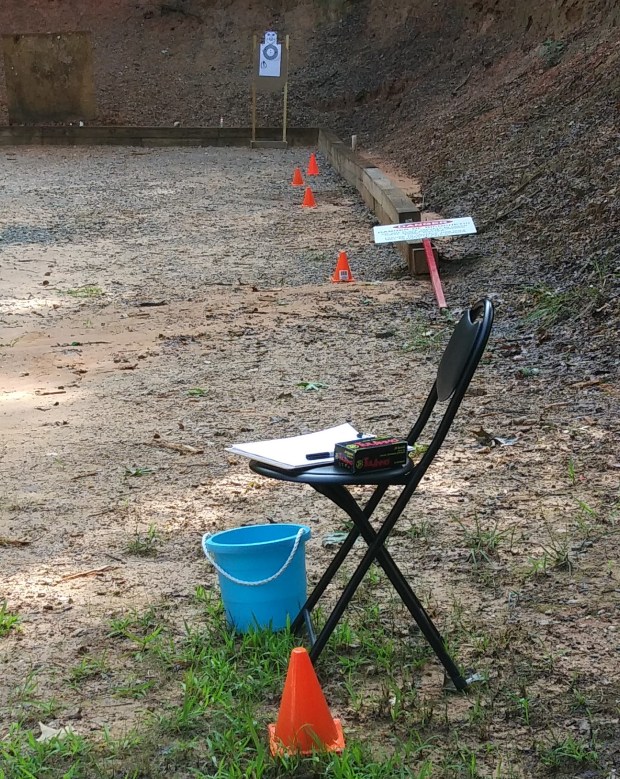
Range setup
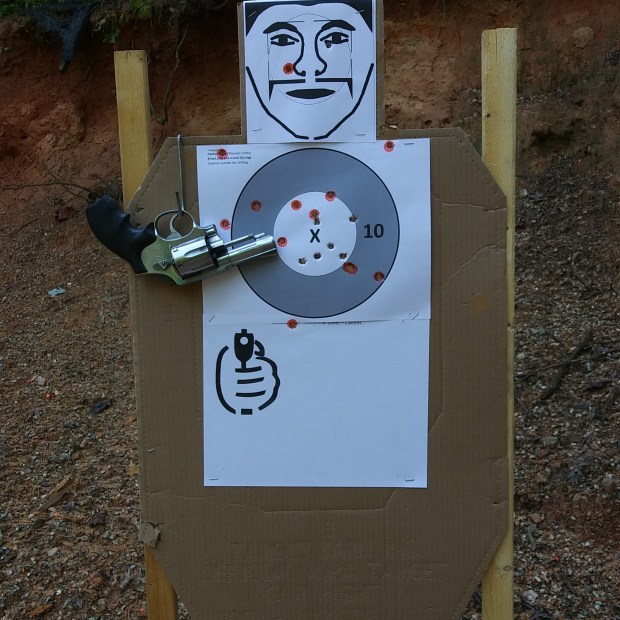
Model 65

Model 642-2
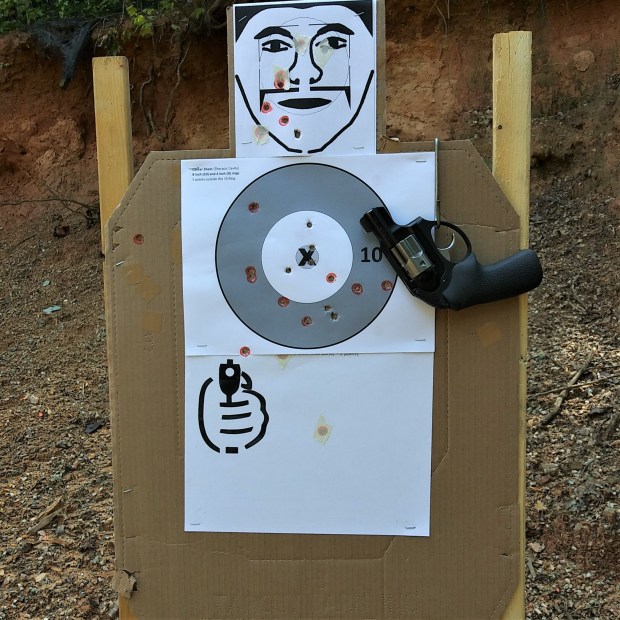
Ruger LCR

SD9VE
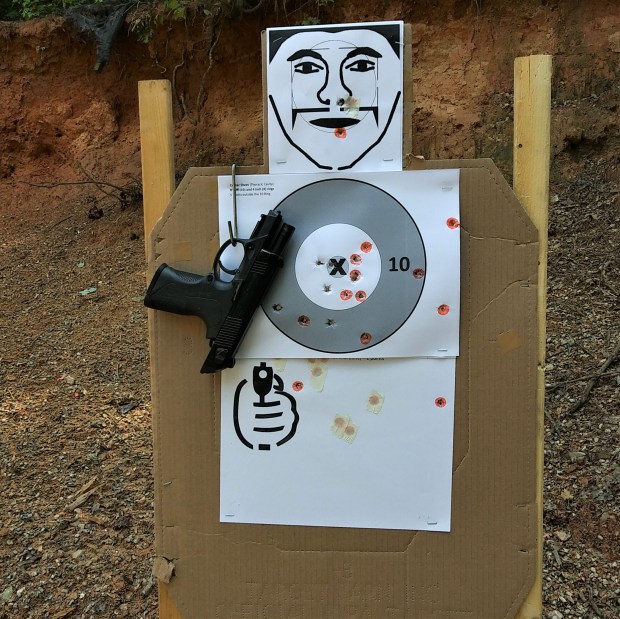
Beretta PX4 Storm Compact
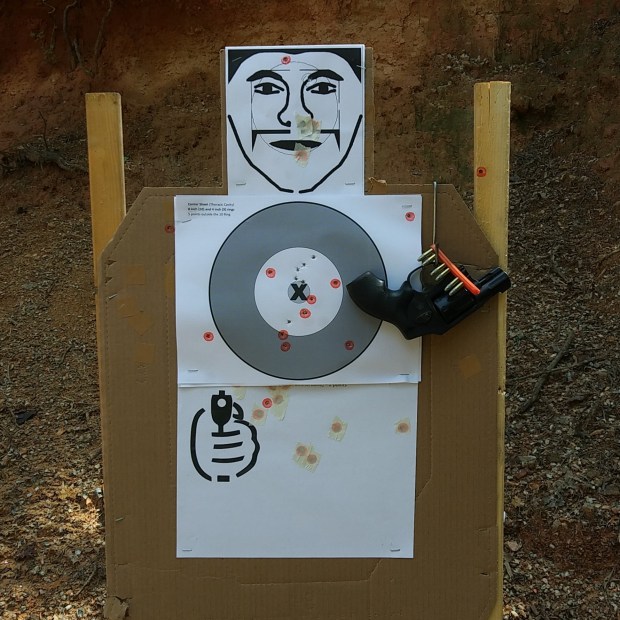
Model 43C
Here’s how the results came out.
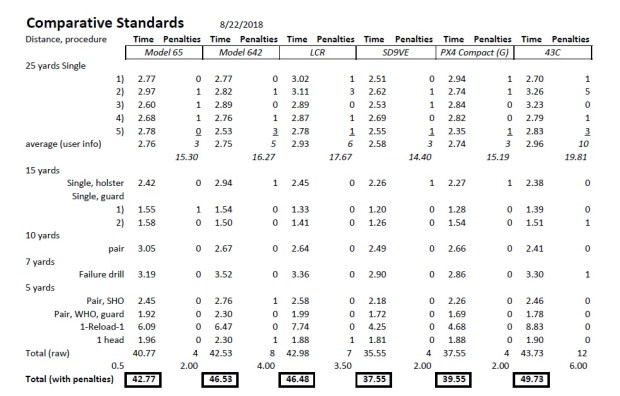
It’s a demanding benchmark analysis. I’m looking forward to seeing the results of the other testers.
If you would like to purchase Concealed Carry Skills and Drills, the link to the downloadable ebook is here. http://concealedcarryskillsanddrills.com
A Clarification
Brian Hill of The Complete Combatant likes to call me ‘The Clarifier.’ However, I apparently have slipped up on that. I received the following question today, via email.
“Comment: Is your “Concealed Carry Skills and Drills” ebook available and downloadable in PDF?”
Yes, it is.
The link to the ebook on my store is Concealedcarryskillsanddrills.com
Clicking on the above link will take you to where the ebook can be purchased. A download link will then be sent to your email. Clicking on the download link will send the PDF of the book to you.
My other ebooks are available by clicking on this link. Claude Werner’s ebooks. The Flashlight practice session of Indoor Range Practice Sessions is available there for FREE because I believe every gunowner should have some familiarity with how to use a flashlight in conjunction with their pistol. It could prevent the Negative Outcome tragedy of shooting a family member or someone else who shouldn’t be shot.
I hope that clarifies things.
The Origin and Evolution of Dot Torture
Dot Torture is a well known practice regimen among skilled shooters. Its origins and evolution are less well known, however.
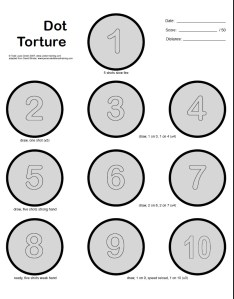
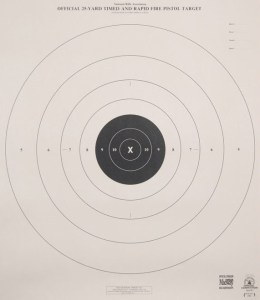
Shooting on dot targets, i.e., small filled in circles from 1.25 to 5.54 inches in diameter, as a speed shooting training and practice exercise, was originated by John Shaw, a World Champion shooter, in the early 1980s. In his book, You Can’t Miss: The Guide to Combat Pistol Shooting, he explains the training standard he established for his students. Until they could consistently hit the black bullseye (5.54 inches) of an NRA B-8 bullseye target from the holster in two seconds at seven yards, he didn’t allow them to move on to more advanced drills.
Shaw’s school, the Mid-South Institute of Self-Defense Shooting evolved the concept of dot shooting to a high level. Combined with shooting at steel targets, as originated by Bill Rogers, founder of the elite Rogers Shooting School, dot shooting became a standard component used in the practice regimens of knowledgeable shooters who aspired to a higher level of competency.
The concept of dot shooting was so effective at teaching shooters to hit the target, it quickly became part of military counter-terrorist pistol training. The US Army Special Forces developed a course called ‘Special Operations Training’ [SOT] during the 1980s to train its personnel to use the 1911 pistol at a level not seen before that time in the military.
Concealed Carry Skills and Drills – The Book
It’s finally done. My new book about Skills and Drills for those who Concealed (or Open) Carry. The book is based on my analysis of over 5,000 incidents involving Armed Citizens who successfully defended themselves and their loved ones.
Concealed Carry Skills and Drills book
Introduction
This book was designed to fill a need. For many gun owners, training is a resource intensive activity that they have difficulty affording in terms of time, money, distance, etc. Introductory Concealed Carry licensing classes generally focus mostly on legal aspects and non-shooting tasks such as situational de‑escalation. The only shooting task, if any, involved in a licensing course will usually be a ‘qualification’ or evaluation of the shooter’s ability to perform to an established standard. In most cases, that standard is quite low but it is still intimidating to many.
The gunowner is thereby placed in an unenviable situation. First, having to learn to shoot prior to attending a licensing course. Even with some instruction, which will often be informal by a friend or relative, this can be a difficult task. Second, assuming the person passes the licensing ‘qualification,’ they often ask the question “What do I do next?” The standard response is “Get more training.” Since spending a day or a weekend at a remote location ‘getting more training’ doesn’t fit into most people’s resource constraints, they simply choose not to unless it’s required at license renewal time.
Gun ranges are not ideal learning environments. Trying to get even informal instruction from someone else when people are shooting on either side of you is rarely productive. The question of what are appropriate tasks to learn and how do we practice them comes next. How do we make the best use of our limited resources at the range is another question. The horrible visualization on TV and in movies of what shooting looks like is non-helpful at best and destructive of proper conceptualization and skill development at worst.
Self-Study is an activity most of us are used to. It is how we often learn to drive a car and perform many other physical and athletic tasks. Not many people who play sports have ever been to a sports training camp. They just go out and practice the activity, play the game, figure out their weaknesses, and then practice some more.
The difficulty of Self-Study with firearms is the question of how to do it safely and properly. Guns are esoteric tools that are not intuitive to use. We have no instincts that prepare us for having explosions repeatedly go off two feet in front of our faces. Few other tools we use have the capability to cause instant death during a moment of ignorance or carelessness.
What this book provides is a guide through the process of improving your shooting skills on your own in the context of Personal Protection. Guided training with a competent instructor is still the best way to improve your skills and will yield the best results. However, an intelligent person who can follow directions can still learn a great deal on his or her own, given a suitable program.
This book is not a guide to becoming a Champion shooter or being able to shoot like a member of an elite military unit. What it can do is help you to become a safer, more competent shooter who can focus your cognitive abilities on the situation, instead of the gun, during a criminal encounter. It is also an excellent reference for more experienced shooters providing informal training to new shooters.
There are 30 different drills in the eBook. They focus on building Concealed Carry skills from the ground up and then refining them. The drills are structured in a stair step approach starting at a level that a new shooter can achieve and then work to a greater degree of difficulty and achievement. Different types of drills are coordinated to build a variety of skills at the same time.
The vast majority of Personal Protection incidents are simple, if rather frightening, events, and are quickly solved by untrained inexperienced persons. The issue is that if an incident goes wrong, it tends to go horribly wrong, a NEGATIVE OUTCOME. The odds are low but the stakes are very high. Helping the Armed Private Citizen stack the deck in their favor is the object of this book.
Armed Citizen® – July 2018 Analysis – Part III
Posts Part I and Part II broke out the circumstances and tasks of the incidents of this month’s (July 2018) Armed Citizen® column. Today let’s discuss the implications of the circumstances and tasks for those who own firearms for personal protection.
The most common task (all six incidents) accomplished was:
- Retrieve the firearm from storage.
There were no incidents this month in which the firearm was carried on the person’s body. This is a subjective call on the part of editors as to which of the plethora of Defensive Gun Uses to include in a monthly column. However, only 6 percent of the adult population has a license or permit to carry a weapon outside the home, according to John Lott’s Crime Prevention Research Center. It’s also commonly acknowledged that among those who have a license or permit to carry, actually carrying on the person is sporadic, at best. Accordingly, it is not surprising that the majority, perhaps vast majority, of Defensive Gun Uses do not occur in public places.
One implication of this fact is that a certain amount of emphasis should be placed on retrieving a firearm from its actual storage location, be it home or vehicle, and then putting it into operation. This is especially true if the firearm is kept in some sort of safe, whether it is large or small. If an autoloader is stored with the chamber empty, the need to be able to place the weapon into a fully fireable condition is also implied. Avoiding Negligent Discharges in the process is desirable.
 tacticalprofessor
You must be logged in to post a comment.