1000 Days of Practice (Part I)
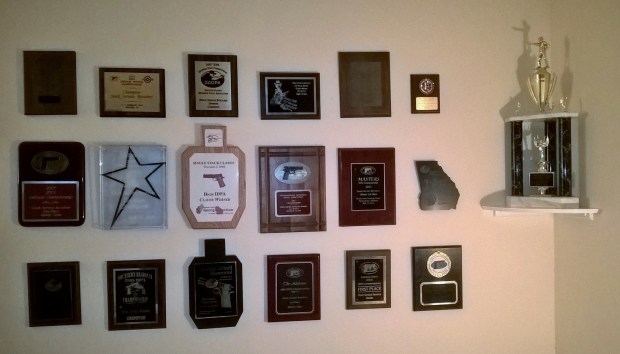
As many of you know, I’m currently working on my second set of doing 1,000 consecutive days of dryfire practice. The first set was done during 2000-2002. This second set started on March 3, 2014 and the 1,000 days will be finished on November 27, 2016, during the week after Thanksgiving.
The original inspiration came from a friend who was working on his Yoga instructor certification. His final requirement to complete his certification was to do 1,000 days straight of meditation. This represented true dedication to excellence in my mind. Being a strong believer in the value of dryfire, I decided to make the same commitment to dryfire and immediately started my own 1,000 Days program. Just as with his meditations, it doesn’t have to be any particular drill or set of drills. Rather, it’s the commitment to do dryfire each and every day, without fail, for 1000 straight days. If I missed a day, I had to start again at the beginning.
Reflecting back on both times I’ve done the 1,000 Days, I have to say they were different experiences and I achieved different things from them. This isn’t surprising, given that they started 14 years apart and a lot went on between them.
The first time was largely a mechanical regimen devoted to further development of my skill level at seeing the sights quickly and pressing the trigger smoothly. Those two skills are fundamental to being more than a mediocre shooter. Unfortunately, shooters who insist on doing only livefire practice rarely learn them well. Recoil masks too many flaws in technique, especially when performance measurement, the third key fundamental, is omitted. Dryfire provides a superior method for learning those key fundamentals.
There is no doubt in my mind that doing the 1,000 Days was instrumental in the successes I had in my competitive shooting career at that time. It was also one of the things that led to my becoming the Chief Instructor of the elite Rogers Shooting School because dryfire is an integral part of the School’s program.
The second run of 1,000 Days had a broader conceptual focus than the first. In between the two runs, I had individually read and created two databases of Armed Citizen and Officer Involved Incidents. Combined, they total over 7,000 incidents. This gave the second run a different perspective on the skills, tactics, and techniques that contributed to success or failure in the context of personal protection.
In addition, I did extensive research about:
- the decision-making process
- instructional design
- performance measurement
- incident analysis
- wargaming and decision exercises
- proxemics, and
- human communication and interaction
These all contributed to my perception of what and how to practice, both dryfire and livefire. Some of the skills I practiced the first time remained important while others became either less significant or even irrelevant.
As I approach the end of the second 1,000 Days, several questions that hadn’t occurred to me the first time arose.
What is the focus of the next 1,000 Days?
Is 1,000 Days necessary?
Am I limited to only one focal point?
Does my focus have even have to relate to personal protection?
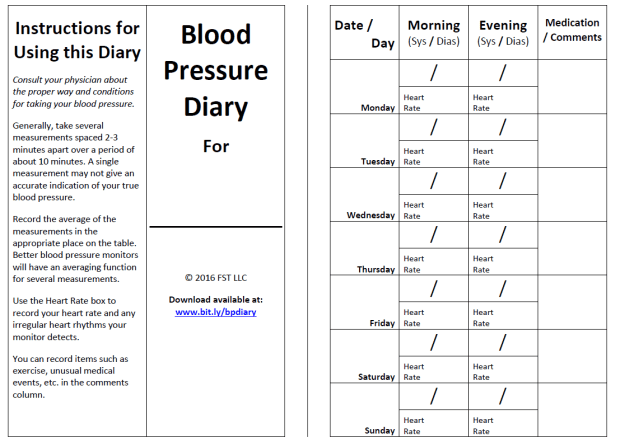
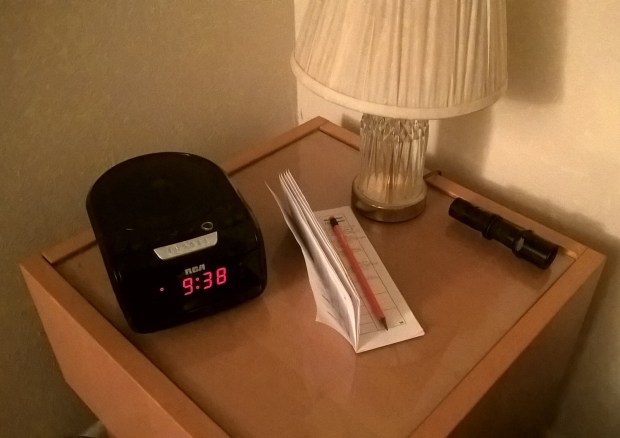
In answer to the last two questions, I resolved to get back on a daily blood pressure monitoring scheme, which I’ve neglected for a while. Since I don’t care much for apps and found the array of paper based products unsatisfactory, I developed my own blood pressure diary. It’s a printable design that’s more compact and organized than the other products available and gives me a better basis for discussions with my cardiologist. For those who are interested, it’s available here.
More in Part II.
Safe Gunhandling Rules
There are several sets of rules regarding safe gunhandling. All the sets of rules emphasize the concerns of their originators. However, many similar things are said but stated in different ways.
Which set of rules you choose to use is less important than picking a set and following it scrupulously. Firearms are instruments of ultimate personal responsibility and can be very unforgiving of even a moment of carelessness. Gunhandling is just as important as marksmanship, but many people are careless about the way they handle firearms, which can result in death or serious injury.
The National Rifle Association’s set. Link
The National Shooting Sports Foundation’s set. Link
Glock has its own set. Link
Like most competitors in the Action Shooting Sports, I use The Four Rules originally developed by Jeff Cooper. Lists of more than three or four items are difficult to memorize, so I still prefer them. There are minor variations but they all follow the same pattern.
- All guns are always loaded.
- Never let the muzzle cover anything you are not willing to destroy.
- Keep your finger off the trigger till your sights are on the target.
- Identify your target, and what is behind it.
When talking about gun safety, we need to be careful about taking our subject matter knowledge for granted, especially nuance. Each of the Four Rules has a given amount of unstated subject matter knowledge inherent in them. I have had this discussion before and I continue to maintain the following: telling people with little experience four sentences and expecting 100 percent positive results is ridiculous.
The Four Rules are a memory aid like OCOKA, not a teaching paradigm. Glibly reciting them and expecting people to understand the depth involved in them is like showing someone a flashcard about algebraic formulas and then expecting the person to understand Mass-energy equivalency. The written explanation I provide my students about the Four Rules is three pages long with multiple (2-7) subsections explaining the nuances of each Rule. In the case of Rule #2, there are seven subsections.
“Never point your gun at something you’re not prepared to destroy,” to someone who doesn’t know much about firearms, can be easily interpreted as “Don’t horseplay around with your gun and act like a toothless buffoon by pointing it at your wife or dog.” There are multiple nuances that are not immediately apparent in a one sentence reading. For instance, here is one subsection of my handout:
“c. In many cases, you will have to choose between pointing the gun at an inanimate object, such as the floor or gun cabinet, or pointing the gun at a person; always choose the inanimate object, never point the gun at a person.”
I speak for no one else but there’s nothing in a gun shop I am prepared to destroy when I handle a gun. However, the choice between shooting a gun cabinet and shooting the person behind the counter is fairly easy to make.
Granted a few people are exceptionally stupid. For instance, the guy who disabled his hand by negligently shooting it and then did it a second time because he insisted the only way he could manipulate the slide was by pushing it against his disabled palm. He posted pictures of the second incident on GlockTalk years ago and almost seemed proud of them. People like that are untrainable.
I think most people would be much more competent if we in the industry didn’t take so much for granted. People who have never operated a handheld device more complicated or dangerous than a coffee maker need an explanation first and the memory aid second to reinforce the explanation.
When explaining the Four Rules, I always include the statement:
In addition to the Four Rules, always store firearms so that they are not accessible to unauthorized persons.
The attached explanation is NOT all inclusive of the implications of the Four Rules. However, it is a starting point to allow shooters to think about the proper way to handle guns safely. Feel free to distribute the PDF to anyone.
Practicing Awareness – Part III
How do you do ‘situational awareness?’ You can’t ‘do’ a noun.
First of all, let’s distinguish between training and practice. My definition of training is something you do under the guidance and supervision of someone else. Practice is something you do on your own to maintain or hone skills you have or are developing.
Although Jeff Cooper’s Color Codes (White, Yellow, Orange, and Red) are the most popular way to describe states of awareness, I prefer to use the NRA format. As a sidenote, Cooper did not include Black as part of his system and actually objected to its inclusion.
The NRA format is described in the Personal Protection In The Home course and book. Military and police personnel tend to use insider jargon to describe things. Jargon is both a shorthand and, linguistically, also a way of excluding outsiders from the group. Shorthand can be useful in some circumstances but to a trainer exclusion is not, so I prefer the NRA terms.
- Unaware (Doi, doi, doi, doi, doi, doi, doi; as we used to say in Chicago)
- Aware (I know who and what is around me and what is going on)
- Alert (Something has caught my attention and makes me uneasy)
- Alarm (Something is definitely wrong in my right world)
Wearing earphones and listening to music automatically put us into the Unaware state. Constant talking on the phone does the same thing, as does concentrating on watching your dog take a dump. If you want to be Aware, you have to be mentally present where you are, not in a musical venue or someone else’s location. Sorry, there’s no way around that.
Tom Givens of Rangemaster mentions two things he thinks are relevant to situational awareness.
1. Who is around me?
2. What are they doing?
To those, I would add three more:
3. Where am I?
4. What is going on? (Not necessarily at this moment)
5. Points Of Likely Concealment (a component of Positioning to be discussed later)
When walking or running, we have an excellent opportunity to practice our situational awareness and positioning. It’s also a good habit for your safety.
You know how they say running is good for your health? In my neighborhood, it can save your life.
–old Chicago joke
To start the practice regimen, the default position for your eyes is on the horizon. It’s true that when walking or running we have to look down periodically to watch out for dog turds and other hazards on the ground. However, most people walk around like they’re continually playing the game “Step on a crack, break your mother’s back.” Having the eyes down makes it very difficult to see anything outside of the Near Phase of Social Space, in terms of proxemics. The boundary between the Near and Far phases (~7 feet) of Social Space is where untrained people will tend to make their final Force decision (Critical Distance). Being fixed on that point makes it impossible to do any information gathering prior to having to react. It’s a failure to follow Items 1 and 2 and a self setup for disaster. There is a discussion of proxemics and its implications in an earlier blog post Situational Awareness and Positioning (part III).
To get into the information gathering mode, something I do when out is to read every sign or anything that has words on it. I do this whether I’m walking or driving because it keeps my head up. As Tom says, most drivers stopped at a traffic signal tend to watch the signal with rapt fascination as if they expected it to start to sing and dance. Reading everything around you keeps your head moving and your mental focus outward.
There are many apartment complexes and residential subdivisions along my walk route. There are also numerous small cross streets with street signs. I make it a habit to read each of these signs every time I pass them, even though I’ve read them hundreds of times before. This accomplishes two things. First, it puts me in an outwardly directed mental state. Second, it makes sure I know exactly where I am at all times; Item 3 on the list. If I had to call 911, being able to say “I’m at the entrance to the Wyndham Hills apartment complex on Nesbitt Ferry Road” or “I’m at the intersection of Peachtree Road and Sequoia Trace” gives any responders a good idea of where I’m at. I also read the address number of every mailbox I pass. This gives a precise location if I’m not near a complex, cross street, or subdivision. Don’t depend on the GPS locator of your phone to give your exact location; it may not.
As I approach and pass the complexes and subdivisions, I look as far as I can past the entrance. What I’m looking for is outgoing traffic and any changes or construction. This is mostly just mental exercise for Item 4 but has helped me avoid being run over by distracted soccer mom drivers on several occasions. Heavy construction equipment near the entrance can also be a Point Of Likely Concealment, Item 5, for criminals, especially at night.
Graffiti is another thing to look for. The appearance of graffiti where it didn’t exist before can be an indicator of a new gang presence. The presence of beer cans is another detail worthy of note. The detritus of cans tossed out the windows of drunken drivers’ cars is not that much of a concern, unless you’re in their path. However, a quantity of cans noticed in a single location over a period of time is. That could be an indicator of nighttime party spot that is best avoided.
Another thing I look for is Small Dead Animals (SDAs) and Large Dead Animals (LDAs), as we called them when I was in the City Planning program at Georgia Tech. Once again, this is mostly mental exercise. However, as the deer presence in my area has increased, I’ve had occasion to call Public Works several times to report dead deer that were hit by cars.
Checking out the drivers in cars waiting to turn when you approach an intersection is mandatory. Any doofus who has their turn signal on and is talking on the phone or texting is a potential assassin. I never make the assumption they’re going to see me and not run me down when I get in the crosswalk. That’s not to say the ones who don’t have their turn signal on won’t try to kill you, either.
Of course, we want to scrupulously follow Item 1 and be aware of other persons around us.
- Walkers and joggers
- People in their yards
- Workers
- Low-lifes
Engaging the normal people is something I always try to do. Just saying ‘Good Morning’ helps engender a small sense of community. Be aware that it’s also a good way to seem like you’re part of the neighborhood, even if you’re not. This technique is used extensively in surveillance work and criminals use it too. It’s also fun to wave at people you don’t know and have them wave back. They go home thinking “Maybe that person knows me but I can’t remember who he is.” This is also another technique for establishing a false neighborhood identity. Workers can be fun because they’re often working in obscure locations and require active work on my part to locate and identify them.
I don’t mind walking past low-lifes but it’s important to be mentally prepared to deal with them and fail the interview. Someone once said that I give my students permission to be rude; that’s totally true. There’s a difference between rude and mean, though. In my vernacular, being rude relates to enforcing my boundaries. Being mean is encroaching on someone else’s boundaries. That can set you up for trouble. If you don’t like the look of them, though, there’s nothing wrong with crossing the street or changing direction to avoid them. Don’t hesitate to turn on your heel and go back the way you came if that seems appropriate.
Earlier posts about Situational Awareness
- Practicing Awareness
- Practicing Awareness – Part II
- Situational Awareness and Positioning Part I
- Situational Awareness and Positioning Part II
- Situational Awareness and Positioning Part III
- Situational Awareness and Positioning Part IV
- Situational Awareness and Positioning Part V
- Situational Awareness in Social Settings
As the real Dr. House mentioned at the Hebrew Hogger last weekend, it’s better to have an option to avoid a situation than to have a tool to get out of a situation.
Indoor Range Practice Sessions
In response to queries and comments about the Pistol Practice Program, I have created a downloadable eBook called Indoor Range Practice Sessions. It is structured as a PDF eBook that you can download to your smartphone or tablet and take with you to the range. That way you always have your practice session with you. Most (99%) gunowners only have access to an indoor range, so the Sessions are designed with this limitation in mind.
The book contains 12 Practice Sessions and 12 Courses of Fire from various States for their weapons carry licensing process. The Sessions are designed to progressively increase in difficulty so when done in sequence they challenge shooters without overwhelming them. The Courses of Fire were chosen to be complementary to a respective Practice Session. Each Session or Course of Fire is 50 rounds or less. They are all structured to maximize the effectiveness of your range time. It also contains sections on:
- Four Rules of Safe Gunhandling
- Gripping the Autoloading Pistol Properly
- Trigger Manipulation
- Using the Sights
- Use of Force philosophy
- and more!
There are considerably more restrictions placed on shooters at indoor ranges than at outdoor ranges. These Sessions were designed with those restrictions in mind. For example, most indoor ranges do not allow drawing from the holster, so the Sessions work on the general idea that no drawing is possible. Similarly, multiple target arrangements are not possible when shooting in a booth at an indoor range, so the Sessions do not include multiple targets.

These Sessions are intended for people who have purchased a firearm for personal protection. They are directed toward newer gunowners; however, ‘newer’ is a relative term. Many people who have owned, and perhaps shot, firearms for years aren’t as proficient as they think they are. Being a hunter, military veteran, security guard, or even police officer is no guarantee of being competent with a pistol. The difference in contexts is huge and often misunderstood.
Learning to shoot is an ongoing process. A misunderstanding that people have is thinking they can take a short training course, attend a seminar, or read a book and then feel they are ‘trained’ or ‘knowledgeable.’ Nothing could be further from the truth. We can only absorb so much information at one time. If we don’t practice what we’ve learned, that skill or knowledge slips away quickly. Repetitive reinforcement of our learning is key to developing and maintaining skill.
The eBook is available for download HERE.
Dryfire drills and objectives
Over the years, I have designed dozens of different dryfire drills for my practice sessions. The first was for a dryfire VHS tape that I produced almost 20 years ago. Frankly, the session and the tape weren’t that good but it was a start. I just kept creating and refining more of them. Now I have a menu of options to choose from each day. Most of them are recordings that I have on my computer and/or my cell phone.
Having a library of pre-made sessions accomplishes a number of things for me.
- Keeps me from getting bored. Since I’m close to finishing my second run of 1000 Days of Dryfire, that’s really important. Let’s face it, having to do the same thing for 1000 days would make it hard to complete the 1000 days. It’s human nature to get bored and we need to accept and anticipate that.
- Having some short sessions makes the 1000 days manageable. A number of my regimens are less than 5 minutes, including setup. Otherwise, I’d probably end up missing a day due to scheduling, fatigue, or other factors. If you want to design some longer sessions like Ben Stoeger or Steve Anderson, that’s great. It’s good practice and I encourage it. However, you should have at least two ready sessions of five minutes or less duration that you can fall back on when you’re busy or tired.
- If you’re a little fatigued, doing a short session helps prevent practicing bad form. Better to get 30 quality reps and end it there rather than doing a longer session and overlaying 70 bad reps on top of 30 good ones.
- Designing short sessions helps me re-focus my long term goals periodically. I shot IDPA heavily for over a decade and a half. During that time, my dryfire sessions were designed around that activity. Doing a lot of dryfire was one of things that helped me win six State Championships. When I became the Chief Instructor at the elite Rogers Shooting School, I created sessions that were more in tune with the skills I demonstrated and taught there. Now that I have become focused on Decision-Making and avoiding Serious Mistakes, my sessions revolve around those objectives.
- Two or three short sessions can be combined into a longer one. For instance, I could combine a timed accuracy oriented session, such as the one I created based on the LAPD Bonus Course, with a Serious Mistakes session, such as flashlight practice.
Think about your goals and what the skills that relate to them are. There are numerous references about dryfire on the Internet and YouTube. My colleague Greg Ellifritz made some very pertinent comments to me recently.
It’s so easy to be good at shooting in today’s world. It takes so little effort to obtain knowledge that was completely cutting edge (and not disseminated outside a very tight knit group of professionals) 25 years ago. A simple google search will provide all the information that took me 10-15 years of constant study to learn.
Just be sure to vet your sources to be sure that it’s not some goober who thinks pointing a pistol at a student’s face, or worse, shooting them, is okay or excusable.
Name that class!
I am pleased to announce that Dr. William Aprill of Aprill Risk Consulting and I have teamed up to create a class about the intellectual side of personal protection. It’s a class designed to work your brain in preparation for the period before an assault to avoid it and, if necessary, rout the attacker.
He will focus on the psychology of Violent Criminal Actors and Victim Selection. My part will cover Strategy, Tactics, Options, and Decision-Making Exercises. This will be a full weekend of learning about how the criminal mind works, how to avoid being picked for victimization, and the decisions necessary to preclude and defeat criminal attacks.
All training will be in the classroom. There will be no shooting, gunhandling, or physical contact involved. However, there will be a significant number of decision-making exercises using a new method I have devised. Every student will leave the class having made decisions to use lethal force, non-lethal force, or no force numerous times.
We would like to solicit some input on what to call the class. The titles we’ve come up with so far, some wordy and some short, don’t really please either of us. William likes The Deep End: Knowledge-Based Management of Criminal Violence but that’s wordier than I like. He wasn’t much for my idea, Those Crazy Criminals, and How to Outthink Them.
So, I am creating a little contest. Send me your suggestion for what you think a good name for the class would be. Only one entry per person, please. William and I will pick the Top Five entries. Each of the Top Five entries will receive a complimentary set of my newly updated Pistol Practice Program and Serious Mistakes Gunowners Make CDs. Entries can be [preferably] emailed to tacticalprofessor@gmail.com or as responses to this announcement on my Tactical Professor Facebook page.
I’m also offering the combination set of the Pistol Practice Program and Serious Mistakes at a 25% savings on my webstore. Anyone who purchases the new combination set and then becomes one of the Top Five will receive a full refund, including shipping.
The schedule of the class dates will be available in the next few weeks. The initial class will be held in the Atlanta area in early Fall. Other cities around the country will follow.
Thanks in advance for all of your suggestions.
Creating dryfire recordings
A friend of mine emailed me the following question.
Claude, what device do you use to make a digital audio recording? How do you transfer the digital recording to your computer?
I had mentioned to him the recording I recently made for an Enhanced Standard version, i.e., not so easy I could pass it blindfolded, of the State of Ill-Annoy Police Qualification Course. I made the recording for dryfire practice but I could use it for livefire, too.
One of the few apps I have on my phone is an audio recorder called Mini Recorder Free. I have a Windows phone but the app is also available for Android. It’s very easy to use and records the input as MP3 files.
First, I look at a course of fire and write a script for the recording. When I’m happy with the script, I record the narration of the course of fire, usually as one file. Where the beeps are supposed to go, I say ‘beep beep’ as a place marker.
Then I record the beeps from my CED 6000 timer by putting the microphone next to the timer. Each of the different times is recorded as a single set of beeps. I can insert each beep file multiple times into the narrative, where that’s appropriate.
I connect my phone to my computer and copy the narrative and beep files to the computer. Finally, I edit them together with Wavepad Sound Editor, which I downloaded from the Internet. Undesirable noises get edited out and I standardize the spacing between the stages so there’s enough time to re-holster, change hands, or do other preparatory work for each string.
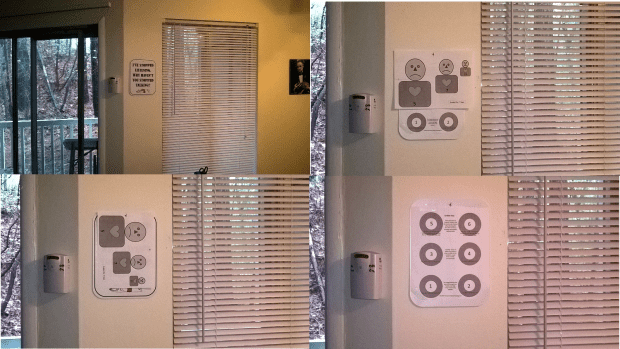
Since I don’t have a 15 yard range in my apartment, I create reduced scale targets to use for dryfire. I create the targets by scaling them with Excel.
A reduced scale target also allows me to conceal my target when I’m not dryfiring, which is something I believe in very strongly. The 12 shot drill is on the back of my wall hanging.
On some of my recordings, I substitute a gunshot sound for the start beep. It just depends on how involved I want to make the recording. For my dryfire recording of the LAPD Bonus Course, I downloaded an audio file of the actual course being shot on the LAPD range. I had to clean that one up a lot but it’s fun to dryfire to because there’s all the range noise, LAPD Rangemaster commands (which sound like a subway conductor), sounds of empty magazines hitting the ground, and gunfire in the background. That’s as close as I can get to an actual range experience in my living room dryfire practice area.
A few of the recordings stay on my phone to use when I’m traveling. I also keep a PDF of the target on my phone so I can print it if I forget to take one along. It fits on one page so it’s easy to print in a motel business center. ISP 7 foot target
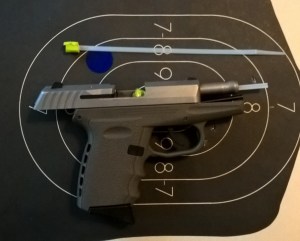
At this year’s Rangemaster Tactical Conference, someone mentioned wrapping a zip tie with a piece of colored duct tape on it as a safety insert. It’s a great idea and I’m using that now along with the Rogers Tap-Rack-Trainer. A round can’t be chambered with the tie in place. No disassembly of the gun necessary to put it in and it’s easy to take out, too. A bag of 8 inch ties costs about $2. The zip tie isn’t a snap cap, though, so keep that in mind.
The audio recording of the ISP Course I created is available as a download for 99 cents on my CDBaby store if you don’t feel like doing all that. There are a number of other recordings of interest, too.
The Woman’s Gun Pamphlet
Through an oblique reference, I recently found a link to The Woman’s Gun Pamphlet. Edit: The link and the server appear to be gone. A PDF of the Pamphlet is available at the edit of this post.
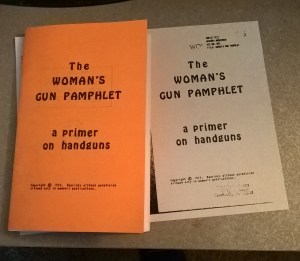
It’s a very interesting publication that was written and published by a colloquium of radical feminists in 1975. The intent was to provide information about both guns themselves and about personal protection attitudes to women of that era who knew nothing about guns or personal protection. As such, I consider it an historically significant document. There’s quite a bit of political rhetoric in it but also a goodly amount of information. Even dry practice is touched on. Some morsels of dry wit are quite entertaining.
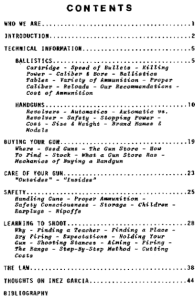
Especially interesting to me is that it was written from the perspective of self-taught women of the time with some input from men and by doing primary and secondary research. What they considered important, how the information was structured, and how it was presented is insightful. There are a number of items in it that made me realize there are areas of my subject matter knowledge I take for granted.
Given this week’s confrontation between the Federal government and a quasi Posse Comitatus group in Oregon, I also found the political views and fears presented in a 1975 publication to be notable. When I graduated high school in 1972, I doubted I would be able to own a handgun, much less carry one in the majority of States, even slightly into the future at that time. The recent shenanigans regarding Weapons Carry reciprocity in Virginia by its anti-gun Governor and his lackey Attorney General echo items in the Pamphlet. The attitudes and tactics of hoplophobes and political control freaks have changed little in the past 50 years. A common one is ‘take something away, then give it back in exchange for something else.’ The saying ‘One step forward, two steps back’ comes to mind. Gun controllists play the long game, just like Mao Zedong, and never view their playbook as a zero sum game.
The Pamphlet took me a little over an hour to read cover to cover, so it’s not heavy reading. Anyone who teaches, either formally or informally, women or Gun Culture 2.0 will find it worthwhile reading.
Practicing for your real world
This morning, I had an opportunity to do some work on putting my money where my mouth is. I’ve been haranguing about Negative Outcomes and wanted to come up with some actionable practice. If you’re not part of the solution, you’re part of the problem, as the saying goes.
Around 5 a.m., someone was loading a pickup in the parking lot outside my apartment. There was quite a bit of ‘bumping,’ which woke me up. Everything was still dark and otherwise quiet. I was satisfied that it was indeed a truck being loaded and what was being loaded wasn’t mine. While lying in bed, I realized I had been awakened by a ‘bump in the night.’ So, I decided to clear my apartment as a dry run.
First, I cleared my pistol and put an orange dummy round in the chamber. I then dryfired it once. If I hadn’t done that sequence correctly, I would have had a Negligent Discharge in my apartment. At 5 a.m., that would have been a Serious Mistake. No doubt an ND would have led to the Negative Outcome of Police Involvement when police officers showed up shortly thereafter. Putting an actual possible consequence into the equation makes it a little more realistic as a practice exercise. Being exposed to real consequences is something most gunowners don’t allow themselves to experience very often.
From this clearing task came my first observation; if one isn’t awake enough to competently perform a simple unload, load, and verify manipulation, is it wise to go through the house in the dark making life and death decisions? Probably not. One of things John Farnam taught in his classes I’ve attended is that it’s a good idea to be awake before you start handling firearms. His counsel is that having a pistol right next to your bed may not be the best idea if you are the type of person who requires a minute to wake up. Having your gun a few steps away might be a better idea. One incident in my Negative Outcomes database is of a man who shot himself in the foot when he picked up his bedside pistol before he was completely awake.
Having cleared the pistol and sterilized it, I then picked up my flashlight. Just to get out of my bedroom, I have to unlock and open the door while holding a pistol and flashlight. As I do this, it’s important that I scrupulously observe Rules 3 and 2, Finger off trigger and Don’t point the gun at [myself] while my support hand is extended in front of my body and holding a flashlight. Using the gun’s laser to check, it was clear that avoiding sweeping my hand is not as easy as might be thought. If there actually was an intruder, the worst possible case would be that he was on the other side of the door when I opened it. How to handle that is something many people don’t think about.
As I worked my way through the apartment, the night lights I have in every room were sufficient for me to see if someone was there. However, I would have needed the flashlight to make an identification. I do have some entertainment signs in my home, so I used them as substitutes for making a suspect identification.
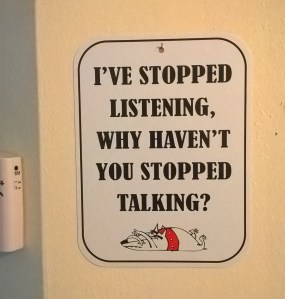 The first thing I did upon encountering a sign was to practice the Challenge, “Who’s there?” It doesn’t have to be loud when practicing, but it’s important to get into the habit of verbalizing. If the ambient light wasn’t sufficient for me to read the sign, then it’s probably not going to be enough for me to make an identification. By lighting it up with the flashlight, I could read the sign, so I can probably make a good ID.
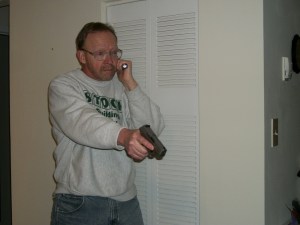
Maybe this seems like a somewhat involved exercise but let’s keep in mind, there are competing sets of probabilities in a home defense situation. The most likely probability is that the 3 a.m. bump you hear or shadow you see is, in fact, a member of your household.
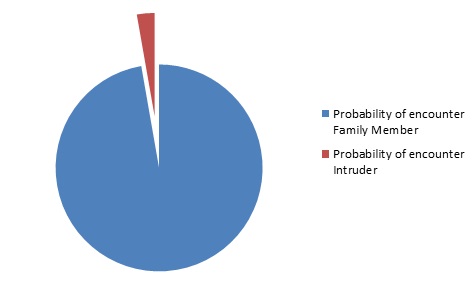
It’s advisable to practice under conditions that resemble the ones you will encounter in YOUR real world, which is different than everyone else’s. Those who have been through shoothouse training will probably notice that the above exercise doesn’t even begin to look like making entry into the shoothouse with your carbine and shooting everything you see. There’s a reason for that, I’ll let you figure it out.
Another Serious Mistake
A father mistook his 14-year-old son for an intruder Tuesday and shot him in the neck, killing him, according to Cincinnati police.
People think I’m exaggerating when I say this sort of thing happens on a very regular basis. Well, I’m not. An awful lot of people regularly babble about ‘the worst possible case.’ This incident represents ‘the worst possible case,’ not some ridiculous fantasy about “providing covering fire one handed with your shotgun in your home while dragging wounded friendlies to safety.” Ugh!
Learn to Challenge before shooting and practice doing it regularly, to wit: every time you go to the range. Two words, “Who’s there?”, probably would have prevented this tragedy. People have no problem running their mouths at every possible opportunity except when it’s most important.
Have a flashlight to identify a suspect and learn to use it in conjunction with your pistol. Just turning on the flashlight in the general direction of the suspect will probably get a response from the suspect and the overwhelming probability is that the response WON’T be ‘the light draws fire.’
Does anyone think that this father will ever have a peaceful day or decent night’s sleep for the rest of his life? The saddest thing to me is that the solution to this problem isn’t rocket science, it’s actually easy if you think about it ahead of time for just one minute.
There are 11 possible categories of Serious Mistakes. Purchase my CD so you know them all and how they happen and don’t make them yourself. It’s the price of a box of ammo, for God’s sake. I’m sick of writing about this sort of thing.


You must be logged in to post a comment.