Name that class!
I am pleased to announce that Dr. William Aprill of Aprill Risk Consulting and I have teamed up to create a class about the intellectual side of personal protection. It’s a class designed to work your brain in preparation for the period before an assault to avoid it and, if necessary, rout the attacker.
He will focus on the psychology of Violent Criminal Actors and Victim Selection. My part will cover Strategy, Tactics, Options, and Decision-Making Exercises. This will be a full weekend of learning about how the criminal mind works, how to avoid being picked for victimization, and the decisions necessary to preclude and defeat criminal attacks.
All training will be in the classroom. There will be no shooting, gunhandling, or physical contact involved. However, there will be a significant number of decision-making exercises using a new method I have devised. Every student will leave the class having made decisions to use lethal force, non-lethal force, or no force numerous times.
We would like to solicit some input on what to call the class. The titles we’ve come up with so far, some wordy and some short, don’t really please either of us. William likes The Deep End: Knowledge-Based Management of Criminal Violence but that’s wordier than I like. He wasn’t much for my idea, Those Crazy Criminals, and How to Outthink Them.
So, I am creating a little contest. Send me your suggestion for what you think a good name for the class would be. Only one entry per person, please. William and I will pick the Top Five entries. Each of the Top Five entries will receive a complimentary set of my newly updated Pistol Practice Program and Serious Mistakes Gunowners Make CDs. Entries can be [preferably] emailed to tacticalprofessor@gmail.com or as responses to this announcement on my Tactical Professor Facebook page.
I’m also offering the combination set of the Pistol Practice Program and Serious Mistakes at a 25% savings on my webstore. Anyone who purchases the new combination set and then becomes one of the Top Five will receive a full refund, including shipping.
The schedule of the class dates will be available in the next few weeks. The initial class will be held in the Atlanta area in early Fall. Other cities around the country will follow.
Thanks in advance for all of your suggestions.
Vet your sources
Please accept no advice or references with regard to personal protection without vetting it directly from the source. That includes anything I say. I try to cite where I get my information but anyone can be mistaken. There is no shortage of misinformation floating around and not all of it comes from gunshop commandos.
Already this morning, not one but two examples of why this is important have been brought to my attention. Another was made apparent last night.
In the first example this morning, a friend and client of mine shared some utterly incorrect advice that was given to her by a local law enforcement officer. My response came from my old website.
Only accept legal advice on firearms and/or self-defense from the POLICE or OTHER LAW ENFORCEMENT AGENCIES OR OFFICIALS if it is in writing on official letterhead signed by a sworn senior supervisory official of that department in his or her official capacity or a current official document of that department bearing the department’s insignia and signed by the current head of the department (Chief of Police, Sheriff, or Special Agent In Charge). Verbal (not in writing) advice from law enforcement personnel may be in error and will have NO standing in a court of law.
It is rare that you will ever get anything in writing and signed by a senior official of the PoPo. There’s a reason for that. The police rarely know the nuances of the law and frequently do not keep up on changes in the law. Last night’s example was the result of a Sergeant using an outdated legal codebook when developing a briefing. His Captain, a friend of mine, fortunately reviewed the briefing prior to it being given. When asked to cite his references, the Sergeant pulled out a five year old codebook. The section he was citing had been changed.
If you want legal advice, go to a legal expert or read a book by a legal expert, such as Andrew Branca or Massad Ayoob. Don’t ask the police. They probably don’t know as much as you would like them to. This also applies to firearms training.
2. This morning I read an article in one of the online NRA Journals that referenced “FBI Crime Statistics.” Whenever you hear or read something that cites “the FBI,” assume it is the result of a game of Chinese Whispers.
FBI information is so rarely cited correctly that your can generally assume what is being said about it is more likely to be wrong than right. Personal Defense Network published my article What Do FBI Statistics Really Say About “Gunfights”? It’s worth reading.
When it comes to using force or training/practicing to use force, either lethal or non-lethal, you have to know what you’re doing. That means doing your own research, not relying on someone else to do it for you. At the very least, do an internet search for “use of force [your State]” and find the statutory code for your State.
Commonalities among trainers
I had a unique opportunity this past weekend to observe two very different firearms trainers on back to back days. Sunday, I was invited to a Back Up Gun class conducted by Ken Hackathorn. Monday, I was able to observe the last two hours of Introduction to Combat Focus Shooting by Rob Pincus.
Hackathorn and Pincus have backgrounds and philosophies that are probably as different as can be found in the training community. Both are good friends of mine and I have noted that despite their quite divergent backgrounds and philosophies, neither gentleman speaks ill of the other. In fact, both have good things to say about each other.
I believe they both recognize what are commonly thought of as ‘facts’ in the training community are actually opinions. Every trainer’s opinion is based on his or her background. As a result, we are all victims of our own experiences and bring our own biases to our training curricula.
As I watched and listened to Pincus, a number of items struck me as echoing things I had heard the previous day in Hackathorn’s class. The parallels between significant parts of their expressed philosophies and desired training outcomes were quite interesting.
Pincus posed three questions to the students during the class. He wanted them to express, at least to themselves, some answers at the close of training.
- What are you capable of with your gun? (I.e., what are your limits?)
- What SHOULD you be better at?
- How do you get better at the answer to #2?
Questions 1 and 2 mirrored primary questions Hackathorn posed to his class the previous day. “What are you capable of doing with the equipment you are carrying?” “What real world problems might you have to solve?” At the end of Hackathorn’s class, he made the statement “Training teaches you what to practice.” This is philosophically not far removed from Question 3 posed by Pincus.
They spoke about it in different ways, but they both emphasized the need to be able to hit the target. Further, they both made the case that reality will dictate defensive shooting requirements. This is very different from being able to pick our cadence and circumstances when we go to the range by ourselves. Both made comments about the difference between training and competition and not confusing the two.
Often in the training community, we become obsessed with differences, sometimes minor, in style or technique. Periodically, the observation is made that it would be more productive to focus on what we have or espouse in common. Approaching both classes with an open mind was a good indicator of the latter.
Mindset and decision-making (2016 Tactical Conference)
Mindset and decision-making are intimately related. One of the phrases we use for having made a decision is ‘I’ve made up my mind.’ While not a formal topic, the concept of mindset and decision-making was a clear subcurrent of thought at the 2016 Tactical Conference. While this wasn’t a formal topic, per se, it was a theme that ran through several presentations and side conversations. As my friend Mark Luell put it, “This [my life and my family] is important to me and I won’t let you take it from me.”
An early conversation I had was about our Mindset as Americans. The focal point of our conversation was an article in The Atlantic Monthly. The article described the difference between US soccer competition and soccer in the rest of the world. A key dissimilarity is that in the US, our children typically spend much more time playing and less time practicing individual skills. We’re eager to confront and control/dominate early as part of our culture in a way that is less common in the rest of the world. The common attitude of “I’ll shoot someone who’s in my house” is rooted in this piece of our American Mindset. Sometimes that works out, sometimes it doesn’t.
The article’s comment about developing individual decision-making skills resonated with me. I continue to be less sanguine that Force on Force training is the panacea it’s thought to be in the training industry. If we don’t teach people the process of decision-making and then just throw them in the deep end of the pool, how helpful is that in teaching them?
“The thing that makes elite players is decision making,” Lemov told me. “They need to integrate not just how to do something but whether, when, and why.” He sees parallels to the difficulty many American students have solving problems independently. “If you give [American] kids a math problem and tell them how to solve it,” he said, “they can usually do it. But if you give them a problem and it’s not clear how to solve it, they struggle.”
John Hearne’s presentation FBI Research: The Deadly Mix got me wondering if being a nice guy is just another form of trying to control the situation. Granted, it’s a different approach to control but maybe it’s just a matter of tone and style rather than substance.
Two of Tom Givens’ presentations had an undercurrent of decision-making. Deciding whether or not our personal protection equipment is ‘needed’ during the course of our daily lives is a serious choice. As Tom puts it, the only failures in his student incident database are the result of ‘forfeits,’ i.e., the victim was unarmed and therefore unable to resolve their problem. Being unarmed was a decision that didn’t work out well in those cases.
John Murphy provided me a video I had previously seen that relates heavily to decision-making. The officer’s action in the video demonstrates the clarity of his decision and how unhesitatingly he applied it.
Those of us who have actively been at this for decades have a very clear idea of our options, their consequences, and how to appropriately apply those options. Choosing options and being clear in your own mind about when and where to apply them is a critical part of the personal protection process.
Thoughts about the Rangemaster 2016 Tactical Conference – Part II
The Rangemaster 2016 Tactical Conference was held March 11-13, 2016 in Memphis, Tennessee. I’m continuing to coalesce my thoughts and observations about the Conference.
A friend emailed me today with this question.
For 30 years I have heard the term Dry-fire. The term has been used in articles, in classes, on training videos. Now it is called Dry-Practice. Have we gone politically correct?
Since dryfire is something I work on quite a bit, that’s a question worth addressing in the context of the Conference. Dry Practice, to me, expands the boundaries of what we can work on beyond trigger manipulation. For instance, if you practiced clearing your house with an inert gun, there wouldn’t be any firing, so it would be dry practice.
I considered including a decision-making component, using decisional flash cards I’ve been developing, in my presentation. Due to time constraints, I had to leave it out. That would also be a form of dry practice even though there wouldn’t be any weapons, live or inert, involved; purely a thought exercise.
So, dry fire is actually a subset of dry practice. When it’s used that way, I can accept both definitions.
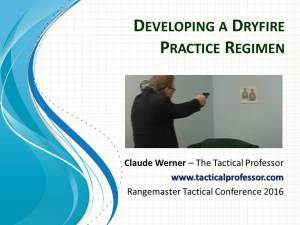
My class for the Conference was Developing a Dryfire Practice Regimen. I focused the class on fundamental manipulation skills of a pistol that were parallel to what could be seen on a square range. For instance, practicing trigger manipulation, presenting from ready or a holster, malfunction clearance, etc. Fundamental skills should be practiced until we are Unconsciously Competent at them. The more repetitions we have at a task, the more likely we are to develop the UC necessary to free our minds for situational input and decision-making.
Other classes at the Conference refined, extrapolated, or demonstrated the need for dry practice. For instance, John Hearne’s presentation Dry Practice: An Evidence Based Approach included several items of physiological theory about why dry practice is an effective form of practice. John’s Master’s degree concentration was in Research Methods so he was very thorough about his research and how he applied it to our Art. Larry Lindenman’s Managing the Don’t Shoot was taught using inert weapons. The students undertook a significant number of progressively complex exercises with multiple repetitions about how to take a threat at gunpoint without firing. Tom Givens’ Low Light Equipment class included considerable material about flashlight technique. All the techniques Tom presented could be practiced dry without going to the range. Low light livefire should simply be a verification of the manipulation skills developed in dry practice. That is the approach used at the elite Rogers Shooting School.
One attendee was so kind as to bring a set of Dry Fire flash cards he had purchased. It was interesting to look at them. While they might have some long term viability for a few shooters, there were some serious barriers to using them for skill development. Most notably, the cards assumed the user was familiar with the drills indicated on the cards. I.e., the creator took his subject matter knowledge for granted. Second, there really was no information provided about how to use the cards as part of a practice regimen. It’s important that we either have a logical sequence for building our skills or that we deliberately work, at random, skills we have already developed to maintain instant recall of our UC. Without a program for doing one sequence eventually followed by the other, the cards’ usefulness is limited, in my opinion.
Caleb Causey and I had an interesting conversation about non-verbal communication. It made me realize how powerful non-verbals can be between an instructor and a student. Chuck Haggard and I have discussed the non-verbal communication that goes on between predators and potential prey. One of the most important components of interacting with predators is to ‘fail the interview.’ Predators frequently observe whom they wish to prey upon in order to make a decision about whether to proceed with the predation. This observation is the initial component of the ‘interview.’ Appearing to be uncooperative from a distance may avert the need for a verbal or physical interaction at all. Being uncooperative is something that can be practiced dry, as well, and doesn’t necessarily require equipment.
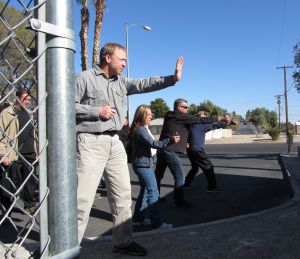
More about the Conference next time.
Initial thoughts about the Rangemaster 2016 Tactical Conference
The Rangemaster 2016 Tactical Conference is now in the record books. It was held March 11-13, 2016 in Memphis, Tennessee. The gathering included 200+ attendees, almost 30 instructors, and the fine facilities and staff of the Firearms Training Unit, Memphis Police Department Academy.
There was a great deal of material presented, more than could be attended. The Conference focuses on an inter-disciplinary approach to personal protection, so there is a lot more than just firearms and shooting involved. There was a challenging pistol match that could be shot, though; 158 people chose to shoot it.
The class I gave was Developing a Dryfire Practice Regimen. I was very gratified by the turnout of 50+ students. As the saying goes, ‘The best way to learn something is to teach it.’ Over the course of creating my presentation, my dryfire techniques became even more refined. One attendee also gave me a new training aid I wasn’t aware of. As in every class I teach, I also learn from the students.
The other classes I attended were:
- Managing the Don’t Shoot – Larry Lindenman
- Gaming the Streetz – Eve Kulczar
- Low Light Equipment – Tom Givens
- Optimizing Classroom Instruction – Tiffany Johnson, Esq.
- Metro-Tactical – Julie Thomas
- Urban Insurgency – Dr. Martin Topper
- Lasers, Red Dots, Iron Sights – Karl Rehn
- FBI Research: The Deadly Mix – John Hearne
- International Terror Operations – Gary Greco/John Holschen
- Dry Practice: An Evidence Based Approach – John Hearne
One of the pleasures of going to Conferences is getting to talk and catch up with my peers. Some of the conversations I had were:
- Cecil Burch – the Venn Diagram of Realization, instructor goals in attending conferences
- Paul Sharp – human gun interaction
- Skip Gochenour – Homicide trials
- Caleb Causey – Non-verbal communication
- Tom Givens – Standards that replicate incident skills
- Richard Jenkins – Dry Fire Flash Cards and skill development
- John Farnam – Attitudes of older fighters
- Gary Greco – American soccer team development, American Mindset (competition and confront/dominate)
- John Murphy – immediacy of action
- Mark Luell – I won’t let you take this from me
- Chuck Haggard – performance of .38 Special and .22 LR in gel and adversaries, S&W metal autoloader maintenance
- Karl Rehn – iron sights, lasers, and red dots
- Julie Thomas – tuning a class presentation
I’ll have more to report about the Conference in future posts.
The quality of training
There have been a number of recent rants about the quality of training and why would students choose one trainer over others.
The following is my commentary from a thread on Facebook:
An issue with rants about the quality of trainers is the underlying assumption that people actually want to be ‘trained.’ That’s not necessarily true. In general, people either want to be entertained or have their tickets punched. Neither of those two objectives has anything to do with training.
Further, real training involves some kind of measurement. As Greg Hamilton succinctly put it ‘without testing there has been no training.’ There are many forms testing can take but it has to be a part of training. Many, if not most, adults have never left high school emotionally. Consequently, they have an inordinate and irrational fear of performance measurement. That’s another reason they’re not really interested in being ‘trained.’ Being tested requires taking a large risk of finding out you’re not the hot shot you like to think you are. Most people have enough smarts to realize that, at best, they’re Walter Mitty, and, at worst, they’re grossly incompetent. They take great steps to protect their egos because of this.
So, what people seek out is Entertainment, Comfort, and Convenience. Nothing wrong with that. Let’s face it, most people live boring lives filled with relentless drudgery and lack of fulfillment.
As the saying goes ‘you get what you pay for.’ The payment in the context of real training is not just money but also emotional energy and commitment. Very few people are willing to make that kind of payment; they limit themselves to paying with money only.
In the end, the market for training, as well as the training provided, will generally follow a bell curve. At the ends, really good and really bad, while the huge middle segment will be mostly mediocre. In most cases, that’s enough.
Ballistic Radio interview about Boyd
John Johnston and I had the opportunity to discuss the nature of Colonel John Boyd’s theories on Ballistic Radio recently.
The OODA Loop isn’t as simple as many people would like it to be. In some cases, it hardly applies at all.
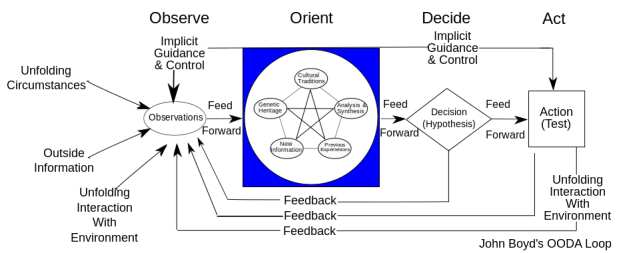
The podcast of our conversation has now been posted.
Friday Fundamentals – Biases and Changes
My colleague Grant Cunningham posed two interesting questions on his blog, which led to a lengthy Facebook discussion.
Question #1: “what are your biases or preconceptions?”
Question #2: “what have you changed your mind about in the last year?”
I gave a brief answer to #2 but I think they both deserve some elaboration.
Question #1: “what are your biases or preconceptions?”
I am very reluctant to design training for myself or others that is rooted purely in hypothesis or conjecture. I.e., I am very biased toward following the scientific method, as much as possible, when developing training paradigms.
The overall process of the scientific method involves making conjectures (hypotheses), deriving predictions from them as logical consequences, and then carrying out experiments based on those predictions. — https://en.wikipedia.org/wiki/Scientific_method

It’s important to note that testing is an inherent part of the scientific method. Testing implies some form of measurement. As a result, I believe that having performance standards is an important part of training. I think of training as ‘outcomes based’ rather than ‘input based.’
We have at our fingertips, via the Internet, an enormous amount of data available to us. At the top of this blog are links to a number of sources that I regularly read to gather information about armed encounters, shootings, gunfights, and gunbattles. I use each of those terms in a very defined way because I consider many terms used in the training community to be fuzzy and ill-defined. Fuzzy and ill-defined terminology does not fit particularly well in the scientific method.
One of the often parroted phrases I hear about gathering information from the Internet is “The plural of anecdote is not data.” I rebut this with the words of one of my accounting professors, “Accounting information is expensive to gather and is sometimes not worth it.” What he meant was that, at some point, you have to accept whatever information you have been able to collect and work with it to form an opinion.
Something I try to avoid is ‘cherry picking’ data that supports my hypotheses. Cherry picking is not always an intentional process, either; it can require a significant amount of intellectual rigor to avoid. I learned this years ago when I was Research Director of a large commercial real estate brokerage company. The brokers all worked specific geographical areas and the Vice President asked me to analyze the Zip Codes of their contact lists. As it turned out, only about 20 percent of the brokers actually had the majority of their contacts in their assigned areas, even though they thought they did. That was when I became a believer in writing things down and checking them periodically to eliminate unconscious errors. A while later, I created a database of five years of data from the Armed Citizen and found some patterns and trends I hadn’t anticipated.
To sum up my bias, I might say:
I’m not interested in conjecture. Tell me where your hypothesis originated, what data supports it, and how you measure the outcome(s) you expect your students to achieve as a result of this training.
Question #2: “what have you changed your mind about in the last year?”
My short answer to this question on Facebook was “The importance of manipulation skills vis–à–vis decision-making.”
I’ve been thinking about this for many years. In 2011, my presentation at the Rangemaster Tactical Conference was entitled The Myth of the Lone Gunman: Working with Family, Friends, and Significant Others.
At the Conference in 2014, my colleague Craig Douglas made the suggestion that I do a presentation about ‘Bad Shootings’ for the 2015 Conference. The results of my research changed me forever.
As many people know, I was part of the Rogers Shooting School for ten years, culminating with being Chief Instructor for five years. Rogers is the most elite and difficult shooting school in the world. Many police and military special units go there to train every year and get to eat a piece of Humble Pie every day of the five day Course. “We’re the best shooters in our Department, by far. Then we come here and find out we suck!” The Handgun Testing Program has no peer for difficulty in the entire training community. It is training on a level that only a select few shooters will ever get to experience. I am enormously proud of my association with the School and maintain a relationship to Bill and Ronnie to this day.
That being said, once I started doing my research on ‘Bad Shootings,’ which eventually morphed into ‘Negative Outcomes,’ I saw a vastly different set of priorities were important. Although I still believe performance standards are important, the level of those standards has changed in my mind. The NRA Defensive Pistol standards, probably at the Sharpshooter level, will suffice to solve almost every confrontation I have been able to find between an Armed Private Citizen and a marauding criminal. Truth be told, those standards would work for most police shootings also. The kicker about the NRA standards is twofold; 1) competence must be demonstrated repetitively and 2) the standard is 100 percent hits.
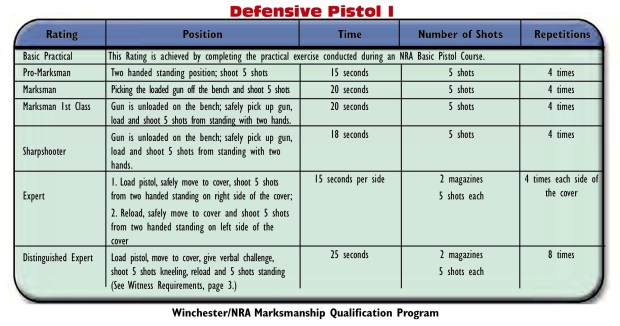
Once a person can shoot a pistol to a reasonable standard, it’s time to move on to thinking about the circumstances of personal protection and becoming proficient at decision making in that context. Decision making can be a very difficult task, especially when we are armed. Lack of proficiency, not just at marksmanship, but at gunhandling under stress, complicates this. Persons who are not Unconsciously Competent can easily become focused on the firearm rather the situation. Focusing on the wrong thing can lead to Bad Decisions, which in turn can result in Negative Outcomes.
These are the Negative Outcome categories I identified in my research. There are probably more.
- Brandishing/showing
- Chasing and shooting
- Downrange failures (shot an innocent while shooting at a threat)
- Intervention
- Lost/stolen guns
- Mistaken identity shootings
- Negligent discharges
- Self-inflicted GSW
- Unintentional shootings
- Police Involvement (arrests for non-shooting related incidents)
- Poor judgement
- Unauthorized access (generally by small children)
- Unjustifiable shootings
- Warning shots
As an example of one category, Unintentional Shootings, here’s a screencap of some of the stories I have collected.
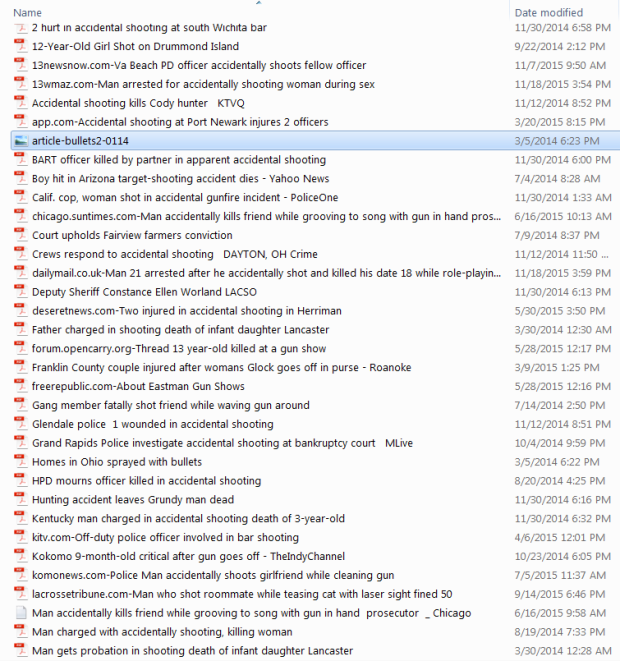
Bad decisions have serious consequences and end up being punished in a variety of ways, some legal and some social. The legal consequences are obvious; the shooter goes to court and sometimes thence to prison. The social consequences of Negative Outcomes are less obvious. If a person accidentally shoots a family member, whether the criminal justice system gets involved or not, I doubt that family relationship will ever be the same. The particular incident I am thinking of occurred when a police officer shot his daughter, thinking she was an intruder.
Decision making has many aspects to it that people don’t often consider. Where you point a gun anytime you handle it is a decision that has to be made. Consider that the next time you’re in a gun shop; where are you going to point the gun as you pick it up to ensure that you don’t muzzle anyone? This relates to another reason I am not fond of the overhand method of slide manipulation. During administrative gunhandling, which happens far more than shooting, the overhand method simply does not give the same level of muzzle control that the slingshot method does. I regularly have to correct students about muzzling themselves when using the overhand method. Using the slingshot technique, not at all.
Note that the Decision Making Process starts long before an incident. For instance, having a flashlight and then practicing with it is a decision. Not having one and/or not practicing with it is a Bad Decision. There are many other possibilities too. Failing to devise emergency plans and then discuss them with your family is a Bad Decision.
Look at the list of Negative Outcomes. The category ‘Downrange Failures’ is the only one that is marksmanship driven. All the rest relate to Decision Making and gunhandling. That’s why I changed my mind.
Snub Revolver DVD Special
Sometimes, you’ll be surprised what you find when you clean.
–my Mother
And she was right. Another box of Secrets of the Snubby turned up. I’m running a package deal on Secrets and Fundamentals as a combo. Only $24.95 for both when purchased as a package.
I like snubs and I like to push the performance envelope with them. Once you know what you’re doing, snubs are a lot more than an “arm’s length gun.”
 tacticalprofessor
You must be logged in to post a comment.