Teaching children about guns
I recently had the opportunity to overhear a friend helping home school her grandchildren via telelearning while we’re under House Arrest during the Beer Plague. It was obvious that the lesson involved firearms. I was fascinated because I said to myself “Whoever wrote that lesson (I didn’t realize it was a book) actually knows something about guns.” When the lesson was finished, I asked what the source of the lesson was. It was Julie Golob’s book Toys, Tools, Guns & Rules: A Children’s Book About Gun Safety. https://www.amazon.com/dp/B078TB9RJB
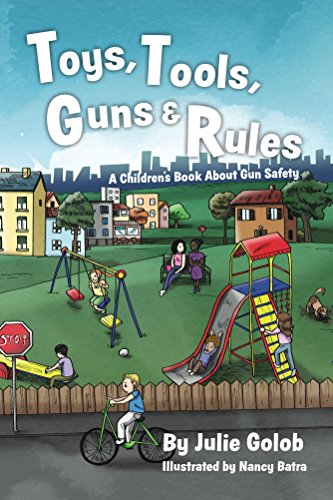
My thought was “Well duh, Tactical Professor, yes indeed Julie Golob knows something about guns.” The meat of her bio is
Julie Golob is one of the most accomplished professional shooters in the world with more than 150 championship titles and top scores in international, national and regional marksmanship competitions in 7 different shooting disciplines.
https://www.juliegolob.com/press
For new gunowners who have children in the house, this book is highly recommended. Long time gunowners will find it useful also. I was impressed by how it explained very fundamental safety rules that kids need to know. Be aware that because it is a color picture book, the Kindle version is not compatible with all Kindle devices. A list of compatible devices is on the Amazon page for the book.
https://www.amazon.com/dp/B078TB9RJB
FTC Notice: I don’t receive any compensation for mentioning Julie’s book. I just think it’s an excellent resource for gun owners, new or long time.
Store guns out of sight and inaccessible
A very recent incident related to me by a friend.
- A man (and his live-in girlfriend) were given a handgun by his grandfather during the Beer Plague.
- They live in a small apartment on the second floor in a large city.
- He placed the gun on top of the bedroom dresser.
- This week, a thief used a ladder to get to the bedroom window and cut the screen to get in.
- The handgun was immediately apparent so it was the first thing the thief picked up.
- The man, who was alone at the time, was sleeping on the sofa in the other room when the thief made entry.
- The thief awakened him at gunpoint.
- The thief stole much of the couple’s possessions, including clothes, laptop, etc. in addition to the gun.
- The thief also demanded the keys and took them.
- After the thief departed, the man called the POlice.
- The POlice Department took the report about the home invasion over the phone.
- The man arranged to have the locks changed but that will take a while.
- The next day, the thief came back and tried to unlock the front door with the keys he had stolen. The door has a cross bar that was in place so the thief was unable to get in. The man yelled at him and he went away.
- Unsurprisingly, the man and his girlfriend are concerned and frightened.
- Fortunately, the thief did not injure the man.
Lessons from the incident
- This is a clear example of a Negative Outcome.
- The purpose of this type of incident report is not to denigrate the person it happened to. Rather, it is to provide important lessons to the rest of us, our family, and our friends.
- Leaving guns in open view is NEVER a good practice.
- Store guns where they are not accessible to unauthorized persons.
- Even a small lockbox or toolbox would have prevented the thief from immediately gaining access to the handgun. The man might have then awakened on his own and been able to achieve a more Positive Outcome.
- For the mechanically handy, most nightstands can be fitted with a drawer lock. While this will not deter a determined thief for long, it will not allow a thief to immediately gain access to your weapon. Such a lock will also prevent children from gaining access to a firearm.
- Guns that are on display as heirlooms or for other reasons should be disabled.
- Some burglars are also known as ‘Second Story Men’ https://www.merriam-webster.com/dictionary/second-story%20man for a reason. Do not assume that living above the ground floor prevents unlawful entry. Even upper story windows should have devices that prevent them from being opened too far when ventilation is wanted.
- Criminals are opportunistic. This incident started out as burglary and then turned into a home invasion. If the man had struggled when he was awakened, it could easily have turned into a murder or homicide. Neither is desirable.
- Even if keys are not obviously taken, you should assume that a burglar has them. This means locks need to be changed and door locks supplemented until the change is made.
“There’s three kinds of men. The one that learns by reading. The few that learn by observation. And the rest have to touch the electric fence.” –often incorrectly attributed to Will Rogers, American humorist
Tactical Professor books (all PDF)
- Serious Mistakes Gunowners Make http://seriousgunownermistakes.com
- Indoor Range Practice Sessions http://indoorrangepracticesessions.com
- Concealed Carry Skills and Drills http://concealedcarryskillsanddrills.com
- Advanced Pistol Practice http://bit.ly/advancedpistolpractice
- Shooting Your Black Rifle http://shootingyourblackrifle.com
Guns 101 – Loading a magazine
Loading (charging) a magazine is another task that’s neither intuitive nor easy for beginners. Here’s an explanation of one way to do it.
Not everyone is going to practice with their new pistol but for those who do, this is a useful skill.
Other useful skills are listed in my book,
Concealed Carry Skills and Drills http://concealedcarryskillsanddrills.com
For those who only have access to an indoor range, which means 99.999% of new gun purchasers, my book
Indoor Range Practice Sessions http://indoorrangepracticesessions.com
is a useful resource.
Guns 101 – next episode
More correctly, the title should be Locking the Slide to the Rear. For a new gunowner, this is not nearly as simple as is often believed. Locking the slide to the rear is an integral part of checking whether an autoloading pistol is loaded or not. For new gunowners, this is worth practicing every day until it can be done readily.
My ebook, Serious Mistakes Gunowners Make is an excellent purchase for new gunowners or as a present if you know a new gunowner.
Serious Mistakes Gunowners Make http://seriousgunownermistakes.com
Guns 101 on Polite Society Podcast
The Polite Society Podcast https://www.youtube.com/channel/UCkVLaQzRB5DKDzZ05J7o2KQ on YouTube has created a series for new gun owners called Guns 101. Each segment is a short (less than 10 minutes) standalone lesson in various fundamental aspects of gun ownership and usage.
The Tactical Professor did a segment on storing guns in cars when it’s necessary. For instance, if a gunowner needed to go into a courthouse, the Post Office, or other denied area, the time to think about what to do with the gun is before you get there.
Also, my book Indoor Range Practice Sessions http://indoorrangepracticesessions.com is an excellent primer for new gunowners who actually want to shoot their guns. When the ranges start re-opening, you can have a plan for when you go.
The Newhall Incident anniversary
At 11:55 p.m., April 5, 1970, two Officers of the California Highway Patrol stopped a car for brandishing a firearm at another vehicle hours earlier. Minutes later, they and two other CHP Officers would lie dead in the parking lot of the restaurant where the stop took place. Their murderers would escape into the night, virtually unscathed in the gunfire.
https://tacticalprofessor.wordpress.com/2018/04/06/the-newhall-incident-april-1970/
RIP, Officers Frago, Gore, Alleyn, and Pence.
Scaling targets
Since dry practice is our main practice method right now, it’s useful to know how to scale targets since most of us don’t have long distances available.

Math is like going to the gym for your brain. It sharpens your mind.
“Claude, how do I shrink an IDPA target so it appears as though it is 25 yards away when my dry fire range is 7 yards? Thank you.”
Many people think they will never use elementary algebra once they leave high school but sometimes it still comes in handy. The above question can be simply solved through the use of cross-multiplication.
The first part of the problem is we have to determine the ratio of the two distances and then solve for the correct size (height) of the target. The IDPA target is 30 inches tall and would be full size at 25 yards. How tall would it be at seven yards?
| Height | 30 | x |
| yards | 25 | 7 |
Cross multiplication means the product of the upper left and lower right will be…
View original post 334 more words
Make Ready speed
Here’s an interesting metric for response time I’ve never seen tested. The question came up because of a Twitter post about two unpleasant people having a confrontation in Philadelphia. The verbal confrontation occurred as a result of a car blocking traffic.
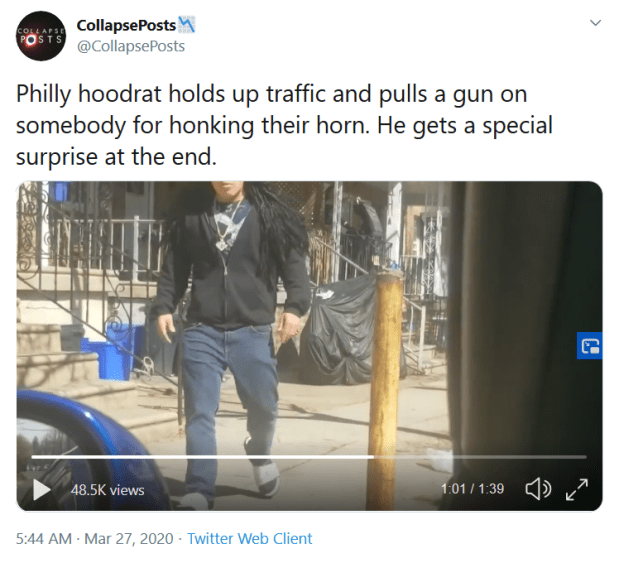
https://twitter.com/CollapsePosts/status/1243473965332541446
Cast of Characters
- Footmobile Personage – Centerline holsterless IWB carry, Browning pattern autoloader in either Condition 2 (hammer uncocked) or, more likely, Condition 3 (hammer down, empty chamber).

- Automobile Personage – Pistol presented in soft IWB holster (Uncle Mikes or Blackhawk) in either chambered or, possibly also, empty chamber carry.

- Automobile Personage’s passenger, who is put in the line of fire as a result of the confrontation.
Possible response time metrics
For the Automobile Personage: if he perceived the Footmobile Personage’s display as an actual deadly threat, how long would it have taken him to get his pistol into action? Within that question, there are numerous different possible start positions; 1) starting with holstered pistol in belt, 2) starting with holstered pistol on seat next to him, or 3) starting with holstered pistol in the console or glove box.
Starting with the holstered pistol in the belt has two variations; 1) holster stays in pants and the draw proceeds normally or 2) the holster comes out of the pants along with the pistol. Then the holster would have to be wiped off the pistol. All three possible starts then have two possible further variations; 1) pistol has a round in chamber, in which case the holster has to be wiped off, necessitating sweeping the Support Hand with the muzzle or 2) the holster has to be wiped off and then the slide cycled to put a round in the chamber.
For the Footmobile Personage: if he perceived the Automobile Personage’s display as an actual deadly threat, how long would it have taken him to get his pistol into action? Start position is with the Primary Hand holding the concealment garment up. The concealment garment is released to draw the pistol. This then has two possible variations; 1) the draw goes as desired with no fouling of the draw by the concealment garment or 2) the concealment garment falls down and fouls the draw, requiring the entire draw sequence to be repeated using the Support Hand to clear the concealment garment. Further variations are; 1) if the pistol is in Condition 2 (hammer down), then the hammer has to be cocked, either with the thumb of the Primary hand or swept to cocked position by the thumb of the Support hand or 2) if the pistol is in Condition 3 (Chamber Empty), then the slide has to be cycled to put a round in the chamber.
For the Automobile Personage’s passenger: how quickly can he exit the Kill Zone if the Footmobile Personage decided to start shooting? There are at least two possible variations; 1) get as low as possible in the car and hope that the car and Automobile Personage absorb any bullets fired by the Footmobile Personage or 2) completely exit the vehicle and take cover outside of it.
Target engagement
From the standpoint of target engagement, the Footmobile Personage is in a much better position to achieve a good firing stance, either for aimed fire or indexed fire (point shooting). The Automobile Personage would probably be forced into an indexed fire stance because of the angle the target is to him. Unfortunately, indexed fire in this position tends to be very erratic because the left eye has a better view of the target and tends to control the movement of the gun.
Fortunately, the entire incident turned out to be an example of social distanced monkey dancing. Nonetheless, we can ask certain doctrinal questions to help our future preparation and Recognition Primed Decision-Making.
Also, is there gun registration in Philadelphia? I thought that was pre-empted by Pennsylvania State law.
Tactical Professor books (all PDF)
Serious Mistakes Gunowners Make http://seriousgunownermistakes.com
Indoor Range Practice Sessions http://indoorrangepracticesessions.com
Concealed Carry Skills and Drills http://concealedcarryskillsanddrills.com
Advanced Pistol Practice http://bit.ly/advancedpistolpractice
Shooting Your Black Rifle http://shootingyourblackrifle.com
Thanks to Gun Free Zone for drawing my attention to the incident.
Dry Practice Safety Procedures
The influx of new firearms owners in the past few weeks has generated considerable interest in dry practice. For both new and long time owners, a primer on dry practice is in order.
Dry practice is the process of practicing with a firearm without using ammunition. Generally, this is done at home but can also be done at the range in conjunction with live fire practice. The purpose of dry practice is to become more familiar with the operation of a firearm without the distractions of recoil and the Overpressure Event aka muzzle blast. In times of limited or no availability of ammunition and range resources, dry practice may be the only practice method available to us.
There are very specific safety precautions that should be used to make dry practice as safe as possible. A one page sheet listing safety precautions is available here. dry practice safety procedures Note that no usage of any potentially life-threatening device, such as firearms, automobiles, chain saws, or electric outlets can be considered completely safe.
Using a chamber safety device is highly recommended when dry practicing. A number of commercially available devices are available and they work well. A field expedient device is a pipe cleaner aka ‘craft fuzzy stick’ through the bore and bent over in the ejection port.
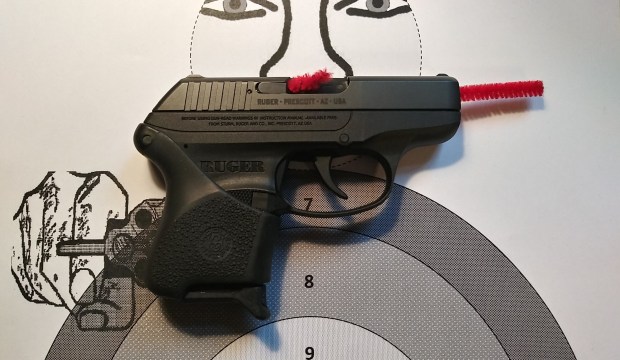 These can be purchased at Wal-Mart for less than one dollar for a large package of them.
Previous articles about dry practice, nee dryfire, can be found by clicking the ‘dryfire’ Category in the right column menu.
Practice and practice safely.
Know The Rules
#fridayfundamentals
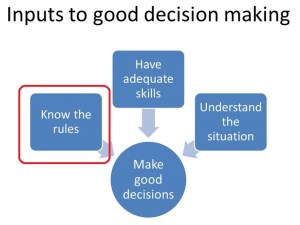
Along with learning gun safety principles and procedures, new gunowners should begin to acquire an understanding of the Rules pertinent to defensive use of firearms. Periodically, long time gunowners should also review them. This is especially true for those who have programmed their Orient Phase with platitudes such as “Better tried by 12 than carried by six, I’ll shoot anyone I find in my home, Don’t draw your gun unless you’re going to shoot,” ad nauseum.
There are two good initial sources for this review. The first is the legal statutes for using Force and Deadly Force of your State. For instance, in the State of Georgia the use of Force and Deadly Force is covered by OCGA 16-3-21, https://law.justia.com/codes/georgia/2010/title-16/chapter-3/article-2/16-3-21, OCGA 16-3-23, and OCGA 16-3-24.
The Statute(s) for every State are available online with a little searching. Some States’ laws are relatively easy to read. Others are confusing tangles of legal gobbledygook. If reading your particular State’s law makes your head hurt, think about what it would be like trying to justify your actions in a criminal court using that miasma.
Keep in mind that there is a significant legal difference between Force and Deadly Force. Discharging a firearm intentionally at another person is a use of Deadly Force, even if the other person isn’t injured. The legal justification for using Deadly Force is very high in every State. Displaying a firearm MAY be a use of [non-deadly] Force in your State or it MAY be a serious felony, such as Aggravated Assault.
The second source is the pamphlet What Every Gun Owner Needs to Know About Self-Defense Law. https://armedcitizensnetwork.org/learn/what-every-gun-owner-needs-to-know It is a general document based on the Model Penal Code that gives an overview of what the process can be like but does not go into the specifics of State laws because they vary so much. The Network will send a free hard copy upon request and a PDF is available at the link.
Normalcy note
I sat on the deck while having my morning coffee today. There were lots of birds out and I like watching them and listening to their calls. A group of three Cardinals flew into a small tree just beyond the deck. At first, I thought one of them was a Sparrow because its plumage wasn’t very colorful but in a little bit it came into better view. The bird had the distinctively colored beak of a Cardinal along with the crest on the head. It must have been immature, although it seemed to be bigger than the two brightly colored one. I’ll have to research the species a little more.
Dale Carnegie note
Please stop berating those who have recently bought guns in a panic, those who don’t have many everyday staples on hand, or who rushed out to buy 27 years’ worth of toilet paper. Doing so is a variation of the psychological game “I told you so.” https://www.tandfonline.com/doi/abs/10.1177/036215377600600306?journalCode=rtaj20
It’s nicer to keep in mind Dale Carnegie’s number One principle from The Golden Book summation of How to Win Friends and Influence People.
Become a Friendlier Person
Don’t criticize, condemn[,] or complain.
Tactical Professor books (all PDF)
Serious Mistakes Gunowners Make http://seriousgunownermistakes.com
Indoor Range Practice Sessions http://indoorrangepracticesessions.com
Concealed Carry Skills and Drills http://concealedcarryskillsanddrills.com
Advanced Pistol Practice http://bit.ly/advancedpistolpractice
Shooting Your Black Rifle http://shootingyourblackrifle.com
Fair Disclaimers:
- I am a member of the Armed Citizens’ Legal Defense Network and a local affiliate trainer. However, I receive no compensation for providing the link to it.
- I am NOT a lawyer and nothing in this post constitutes legal advice.
 tacticalprofessor
You must be logged in to post a comment.