Claude Werner’s Revolver Operator Class
I like revolvers and I like teaching people how to use them well. It’s only an “arm’s length gun” if you’re incompetent.

The trap of specialization is rampant in martial training, whether it is empty hands or tools. The belief that a narrow focus is the path to mastery will often lead to the problem of “functional fixedness”.
In David Epistien’s book “Range: Why Generalists Triumph in a Specialized World” uses the 2008 financial collapse as an example of over specialization. He says “legions of specialized groups optimizing risk for their own tiny pieces of the big picture created a catastrophic whole.”
Many believe learning to be linear, in other words a modular progression, and some favor the circular, a continuing cycle of review and depth, both are important, nevertheless a holistic approach, or the master key has the benefit of a quick prioritization of important information allowing adaptation to a new skill. Therefore I am constantly seeking new learning experiences in shooting, and when Claude Werner offered me the…
View original post 542 more words
Get Ready (part 2)
Why do people carry an autoloader with an empty chamber? Because they’re concerned about having an Unintentional Discharge.
Sheriff’s gun goes off inside Walmart during a ‘Shop with a Sheriff’ event
One of the comments about the incident on Facebook sums up many people’s feelings about it.

Which is more likely to save your life? Carrying an autoloader with the chamber empty or carrying a revolver ready to go? Active Self Protection provides us with some food for thought.
A Stark Reminder to Keep Your Defensive Firearm Chambered
Armed Robber Kills Store Owner Whose Gun Wasn’t Ready
Another Reminder to Carry Chamber Full
Jack Ryan Season 2

Although the female character Harriet Bauman in the latest Jack Ryan series on Prime described herself as ‘former KSK,’ [German Special Forces] no women had passed the KSK selection process as of 2015. Being part of the BND [German Federal Intelligence Service] would be more believable except that there is no particular method of transition from those services to each other. A more likely transition would have been from the KSA [Strategic Reconnaissance Command of the Bundeswehr].
Overall, the second season has been largely disbelievable and highly contrived. The sequence involving the assassination of Senator Moreno was ridiculous. The idea that the State Department’s Diplomatic Security Service wouldn’t be on top of the travel and security arrangements for a visiting US Senator in a semi-hostile country is laughable. To compound the absurdity came the recruiting of a reluctant and non-vetted ‘boat driver’ for the CIA Special Activities Center nee Division team. Then the boat driver and Ryan becoming total loose cannons made it even worse.
I haven’t read a Tom Clancy book in a while but I hardly think he would approve of this buffoonery.
Get Ready
It’s often apparent in classes how much time it takes people to switch gears and ‘Get Ready.’ Transitioning our Defense Condition, both mentally and physically, from Not Ready to Ready may be the most important skill we develop. We don’t necessarily have to deal with the Tueller Principle but even if a criminal is moving at a brisk walk, we seldom have 12 seconds to ‘Get Ready.’
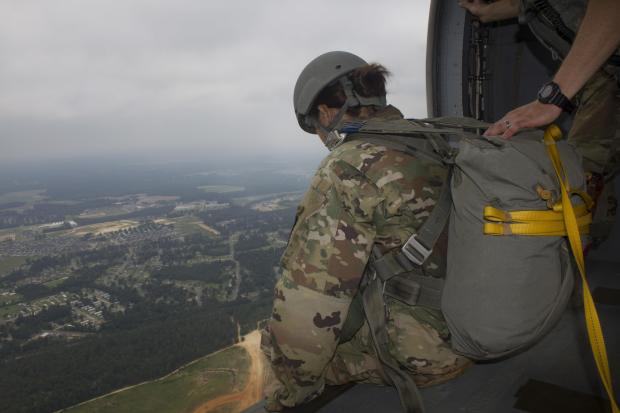
U.S. Army photo by Staff Sgt. Felix Fimbres
Ten to 12 seconds is a common response time to a Ready command during firing squad practice on the firing line during classes. That’s a luxury of time we will seldom have prior to a criminal attack. Often people will look around to see what others are doing before Getting Ready. When a criminal comes for you, others will seldom even notice, much do anything to give you an Alert.
Get Ready is actually what Jeff Cooper’s Color Codes are about. They describe a state of mental readiness to act.
Mental condition comes first and can be followed by increasing our physical Readiness status.
- Ready positions worth practicing
- Hands in front
- Hand on gun
- Transition from OC (OC canister at arm’s length)
- Low Ready
When is Low Ready appropriate? Avoiding Aggravated Assault charges is just as important as avoiding the assault itself. Either can change our lives forever. A good guideline comes from the Los Angeles POlice Department.
What is the value of training?

Firearms instructors are periodically asked the question “Why should I take training?” The answer often comes in the form of a list of skills that are taught or the reasoning behind using a certain technique. However, these do not address the underlying fundamental reasons for taking firearms training at all.
- You don’t know what you don’t know.
- Much of what you know is wrong.
- It’s good to have some of the answers to the test before taking it.
These issues relate to both technical competency with using a firearm (gun safety and marksmanship) and the ability to use the firearm correctly in a personal protection situation (legal and tactical).
You don’t know what you don’t know.
Shooters who only take their gun to an indoor range once a year “to sight it in” generally have a highly ‘cocooned’ knowledge of firearms. They know how to operate a firearm in a…
View original post 1,037 more words
Capable v. Likely
What are we capable of versus what are we likely to do?
John Johnston of Citizens Defense Research and I have been discussing this topic in relation to standards in a class. He and I are both believers in having standards and being able to demonstrate competent execution of those standards. Being able to demonstrate means both the instructor and the client.
One of the things I do in private sessions is to have the client take a hostage rescue shot. The target is a complete head next to and not obscured by the hostage head. Only one shot is allowed. The client gets to pick the distance. Most clients, even competent shooters, will close to 3 yards (9 feet) or less. That’s always interesting because the boundary between the near and far phases of Social Space in proxemics is 7 feet for North Americans.
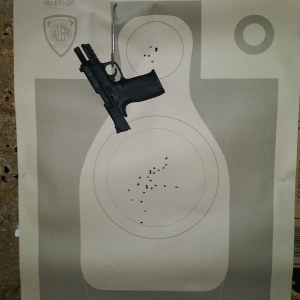
Our technical capabilities are limited by what is within our own heads. What we think we can do represents ‘likely,’ regardless of what we’re actually capable of.
As Ken Hackathorn has said for many years:
You are unlikely to do something in a stressful situation that you’re not reasonably sure you can do competently.
The real value of training and practice isn’t gaining technical competence, it’s achieving confidence in your abilities.
If you are interested in bringing your Strategies, Tactics, and Options for Personal Protection to a higher level, please subscribe to my Patreon account for $5 per month. It’s an investment in yourself. https://www.patreon.com/TacticalProfessor
If you are interested in bringing your skill level higher, please purchase one of my books about how to practice effectively. https://store.payloadz.com/results/337896-tactical-professor
METT-TC and how it applies to us
Excerpt from: FM 6-0 Mission Command: Command and Control of Army Forces – August 2003
RELEVANT INFORMATION SUBJECT CATEGORIES—METT-TC
B-10. Relevant information is all information of importance to the commander and staff in the exercise of command and control (FM 3-0 [Operations – February 2008]). In the context of information management, the six factors of METT-TC — Mission, Enemy, Terrain and weather, Troops and support available, Time available, and Civil considerations—make up the major subject categories into which relevant information is grouped for military operations. The commander and staff consider R[elevant] I[nformation] for each category in all military operations. The relative impact of each category may vary, but the commander and C2 [Command and Control] system consider them all.
MISSION
B-11. The mission is the task, together with the purpose, that clearly indicates the action to be taken and the reason therefore (JP 1-02 [Department of Defense Dictionary of Military and Associated Terms]). It is always the first factor commanders consider during decisionmaking. (See FM 5-0 [The Operations Process – March 2010].) A thorough understanding of the mission focuses decisionmaking throughout the operations process. … Commanders and staffs view all the other factors of METT-TC in terms of their impact on mission accomplishment.
B-12. The mission statement defines the who, what, when, where, and why of the operation. A thorough understanding of why the unit is conducting an operation provides the focus for planning.

In every encounter there is an element of chance.
–John Hall, former head of the FBI Firearms Training Unit
Family mourns loss of single father of two girls
The perils of Intervention are very high. The question I like to pose about mission definition is:
To whom does your primary duty and allegiance lie, a total stranger or your family?
That’s a moral decision I do not choose to answer for anyone else, only myself.
Tactical Reloading
There is still considerable disagreement about the utility of the Tactical Reload. However, whether it has utility or not, it doesn’t have to be a clumsy technique. This is how the Tactical Reload is taught at the elite Rogers Shooting School and Dodd & Associates.
The magazines are handled by the thumb, forefinger, and middle finger. For visual clarity in this photo essay, the partially depleted magazine is depicted by an empty stainless magazine and the full replacement magazine by a blue magazine with a dummy round on top.
- Draw the reload magazine as usual, forefinger along the front.
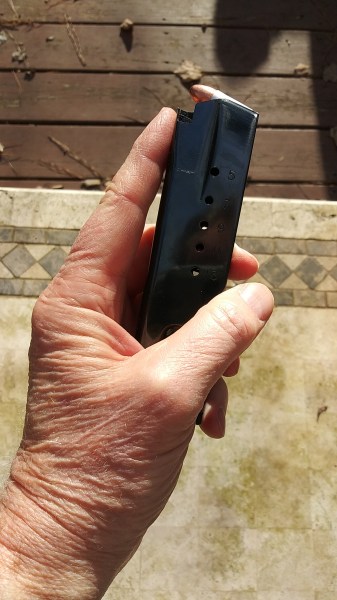
- Slip the forefinger down the magazine so the full magazine is held between the forefinger and middle finger. This leaves the thumb and forefinger available to catch the partially depleted magazine.
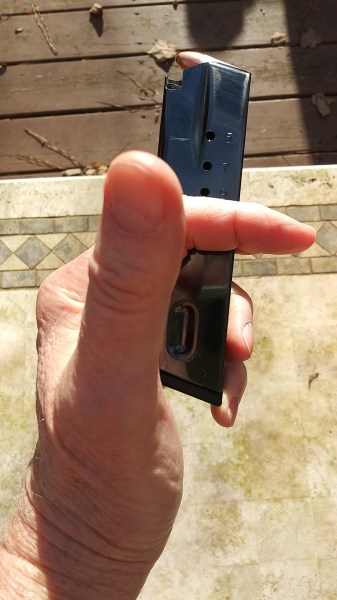
- Eject the partial magazine between the thumb and forefinger and catch it.
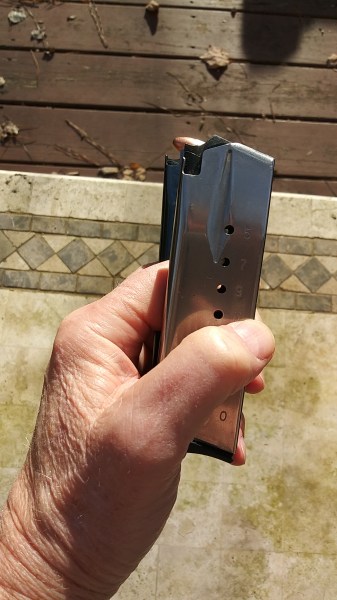
- Insert the full magazine, which is held between the forefinger and middle finger, into the pistol.
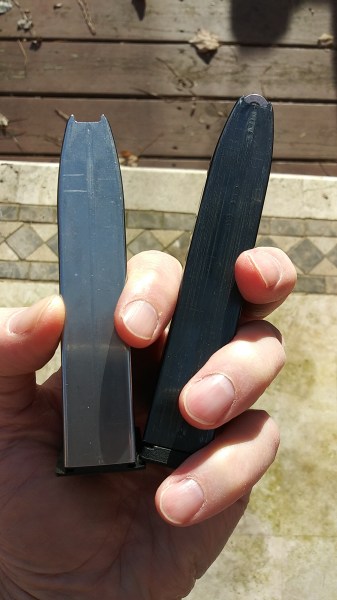
- Stow the partial magazine in a pocket, pouch, or your belt.
This method uses the hand’s two most dexterous digits, the thumb and forefinger, to catch the partially depleted magazine. Using the hand’s most dexterous digits makes it simple to handle even double column magazines.
The Role of Questions in Personal Protection
Who is around me and what are they doing? – Tom Givens
What are you capable of? – Ken Hackathorn
What’s the object of the exercise? – the Tactical Professor
What is the best use of my time right now? – Alan Lakein
METT-TC is a well developed structure for asking questions when developing plans for Personal Protection.
- Mission
- Enemy
- Terrain and Weather
- Troops and Support Available
- Time Available
- Civil (Legal and moral) Considerations
SALUTE is a good structure for gathering information in the moment.
- Size
- Activity
- Location (proximity)
- Unit
- Time
- Equipment
When we are children, we are constantly asking questions. As adults, we usually get in the habit of providing opinions, experiences, and self-promotion instead of asking question. Information gathering is a vital skill in Personal Protection. Putting ourselves back into the question asking mode requires a shift in our thinking patterns that requires practice.
My thanks to John Correia of Active Self Protection for stimulating my thinking about the topic.
My Patreon page is where I go into more depth on Personal Protection topics. https://www.patreon.com/TacticalProfessor
Muzzle direction is the primary safety
Muzzle direction is the primary safety. Always has been and always will be.
–Bill Rogers of the elite Rogers Shooting School
“He told police he was oiling a handgun and had put a magazine in it and racked the slide when it fired, hitting his wife as she sat on a couch nearby.”
Man sentenced to probation in shooting of his wife
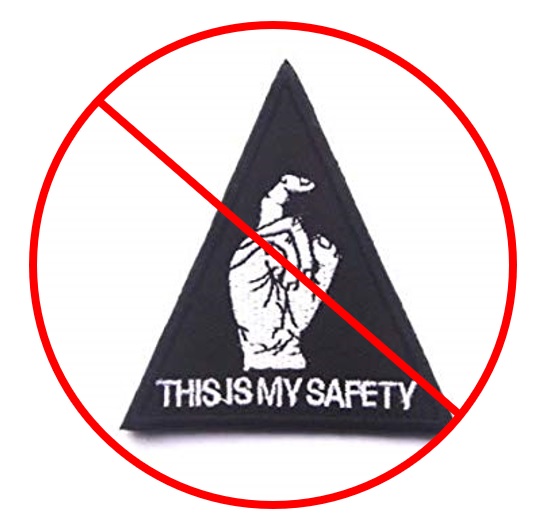
I absolutely despise the meme from Blackhawk Down that shows a trigger finger with the phrase “This is my safety.” Trigger finger discipline is a good thing but there’s a reason it’s Number 3 in the Four Rules of Gunhandling. Muzzle Direction is Number 2, as it should be in the scheme of things.
 tacticalprofessor
You must be logged in to post a comment.