Name that class!
I am pleased to announce that Dr. William Aprill of Aprill Risk Consulting and I have teamed up to create a class about the intellectual side of personal protection. It’s a class designed to work your brain in preparation for the period before an assault to avoid it and, if necessary, rout the attacker.
He will focus on the psychology of Violent Criminal Actors and Victim Selection. My part will cover Strategy, Tactics, Options, and Decision-Making Exercises. This will be a full weekend of learning about how the criminal mind works, how to avoid being picked for victimization, and the decisions necessary to preclude and defeat criminal attacks.
All training will be in the classroom. There will be no shooting, gunhandling, or physical contact involved. However, there will be a significant number of decision-making exercises using a new method I have devised. Every student will leave the class having made decisions to use lethal force, non-lethal force, or no force numerous times.
We would like to solicit some input on what to call the class. The titles we’ve come up with so far, some wordy and some short, don’t really please either of us. William likes The Deep End: Knowledge-Based Management of Criminal Violence but that’s wordier than I like. He wasn’t much for my idea, Those Crazy Criminals, and How to Outthink Them.
So, I am creating a little contest. Send me your suggestion for what you think a good name for the class would be. Only one entry per person, please. William and I will pick the Top Five entries. Each of the Top Five entries will receive a complimentary set of my newly updated Pistol Practice Program and Serious Mistakes Gunowners Make CDs. Entries can be [preferably] emailed to tacticalprofessor@gmail.com or as responses to this announcement on my Tactical Professor Facebook page.
I’m also offering the combination set of the Pistol Practice Program and Serious Mistakes at a 25% savings on my webstore. Anyone who purchases the new combination set and then becomes one of the Top Five will receive a full refund, including shipping.
The schedule of the class dates will be available in the next few weeks. The initial class will be held in the Atlanta area in early Fall. Other cities around the country will follow.
Thanks in advance for all of your suggestions.
Vet your sources
Please accept no advice or references with regard to personal protection without vetting it directly from the source. That includes anything I say. I try to cite where I get my information but anyone can be mistaken. There is no shortage of misinformation floating around and not all of it comes from gunshop commandos.
Already this morning, not one but two examples of why this is important have been brought to my attention. Another was made apparent last night.
In the first example this morning, a friend and client of mine shared some utterly incorrect advice that was given to her by a local law enforcement officer. My response came from my old website.
Only accept legal advice on firearms and/or self-defense from the POLICE or OTHER LAW ENFORCEMENT AGENCIES OR OFFICIALS if it is in writing on official letterhead signed by a sworn senior supervisory official of that department in his or her official capacity or a current official document of that department bearing the department’s insignia and signed by the current head of the department (Chief of Police, Sheriff, or Special Agent In Charge). Verbal (not in writing) advice from law enforcement personnel may be in error and will have NO standing in a court of law.
It is rare that you will ever get anything in writing and signed by a senior official of the PoPo. There’s a reason for that. The police rarely know the nuances of the law and frequently do not keep up on changes in the law. Last night’s example was the result of a Sergeant using an outdated legal codebook when developing a briefing. His Captain, a friend of mine, fortunately reviewed the briefing prior to it being given. When asked to cite his references, the Sergeant pulled out a five year old codebook. The section he was citing had been changed.
If you want legal advice, go to a legal expert or read a book by a legal expert, such as Andrew Branca or Massad Ayoob. Don’t ask the police. They probably don’t know as much as you would like them to. This also applies to firearms training.
2. This morning I read an article in one of the online NRA Journals that referenced “FBI Crime Statistics.” Whenever you hear or read something that cites “the FBI,” assume it is the result of a game of Chinese Whispers.

FBI information is so rarely cited correctly that your can generally assume what is being said about it is more likely to be wrong than right. Personal Defense Network published my article What Do FBI Statistics Really Say About “Gunfights”? It’s worth reading.
When it comes to using force or training/practicing to use force, either lethal or non-lethal, you have to know what you’re doing. That means doing your own research, not relying on someone else to do it for you. At the very least, do an internet search for “use of force [your State]” and find the statutory code for your State.
Intervene and die – Part II
Police: Student stabbed to death on Georgia college campus
ATLANTA – A freshman at Fort Valley State University was stabbed to death after he came to the aid of some female students who were being harassed and groped by a man outside the school cafeteria, a Georgia Bureau of Investigation agent said Wednesday.
When someone is engaging in socially unacceptable behavior, it’s hard to tell how far they’re willing to take it. Unless you passed that Mind Reading 101 class with flying colors, you have no way of knowing.
And pulling your gun on someone who is ‘harassing and groping’ might not work out too well, either. This kind of situation is so touchy and nebulous that there’s not much upside and a great deal of downside.
Self-inflicted gunshot wounds and unintentional spouse/child/sibling shootings happen much more often than people think. So do Negative Outcomes from interventions.
If you insist on thinking intervening is a good idea, be smart about it. Years ago, I heard a struggle and shouting going on in the hallway of the apartment building I lived in. Even 25 years ago, I kept a large can of unpleasant chemical called Phaser by my front door. It was a can of CS gas the size of a small fire extinguisher. My plan was to open the door and hose everyone outside down with gas because I had no way of knowing who was whom and what was going on. When I opened the door, it turned out to be two Atlanta police officers trying to get the bracelets on some low-life. So I let them finish the job, without hosing them down, and then went back to my book.
Verbalization is for pre-fight situations. Once a struggle has begun, the time for talking is over. I didn’t plan to say anything to whomever was in the hall, I was just going to let them have it. But I did have enough decision-making sense to abort my plan when I saw who was involved. Subject identification is always necessary.
Like one who grabs a stray dog by the ears is someone who rushes into a quarrel not their own.
I’m not a particularly religious man but there’s a lot of wisdom in that saying. It’s been true for thousands of years and probably will be for thousands more.
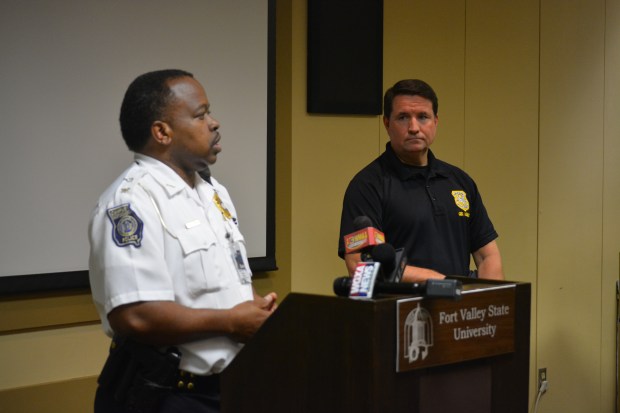
Campus Police Chief Kenneth Morgan (left) and Georgia Bureau of Investigation Special Agent in Charge J.T. Ricketson at a May 4, 2016 press conference about the murder.
Intervene and die
Concealed carry gun-wielder intervenes in domestic dispute and shot dead in Texas
The concealed carry permit holder was trying to intervene in a domestic dispute, trying to disarm the fleeing shooter, trying to do [t]he job ordinarily reserved for police.
The man leaves behind a wife and three now fatherless children.
“Getting shot while intervening in affairs that are not yours” is an item I will now have to add to my list of Serious Mistakes Gunowners Make. Having your wife widowed and your children orphaned for someone else’s issues definitely qualifies as a “Negative Outcome.” So many things can go wrong in an intervention that it’s almost never a good decision, regardless of what ‘sheepdogs‘ might think. Sheep dip is probably a better general analogy.
The Charge of the Light Brigade
‘He went into protective mode. He’s a father, he’s protective by nature,’ [the deceased man]’s pastor, Marc Lowrance, told reporters Monday. ‘And he thought he could help everyone involved, and tragically it went a different way.’
[He], Lowrance said, ‘sacrificed himself for this family, much the way he sacrificed himself for strangers today.’
The above comment accentuates why we need to think about and plan for events in advance. Think about what’s most important to you, your family or a stranger? Make your decisions in advance accordingly.”In every encounter, there is an element of chance.”
I often say “The conscious mind has a lifespan of one shot.” That’s not only the shot you fire but it can be the round fired by someone else. A common saying in the training industry is “You won’t rise to the occasion but will rather default to the level of your training.” While this is almost always used in the context of skills, it is equally applicable to decision-making. In that sense, this man’s death has similarities to the man killed trying to stop two active shooters in the Las Vegas Walmart in 2014. In the absence of decisions proactively made in our best interests and the best interests of our families, it’s easy to get caught up in the moment.
The worst part of the whole situation is that he sacrificed himself for nothing in the situation. The shooter had finished his violent act, which inflicted a non-life threatening wound, and was trying to leave when Mr. Antell intervened and was killed trying to stop him. The best way we can honor his sacrifice is to make sure it doesn’t happen to us.
Interview with a future criminal
I hadn’t planned on having a real life example of Know the Rules in relation to Decision Making but sometimes life gives us opportunities. In this case, it didn’t concern legal rules but social rules.
Out on my walk this morning, I had an interesting encounter with a future criminal, perhaps several potential criminals. It brought to mind something that I mentioned in my guest lecture at The Complete Combatant last weekend. Know the Rules, including the rules of the criminal interview.
The setting was a typical suburban area with sidewalks on both sides of a two lane arterial street. Three middle school aged boys were walking toward me on the sidewalk. There’s nothing unusual about that, although the time was a little late to be going to school. They were twenty to thirty yards away from me. When I first saw them, they had just passed the traffic signal on the corner I was walking toward.

As soon as I saw them, I identified them as Green shoes, Red shoes, and Brown shoes. This is a habit I got from Jimmy Cirillo, as he mentions in his book Guns, Bullets, and Gunfights. I don’t even know if it has any general value but it’s fun to me. A variation of the technique worked very well for me during one stage of an IDPA Championship that had a multiple moving target array.
As they walked along the sidewalk, they stepped aside in the bank driveway and had a pow-wow. Right away, I knew something was up. Secretive pre-contact activity is a clue. Then they got back on the sidewalk and started walking again.

I made an immediate decision. Although I had both a pistol and pepper spray on me, this was unlikely to shape up as a situation where those would be the appropriate tools. “If he pulls a weapon, I’m going to grab it from him or grab his hand and twist his arm to give him a radial fracture.” In any criminal encounter that I can’t avoid, my primary objective has evolved into “I’m going to fuck you up. Win, lose, or draw, you’re going to have to go to the Emergency Room.” Then those difficult and uncomfortable questions by the police begin.
As we closed, Mr. Green shoes, the largest, made the approach. Mr. Red shoes and Mr. Brown shoes looked younger and were noticeably smaller. Green shoes was clearly the Alpha in the group.
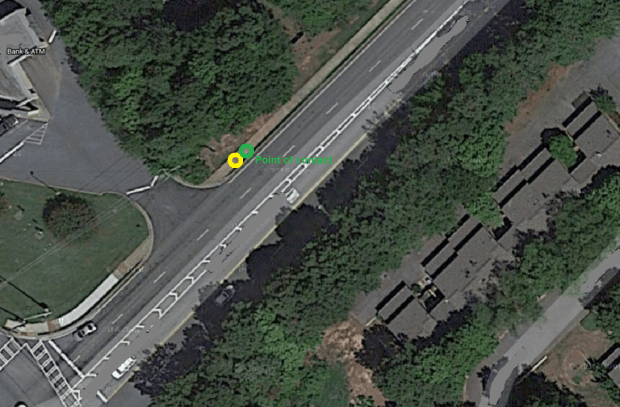
His initial approach was so tentative I couldn’t hear what he said. That set the tone for the interview. Clearly, he wasn’t practiced at his craft, so I could have a little fun with the situation.
“Excuse me?” was my response. This was in a decisive firm voice. Something criminals are looking for is indecision. If you don’t display it, they frequently don’t know what to do. As I said it, I started to rub the palms of my hands together. This isn’t an unusual gesture but it pulls the hands up into a low fence position.
“Do you have any money? I’m going to …..”
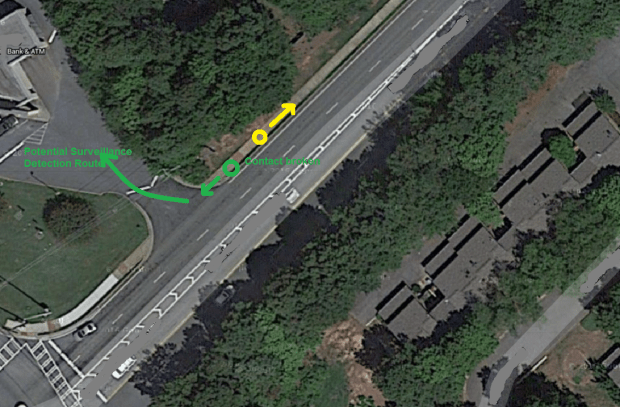
Before he could even finish, I cut him off. “No, I don’t” and put my left hand up to accentuate the point. The hand up would have allowed me to block or divert a weapon if he had produced one. Then, I immediately started back on my way and left them in the dust. Once again, decisiveness is key. I.e., ‘this interview is over.’ I kept an eye on the shadows to make sure they didn’t follow, which they didn’t. One of the reasons I like this walk route is that the sun is at my back and throws the shadows where I can see them.
There’s no doubt in my mind that Mr. Green shoes will graduate to full-fledged robbery, either strong arm or armed, fairly soon. Probably in less than a year, he’ll go for it. He was just getting accustomed to his skills, much in the way boys play catch before they start actually playing baseball. Since I didn’t interact with Red shoes or Brown shoes, I have no opinion about their future plans.
Good points
When I walk, I don’t walk around in la-la land listening to music, talking on my cell phone, or being task fixated watching my dog take a dump. My head is up and my eyes are on the horizon. Consequently, I saw them at a distance and had time to adjust my Awareness and mental DefCon appropriately. This is also a good approach to driving, rather than being visually fixated on the rear bumper of the car in front of you.
Having my hands in a low fence position would have allowed me to respond much more quickly than if they were at my sides. I prefer a low fence in general because I live in a mostly normal world. The high fence is actually a superior defensive posture but it’s weird looking and off-putting if you usually deal with benign people.
Being decisive is important to controlling the situation. If you can maintain control of the situation, you can often walk away without conflict.
Items for improvement
I let Red shoes and Brown shoes get behind me while I interacted with Green shoes. They were both small and I have no doubt I could have easily nailed either of them. But if they had weapons, the situation could have become much different. I need to practice getting into a position where I can see them all.
Taking a short ‘breather’ a few steps after breaking contact would have allowed me to maintain surveillance on them and be sure they had continued on. Or turning off route and going into the bank parking lot. If their moving off had been a feint, watching them or eluding them would have precluded them from bum rushing me from behind.
For whatever reason, the eggs I made when I returned home tasted even better than usual.
Sometimes a Serious Mistake isn’t a Negative Outcome
‘The perpetrator pulled out a weapon and shot himself in the leg before shooting the victim in the chest three times,’ [Sheriff’s Office spokesman] Fortunato said.
Suspect accidentally shot self before victim
Even when committing an attempted murder, trigger finger discipline is important.
“Pew.
Damn it!
Pew, pew, pew.”
Commonalities among trainers
I had a unique opportunity this past weekend to observe two very different firearms trainers on back to back days. Sunday, I was invited to a Back Up Gun class conducted by Ken Hackathorn. Monday, I was able to observe the last two hours of Introduction to Combat Focus Shooting by Rob Pincus.
Hackathorn and Pincus have backgrounds and philosophies that are probably as different as can be found in the training community. Both are good friends of mine and I have noted that despite their quite divergent backgrounds and philosophies, neither gentleman speaks ill of the other. In fact, both have good things to say about each other.
I believe they both recognize what are commonly thought of as ‘facts’ in the training community are actually opinions. Every trainer’s opinion is based on his or her background. As a result, we are all victims of our own experiences and bring our own biases to our training curricula.
As I watched and listened to Pincus, a number of items struck me as echoing things I had heard the previous day in Hackathorn’s class. The parallels between significant parts of their expressed philosophies and desired training outcomes were quite interesting.
Pincus posed three questions to the students during the class. He wanted them to express, at least to themselves, some answers at the close of training.
- What are you capable of with your gun? (I.e., what are your limits?)
- What SHOULD you be better at?
- How do you get better at the answer to #2?
Questions 1 and 2 mirrored primary questions Hackathorn posed to his class the previous day. “What are you capable of doing with the equipment you are carrying?” “What real world problems might you have to solve?” At the end of Hackathorn’s class, he made the statement “Training teaches you what to practice.” This is philosophically not far removed from Question 3 posed by Pincus.
They spoke about it in different ways, but they both emphasized the need to be able to hit the target. Further, they both made the case that reality will dictate defensive shooting requirements. This is very different from being able to pick our cadence and circumstances when we go to the range by ourselves. Both made comments about the difference between training and competition and not confusing the two.
Often in the training community, we become obsessed with differences, sometimes minor, in style or technique. Periodically, the observation is made that it would be more productive to focus on what we have or espouse in common. Approaching both classes with an open mind was a good indicator of the latter.
Creating dryfire recordings
A friend of mine emailed me the following question.
Claude, what device do you use to make a digital audio recording? How do you transfer the digital recording to your computer?
I had mentioned to him the recording I recently made for an Enhanced Standard version, i.e., not so easy I could pass it blindfolded, of the State of Ill-Annoy Police Qualification Course. I made the recording for dryfire practice but I could use it for livefire, too.
One of the few apps I have on my phone is an audio recorder called Mini Recorder Free. I have a Windows phone but the app is also available for Android. It’s very easy to use and records the input as MP3 files.
First, I look at a course of fire and write a script for the recording. When I’m happy with the script, I record the narration of the course of fire, usually as one file. Where the beeps are supposed to go, I say ‘beep beep’ as a place marker.
Then I record the beeps from my CED 6000 timer by putting the microphone next to the timer. Each of the different times is recorded as a single set of beeps. I can insert each beep file multiple times into the narrative, where that’s appropriate.
I connect my phone to my computer and copy the narrative and beep files to the computer. Finally, I edit them together with Wavepad Sound Editor, which I downloaded from the Internet. Undesirable noises get edited out and I standardize the spacing between the stages so there’s enough time to re-holster, change hands, or do other preparatory work for each string.
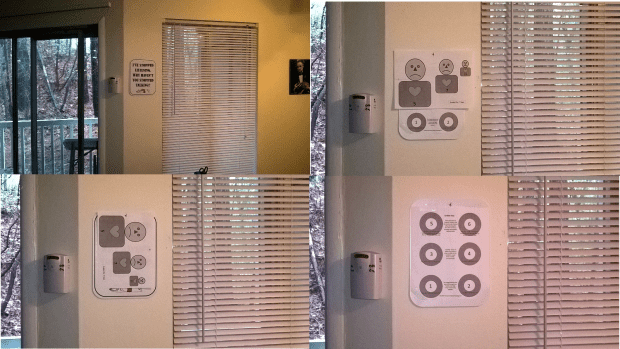
Since I don’t have a 15 yard range in my apartment, I create reduced scale targets to use for dryfire. I create the targets by scaling them with Excel.
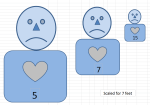
A reduced scale target also allows me to conceal my target when I’m not dryfiring, which is something I believe in very strongly. The 12 shot drill is on the back of my wall hanging.
On some of my recordings, I substitute a gunshot sound for the start beep. It just depends on how involved I want to make the recording. For my dryfire recording of the LAPD Bonus Course, I downloaded an audio file of the actual course being shot on the LAPD range. I had to clean that one up a lot but it’s fun to dryfire to because there’s all the range noise, LAPD Rangemaster commands (which sound like a subway conductor), sounds of empty magazines hitting the ground, and gunfire in the background. That’s as close as I can get to an actual range experience in my living room dryfire practice area.
A few of the recordings stay on my phone to use when I’m traveling. I also keep a PDF of the target on my phone so I can print it if I forget to take one along. It fits on one page so it’s easy to print in a motel business center. ISP 7 foot target
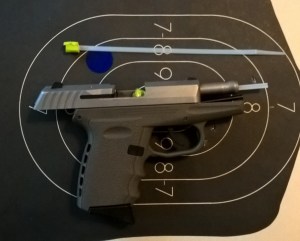
At this year’s Rangemaster Tactical Conference, someone mentioned wrapping a zip tie with a piece of colored duct tape on it as a safety insert. It’s a great idea and I’m using that now along with the Rogers Tap-Rack-Trainer. A round can’t be chambered with the tie in place. No disassembly of the gun necessary to put it in and it’s easy to take out, too. A bag of 8 inch ties costs about $2. The zip tie isn’t a snap cap, though, so keep that in mind.
The audio recording of the ISP Course I created is available as a download for 99 cents on my CDBaby store if you don’t feel like doing all that. There are a number of other recordings of interest, too.
Decisions about what you’re capable of
While researching personal protection incidents in 2015 involving armed females, I came across a story that I found disturbing on several levels. The incident actually took place in October of 2014 but was featured in the Armed Citizen® column of the NRA Official Journals in January 2015.
The incident began when a woman discovered a man raping her pet pit bull one morning. The NRA synopsis is as follows:
Alice Woodruff heard noises outside her home around 10:30 a.m. When she went to investigate, she found a nude man attacking her dog in the backyard. Woodruff grabbed her pistol as a family member dialed 911. She then ran to her car to retrieve the gun’s magazine. She kept her distance from the man and warned him not to come toward her as he ranted about being with ISIS and having Ebola. He then claimed to be the anti-Christ. Woodruff held the man at gunpoint until police arrived shortly thereafter. After a nearly two-hour chase, the assailant was arrested and is expected to be charged after his release from psychiatric placement in a local hospital. (/Republican American/, Waterbury, CT, 10/24/14)
Let’s leave aside the issue of raping a dog, which is disturbing enough. A friend in the animal rescue community has informed me this is far more common than any sane person in the civilized world could believe. Several other more commonplace decisional issues are apparent.
First, in an interview with a local TV station, the woman stated:
I ran in, got my [.380 pistol] out of the bedroom, and realized as usual the ammunition is in my car locked in my glove box.
This is a serious problem of mindset and decision-making. Perhaps the woman is attempting to ensure there is no unauthorized access to a loaded weapon in her home. However, her protocol carries this rule to unreasonable extremes. Fortunately, the situation allowed her to “[keep] a picnic table between herself and the man as she opened the car to grab the magazine” Then:
I showed him the clip went in but I always kept the gun at my side while I was talking to him.
This is yet another decisional issue. She should have loaded the gun the moment she had accessed the magazine. Waiting to demonstrate to the man that she was loading the gun actually demonstrated to him that 1) she wasn’t ready to respond in the first place, and 2) she was not mentally prepared to shoot him.
The standoff with the man continued for several minutes as the man made numerous irrational statements. Although she warned him not to move toward her during the standoff, he eventually did. According to the story, the man was standing about 20 feet away from her. While the intent of the Tueller Principle has become heavily misconstrued in the training community, its applicability to a situation like this is clear. As a result of his moving:
Woodruff fired into the ground nearby when he moved toward her, though she said she wasn’t going to kill him.
The warning shot didn’t deter him. He tilted his head back, stretched his arms to his sides as if he was on a cross, and told her to shoot him, she recounted.
As more people own firearms for protection, it’s likely we will encounter an extrapolation of the ‘suicide by cop’ into ‘suicide by citizen.’ While I have said in the past ‘never say never’ about warning shots, we have to also consider that they may not work and a Plan B will be necessary.
But the single most inappropriate decision by this lady was to have a gun at all. A statement she made clearly indicates a firearm is not an appropriate tool for her to own.
And now I have to be the judge and jury and god for him? That’s not fair.
There’s nothing wrong with deciding you are not able to take another person’s life. We all have unique moral principles that guide us. This is why I never proselytize about gun ownership. Having a firearm for protection purposes is a deeply personal decision of the same magnitude as deciding to lose one’s virginity, get married, or have a child. However, someone who cannot bear the thought of taking another’s life in self-defense should not have a firearm as a protection tool. Pepper spray, a Taser, or some other alternative would be indicated.
Eventually, the authorities decided that the woman will not face any charges.
“She feared for her safety,” Deputy Police Chief Christopher Corbett said. “She fired a warning shot into the dirt.”
That warning shot was a reasonable thing to do given the circumstances, Corbett said.
“Every situation is unique,” the deputy chief said. “If you fear for your life, or if you fear for someone else’s life, you can use reasonable force to defend yourself.”
A consideration is that a warning shot may be no more legally justifiable than actually shooting someone. Gunowners do sometimes face criminal charges for firing warning shots.
This incident show a number of nuances to the decision process that we as gunowners should consider ahead of time. Although things worked out in this particular case, it had the potential to turn into a Negative Outcome in a number of ways.
Mindset and decision-making (2016 Tactical Conference)
Mindset and decision-making are intimately related. One of the phrases we use for having made a decision is ‘I’ve made up my mind.’ While not a formal topic, the concept of mindset and decision-making was a clear subcurrent of thought at the 2016 Tactical Conference. While this wasn’t a formal topic, per se, it was a theme that ran through several presentations and side conversations. As my friend Mark Luell put it, “This [my life and my family] is important to me and I won’t let you take it from me.”
An early conversation I had was about our Mindset as Americans. The focal point of our conversation was an article in The Atlantic Monthly. The article described the difference between US soccer competition and soccer in the rest of the world. A key dissimilarity is that in the US, our children typically spend much more time playing and less time practicing individual skills. We’re eager to confront and control/dominate early as part of our culture in a way that is less common in the rest of the world. The common attitude of “I’ll shoot someone who’s in my house” is rooted in this piece of our American Mindset. Sometimes that works out, sometimes it doesn’t.
The article’s comment about developing individual decision-making skills resonated with me. I continue to be less sanguine that Force on Force training is the panacea it’s thought to be in the training industry. If we don’t teach people the process of decision-making and then just throw them in the deep end of the pool, how helpful is that in teaching them?
“The thing that makes elite players is decision making,” Lemov told me. “They need to integrate not just how to do something but whether, when, and why.” He sees parallels to the difficulty many American students have solving problems independently. “If you give [American] kids a math problem and tell them how to solve it,” he said, “they can usually do it. But if you give them a problem and it’s not clear how to solve it, they struggle.”
John Hearne’s presentation FBI Research: The Deadly Mix got me wondering if being a nice guy is just another form of trying to control the situation. Granted, it’s a different approach to control but maybe it’s just a matter of tone and style rather than substance.
Two of Tom Givens’ presentations had an undercurrent of decision-making. Deciding whether or not our personal protection equipment is ‘needed’ during the course of our daily lives is a serious choice. As Tom puts it, the only failures in his student incident database are the result of ‘forfeits,’ i.e., the victim was unarmed and therefore unable to resolve their problem. Being unarmed was a decision that didn’t work out well in those cases.
John Murphy provided me a video I had previously seen that relates heavily to decision-making. The officer’s action in the video demonstrates the clarity of his decision and how unhesitatingly he applied it.
Those of us who have actively been at this for decades have a very clear idea of our options, their consequences, and how to appropriately apply those options. Choosing options and being clear in your own mind about when and where to apply them is a critical part of the personal protection process.
 tacticalprofessor
You must be logged in to post a comment.