Thoughts about the Rangemaster 2016 Tactical Conference – Part II
The Rangemaster 2016 Tactical Conference was held March 11-13, 2016 in Memphis, Tennessee. I’m continuing to coalesce my thoughts and observations about the Conference.
A friend emailed me today with this question.
For 30 years I have heard the term Dry-fire. The term has been used in articles, in classes, on training videos. Now it is called Dry-Practice. Have we gone politically correct?
Since dryfire is something I work on quite a bit, that’s a question worth addressing in the context of the Conference. Dry Practice, to me, expands the boundaries of what we can work on beyond trigger manipulation. For instance, if you practiced clearing your house with an inert gun, there wouldn’t be any firing, so it would be dry practice.
I considered including a decision-making component, using decisional flash cards I’ve been developing, in my presentation. Due to time constraints, I had to leave it out. That would also be a form of dry practice even though there wouldn’t be any weapons, live or inert, involved; purely a thought exercise.
So, dry fire is actually a subset of dry practice. When it’s used that way, I can accept both definitions.
My class for the Conference was Developing a Dryfire Practice Regimen. I focused the class on fundamental manipulation skills of a pistol that were parallel to what could be seen on a square range. For instance, practicing trigger manipulation, presenting from ready or a holster, malfunction clearance, etc. Fundamental skills should be practiced until we are Unconsciously Competent at them. The more repetitions we have at a task, the more likely we are to develop the UC necessary to free our minds for situational input and decision-making.
Other classes at the Conference refined, extrapolated, or demonstrated the need for dry practice. For instance, John Hearne’s presentation Dry Practice: An Evidence Based Approach included several items of physiological theory about why dry practice is an effective form of practice. John’s Master’s degree concentration was in Research Methods so he was very thorough about his research and how he applied it to our Art. Larry Lindenman’s Managing the Don’t Shoot was taught using inert weapons. The students undertook a significant number of progressively complex exercises with multiple repetitions about how to take a threat at gunpoint without firing. Tom Givens’ Low Light Equipment class included considerable material about flashlight technique. All the techniques Tom presented could be practiced dry without going to the range. Low light livefire should simply be a verification of the manipulation skills developed in dry practice. That is the approach used at the elite Rogers Shooting School.
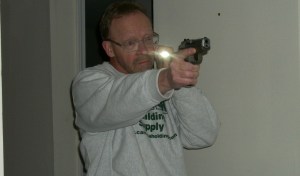
One attendee was so kind as to bring a set of Dry Fire flash cards he had purchased. It was interesting to look at them. While they might have some long term viability for a few shooters, there were some serious barriers to using them for skill development. Most notably, the cards assumed the user was familiar with the drills indicated on the cards. I.e., the creator took his subject matter knowledge for granted. Second, there really was no information provided about how to use the cards as part of a practice regimen. It’s important that we either have a logical sequence for building our skills or that we deliberately work, at random, skills we have already developed to maintain instant recall of our UC. Without a program for doing one sequence eventually followed by the other, the cards’ usefulness is limited, in my opinion.
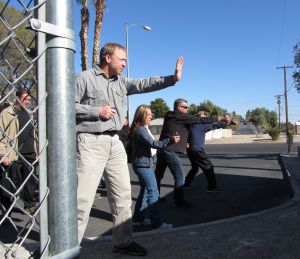
Caleb Causey and I had an interesting conversation about non-verbal communication. It made me realize how powerful non-verbals can be between an instructor and a student. Chuck Haggard and I have discussed the non-verbal communication that goes on between predators and potential prey. One of the most important components of interacting with predators is to ‘fail the interview.’ Predators frequently observe whom they wish to prey upon in order to make a decision about whether to proceed with the predation. This observation is the initial component of the ‘interview.’ Appearing to be uncooperative from a distance may avert the need for a verbal or physical interaction at all. Being uncooperative is something that can be practiced dry, as well, and doesn’t necessarily require equipment.
More about the Conference next time.
Initial thoughts about the Rangemaster 2016 Tactical Conference
The Rangemaster 2016 Tactical Conference is now in the record books. It was held March 11-13, 2016 in Memphis, Tennessee. The gathering included 200+ attendees, almost 30 instructors, and the fine facilities and staff of the Firearms Training Unit, Memphis Police Department Academy.
There was a great deal of material presented, more than could be attended. The Conference focuses on an inter-disciplinary approach to personal protection, so there is a lot more than just firearms and shooting involved. There was a challenging pistol match that could be shot, though; 158 people chose to shoot it.
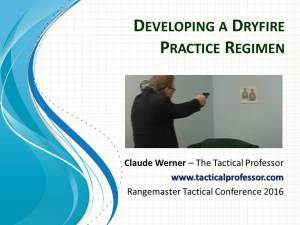
The class I gave was Developing a Dryfire Practice Regimen. I was very gratified by the turnout of 50+ students. As the saying goes, ‘The best way to learn something is to teach it.’ Over the course of creating my presentation, my dryfire techniques became even more refined. One attendee also gave me a new training aid I wasn’t aware of. As in every class I teach, I also learn from the students.
The other classes I attended were:
- Managing the Don’t Shoot – Larry Lindenman
- Gaming the Streetz – Eve Kulczar
- Low Light Equipment – Tom Givens
- Optimizing Classroom Instruction – Tiffany Johnson, Esq.
- Metro-Tactical – Julie Thomas
- Urban Insurgency – Dr. Martin Topper
- Lasers, Red Dots, Iron Sights – Karl Rehn
- FBI Research: The Deadly Mix – John Hearne
- International Terror Operations – Gary Greco/John Holschen
- Dry Practice: An Evidence Based Approach – John Hearne
One of the pleasures of going to Conferences is getting to talk and catch up with my peers. Some of the conversations I had were:
- Cecil Burch – the Venn Diagram of Realization, instructor goals in attending conferences
- Paul Sharp – human gun interaction
- Skip Gochenour – Homicide trials
- Caleb Causey – Non-verbal communication
- Tom Givens – Standards that replicate incident skills
- Richard Jenkins – Dry Fire Flash Cards and skill development
- John Farnam – Attitudes of older fighters
- Gary Greco – American soccer team development, American Mindset (competition and confront/dominate)
- John Murphy – immediacy of action
- Mark Luell – I won’t let you take this from me
- Chuck Haggard – performance of .38 Special and .22 LR in gel and adversaries, S&W metal autoloader maintenance
- Karl Rehn – iron sights, lasers, and red dots
- Julie Thomas – tuning a class presentation
I’ll have more to report about the Conference in future posts.
The quality of training
There have been a number of recent rants about the quality of training and why would students choose one trainer over others.
The following is my commentary from a thread on Facebook:
An issue with rants about the quality of trainers is the underlying assumption that people actually want to be ‘trained.’ That’s not necessarily true. In general, people either want to be entertained or have their tickets punched. Neither of those two objectives has anything to do with training.
Further, real training involves some kind of measurement. As Greg Hamilton succinctly put it ‘without testing there has been no training.’ There are many forms testing can take but it has to be a part of training. Many, if not most, adults have never left high school emotionally. Consequently, they have an inordinate and irrational fear of performance measurement. That’s another reason they’re not really interested in being ‘trained.’ Being tested requires taking a large risk of finding out you’re not the hot shot you like to think you are. Most people have enough smarts to realize that, at best, they’re Walter Mitty, and, at worst, they’re grossly incompetent. They take great steps to protect their egos because of this.
So, what people seek out is Entertainment, Comfort, and Convenience. Nothing wrong with that. Let’s face it, most people live boring lives filled with relentless drudgery and lack of fulfillment.
As the saying goes ‘you get what you pay for.’ The payment in the context of real training is not just money but also emotional energy and commitment. Very few people are willing to make that kind of payment; they limit themselves to paying with money only.
In the end, the market for training, as well as the training provided, will generally follow a bell curve. At the ends, really good and really bad, while the huge middle segment will be mostly mediocre. In most cases, that’s enough.
How to think ahead about your decisions
ALBUQUERQUE, N.M. — When an Albuquerque couple caught a man burglarizing their garage, they asked him to stop.
When that didn’t work, they pulled out a rifle and a handgun, and held him at gunpoint until police officers arrived.
As reported in the Albuquerque Journal
The above story is referenced in this month’s issue of The Armed Citizen®, published as part of the Official Journals of the National Rifle Association. It is also available in the online version of The American Rifleman magazine. A similar story is published at least weekly and available online at the American Rifleman.
The Armed Citizen® is very worthwhile reading because it describes actual incidents that armed Americans face when dealing with criminal predation. Reading the columns shows the difference between real life and the ludicrous ‘ninjas coming from the ceiling’ figbars of their imaginations that people frequently cook up.
For space and copyright reasons, The Armed Citizen® only publishes a summary of each incident, which the NRA does not copyright. The NRA summary of the above incident goes as follows:
Two New Mexico burglary victims used a rifle and a handgun to keep a thief under wraps until the police arrived. One of the Albuquerque residents came home and noticed a stranger loading items—including a generator the homeowner recognized as his—into a vehicle. He approached the alleged thief and asked him to stop, but the bad guy scoffed at him. The man went into his house, armed himself and his wife, and the two confronted the suspect, holding him at gunpoint until the police arrived. (Albuquerque Journal, Albuquerque, N.M., 11/21/15)
It’s useful to backtrack and find the original article. In many cases, there’s a lot more detail in the original story. Sometimes there is a wealth of information that we can learn from and think about our own situations ahead of time.
There are three kinds of men. The one that learns by reading. The few who learn by observation. The rest of them have to pee on the electric fence for themselves.
The Albuquerque Journal article even includes video from the bodycam worn by the arresting officer.
What can we learn from the article and bodycam footage in this case? What questions are worthwhile to ask ourselves while we have the opportunity of cool reflection? Are there decisions we can make ahead of time to keep us out of trouble? Here are a few points to consider. There are probably more.
The couple has the alleged burglar at gunpoint. So far, so good. Let’s consider, however, that they were no longer on their own property at that point. Depending on the state you may be in, once you leave your own property, even by a few steps, the rules (Know the Rules) can change quite a bit. Let’s pose the question “What if the perp takes off running when the officer arrives?” Shooting him in the back at that point probably wouldn’t be a good decision, even in Texas. Remember that YOU have a good idea who the good guys and bad guys are, but the Officer has to sort that out. Don’t assume the Officer has all the pertinent information (Understand the Situation) or that he or she even believes the information given so far. It’s not like a false report has never been phoned in.
It appears on the bodycam footage that the Officer goes between the perp and the couple to handcuff the dude. The woman lowers her pistol as the Officer moves in; good for her. Unless you’re familiar with Contact and Cover procedures, how you’re going to react when the PoPo arrives is best thought of ahead of time. Given that it’s a physical skill, (Have Adequate Skills) maybe even a little practice is in order. Given the circumstances, the woman probably didn’t even have a holster on. What are you going to do with your heater at that point?
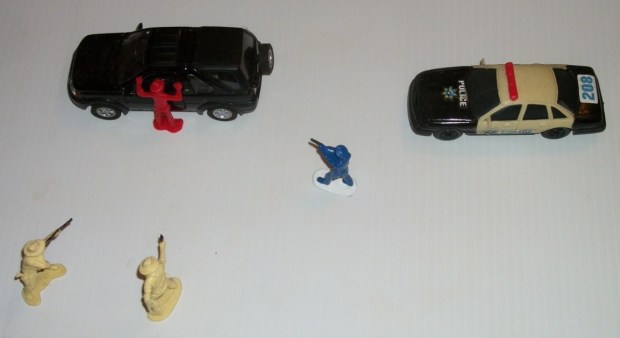
The perp was released on his own recognizance the same day and then arrested again a few hours later for armed robbery. What if instead of going after someone else, he came back to the house he burglarized? It’s not hard to tell he’s a nitwit. Keep in mind that criminals don’t think the way we do. What state of alertness and readiness are you going to be in, post-event? If an entryway to your home has been damaged, are you going to stay there? What if your weapons have been taken into evidence? Do you have backups, not necessarily at your home?
Peeing on the fence isn’t much of a strategy. We have a lot of information available that we can use to put together at least a rough plan for circumstances that are foreseeable. And it’s not like we have to make it into a heavy duty wargaming exercise. There are typically five or six incidents referenced in The Armed Citizen® each month. There’s one or two a week listed online. Five minutes thought per incident still works out to less than an hour per month.
The Armed Citizen® online at American Rifleman.
The Armed Citizen® database of all incidents ever reported is available on the NRA-ILA website.
Decisions determine outcomes
The decisions we make almost inevitably determine the outcomes that result. Good Decisions lead to Positive Outcomes and Bad Decisions lead to Negative Outcomes. We all know that decision making is difficult in a broad array of situations. Having a framework for decision making can be helpful.
Skill development and to a lesser extent, ‘situational awareness’ are the most often taught or talked about aspect of personal protection. In the broad scheme of things, though, those are only a couple of aspects to the process of not being criminally victimized. Ultimately, skills and awareness are just inputs to our decision making process. The decisions we make are what will determine the outcome of any encounter.
It’s trendy now to view Colonel John Boyd’s OODA Loop as if it is a model that can help us ‘think faster,’ i.e., make tactical decisions more quickly than our opponent. Unfortunately, that’s just not the case. The O-O-D-A Loop is a representation that describes in a strategic sense how one party thinks during the course of the decision process. That is a far cry from being a usable decision model or even framework. Colonel Boyd never mentioned O-O-D-A as a tactical decision model, nor do I believe he intended it as such.
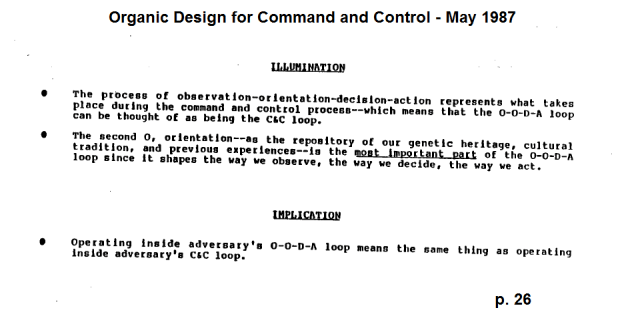
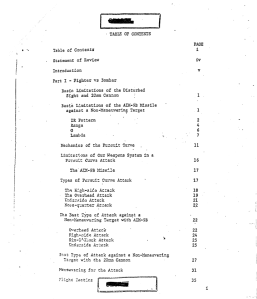
Those who wish to look to Colonel Boyd for a decision model would be best advised to read his Aerial Attack Study. Over 50 years after its publication it is still considered the manual for fighter combat. The Aerial Attack Study describes a decision process almost completely the opposite of the way most common taters describe the O-O-D-A Loop. By performing an in-depth analysis of the situations fighter aircraft could encounter, Colonel Boyd described exact maneuvers and counters our fighters could use to defeat the enemy. That’s a better framework for defining tactical decision making.
This post is the first in a series describing a conceptual framework for decision making. Several other people contributed thoughts to it and I thank them for their input.
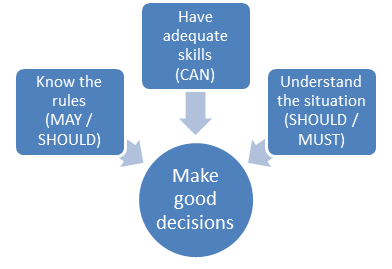
Know the Rules and Have Adequate Skills were proposed to me as inputs to good decision making by my friend LTC (Ret.), JAGC John Taylor. In addition to them, I include Understand the Situation.
Next, we have to consider four levels of priority as developed by Steven Harris, Esq. and published on the Modern Service Weapons blog.
- Can
- May
- Should
- Must
If we overlay these two sets of inputs, a graphic would look like this.
Finally, to make Good Decisions, we need to consider two levels of focus:
- Tactical – doing things right, our techniques and procedures
- Strategic – doing the right things, what is in our and our family’s best long term interests
What rules do we need to know?
- Legal
- Use of force
- Use of deadly force
- Employer policy and cultural peer pressure are corollaries to the legal
- Other rules
- Firearms and other weapons’ safety rules
- Our personal core values
- Proxemics
- Rules of ‘the interview’ (between predators and prey)
- Difference of criminals’ psychological rules from our own
- Changes from the (your) past
Knowing the legal rules bears some discussion. There are several excellent books about the legalities of using deadly force, such as:
The Law of Self Defense
Deadly Force Understanding Your Right to Self Defense
What Every Gun Owner Needs to Know About Self-Defense Law
However, there isn’t much material about the use of non-lethal and less-lethal force. This leads to some confusion in people’s minds about tools like pepper spray. One common tater opined that pepper spray couldn’t be used legally unless the victim had already been physically battered and the battery was continuing. While this might POSSIBLY be true in some States where citizens, or perhaps subjects, exist in an almost perpetual state of arrest, it’s certainly not true in most of the US, where the citizenry remains free.

As an example of relative importance, most law enforcement officers will never apply deadly force in their entire careers. On the other hand, they will use some kind of physical force on a regular basis. As private citizens, there are only a few situations that justify the use of deadly force on our part. Having the ability to employ some form of non-deadly force is an option that needs much more serious consideration than it is generally given.
Note also that of the ‘Other rules,’ only the Safety rules for firearms are commonly taught. Although the balance of the Other rules aren’t thought of, they will definitely be inputs to our decision making.
Since it’s probably the first thing we should consider, we’ll go into Know the Rules in more depth in the next installment. Far too many people don’t consider the Rules very much, especially the Other rules.
There’s a Safariland holster blowout sale on my webstore. Glock 17 and S&W M&P holsters at prices you can’t afford to pass up.
The Medina, ND Shootout – 1983
In 1983, a very violent gunbattle took place in Medina, North Dakota. Although less well known than the Miami Massacre in 1986, it was every bit as bloody and violent. Something it had in common with the Miami Massacre was the decisiveness of long guns at pistol fight ranges and preparation for conflict.
On one side was a task force of US Marshals and local law enforcement officers. On the other side were members of a local Posse Comitatus group. Casualties were high on both sides. Four months later, a second related encounter, hundreds of miles away, brought more loss of life.
The Prelude
Gordon Kahl was a Midwestern farmer and Federal tax resister. He was a member of a loosely knit organization called the Posse Comitatus. The Posse recognized no authority above the county level and held many hateful beliefs. He had been imprisoned for Federal tax evasion but had been released on probation. However, he failed to report to his Probation Officer and a Federal warrant for his arrest was issued.
The US Marshal’s Office in North Dakota determined to take him into custody as a result of information received that Kahl was attending a meeting in Medina. The Marshal, Ken Muir, and three Deputies; Carl Wigglesworth, James Hopson Jr., and Robert Cheshire drove to Medina to make the arrest. There, they were joined by a Stutsman County Deputy Sheriff, Bradley Kapp, and a Medina Police Officer, Steve Schnabel.
On request of the Medina police Chief, the determination was made to conduct the arrest just outside of town. This was because Kahl was known to carry a Mini-14 rifle at all times. The Chief did not wish to have violence within the town itself that would endanger the townspeople.
A roadblock was set up on the route out of town by Marshal Muir, Deputy Wigglesworth, and Officer Schnabel. The remaining Deputies stayed in town to follow Kahl once he left the meeting. Deputy Kapp joined Deputy Marshals Cheshire and Hopson in the Ramcharger.
Accompanying Kahl to the meeting were his wife, Joan, his son, Yorie Kahl, his friends, Scott Faul, Vernon Wagner, and Dave Broer. Several of the males in the Kahl party were armed with rifles. Joan was not armed.
When the meeting finished, the Kahl party departed town in two vehicles, unknowingly headed toward the roadblock. The stage was set for a bloody shootout.
In the aftermath of the shootout, Muir and Cheshire would lie dead. Hopson, Kapp, Schnabel, and Yorie Kahl would be seriously wounded. Yorie Kahl and Scott Faul would be convicted of murder and sentenced to life imprisonment.
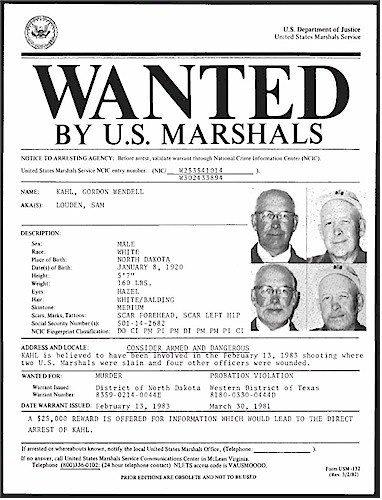
Gordon Kahl was killed, along with Lawrence County (Arkansas) Sheriff Gene Matthews, the following June. A nationwide manhunt had tracked him to Arkansas where a confrontation with local and Federal law enforcement officers took place.
The Marshals Service memorial to Muir and Cheshire can be found here.
Ballistic Radio interview about Boyd
John Johnston and I had the opportunity to discuss the nature of Colonel John Boyd’s theories on Ballistic Radio recently.
The OODA Loop isn’t as simple as many people would like it to be. In some cases, it hardly applies at all.
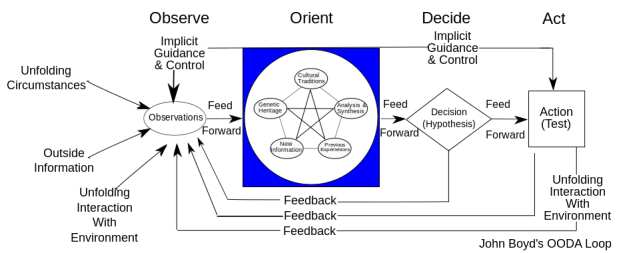
The podcast of our conversation has now been posted.
[W]hen it hits home it’s hard
You know, I’ve always had this thought that this could only happen to someone else, you know you only hear about these things, but when it hits home it’s hard.
–Kimberly’s maternal grandfather
Everyone that this kind of tragedy happens to thinks it could only happen to someone else. If you leave your guns laying around when children are in the house, you’re playing Russian Roulette with their lives.
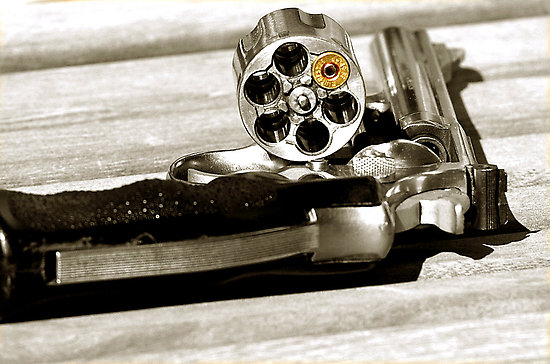
An Irondale family is grieving the loss of a 9-year-old girl, who police say was accidentally shot and killed by her 3-year-old brother.
Watson said Kimberly’s brother got hold of a loaded gun on a nightstand at his great-grandparents’ home in the 2300 block of Monroe Drive around 1:30 p.m. Saturday.
The boy accidentally shot Kimberly while she was sitting on the floor in a bedroom.
Don’t let it happen to you. I don’t care if you buy my recording or not, but please lock your guns up when little children are around. You can’t teach the Four Rules to a three year old. I’ve done some additional research about how often this happens and, frankly, the results sicken me.
Thinking ahead
If we get carjacked, as long as you and I can both get out of the car, they can have it; I have insurance. But if either of us can’t get out of the car because we get hung up in the seat belts or something, turn your face away from me and close your eyes because I am going to start shooting. I don’t want his loathsome blood-borne pathogens to get in your eyes.
–my personal policy/Standard Operating Procedure, as related to a former girlfriend who lived near Murder Kroger in Atlanta
A California man shot the carjacker of his van Friday as the carjacker drove away. The carjacker died shortly thereafter and the shooter was arrested for Murder. Once the threat of Death or Serious Bodily Injury has passed, the time for gunfire has ended.
“Nice people lock their doors.” –my mother
‘Don’t sit around in unsecure parking lots working on your czechbook, writing reports, texting, or talking on the phone.’ –paraphrased from Bill Rogers and Craig Douglas
“Firearms shall not be discharged at a moving vehicle unless a person in the vehicle is immediately threatening the officer or another person with deadly force by means other than the vehicle. The moving vehicle itself shall not presumptively constitute a threat that justifies an officer’s use of deadly force.” —LAPD Manual Volume 1 Section 556.10 POLICY ON THE USE OF FORCE
Policies, SOPs, or whatever you wish to call them are simply committing to memory, or writing down, actions that you have thought about ahead of time. For some reason, the word ‘policy’ evokes a great deal of resistance on the part of people I talk to about it. Not thinking about things ahead of time is probably the most Serious Mistake Gunowners Make and I will have to add that to the next edition.
In a crisis, the conscious mind has an extremely short life span, probably less than a second. Once the conscious mind expires, either training/practice or the amygdala will take over. Trying to make up a plan on the spot is an extraordinarily difficult task.
Perhaps the inability or lack of desire to think ahead is the reason for the popularity of the OODA Loop. Relying on the OODA Loop implies that you can out-think the situation in the moment. This is just being lazy and an excuse for not thinking ahead. No plan survives the test of combat, as the saying goes, but it is ALWAYS easier to modify a pre-existing plan than to make one up on the spot.
Fighter pilots have been at the forefront of developing policy and procedure for ‘in the moment’ encounters. Their creations over the past century have shown increasing sophistication as they have evolved.
- Dicta Boelcke, a list of principles, was formulated during WWI by Hauptmann Oswald Boelcke, a German fighter pilot and squadron commander. It is interesting to note that he was killed when he violated one of his own dicta, never close in on a single combatant when others are also pursuing it.
- Lieutenant Commander Jimmy Thach recognized the superiority of Japanese fighter aircraft in the early days of WWII. To counter them, he developed, using matchsticks on a tabletop, the Thach Weave as a defensive maneuver. Then he tested the maneuver under conditions simulating the disadvantages US Navy fighters would face.
- No Guts, No Glory, a USAF training document, was written by Major General (then Major) Frederick C. Blesse shortly after the Korea Conflict. It was an explanation of his experiences flying F-86 Sabres against MIG fighters and how to defeat them.
- Colonel John Boyd wrote the Aerial Attack Study, which is the most comprehensive manual on fighter combat ever written, in 1959. In it, he methodically worked out all the possible attacks and counters a fighter could make in relation to both bombers and other fighters. His study was heavily based on a thorough understanding of the flying and weapons capabilities of both US and Soviet aircraft.
In every one of these documents, specific principles, procedures, and pitfalls are worked out in advance. Speed of decision in tactical situations is achieved by picking from a list of possible options to best solve an unfolding incident rather than trying to ‘think faster,’ which is physiologically impossible. The distinction between ‘thinking faster’ and picking from a menu of possible decisions escapes many common taters about the OODA process. Boyd’s description of the process is much more involved than generally assumed and explained using a simplistic circular diagram. That circular graphic does no justice to the concepts that Colonel Boyd developed.
In order to make decisions in advance, it’s necessary to think about likely scenarios, at least, ahead of time and decide how to solve them. This includes the legal ramifications of your possible actions. Thinking ahead is a key component of avoiding becoming a victim or incurring a Negative Outcome in the criminal justice system.
John Johnston and I will be discussing this timely topic in more depth on Ballistic Radio tonight. Ballistic Radio is available over the Internet.
Serious Mistakes now available as a download
There have been many requests for the Serious Mistakes Gunowners Make recording as a download. Despite being something of a Luddite, I figured out a way to do it.
The recording is now available as a download for $9.95. Link
 tacticalprofessor
You must be logged in to post a comment.